https://vine.co/v/ea0bJgvBdiL/embed/simple
Sorry, but I wasn’t able to embed this Vine video. Click on link to watch. ❤
https://vine.co/v/ea0bJgvBdiL/embed/simple
Sorry, but I wasn’t able to embed this Vine video. Click on link to watch. ❤
I felt like I needed something light and cute after my last post. This made me smile. 🙂 Cats are awesome.
Today I will be rehoming my dog, Dexter and two of my cats–Mr. Biggles and Cleo. I wrote about all my pets back in November in this post.
Some of you may be shocked or even upset with me that the person who is taking them is none other than my MN ex. You may assume I don’t care about my pets or that I am a terrible pet owner for allowing this. But there’s a few practical and even good reasons I made the decision to let him take my dog and two of my cats.
1. My ex, in spite of his terrible treatment of people (women in particular) has always been very kind to animals. I have never known him to be cruel to any animal and in fact he has more patience with them than I do. Even psychopathic malignant narcissists like him may have their good points–a small uncorrupted part of their soul that sticks out from the mass of malignancy like a blade of grass sticking out of a pile of dog crap.
2. Mr. Biggles was his cat (my ex was the one who brought him home originally) and he was always more attached to him than I was. In fact, Biggles was his favorite.
3. Cleo would be living in a more remote area that is less close to the main roads than I am (my ex finally found a place to live and it’s nice). She’s an indoor/outdoor cat (who prefers the outdoors) and will be less likely to be hit by a car.
4. Dexter was initially my ex’s dog (he adopted him too) and frankly, I’m more of a cat person than a dog person which means I don’t give Dexter the attention he requires or play with him as much as I should. Lately he’s been whining a lot and acting neurotic due to the lack of attention but I just don’t have enough interest or time (because I work all day) to spend more time interacting with him, although I do try. My ex was always very attached to Dexter and I know will spend more time playing with him than I do. He’s also on disability so is home all the time.
He also has a fenced in area in the back of the house that I do not. Dexter needs to run, and I can’t afford to have my yard fenced in right now.
5. Not that I really give a damn about my ex’s feelings anymore, but having these 3 animals he already knows well would make him happy. I’m a nice person.
6. Living in a 2-bedroom house, I have more pets than I can practically afford or maintain. This will bring the number down to three cats.
7. The cats would be happier if there weren’t so many of them crammed into a small place like this. They like their space and are invading each others’ boundaries!

Cleo.

Mr. Biggles.

Dexter.
It’s not without some sadness I will be saying goodbye to Cleo, Mr. Biggles and Dexter today. I love all three of them and will miss them, but I know this is the right decision and that they will be okay. If I knew they would be treated badly or ignored, I would not be parting with them.

I wonder.
Earlier today I posted Sam Vaknin’s story about his goldfish Ned. He seemed to be feeling something close to empathy for the tiny creature’s suffering when it became ill and something closely resembling grief when the end finally came. Rather than watch the fish continue to suffer, he decided to take matters into his own hands. Did he do this to end the fish’s suffering–or to end his own suffering?
But even if he only desired to end his own suffering, watching the goldfish suffer was causing him pain. So either way, he cared about the fish, even if he only did what he did because watching Ned continue to get sicker was too painful.
This made me think about other narcissists I know who own pets. Do they really care about their pets, or are their pets, like their children, just extensions of themselves?
I think the answer is both. Yes, many narcissists who own pets regard them as extensions of themselves. I think of a neighbor of mine, an insufferable, conceited malignant narcissist if I ever saw one, who has a purebred Bichon Friese. She said she would never own a “mutt” from the pound. Oh, no. Only a purebred dog who makes HER look good will do. She puts bows in Fifi’s hair and gets her toenails painted at the groomer’s. She takes her everywhere and shows her off, as if she’s showing off a new car. Narcissists treat their children the same way–as accessories to make them look good, but because a dog isn’t supposed to have a mind of its own, it’s more acceptable and far less damaging to a dog to be treated this way than it would be for a child.
Yet it’s clear she loves that dog. She spoils Fifi rotten, and the little dog seems happy enough. Again, it’s a dog, not a child, so being objectified is probably okay. I know if anything were to happen to Fifi, this woman would be devastated with grief, at least until she found a new source of canine narcissistic supply. She’s the type who would probably have a funeral for her dog and a custom made urn with Fifi’s likeness painted on it to display on her mantel.
But she would also not hesitate to have Fifi put down were she to become ill. Some may say this is the humane thing to do–that anyone with a conscience and a heart would not want to see a pet suffer needlessly, and that’s true if the pet is truly ill and has little to no chance of recovery or is in a great deal of pain. But to a narcissist, a sick pet is also an inconvenience and a burden. A sick pet is no longer an acceptable extension of themselves; it becomes a separate being who has needs of its own that do not fit the narcissist’s agenda. A sick pet no longer makes them look good.
How much will a narcissist sacrifice before having an ill pet put down? Most people won’t euthanize a pet unless everything else has been tried first. It’s a last resort, something none of us want to do, but at some point it becomes more selfish to try to keep a sick pet alive than to put an end to its suffering. I remember years ago a narcissistic woman I knew had her cat put down because it had worms. The cat was suffering severe diarrhea and was losing weight. The worms could have been easily treated, but she didn’t want to be bothered. Cleaning up the cat’s messes was too much of a chore, and apparently so was taking the cat to the vet to be treated. So she had her cat put to sleep. It’s pretty obvious this woman didn’t have the cat euthanized out of humane compassion, but because it was more convenient than trying to keep him alive. To her, the cat was not a living creature, but a toy to be tossed away the minute it was no longer so much fun to play with or required maintenance.

It can work the other way too. I knew a narcissistic man who also had a dog, a beautiful Golden Retriever named Bruno. When Bruno was about 12, he developed cancer. The man was very attached to Bruno, and used to tell everyone he was the only friend he had. Even when Bruno got to the point where he stopped eating and slept most of the time, the man refused to have him euthanized. The animal was clearly suffering, and everyone told him it was the only humane thing to do, but the man still refused. Bruno finally died at home in an emaciated state. Clearly, this man cared nothing about Bruno’s suffering even though he appeared to love the dog. He obviously was attached to his pet, but if he truly loved him, he would have put the animal’s needs first, even if it hurt to do so. Real love–whether for a pet or another human being–requires sacrifice and putting the other’s needs first. This man may have “loved” his dog, but he was putting his own needs first.
Most narcissists claim to be attached to their pets, and most of the ones I know truly are. But is attachment love? Or does attachment to a pet just mean the animal is another source of narcissistic supply–a creature who is never going to judge them, disagree with them, insult them, or abandon them?
Sam’s grief over his goldfish appears to have been real, and I think he did the right thing because that fish was most likely suffering (as much as a goldfish can suffer) and wasn’t going to make it. Would he have been the same way with a cat or a dog–or a child? We can’t answer that. Maybe it’s easier for a narcissist to feel empathy and act in unselfish ways for a simple creature–a reptile, fish or invertebrate–who is very unlike a human (unlike a cat or dog, who resemble human children in many ways) and therefore make fewer emotional demands on them. Maybe narcissists just can’t empathize with other humans or highly evolved animals who resemble them too closely or make too many emotional demands.
Can a narcissist feel empathy for a tiny creature like a goldfish? Maybe. I like this story, even though it’s sad.
Ned’s Short Life
by Sam Vaknin
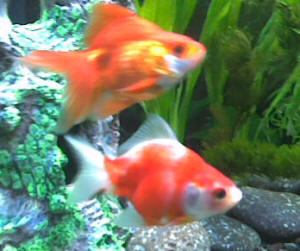
Lidija returned home all dusty and breathless, as was her habit ever since we have bought the apartment and she embarked on its thorough renovation, long months ago. Between two delicate but strong fingers she held aloft a transparent plastic bag, the kind she used to wrap around half-consumed comestibles in the refrigerator. Instinctively, I extended an inquisitive hand, but she recoiled and said: “Don’t! There’s a fish in there!” and this is how I saw Ned for the first time.
“He is a male,”—Lidija told me—”and Fred is a female”. In the crowded and smelly pet shop the salesgirl elaborated on the anatomic differences between the sexes. So, now Fred had a mate.
“Fred” is Fredericka, our first attempt at a goldfish. One of the handymen gave her to Lidija “to keep your husband company while you are away”, he explained mischievously. Fred grew up in a bowl and then graduated into a small and rather plain aquarium. I placed a clay elephant and a plastic, one-legged ballerina in it, but this unlikely couple did little to liven it up. Fred’s abode stood on the kitchen counter, next to a pile of yellow bananas, flame-orange mandarins, and assorted shrink-wrapped snacks. She swam melancholily to and fro, forlorn and lonely, toying with her own reflection.
A fortnight later, Lidija and I purchased a bigger tank. I filled it with tap water and dumped Fred in it. Shocked and distressed, she hid under a shell and refused to emerge, no matter the temptation. Hence Ned.
I knew next to nothing about new fish tanks, the need to “cycle” them owing to the absence of nitrogen-devouring bacteria, and the stress that all these cause the unfortunate inhabitants of my aquarium. I dumped Ned in the crystal-clear waters as unceremoniously as I did his would-be mate. But Ned—having graduated far worse aquaria in dingy pet shops—swam a few triumphant laps around the receptacle and then settled down to the business of chasing food scraps. Fred eyed him shyly and then joined him hesitantly. It was the first time she had moved in days.
As the time passed, Fred, a codependent goldfish if I ever saw one, excitedly clung to Ned’s bright orange tail and followed him wherever he glided. But Ned did not reciprocate. Far more aggressive than Fred, he deprived her of food, pursuing her in circles and leveraging his longer body and broader amidship to tackle the silvery female. All my exhortations and threats went on deaf ears: Ned would coyly slink away only to resume his belligerence when he figured I am out of range.
Still, every few hours, Fred and Ned would align themselves, as arrow-straight as soldiers on parade, and swing to and fro in unison in the currents, perfectly at peace, their delicate fins flapping regally and slowly. It was a bewitching, hypnotizing manifestation of some primordial order. I used to sit on the armrest of a couch, enthralled by their antics, monitoring who does what to whom with the avidity of a natural scientist and the wonderment of a child. Gradually, the susurration of the air pump; the gentle breeze of bubbles; and the elegant motility of my fancies all conspired to calm my rampant anxiety. I made a living off the proceeds of books I have written about my mental health disorder and so was gratified to escape the stifling and morbid environment of my own making.
Then, one morning, I woke up to find the couple gasping at the shell-covered bottom of their tank, tail and fins streaking red and rotting away, bit by tiny and ephemeral piece. The magic gone, it was replaced with the nightmarish horror that permeated the rest of my existence. I felt guilty, somehow threatened, imbued with the profound sadness that other people—normal people—associate with grieving. Reflexively, I surfed the Internet frenetically for answers; I downloaded a dozen books and read them; and I got up at all hours of the night to change the water in my Ned and Fred’s minacious cesspool. I woke up with dread and bedded with foreboding and so did my version of Fred, my Lidija.
Ned’s body was decaying fast. Fred continuously nudged him: “Are you alive? You come to play?” But, when she saw how serious his condition is, her whole demeanour changed. His swim bladder affected, his dwindling scales plastered with burrowing parasites, besieged by toxic levels of ammonia, Ned’s compromised immune system—ravaged by his crammed and foul apprenticeship in the pet shop—didn’t stand a chance. He wobbled pitifully. Fred stood next to him, still as a rock, allowing his sore body to rest against hers, giving him respite and the solace of her company. Then, exhausted by her own condition and overpowered by his much larger weight, she would swim away, glancing back sorrowfully as Ned sank and darted, staggered and careened.
Yet, Ned wouldn’t give up. His magnificent tail consumed, he still took after the flakes of food that drifted down the water column; he still toured his new home, leftover fins flailing, bullet-like body strained, eyes bulging; he still teased Fred when he could and Fred was much alive when he revived. They slept together, occupying an alcove that afforded them protection from the filter-generated waves.
As the days passed and I added salt to the aquarium, Ned seemed to have recovered. Even his tail began to show some signs of black-tipped resurrection. He regained his appetite and his territorial aggression and Fred seemed delighted to be again abused by a reanimated Ned. I was the proudest of fish-owners. And Lidija’s crystalline laughter reverberated whenever Ned’s truncated trunk ballistically caroused the waters.
But this was not to last: the salt had to go. The fresher the water became, the sicker Ned grew, infested with all manner of grey; shrunken; lethargic; and immobile except when fed. This time, he ignored even Fred’s ichtyological pleas. Finally, she gave up on him and drifted away sullenly.
One morning, I lowered a tiny net into the water. Ned stirred and stared at the contraption and then, with an effort that probably required every last ounce of his strength, he bubbled up, rolling over and over, like a demented cork, all the while eyeing me, as though imploring: “You see? I am still alive! Please don’t give up on me! Please give me another chance!” But I couldn’t do that. I kept telling myself that I was protecting Fred’s health and well-being, but really I was eliminating the constant source of anxiety and heartbreak that Ned has become.
I captured him and he lay in the net quiescent, tranquil. When his mutilated body hit the toilet, it made a muffled sound and, to me it sounded like “goodbye” or maybe “why”. I flushed the water and Ned was gone.

I don’t care what some religious people say–I believe animals have souls. How can you look into the face of your dog or cat and not just KNOW it’s there?
But this is not a religious or philosophical discussion of whether animals have souls or not. It’s also not about dogs (who definitely have a form of empathy, the way I see it).
This is a little story that shows that cats may have empathy, at least some cats.
A woman whose house I clean (I’ll call her Judy) had a beautiful shorthaired gray cat named Dusty. Dusty was 14 and by the way he moved, you could tell he was getting up there in years.
A month ago, Judy described the way Dusty always sits on her lap when she’s reading or looking out the window. Dusty has given her a lot of comfort since her husband of over 30 years died right around the holidays. Since the day she lost her husband, Dusty has always been right there, sitting on her lap, and sleeping curled up next to her at night.
She told me an incredible story. One day Judy was crying hard because she was missing her husband so much. Dusty came over to her, gently placed his paw on her face, and she looked up to see him gazing at her sadly. She told me Dusty’s eyes looked full of tears. According to scientific evidence, humans are the only known species (except elephants and possibly some apes) able to shed emotional tears. But I’m not so sure. I swear I used to see my dog Daisy get tears in her eyes when she was punished and knew she’d been naughty, and I’ve seen this in other dogs too. But cats? It could be–or maybe Dusty is just a very special cat.
Judy cried into Dusty’s fur for a little while, and Dusty just sat there in her lap while she stroked him. When she was done crying, he looked up at her and then, amazingly, licked the tears from her face.
Dusty felt Judy’s sadness and knew exactly what she needed.
Last week I went back to Judy’s house I noticed Dusty wasn’t there and I asked her about him. She started to tear up and gave me the sad news. Dusty had to be put to sleep because he had developed kidney disease.
I felt awful. I didn’t know what to say, so I just quietly said, “I’m sorry.”
Dusty gave a lot of comfort to Judy in her time of loneliness and grief. Now she must move on.
Dusty certainly seemed to have empathy. I do wonder if intelligent animals like dogs and cats can feel empathy for their loved ones. I think they can and I think this story proves it.
For further reading, here is an interesting article about empathy in animals, that concludes they can feel it. Dogs in particular can be empathic, but it’s been seen in other animals as well, even chickens.
I have posted about Babycat before. She’s my daughter’s favorite of our 5 kitties, and is a very affectionate and sweet cat. In my first post about her, I talked about her alopecia and possible skin allergies (probably due to the horrible case of fleas we had last summer). She wasn’t looking quite like herself, and her beautiful mane was gone and her fur was patchy.
Then she went through quite an ordeal when my daughter took her to live with her shortlived psychopathic ex, Paul. He made it very difficult for us to get her back, and placed her life in danger.
Babycat has been back with us for a few months and she looks so pretty again. all her fur has grown back. I also switched her from a diet of all dry food to canned food once a day, and I think that helps too.
Here are some photos I took of her this morning.
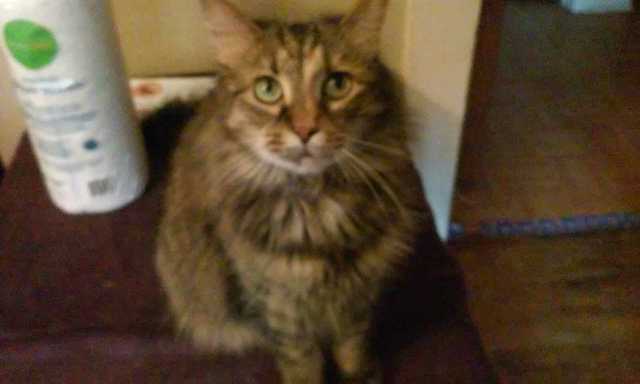


That’s Dexter standing there in the doorway. 🙂
One of the coolest things about Babycat (and one of the cutest too) is the fluffy and soft jet black toe tufts between her toes. She doesn’t mind at all when I massage her toe tufts.

If only it were so easy.
Dogs are awesome teachers, friends, and therapists. They never worry, they’ll never mindfuck you, they will never lie to you, they live for the moment and enjoy simple things, they’re loyal and protective, they will listen to all your problems without judging or putting you down, and no matter how bad you think you’ve been, they still love you unconditionally.
I love watching otter videos (hence my name). You can’t watch one without smiling. This one (an Asian small clawed otter named Oscar) is one of the cutest I’ve ever seen.
Tragically, this pet otter (the owner lives in Bali, where it’s legal to keep them as pets) was deliberately poisoned by a neighbor shortly after this video was made. I just can’t understand how some people can be so cruel to a helpless animal.
It looks like Oscar had a good life though.
I love the song too.
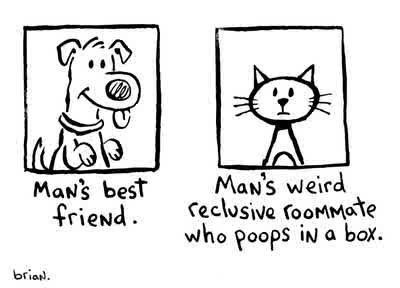
Based on a search term from today, “psychopaths hate cats” I decided to Google that search term myself and found this article, which I’ll reprint here.
http://research.personality-testing.info/are-psychopaths-dog-people/
British journalist Jon Ronson is obsessed with obsessives. He’s best known for writing the book behind the George Clooney film “The Men Who Stare At Goats.” In his latest book, Jon Ronson has turned his own obsessive eye toward psychopaths. The book is called “The Psychopath Test.”
[………………..]
One of the stranger characteristics of psychopaths is their choice of pets. Ronson says they are almost never cat people. “Because cats are willful,” he explains.
Psychopaths gravitate toward dogs since they are obedient and easy to manipulate. Ronson says he spoke with individuals who would qualify as psychopaths who told him they aren’t sad when they hear about people dying. “But they get really upset when their dogs die because dogs offer unconditional love.”
I was unable to find the justification for this claim with some searching and as such specific statements never tend to be very true, I thought this one should be put to the test.
To this end, I appended the question
If you had to choose, what would you describe yourself as?
A ‘dog person’.
A ‘cat person’.
I don’t want to answer.
to the end of the Psychopathy Scale as a “research item”. The scale is short questionnaire used for the study of psychopathy in adult populations. It can not diagnose psychopathy, but it correlates very well with the Hare Psychopathy Checklist which can. In measures two scales: primary psychopathy (things like arrogance, manipulativeness, callousness, lying) and secondary psychopathy (things like irresponsibility, impulsiveness, lack of long-term goals and boredom proneness).
Here are the results.
Answer Primary psychopathy Secondary psychopathy #
Dog person 2.44 2.67 304
Cat person 2.54 2.84 283
Didn’t answer 2.92 2.94 102
As can be seen, dog people actually scored lower for both dimensions of psychopathy than cat people, although not by much. The claim would appear to be wrong.
Some weeks ago I wrote my article, “Psychopaths and Pets” about the the way psychopaths treat animals (basically, as extensions of themselves).
 Lucky Otters Haven