
An interesting and slightly scary walk along the narcissistic continuum, from “healthy” (adaptive) narcissism up to sociopathic or malignant narcissism…
Tag Archives: narcissistic personality disorder
Narcissists are just highly trained monkeys.

It seems some people think narcissists are smarter than other people, because their mental and emotional abuse and manipulations appear so calculated and complex, and they seem to always be able to anticipate your actions and reactions. People also think you can’t outsmart a narcissist for the same reason.
While it’s true that outsmarting a narcissist means you always have to anticipate their actions ahead of time (which is difficult for a victim to do), it can be done, especially if the narcissist isn’t very smart. In fact, some of them are pretty stupid. The stupid ones are probably less dangerous, but even the highly manipulative and cunning ones who are experts at gaslighting and other mind games aren’t necessarily all that smart.
They’re more like highly trained monkeys. Some monkeys can perform very complex tasks that make it appear as if they’re incredibly smart. But this is an illusion. The monkey was trained over a long period of time by being taught one simple task at a time, and when one task was mastered, they were taught the next task. String all those simple tasks together, and the monkey looks like they’re performing a complex operation. Another analogy is a child of average intelligence who is multilingual. If the child grew up hearing several languages spoken, they will pick up all the languages and become fluent in them. Of course, language is harder to learn as an adult, so knowing several languages makes you appear highly intelligent, but if the languages were learned in childhood, this isn’t a given.
An even more dramatic example is the bower bird. A male bower bird builds a rather complex structure (the bower) resembling a thatched hut and a surrounding decorative display to attract a female, choosing objects that are all the same color, and arranging them in attractive patterns to impress the opposite sex. It would appear these birds must be creative and intelligent to be able to build a complex bower and a beautiful, color coordinated display, but in actuality they aren’t any more intelligent than other birds. Their behavior is mostly instinctual, although some elements may have been learned. They are probably not really thinking when they build their mating habitat, at least not the same way an architect does when he draws up a blueprint for a new house. Still, most of us probably wouldn’t know how to build a hut as structurally sound as the bower bird’s.

Male bower bird shows off his display of blue objects.
A narcissist can be of quite average intelligence but still seem to be able to anticipate your every move and every word and know exactly what moment to manipulate or gaslight you. This makes them appear cunning and calculating. Most of us associate those traits with high intelligence. But in actuality, all of it’s an elaborate defense mechanism learned when they were very young. Like the highly trained monkey performing a complex task, the narcissist learned all these behaviors over a long period of time, without even being aware of what they were learning. They just did whatever worked (or whatever was rewarded). They don’t think about what they’re doing; they just do it. Like the bower bird’s impressive display, their machinations are instinctual.
DMT, healing, spirituality and ego death.

Example of the type of visuals you might see in the beginning of a DMT trip.
Disclaimer: I do not recommend or condone taking illegal drugs, nor do I recommend tampering with occult or new age practices such as attempting to open the Third Eye (which really does exist as far as I’m concerned) since I do think it could potentially open doors for evil spirits to gain access to your soul. Still, the intensely psychedelic chemical known as DMT (dimethyltryptamine), which is produced naturally by the human pineal gland (and is present in almost all plants and animals), has fascinating implications for treating or curing personality disorders, including NPD. So read on, even if (like me) you never want to mess with it.
I’m an obsessive kind of person who gets intensely interested in certain topics and reads as much as I can about them while my intense interest lasts (another reason I thought I was an Aspie for so long).
Over the past week or so, I’ve been reading up a lot about DMT (dimethyltryptamine), a naturally produced hallucinogen that has several unique properties: (1) it’s naturally produced in the human brain (by the pineal gland, which corresponds to the “third eye”) during birth, death (and accounts for NDE’s), and while we dream; (2) it occurs in almost all living things, including ourselves, and therefore is widely available although it’s hard to extract and synthesize and is also the most illegal drug there is (except in places where it is sanctioned for shamanic use, such as Peru, where it’s drank in ayahuasca tea); (3) In almost all “trip reports” of DMT users report “coming back” feeling completely humbled and with a renewed appreciation for life and our connection with the universe and with others; and (4) the trip lasts only about 10 minutes! It’s also been known to cure drug addiction (!) and alcoholism. DMT itself is non addictive, as are all psychedelics.
DMT is the most intense psychedelic known.

The DMT molecule.
Unlike most other psychedelics, you do not lose your sense of judgment and rationality during the experience. Although you’re completely out of touch with reality (as we know it) and you won’t remember you’ve taken a drug at all, your cognitive functioning remains intact so you are able to learn from the experience–if you can remember it.
Is DMT really a drug at all? I’m not so sure after reading what I have on Erowid.org and watching a number of videos and reading articles and trip reports. I think it’s a chemical that causes you to become aware of other dimensions and realities, and the “hallucinations” are actually quite real–ways of seeing the universe with the Third Eye (the pineal gland) rather than the physical eyes.
I’ve always been fascinated by trip reports for some reason, even though the only drug I’ve ever taken regularly (besides alcohol) is weed.
I’m not encouraging anyone to take illegal drugs, and personally, while one part of me longs for this experience, I doubt I could handle it. I just know I’d be one of those people who’d totally freak out. From everything I’ve read, the trip is INCREDIBLY intense–much more so than with any other hallucinogen. Even with LSD (which I really disliked the one time I took it) you still have some tenuous grip on reality and some ability to ground yourself/control the trip. You don’t forget the fact that you are tripping, and can usually remind yourself of that to avoid a really bad trip.
But with DMT (which is usually smoked) you are completely out of control and find yourself so out of touch with 3-dimensional reality you don’t even remember you have taken a drug, and believe things have always been this way and always will be, and what you’re seeing is your new reality. You can’t remember who you are, where you are, what your name is, or even what you are. Yet your cognitive abilities remain intact!

Delicate DMT crystals.
What a DMT trip is like.
From my readings, it seems the entire experience goes something like this for almost everyone who’s tried it.
1. you smoke about 2-3 hits which is enough to get the full effect; 3 if you want to “break through” (which I’ll explain in a minute). Usually you can’t smoke more because the trip comes on so rapidly and by the time you’d be ready for a 4th hit you are in hyperspace and have no idea what you just did or where you came from or who you are.
2. almost immediately you start seeing intricate, colorful, geometric patterns, fractals, grids, and other psychedelia constantly moving and shifting into new configurations. Some of the visuals you see are impossible in 3 dimensional reality because they are showing you other dimensions. Sometimes you can get a similar effect during hypnagogic hallucinations that happen just as you fall asleep. But we rarely remember those and they’re fleeting. Apparently (though it’s not proven), DMT is released by the brain when we dream, and we only remember the dreams that are most like reality (usually, the ones that happen toward the morning) but actually most of the dreams we have earlier in the night or in deep REM sleep are very similar to a DMT trip. Also, like a dream, it’s very difficult to remember the trip after “coming to”–it fades or dissolves very similar to a dream. DMT is also released during near death experiences (NDE’s).
3. Early in the trip, if you have smoked enough, you pass through a kind of membrane that is similar to a lotus flower. Once you “break through” you will be in a place where impossible things happen and time and space don’t exist the same way they do in the physical world. Time either stops, or the person feels like they spend years or even eons in this place. Most people report a feeling of familiarity, as if they have been there many times before (maybe remembering their own birth or time spent in dreams?) Objects have more than three dimensions and almost everyone reports a feeling of meeting other entities who communicate with them. They could be demons, angels, or aliens, or sometimes are disembodied entities who don’t actually speak at all, but the user feels like someone or something is communicating with them. Sometimes these entities offer gifts–objects so incredibly intricate and beautiful they defy the imagination and can’t possibly exist in our own 3 dimensions. Profound insights are revealed. You are warned to not allow your astonishment (and you will be astonished) to keep you from paying attention to what you are being shown. At some point the user is told their time is limited and they begin to slowly feel reality come back.
There is no way to ground yourself in any way during these experiences; you must completely give into it and in fact you have no other choice. If you go into such a trip with any trepidation, the experience could be the most terrifying thing that ever happened to you.

But even when the experience is terrifying, most people say later they’re glad they experienced it, because they were able to take away some realization of unbelievable profundity and say theywere humbled by the experience and see life and their relationships in a completely new way after returning. People have been cured of PTSD, drug addictions, and other psychological disorders by using DMT only one time. Some people are also able to recall long-forgotten childhood memories during the trip.
The stories I’ve read are so similar in nature (although each person receives a different insight or message or communicates with different entities) that I think the trip is to an actual place, not just something created by the mind. Shamans in South America and Mexico have been using it for ages and many people come to these shamanic healing sessions and leave a changed person.
During the intense trip, there is often a cleansing of both body and soul. Participants have reported severe nausea and vomiting (which could be due to slight poisoning) followed by diarrhea, but there is also emotional cleansing and catharsis with participants screaming and crying as they shed their egos and forget who or what they are. Sometimes spontaneous orgasm is even reported. Almost all these participants, although they appear to have suffered severely during the trip, feel great the next day, as if they’ve been reborn. Some say they are forever changed for the better, and the one experience they had doesn’t lead to a desire to do it again, because there’s simply no need to anymore.
To get a small idea of what a DMT trip is like, here’s an excellent simulation that includes commentary by Terence McKenna.
As one commenter who’s tried DMT under the video pointed out, this simulation is accurate but only about .000000001% what the real experience is like! I don’t think I want to try it! 😮
Implications for healing NPD and other personality disorders.
Since DMT has been effective on people with PTSD and other physical and psychological disorders and addictions to drugs and alchohol, I wonder if it could be effective on someone with NPD, even deeply ingrained or malignant NPD. NPD is itself a type of addiction and in many respects it does resemble addiction to a drug, the drug being narcissistic supply.
On DMT a person experiences complete ego death, to the point they don’t even know if they exist or what they are or where they come from. But even with a bad experience, the user (if they don’t go psychotic) is changed for the better. People who were overly concerned with acquisition or materialism or money before their experience come back with different priorities, and more caring for themselves and others. They realize there is much more to the universe than themselves or their image, or the material things they can attain. They realize how insignificant they are and yet at the same time how much power they have (but power in a truly confident sense, not a narcissistic one). They feel more connected to the spiritual. Some atheists have suddenly come to believe in God. People emerging from the DMT trip are able to see beauty and goodness in the world and in others for the first time since early childhood, and sometimes memories of early childhood are aroused and purged during the trip. Some people report they suddenly can feel empathy and caring for others they never felt before.

South American shaman offering cup of ayahuasca.
For anyone interested in the implications of the beneficial uses for DMT, I highly recommend reading the FAQ and trip reports for DMT over at Erowid.org. There is a book called “DMT: The Spirit Molecule” by Dr. Richard Strassman. A man called Terence McKenna also has many interesting Youtube videos where he describes his own trips and the properties of DMT. He doesn’t seem any the worse for wear.
Why is it illegal?
DMT is a Class 1 drug in the United States (and most other countries), which means it’s highly illegal and carries severe charges for possession, distribution, or synthesis. There’s a reason why this drug is illegal even though it occurs naturally in all of us–it’s intense and otherworldly beyond anyone’s wildest imagination and probably would cure many disorders instantaneously (well, within the 10-15 minutes the trip takes) and the pharmaceutical companies would lose money on their synthetic antidepressants and sedative drugs that don’t cure but simply maintain a person so they can function. If made legal, unconventional therapists or practitioners of alternative medicine might use it on a patient during a session and the drug companies would go out of business! (So would traditional therapists, for that matter.)
Again, I’m not recommending that anyone do illegal drugs or take something so intense as DMT. It’s very hard to obtain in smokable form or extract yourself anyway. But I think the implications here are fascinating and possibly earth-shattering for people with NPD and other personality disorders.
The dark side of DMT.

There are several drawbacks to using DMT (besides the severe nausea and vomiting some people report). People with NPD and a few other personality disorders (such as Schizoid or Obsessive Compulsive PD) might have a more unpleasant trip than the non-disordered, due to how closed off from themselves and unwilling to “let go” they are. But in the end, that unpleasantness could actually be a good thing. Long term psychodynamic therapy for people with NPD is extremely unpleasant too. There’s no way around it–the cure is going to be unpleasant, whether it’s in the form of 10 years of therapy, or a ten minute DMT trip.
DMT/ayahuasca aren’t drugs that should EVER be used for recreational purposes, if at all. They aren’t fun drugs so you and your buddies can “get high.” They may have healing, religious, or shamanic purposes if used responsibly, and preferably under supervision or at least with a responsible trip sitter. They have had some success not only with people with certain physical and mental illnesses such as PTSD, but with the terminally ill to help them come to terms with impending death and what the experience of dying will be like. Terminally ill patients given DMT usually become less afraid of death and dying. DMT is a serious drug meant only for sacred or teaching purposes and should never be used for recreation.
They can also open you up to evil or malicious entities who take advantage of the psychic door that’s opened during a trip. There are ways you can protect yourself. Here’s a very good article about the darker side of using DMT/ayahuasca (and other psychedelics) and how to avoid encountering dark spirits who might want to take something from you.
I read on one Christian website about a born again Christian who claims he was actually saved during a DMT trip, and still uses it occasionally to communicate directly with Jesus/God, but only with his sober pastor present, who apparently condones his use. I can’t say what my own faith’s stance is on using psychedelic substances for enlightenment, but as far as I know, it’s not condemned anywhere in the Bible. Of course, Adam and Eve’s “Tree of Knowledge” could well have been a psychedelic plant and their ingestion led to the Fall…so who knows? Deliberately ingesting psychedelic drugs could also be considered a form of sorcery, so if you have religious misgivings about it, you should probably stay away, even if only to avoid a bad trip caused by your fear of having one! Suggestibility while on any psychedelic substance is high, so if you believe you will run into demons or evil entities, then that’s what you’ll probably see.
DMT won’t kill you, but there’s always the small possibility of developing PTSD or even psychotic conditions due to suffering a particularly intense bad trip. There is no sure way to say for sure you won’t be a casualty. I can’t stress enough how potent this drug is.
A dream journal as an alternative.
One way around having to obtain or take DMT could be to keep a dream diary and begin to record and pay attention to your dreams and what they are telling you. Wake yourself up earlier in the night, when the dreams are of the more intense, DMT-type variety that are probably blocked off by the conscious mind to protect yourself. It’s been speculated the reason both DMT trips and dreams are so easily forgotten when we wake up or “come to” is because both stir up repressed memories and buried information in the unconscious mind that would freak the person out if they became conscious of it, or cause a severe depression. A person with NPD is especially cut off from their unconscious mind and repressed memories.
At some point I’ll be writing a longer post about dreams and how keeping a dream journal and recording dreams can help people with personality disorders and PTSD.
When a narcissist finally opens up to you.

That’s all you “can” expect.
“Soulmates in Hell: Religious Narcissists–Evil in Disguise. “

I stumbled on a new blog and just read this article. Every word the author says is true. I’ve known so many religious types who use religion as a tool to abuse. These are truly the wolves in sheep’s clothing. Unfortunately, such people’s children are often turned off my the whole idea of God and religion because it becomes so triggering.
Soulmates in Hell: Religious Narcissists–Evil in Disguise
By Larry Giddens
If you have had the unfortunate experience of being in a relationship with a narcissist with religious pretensions, you know how difficult and confusing it can be. The narc spouts scripture and postures as “holy”, and they use religion to create a veneer of “godliness”.
Now, I’ve read various articles on the topic that seem to miss the point, which is, that a religious narcissist will just drive you crazy with their constantly letting you know how much better they are than you, or anyone else, for that matter. There is no situation for which they won’t butt in with some scripture quote, and no conversation that won’t soon turn into a sermon, just to let you know that while you have mundane, everyday concerns like whether you need to buy milk, their mind is on “the things of God”.
The rest of this article can be read here.
http://soulmateinhell.blogspot.com/2015/10/religious-narcissists-evil-in-disguise.html
The Pooooor Narcissist
Do you know a “do gooder” who always somehow makes you feel guilty and less saintly than they are? Everyone knows someone who plays the martyr. Do you know a Needy Nancy or Ned who has an endless litany of problems that never seem to go away? Do they get mad at you when you try to help because your help isn’t good enough or is the wrong kind of help? Do you know someone who never apologizes, never admits wrongdoing, and never even says thank you when you offer help? That “victim” may actually be a narcissist. How can you tell the difference? Red flags. Gaslighting. Manipulation. Guilt trips. Projection. Blaming. They are never wrong but you always are, especially if you dare to suggest their problems may be their own fault. You can’t win with one of these characters.
This article describes the covert type of narcissist, who can be much harder to spot because they aren’t arrogant, grandiose and in your face. They’re good at what they do, so it pays to be vigilant.

It’s Narcissist Friday!
N – Get off the road, stupid idiot! That guy drives just like your brother!
You – Why do you say such mean things? It isn’t like you are a perfect driver.
N – What complaint do you have with my driving? You are always criticizing me. I have to be perfect before I can say anything anymore.
Then, when you get home:
N – Well, you can breathe now. I didn’t say anything mean and we got home without an accident. If you still think you can handle such a mean person, you should probably drive tonight when we go out. That way you can feel safe. Maybe I can sit back and criticize your driving.
Ever notice how the narcissist can become the instant victim? I used to have a relative who could say anything, accuse of anything, or criticize anything. But if…
View original post 628 more words
A malignant narcissist’s rage in action.
I’m not going to review the movie “Boogie Nights” here but there’s a scene I want to talk about because of how powerful it is.
“Boogie Nights” is a 1997 film that starred Mark Wahlberg as Dirk Diggler, young man who fled his mother’s abuse and became successful as an adult film star during the late Disco era. The soundtrack consists of disco and dance hits from the late 1970s and early 1980s.
This was actually a very good film, and the acting by his mother (Joanne Gleason) in this scene (set in 1977, when the story begins with Dirk leaving home), is terrific. She is like a lower-middle-class version of Mary Tyler Moore’s character in “Ordinary People.” She shows more “emotion” because of her social class, which doesn’t require her to “stuff” over-the-top emotion, but she’s every bit as malignant as the mother in “Ordinary People,” and Dirk is obviously her scapegoat. She may have BPD rather than NPD, but it really doesn’t matter either way, because sociopathic, soul-murdering behavior like this is possible with either disorder.
Notice the way she gaslights and blame-shifts, while at the same time is freaking out because Dirk is refusing to provide her the supply she needs and is leaving her. This is one of the things that can happen when you inflict injury on a high spectrum, malignant narcissist. Wahlberg’s character is a somatic narcissist himself, but it’s hard to see that in this scene.
Grumpy old men: narcissists in old age.

It’s been said narcissists grow worse with age. As they lose their looks and mental acuity and become less sexually desirable and more unemployable, they lose the ability to attract the supply they need to feel like they exist. Most will fall into deep depression and a few might even commit suicide. Growing old and having to confront one’s own mortality is the ultimate narcissistic injury. The only thing they have left to obtain supply is their advanced age itself.
Some will become the stereotypical “get off my lawn” grouchy old man or woman, demanding their entitlements (or what they think are their entitlements) be met, no matter how unreasonable. They don’t bother with “charm.” They don’t even try to hide their self-centeredness or contempt for others anymore or make any attempt to be “nice.” They’ve given up playing the games they used to attain supply when they had their youth, looks, and health. They know they have nothing they can use anymore to attract respect, admiration, adulation, and attention, so they just demand and yell and cuss and bully other people to get it, using their age as an excuse to be mean.

These are people who reach the age of 70, 80 and 90 and are still emotional 3-year-olds. They are filled with hate for the world and for what has been done to them to make them that way (unresolved childhood trauma), for what they have become, and regret for what they never could be. They project their self-hatred onto anyone who crosses their path.
I read this description of what one old narcissist was like. It’s sad but all too true. I’ve known people like this. I see my ex becoming one.
I’ve seen old narcissists. I used to see a 72’ish guy at the grocery store. It was awful. He would angrily force himself to the front of the line. Each person he pushed in front of and angrily exclaimed “I only have 3 things” was as much a source of supply as the supply I would extort through more elegant means. He was down to the point of just taking it. The more people acted startled and offended, but withheld their protests due to his age and frailty, the more he felt he existed.
He would reach the cashier and then insist that the price is wrong, putting the cashier in the position of holding up all those kind folks he cut in front of. It’s not his fault they’re being inconvenienced. Then he’d demand a new “shopper/loyalty card” to get the discounts — why saying “I don’t want it, throw it away.” Too important to be bothered with carrying a card like everyone else. Probably some long-held criticism that stores should just charge the same price for everything and not do the “member price” gimmick. Something he could criticize in the past, now something he could incorporate into his bitter existence.
He would then contemptuously instruct the cashier to take the coins from his hand because his fingers are knurled from arthritis. Projecting onto the cashier his own contempt for his body failing his grandiosity. As he walked away, he would throw his receipt on the floor as if he had been intentionally offended by receiving it.
“The Narcissistic Mother”

TRIGGER WARNING!
This 2007 article from the Deconstructing Jezebel blog may be the most comprehensive, descriptive, detailed, and yes, extremely triggering article about narcissistic mothers I have ever read. Reading this was like reliving the trauma all over again. But if you were raised in a narcissistic home, it will open your eyes too, and if you had any doubt your mother (or father) was a narcissist, this should clear up any doubt.
Although written about mothers, all of these things could apply to fathers too.
It’s also very long but well worth reading.
The Narcissistic Mother

The Destructive Narcissistic Parent creates a child that only exists to be an extension of her self.
It’s about secret things.
It’s about body language.
It’s about disapproving glances.
It’s about vocal tone.
It’s very intimate.
And it’s very powerful.
-Chris
Characteristics of Narcissistic Mothers
1. Everything she does is deniable. There is always a facile excuse or an explanation. Cruelties are couched in loving terms. Aggressive and hostile acts are paraded as thoughtfulness. Selfish manipulations are presented as gifts. Criticism and slander is slyly disguised as concern. She only wants what is best for you. She only wants to help you.
She rarely says right out that she thinks you’re inadequate. Instead, any time that you tell her you’ve done something good, she counters with something your sibling did that was better or she simply ignores you or she hears you out without saying anything, then in a short time does something cruel to you so you understand not to get above yourself. She will carefully separate cause (your joy in your accomplishment) from effect (refusing to let you borrow the car to go to the awards ceremony) by enough time that someone who didn’t live through her abuse would never believe the connection.
Many of her putdowns are simply by comparison. She’ll talk about how wonderful someone else is or what a wonderful job they did on something you’ve also done or how highly she thinks of them. The contrast is left up to you. She has let you know that you’re no good without saying a word. She’ll spoil your pleasure in something by simply congratulating you for it in an angry, envious voice that conveys how unhappy she is, again, completely deniably. It is impossible to confront someone over their tone of voice, their demeanor or they way they look at you, but once your narcissistic mother has you trained, she can promise terrible punishment without a word. As a result, you’re always afraid, always in the wrong, and can never exactly put your finger on why.
Because her abusiveness is part of a lifelong campaign of control and because she is careful to rationalize her abuse, it is extremely difficult to explain to other people what is so bad about her. She’s also careful about when and how she engages in her abuses. She’s very secretive, a characteristic of almost all abusers (“Don’t wash our dirty laundry in public!”) and will punish you for telling anyone else what she’s done. The times and locations of her worst abuses are carefully chosen so that no one who might intervene will hear or see her bad behavior, and she will seem like a completely different person in public. She’ll slam you to other people, but will always embed her devaluing nuggets of snide gossip in protestations of concern, love and understanding (“I feel so sorry for poor Cynthia. She always seems to have such a hard time, but I just don’t know what I can do for her!”) As a consequence the children of narcissists universally report that no one believes them (“I have to tell you that she always talks about YOU in the most caring way!). Unfortunately therapists, given the deniable actions of the narcissist and eager to defend a fellow parent, will often jump to the narcissist’s defense as well, reinforcing your sense of isolation and helplessness (“I’m sure she didn’t mean it like that!”)
2. She violates your boundaries. You feel like an extension of her. Your property is given away without your consent, sometimes in front of you. Your food is eaten off your plate or given to others off your plate. Your property may be repossessed and no reason given other than that it was never yours. Your time is committed without consulting you, and opinions purported to be yours are expressed for you. (She LOVES going to the fair! He would never want anything like that. She wouldn’t like kumquats.) You are discussed in your presence as though you are not there. She keeps tabs on your bodily functions and humiliates you by divulging the information she gleans, especially when it can be used to demonstrate her devotion and highlight her martyrdom to your needs (“Mike had that problem with frequent urination too, only his was much worse. I was so worried about him!”) You have never known what it is like to have privacy in the bathroom or in your bedroom, and she goes through your things regularly. She asks nosy questions, snoops into your email/letters/diary/conversations. She will want to dig into your feelings, particularly painful ones and is always looking for negative information on you which can be used against you. She does things against your expressed wishes frequently. All of this is done without seeming embarrassment or thought.
Any attempt at autonomy on your part is strongly resisted. Normal rites of passage (learning to shave, wearing makeup, dating) are grudgingly allowed only if you insist, and you’re punished for your insistence (“Since you’re old enough to date, I think you’re old enough to pay for your own clothes!”) If you demand age-appropriate clothing, grooming, control over your own life, or rights, you are difficult and she ridicules your “independence.”
3. She plays favorites. Narcissistic mothers commonly choose one child to be the golden child and one to be the scapegoat. The narcissist identifies with the golden child and provides privileges to him or her as long as the golden child does just as she wants. She attempts to replicate herself in the golden child. The golden child has to be cared for assiduously by everyone in the family. The scapegoat has no needs and instead gets to do the caring, or is ignored, or is harmed. The golden child can do nothing wrong. The scapegoat is always at fault. This creates divisions between the children, one of whom has a large investment in the mother being wise and wonderful, and the other(s) who hate her. That division will be fostered by the narcissist with lies and with blatantly unfair and favoritizing behavior. The golden child will defend the mother and indirectly perpetuate the abuse by finding reasons to blame the scapegoat for the mother’s actions. The golden child may also directly take on the narcissistic mother’s tasks by physically abusing the scapegoat so the narcissistic mother doesn’t have to do that herself.
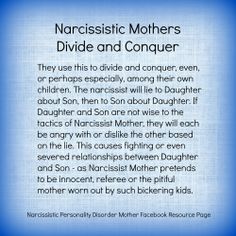
4. She undermines. Your accomplishments are acknowledged only to the extent that she can take credit for them. Any success or accomplishment for which she cannot take credit is ignored or diminished. Any time you are to be center stage and there is no opportunity for her to be the center of attention, she will try to prevent the occasion altogether, or she doesn’t come, or she leaves early, or she acts like it’s no big deal, or she steals the spotlight or she slips in little wounding comments about how much better someone else did or how what you did wasn’t as much as you could have done or as you think it is. She undermines you by picking fights with you or being especially unpleasant just before you have to make a major effort. She acts put out if she has to do anything to support your opportunities or will outright refuse to do even small things in support of you. She will be nasty to you about things that are peripherally connected with your successes so that you find your joy in what you’ve done is tarnished, without her ever saying anything directly about it. No matter what your success, she has to take you down a peg about it.

5. She demeans, criticizes and denigrates. She lets you know in all sorts of little ways that she thinks less of you than she does of your siblings or of other people in general. If you complain about mistreatment by someone else, she will take that person’s side even if she doesn’t know them at all. She doesn’t care about those people or the justice of your complaints. She just wants to let you know that you’re never right.
She will deliver generalized barbs that are almost impossible to rebut (often in a caring tone): “You were always difficult” “You can be very difficult to love” “You never seemed to be able to finish anything” “You were very hard to live with” “You’re always causing trouble” “No one could put up with the things you do.” She will deliver slams in a sidelong way – for example she’ll complain about how “no one” loves her, does anything for her, or cares about her, or she’ll complain that “everyone” is so selfish, when you’re the only person in the room. As always, this combines criticism with deniability.
She will slip little comments into conversation that she really enjoyed something she did with someone else – something she did with you too, but didn’t like as much. She’ll let you know that her relationship with some other person you both know is wonderful in a way your relationship with her isn’t – the carefully unspoken message being that you don’t matter much to her.
She minimizes, discounts or ignores your opinions and experiences. Your insights are met with condescension, denials and accusations (“I think you read too much!”) and she will brush off your information even on subjects on which you are an acknowledged expert. Whatever you say is met with smirks and amused sounding or exaggerated exclamations (“Uh huh!” “You don’t say!” “Really!”). She’ll then make it clear that she didn’t listen to a word you said. She doesn’t care what you said.
6. She makes you look crazy. If you try to confront her about something she’s done, she’ll tell you that you have “a very vivid imagination” (this is a phrase commonly used by abusers of all sorts to invalidate your experience of their abuse), that you don’t know what you’re talking about, or that she has no idea what you’re talking about. She will claim not to remember even very memorable events, flatly denying they ever happened, nor will she ever acknowledge any possibility that she might have forgotten. This is an extremely aggressive and exceptionally infuriating tactic called “gaslighting,” common to abusers of all kinds but especially used by the subtlety of narcissists.. Your perceptions of reality are continually undermined so that you end up being extremely confused, and wondering if you are as she says you are; usually, you will begin to believe deeply her lies about you. You will end up without any confidence in your intuition, your memory or your powers of reasoning. This makes you a much better victim for the narcissistic abuser.
Narcissists gaslight routinely. The narcissist will either insinuate or will tell you outright that you’re unstable, otherwise you wouldn’t believe such ridiculous things or be so uncooperative. You’re oversensitive. You’re imagining things. You’re hysterical. You’re completely unreasonable. You’re over-reacting, like you always do. She’ll tell you that she’ll talk to you when you’ve calmed down and aren’t so irrational. She may even characterize you as being neurotic or psychotic to your face, but often will say these things to others, particularly to other family members in her efforts to destroy your credibility Once she’s constructed these fantasies of your emotional pathologies, she’ll tell others about them, as always, presenting her smears as expressions of concern and declaring her own helpless victimhood. She didn’t do anything. She has no idea why you’re so irrationally angry with her. You’ve hurt her terribly. She cannot understand why you won’t talk to her or won’t spend time with her. She thinks you may need psychotherapy. She just doesn’t know what to do (and she’ll ask others for their opinion of you, carefully skewing the impressions they have of you to fit her image of you). You keep pushing her away when all she wants to do is help you.
She has simultaneously absolved herself of any responsibility for your obvious antipathy towards her, implied that it’s something fundamentally wrong with you that makes you angry with her, and undermined your credibility with her listeners. She plays the role of the doting mother so perfectly that no one will believe you.
7. She’s extremely envious. Any time you get something nice she’s angry and envious and her envy will be apparent when she admires whatever it is. She’ll try to get it from you, spoil it for you, or get the same or better for herself. She’s always working on ways to get what other people have. The envy of narcissistic mothers often includes competing sexually with their daughters or daughters-in-law. They’ll attempt to forbid their daughters to wear makeup, to groom themselves in an age-appropriate way or to date. Or they will encourage you to present yourself in a sexually provocative way, and then they will directly compete with you for male attention. They will criticize the appearance of their daughters and daughters-in-law, no matter what their appearance is like. This envy extends to relationships. Narcissistic mothers infamously attempt to damage their children’s marriages and interfere in the upbringing of their grandchildren.
8. She’s a liar in too many ways to count. In fact, her lying usually reaches pathological proportions. Any time she talks about something that has emotional significance for her, it’s a fair bet that she’s lying. Lying is one way that she creates conflict in the relationships and lives of those around her – she’ll lie to them about what other people have said, what they’ve done, or how they feel. She’ll lie about her relationship with them, about your behavior or about your situation in order to inflate herself, cause divisions between people, and to undermine your credibility.
The narcissist is very careful about how she lies. To outsiders she’ll lie thoughtfully and deliberately, always in a way that can be covered up if she’s confronted with her lie. She spins what you said rather than makes something up wholesale. She puts dishonest interpretations on things you actually did. If she’s recently done something particularly egregious she may engage in preventative lying: she lies in advance to discount what you might say before you even say it. Then when you talk about what she did you’ll be cut off with “I already know all about it…your mother told me… (self-justifications and lies).” Because she is so careful about her deniability, it may be very hard to catch her in her lies and the more gullible of her friends may never realize how dishonest she is. If you do try to take action to expose her lies, you will look like the one with ‘the problem’ as she has carefully cultivated others to believe you are. The more emotional or dramatic you become in trying to have others see the truth of how you are treated by her, the more unbalanced you will look and the more solid will become their agreement with her subtle assessment of you that she’s planted into them.
To you, she’ll lie blatantly. She will claim to be unable to remember bad things she has done, even if she did one of them recently and even if it was something very memorable. Of course, if you try to jog her memory by recounting the circumstances “You have a very vivid imagination” or “That was so long ago. Why do you have to dredge up your old grudges?” Your conversations with her are full of casual brush-offs and diversionary lies and she doesn’t respect you enough to bother making it sound good. For example she’ll start with a self-serving lie: “If I don’t take you as a dependent on my taxes I’ll lose three thousand dollars!” You refute her lie with an obvious truth: “No, three thousand dollars is the amount of the dependent exemption. You’ll only lose about eight hundred dollars.” Her response: “Isn’t that what I said?” You are now in a game with only one rule: You can’t win. If you press the issue, you will slowly see the outrageous anger that a narcissist can display towards you – she will only show you or others whom she has devalued and ‘split off’; others who are still useful to her will not see this side of her. Thus, if you try to tell others of the depth of her anger or her fury or her harm, they simply will not believe you.
9. She has to be the center of attention all the time. This need is a defining trait of narcissists and particularly of narcissistic mothers for whom their children exist to be sources of attention and adoration. Narcissistic mothers love to be waited on and often pepper their children with little requests. “While you’re up…” or its equivalent is one of their favorite phrases. You couldn’t just be assigned a chore at the beginning of the week or of the day, instead, you have to do her wishes on demand, preferably at a time that was inconvenient for you, or you had to “help” her do it, while she quietly glories in the command and control she wields over you. For a narcissist, it is always, and only, about them. Your primary function is to satisfy their needs and wants.
A narcissistic mother may create odd occasions at which she can be the center of attention, such as memorials for someone close to her who died long ago, or major celebrations of small personal milestones. She may love to entertain so she can be the life of her own party. She will try to steal the spotlight or will try to spoil any occasion where someone else is the center of attention, particularly the child she has cast as the scapegoat. She often invites herself along where she isn’t welcome. If she visits you or you visit her, you are required to spend all your time with her, doing as she wants. Entertaining herself is unthinkable. She has always pouted, manipulated or raged if you tried to do anything without her, didn’t want to entertain her, refused to wait on her, stymied her plans for a drama or otherwise deprived her of attention.
Older narcissistic mothers often use the natural limitations of aging to manipulate dramas, often by neglecting their health or by doing things they know will make them ill. Sometimes they will do this by addictions to alcohol or drugs or other obsessions. This gives them the opportunity to cash in on the investment they made when they trained you to wait on them as a child. Then they call you (or better still, get the neighbor or the nursing home administrator to call you) demanding your immediate attendance. You are to rush to her side, pat her hand, weep over her pain and listen sympathetically to her unending complaints about how hard and awful it is. (“Never get old!”) It’s almost never the case that you can actually do anything useful, and the causes of her disability may have been completely avoidable, but you’ve been put in an extremely difficult position. If you don’t provide the audience and attention she’s manipulating to get, you look extremely bad to everyone else and may even have legal culpability. (Narcissistic behaviors commonly accompany Alzheimer’s disease, so this behavior may also occur in perfectly normal mothers as they age. But, in narcissistic mothers, it is a given.)
10. She manipulates your emotions in order to feed on your pain. This exceptionally sick and bizarre behavior is so common among narcissistic mothers that their children often call them “emotional vampires.” Some of this emotional feeding comes in the form of pure sadism. She does and says things just to be wounding or she engages in tormenting teasing or she needles you about things you’re sensitive about, all the while a smile plays over her lips. She may have taken you to scary movies or told you horrifying stories, then mocked you for being a baby when you cried. She will slip a wounding comment into conversation and smile delightedly into your hurt face. You can hear the laughter in her voice as she pressures you or says distressing things to you. Later she’ll gloat over how much she upset you, gaily telling other people that you’re so much fun to tease, and recruiting others to share in her amusement. . She enjoys her cruelties and makes no effort to disguise the smaller cruelties – the most serious cruelties, she will perform with you in secret or when just you and she are alone. She wants you to know that your pain entertains her. She may also bring up subjects that are painful for you and probe you about them, all the while watching you carefully. This is emotional vampirism in its purest form. She’s feeding emotionally off your pain. She enjoys your pain. This may be the hardest aspect of the character of mothers with narcissistic personality disorder to believe and accept. After all, she is your mother.
A peculiar form of this emotional vampirism combines attention-seeking behavior with a demand that the audience suffer. Since narcissistic mothers often play the martyr this may take the form of wrenching, self-pitying dramas which she carefully produces, and in which she is the star performer. She sobs and wails that no one loves her and everyone is so selfish, and she doesn’t want to live, she wants to die! She wants to die! She will not seem to care how much the manipulation of their emotions and the self-pity repels other people. One weird behavior that is very common to narcissists: her dramas may also center around the tragedies of other people, often relating how much she suffered by association as she cries over the horrible murder of someone she wouldn’t recognize if they had passed her on the street.
11. She’s selfish and willful. She always makes sure she has the best of everything. She insists on having her own way all the time and she will ruthlessly, manipulatively pursue it, even if what she wants isn’t worth all the effort she’s putting into it and even if that effort goes far beyond normal behavior. She will make a huge effort to get something you denied her, even if it was entirely your right to do so and even if her demand was selfish and unreasonable. If you tell her she cannot bring her friends to your party she will show up with them anyway, and she will have told them that they were invited so that you either have to give in, or be the bad guy to these poor dupes on your doorstep. If you tell her she can’t come over to your house tonight she’ll call your spouse and try get him or her to agree that she can, and to not say anything to you about it because it’s a “surprise.” She has to show you that you can’t tell her “no.”
One near-universal characteristic of narcissists: because they are so selfish and self-centered, they are very bad gift givers. They’ll give you hand-me-downs or market things for themselves as gifts for you (“I thought I’d give you my old bicycle and buy myself a new one!” “I know how much you love Italian food, so I’m going to take you to my favorite restaurant for your birthday!”) New gifts are often obviously cheap and are usually things that don’t suit you or that you can’t use or are a quid pro quo: if you buy her the gift she wants, she will buy you an item of your choice. She’ll make it clear that it pains her to give you anything. She may buy you a gift and get the identical item for herself, or take you shopping for a gift and get herself something nice at the same time to make herself feel better.
12. She’s self-absorbed, totally self-centered. Her feelings, needs and wants are very important; yours are insignificant to the point that her least whim takes precedence over your most basic needs. Her problems deserve your immediate and full attention; yours are brushed aside. Her wishes always take precedence; if she does something for you, she reminds you constantly of her munificence in doing so and will often try to extract some sort of payment. She will complain constantly, even though your situation may be much worse than hers. If you point that out, she will effortlessly, thoughtlessly brush it aside as of no importance (It’s easy for you…/It’s different for you…). If you refuse to give her the attention that she demands, she may cut you off and ignore you outright.
13. She is insanely defensive and is extremely sensitive to any criticism. If you criticize her or defy her she will explode with fury, threaten, storm, rage, destroy and may become violent, beating, confining, putting her child outdoors in bad weather or otherwise engaging in classic physical abuse and emotional abuse. It’s easy to provoke her wrath because she takes everything personally and any attitude short of constant emotional and physical availability is perceived as a slight. If you’re short with her because you’re exhausted and depressed, she has to have it out with you over your “hostility.” If a toddler shouts “I hate you” at her she gets angry and punitive – punishment is payment and is often cruel and way out of proportion to the event. If you refuse her nosy request to let her read the letter you got she shouts about how unappreciative you are and how you only think of yourself…. She has no sense of perspective or separation – there are no boundaries between narcissistic mothers and their targeted daughter – and she can’t let anything go. Because the narcissistic mother is so extremely defensive, she is completely resistant to change. Narcissists infamously cannot be helped because they simply refuse to see that there is anything wrong with their behavior – it is not them, it is you..

14. She terrorizes. All abusers use fear to control their victims, and your narcissistic mother used it ruthlessly to train you. Narcissists teach you to beware their wrath even when they aren’t present. You are very very afraid of them, to your core. The only alternative you have is constant placation. If you give her everything she wants all the time, you might be spared. If you don’t, the punishments will come. Even adult children of narcissists still feel that carefully inculcated fear. Your narcissistic mother can turn it on with a silence or a look that tells the child in you she’s thinking about how she’s going to get even.
Not all narcissists abuse physically, but most do, often in subtle, deniable ways. It allows them to vent their rage at your failure to be the solution to their internal chaos and havoc (narcissists are deeply self-loathing but absolutely will not let themselves feel that), and simultaneously to teach you to fear them. They want you to fear them. You may not have been beaten, but you were almost certainly left to endure physical pain when a normal mother would have made an effort to relieve your misery. This deniable form of battery allows her to store up her rage and dole out the punishment at a later time when she’s worked out an airtight rationale for her abuse, so she never risks exposure. You were left hungry because “you eat too much.” You always went to school with stomach flu because “you don’t have a fever. You’re just trying to get out of school.” (She resents having to take care of you. You have a lot of nerve getting sick and adding to her burdens.) She refuses to look at your bloody heels and instead the shoes that wore those blisters on your heels are put back on your feet and you’re sent to the store in them because “You wanted those shoes. Now you can wear them.” (You didn’t want these shoes. All you said was that the ones she wanted to get you were ugly. She liked them because they were just like what she wore 30 years ago). The dentist was told not to give you Novocaine when he drilled your tooth because “she has to learn to take better care of his teeth.” Unlike psychopaths (which is an extreme version of narcissism), narcissists do understand right, wrong, and consequences, so they are not ordinarily criminal. She beat you, but not to the point where you went to the hospital. She left you standing out in the cold until you were miserable, but not until you had hypothermia. She put you in the basement in the dark with no clothes on, but she only left you there for two hours. She sadistically used you in some way, but never when someone else could witness it, and she bought you an ice cream or let you watch a movie afterwards.
Narcissistic mothers also abuse by loosing others on you or by failing to protect you when a normal mother would have. Sometimes the narcissist’s golden child will be encouraged to abuse the scapegoat. She finds some kind of pleasure when she is able to turn others against you and manipulate them into harming you. Narcissists also abuse by exposing you to violence or to horror of various kinds. If one of your siblings got beaten, she made sure you saw. She effortlessly put the fear of Mom into you, without even touching you.
15. She’s infantile and petty. Narcissistic mothers are often simply childish. If you refuse to let her manipulate you into doing something, she will cry that you don’t love her because if you loved her you would do as she wanted. If you hurt her feelings she will aggressively whine to you that you’ll be sorry when she’s dead that you didn’t treat her better. Anytime she feels hard-done-by, she pouts and whines, or she gives the silent treatment. When you were a child, she would justify things she did to you by pointing out something that you did that she felt was comparable, as though the childish behavior of a child was justification for the childish behavior of an adult. “Getting even” is a large part of her dealings with you. Scores must be settled, and she will wait for an opportunity to take action to settle a score. Anytime you fail to give her the deference, attention or service she feels she deserves, or you thwart her wishes, she has to show you.
16. She’s aggressive and shameless. She doesn’t ask. She demands. She makes outrageous requests and she’ll take anything she wants if she thinks she can get away with it. Her demands of her children are posed in a very aggressive way, as are her criticisms. She won’t take no for an answer, pushing and arm-twisting and manipulating to get you to give in.
17. She “parentifies.” She shed her responsibilities to you as soon as she was able (sometimes as early as birth), leaving you to take care of yourself as best you could. She may deny you medical care, adequate clothing, necessary transportation or basic comforts that she would never have considered giving up herself. She, without exception, will deny you herself – she will give you nothing of her. She never gave you a birthday party or let you have sleepovers. Your friends were never welcome in her house. She didn’t like to drive you anywhere, so you turned down invitations because you had no way to get there. She wouldn’t buy your school pictures even if she could easily have afforded it. As soon as you got a job, every request for school supplies, clothing or toiletries was met with “Now that you’re making money, why don’t you pay for that yourself?”
She also gave you tasks that were rightfully hers and should not have been placed on a child. You may have been a primary caregiver for young siblings or an incapacitated parent. You may have had responsibility for excessive household tasks.You may have been the go-between between she and your father, or she and others with whom she had a rocky relationship. Above all, you were always her emotional caregiver which is one reason any defection from that role caused such enormous eruptions of rage. You were never allowed to be needy or have bad feelings or problems. Those experiences were only for her, and you were responsible for making it right for her. From the time you were very young she would randomly lash out at you any time she was stressed or angry with your father or felt that life was unfair to her, because it made her feel better to hurt you. You were often punished out of the blue, for manufactured offenses. As you got older she directly placed responsibility for her welfare and her emotions on you, weeping on your shoulder and unloading on you any time something went awry for her, and forcing you to carry the weight of her emotional burdens.
18. She’s exploitative. She will manipulate to get work, money, or objects she envies out of other people for nothing. This includes her children, of course. If she set up a bank account for you, she was trustee on the account with the right to withdraw money. As you put money into it, she took it out. She may have stolen your identity. She drug you into her schemes and made you a part of her wrongdoing. She used you as a protective cover for herself. If she made an agreement with you, it was violated the minute it no longer served her needs. If you brought it up, demanding she adhere to the agreement, she brushed you off and later punished you so you would know not to defy her again.
Sometimes the narcissist will exploit a child to absorb punishment that would have been hers from an abusive partner. The husband comes home in a drunken rage, and the mother immediately complains about the child’s bad behavior so the rage is vented on to the child. Sometimes the narcissistic mother simply uses the child to keep a sick marriage intact because the alternative is being divorced or having to go to work. The child is sexually molested but the mother never notices, or worse, calls the child a liar when she tells the mother about the molestation.
19. She projects. This sounds a little like psycho-babble, but it is something that narcissists all do. Projection means that she will put her own bad behavior, character and traits on you so she can deny them in herself and punish you. This can be very difficult to see if you have traits that she can project on to. An eating-disordered woman who obsesses over her daughter’s weight is projecting. The daughter may not realize it because she has probably internalized an absurdly thin vision of women’s weight and so accepts her mother’s projection. When the narcissist tells the daughter that she eats too much, needs to exercise more, or has to wear extra-large size clothes, the daughter believes it, even if it isn’t true. If she is sexually conflicted, the mother will often project her own insecurities, or propensities for ‘acting out’ behaviors onto you. If she wishes that she could ‘go wild’, she will accuse you of being a whore.
She will sometimes project even though it makes no sense at all. This happens when she feels shamed and needs to put it on her scapegoat child and the projection therefore comes across as being an attack out of the blue. For example: She makes an outrageous request, and you casually decline. She’s enraged by your refusal and snarls at you that you are such an ungrateful child that she regrets having you, and says that she’s refusing to talk to you anymore. And she ‘disowns’ you. Your refusal has made her feel the shame that should have stopped her from making shameless demands in the first place. That’s intolerable to her. She can transfer that shame to you and rationalize away your response: you only refused her because you’re so unreasonable, and so selfish. Having done that she can reassert her shamelessness and indulge her childish willfulness by turning your refusal into a subject for further discussion. You’ll talk about it again “later” – probably when she’s worn you down with histrionics, anger and the silent treatment so you’re more inclined to do what she wants.
20. She is never wrong about anything. No matter what she’s done, she won’t ever genuinely apologize for anything, because she does not feel responsible. She will not take responsibility. Rarely will she apologize. If she ever feels she is being made to apologize, she will issue an insulting apology or negate the apology she has just made with justifications, qualifications or self pity: “I’m sorry you felt that I humiliated you” “I’m sorry if I made you feel bad”, “There’s nothing I can do about it now” “I’m sorry you feel clumsy, stupid and disgusting” “I’m sorry but it was just a joke. You’re so over-sensitive” “I’m sorry that my own child feels she has to upset me and make me feel bad.” The last insulting apology is also an example of projection.

21. Sometimes she seems to have no awareness that other people even have feelings, and yet she can seem to be sensitive to other people’s emotions, just not yours.
Every child of a narcissist recognizes this contradiction because narcissistic mothers do possess the ability to exercise faked – empathy, and in abundance. They can perform in ways that make them appear that they identify emotionally with people who are suffering and to express caring for them. When caring about another’s suffering interferes with something the narcissist wants, though, the caring vanishes. When a narcissistic mother wants validation, when she feels like eliciting some emotional pain, when something she wants hurts someone else, the faked-empathy is turned off as though it never existed. Narcissistic mothers have a very ‘cold’ feeling to them.
From the perspective of ability, narcissists are ‘sensitive’ in a strange way to others; indeed they have a gift of telling what other people are feeling and thinking. Their skill at discerning and guiding the emotions of other people is the basis of many characteristically narcissistic interactions. Narcissists are very socially adept which is why no one ever believes their children when they complain of their mothers. They know just how to make everyone think that they’re delightful. Narcissistic mothers are exceptional manipulators, and manipulators must be extremely aware, on a moment-by-moment basis, of the emotions of their targets. If you don’t know what people are feeling, you can’t push their buttons. Their exceptional sensitivity to the feelings of others is also the wellspring of their pleasure in inflicting emotional pain through dramas and no-win scenarios. Narcissistic mothers enjoy inflicting emotional pain and they do it very well because they know just what their “target children” are feeling. That exquisite sensitivity is the reason they don’t need to batter. They can inflict agony without lifting a finger, so why risk exposure and waste effort with beatings when they can elicit the same pain and suffering with words alone?
What narcissistic mothers lack is concern for the consequences of their actions, a behavior that seems rooted in profound selfishness. Mothers with NPD are certainly capable of feeling for others: they’re always feeling for the people with whom their scapegoat has conflicts. They feel for their fellow narcissists. They feel for people who have validated and praised them. They feel for people that they can see have potential to be used by them. They even feel for their child when it doesn’t cost them anything to do so. They just don’t feel for their child when they’re using or abusing her. They don’t feel anything that interferes with their absorption in their own wants and needs.
22. She engineers “no-win” situations that leave you violated and angry and not sure why you feel that way. In the classic “no-win” scenario, the narcissist’s child is subtly manipulated into a corner and then presented with a demand that the child do something degrading, humiliating or painful in order to please the narcissist. Any response other than compliance triggers retaliation.
These sadistic scenes are a defining characteristic of the narcissist. As so often with narcissistic behavior, the payoff for your mother is the elicitation of painful emotions. Whether you subject yourself to her degradation or you fight back and provoke punishment from the narcissist, you will experience a sense of entrapment and fear, and those emotions are very satisfying to her. Her pleasure is augmented by the pain she elicits by undermining, insulting and demeaning you and, as the scene winds down, by blaming you for the entire event. There is no way out for you in her scenarios at all.
These scenes are set up very stealthily; so much so that the children of narcissists rarely realize that a trap has been laid before it’s sprung. As always, the narcissist maintains deniability, but the consistencies between scenes betray their deliberate nature. Although the narcissist plays the scene as though it was spontaneous, it never is. It is scripted and premeditated and the stage is set well in advance. If a scene plays out away from home, you can be sure that the mother is in charge of transportation so that the child doesn’t have the option of walking away. If the scene is staged at home, it’s almost always in the absence of others, or if the child is an adult, it will occur in the mother’s home, not the child’s home, and engineered so that once again, it’s extremely difficult for the child to walk away. The narcissist commonly arranges things so she is alone with her victim, but she may also use the presence of a young child or complicit spouse to ensure that her target doesn’t react with any real force.
Often the worst part of these scenes for the child is the awareness of how much her mother enjoys her distress; the children of narcissistic mothers often describe their mother’s “little smile” and air of pleasure as she plays out the no-win scenario. When confronted, some narcissistic mothers will even defend their behavior by saying they were “just having fun.” There is no betrayal more wounding than knowing your own mother is reveling in the pain she purposely caused, nor any emotion more delicious to your narcissistic mother than your sense of shock and misery at your knowledge that she is hurting you deliberately and for fun.
In the following story, an adult daughter is manipulated into a no-win situation. If she does not want to provoke retaliation from her narcissistic mother, she must accept and express gratitude for a gift that was clearly meant as an insult:
A few days before Christmas, my mother walked into the room where I was sitting carrying a pair of old, worn tennis shoes – the kind with the rubber soles and canvas uppers. She said “I know you asked for a pair of running shoes for Christmas. I thought I could give you these and get myself a new pair instead.” My mother was a clothes horse, and always had many pairs of new running shoes in her closet. What’s more, her feet are bigger and narrower than mine, so there’s no way her shoes would have fit me, but I was too shocked and angry to think of that. I said “I don’t want your cast-offs” and she looked very satisfied and pleased and said “Fine” and walked away. That year I got no gift for Christmas, even though I had bought her something from her wish list, and even though my brother and sister got gifts from her.
I did get a letter after I got home that started “I’m sorry you felt that I offered you “cast-offs” and went on to describe how good her intentions were, how she thought I would be happy to let her do something nice for herself, and how hard she had it as the mother of an “unappreciative” child like me. This wasn’t the first time either. The preceding year she had tried to give me an old, rusty bicycle for Christmas with the stipulation that she would then get herself a new one.
Conrad (Tim Hutton) tries to hug his cold as ice narcissistic mother in “Ordinary People.”
This story illustrates a classic no-win scenario (although the stakes here were much smaller than many ‘no-wins’ that capable narcissists perform). Although the young woman did not realize it at the time, her mother had manipulated her into a corner. She had traveled to her mother’s house for Christmas and it was late at night. As a graduate student, she was perpetually short on funds, and going to a hotel, even if she could find one at that hour, was out of the question. None of the rest of the family was there yet, so she and her mother were alone in the house. There had been no argument or tension, and the attack by her mother came out of the blue. Her mother proposed something very insulting: she would give the daughter her own worn shoes (which didn’t fit the dtr and, for which gift the dtr was to be “appreciative”). You would have to be very aware and self-possessed to respond calmly to such a demeaning suggestion, and the dtr, tired, shocked, and angry, blurted out the first thing that came to mind. Her mother got exactly what she wanted: a good feed on the dtr’s hurt and anger, and an excuse to punish the dtr with exclusion and withholding and later with a letter filled with guilt-inducing remonstrations.
In reality her mother never planned on giving her a Christmas gift. She was angry that her dtr had made herself unavailable for abuse by going to graduate school in another state, and seeming to enjoy it very much, and she wanted to punish the dtr for her defection. So she manipulated a no-win scenario in which she could simultaneously insult the dtr and turn her predictably angry response into an opportunity for punishment and narcissistic venting. In her letter, she projected her own hostility and selfishness on to her dtr, blamed her dtr for her own bad behavior, and depicted herself as a martyr, all the while maintaining complete deniability about the deliberate nature of the original interaction. In fact, in telling of this to her other children, it is certain that the mother arranged the story so that the other siblings would ‘blame’ the daughter, thus drawing them closer to the mother and separating out the ‘split off’ daughter even more.
23. She blames. She’ll blame you for everything that isn’t right in her life or for what other people do or for whatever has happened. Always, she’ll blame you for her abuse of you. You made her do it. If only you weren’t so difficult. You upset her so much that she can’t think straight. Things were hard for her and your backtalk pushed her over the brink. This blaming is often so subtle that all you know is that you thought you were wronged but now you feel guilty. You may find yourself telling her time and time, “I’m sorry” and not quite knowing what you are apologizing for. Your brother beats you and her response is to bemoan how uncivilized children are. Your boyfriend dumped you, but she can understand – after all, she herself has seen how difficult you are to love. She’ll do something egregiously exploitative to you, and when confronted will screech at you that she can’t believe you were so selfish as to upset her over such a trivial thing. She’ll also blame you for your reaction to her selfish, cruel and exploitative behavior. She can’t believe you are so petty, so small, and so childish as to object to her giving your favorite dress to her friend. She thought you would be happy to let her do something nice for someone else.
Narcissists are masters of multitasking as this example shows. Simultaneously your narcissistic mother is 1) Lying. She knows what she did was wrong and she knows your reaction is reasonable. 2) Manipulating. She’s making you look like the bad guy for objecting to her cruelties. 3) Being selfish. She doesn’t mind making you feel horrible as long as she gets her own way. 4) Blaming. She did something wrong, but it’s all your fault. 5) Projecting. Her petty, small and childish behavior has become yours. 6) Putting on a self-pitying drama. She’s a martyr who believed the best of you, and you’ve let her down, again. 7) Parentifying. You’re responsible for her feelings, she has no responsibility for yours.
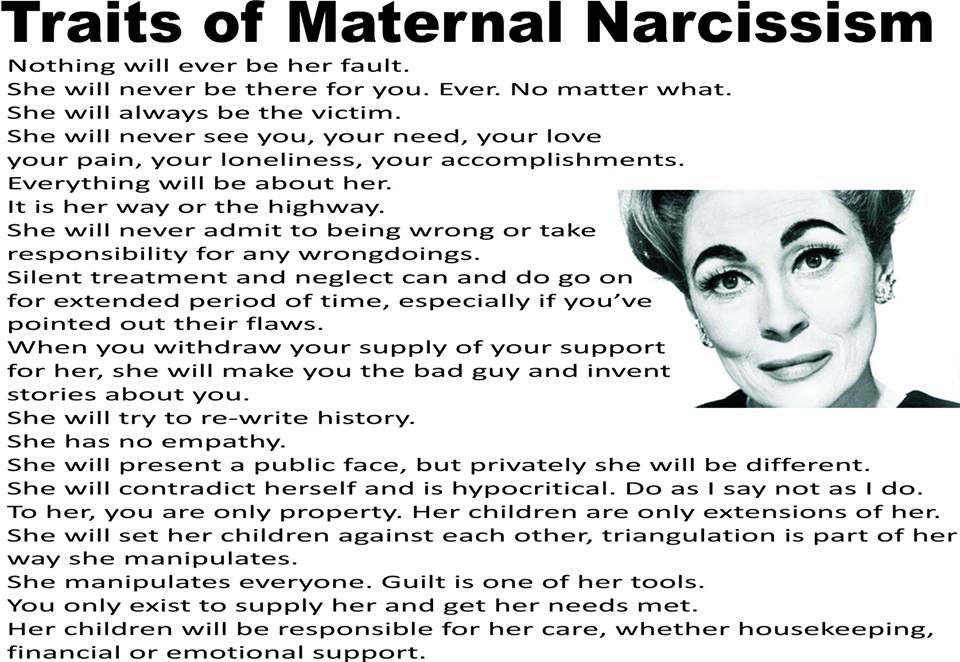
24. She destroys your relationships. Narcissistic mothers are like tornadoes: wherever they touch down families are torn apart and wounds are inflicted. Unless the father has control over the narcissist (which is nearly impossible) and holds the family together, adult siblings in families with narcissistic mothers characteristically have painful relationships. Typically all communication between siblings is superficial and driven by duty, or they may never talk to each other at all. In part, these women foster dissension between their children because they enjoy the control it gives them. If those children don’t communicate except through the mother, she can decide what everyone hears. Narcissists also love the excitement and drama they create by interfering in their children’s lives. Watching people’s lives explode is better than soap operas, especially when you don’t have any empathy for their misery.
The narcissist nurtures anger, contempt and envy – the most corrosive emotions – to drive her children apart. While her children are still living at home, any child who stands up to the narcissist guarantees punishment for the rest. In her zest for revenge, the narcissist purposefully turns the siblings’ anger on the dissenter by including everyone in her retaliation. (“I can see that nobody here loves me! Well I’ll just take these Christmas presents back to the store. None of you would want anything I got you anyway!”) The other children, long trained by the narcissist to give in, are furious with the troublemaking child, instead of with the narcissist who actually deserves their anger.
The narcissist also uses favoritism and gossip to poison her children’s relationships. The scapegoat sees the mother as a creature of caprice and cruelty. As is typical of the privileged, the golden child doesn’t see her unfairness and she/he excuses her abuses. Indeed, they are often recruited by the narcissist to adopt her contemptuous and entitled attitude towards the scapegoat and with her tacit or explicit permission, will inflict further abuse. The scapegoat predictably responds with fury and equal contempt – or is so beat down that she acquiesces and goes silently inward. After her children move on with adult lives, the narcissist makes sure to keep each apprised of the doings of the others, passing on the most discreditable and juicy gossip (as always, disguised as “concern”) about the other children, again, in a way that engenders contempt rather than compassion.
Having been raised by a narcissist, her children are predisposed to be envious, and she takes full advantage of the opportunity that presents. She may never praise you to your face, but she will likely crow about your victories to the very sibling who is not doing well. She’ll tell you about the generosity she displayed towards that child, leaving you wondering why you got left out and irrationally angry at the favored child rather than at the narcissist who told you about it. She may tell you of gifts she’s given to the golden child, or lunches they’ve had together, or trips they’ve taken, always in glowing terms, intended to make you, the scapegoat, feel confused or less-then by comparison.
The end result is a family in which almost all communication is triangular. The narcissist, the spider in the middle of the family web, sensitively monitors all the children for information she can use to retain her unchallenged control over the family. She then passes that on to the others, creating the resentments that prevent them from communicating directly and freely with each other. The result is that the only communication between the children is through the narcissist, exactly the way she wants it.
25. As a last resort she goes pathetic. When she’s confronted with unavoidable consequences for her own bad behavior, including your anger, she will melt into a soggy puddle of weepy helplessness. It’s all her fault. She can’t do anything right. She feels so bad. What she doesn’t do: own the responsibility for her bad conduct and make it right. Instead, as always, it’s all about her, and her helpless self-pitying weepiness dumps the responsibility for her consequences AND for her unhappiness about it on you. As so often with narcissists, it is also a manipulative behavior. If you fail to excuse her bad behavior and make her feel better, YOU are the bad person for being cold, heartless and unfeeling when your poor mother feels so awful.
© 2007 Psychological Services, Inc.
Does excess praise and spoiling create narcissists?

Many experts, including Sam Vaknin, think spoiling a child or pouring on excess praise (placing them on a pedestal) is actually a form of child abuse, because it does not mirror the child as who they really are, but as who the parents wish them to be or believe them to be. Children not mirrored appropriately, whether excessively criticized or excessively praised, grow up unable to form a viable true self and are vulnerable to developing disorders of the self, especially NPD.
The following article explains in further detail why excessively praising a child can actually hurt their self esteem, rather than help it develop normally. It also describes the two types of praise–one that builds self esteem because it takes a child’s effort into account (“you worked hard to win that contest” or “you showed a lot of dedication in getting those A’s”) and one that fosters narcissism because it implies inherent superiority over others (“you’re the prettiest girl in school” or “you’re the smartest kid ever”).
Do Parents Nurture Narcissists By Pouring On The Praise?
By Poncie Rush, for NPR.org
When a kid does something amazing, you want to tell her so. You might tell her that she’s very smart. You might tell her that she’s a very special kid. Or you might say that she must have worked really hard.
On the surface, they all sound like the same compliments. But according to Brad Bushman, a communications and psychology professor at Ohio State University, the first two increase the child’s chances of becoming a narcissist. Only the last one raises the child’s self-esteem and keeps her ego in check.
Bushman and a group of collaborators surveyed parents to see how they show warmth and value their child’s accomplishments. They then compared those findings to the children’s levels of self-esteem and narcissism. The results were published Monday in the Proceedings of the National Academy of Sciences.
Of course, self-esteem and narcissism are two very different things. The difference has to do with how you value yourself compared to other people. “Self-esteem basically means you’re a person of worth equal with other people,” Bushman tells Shots. “Narcissism means you think you’re better than other people.”
And not in a good way.
“Narcissism is a somewhat toxic personality trait,” Jean Twenge, author of The Narcissism Epidemic and psychology professor at San Diego State University, tells Shots. Narcissists tend to overestimate their abilities, take too many risks and mess up their relationships, she says. Some people see narcissists hurting the people and society around them, but they hurt themselves, too. “In the long term it tends to lead to failure,” Twenge says.
While narcissists tend to have high self-esteem [my note–this is not true], not all people with high self-esteem are narcissists. Bushman needed to separate the two. So he asked children ages 7 to 12 years old how they felt about statements like “Some kids like the kind of person they are,” or “Kids like me deserve something extra.” The first statement measures self-esteem; the second, narcissism.
Bushman made sure to focus on children between 7 and 12 years old, so that by the time the study finished all of them would be older than 8. “You can’t measure narcissism in children before age 8, because every child is a narcissist,” he says. If you ask younger kids in a classroom if they are good at math or good at baseball, Bushman says all the kids will raise their hands.
Then he surveyed the children’s parents, asking them to respond to statements to determine whether they overvalued their children. For example, “I would not be surprised to learn that my child has extraordinary talents and abilities,” or “Without my child, his/her class would be much less fun.” And he asked how they expressed warmth toward their child by measuring how strongly they agreed with statements like “I let my child know I love him/her.”

When he analyzed the results from the surveys, Bushman found that the more narcissistic children had parents who consistently overvalued their accomplishments. He ran additional tests to make sure that the parents weren’t narcissists, too — after all, it’s possible that the children could be mirroring narcissistic behavior. But statistically, the children of narcissists aren’t more likely to be narcissists themselves.
The research team continued to survey the same group of 565 children and their parents for a year and a half. They watched the children develop, and they could link each child’s tendency toward self-esteem or narcissism back to what the parents had told them six months earlier.
“We’re not just measuring their narcissism at time one; we’re using these measures to predict the behavior a year and a half later,” says Bushman. “Parental warmth doesn’t predict it. Parental narcissism alone doesn’t predict it. But parental overvaluation alone does predict it.”
Bushman is particularly worried about narcissism because both he and other researchers have linked it to aggressive and violent behavior. He thinks it’s partly because narcissists are less likely to feel empathy toward others.
“Empathy involves putting yourselves in other people’s shoes, but narcissists have a very difficult time putting themselves in other people’s shoes,” Bushman says. Plus, he says that narcissists respond poorly when they don’t get special treatment. “Whenever people have this sense of superiority, then they lash out at others in an aggressive way.”
Of course, someone who appears more narcissistic at age 10 isn’t necessarily going to grow up to be a narcissistic adult, let alone aggressive. And the results of this study hinge on a handful of short surveys — no extensive personality testing here.
“There are definitely going to be things that influence the personality after that stage,” says Twenge. “Those [narcissistic] tendencies may start to show up around then, but will continue to be influenced by parenting and environment throughout adolescence.”
But this study has Bushman thinking about the way he praises his own children. “It’s a lot better to say ‘You worked really hard’ than ‘You must be really smart,’ ” he says, “because if you tell the kid that they’re smart and then if they fail they think ‘Oh I’m stupid.’ ” If the praise relates to effort, a child who fails will work harder next time.
Bushman is also trying to cultivate self-esteem in his children, because people with high self-esteem tend to have lower levels of anxiety and depression over time. Based on Bushman’s research, parents can raise their children’s self-esteem just by expressing more warmth.
Both researchers agree that voicing the connection you feel to your children really helps. “If you want to look for a substitute for ‘You’re special,’ just say ‘I love you,’ ” says Twenge. “It’s what you mean, and it’s a much better message.”
Have a child age 8 to 12? Find your own “Parental Overvaluation” score here.
Original article is here.
 Lucky Otters Haven