Beware who you befriend on the Internet.

wolf_in_sheeps_clothing (1)

Not all ACON blogs or bloggers are “safe.” On another blog, which I will not name, my character is being ripped apart and an article I posted which was one of my most honest and vulnerable ones is being used as fodder for the attack. In this abusive post, my character is being cruelly compared with golem (a type of demon). There was no instigation for this attack, since I have made no references at all to this other blogger, their blog, or their friends’ blogs in in over a year. The attack just came out of the blue. Interesting that a post was chosen where I was at my most vulnerable. Isn’t this what narcissists do? The hypocrisy is staggering.

Someone also tried to send me a virus in my email yesterday. I wonder if there is any connection? Hmmmm.

Here’s a little background. About a year ago, I was mobbed and my character ripped to shreds on a few blogs (not WordPress blogs, fortunately) because of a disagreement with a blogger who I had thought was a friend. Boy, was I wrong. This person is part of a tight clique of bloggers who may well have suffered horrendous childhood abuse (no one could make up the stories they tell), but if you have the slightest disagreement with any of them, you will be added to their shit list. You will be called names, vicious lies will be told about you, and you will be accused of doing things they themselves are doing (projection). They are so angry and bitter they can only see in black and white, never any shades of grey. Their rage has turned them into the very thing they hate the most and they are incapable of seeing their own narcissism and abusive behavior. Or they just don’t care. They are wolves in sheeps’ clothing, but claim to be anything but.

I was thinking about just ignoring the post and saying nothing, but why should I? Why should I let this dangerous person intimidate me? Why should I not warn others? I only wish I had paid attention to the red flags early on (or seen them). I know better now. I won’t name these blogs or this particular blogger here, but here are some things to watch out for. If you see a blog that does any of the following, do not comment or get involved with that blog. If you must read that blog, read it as a lurker.

I am setting my other blog to private for now because that’s the source of the article that fueled this sneak attack.

Does the blog you read belong to a narcissist or abuser?

1.  Black and white thinking: they preach hatred and demonize a certain group of people (in this case narcissists) as being ALL bad or ALL evil ALL the time. Sure, some narcs may be *close* to 100% bad, but the seething black hatred that never seems to end is not merely a red flag, it’s a flashing neon sign.

2.  Cultishness: no tolerance for disagreement; they launch ad hominem and personal attacks on commenters who have the audacity to disagree with them;  dismiss the writers of critical (not abusive) comments as “trolls”

3.  Religion is used to shame, intimidate, and threaten (if you don’t believe *whatever* you are going to burn in Hell, etc.)

4.  If applicable, dwell on how they were abused and how they continue to suffer, without seeming to ever grow or change or learn anything about themselves from the experience.

5.  Paranoid and hypervigilant, suspecting everyone who disagrees with them or displeases them in some way as being narcissists or even sociopaths. (Yes, I have been called a sociopath by this group).

6.  Quick to project their own abusiveness onto others

7.  Never seem to take responsibility or admit when they’ve been wrong.

8.   Continue their vicious attacks even after the “danger” has passed (I haven’t had any dealings or made any mention of this blogger or their minions in over a year). This is just plain bullying.

9.   They use information you have given them (or that they have found out) against you or twist it around into a lie. If you have posted something where you admit vulnerability, expect that to be used against you later on.

10.  Usually have allies (flying monkeys) who appear out of nowhere to assist in the abuse when you have offended one member of the group and they have decided you’re an Enemy. May be part of a tight clique of other bloggers or hangers on.

11.   You just feel uncomfortable commenting or being honest on that blog or you feel somehow intimidated or judged — listen to your intuition: it’s telling you something.

Here’s a very good article about these types of online bullies:
22 Signs of Online Destructive Narcissists in Forums and Online Communities

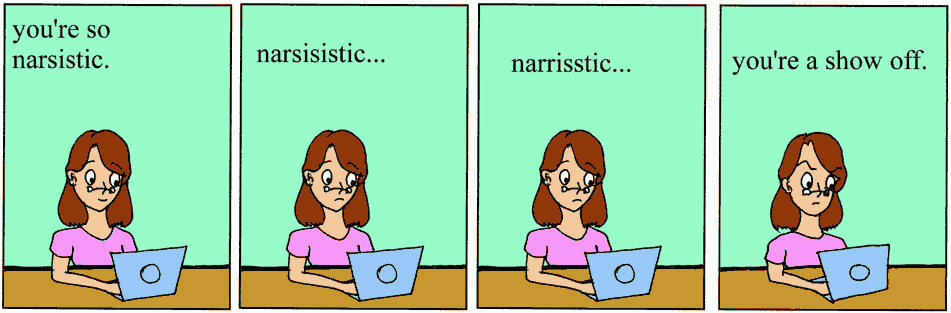
Show-off.

Image

showoff

Divorcing The Donald: Cutting Ties with The Narcissist.

Allison Patton, family lawyer, wrote an eye opening article for The Huffington Post that goes beyond simply describing Donald Trump as an NPD poster boy, which many have already done.

In family law, individuals with NPD are known a HCPs-high-conflict persons. Here, Ms. Patton describes the way Trump’s blatant narcissism has not only alienated him from the Republican Party, but how he could potentially serve as a public example of a serious disorder that family lawyers, judges, and the courts are surprisingly ignorant about–and often unwittingly reward the narcissistic spouse and punish the real victim, due to the narcissist’s glibness and ability to lie convincingly.

Unfortunately, Trump has succeeded in pulling the wool over the eyes of millions of Americans who continue to support him–even though it’s no secret he has been publicly diagnosed with Narcissistic Personality Disorder. Many of these Americans tell themselves, “well aren’t all politicians narcissists anyway?”
Well, most probably have some narcissistic traits, but most are not full-blown NPD like Donald Trump either.

Divorcing The Donald: Cutting Ties With The Narcissist
By Allison Patton, for The Huffington Post
http://www.huffingtonpost.com/alison-patton/divorcing-the-donald_b_9633460.html

Republican presidential candidate Donald Trump speaks during a campaign rally, Wednesday, April 6, 2016, in Bethpage, N.Y. (AP Photo/Julie Jacobson)

Republican presidential candidate Donald Trump speaks during a campaign rally, Wednesday, April 6, 2016, in Bethpage, N.Y. (AP Photo/Julie Jacobson)

Narcissistic Personality Disorder
A “Cluster B” personality disorder in which a person is excessively preoccupied with personal adequacy, power, prestige and vanity, mentally unable to see the damage they are causing to themselves and often others.

While the Republican Party is desperately trying to cut ties with Donald Trump, the world watches in disbelief. All, that is, but a particular group of women and men with one thing in common: each of them has divorced a narcissist, and some still share child custody with one.

They know the story and could write the script. The successful, gregarious person who swept them off their feet. The promises that followed. Gradually the realization that it was all a façade. There could never be a “we” because narcissists care only about themselves. Then the real nightmare began, the battle to remove this toxic person from their lives. . . . and for those with children, the misery of trying to co-parent with an ex who acts and thinks like The Donald.

As a divorce lawyer, these cases are the most difficult and disturbing. In my family law circle, we refer to someone with a narcissistic personality disorder as “an NPD” (or the more general term “HCP” — which stands for “high conflict person”). The legal battle is always the same: the unaffected spouse tries to explain to the attorneys, judge and appointed psychological expert (if there is one) the narcissist’s behavioral pattern: control, emotional abuse, manipulation, duplicity and the damaging impact on the children. The NPD denies it all and mounts a legal response that consists of blame laying, factual distortions, outright lies and a character assassination of the other spouse.

The experts and the judge are sometimes able to weed through the chaos and confusion, identify the personality disorder at play and make decisions that protect the children and unaffected spouse. Often, however, the legal system gets it wrong. Just as we’ve seen with Donald Trump, the NPD can be very convincing and manipulative. And the court system – like the general public – either gets conned by the NPD or isn’t equipped to manage the level of conflict created by a Donald. Often the court assumes both parties are equally to blame for creating and maintaining a high conflict case, so the innocent parent who is fighting to protect the kids is treated as skeptically as the narcissistic parent.

For decades, there has been little understanding of how to spot and handle personality disorders in family law. As recently as 2011, when I blogged on Huffington Post about high conflict people in divorce court, I received emails from out-of-state divorce professionals indicating the information was new to them and they hadn’t heard the term “high conflict people” used in their family court.

Thanks to Donald Trump and his campaign, the entire world now gets daily lessons on NPD behavior. As disturbed as I am by what the Donald has pulled off, the divorce lawyer in me sees the opportunity here. The Donald is our new high conflict poster child. Those of us who want change in the family law system couldn’t hope for a better example. The common traits and behaviors of this personality disorder are being revealed, in their full horrific glory.

Read the rest of this article here.

Bonus article: Donald Trump’s Amazing Answer to “Do You Cry?”  (Washington Post)
https://www.washingtonpost.com/news/the-fix/wp/2016/01/19/donald-trumps-amazing-answer-on-do-you-cry/
Hilarious.

Empathy begins at home.

happy_childhood

I know that for a very long time I’ve had issues empathizing with others on a one to one basis (with a few rare exceptions like my children). It’s not that I like seeing others in pain or want to hurt them (I don’t, at all), more that I have had so much trouble connecting to my emotions, especially tender or vulnerable feelings, that this avoidance extends to everyone else. I’ve always felt empathy when it’s “safe” though–therefore I can cry for a character in a movie or novel, or even a TV commercial. I can get quite upset reading a news story about someone who’s been abused, especially if it’s an animal or a child.

But when it comes to real life people, I just can’t allow myself to get that close. I hold everyone at arm’s length. It’s too dangerous to let them in, because they might stir up emotions I haven’t wanted to feel. Of course this means emotional (as opposed to cognitive) empathy goes out the window too. You can’t feel an emotion for someone else if you can’t even access it for yourself.

It’s a common belief that all people who lack empathy are narcissists or psychopaths (or have some kind of schizoid disorder or psychosis, or autism). But a lack of empathy is also a common symptom in people with complex PTSD. Shutting off emotions–including empathy–is a defense mechanism that protects you from further harm. The problem is, this protection also “protects” you from feeling much joy or being able to really love anyone else.

Recently I’ve been feeling a kind of tender regard for my child-self/true self. Right now she’s not integrated and feels far away sometimes, but I can feel her sadness and pain. I can also feel that she’s a good person, a gentle sensitive spirit with so much love to give. I feel a tender protectiveness now where before I felt only shame and wanted to hide her away, just as she had been hidden away by the narcissists who “raised” her. So how was I any different from them, by keeping her hidden, projecting badness and shame onto her, refusing to see her strengths? Sometimes I just want to hold her like my own child. It’s not self-pity; it’s closer to empathy and even love.

Is this where empathy begins? Does it begin with loving yourself–your true self? If you hate your real self, you cannot learn to expand empathy onto others, since you can’t even empathize with yourself. If all you feel is shame, that is going to be projected onto others. That would apply to narcissists and the personality-disordered as well as people suffering from C-PTSD.   The problem for the disordered is it may be too late for some of them.  They are so thoroughly shielded by a false self they cannot even access their real selves or only with a great deal of difficulty that could take years.  There are much stronger defenses to break through.  They may be so shut off they can’t even see the lie they are living and think it’s everyone else–not them–with the problem.

The root of attachment and trauma disorders is is rejection of the self internalized from the people who were supposed to love you and mirror you; to heal, you must be able to develop empathy for your true self. That’s what my therapist has been helping me do.

More narcissist word salad.

blah-blah1

I found this rambling diatribe on a forum for bereaved parents. I understand there is always anger during the grieving process, even toward the deceased, but the entire manner and tone of this post, as well as the whiney, self-pitying, blaming attitude and total lack of empathy for her deceased child’s emotional needs, screams NPD. I didn’t see any other posts by this author on the forum. Note the contradictions and inconsistencies, the irrelevant interjections, and the total disregard for her child’s emotional (as opposed to material) needs.

I’m suspecting the deceased daughter was the family scapegoat, who she seems to regard unfavorably. It doesn’t surprise me too much she would have been suicidal.

Hello, I hope you can all help me figure out what I’m supposed to do. I can’t stop crying the tears are always right on the surface, I had to quit my job because of what an emotional wreck I am. You can’t have someone running a busy, productive office if they’re always mopping up their eyes with mascara streaks everywhere and blowing their nose, can you. I never used to be like that. I could always hold my composure, which is why I always make a good impression on interviews and why I always get promoted. Well, not anymore, so I had to quit. I couldn’t concentrate. It was quit or be fired! What has made me such an emotional basket case is this. My beautiful, perfect daughter killed herself in January. She was 18. She swallowed a bottle of pills and downed them with liquor. I always told her she should go to AA because of her drinking but she never listened. She never did what I or her father advised. Oh, she was a rebel. Always a spitfire. After she did this she did not call anyone and she didn’t leave a note. Of course this shattered me, her father, and her brothers and sister, who all of us only tried to help her. We didn’t deserve to have her do this to us. She always got everything she always wanted. She wanted to be in pageants when she was a little girl, so we spent thousands of dollars on dresses, tiaras, fees, hotels, etc. and we never pushed her, she wanted to do this. But she changed her mind when she was 12 and decided she didn’t like it anymore. All that money we spent for no reason. She got everything–the new car, the computer, the new big screen TV, the gadgets, all the clothes, makeup, jewelry, everything she wanted! She had no reason to be depressed! Last Christmas we took her on an expensive Ski trip to Colorado and she spent the entire time watching TV instead of out on the slopes. We tried to talk to her but she wouldn’t budge, just sit there sullenly sulking and making things very unpleasant for the rest of us. She was never an easy child, no sirree! She was a fussy baby who cried all night and all day, a tantrum throwing toddler, an unruly child, a rebellious teenager. Even when I was pregnant she gave me trouble. I developed gestational diabetes when I was pregnant with her (not with my first two children, she was my third) and I threw up almost every day for the entire nine months! Maybe we gave her too many things, but we always tried everything to make her happy. I just don’t understand how a child who is given everything–all the expensive and beautiful clothes, good food and plenty of it, good schools, a nice room with her own bathroom and sitting area, how a child like that can be so unhappy. She acted like she hated me! I never did anything to her, I was always giving her what she wanted and trying to make her happy! I was a good mom, even my other children always tells me what a good mother I am and my friends think so too! They are jealous because I am such a good mother and they have so much to learn. I don’t know what I did to deserve a child who acted like she hated me and then had to go and make things even worse by killing herself. The ultimate slap in the face! I just don’t know what to do, where did I go wrong? This should never have happened! If she had not been so hard headed and done the things we told her to do (like go into real estate–her father is a successful Realtor) [My note: You said your daughter was 18 so that makes no sense!] instead of pursuing all these wild pipe dreams then she would have been happy and would not have done this horrible thing to her family. And not even have the decency to leave a note? Please tell me what I can do to cope with this mess. Oh god, I’m crying again. Please help me.

Inside the Mind of the Malignant Narcissist

Narcissist word salad–want oil and vinegar with that?

Comments have been disabled; please comment on the original post.

Guest Post #8 : Abusers break you–and then HATE you for being broken.

My dear friend and active participant on this site, Linda Lee, has written a wonderful and OMG SO TRUE post, which describes a lifetime of abuse, including incarceration in a state mental hospital, and being faced with unethical doctors and caregivers, including one who raped her. She was sent back home to a rejecting family–who had put her there in the first place! Linda Lee has Complex PTSD, a form of PTSD that’s often the result of chronic abuse during childhood, rather than an isolated traumatic incident later on in life. After describing the insane house of mirrors she had been thrusted into that seemed to have no way out, Linda lifts the reader out of the darkness with an uplifting message about Easter and the resurrection.

Linda Lee also has a blog about her Complex PTSD caused by prolonged, severe trauma called Surviving Trauma (formerly Heal My Complex PTSD).   (I got a little confused here because Linda recently changed her blog but the old one is still there too.  Her new blog is called A Blog About Healing From PTSD. )

I know the following story sounds so crazy, it’s hard to believe. But it is all true, so help me God… unless I really AM nuts, and the mental health professionals who have told me otherwise over the years were all wrong!

ABUSERS BREAK YOU — AND THEN HATE YOU FOR BEING BROKEN
By Linda Lee, Surviving Trauma and A Blog about Healing From PTSD

going_crazy_bookcover
The cover for Linda Lee’s future book, which she designed herself!

If you take a young puppy away from his canine family before he is weaned, yell at him, kick him, shake him, beat him, half-starve him, and leave him on a chain outdoors, exposed to every kind of weather without shelter, that poor little puppy is going to grow up to be a deeply disturbed dog – if he lives to grow up.

If you treat human children like that pitiful dog, they are going to have behavioral and emotional problems, too.

I grew up with parents who were normal and nice some of the time, and behaved like insane, demonically possessed monsters part of the time. I never knew from one day to the next whether my mother was going to be like June Cleaver in the TV show “Leave it to Beaver,” or Joan Crawford in the movie “Mommy Dearest.”

As for my dad, a fundamentalist minister whose episodes of violence led to his diagnosis of multiple personality disorder (now known as Dissociative Identity Disorder), some people believed that he actually was possessed by demons.

When I was fourteen years old, I began to have some emotional problems. Big surprise, right? I told my mother about the difficulty I was having, hoping she could help me. But, although my problems were mild compared to both of my parents’ history of extreme mental problems, my mother said “You are crazy just like your father!” Then she contacted my dad (my parents were divorced by then), and he agreed with her that I needed to be put in a state mental institution – against the advice of my doctor!

Of course, my dad said that I was “crazy like your mother.” He also told me he was GLAD I had psychiatric problems, because now I would understand what he had gone through.

But I did not understand. Almost fifty years later, I still don’t. Unlike both of my parents, my behavior was not out of control. On the contrary, although I wasn’t perfect, I was obedient, subservient, and eager to please. I had never been the least bit violent. I had never threatened or tried to harm anyone.

My dad, on the other hand, came so close to murdering my mom when I was twelve years old that for several terrifying moments I had thought she was dead. That’s when my father was arrested, then put in the psychiatric ward of a general hospital after the police took him to the emergency room because his insulin-dependent diabetes was out of control.

As for my mother, a few weeks after my dad tried to kill her, she did something even worse – she tried to gas us all to death while my four younger brothers and sisters and I were sleeping in our beds. Yet she never put herself under any kind of psychiatric care. With no other responsible adult living in the house at the time, there was no one to force her to get help. So now, because she has never been to a mental health professional and labeled with a psychiatric diagnosis, my mother thinks she is “just fine.”

When my dad’s medical insurance ran out and he was discharged from the psych ward, my mother dropped her charge of attempted murder so he could go back to work and provide financial support. Then my dad married the head nurse of the psychiatric ward whom he had met while he was a patient there (how unethical is that?), and my mother started dating a newly divorced man who had previously worked with my dad. She soon became pregnant (accidentally on purpose?), and quickly married the unborn baby’s father.

So now my parents were living happily ever after with their brand new loves while I, their eldest daughter, became the family scapegoat and “the crazy one.” And together my parents decided that I needed to be locked up in a state insane asylum, because: “she might become violent some day.”

Projection much?

About a year after my parents put me in the institution a new psychiatrist, Dr. Fenster, was hired to replace the rapist shrink who had been caught and fired the third time he drugged me unconscious and raped me. Lucky Otter posted this story for me almost a year ago. Here is the link: https://luckyottershaven.com/2015/04/12/have-you-ever-been-hurt-by-a-psychiatrist-guest-post-by-alaina-holt-adams/. (I wrote that post under the pen name Alaina Adams. I have since changed my pen name to Linda Lee, because it’s more like the real me.)

I had originally met the newly hired doctor when I was first put in the asylum and he was there, finishing his psychiatric residency. He had told me then that there was nothing mentally wrong with me, in his opinion, and he was confident that the psychiatrist in charge of my ward would soon have me released.

When Dr. Fenster took over my case more than a year later, he was shocked and dismayed to see that I was still there. Within the first five minutes of his first day on the job, the good doctor made me a promise: “I am going to get you out of here as soon as possible. You never should have been put here in the first place!”

But his promise turned out to be much easier said than done. Eight months later, Dr. Fenster called me into his office one last time before sending me out into the world. “I am very sorry that it has taken me so long to get you out of here,” he said. “The amount of legal red tape involved to release a patient from a state hospital is unbelievable, especially when it comes to a minor child. Because you are only sixteen, you are legally a ward of the state and you cannot be released on your own recognizance until you are twenty-one, five years from now! Until then, you can only be released into the care of a responsible adult. I have spoken with every adult in your family several times, at length – with your grandparents on both sides, and your mother and father. I hate to tell you this, but every last one of them is far sicker than you ever were! Frankly, it’s no surprise to me that you had emotional problems. Coming from a hateful, self-centered crew like that, I don’t understand how you can be as sane as you are! Even your maternal grandparents are unbelievably hard-hearted and selfish! At first, I thought they would be the best hope for you to have a decent chance at life. With your grandfather’s current position as the associate warden of Leavenworth Federal Prison, they could so easily provide you with a stable home and every advantage.”

He shook his head sadly. “I hate to tell you this, Linda, but no one in your family wants you. Every single one of them came right out and told me they don’t want a ‘mental patient’ living in their home. It didn’t make any difference when I told them that you are not mentally ill and you never should have been put here in the first place. In fact, when I mentioned that, your mother said that just by virtue of the fact that you have been kept here in this place for so long, you have probably been changed by the experience and now you may be dangerous! So… when I kept hitting a brick wall with everyone in your family, I gave up and tried to find a foster home willing to take you in. But they have to be informed about your time in this institution, and I could not find any foster parents willing to take the chance. I even tried to talk my wife into the two of us fostering you, but… it was a no-go.”

Dr. Fenster stared down at his hands, which were lying palms-up on his desk in an attitude of defeat. “Your mother is coming to take you out of here today,” he said. “although she is the last person I want to send you home with. Why she chose to have so many kids when she doesn’t have a maternal bone in her body is beyond my understanding. But she is coming to get you because – frankly – I found out something about her and I have used it to blackmail her. But even then, she would not agree to take you unless I wrote your discharge paper in such a way that it says you are being sent home on an ‘indefinite leave.’ I’m sorry this isn’t a full discharge. What it means is that your mother can bring you back here at any time, for any reason, or for no reason at all. So my advice to you is to get as far away from everyone in your family as soon as you can – and don’t ever go back!”

A nurse handed me a paper bag full of my threadbare clothes, then escorted me from the doctor’s office down to the lobby. My mother and her mother were waiting there, both with very grim faces. After a tense, silent two-hour car ride to my mother’s house, I discovered that I no longer had a bedroom or a bed – I was told to sleep on the living room sofa. In fact, everything that I had ever owned, my beloved books, the papers I had written, my clothes, my costume jewelry, and the childhood toys I had cherished and saved, were all gone. Taken to the dump, I was told, right after I was put in the mental institution.

My “WELCOME HOME” was nonexistent. Not one person said “I’m glad you’re back, I’ve missed you.” My much younger sisters and brothers had always looked up to me, loved me, and depended on me, especially during our mother’s deep depression after the violent end of our parents’ marriage. Along with my new stepfather, my four little siblings had begged our mother not to send me to the institution two years earlier. Even my grandparents may have questioned why she would send her adolescent daughter to the most notorious insane asylum in the region, when my behavior, to all outward appearances, was completely normal. So then my mother had told horrible projecting lies about me, to justify what she had done. Lies which the majority of my family apparently believe to this day.

Three days after my return “home,” while I was being ultra careful not to be a bother to anyone in any way, my mother waited until my stepfather was at work and my school age siblings were all in school, and then she told me that I needed to leave – to run away – because she could not afford to feed a big grown girl like me.

“I can barely afford to feed the five little ones,” she said. “Your father doesn’t pay nearly enough child support, and it wouldn’t be fair to expect your stepfather to feed you. And after where you have been, I am afraid you might be a bad influence on the younger children. I had you when I was only eighteen, too young to know what I was doing. So I made all my mistakes on you. Unfortunately, it’s too late for you. But I think that throwing one child away, in order to save the other five, is the right thing to do, don’t you? And don’t worry, I promise I won’t call the police and report you as a runaway!” She said this, about not calling the police, with a big smile on her face, as though she had just handed me the keys to a brand new car.

“You know, I married your father when I was sixteen. Sixteen is old enough to be on your own. And, like I’ve been telling you ever since you reached puberty – no house is big enough for two women!”

This happened in the middle of a cold December and there were several inches of snow on the ground. The tiny town where my mother and stepfather had moved to while I was in the institution was miles away from a city, where there might be some kind of shelter or help. Without a penny to my name, with my few clothes bunched up in a pillowcase, because the paper bag I had brought my clothes home from the hospital in, had torn – and I remember feeling guilty for taking one of my mother’s pillow cases, that’s what a “terrible” daughter I was! – I walked out the door into the frozen December morning. I had not eaten any breakfast that day, because no one had offered me anything and I was trying so hard not to be a bother….

Whew. Right now, as I am writing about that terrible time in my life, I feel so ANGRY!

My husband today, a combat veteran from the war in Vietnam, has talked about the pain of coming back from the hell of war and getting rejection, instead of a Welcome Home. I’ve told him I understand how that feels. A few years ago, there was a big push to finally welcome our Vietnam War Veterans home. I’m so glad they got that. They deserve it. But… deep down inside, I feel like I am still waiting for my Welcome Home.

I did not follow Dr. Fenster’s advice to have nothing to do with anyone in my family of origin, until I was in my fifties. Why? Because I loved my family. I wanted to have a family! Although I stopped living in the same state forty years ago, I kept reaching out to them, time and time again, over the years – by driving very long distances to visit them, by phone calls, by letters, and finally, when social media became available, I reached out to them through Facebook.

With the exception of my aunt (my mother’s younger sister) and my oldest niece, every time that I have ever reached out in any way to anyone in my family of origin, I have been hurt and abused all over again. The bullying I took on Facebook was so bad, I ended my account. Even today, every time I see that ubiquitous blue logo, I shudder inside.

WHY does my family of origin despise me so much? Because they apparently believe my mother’s lies about why she “had no choice” but to commit me to an insane asylum almost half a century ago. And anything that I have to say on the subject is suspect because, you know, I must have been really crazy in order to be locked up.

They BREAK you, and then they HATE you for being broken.

Every trauma story is unique. Some people have told me that my trauma story is so extreme, it makes them feel ashamed of having any kind of emotional problems when their trauma is “less” by comparison. But I absolutely do not want anyone who reads this to feel that way! Please!! Pain is pain, trauma is trauma, and – in my experience – THE WORST PAIN OF ALL IS THE PAIN OF BEING REJECTED BY THE PEOPLE WHO ARE SUPPOSED TO LOVE YOU. Not the terrifying episodes of violence, not the rapes, not even being labeled “crazy” and locked up for almost two years in a lunatic asylum, hurts as bad as this!!

If you, like me, have ever been scapegoated, lied about, shunned, and rejected for being so “bad” as to have any kind of emotional or mental problems, then I believe your wounds go just as deep as mine.

Thank you for reading this. Please feel free to share your own story in the comments. And thank you, Lucky Otter, for giving people like me the opportunity to share our mental health struggles with your readers. God bless.

In truth and love, Linda Lee

PS: Today is Easter, the day we Christians celebrate our risen Lord. I believe HE is the reason why I finally got free of the insane asylum, during an era when 97% of the people committed there were never released. (This is what one of the psychiatrists told me right after I got there, when I asked him how soon I could go home.) I was one of the lucky few who got a second chance at life. I think the reason may be because I had given my heart to Christ when I was a little girl. “Weeping may endure for a night, but joy comes in the morning.” Amen!

Superman metaphor for personal transformation.

Something I was thinking about…

The Mockery of Mimicry

Narcissists are bar none at mimicry. That’s why they can seem so good at so many things, and also why they seem so “understanding” when you’ve fallen under their spell.  They have been watching you, cataloging your ideals, values, loves and hates in their minds as if they share them with you.  During the love-bombing phase, they seem to be the soulmate you’ve been searching for…and you believe them because they are such good actors.

But there’s a dark, very dark side, to their ability to mimic, when they begin to devalue you….my MN ex was a master at this sort of mimicry, so this post was quite triggering.

I’m reminded of the brilliant song Liar by Henry Rollins.

https://www.youtube.com/watch?v=awY1MRlMKMc

Comments have been disabled for this post; please comment on the original post.

HG Tudor's avatarHG Tudor - Knowing The Narcissist - The World's No.1 Resource About Narcissism

I love to copy. I have to copy. It is all I have known for as long as I can remember. It is my natural setting to mimic those around me. I have to fit in, I have to belong and the most effective way for me to achieve this is to replicate everything that I come into contact with. If I interact with an esteemed academic I will listen to his or her achievements and then pass those off as my own as I peel away their glittering accolades and apply them to myself. Should I spend time with an exceptional sporting individual then their record-breaking endeavours will be purloined for my benefit and sported as my own in furtherance of my own belief in my exceptional ability. Author? Yes I have written books too. Model? Yes I do some modelling from time to time. Chef? You should try…

View original post 858 more words

The Making of a Psychopathic Narcissist

Linda Lee makes a very important distinction here, one I’ve always believed. I agree with her that, like her mother, many narcissists switch back and forth between the covert and overt subtypes. When supply is abundant, they tend to become more aggressive and grandiose (this is why my ex was harder for me to deal with when things were going well for him) but when supply is low, they switch to the more covert form. Whether or not someone is “covert” or “overt” might have more to do with their life circumstances than a real difference in the type of NPD they have. NPD is NPD and it’s all pretty much the same at it’s core.

Comments have been disabled, please leave comments under the original post.