Walls of words.

walloftext

Nothing will make me avoid reading a post quicker than a long wall of words, unbroken even by paragraphs. I don’t care how well written your post otherwise is, I don’t care how cutting edge or educational or interesting or brilliant your thoughts are, I don’t care how much I might relate to your incredible, moving story. You could write at the level of Shakespeare or Poe, but if my eyes feel like they’re swimming in a vast ocean of text, let me make one thing clear: I won’t read it.

Fortunately I haven’t seen many bloggers who are guilty of this. Most bloggers have at least a rudimentary knowledge of how to use paragraph breaks, pictures, and graphics to break up text. There’s nothing wrong with writing long articles. There’s no need to dumb everything down and write only two sentences just because it’s on the Internet. When a post is too short and the title promises meat, it’s like a bait-and-switch and I feel cheated. If the article’s title suggests there will be meat, then it’s meat that I want, not the appetizer. I don’t want a few words and a bunch of pretty pictures because the blogger is too lazy or doesn’t know enough about what they’re writing about to put anything with more substance there. So there’s nothing wrong with writing long articles. Many of my posts are very long indeed. But when they are, I always try to use something, preferably eye-catching, to break up the words every 3 or 4 paragraphs or so (without overdoing it, of course).

If you’re a minimalist and don’t like too many pictures or graphics in your posts, paragraph breaks or subheaders are just fine. Learn to use them. If you don’t like or don’t know how to use them, perhaps you shouldn’t be blogging at all and should take a class in basic written English. It’s just common courtesy. It’s very rude, in my opinion, to write a post that makes my eyes feel like they’re caught in a digital sandstorm and that bring on pounding migraines.

Bloggers: share your stuff here!

old_typewriter

Good morning, fellow bloggers! I’m taking a page out of Opinionated Man’s book of tricks and asking you to share your blog, favorite post, or most recent post here. I also feel like it’s time to pay it forward for all the help I received when I was new to blogging. This blog gets enough traffic now that posting your link here should give you a small boost in hits.

If I’m really impressed by your article or blog, I may reblog it or write a short post about your blog. So let’s see what you’ve got.
If this experiment has a good turnout I may do more of these in the future.

A blog for the INFJ personality type.

infj

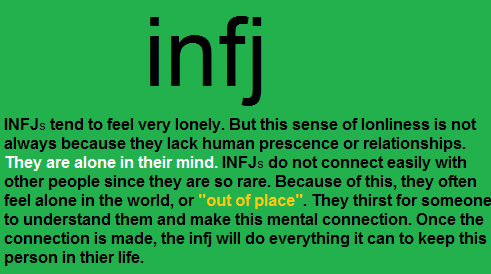
I just found a blog for INFJs today, called, simply enough, The INFJ Blog. INFJ happens to be my personality type.

INFJ is one of the rarest Myers-Briggs personality types. The letters stand for Introverted-iNtuitive-Feeling-Judging. (their opposites are Extroverted, Sensing, Thinking, Perceiving). Here’s a good description of this personality type.

infj_cartoon

Making up anywhere from 1 to 3 percent of the population, INFJ is considered to be the rarest of the 16 Myers-Briggs personality types. For this reason, INFJs often struggle with feeling different or weird, and so they often hide large parts of their personality from others, until they feel comfortable enough to reveal their true selves.

INFJs are introverts, and like any other introvert, they place a high value on alone time. They love spending time with those they are close too, but need just as much, if not more, time to themselves in order to ¨recharge¨. Even as introverts, INFJs have a strong love of people. They genuinely care about understanding others to the point that at times it can even become an obsession. Since INFJs know what it’s like to feel misunderstood, they spend a lot of time trying to really dissect the personalities of others and understand their true feelings and intentions. This often leads an INFJ to put the needs of close friends and family before their own. It is important for INFJs to spend just as much time paying attention to their own wants and needs in order to live a peaceful and happy existence.

Like other idealists, INFJs are imaginative, creative and dream of helping to make the world a better place. INFJs may at first impression come across as overly agreeable, but they have strong ideals and values, especially when it comes to helping others, and stubbornly stick to these values regardless of the person or situation. Others are usually shocked to see the side of the INFJ that comes out when their values are dismissed or questioned.

INFJs are known as the Counselor type, and it is no surprise that many INFJs choose counseling or a similar field as a career choice. INFJs are potentially the best type when it comes to helping others deal with their problems. Because of their extroverted feeling function, they are able to see the issue from the other persons perspective, but use their introverted intuition and thinking functions to separate themselves from the situation and guide the person down a healthier path. As introverts and feeling types, INFJs are great listeners and genuinely care about the concerns of others, which is a trait that makes them very appealing, and even if it is not their profession, INFJs often find themselves playing the Counselor role among friends, family, coworkers and sometimes even casual acquaintances.

INFJs are perfectionists and spend a lot of time thinking about how to make themselves and others better. In relationships, they are best matched with people who share their ideals and also strive for growth both personally and within the relationship. The ideal partner for an INFJ is someone who listens and makes effort to understand the INFJ and who also allows the INFJ to be their true selves without judgment or criticism.

Read more at The INFJ Blog.

I’m looking forward to reading more of the articles.

For further reading:
The 16 MBTI Personality Types: http://www.myersbriggs.org/my-mbti-personality-type/mbti-basics/the-16-mbti-types.htm

Lucky Otter’s Haven is growing up!

stats_92815
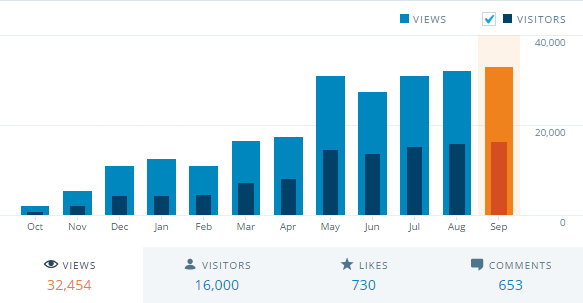
Graph showing how this blog has grown since October 2014 (September 2014 is not available but was even lower than October). I remember thinking 50 views a day was a big deal (that’s about where “Down The Rabbit Hole” is at right now, but I don’t ever expect that blog to ever have the same draw as LOH, because it has a much narrower focus than this one and a much more limited audience.)

The abnormally high views for May were due to a controversial article that attracted an undue amount of negative attention. Controversial articles do get you seen! (But I hate having haters).

The numbers at the bottom are for September 2015, highlighted in orange on the graph.
Click image to enlarge.

I’ve been reluctant to post the good news about my stats, because it might make me seem too narcissistic, but hell, I’m proud of this, and I want to brag! I think anyone would want to crow a little.

This month, I probably won’t quite reach 40K views, but it will be close enough.
This blog now averages well over 1,000 views a day and is creeping up into the neighborhood of 1200-1300 per day in the past few weeks.

I can actually afford to get a bit lazy sometimes now. I’ve reached the point, after a little over a year of blogging, where I need not even post new stuff every day for LOH to continue to get hits and new viewers. That’s because a few of my articles have become self-perpetuating magnets to this blog. In other words, several articles (some posted quite a long time ago–many of them are listed under “Most Popular Posts” in the sidebar) are now appearing at the top of Google for related search terms, so whenever people use those search terms in Google my articles are the first ones they see. The continued views keep them at the top of Google so they continue to get hits every day.
That’s why using appropriate search terms (tags, categories, and making sure the term is somewhere in your title) is so important. I’m learning all this stuff as I go along.

This is good, because it’s a motivator, and those of you who follow LOH know I haven’t been feeling particularly motivated lately. So this helps!

Now I can set some goals. WP’s November challenge (Nano Poblano or whatever it was called last year) is looming on the horizon and that will motivate me to post every day, the way I have been until recently. It’s my hope that by the end of this year (where did this year GO, anyway???), LOH will be getting 50K or more views per month.

It also is great that the views/viewer ratio is about 2:1. That means that for the 32.4K views I have for September so far, there have only been 16K viewers, which means viewers are looking at more than the one article they found by searching on Google (and other search engines). They are finding reason to stick around and look at other things too.

This kind of made my day. 😀

The 16 kinds of bloggers: which one are you?

different_bloggers

There are as many types of bloggers as there are blogs. Here I’m going to describe the 15 different types of bloggers I’ve encountered in the blogosphere. Which one are you?

1. The Self-Therapist.
I began my blogging experience as a member of this category. Having just left a long, abusive relationship, I felt the need to document my journey to recovery after abuse by writing about it. My intuition told me that making my therapeutic journal public for all eyes would ultimately be more beneficial for me than just putting it on WordPad or something. My intuition proved correct and I’ve been able to help others too, just by going public. Now I seem to have moved more in the direction of The General Purpose Blogger (#13). This type of blog has become increasingly common in recent years, probably because of the sagging economy that makes it difficult for many people to be able to access or afford good psychotherapy.

2. The Journalist.
Somewhat related to #1, The Journalist writes about their daily experiences, observations, thoughts, opinions, activities, etc. for the whole world to see. The intention isn’t necessarily self-therapeutic, just a way to express to the world their subjective state or feelings at the time. If well written, these blogs can be brilliant and entertaining slices of life many people can relate to, sometimes rivaling New Yorker essays. But if the writer isn’t careful (or is a terrible writer), such posts could come off as narcissistic or just mind-numbingly boring.

3. The Show-Off.
This may be the most common sort of blog, and they are a dime a dozen. Basically an extension of a Facebook or social media page, Show Offs post blog entries documenting family picnics, children’s school events, Breanne and Jacob’s soccer trophies, the progression of the blogger’s pregnancy, home projects, the Family Trip to Disney World, “what I cooked for dinner for the kids last night using only leftovers,” and other bland minutiae of family life. These would be the infamous “Mommy blogs” that have become so vilified of late. Show Off blogs aren’t just limited to moms though–here you would also find teenagers and young adults posting pictures of their friends making silly faces, documenting their social activities, posting videos of drunken parties, and of course, lots and lots of selfies. Show Off blogs could also include pet lovers posting pictures of Fido sporting his new rubber boots or Fifi in her brand new tutu. In all cases, these sort of blogs are essentially extensions of their social media page. Sometimes these sort of blogs even include a Music Player (always the blogger’s current favorite song) that cannot be turned off when viewing the blog.

dog_dress

4. The Vindicator.
Not that common, but there are a few blogs that exist solely to “get back” at a person or group of persons they feel offended them personally. Blog entries are basically endless rants against the offending person or group. Occasionally, the person or group attacked will attack back, and blog wars can arise. These kind of blogs tend to be short lived, until the blogger’s rage burns out, or the offending party (now the offended) threatens civil action.

5. The Pundit.
Many blogs are basically political soapboxes for people to spew their political beliefs. Nothing more needs to be said. There are also bloggers on larger news sites such as Huffington Post, who have been given their own license to do the same thing.

6. The Preacher.
Related to The Politician (above), The Preacher’s mission is to convert everyone to their belief system, whatever it may be. These blowhards may quote from the Bible or other religious text excessively to back their views. If you don’t do exactly as they say, you are going to burn in Hell. Disagreement in comments is usually not tolerated, and comments are sometimes not even allowed.

preaching-fire

7. The Expert.
Usually a professional in their field, such a blogger may be a paid guest blogger for a large website. Such experts could be doctors, psychologists, nurses, teachers, finance and business executives, or experts in any other field.

8. The Practical Muse.
These are the “how-to” bloggers, who focus on their hobbies or interests like cooking, gardening, home decor, beauty and fashion, child-rearing, car maintenance, blogging, etc. Sometimes the focus is more specific: bonsai gardening, dessert cookery, antique car maintenance, fashion for wannabe hip hop stars, raising a child with autism, blogging for fame and fortune, etc.

9. The Creative Writer.
These blogs can be either great or terrible. These are the blogs where you’ll find the angsty adolescent poetry, word-salad like prose, bad (or sometimes great) fiction, fan fiction, etc. This category sometimes bleeds over into #1 (The Self Therapist) or #2 (The Journalist).

10. The Hater.
Blogs like these exist to celebrate hatred toward a person (usually a celebrity or other public figure) or group of people. These blogs can be entertaining (if you agree with the prevailing sentiment) or infuriating (if you do not). Unless you are in a agreement, it’s probably best not to comment on these blogs, because you will be mobbed and acquire a new lower orifice in the process. Hater blogs tend to last only as long as the blogger’s passionate ire lasts, so they tend to burn themselves out (or are sometimes forced to be taken down by offended parties).

bieber_hate

11. The Motivational Blogger.
All sweetness and light and positive thinking, 24/7, 365 days a year. Such bloggers focus on inspirational memes, verses, quotes, and sometimes original essays, meant to make you feel inspired or motivated. Unfortunately blogs like these can sometimes have the unintended effect of making you feel like a horrible person or a failure because you’re not that upbeat, happy and successful all the time. Or they can simply be annoying.

12. The Artist.
A showcase for an artist’s creations, showing their paintings, sculpture, photography, jewelry, etc. Sometimes these can also be “Merchant” blogs, if the artwork is for sale.

13. The General Purpose Blogger.
Opinionated Man’s A Good Blog Is Hard to Find (formerly HarsH ReaLiTy) is such a blog. A General Purpose blogger writes about everything. Nothing is off limits. General Purpose blogs tend to become popular due to the fact they attract a large audience who have varying interests. The only problem with blogs of this type is the blogger can be seeming to spread themselves too thin, and the blog seems to lack a focus or sense of cohesiveness and can overwhelm readers with too much information.

This blog seems to be veering in the General Purpose direction too, because I’ve been running out of new things to say about narcissism (and frankly I’m getting a little burned out on the subject too). But it’s always been sort of a general purpose blog anyway, because from the very beginning only about 80% of my articles have been about narcissism or mental health. I’ve always written about other things too. It’s just that lately, “other things” is a larger chunk of the pie.

juggler

14. The Popularity Seeker.
These bloggers just want to get as many views and hits as they can. They want to present an image–a sort of online “false self,” if you will. They are trying to be cool and only write about things they think are cool or “cutting edge,” even if those things don’t really interest them. You can always tell a blog that’s trying too hard to be popular, because it will usually bore you to tears. You can just tell the blogger doesn’t really give a shit about what they’re posting, they just want as much traffic as they can get and want to present an image of something they probably aren’t in real life. Bloggers like these are usually narcissists or people with low self esteem using blogging to try to feel better about themselves.

15. The Merchant/Entrepreneur.
A blogger whose posts are essentially cleverly concealed advertisements for items or services they’re selling. Artist blogs (#12) often (but not always) bleed over into this category.

16. The Fan.
Like #10, fan blogs focus on a celebrity or other public figure, only the blogger is a fan instead of a hater. Haters of the blogger’s object of adoration need not comment.

What’s my problem?

confused

After over a month of being convinced I’m a covert narcissist, now I’m starting to wonder if my assessment of myself could be incorrect. Most people are having trouble believing me (even good friends) and there are so many disorders that appear similar to it. I no longer think my symptoms are due to Aspergers the way I used to, but BPD + Avoidant PD in the same person can look exactly like covert NPD. So can complex PTSD in some cases.

I’ve been told again and again that real narcissists are unlikely to ever admit they are narcissists, and if they do, they won’t be beating themselves up that much over it. I don’t know if that’s always true (I’ve met a few low spectrum covert narcissists on Psychforums who actually have a diagnosis and feel terrible about things they’ve done and want to change, but maybe the diagnosis they got is wrong and they just have more than the normal amount of N traits). Victims of narcissistic abuse are often quick to diagnose narcissism in themselves and others. We’re hypervigilant and tend to see narcissism everywhere, and we don’t even exempt ourselves. The real narcissists are probably more likely to keep insisting that they are not. Abuse victims think too damn much. It’s all very confusing.

narcissism_selfies

I guess there was a reason why I never added “Covert NPD” to “My Disorders” in the header. Without an official diagnosis for that, I really can’t say that’s what my problem is. It could be, but if so I think it’s at a low level. I know I have a number of narcissistic traits, but most abuse victims do. That doesn’t necessarily mean I have NPD, covert or otherwise. I could just have a really bad case of “fleas,” or just BPD + AvPD, or even complex PTSD.

I’m still glad I started Down The Rabbit Hole because it’s also intended for people with BPD, which I have an actual diagnosis for. I still think my “trip down the rabbit hole” early in August was real but that doesn’t necessarily mean I have NPD. It was still a trip to the walled off parts of my mind, and most abuse victims are at least partly walled off from themselves. We may be partially narcissistic but not enough to qualify for the label.

I care about people with low spectrum NPD and BPD who want to heal or improve, so that’s another reason I’m going to keep DTRH going. It’s getting a good reception. Another one of my missions is to help reduce the negative stigma against people with BPD. I don’t ever expect DTRH to gain the amount of activity this blog has received, but if only one or two people can be helped by my posts, and I can help myself by continuing to do exactly what I’ve been doing, then it’s worth it to keep it going, isn’t it?

Really, at the end of the day, all these labels are just labels and don’t really mean anything at all.

Guess who’s one year old today!

1yearanniversary

It’s hard to believe that this blog, which I started on a whim one year ago today, was just the beginning of a life changing journey that would take way too long to detail here.

In one year, Lucky Otter’s Haven has achieved the following milestones:

187,101 views
87,188 visitors from 177 countries
1,012 posts
1,183 followers

LOH has been viewed most often by:
1. United States
2. United Kingdom
3. Canada
4. Australia
5. Germany
6. Netherlands
7. South Africa
8. India
9. Ireland
10. France

Top 10 posts (2015 only):
1. A Match Made in Hell: Narcissists and HSPs: 8,980 views
2. 20 Songs About Narcissists (#11-20): 7,999 views
3. 20 Songs About Narcissists (#1-10): 5,503 views
4. Grandiose and Vulnerable Narcissists: 4,868 views
5. Famous People Who Have NPD: 3,838 views
6. The Distinctive “Look” of Psychopathy: 3,394 views
7. Why You Should Never Jump into a New Relationship After Narcissistic Abuse: 3,278 views
8. Do Narcissists Cry? 2,317 views
9. 12 Weird Things You Might See a Narcissist Do: 1,942 views
10. 12 More Songs About Narcissism: 1,620 views

Baby picture (what LOH looked like in January 2015):
luckyotterhaven_jan2015

Opinionated Man Update

I have no idea who is doing this to OM or why. It seems to me Jason is well liked by almost everyone and has helped so many bloggers when they’re just getting started. He makes them feel supported and welcome.

I think it boils down to envy. Jason has many followers, many more than any other non-commercial WordPress blogger I know of and that might not sit well for some. But frankly, Jason deserves the adulation because he always pays it forward and never feels threatened when another blog becomes successful. In fact, he’s more than likely to be cheering that blogger on and applauding their successes.

This is absolute bullshit and it breaks my heart.

OM, don’t let your haters get to you. You are better than them and why should you allow haters, trolls and other assorted malcontents who are obviously envious of you dictate what the content of your blog should be, or whether it should exist at all? Why give up something you clearly love doing so much?

When I was first getting started last year, I don’t know what I would have done without your help and your welcoming and supportive attitude. Not once did I ever feel like I was being dismissed or patronized because I was a “newbie.”

I feel sorry for new bloggers who won’t be able to benefit from all the support you have given me and so many others.

I want you to know I’m furious about this. I hope you stay around.

Blogging 101: you don’t need to pay for SEO

google_logo

If you’re like me and want to increase your visibility on the web, you might be tempted to take advantage of those email ads promising instant visibility for a fee: search engine optimization. If you’re not familiar with the term, search engine optimization (SEO) is a service provided by individuals and companies that will put your blog or website and its articles on the top of Google and other search engines. But commercial SEO is expensive and unnecessary. You can optimize your own blog, using some simple tricks, and it costs nothing. All you need is a little patience.

I’ve written other articles about how to write a post people want to read, so here I won’t be focusing so much on how to write interesting and engaging articles, because that’s really another topic. Of course good writing and good looking posts are important, but here I’ll be focusing mainly on how to get the most out of things like social media share buttons, tags, categories, pingbacks/trackbacks, linking, and other tricks that generate maximum traffic to your blog.

1. The title is everything.
Make your titles short and catchy–and maybe a little sassy or controversial too.
This is really part of writing an engaging article but it belongs here because the title is SO important. Titles that are too long and sound like the title of a Ph.D thesis get ignored. It doesn’t matter how interesting or well written your article is. If the title is boring or pretentious, people assume what you have to say is boring or pretentious, and will skip over it. Try to be creative but not so creative your title has nothing to do with the article.

2. Use the Share buttons.
I can’t tell you how important this is. If you’re a WordPress blogger, the share buttons are available through the Dashboard, and include almost all the most popular and well known social media sites. You can also add your own, if the site you want a share button for isn’t available. Even if you can’t stand social media, other people reading your article will use the buttons and do your dirty work for you. I’ve had articles that reached 1K+ shares to Facebook, which would not have been possible without the share buttons. If the buttons aren’t there, chances are no one will bother to share them, even if they enjoyed your article.

share_buttons

3. Use tags and categories.
Be careful with this. I have a bad habit of using too many tags and categories per post. It’s best to choose tags that are relevant to the post, but are no more than one or two words long. Categories are more general and you should use fewer of them than tags. For example, if you wrote an article about why cats shouldn’t be declawed, the categories you would use should be something like: cats, animals, pets, veterinary medicine. The tags could be more specific–unethical veterinary practices, declawing a cat, pets, animals, cats, animal cruelty. It’s okay to repeat your tags and categories, but the tags would be more specific, while the categories are more general. The reason why tags and categories are important is because when someone is doing a Google (or other search engine) search, the tags will refer to your article so it will be listed on the search engine page. Using too few tags means your article may get fewer hits (because people use more than one word or phrase to search for something), but using too many isn’t good either (though I’m not sure what the reason is, and I’m guilty of it).

4. Post every day.
If you’re a serious blogger, you should write at least one article a day. If you only post once a month or once a year, people aren’t going to bother to keep checking your blog for new material (of course, not all bloggers care about visibility and are writing primarily for themselves and that’s okay too, but if you’re that kind of blogger, you have no use for this article anyway).

There will be days you can’t think of anything original or are just too tired to write, so then it’s okay to reblog someone else’s post, post a video you like, a funny or attractive photograph, a joke, a meme, or what have you. But make sure you do post original material often. People will lose interest in a blog that’s nothing but a compendium of other people’s material.

5. Use Twitter #hashtags.
Even if you dislike Twitter (many people do, because of the 140 character limit), if you want to promote your blog, every so often you should choose articles you want to promote or think may generate interest and post it to Twitter with hashtags. If your blog is set up to automatically share to Twitter (as mine is), you can’t add hashtags to the initial share, but later on you can reshare it and manually use hashtags. Hashtags act like tags, and will generate more traffic because when people search for a term using a hashtag, your article will come up in the list if you have tagged it that way. For example, an article about baking chocolate chip cookies could have hashtags like #baking, #cookies, #desserts, #sweets. Unfortunately, hashtags can be one word only, unless you put two or more words together as one, such as #chocolatechipcookie. You should do this only if it’s a term you think people will actually search for. #chocolatechipbananacookies probably won’t work. Keep in mind that due to the 140 character limit on tweets, you can’t use more than 2 or 3 hashtags, so choose them wisely.

Here’s what I do. Every few weeks or so, I pull up my stats page and check which articles are getting the most views and shares (sometimes the most popular ones surprise me!) Since these articles are already getting a lot of hits, I’ll reshare them to Twitter, this time using hashtags, to capitalize on the article’s popularity and generate even more hits. Also, if there’s an article I really like but it seems to be getting ignored, I’ll give it another chance by hashtagging it. Sometimes this works too, and the article suddenly gets noticed even though it didn’t the first time around.

6. Be a necromancer.
Every so often (but not too often!), you can give an old article new life by resharing it. You might want to do this for an article you’re especially proud of or ones that are already getting a lot of hits since those articles are resonating with people anyway. By resharing an article that resonates, your hits will reach the stratosphere.

When you reshare a post to Twitter, you should also reshare to other social media as well. On Facebook, be sure to set it up so anyone can see it, on or off Facebook, not just your friends. At the top of each post, there’s an option for this. The little globe means anyone on or off Facebook can see it.

Set up accounts on other social media too, just to share your articles. I have a Tumblr account I never use other than to share my articles.

necromancer_concept_by_denjinprime
Credit: Necromancer / Deviantart

7. Link to other blogs or websites.
Not only will other bloggers like you (and maybe follow you back) if you give them credit or quote them in your posts, linking to their article generates a trackback or a pingback, which appears on their site under the article itself or in the comments section. The curious may click on the pingback, which will take them to your article.

8. Love your haters.
You might hate having haters (I sure do and will probably never be comfortable with it), but having haters also means your blog is getting noticed. Haters generate traffic. A controversial article will get noticed and that means more hits for you, and your haters and detractors might even share it too. My haters have actually unintentionally brought me new followers, so I do appreciate them for that. That doesn’t mean you should write something controversial or incendiary just to get hits (because that’s basically just being a troll), but it does mean you should be able to write about what YOU want, even if it’s an unpopular opinion or idea.

Since I run ads on this blog, I like to tell my haters that I make money off them every time they visit (it’s only pennies, and I don’t do this for the money anyway, but saying that usually shuts them up).

9. Self-generating hits.
If you do all or most of the above things, there probably will come a time when certain of your articles become self-promoting. That allows you to rest on your laurels a little bit (but only a little). An example is my “20 Songs About Narcissism” list, which was split into two articles so I didn’t have to put too many videos in the same article. If you Google “songs about narcissism” these two articles now appear at the top of page one! That wasn’t the case when I posted them. I think they were on page 16 or something. It happened because as those articles’ Google rank began to rise over time (due to my promoting them), their higher placement generated even more traffic, without my having to do anything. Since there are a lot of people apparently Googling songs about narcissism, and my articles are the first thing they see, they continue to get a lot of hits, and I don’t have to do anything at all to promote them!

So that’s basically how SEO works. All you need is patience and the willingness to pimp your blog in the ways I’ve outlined and watch your Google rank rise and the hits start popping like Jiffy Pop.

Of course, if you’re not patient and can’t do without “instant gratification,” you can always pay for SEO too.

Also see 12 Ways for Non-Lazy Bloggers to Get More Hits.

For even more of my articles about writing and blogging (and how to handle trolls and bullies), see “The Art of Blogging” topic in the header.
New blog!

mirror2

Down the Rabbit Hole