Narcissism is a family disease

abused


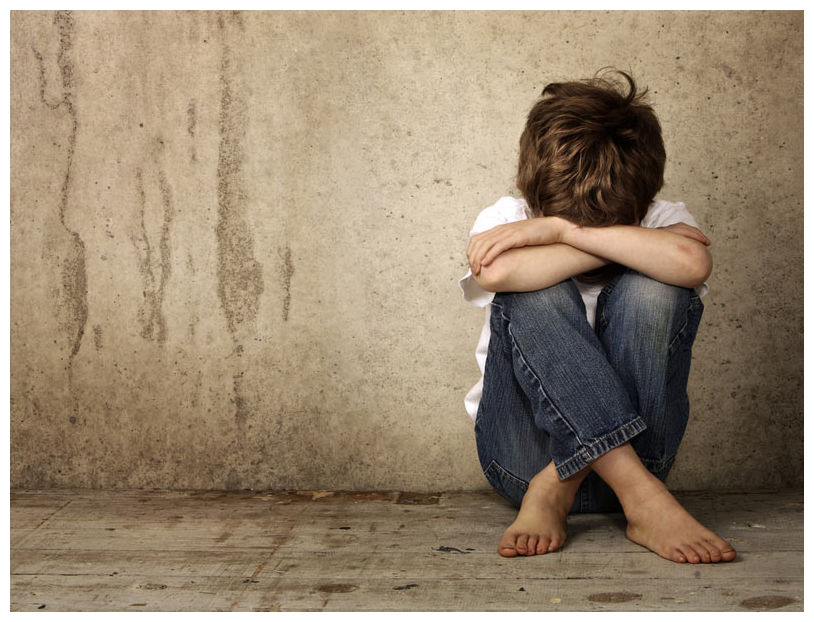
Children of narcissistic parents are always deeply damaged people. Because it’s a genetically inherited disorder (at least to some degree) but also because narcissism is a defense mechanism to protect and isolate oneself from abuse, many victims of narcissistic abuse become narcissists themselves. Those who do not become narcissists suffer from all manner of mental disorders, especially PTSD, avoidant personality disorder, schizoid and schizotypal personality disorder, depression and bipolar disorder, the whole gamut of anxiety and dissociative neuroses, and even psychoses like schizophrenia. And it’s entirely possible to be a narcissist and ALSO suffer from those other disorders. Being a child of a narcissist is the ultimate mind-fuck. There is no way to escape its effects, unless you are removed from the disordered FOO at an early age and adopted and raised by loving parents. Even then, the child will be scarred (“Child of Rage” Beth Thomas is a good example of a child who was severely abused and adopted by a loving family at age one and a half, but still needed years of therapy to overcome the damage that was done to her.)

I see signs of this happening in my daughter due to her MN father’s psychological mind games and mental abuse, but I don’t think it’s deeply entrenched in her because she also suffers from guilt and remorse and does have empathy or at least seems to, so I may be wrong. I hope I am. I still see signs of the sweet child she was, and her currently relationship seems to be bringing that out in her more and more often; she told me sincerely she wants to change her behavior and stop doing things that sabotage herself and hurt others.

Sam was an abused child, the oldest son of a malignantly narcissistic, thoroughly evil mother. He is an ACON, like we are. This is an interview he gave to a writer for Psychology Today, in which he describes what his childhood is like. It’s an excerpt from this journal entry from his website.

Interview granted to Elizabeth Svoboda of Psychology Today

Q. Could you briefly describe your relationship with your parents growing up? What were some of the high and low points?

A. My mother was by far the dominant presence in my life. She treated me as an extension of herself. Through me she sought to settle “open scores” with an indifferent world who failed to appreciate her gifts and to provide her with the opportunities that she so richly deserved. My role was to realise her unfulfilled dreams, wishes, and fantasies. I thus became a child prodigy.

But this was a vicious circle. The more successful I was, the more insidious envy I inspired in her and the more she attempted to subvert me and my accomplishments. Moreover, she resented my newfound personal autonomy. Smothering and doting turned into undisguised contempt and hatred and these fast deteriorated into life-threatening physical and psychological abuse.

Apart from savage beatings, she hit me where it hurt most: tore my poems, shredded my library books, invaded my privacy, humiliated me in front of peers and neighbours. Instead of being her prized possession, I now came to represent the much despised “establishment”. To avoid this disorienting predicament, I made myself into a juvenile delinquent, a gang member, a truant, a rebel with one cause: to regain my mother’s attention. But to no avail.

I hate the words “physical abuse”. It is such a clinical term. My mother used to burrow her fingernails into the soft, inner part of my arm, the “back” of my elbow and drag them, well inside the flesh and veins and everything. You can’t imagine the blood and the pain. She hit me with belts and buckles and sticks and heels and shoes and sandals and thrust my skull into sharp angles until it cracked. When I was four she threw a massive metal vase at me. It missed me and shattered a wall sized cupboard. To very small pieces. She did this for 14 years. Every day. Since the age of four.

She tore my books and threw them out the window of our fourth floor apartment. She shredded everything I wrote, consistently, relentlessly.

She cursed and humiliated me 10-15 times an hour, every hour, every day, every month, for 14 years. She called me “my little Eichmann” after a well known Nazi mass murderer. She convinced me that I am ugly (I am not. I am considered very good looking and attractive. Other women tell me so and I don’t believe them). She invented my personality disorder, meticulously, systematically. She tortured all my brothers as well. She hated it when I cracked jokes. She made my father do all these things to me as well. This is not clinical, this is my life. Or, rather, was. I inherited her ferocious cruelty, her lack of empathy, some of her obsessions and compulsions and her feet. Why I am mentioning the latter – in some other post.

I never felt anger. I felt fear, most of the time. A dull, pervasive, permanent sensation, like an aching tooth. And I tried to get away. I looked for other parents to adopt me. I toured the country looking for a foster home, only to come back humiliated with my dusty backpack. I volunteered to join the army a year before my time. At 17 I felt free. It is a sad “tribute” to my childhood that the happiest period in my life was in jail. The peaceful, most serene, clearest period. It has all been downhill since my release.

But, above all, I felt shame and pity. I was ashamed of my parents: primitive freaks, lost, frightened, incompetent. I could smell their inadequacy. It wasn’t like this at the beginning. I was proud of my father, a construction worker turned site manager, a self-made man who self-destructed later in his life. But this pride eroded, metamorphosed into a malignant form of awe of a depressive tyrant. Much later I understood how socially inept he was, disliked by authority figures, a morbid hypochondriac with narcissistic disdain for others. Father-hate became self-hate the more I realized how much like my father I am despite all my pretensions and grandiose illusions: schizoid-asocial, hated by authority figures, depressive, self-destructive, a defeatist.

But above all I kept asking myself:

WHY?

Why did they do it? Why for so long? Why so thoroughly?

I said to myself that I must have frightened them. A firstborn, a “genius” (IQ-wise), a freak of nature, frustrating, overly-independent, unchildlike Martian. The natural repulsion they must have felt having given birth to an alien, to a monstrosity.

Or that my birth fouled their plans somehow. My mother was just becoming a stage actress in her fertile, narcissistic, imagination (actually, she worked as a lowly salesperson in a tiny shoe shop). My father was saving money for one of an endless string of houses he built, sold and rebuilt. I was in the way. My birth was probably an accident. Not much later, my mother aborted my could-have-been-brother. The certificate describes how difficult the economic situation is with the one born child (that’s me).

Or that I deserve to be punished that way because I was naturally agitating, disruptive, bad, corrupt, vile, mean, cunning and what else.

Or that they were both mentally ill (and they were) and what was to be expected of them anyhow.

And the other question:

WAS IT REALLY ABUSE?

Isn’t “abuse” our invention, a figment of our febrile imagination when we embark upon an effort to explain that which cannot be explained (our life)?

Isn’t this a “false memory”, a “narrative”, a “fable”, a “construct”, a “tale”?

Everyone in our neighbourhood hit their children. So what? And our parents’ parents hit their children as well and most of them (our parents) came out normal. My father’s father used to wake him up and dispatch him through hostile Arab neighbourhoods in the dangerous city they lived in to buy for him his daily ration of alcohol. My mother’s mother went to bed one night and refused to get out of it until she died, 20 odd years later. I could see these behaviours replicated and handed down the generations.

So, WHERE was the abuse? The culture I grew in condoned frequent beatings.

It was a sign of stern, right, upbringing. What was different with US?

I think it was the hate in my mother’s eyes.

You can read about the daily reality in our home:
Nothing is Happening at Home
http://gorgelink.org/vaknin/wronghome-en.html

Q. Once you became an adult, how did your relationship with your parents change? What are some of the unique difficulties of being an adult child of narcissistic parents? Feel free to give examples or describe specific situations you found yourself in.

A. Adult children of narcissists adopt one of two solutions: entanglement or detachment. I chose the latter. I haven’t seen my parents since 1996 (Actually, since I left the army in 1982). I avoid the encounter because it is bound to stir up a nest of emotional hornets which I am not sure I could cope with effectively. I also refuse to subject myself to repeated abuse, however subtle, surreptitious, and ambient. Absenteeism is my way of neutralizing my parents’ weapons.

But the vast majority of grown up offspring of narcissists find themselves enmeshed in unhealthy permutations of their childhood, caught in an exhausting dance macabre, developing special semiotic vocabularies to decipher the convoluted exchanges that pass for communication in their families. They compulsively revisit unresolved conflicts and re-enact painful scenes in the forlorn hope that, this time around, the resolution would be favorable and benign.

Such entanglement only serves to exacerbate the corrosive give-and-take that constitutes the child-parent relationship in the narcissist’s family. Such recurrent friction, unwelcome but irresistible, deepens and entrenches the grudges and enmity that both parties accumulate in sort of a bookkeeping of hurt and counter-hurt.

Q. What effects do you think your parents’ personality problems had on you–as a child and as an adult?

A. I owe my multiple personality disorders – narcissistic, borderline, masochistic – and my depression to their unhealthy upbringing and to the nightmarish atmosphere that they have instilled in our home. I owe them every single self-destructive and self-defeating act I have since committed (quite a few). I inherited from them and via their flawed version of socialization my paranoid delusions, my antisocial behavior, my misanthropy, my a-sexuality.

I am fully accountable for my conduct. My parents cannot be held responsible for my choices at the age of 46. But that I react the way I do, that I am the sad vessel that I am, is their doing, no doubt.

Q. When we become adults, what are our responsibilities to parents who have personality problems? Do you think we’re obligated to put up with them as a kind of payback for everything they gave us when we were young, or are we justified in cutting them off if the situation gets too intractable?

A. Our first and foremost obligation is to ourselves and to our welfare – as well as to our loved ones. People with personality disorders are disruptive in the extreme. They pose a clear and present danger both to themselves and to others. They are an emotional liability and a time bomb. They are a riddle we, their progeny, can never hope to resolve and they constitute living proof that not only were we not loved as children but are unloveable as adults.

Why would one saddle oneself with such debilitating constraints on one’s ability to feel, to experience, to dare, and to soar to one’s fullest potential? Narcissistic parents are an albatross around their children’s necks because they are incapable of truly, fully, and unconditionally loving.

Q. Now that your parents are no longer part of your life, have you compensated by putting together your own “adopted family,” so to speak, of people you care about and that care about you? If so, could you talk a little bit about what effect doing this has had on your well-being?

A. In my late teens and early twenties I was still making the mistake of looking for a surrogate family. Soon enough, I have discovered that I cannot but import into these new relationships all the pathologies that characterized my family of origin. Ever since then I am careful not to get involved with family structures. I haven’t even created my own family. I am married (for the second time) but am repulsed by the idea of having to parent children. In general, I am trying to avoid relationships with an emotional component.

further reading: The Narcissist is Looking for a Family
http://samvak.tripod.com/narcissistnofamily.html

Q. How can we try to manage difficult parents’ behavior, if at all—or at least, minimize its impact on us? Q. What advice would you give others who find themselves in a similar situation with their parents? What were some of the strategies that worked for you?

A. At the risk of sounding repetitive: disengage to the best of your ability. Make it a point to limit your encounters with these sad reminders of your childhood to the bare minimum. Delegate obligations to third parties, to professionals, to other members of the family. Hire nurses, accountants, and lawyers if you can afford it. Place them in a senior home. Move to another state. The more distance you put between yourself and your personality disordered abuser-parents and their radioactive influence, the better you are bound to feel: liberated, decisive, empowered, calmer, in control, clear about yourself and your goals.

These points are crucial:

Do not allow your parents to manage your life any longer

Do not allow them to interfere with your new family: your wife and children

Do not allow them to turn you into a servant, instantaneously and obsequiously at their beck and call

Do not become their source of funding

Do not become their exclusive or most important source of narcissistic supply (attention, adulation, admiration)

Do not show them that they can hurt you or that you are afraid of them or that they have any kind of power over you

Be ostentatiously autonomous and independent-minded in their presence

Do not succumb to emotional blackmail or emotional incest

Punish them by disengaging every time they transgress. Condition them not to misbehave, not to abuse you.

Identify the most common strategies of fostering unhealthy (trauma) bonding and the most prevalent control mechanisms:

Guilt-driven (“I sacrificed my life for you…”)

Codependent (“I need you, I cannot cope without you…”)

Goal-driven (“We have a common goal which we can and must achieve”)

Shared psychosis or emotional incest (“You and I are united against the whole world, or at least against your monstrous, no-good father …”, “You are my one and only true love and passion”)

Explicit (“If you do not adhere to my principles, beliefs, ideology, religion, values, if you do not obey my instructions – I will punish you”).


My son’s dance competition performance

If anyone is interested, here’s my son’s dance competition entry at Midwest Furfest, held in Chicago, where he placed second in his division (out of 51). He is dressed as “Mex,” the hipster weasel.

Here’s a better video that includes the judges’ comments at the end but they’re hard to hear.

Here is he video where the winners are announced (1st – 3rd place in 3 categories, Novice, Veteran and Group). He said he’s glad he didn’t win because if he had he wouldn’t be allowed to compete in novice anymore and the competition in the veteran category is much stiffer.

The day Sam Vaknin knew he was a narcissist

Vector illustration of a man lock up in prison

I’m going to go ahead and confess part of the big secret that I alluded to in an earlier post. I’m writing a book about Sam. I can’t say too much else about it right now because the book’s focus hasn’t completely gelled in my mind yet. Right now I intend for it to be a biography, focusing on NPD from the inside–that is, what the disorder FEELS like. Sam is a controversial figure, and has enemies within the narcissistic abuse community and even more so among professionals who specialize in NPD (mainly because in their minds he lacks the proper qualifications), but there are also a great many people he has helped–even if helping wasn’t his intention, which it most likely wasn’t if he really is the malignant narcissist he says he is.

I took on this project because I need to come to my own conclusions without being influenced by others, either positive or negative. I do feel like Sam’s been more maligned that he deserves over the brouhaha over his “paper mill” degree, among other things. He’s an interesting character, and to my way of thinking, deserves to have a book written about him. I realize it will probably be a small market, but that’s okay–his story needs to be told. I also realize this will most likely be a feast of narcissistic supply for Sam, but I can live with that. Of course, I’m not going to sugar coat anything–but narcissists even consider negative attention to be satisfactory supply. In fact, some even prefer it. I think my book will be balanced, and there are good reasons to defend him from his haters but there are many things I don’t know about him yet either. If he’s really that malignant, I could wind up hating him myself when I’m done with this project. Or maybe not. Whatever happens, I know it will be very educational and mind-expanding and I feel that one way or another, writing this book will change me in some profound (and good) ways.

So anyway…Sam gave me the go ahead for this project after I emailed him wanting to do it. I’m trying to figure out how to go about getting an interview with him (I would have to go to Macedonia), but for the time being, I emailed a woman who did interview him who has some tapes and who may be able to share those with me. I’m waiting for a reply. Sam also sent me a long list of links to his writings, most which I have never seen before but which are publicly available here. These are his personal journals, poetry and short stories. I have a lot of reading to do!

Sam’s disordered mind fascinates me because he has two qualities in spades that both fly in the face of the typical narcissist (and he insists he is a malignant narcissist; of that I still have my doubts but that’s another thing I need to find out on my own): he is completely and brutally honest, and he has incredible insight into his disorder.

I’ve rambled on long enough about why I want to write this book. In reading Sam’s journal entries, I came across this one that left me gutted, breathless and nearly crying. It’s hard to wrap my mind around how a narcissist–a machine-like being with the inability to feel–can write about themselves with so much raw and searing emotion. There’s something else going on there. He’s a wicked good writer, but I believe with the certainty that the sun will rise tomorrow that there’s not one shred of fiction in this journal entry. I can smell bullshit from a mile away by now, and there’s no bullshit here. For the record, Sam’s poetry is just as gut-wrenching as his prose.

It’s about the day he became aware he was a narcissist. Until that day he had no insight into his disorder; he gained all his insight after the incidents leading up to that day. In some ways, the way he describes it, NPD seems much like a dissociative disorder, like MPD (multiple personality disorder). I have written before about how taking away a narcissist’s supply would send them into a “narcissistic crisis” of severe depression, forcing them to confront their own emptiness, which in turn results in emotional catharsis; this is exactly how it happened here for Sam.

Unfortunately, he got to that point, but was either unable or unwilling to seek further treatment to attempt to rewire his brain to have empathy or a conscience. A cure may not be possible. Maybe you can’t retrain the adult brain to have a conscience the way it was done for a child like Beth Thomas; I just don’t know. That’s one more thing I need to find out more about. I sure have my work cut out for me.

How I “Became” a Narcissist

prisonman2

I remember the day I died. Almost did. We were in a tour of Jerusalem. Our guide was the Deputy Chief Warden. We wore our Sunday best suits – stained dark blue, abrasive jeans shirts tucked in tattered trousers. I could think of nothing but Nomi. She left me two months after my incarceration. She said that my brain did not excite her as it used to. We were sitting on what passed as a grassy knoll in prison and she was marble cold and firm. This is why, during the trip to Jerusalem, I planned to grab the Warden’s gun and kill myself.

Death has an asphyxiating, all-pervasive presence and I could hardly breathe. It passed and I knew that I had to find out real quick what was wrong with me – or else.

How I obtained access to psychology books and to Internet from the inside of one of Israel’s more notorious jails, is a story unto itself. In this film noire, this search of my dark self, I had very little to go on, no clues and no Della Street by my side. I had to let go – yet I never did and did not know how.

I forced myself to remember, threatened by the immanent presence of the Grim Reaper. I fluctuated between shattering flashbacks and despair. I wrote cathartic short fiction. I published it. I remember holding myself, white knuckles clasping an aluminum sink, about to throw up as I am flooded with images of violence between my parents, images that I repressed to oblivion. I cried a lot, uncontrollably, convulsively, gazing through tearful veils at the monochrome screen.

The exact moment I found a description of the Narcissistic Personality Disorder is etched in my mind. I felt engulfed in word-amber, encapsulated and frozen. It was suddenly very quiet and very still. I met myself. I saw the enemy and it was I.

The article was long winded and full of references to scholars I never heard of before: Kernberg, Kohut, Klein. It was a foreign language that resounded, like a forgotten childhood memory. It was I to the last repellent details, described in uncanny accuracy: grandiose fantasies of brilliance and perfection, sense of entitlement without commensurate achievements, rage, exploitation of others, lack of empathy.

I had to learn more. I knew I had the answer. All I had to do was find the right questions.

That day was miraculous. Many strange and wonderful things happened. I saw people – I SAW them. And I had a glimmer of understanding regarding my self – this disturbed, sad, neglected, insecure and ludicrous things that passed for me.

It was the first important realization – there were two of us. I was not alone inside my body.

dualman

One was an extrovert, facile, gregarious, attention-consuming, adulation-dependent, charming, ruthless and manic-depressive being. The other was schizoid, shy, dependent, phobic, suspicious, pessimistic, dysphoric and helpless creature – a kid, really.

I began to observe these two alternating. The first (whom I called Ninko Leumas – an anagram of the Hebrew spelling of my name) would invariably appear to interact with people. It didn’t feel like putting a mask on or like I had another personality. It was just like I am MORE me. It was a caricature of the TRUE me, of Shmuel.

Shmuel hated people. He felt inferior, physically repulsive and socially incompetent. Ninko also hated people. He held them in contempt. THEY were inferior to his superior qualities and skills. He needed their admiration but he resented this fact and he accepted their offerings condescendingly.

As I pieced my fragmented and immature self together I began to see that Shmuel and Ninko were flip sides of the SAME coin. Ninko seemed to be trying to compensate Shmuel, to protect him, to isolate him from hurt and to exact revenge whenever he failed. At this stage I was not sure who was manipulating who and I did not have the most rudimentary acquaintance with this vastly rich continent I discovered inside me.

But that was only the beginning.

“I thought these rugs were dogs.”

I love this Twitter account: Faces in Things. I always stop here if I want to smile.

This one made me spew coffee all over my keyboard.

ithoughttheserugs
dogrugs

I want one!

Off topic, but I reached 200 posts, and this is my 201st. 🙂

The Burnt Child

Searing, powerful poetry from a fellow ACON. There’s nothing more I can add, so I’ll let her words speak for themselves.

EWWWW!

ianrowan3
Click on photo to enlarge.

I love candid photos. Here’s one of my very favorites of my children taken in April of 2001. Molly had just turned 8, and Ethan was 9 going on 10.

Their expressions here are priceless. We were visiting my father in Dallas, TX, and while playing outside, Ethan got himself covered with some black beetles. He seemed to find the whole thing a hoot, but his sister Molly definitely doesn’t approve!

Take your office Christmas party and shove it.

officeparty
Get out of my face with your absurd fake smiles and stupid Santa hats.

So tomorrow night is the annual office Christmas party. I will not be attending. It’s not like I have some high level job where my presence is expected or necessary anyway. I doubt anyone will even notice my absence or care.

As an Aspie, I have never been able to tolerate the forced upbeat perkiness and all the small talk and chit chat about nothing in particular that abounds at these events. Too much social input coming in from all directions overwhelms my oddly wired brain, causing it to short circuit. I wind up in a state of near panic and to compensate, I become mute to avoid reading a social cue wrong and say something out of context that causes people to look at each other knowingly and roll their eyes at my social ineptness.

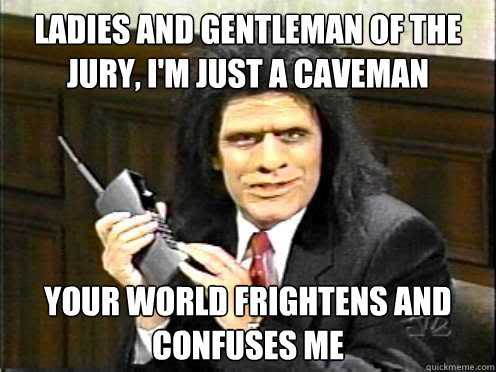
I feel like the old Saturday Night Live character Unfrozen Caveman Lawyer, whose mantra was “your world frightens and confuses me.” The world of neurotypicals, a world of people who love to socialize in groups, attend parties and engage in small talk, has that effect on me.

yourworld

Whenever I’ve attended one of these things, I leave as exhausted as if I just spent the day digging holes in dry packed mud. Because I’m nearly silent at these events, people don’t even attempt to talk to me. More often that not, I wind up sitting there at the table alone, picking at my plate of stuffed mushrooms and baby carrots, feeling as self conscious and awkward as the school geek in a roomful of popular kids, because I can find no one to talk to and apparently no one really wants to talk to me either.

Small talk is utterly boring to me. Aspies tend to like “deep” talk, but I learned that serious, in depth conversations about things that matter is verboten at parties, especially office parties, where you are forced to spend an evening acting like people you probably wouldn’t give the time of day to if you didn’t have to work with them are your best friends. It’s all so fake and stupid to me.

I don’t get jokes a lot of the time, especially if they’re inside jokes that, because I don’t have close friends at work and am not part of a clique, I haven’t been filled in on the background that makes these jokes funny to others. It’s hard to laugh at a joke you don’t get. But you must laugh anyway so people don’t think you’re cold and unfriendly or worse, didn’t get the joke, which implies stupidity. But telling jokes is de rigeur for office Christmas parties.

The other thing that drives me crazy is everyone talking about their upcoming holiday plans. Most neurotypicals have lots of friends and love to talk about the gifts they are buying and the parties and other events they will be attending with those friends. Most people also have loving families and nearby relatives and all the talk about what toys they are buying little Isabella and Caleb at Sam’s Club makes me want to stick hot pins in my eyes. Being a person with hardly any money to buy gifts for anyone in a world that seems full of people who are living in two income households and have disposable income to throw around drives me mad too.

The only way I could cope with this type of an event would be if I had a few drinks ahead of time, but that wouldn’t be worth it either and besides, I’d still have to drive. I don’t really need a DWI on top of all the other shit I’m dealing with.

I’m no Scrooge, but you can keep your office Christmas party. I have better things to do, like socialize with my cats who don’t give a damn how awkward I am, or write more blogs posts.

My Top Ten articles of all time

I know I made a similar post about a month ago, but here’s the updated version of my ten most popular articles over the entire time this blog has existed. (“My Story” is actually not an article, but a page of links in my header).

stats1214
Click on table to enlarge.

This blog is growing. Yours can too.

statsdec2014
Click graph to see more detail.

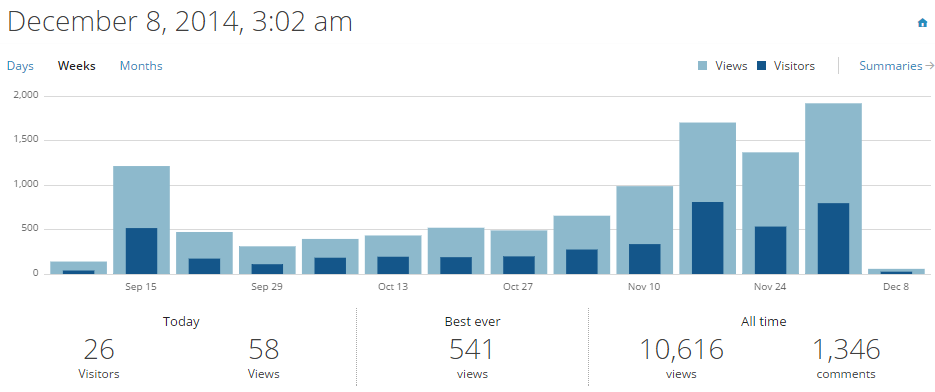
Now that I can finally crop parts of a screenshot, I can visually show my readers how this blog has done since I started it on September 10th. Its growth has been pretty steady and seems to be increasing fairly quickly, given this blog has only existed for 3 months.

The only anomaly in the graph is the huge spike in views during my second week–the week of September 15th. That was when OM from Harsh Reality reblogged my rant about being frustrated because no one was seeing my blog (I had 12 followers at that point and almost no likes or comments–I was a whiney and impatient noobie!)

Due to OM’s act of generosity, I got 354 views that day, which remained my Best Ever day until a couple of weeks ago, when I wrote my post about whether Sam Vaknin (self professed narcissist and writer of books about narcissism) was a narcissist or not. That article itself would probably not have been all that popular–except Sam himself saw it and commented, then he did the unbelievable; he linked it all over various social media–and that brought me a ton more viewers and about 15 new followers. That was the day I beat my previous Best Day Ever, with 541 views!

While things have died down just a bit from that HUGE spike, overall it appears this blog’s visibility on the web is still growing. I was tickled to death to find several of my articles (the more popular ones mainly) now showing up on the first 3 pages of Google, instead of way back on page 68 or something. They’re starting to show up on other search engines too.

Things new bloggers can do to increase visibility and views.

Blogging (1)

–Read OM’s blog.
I try to take all OM’s advice to new bloggers, and he does know what he’s talking about. I highly recommend his blog, which offers all kinds of advice to beginners and veterans alike. He follows new blogs all the time. He even occasionally offers bloggers the opportunity to “pimp” their blog on his site. Take advantage of it! Here is his blog. Do what he says–it does work.

–The title is everything.
I find it helpful to keep my titles “grabby.” Make them stand out. Make them a little controversial (“Don’t judge me because I’m poor”), a little confessional (“People think I’m stupid” or “I’m Frustrated”), or even pose a challenge to the reader (“My Son is Furry–Have a problem with that?”) Don’t try to make them too “nice”–then they will just be boring.

Keep your titles as short as possible. Never, ever write a title that sounds like a Ph.D thesis, such as: “Preternaturally narcissistic and sociopathic actions within the social media milieu: a paradigm of the interglobal loss of interpersonal altruism.” WUT?
Never, EVER use the word “paradigm” in a title. If you do that, I will personally come to your house and pour water all over your keyboard. That’s a promise. The same goes for “milieu.” Don’t use that word. Ever. No one even knows how to spell it anyway.

paradigm

–Keep your subject matter on topic as much as you can.
It’s alright to veer off topic to tell an anecdote or provide an example–in fact that can make your post seem more personal. But try not to veer off the topic the title promises too much. It’s hard to do sometimes, but if you do, always somehow bring the article back to your original topic, and it will look like you intended for it to veer off topic a little to make a point.

–Break up your text!
Readers don’t like walls of text. While a photo or picture isn’t required for a very short post, it can make it stand out more and look more appealing. If your post is very long, break it up. Use photos or pictures or quotes at appropriate intervals that illustrate the point of your story or article. It’s easy to Google images you want to use–just type the subject matter into the browser and click on Images, and you will find the perfect image to illustrate your article. That’s the way I do it. Your own photos or pictures are fine to use too.

Beyond that, break up your paragraphs into smaller, easier to chew pieces. Readers are not cavemen gnawing an entire flank of beef at once. They are civilized humans who like their steak cut into small pieces that can be picked up and savored one at a time. The same advice goes for paragraphs. Keep them bite size and they will be much more readable and taste better too.

–Use the share buttons!
Even if you hate social media (like I do), make sure each blog post contains all the social media share buttons available, which can be found in the dashboard. Even if YOU don’t want to link your post to them, OTHER people will use them. If they’re not there under your post, people probably won’t bother sharing your post. Share buttons are a lazy way of getting your post seen by many people, only you’re letting your readers do the work for you. Nothing wrong with that.

–Link to other blogs.
Linking to other blogs within your post creates a pingback: the writer of that blog will see that you quoted them, and will come and check out your blog. It’s more than likely that blogger will start following you back. Creating a blogroll (in Widgets) will help your blog too. It shows you read other blogs as well as your own, and the other bloggers will appreciate your support.

–Reply to the comments you get!
If you ignore your comments, people will lose interest in your blog. People don’t want to feel ignored. If you fail to answer your comments, it’s insulting to the reader who wrote the comment or asked the question, and it will seem like you don’t care. If you don’t want comments on your blog, you can always disable them, but I never understood why anyone would do that. All popular blogs are interactive blogs, where people can comment and lively conversations and debates can get started. It’s helpful to comment on other people’s blogs as well.

–Write frequently.
You should challenge yourself and try to write a post a day. If you can think of nothing to write about (I have those days), post a funny or attractive photo or a quote you like. If you don’t post frequently, people will stop visiting your blog. Sometimes I write 3-5 posts a day. You don’t have to write that many, but one post a day will keep your blog from stagnating like unmoving pond water.

–A few other things to remember.
If you’re a new blogger, don’t panic if things go slowly at first. Don’t get discouraged, frustrated or give up because at first it will seem like no one is reading your blog. It takes time. Becoming visible and getting lots of views and follows takes some people longer than others. The only reason mine seems to be growing faster than some new blogs is because of fortuitous visits by a person in the field I focus on (narcissism and psychopathy) who is somewhat well known and helped get my blog out there. I also write about a topic that happens to be “hot” right now. I don’t think the growth of this blog is because it’s “better” than any other–in fact I think there are many blogs that are much better written and more professional looking than mine.

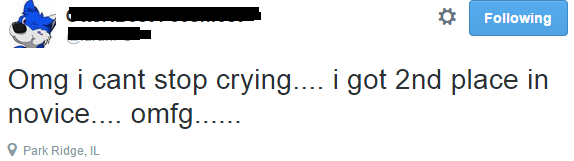
OMFG. My son won 2nd place in the dance competition!

I can’t believe it. I’m in tears right now. Ethan wanted to make the Top 3 so badly, and he did one better than that (this was out of a group of 50 dancers–he made it to the final ten of the Novice category last night).

He’s been dancing for 3 years and this is the first time he placed in the Top 3.

Here is the tweet he just sent:

2ndplacetweet

I’ll post the video of his dance performance as soon as it’s up on Youtube. In the meantime, here is his performance at another convention he attended in Orlando, Florida in August, where he was a finalist but did not place. The convention he is at in Illinois has more attendees and making the finals in this competition is more difficult and competitive than the one he attended in Florida.

All that practice has really paid off!


Ethan’s performance at Megaplex 2014 in August.

ETA: Someone on Twitter just posted this photo of him competing today.
mwff2014