A field guide to the most common narcissist subspecies.

hunter

Narcissists are predators, but they can be turned into prey fairly easily. Here’s a quick field guide to the most common types of narcissists you may find out in the wilderness of real life. Binoculars are good to have on hand to spot them, but make sure you keep yourself camouflaged well and carry the weapon of Truth. Truth to a narc is like garlic to a vampire–they will run faster than Montezuma’s Revenge.

It’s easy to learn how to identify the subspecies of common narcissists by using this Field Guide to help you identify the most common types, their preferred habitat, and chosen source of supply (food). They can all be either male or female, but where a particular gender is more commonly seen, it will be indicated in the subspecies description.

1. Narcissus grandiosis.

conceptual caricature of caucasian businessman in suit he whips employee pulling him around in chair

N. grandiosis is the “classic”, grandiose, aggressively ambitious (and often successful) narcissist. Usually male but there are many females too. N. grandiosis is full of himself, boasts about his achievements, uses and consumes others to get ahead, and the only emotion they show is rage and occasional glee over their own greatness. A close subtype of N. grandiosis is N. grandiosis cerebrus. He is smarter than you and wants to make sure you and everyone else knows just how superior his mind is to the all the plebes like yourself.
Habitat: the corner office in big corporations, the political trail, Hollywood, Wall Street.
Preferred food: unassertive, codependent people they can boss around, impress, use, and have complete control over.

2. Narcissus coverticus vulnerabilis.

pouting_man

Looks can be deceiving. N. vulnerabilis may appear to be some other species of psychological or personality disorder. N. vulnerabilis is likely to be female (but not always). They seem almost cloyingly nice, but watch out–they are predators of the emotional vampire subspecies. They seem to have endless problems and misfortunes and emotional crises and expect you to ALWAYS be there for them. If you are not, they will sulk, whine, cry, give you the silent treatment, or tell everyone what a heartless, cold narcissist YOU are. Or make endless excuses why the advice you give them will NEVER work. Eventually, they will suck away your soul until you’re as down and out as they are. They’re going down and taking you with them.
Habitat: Unemployment and social service offices, food banks, therapist’s offices, your couch, your bed.
Preferred food: Highly empathetic people, people working in the helping professions.

3. Narcissus religiosis.

church_lady2

N. religiosis is likely to be female, but don’t be fooled. Males often rise to positions of leadership in churches, at which point they can be easily confused with N. grandiosis (a subspecies who may share their habitat). N. religiosis is always holy, always pious, always reads their Bible and attends church (or other place of worship) whenever they can, and is always right. They love to lord their self-righteousness over those they deem unworthy of salvation, and secretly desire to be Gods themselves. If anyone tells you you’re going to hell for believing what you believe, you are looking at a N. religiosis. Many of this subspecies are hypocritical and don’t practice what they preach.
Habitat: Churches, synagogues, religious events. They are also common on the political trail and can be spotted on school boards trying to get certain books or the teaching of sex education or evolution banned.
Preferred food: The unworthy, the ungodly, the sinful, all atheists and agnostics, or anyone who doesn’t believe exactly as they do.

4. Narcissus generosa.

giving_to_homeless

This subspecies can fool you because they appear to be so giving. N. generosa is usually female. They are big givers to charitable organizations and causes and loudly talk about how much they gave. They don’t really care about helping others–they are doing it to impress you with how altruistic and selfless they are. N. generosa gets a huge dose of narcissistic supply when others are impressed by their giving nature and makes sure you know about all those other times they gave selflessly too. N. generosa is often the long-suffering female relative, often a mother, who endlessly reminds you how much they have done for you and what a martyr they have been for doing so.
Habitat: Charitable events and meetings, volunteer organizations, church groups, the kitchen (slaving away to cook dinner for you). They have also been spotted in hospitals, spending time with the sick and disabled.
Preferred food: The poor, the sick, the disabled, the down on their luck, the very young and old, and vulnerable prey of all kinds.

5. Narcissus minimus.

little_bit_narcissistic

N. minimus may be a hybrid species because they show fewer traits of the Narcissus species. The only subspecies who may have the ability to become a member of Homo sapiens with the appropriate care and feeding. They may have narcissistic traits and act arrogant and full of themselves, but have small levels of empathy and a slight ability to feel bad about their predatory behaviors.
Habitat: Anywhere.
Preferred food: N. minimus can survive on a low calorie diet and can go for long periods without food at all, although they would prefer to have a more frequent diet, and are willing to hunt for their prey, although with less aggression than the other subspecies.

6. Narcissus hypochondrosis.

which_illness

N. hypochondrosis can be male or female. They are always sick or complaining about their endless ailments. Their chronic fake maladies make it possible for them to get supply from others in the form of medical or nursing care, or just the sympathy they crave. Being “sick” so often also frees them from the need to have to work for a living, because, you see, they are too sick. N. hypochondrisis is often a hybrid type combined with N. parasitis. Also known by their alternative name, N. Malingerosa. Being “sick” could also mean they “suffer” from a nonexistent mental disorder such as schizophrenia or Bipolar. Because they are “crazy,” this gives them carte blanche to treat you in whatever shabby manner they desire and exempts them from societal expectations to treat others with respect and manners.
Habitat: Doctor’s offices, hospital emergency rooms, at home in bed, at home in your bed or on your couch.
Preferred food: The sympathetic and people pleasing, the nurturing, nurses and doctors.

7. Narcissus parasitis.

narc_on_couch

Closely related to N. hypochondronsis and N. coverticus vulnerabilis, N. parasitis seems meek and unassuming. But she will eat you alive in her neverending quest for nurturing, sympathy, a bed to sleep in, free access to your home, fridge and bank account, and an aversion to having to hunt for their own food.
Habitat: Your home and your entire life.
Preferred food: codependent and people-pleasing people, the generous, the softhearted, the maternal, or anyone who can be easily manipulated and used.

8. Narcissus psychopathis dangerosa.

charles_manson

N. psychopathis dangerosa is also known as the malignant narcissist, or sometimes, psychopath. Many are hybrid with Antisocialis dangerosa. These are the most aggressive and dangerous predators in the narcissist kingdom, and will stop at nothing to get what they want, even if it means they have to kill you to get it. Some enjoy the means to that end, and others just do what they have to do to get their fix of supply. To them, you are no better than common housefly and they will think nothing of swatting the life out of you.
Habitat: Everywhere. While not the most common subspecies, they have no preferred habitat. However, prisons and jails seem to have a surplus of this subspecies.
Preferred food: Everyone who appears to be “weaker” or nicer than they are, which means almost everybody. They will avoid other individuals of their own subtype, however.

9. Narcissus somaticus histrionicus.

somatic_narc2

Here we find the Somatic subtype of narcissist. These predators care only about their physical appearance, and like a cat, will preen and primp all day if they weren’t required to also hunt to survive. They are much better looking and enjoy much better health than you, you ugly piece of garbage. If you fail to give them the attention they deserve, expect a vicious attack.
Habitat: gyms, health clubs, the beach (to show off their perfect bodies), in front of a camera, especially their own. They have perfected the skill of taking the Selfie to a fine art form.
Preferred food: Anyone who fawns over how beautiful or handsome they are and worships them for the gods and goddesses they are.

10. Narcissus borderlinensis.
unstable_emotions

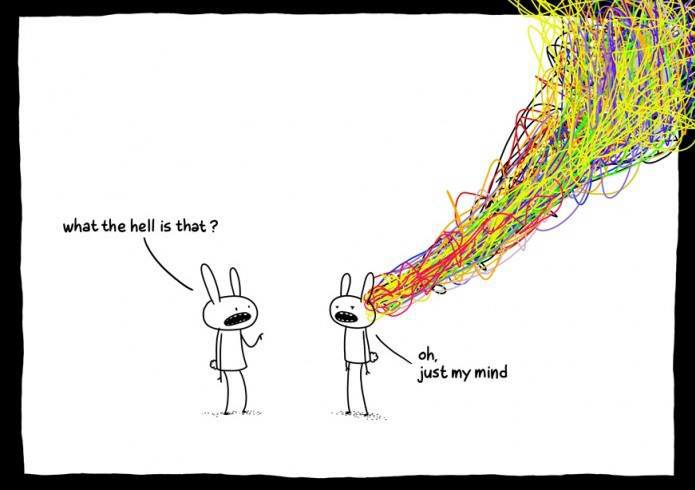
N. borderlinensis is another hybrid type, with Borderline traits. N. borderlinensis is emotionally unstable, moody, and prone to frequent rages and temper tantrums. It’s surprising this subspecies hasn’t gone extinct yet, since so many of them display self destructive tendencies and are prone to self-starvation, self-induced vomiting, using mind-expanding (or more likely mind numbing) substances, habitual risk taking, and other forms of self abuse. While these are dangerous predators, spotters have noticed when things are not going well for them, they are as likely to attack themselves as they are to attack you. Unlike most other subspecies, N. borderlinensis have been spotted apologizing for their actions.
Habitat: Everywhere.
Preferred food: Anyone they can take out their anger and bad temper on.

Protect Yourself!
Make sure you come well armed with either of these two products to repel them.

Spray this on the narcs:
narc_b_gone

Spray this on yourself:
narc_repellant

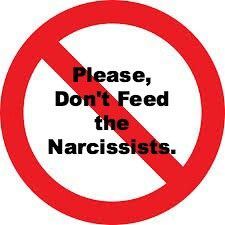
Finally, it’s always prudent to remember this slogan–
narc_repellent

Most important of all: the Truth will set you free and make the narcs flee!

A Beachside Affair (guest post).

Here is another guest post by the same writer who contributed “The Narc from Costa Rica.” Again she has asked to remain anonymous, but I think this story does a better job of describing the narcissism of a man who seemed to be extremely romantic. Talk about a whirlwind romance!

It’s common for narcissists (especially somatic ones) to act very romantic in the beginning of relationships. But the problem is, it’s an ACT. They can sweep you off your feet with their charm, declarations of undying love (which are lies), seemingly endless desire to make love to you, and gifts of wine, candy and roses. They also can move in very fast, and it’s not uncommon for one to propose marriage very soon into the relationship. (There are other narcs who are relationship-phobic, usually the cerebral type.). My ex proposed only three months after we met. He was cerebral though, so not all “romantic,” fast-moving narcissists are somatics.

The man in this story, Michael, seems to be a covert or “vulnerable” narcissist. They can seem to have very deep emotions and be quick to express their insecurities and vulnerabilities, but they’re still dishonest and manipulative, and they still have no empathy and will leave you in a heartbeat if a better source of supply comes along. Covert narcissists can be more dangerous than aggressive (classic) narcissists because you never see what’s coming. They can completely fool you because they seem to need you so much.

A Beachside Affair
By Anonymous

summer_love

My whirlwind relationship with Michael lasted for only 3 months. It was a summer love, like something out of the movies. Our affair ended abruptly, leaving me completely gutted emotionally and even physically. It was as if he’d ripped my heart out and taken it with him, leaving me with a huge hole inside my soul.

I met Michael on the beach. We quickly became obsessed with each other. He was like an addiction to me. I went to work during the day and all I could think about was Michael. I’d go home and polish myself from head to toe, making sure I looked and felt as beautiful as possible. Before I met Michael I just didn’t feel good. I was in a failing marriage to another narcissist. My husband ignored me. He never talked to me and I was dying inside. I remember that I’d go home and get drunk on wine, just to blur out the feelings of emptiness I felt from my husband’s coldness, on top of having suffered an empty childhood and adolescence due to having been raised by a narcissistic father and a borderline mother who wasn’t much better.

I knew having an affair was wrong, but at that point I no longer cared. I needed to feel loved and needed. Michael fit the bill perfectly, at first. I remember the day I met Michael. He was beautiful, his tanned muscles shimmering and rippling in the sun. We talked for a little while and before long he started to kiss me and held me for 4 hours straight, as the sun went down over the ocean.

After that heady experience I made a decision to leave my husband because I no longer could stand being with him. There was just no comparison.

I’m not sure why Michael had me under such a powerful spell. I’m not sure if it was inverted or covert narcissism or codependency on my part that made me so attracted to him. I know he mirrored my own narcissism and I think that was part of the attraction. Or (in my thinking at the time) maybe it was just that we were both artists that craved something more and we needed attention and had a burning desire to express our vision of life through our art. All I know is that when the two of us got together we melted together like butter. All the love that I never got, all the love I craved and all my neediness was being filled by Michael and I couldn’t get enough of him. He was everything to me.

beachside_romance

Michael had an apartment in a very famous town in coastal New Jersey that was known for its rock n roll legacy, especially Bruce Springsteen. Famous bands played in a place called The Stone Pony in Asbury Park. Back then, over 30 years ago, the town was run down and almost abandoned. The Stone Pony was the only thing that held the weak fabric of this town together. But I loved it there. This run down seaside town was always beautiful to me because I always felt like this was my home. I still do. I knew that one day I’d play up on the same stage where other famous artists had played. There was fire in my belly. A void that needed to be filled with a whole lot more than a man’s love. If there was an Angel on Ocean Avenue, she was certainly watching over me.

Micheal was an art student who had nude sketches of himself all over his wall. He played the guitar too and we often played music together and I would sing. I use to stay at Michael’s house every night. We went to parties at the homes of mutual friends we had met out on the beach. The bonfires were wonderful and we would all sit around and sing songs. We sang Beatles songs and Bowie songs and I felt like a reincarnated hippie. My favorite song we sang was David Bowie’s “Space Oddity.”

“Tell my wife I love her very much…she knows.
I’m here and I’m floating in my tin can.
Far above the world. Planet earth is blue and there’s nothing I can do.”

beachside_romance2

There was magic and presence and energy and the love in all the people we met at these parties and on the beach. People liked to watch Michael and I, because they were intrigued by our obsession and need for each other. We vicariously fulfilled their need for romance. I felt so validated, loved, sexy and happy. It seemed too good to be true and it was. This couldn’t be real life. It was too perfect.

We were a study in contrasts physically, and I think that’s another reason for the fascination our friends had for us. Michael had beautiful blue eyes and long blonde silky hair, and a great body. I had long black hair and lots of curves. People liked to photograph us together. We use to sit down in front of a long mirror in his room and stare at the contrast. We made each other feel beautiful. And together, we were. At that time it seemed we were good for each other’s self-esteem. At the county college Michael was studying for an Associates degree in graphic arts we were both asked to pose nude for $10 dollars an hour for the students who sketched still lifes in the human anatomy drawing class.

Michael’s background was sad. He told me that he was beaten by his father with a belt consistently during his infancy and his dad was also an alcoholic. Michael was depressed and he had to take psychiatric medication to fight his depression from the abuse he endured as a child. I remember watching him go into this weird state where sometimes seemed almost frozen and off in some other universe (dissociation is a common symptom in people with NPD and BPD). When in these near-catatonic states, he’d punch the floor or the wall over and over again, sometimes lasting for up to 20 minutes. It was sad and very scary. He was not mean or malignant though. He seemed like a gentle, artistic soul who just couldn’t take care of himself. He was never controlling, but seemed very needy for my constant attention and love. I think he was a covert narcissist.

Our affair came to an abrupt end at the end of that summer, because Michael left me for another women who said she was in love with him. She was willing to pay the rent on his apartment. So in the end, he chose money and security over me. I was devastated because the drug of my addiction to him filled me all summer and was suddenly ripped out of my heart in an instant and the devastation and grief was almost too much to bear.

But if I’d known about narcissism, I would have known Idealize and Devalue is all part of their game. They can’t help it. Even covert narcissists are at heart predators out to use you and throw you away when you’re no longer of use to them.

My next phantom lover was a drummer named Karl. I was so needy that I of course fell into the hands of another narcissistic man. And so it goes on…

Disturbing documentary about narcissists and psychopaths

I never saw this film (Narcissism: The Psychology of Demons) before. While I dislike the all-too-common merging together of the characteristics of psychopathy/sociopathy/ASPD with those of NPD (non-malignant narcissists are not without feelings, even if they are very self-centered), this is still a very interesting, scary and disturbing video describing the emotional vampires in our lives and that dominate our society.

Several people are interviewed about narcissism in the video. Zain Arcane (the smarmy Slash-looking dude in the hat and sunglasses), a vocal coach who makes videos about narcissism, gives me VERY stong narc vibes. I have read elsewhere he does in fact have NPD and is probably a psychopath. During the few minutes he takes off his sunglasses, his eyes look unfocused and lifeless and he doesn’t seem mentally all there. Maybe he’s on drugs, but there’s every reason to believe he’s a wolf in sheep’s clothing and thinks of himself as a god, based on what I read.

The creepiest part of this film is the interview with the little 5 year old girl from “Toddlers and Tiaras” and her mother (this starts at 33:32). The mother is obviously a narcissist, and has turned her daughter into her little mini-me by forcing her into beauty pageants. The little girl is already showing the odd emotional disconnection, complete self-absorption and the dead, flat eyes of the malignant narcissist/sociopath–and her self absorption is so great she doesn’t even seem to hear the interviewer and her mother talk. If this girl doesn’t get intervention very soon (and she probably will not), she is going to become an extremely dangerous, Jezebel-like woman when she gets older and utterly destroyed when her looks begin to decline. It may already be too late for her, because something about her already seems thoroughly corrupted, even evil. It’s hard for me to look at her face without wanting to recoil and get away fast.

When Narcissists Claim to be Victims of Narcissists – Who is the Narcissist?

One more great article from a fantastic blogger about narcissists who claim to be victims of narcissists…and then write about them. How to protect yourself in the blogosphere and identify who’s really a narcissist…and who is not.

If you blog about narcissists you will, sooner or later, probably be accused of being a narcissist. Don’t take it too personally. Just learn how to be wary and protect yourself.

Blogging about narcissism can be very crazymaking indeed.

anupturnedsoul's avatarAn Upturned Soul

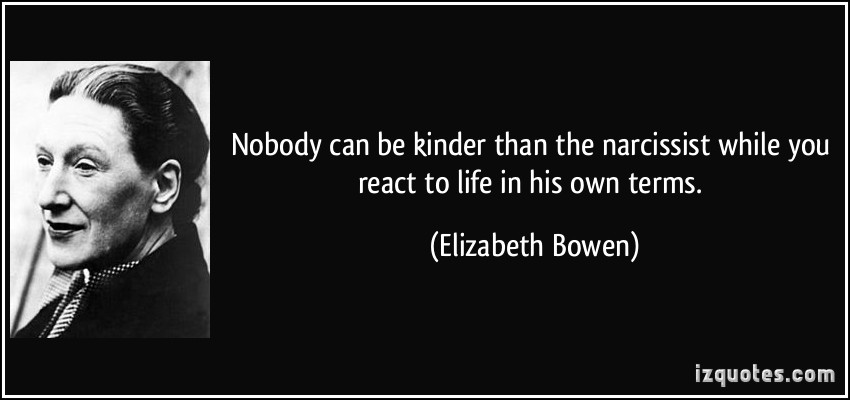
NPD - ELizabeth Bowen

If you’re searching online for information about Narcissists, Narcissism, Narcissistic Personality Disorder (NPD), Narcissistic parents, being a Child of Narcissists, an ACoN – Adult Child of Narcissists, being in a relationship with a Narcissist, being a Victim of a Narcissist, How to Play the Narcissist’s Game and maybe win, How to Piss a Narcissist Off (which is one of the most popular search terms in my stats), or any other variation on the theme, you will be inundated with results.

The subject of Narcissism is trending, a Hot Topic.

The internet is bursting with information about it, from professionals, experts in the field, and from people like me who are sharing their experiences and working their way through them publicly.

Why share your private story publicly?

If your particular Narcissist has managed to isolate you and surround you with people who are on their side, then the chances are that…

View original post 4,423 more words

You are just an object to a narcissist.

objectification

I saw this post in the NPD forum at Psychforums. The discussion was about narcissists who seem to care more about animals than people. “StupidPig,” a poster with NPD wrote an interesting post, which I think is a great explanation of what “love” means to a narcissist. In a nutshell: it’s not love. It’s not even really attachment. Everything is an object to them. A narcissist can be as “attached” to an object or an animal as a person, sometimes more so. It all depends whatever is giving the narcissist more pleasure/supply at a given time and whatever requires less maintenance or emotional input from them. The “love object” can change from one day to the next. People and animals are just objects to a narcissist.

I did not edit StupidPig’s post or correct his spelling errors.

http://www.psychforums.com/narcissistic-personality/topic47260-10.html

I am a narcissist with NPD, and I used to like to “own” animals as a kid. However, I never liked to “care” for them.

Someone with NPD cares only for his image, or what the books call the “Glorified Self Image”. Anything else other than his Glorified Self Image is considered an object to him (be it his mother, his children, his spouce, his boss, his car, his own body, or his pet snake or whatever) , and the value of such object will be defined only on basis of how much narcissistic supply it would give him. I.e. how much it enhances his Glorified Self Image.
So, if owning a dog (or a car or a pretty girlfriend) would make me look better, then I would enjoy it, but I would never do any effort to maintain the car, walk the dog, or be nice to the girlfriend, because, as someone with NPD, I have an exagerrated sense of entitlement. this means that I strongly belive that I “deserve” to have the objects that make me look good, and I do not need to do any effort to “keep” those objects.

A pet is no different from a spouce or a car or a friend or a watch or a parent to a Narc. It is just an object that gains value when it makes him look better or feel superior and loses value immidiatly if it doesn’t give him such supply. Based on this, if your car does a 18/20 job in making you look better and feel superior, while your dog does a 10/20 at that job, and your spouce or son does a 5/20, then you would love your care more than your dog and your dog more than your family. But, if on the next day your son wins the world championship in swiming and tells the world on TV that you, his father, is the reason behind this victory, you would shift into loving your son more than your dog and your car, and if three days latter your son makes a fight with you because he wants the car, and the car gets dented in an accident, you will love your dog more than your car and your son, and so on.

In all cases, the narc will never do much to maintain those “objects” and will never really hold any of them dear to his heart because they are all just objects to him.

Only in the light of this should one talk a comparitive view at the different objects in a narc ‘s life and their different merrits and drawbacks. using myself as an example, the advantages and dissadvantages go as follows:

– Pet-objects: They are submissive ( do not need much effort to do as told) and not judgemental (and so do not pose a threat to the Narc’s ego), but they do have several drawbacks, the most important of which is that they need feeding, cleaning, medical care, etc. Narcs hate objects that require lots of maintenance.
Another drawback concerning pet-objects is that they sometimes require “feelings” from you. Not as much as human-objects do of course, but it is still a nagging requirement.

– Human-objects: They can offer much more supply than a pet-object ( e.g. a woman-object who adores you gives more types and quantities of narcissistic supply than a dog) but the drawbacks are that human-objetcs require much more maintenance than other objects and are apt to judge you (and hence are a threat to the ego, or the glorified self image) and they need scary amounts of feelings in order to function properly and, worst of all, they might have “opinions” about your actions and would try to aplly measures that restrict your freedom. They are great objects but they come with a great price..in most cases, this makes them not worth the Narc’s effort(in his twisted opinion of course).

-Inanimate objects (like watches, cars, computers, etc) : They do what they are expected to do, they are never judgemental, and they do not require any emotional input to function properly and they hardly limit your freedom in anyway.

Give me robots at work, at home and in bed and I’ll be a very happy narcissist! ( oh, but please make them cheap, efficient, self maintaining and guranteed for life.)

But, once again, you are never really attached to any of those “things”. You can, as a narc, always kick your dog away for a better looking and more submissive dog, and never regret it. You will never feel any remorse for having sex a billion times outside your marriage, and you will never remember how your old battered car which served you for 10 years looked like after the first week of driving your new BMW around.
A narc may have a preference for one of those posessions over the other for one day (cat over son, girlfriend over dog), but don’t let that fool you, because it is only ephemeral and can very easily change on the next day.

Healing a narcissist is like performing a skeleton transplant.

skeleton-transplant
Credit: notrightinthehead.net

While it’s theoretically possible to heal NPD (some psychologists like Masterson and Kohut specialize in healing narcissistic and borderline disorders and have had results), in the real world, it’s exceedingly difficult and has rarely worked. As a self-diagnosed narcissistic young man recently said to me, for a full-blown narcissist to be cured (rather than simply treated for symptoms) would be no less daunting and excruciating than undergoing a skeleton transplant. It’s a good analogy.

Full blown NPD is almost always so deeply ingrained in the personality–since early childhood in most cases–that to remove it would practically remove the person’s whole personality. Its removal could even kill them (they would be driven to suicide as the False Self gives way to the true one).

But not quite. There is a tiny, atrophied but still-living seed deep inside every narcissist that never got to grow into a plant: the True Self.

Back in November, I wrote a post called “Could Reparenting Actually Cure a Narcissist.” That was around the time I became deeply interested in whether or not such a therapy–one that addressed the root causes of NPD rather than treating symptoms–could actually work, and since then I’ve have read a lot more about it and know a lot more than I did.

At that time, I came up with a series of 4 steps (based on the work of various professionals who specialize in NPD) that might be able to cure NPD in some cases:

Stage 1: The Narcissistic Crisis. A narcissist may enter therapy when their entire world falls apart and they have lost their primary (or all of their) sources of narcissistic supply. Like an addict without a fix, he will be in pain and may submit to therapy at that point–anything to diminish the pain of loss. The therapist must not offer the patient any narcissistic supply during this time! They must simply listen and make the narcissist feel safe enough to open up and talk.

Stage 2: Cold therapy/cold empathy. The therapist must continue to not give the narcissist any supply while not enraging them either. It’s a delicate balance and the narcissist is likely to project their anger and frustrations onto the therapist who is refusing them supply. Working from the rage and frustration, the therapist can guide the narcissist to think about the reasons why they feel so much rage, and start to address the trauma and hurt behind the rage. This may take a very long time and the narcissist is likely to leave therapy. Another reason the therapist must not give the narcissist any supply is because once the narcissist gets supply, like a drug addict, they may feel good enough to leave therapy.

Stage 3: Reparenting. The therapist takes the place of the mother who abused/rejected the narcissist as a child. Physical contact may be necessary and a waiver can be signed to allow limited nonsexual touching. At this point the narcissist will be in great pain and will internalize the unconditional support/maternal “love” the therapist will be giving, mostly through listening and not judging one way or the other. The therapist must remain empathetic and at the same time detached enough to not allow the narcissist to try to manipulate them (which they will be trying to do).

Stage 4: Retraining and Internalizing the Conscience. When the painful emotions from the past are addressed and released, the therapist can start the recovering narcissist in an intensive brain-retraining program in pro-social behaviors and developing a conscience, just as a young child would. This would probably require institutionalization in a very restrictive setting, such as a hospital or high security rehab center. The narcissist would need to “earn back” privileges by having none to begin with. They would be forced to ask permission to do anything at all, and rewarded and punished for bad or good behaviors. At the same time they would attend classes on empathy and given opportunities to practice and eventually internalize this new brain connection.

I have no idea if such a program would actually work, but in the best case scenario, I think it could. Most narcissists won’t stick it out though, so maybe it could be instituted on narcissistic prisoners, who cannot leave prison, or those in mental hospitals (depressed narcissists are often hospitalized).

depression

Today I read an article by Melanie Tonia Evans, called “What Would It Take for a Narcissist to Heal?” Her idea for curing a narcissist is remarkably similar to what I’ve proposed (and others have proposed):

The Narcissist’s “Healing Cell”
I remember years ago (unfortunately I can’t remember the source, so if anyone knows please tell me!) I came across an article regarding a person’s theory about how a narcissist could heal.

Knowing what I know now I agree…

It goes like this…

The solution:

Solitary confinement with no possibility of contact with the outside world, or the gaining of narcissistic supply.

Then, a committed effort to meet and release the original emotional traumas.

Then, stimulation and re-learning of empathy, compassion, connection to life and others, and integrity. Effectively re-parenting where these brain pathways left off, in order to catch them up to present time.

Truly – what narcissist is going to go through that? What facility is there to have that happen?

Additionally there would have to be every method possible to stop the narcissist committing suicide, because if narcissistic supply was removed, the narcissist would not want to live.

Please note I am not stating this is the case for people with mere ego issues or even narcissistic tendencies.

I believe everyone – co-dependents, and even ‘normal’ people all have varying degrees of survival mechanisms which are creating them to be not aligned in the true harmony of Who They Are.

All of these fears emenate from inner wounds that we closed down inside of us and tried to protect.

I have worked with thousands of people with confronting and releasing inner wounds, as well as confronting and releasing my own inner wounds, and I know the courage and commitment it takes to face them, to let them go and be free of them.

And I know that the people who decide to do this, need to commit to dropping all addiction (avoidance techniques) to be willing to be with and meet their pain in order to finally deal with it, and be liberated from it.

That’s what personal evolution and growth is all about.

Quick fixes, opting out, and self-avoidance just doesn’t cut it!

I have seen people who have had enough of living a life through their inner wounds, absolutely make the decision enough is enough and do the work.

Interestingly, I have been receiving many more than normal emails from people claiming to be narcissists who have had enough of the pain, and want to heal.

I refer all of these people onto the Narcissistic Abuse Recovery Program. Their healing is identical to the healing for co-dependents. It is ALL about healing the traumas of abuse, and releasing fear, pain and survival programs.

These people may be in narcissistic injury and will discredit the Program later, or maybe the pain has become greater than the False Self – and maybe they are not fully NPD.

It is individuals suffering with NPD (Narcissistic Personality Disorder) who I believe are incapable of doing this.

My definition of NPD is when a person has crossed the line into malicious, pathological, and conscienceless behaviour.

– See more at: http://blog.melanietoniaevans.com/what-would-it-take-for-a-narcissist-to-heal/#sthash.IN7qE2ct.dpuf

Evans goes on to explain why therapies that only address the narcissist’s behaviors (like CBT) don’t really work because they never even get close to addressing and releasing the original trauma that caused the NPD.

The most effective therapy for someone with NPD would be pretty much the same trauma therapy that works on people with other trauma-based disorders such as C-PTSD and PTSD–because NPD *is* trauma-based. But she also admits that a narcissist sticking out such a program for the duration (and it can take years) is highly unlikely. They are most likely to flee therapy during the painful process of retrieving memories and releasing painful emotions, because narcissism is all about masking painful emotions. She explains it this way:

It’s sad, and it’s tragic because narcissists are the product of abuse, sometimes bad genetics, and often cruel violence, abandonment or pathological engulfment.

They did not ‘choose’ logically to kill off their True Self and live a pathological life – being more and more taken over by a painful, empty, angry , demanding and never appeased False Self.

However, we have to realise the truth.

There is no helping someone who won’t (or can’t) help themselves.

Being attached to a narcissist is not like being attached to a helpless person such as a quadraplegic. I totally understand the devotion people have when they sacrifice their lives to lovingly assist others.

The narcissist, however, as this helpless to ‘get better’ person is viscious, calculating and he or she will abuse you all the way to your demise. THAT is why you need to stop trying to fix this person.

Whilst the False Self is on guard there is no breaking through to a narcissist, and no getting them to work on these deep inner wounds – which are EXACTLY what they have been avoiding, deflecting and projecting on to other people their entire life.

To meet the inner wounds is equal to annihilation for a narcissist – it just can’t be done.

Sam Vaknin describes it as the narcissist intuitively knowing that he or she does not have the inner resources to deal with the onslaught of these inner wounds. His belief is that a narcissist would risk a complete psychotic and catatonic breakdown if he or she did face these wounds.

Knowing what I know about energy healing – I do know it is possible in theory for a narcissist to energetically claim and clear wounds and re-connect back to the Source of wellbeing that all of us are connected to at some level…even narcissists.

It would be excruciating and gruelling, and incredibly painful – but (I believe) it could be done.

However, here is the sticking point.

The narcissist is addicted to narcissistic supply worse than a heroin addict is addicted to heroin. The narcissist literally feels like he or she would disappear into oblivion if not getting an energy supply (attention) from the outside. The narcissist has ‘killed off’ his or her connection to being an energy Source from ‘self’.

What this means is: the narcissist when feeling any emotional low (frequent) will frenetically need to get a ‘hit’ to try to offset the pain.

Deep inner healing and personal transformation for anyone is all about being with the pain and resisting these urges to self-avoid – and dealing directly with the pain instead.

The narcissist’s False Self is its own entity which has taken over the narcissist.

The False Self has all the reasons, all the excuses, and all the justifications to make what the narcissist does as ‘okay’.

It’s like a devil on the narcissist’s shoulder talking him or her into the most outrageous reactions and acts possible. Many narcissists (Sam Vaknin agrees) report that whilst doing these acts – it is like an out of body experience – it is like the False Self has completely taken over – and the narcissist is watching from the side lines unable to stop it happening.

That takes ‘knee jerk reaction’ to a whole new level.

So, is the False Self going to consistently go to a healing space over and over again, go within and leave alone the outside world and narcissistic supply in order to face and release deep inner traumatic wounds?

The answer is FIRMLY “No”…

What I have observed is that it is only narcissists in deep narcissistic injury ( life has hit SO hard), and are literally on their knees, who will dedicate time to inner healing. The reason is because when life kicks someone that hard – the ego is temporarily too injured to operate.

Life can be a HUGE humbler in the face of shocking catastrophe.

However, the narcissist’s brain has been established and hard wired onto obtaining narcissistic supply for most of their life.

Therefore as soon as a therapist grants the narcissist enough attention (narcissistic supply) for the False Self to reinstate itself again, those brain pathways start firing again, and the narcissist’s humility is incredibly short-lived.

He or she is back to the grandiose, entitled conscienceless version of hunting narcissistic supply – and on the story goes…

So the prospect of someone with NPD being healed (at least for those at mid-spectrum and above) does look pretty bleak, even though in theory (and in very rare cases) they could be.

Dr. James Masterson has apparently had some success though. I’m currently reading his book “The Search for the Real Self” (which I’ll be reviewing at a later point). In the book are two case studies of two men named Walter and Frank, both who suffered from NPD. Both were cured of their disorder using psychoanalytic techniques. Particularly moving was Frank’s story, because his narcissism was more severe and it took over five years of incredibly painful and intensive therapy for him to be healed of NPD and begin to experience actual emotions of empathy and love. I think the fact that this disorder was ever healed at all to be very hopeful.

But never, ever try to fix a narcissist yourself. You can’t.

23 signs you’re secretly a narcissist masquerading as a “sensitive introvert”

covert_narcissism

Ruji posted a link to this article from Scientific American and I thought it was so interesting it deserves a blog post of its own. (It’s also quite funny.)

Ever known anyone like this? Of course you have. He’s the nerdy bookworm you know who always talks (proudly) about what an introvert, INFP, or HSP he is, but always changes the subject when you have a problem you want to talk about or is suddenly “too busy” when you need help moving.

She’s your long-suffering, martyred mother who constantly whines about how much she does for you and how unappreciated she is.

She’s your quiet coworker who cries at the drop of a hat but complains loudly when others are given credit, rewards or praise and she isn’t.

He’s the sensitive songwriting hipster who writes confessional ballads about heartbreak and rejection but treats his girlfriend like a piece of furniture or sometimes a punching bag.

All narcissists are highly sensitive about themselves and cannot tolerate criticism, rejection, or being ignored. They are all very easily hurt and cannot laugh at themselves. But all narcissists–whether covert or grandiose/aggressive (the more traditional type recognized by the DSM)–lack empathy, which means they are highly insensitive to the needs of anyone else. The difference between an grandiose/aggressive (traditional) narcissist and a covert one is a matter of, well, grandiosity and aggressive behavior. An aggressive or grandiose narcissist believes they are special, unique, better than everyone else and demand to be treated as such (and will rage and attack if they are not), while a covert narcissist believes they are beneath contempt and expect everyone to give their problems #1 priority (and are more likely to sulk and whine than overtly attack). But make no mistake–both types of narcissists are emotional vampires because both think they are the most important human beings on the planet and manipulate and abuse others to get what they want, even though one advertises their emotional vulnerability and low self-esteem and the other masks it behind a facade of stoic invulnerability. Covert narcissism has been referred to elsewhere as “vulnerable narcissism.”

Reading this, a question formed in my mind. The items on the test for covert narcissism seem suspiciously similar to many of the characteristics of BPD (except for the introversion, but borderlines can be introverted too). In reading about covert narcissism and BPD in general, there doesn’t seem to be a lot of difference. Covert narcissism is not recognized as a disorder by the DSM but BPD is. Are covert narcissism and BPD the same thing? I seem to have a lot of these traits. Guess I’ll have to take the test at the end of this article.

23 Signs You’re Secretly a Narcissist Masquerading as a Sensitive Introvert.
By Scott Barry Kaufman

If I see one more listicle about introversion, I’m going to cry.

It started out with the fairly reasonable “31 Unmistakable Signs That You’re An Introvert.” Sure, many of the items on the list offered an exaggerated version of introversion, but there were some real gems that had a large grain of truth. Like this one:

covert_narcissist

But then this happened:

22 Signs Your Dog’s An Introvert

“He often wears headphones with no music playing, in the hopes no one will try and talk to him.”

You’d think that’d be enough for a lifetime of listicles. But no… they kept coming, mixing together many different traits under the general umbrella “introversion.” For instance, some lists include shyness-related behaviors, but it’s well documented that shyness is not the same thing as introversion. Shyness is more related to being anxious and neurotic. There are plenty of introverts who prefer alone time but really aren’t anxious or shy when interacting with other people.

Another common misconception perpetuated by these listicles is that introversion and sensory processing sensitivity are the same thing. From “23 Signs You’re Secretly An Introvert”:

“While extroverts tend to get bored easily when they don’t have enough to do, introverts have the opposite problem — they get easily distracted and overwhelmed in environments with an excess of stimulation.”

Actually, sensory processing sensitivity is not the same thing as introversion. There are plenty of socially introverted folks who can deal with loud sounds and bright lights, even though they may get emotionally drained from too many superficial social interactions. Vice versa, there are plenty of socially extroverted individuals who get overstimulated by sensory input. A number of studies support that idea that sensory processing sensitivity is much more strongly linked to anxiety (neuroticism) and openness to experience than introversion.

But when I saw this listicle, I just about flipped my lid:

7 Signs Kanye West Is Secretly An Introvert

Really? Let’s clarify something here: Narcissism is definitely not the same thing as introversion.

Have you ever met someone who constantly tells you how “sensitive” and “introverted” they are, but all you actually see is selfishness and egocentricity? I’m sure you have, because these people exist in spades.

When most people think of narcissism, they think of the public face of narcissism: extroversion, aggression, self-assuredness, grandiosity, vanity, and the need to be admired by others (see “How to Spot a Narcissist”). But as far back as 1938, Harvard psychologist Henry Murray noticed another breed of narcissist among his undergraduates: the covert narcissist. While the “overt” narcissists tended to be aggressive, self-aggrandizing, exploitative, and have extreme delusions of grandeur and a need for attention, “covert” narcissists were more prone to feelings of neglect or belittlement, hypersensitivity, anxiety, and delusions of persecution.

In the 90s, psychologist Paul Wink analyzed a variety of narcissism scales and confirmed that there are indeed two distinct faces of narcissism, which they labeled “Grandiosity-Exhibitonism” and “Vulnerability-Sensitivity”. He found that both shades of narcissism shared a common core of conceit, arrogance, and the tendency to give in to one’s own needs and disregard others. But that’s where the similarities ended.

While Grandiosity-Exhibitionism was associated with extraversion, aggressiveness, self-assuredness, and the need to be admired by others, Vulnerability-Sensitivity was associated with introversion, hypersensitivity, defensiveness, anxiety, and vulnerability. Further research by Jonathan Cheek and Jennifer Odessa Grimes at Wellesley College found a moderate correlation between covert narcissism and the Highly Sensitive Person Scale developed by Elaine Aron.

In other words, while introversion, sensitivity, and narcissism are all partially separate traits, hypersensitive covert narcissists are more likely to report that they are introverted and sensitive.

Are You a Covert Narcissist?

By this point, you’re probably wondering if you’re secretly a hypersensitive covert narcissist masquerading as a sensitive introvert. Without further ado, here are 23 items that will allow you to gain greater insight into your personality. In a recent study conducted on a group of 420 undergraduates, Jonathan Cheek and colleagues found that higher scorers on this “Maladaptive Covert Narcissism Scale” tended to also score higher on tests of entitlement, shame, and neuroticism, and tended to display lower levels of self esteem, extraversion, agreeableness, and conscientiousness. In contrast, maladaptive overt narcissism wasn’t related to shame, self esteem, or neuroticism, even though overt narcissists reported feeling just as entitled as covert narcissists. It seems if you have to be a narcissist, it’s better to be an overt narcissist than a covert narcissist!

So here’s the test. Be honest with yourself!

Take the test and read the rest of the article here:
http://blogs.scientificamerican.com/beautiful-minds/23-signs-youe28099re-secretly-a-narcissist-masquerading-as-a-sensitive-introvert/

Online narcissism: writers with NPD

envious_blogger

This is a very interesting and well written article about how to identify if a blog is written by a narcissist. I’m sure I’ve been guilty of a few of these things myself at times (I think blogging is by nature a bit of a narcissistic activity), but watch out for someone who does these things on a regular basis, or has most or all of the traits listed here:

http://hubpages.com/hub/Online-Narcissism-Writers-with-NPD

I also highly recommend reading this article from The Narcissistic Continuum (which I reblogged here), which is probably the best article about online narcissism I ever read–the writer misses NOTHING!

One more thing I’d like to add. I think the best indicator to tell if a blogger is a narcissist is to look at the way they respond to comments. Aggression and combativeness (which could include sarcasm and snarkiness) is a huge red flag, the way I see it. If a blogger can’t accept disagreement or differing opinions without resorting to aggression or personal attacks, you might not want to bother commenting if you disagree with them, unless you want a new one ripped for yourself. Even if you agree with what they wrote, telling them so is just feeding their need for narcissistic supply.

The incredible shrinking world of the narcissist’s victim.

lonely_room

When I was still with my ex, I became a recluse, holed up in my small room when I wasn’t at work, never venturing out even into the living room or kitchen. This was because he had taken over the whole house to the point I dreaded leaving the safety of my room, because of how obnoxious, loud, abusive and demanding he was.

He was sleeping on the living room couch (I was “nice” enough to let the parasitic loser crash there for almost 7 years–but that’s a whole ‘nother story) and he was extremely messy, loud and dirty–overflowing ashtrays, trash all over the table, plates left crusted with food or day old coffee, crumbs on the furniture and floor, and he never, ever cleaned anything. His idea of washing the dishes was letting them soak in soapy water and they’d sit there until they began to stink or someone else (usually me) washed them. He also talked loud, discussed inappropriate things with my daughter’s young friends (she was living here too at that time), and blasted his death metal and riot girl music (which he knew I couldn’t stand) just because he knew it would piss me off. Whenever I complained or even politely asked him to stop or turn the music down, he told me (in front of his friends and my daughter and her friends) that I was “crazy.” He’d announce to everyone things like, “oh, well you know Lauren’s a BORDERLINE, so that’s why she acts that way.” He also was deliberately loud when I needed to sleep. I was the only one working at the time, and had to be up early. You think he cared? Ha! Not when he yelled at me for being “emotionally unstable” or “selfish” because I wanted quiet at night when I was trying to sleep.

I couldn’t stand leaving my room because he seemed to be everywhere in that small house. I was too depressed to go out, and didn’t have anyplace to go anyway. See, another thing that happens when you live with a narcissist is that you may not have any money. Some narcissists hide all the money from you, keeping it tucked away in their bank accounts where you don’t have access to it. If you work, they may demand you hand over most or all of your paycheck. Or they simply grind down your confidence in your abilities to the point where you only take jobs that are far beneath your actual ability. Or, in some cases, the narcissist simply refuses to work, while racking up the bills and then expects others to pay. This last type was what my ex was.

For seven years he didn’t work, but freeloaded off my good will and codependency. He was the worst kind of parasite. Yes, I enabled him so that was my fault. But in me, he saw an easy “mark,” someone who was a people-pleaser who could be easily taken advantage of. In the winter, he’d turned the heat register to the highest temperature, so the living room felt like an oven. If I tried to call him on that and remind him that I couldn’t afford to pay a high electric bill, he’d deny it was him. He’d blame his daughter, or even say I was turning the heat up myself and didn’t remember (this was gaslighting of course). I knew he was lying but couldn’t prove he was, because he’d crank up the heat when I wasn’t around. Another thing he did was order movies, sometimes porn, without my knowing and these charges sometimes almost doubled the cable bill. Of course I wound up having to scrape together the money to pay it. When I confronted him about the movies he’d ordered, he denied responsibility, saying it must have been our daughter (she was never home and barely watched TV at all so I knew he was lying).

He did get food stamps, but that was the only way he contributed, and the amount he was getting wasn’t very much. He’d complain about the groceries I bought because they didn’t include expensive steaks, legs of lamb, and condiments that he needed “for his diabetes.” I was trying to stretch the budget, and that meant buying inexpensive foods. These were not to his high standards though. You get the idea.

My job was low paying (and still is). So of course after taking care of all his needs and paying gigantic electric bills thanks to him, and never having anything to eat because he’d eat all the food himself, there was never any money. So I couldn’t go anywhere. Hell, I couldn’t even afford a movie or the $3.00 fee for the community pool, never mind ever being able to get away for the weekend to the beach.

give-up-power

I also had no friends. He’d convinced me I was so unlikeable and socially inept that I had stopped even trying to make friends. People who approached me in friendship I kept at arms’ length and never accepted their invitations or phone calls. I was afraid if they got to know me, they wouldn’t like me. Being avoidant and terribly shy anyway, socializing was never something that came naturally to me. So any fun activities or getaways I might have gotten involved with through a friend just didn’t happen, because I didn’t allow myself to have friends. I was also too embarrassed to let anyone come to the house because of its filthy and disheveled condition (thanks to him) and the fact there was never any food to eat, not to mention the certainty that this parasitic loser would say something embarrassing or inappropriate in front of any friend I might have brought over. Also, never having enough money to do anything fun, made getting together with friends difficult. I certainly couldn’t expect them to always pay my way!

Some narcissists won’t let their victims have friends. They either forbid it, or manage to turn the victims’ friends against them with their charming triangulating. Mine never actually forbade it, but just made it so uncomfortable and impossible for me to have friends that I gave up on having any.

At age 45, i noticed I was living like an 80 year old, pretty much confined to the house, and dutifully going to my job (which I hated) every day. I had no life at all, no interests, no hobbies, no money, no friends. All I had was TV, my computer and books. So I holed myself up in my little room and read and slept a lot. I didn’t even have the motivation to do something creative, like start a blog. I just vegetated in there, pigging out on junk food and snacks and growing fatter every day. I slept a lot during the day. Not long ago I posted a photo of what I used to look like. I can’t believe the difference–I don’t look like the same person.

That’s what living with a narcissist will do to you: destroy your looks, your motivation, your self esteem, your interest in anything, your pride in your own body and mind, eventually your sanity. I actually thought I had lost all my creativity and intelligence. I thought I had nothing left to offer to anyone, and my sole purpose in life was having to put up with the narc in the house who was sucking me dry like a vampire. He reminded me every day it was his right, and that I had no choice because if I tried to make him leave, he would kill himself and possibly take me with him. I was terrified of that possibility, but I now know he was full of doggy doodoo and just said that to manipulate me because he knew I’d fall for it. That man would never kill himself. That I know. If he was going to, he already would have.

Oh, there was more, so much more, but I’ll stop here before this turns into a book.

Don’t let a narcissist shrink your world and reduce you to living in a self-imposed prison. You deserve better than that. I know if I hadn’t gone No Contact with him last year, I would very likely be dead or very ill by now. They may not kill bodies, but they kill souls, and you die a slow and painful death which could eventually destroy your body too.

What I believe about No Contact.

no_contact1

Apparently a few people are under the mistaken impression that I don’t believe in No Contact because they believe I am a “narc hugger.”

I may never have been clear about where I stand about No Contact, so now is the time to clear up any misunderstandings.

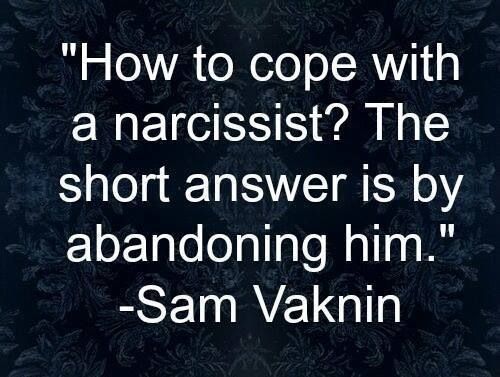
I definitely believe No Contact is the ONLY viable way to “handle” a narcissist. I don’t hate narcissists per se, but I hate what they do. Even if you sympathize with the “lost true self” living deep inside every narcissist, that doesn’t take way from the fact they are extremely dangerous people and will use everything in their power to destroy your reputation, your self confidence, your sanity, and even your life if you allow one to get too close to you. Going No Contact is not an act of hate or retribution; it’s an act of survival for yourself and your children if you have any.

no_contact2

While there are some situations where going completely No Contact may not be possible (for example, if you have children with a narcissist), then go for the next best thing–Very Low Contact. That’s the kind of relationship I have with my ex. I only have dealings with him when I must–when information about our two adult children needs to be communicated. Other than that, I refuse to deal with him at all.

But I think in most situations, No Contact is not only possible, but is necessary for your recovery and happiness. It doesn’t matter if it’s your mother or other close relative. Don’t feel guilty. Hell, they never did when they abused you!

So that’s where I stand on the matter, in case there were ever any doubts.

No Contact is always best.