Guest Post: Descartes and the Killer Bees (by Anna Girolami)

rene_descartes

A reader named Anna Girolami (she has a blog called Good Red Herring) emailed me wondering if she could write a guest post for this blog.    I felt honored that she wanted to do this!  The post she wrote is definitely out-of-the-box and thought-provoking and has some intriguing ideas about handling people with various personality disorders, especially the Cluster B’s. I had to laugh at the reference to the “Killer Bees” (and will overlook the fact that technically, I’m included in this category, but since I’m recovering or maybe already recovered from BPD, maybe not).

I do want to add a disclaimer, however.   Anna’s thoughts about “managing a narcissist (or other disordered person)” are interesting, but I don’t think it would be wise in most situations, at least not for any length of time, and certainly not for any malignant narcissist or sociopathic personality.    No Contact, is of course, ALWAYS the best way to “manage” a narcissist, but there are situations where going NC may not be feasible.   In those cases, there is a technique known as “grey rocking,” which basically means being so mind-numbingly boring to the narcissist they go elsewhere and leave you alone.  Even that doesn’t always work, but I don’t think it’s really feasible to “manage” a disordered person without doing damage to yourself.  I think to try to manage a narcissist or another person with a personality disorder in this manner would prove extremely exhausting at best, and soul killing at worst.  Essentially, it means providing them with narcissistic supply!  So I don’t recommend it, but perhaps it’s something you can try if all else fails. It might work for the non-“Killer Bees” like the obsessive-compulsive or dependent PDs that Anna mentions; I’m not sure though, since I’m not as familiar with the Cluster C category of personality disorders.

That being said, I do see Anna’s logic here, and perhaps with a narcissist who isn’t very high on the spectrum or someone with a different personality disorder, this type of management might be an option.  Or, it might work in a pinch, when you can’t get away but you’re only with the disordered person for a short time, say at a party or a meeting.  It might work on a boss, too, if you really don’t want to leave your job and grey-rocking might seem too rude. (Never tell your Histrionic boss they’re sexy, though!)

Descartes and the Killer Bees.

By Anna Girolami

Blog: Good Red Herring

fish_logo

René Descartes is regarded by many as the father of modern western philosophy. For most of us, he boils down to a single, famous phrase:

Cogito, ergo sum (I think, therefore I am).

A lot of disordered people, however, operate on a variation of this theme. I’m talking about Cluster B people – the Killer Bees. They don’t think, they really don’t want to think. That’s the last thing they want to do. No, their being depends upon something else:

Videor, ergo sum (I am seen, therefore I am).

Equally important to them, is the flip side:

Non videor, ergo non sum (I am not seen, therefore I am not).

One of the hallmarks of disordered people is “splitting” – the simplistic belief that things are either completely wonderful or completely dreadful. Anything more ambivalent than that is just too difficult to deal with.

For our Killer Bees, this habit of splitting combines with the above dictum in a catastrophic way. They can admit only two possibilities – either the whole world is watching them and thus they are alive or no-one at all is watching them so, arrrrgh!, they cease to exist.

Given that very terrifying choice, which one would you go for? A Killer Bee has no real option but to cling desperately to the belief that every single person in the world is watching them for every second of the day. It’s either that or existential obliteration.

This belief requires that – consciously or not – they beat down any aptitude for empathy that they may have. Iris Murdoch (who was a philosopher before she was a novelist) nailed this when she said “Love is the extremely difficult realisation that something other than oneself is real.”

I take some issue with this as a definition of love. As a definition of empathy, however, it’s absolutely bang on.

The proper acknowledgement of other people’s autonomy and identity is a highly evolved function – one that many people seem unwilling to develop, on the very understandable grounds that it would deprive them of a great deal of secondary gain.

A Killer Bee cannot afford to acknowledge that anyone else is real. Even those – especially those – they ought to love the most. Other people are merely robots whose only function is to watch the Bee and thereby preserve them from extinction. Ideally, they should watch and approve. But even watching and disapproving is better than nothing.

What the watch-bots simply cannot be allowed, is any independent thought or action or intent of their own. That would mean they might stop watching the Bee for a while and then the Bee would cease to exist.

For a Killer Bee, it really is that simple – and that important.
Non videor, ergo non sum.

*****

If you’re married to or in some other way entangled with a Killer Bee, it is futile expecting them to notice you, support you or in any other way treat you as if you are real. They can’t do it. Not without professional help and not unless they want to. Very, very few want to – why should they give up this way of living that means lots of lovely attention and never having to think about anybody else?

So, what do you do? If your Killer Bee is of the mild-to-moderate variety, you have three choices:

1. Suck it up, suck it all up.
2. Ditch ’em.

Or..

3. you can manage them.

If you can’t/don’t want to ditch them, it seems obvious that your best option is to manage them. They’re quite primitive machines and, if they’re not too far gone, it is possible to manage them once you understand the clockwork. Oh sure, it makes you seethe, having to “manage” an adult, simply to stop them behaving like a three year old with low frustration tolerance. But it’s either that or suck it up, suck it all up.

Remember: videor, ergo sum.

Each variety of Killer Bee needs to be seen in a slightly different way.

–The Narcissist needs: “I see you, darling, you’re amaaaazing.”
–The extraverted Histrionic needs: “I see you, darling, you’re sooo sexy.”
–The introverted Histrionic needs: “I see you, darling, you’re so pretty but don’t get up, you’ll spoil the effect. Just you sit there and look perfect, I’ll do everything.” Or something like that.
–The Obsessive-Compulsive (OCPD, not OCD) needs: “I see you, darling, you’re trying so hard.”
–The Dependent or the Borderline needs: “I see you, darling, don’t worry. I’m here, I’m always here.”
(Yes, I know obsessives and dependents aren’t technically in the Cluster B group, but they often wander over into their territory.)

If you don’t know exactly which type you’ve got, just go with “I see you, darling, you’re wonderful.” That will keep most of ‘em happy, it’s the seeing that really matters. When Killer Bees are happy, they can actually play quite nicely.

This sounds easy enough but here’s the thing – you have to do it all the time. Every waking second of their day, or near enough. Once a week simply doesn’t cut it.

Remember: non videor ergo non sum.

They genuinely feel that if they are not sufficiently seen, then they don’t exist. When that happens, anxiety quickly overwhelms them. The narcissist will rage and belittle you, the histrionic will weep, the obsessive will sulk. Whatever.

It’s exhausting (and maddening) to have to supply this amount of constant watching with, inevitably, no reciprocation. It is, however, less exhausting than the tantrums. It may help if you realise that it doesn’t always have to be you who does the watching. They’re not fussy, these people. No one is real to them. One watch-bot is as good as any other.

So if you can do it reasonably, consider offloading some of the watching duties onto others (although not onto your children, that’s absolutely not supposed to happen. It’s a tragedy that it so often does). My own particular Killer Bee, an Obsessive with a heavy histrionic topcoat, is good at running, so I encourage him to enter as many races as he can. When he does well (which is usually. He’s an obsessive, after all), he gets a big chunk of lovely watching and approval from a whole host of other people – and I get a bit of time off. Its almost win-win.

Our holidays aren’t very restful though.

Have a great week,
Anna

My stupid ego stands in the way of empathy.

pride_humility

There’s been something on my mind that’s been bothering me a lot, but I’ve hesitated posting about it because it makes me sound like a terrible person.  But I’ve always aimed to be honest on this blog, so I’m not going to make an exception this time.

A few weeks ago, I made a new online friend.  She’s in a severe depression right now due to receiving some bad news. She was so grief-stricken she had to go into the hospital and get treated for her depression.   Since then she’s been confiding in me by email, because she’s too shy to publicly comment about her situation.   For about a week or two, we corresponded almost daily.   Our emails to each other were long and deeply personal, and they proved therapeutic for me as well as for her.

I’m no therapist, but I’m always willing to correspond via email and try to direct people to the proper resources or actually help them directly if I can.   I felt like I could relate to this woman; I identified with a lot of her issues. She said she felt the same way about me.  I began to think of her as a friend, someone I cared deeply about, even though we never met and we’d only been corresponding for such a short time.   I felt a great deal of empathy for her situation.  These empathic feelings are  something rather new for me, because only recently I was too busy working on my own issues and trying to recover from my own trauma that I didn’t have the time or inclination or even the ability to really be able to empathize with anyone else.   Lately though, I’ve been rediscovering the empathy I possessed so much of as a child, and it’s a beautiful and wonderful thing.  I want it to keep growing because it makes it easier for me to connect with people and makes it possible for me to be authentic and help someone else in need, which is what I’ve been aiming to do more of.

My new friend told me that writing to me helped her a lot, and I was extremely touched by this.  I told her she was helping me too, which is true.   I began to look forward to her emails, because, well, the things she told me made me feel good.   I felt my ego puffing up with pride like a loaf of baking bread.   I began checking my inbox several times a day to see if there were any new emails.  I was getting a little obsessed, to be honest.  I was jonesing for that feeling of being needed, of feeling like I was important to someone, of knowing that someone I liked and cared for valued me that much.

I haven’t heard back from her in a few days.  Now I’m becoming insecure and hypervigilant and wondering if I said something wrong or overstepped her boundaries or if she just got tired of writing to me.    I kept reading over our emails trying to find anything, any hint at all, that I might have said something offputting that ran her off or made her want to stop emailing me.   I found nothing but obsessively, I kept looking.

After 3 days of no correspondence, I finally emailed her again.  I was extra careful not to sound too needy, and because she’s so fragile right now and came to me for help (and not the other way around), I tried extra hard to not to project my own “stuff” into my email to her.  I read it over several times and it sounded alright to me, but I still worry she may be able to pick up on my neediness.

I realized with horror that my worry about her possibly abandoning me was more powerful than my concern that she might have had to go back into the hospital (or just couldn’t get online, or was busy, or whatever).    My insecurity made my email sound more stilted and less natural than usual.  I no longer feel like I can be as open and honest, because of my own stupid fears of being offensive or overbearing and making her think badly of me.  It isn’t her fault I feel like this–it’s my own ego getting in the way of the real empathy I have for this person.

This happens to me all the time, and is one of the reasons I’ve sometimes thought I’m actually a narcissist.  Everything is always about me, my ego, what other people are thinking about me, am I being validated, am I still valued by them, are they going to leave me, do they secretly hate me?  Even when all the evidence is to the contrary, I still look for the microscopic speck of dirt in my bowl of ice cream–and always find it even though it isn’t really there.

Yes, I do have empathy–and a lot more of it has been freed to me lately–but when there’s any uncertainty or insecurity and I begin to feel hypervigilant and paranoid.  I start fretting that maybe I’m being deliberately ignored or God forbid, abandoned, and all that wonderful, healing empathy I’m learning how to use goes flying out the window and everything becomes all about me and my stupid ego again.

I still care about this individual and want to help her, but I want my empathy to flow naturally and my ego to stay out of it, because all that does is fuck everything up.  I’ve been praying for this to change, because how can I ever really be of help to anyone else if I’m always worried about what other people are thinking about me?   This isn’t about me; it’s about her and trying to help her heal, not getting some sort of ego boost for myself.

I’m not going to email her again.   I’ll just wait now, and if I never hear from her again, I can live with that.   Maybe she got what she needed from me–the encouragement she needed–and that should be enough.   I hope she is okay.

If nothing else, then I have learned a hard lesson about pride and ego: pride comes before the fall.  True empathy requires humility and the ability to set your own ego outside the door.

The Scorpion and the Turtle

I love this old fable. The scorpion can be compared to the Narcissist. It will sting you because it’s in his nature.

Comments are disabled; visit the original post to comment.

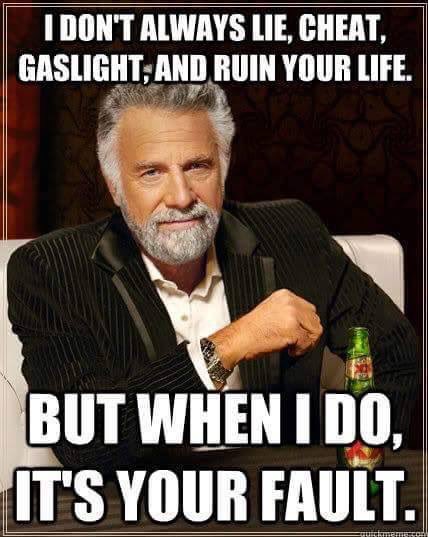
It’s always your fault!

narcissist_meme

Thanks to my friend Nikita for this meme!


Lightning Rod

Interesting thoughts here about Taylor Swift, probably the biggest megastar he music world has ever seen. I have to confess a liking for her music. I’ve always liked her music. Taylor isn’t the best singer but I rather like the wobbly vulnerability of her vocals and no one can write catchier songs. For several years (when she was a “country” artist) she came across as this sweet, innocent victim-type of girl, a girl moms didn’t mind taking their 12 year old daughters to see. But I always suspected something a little off about Taylor–that she wasn’t quite what she seemed. Is Taylor a psychopath or is she just a narcissist? I think a little of both.

Whatever she is, who would have grokked that this virginal girl next door who sings songs about love gone wrong was really a card carrying member of The Dark Triad? But that’s what psychopaths and narcissists are best at: putting on masks.

nowve666's avatarCLUSTER B

Taylor Swift

everyone’s favorite fantasy…

blank_spaceWhen I was a teen, I made some gay friends. We would watch TV together and this one was gay and that one was gay. Celebrities are almost always a repository in which to dump our own “stuff.” But nobody seems to fulfill that role better than Taylor Swift. According to various opinions, she is a really nice, unpretentious gal whose talent made famous, a danger to the morale of the country, a psychopath or a member of (victim of?) the Illuminati.


Taylor Swift, the Psychopath

View original post 613 more words

One way to peg a narcissist you probably never heard of.

finger-pointing

It may sound ridiculous but I think this is a good way to judge a person’s character without their suspecting anything.

Chatter about movies, books, and other forms of entertainment is a standard ice breaker (and is part of the dreaded “small talk” we introverts hate so much), usually used to make polite conversation with someone you don’t know that well (of course, these things can be discussed more in depth too with closer friends and loved ones).    Movies, books, TV, and public figures are safe conversation starters.   You can talk to people about these things without seeming to cross anyone’s boundaries or getting too personal.

But such seemingly innocuous conversations can also help you peg whether or not a person is a narcissist or sociopath–without them suspecting a thing.  When you meet a new person, ask them the way you would ask anyone about movies they’ve seen and books they’ve read, and then ask them whose side they were on, or which characters they most identified with.   Of course, you must be familiar with the movie or the book, including its main characters.   Television personalities and other public figures will also do.

Narcissists can feel empathy for other narcissistic characters–characters that are like themselves.   I’ve noticed they will often feel empathy for the villain, rather than the hero/heroine.   A narcissist woman, for example, will feel simpatico with a villain like Beth Jarrett from Ordinary People, and think her behavior toward her son wasn’t that bad–she may even think he deserved it and find Jarrett’s justifications for abusing him valid.    My mother found nothing wrong with her behavior and was puzzled as to why I found it so triggering and upsetting.  (Of course I didn’t tell her why).

My mother also couldn’t understand why the the “Queen of Mean” hotelier Leona Helmsley was given such a hard time in the press over her arrogant statement, “We don’t pay taxes, only the little people pay taxes.”   She also identified with Sherman McCoy, the narcissistic, selfish, and greedy investment banker in the novel Bonfire of the Vanities, who wound up losing everything due to a chain of events stemming from a hit and run accident which McCoy was involved in.  I remember her lamenting almost tearfully about how “his beautiful life was ruined” by the events that played out in the novel.    She also couldn’t stand good, sweet Melanie, from Gone With the Wind.   I suppose Melanie could come across as a tad simpering and holier-than-thou, but my mother hated her.   The heroine of that same movie, Scarlett O’Hara, is more than a little narcissistic (or possibly Histrionic?)–charming, flirtatious, manipulative, entitled, and possessing very little empathy.  She didn’t even seem that upset when her own daughter, Bonnie, died after falling off a horse.    I never understood why Scarlett has been such a huge role model for generations of women.   She really didn’t have too many redeeming qualities when you think about it.

A  man (or woman) with NPD or psychopathy might identify or sympathize with any of Ayn Rand’s psychopathic heroes–Howard Roark from The Fountainhead or John Galt from Atlas Shrugged come to mind.   Of course, these are popular books, especially among conservatives–but holding these two highly narcissistic men up as worthy of worship might be a red flag.   Be wary of such a person.

My ex, a sociopath who has been diagnosed with Antisocial Personality Disorder (but is really a malignant narcissist) always liked villainous characters, especially if they broke the law.  He often rooted for the bad guy (or sometimes, girl) and the more ruthless or cruel they were, the more they seemed to enthrall him.   He likes Charles Manson.   He watched South Park because he thought the sociopathic Eric Cartman was so cool.  He also rooted for the alien in Aliens.   In addition to that, he likes satanic and demonic imagery, which always disturbed me, even when I was agnostic.     We all have a touch of schadenfreude and many normal people (including yours truly) have a fascination with serial killers and other outlaws–according to Jung, that’s because we all have a shadow self that’s drawn to dark things.  But there’s a difference between fascination or morbid curiosity and actually liking these things or identifying with or sympathizing with villains, malignant narcissists, and antisocial people.

So if you’re on a date with a new person, have them take you to a movie (or take them to a movie) and see who they seem to identify with or sympathize with the most (or who they seem to dislike the most).   It could tell you a lot about that person’s character.

Losing the false “I’m unlovable” scapegoat baggage

Katie has done it again! I could relate to every single word in this post. I could have written this myself.  There’s no need for me to editorialize any further.

Please leave comments on the original post.

There Is A Need For This-the things no one will tell you

Rubycommenting just started a blog about narcissistic abuse and being the family black sheep. Not much is there yet, but there are a couple of posts already and I want to get the word out and help her get some followers. 🙂

Congratulations on your new blog, Ruby! I think you will find that blogging will bring you a lot of clarity and understanding and it feels so great to know you’re helping others too.

Now Rubycommenting can change her handle to Rubyblogging! LOL!

Comments here are disabled; please comment under the original post.

There should be no “shame” in having a Cluster B diagnosis.

noshame

Yes, another potentially controversial post.  Please hear me out before judging.

There are some (actually, many) people in the blogosphere who believe that people with disorders like Borderline or Narcissistic Personality Disorder made some kind of conscious choice to have their disorder.   With unusual exceptions (which I’ve discussed in others posts), I think this is wrong.

Bad seeds?

People with Cluster B disorders, in spite of what you probably read or heard, aren’t inherently evil or “bad seeds.”   Certainly, some become evil, because they’ve been programmed for a psychological need to obtain narcissistic supply in order to feel like they exist.  In order to get that supply, they became abusive and manipulative.   People addicted to drugs or alcohol are also abusive and manipulative, in order to get their chemical fix.

People with psychopathy may have been born without the brain capacity to feel empathy or have a conscience, but I don’t think Psychopathy should even be categorized as a Cluster B disorder at all, since it seems to have its roots more in brain chemistry than in early trauma.   Plenty of psychopaths came from normal, loving families.  The jury’s out as to whether Antisocial Personality Disorder is the same thing as psychopathy.  I think they may coincide often and their symptoms are similar, but I’m not at all sure they’re the same thing.    I don’t know a whole lot about ASPD, but I think it, too, usually has its roots in trauma as a child.   I know almost nothing about its treatability, but it’s my understanding it’s very difficult to treat, even more so than NPD.    But I digress:  talking about ASPD or psychopathy is not the point of this post.

Another blogger who commented on a post of mine today mentioned that she may have undiagnosed, recovered BPD.   I sensed from the tone of her admission that this might be something she’s  ashamed to admit.   I wondered why.   BPD, like NPD, has a terrible stigma, although in its favor, there’s a movement in the BPD community to reduce its stigma as “evil” and “incurable.”    Their efforts seem to be working, because BPD is seen today as being less of a “mark of the beast” than NPD is, although the stigma certainly still exists.

Why no anti-stigma movement for NPD?

I’m not sure why there is no grass-roots movement among narcissists to change the stigma against NPD, but from everything I’ve read from self-aware narcissists (and you’d be surprised how many of them there are online), they’re either: (a) proud that they are narcissists and wear the “evil” stigma like a badge of honor (these tend to be malignant, overt narcissists with antisocial or sociopathic traits), or (b) *this is a shocker* so ashamed of their narcissism that although they hate the stigma, they seem resigned to it and and seem to hang their heads in shame, quietly accepting how “bad” they are.  “I deserve it,” they say.   It may seem hard to believe, but some of them even defend the narc-haters.  Remember we are talking about self-aware narcissists.  Most narcs never get to that point.   Their grandiosity keeps them from having enough insight to do that.

Ego-dystonic vs. ego-syntonic.

Because people with BPD are almost always ego-dystonic about their disorder (they aren’t happy with themselves), and because generally BPD doesn’t lend itself to self-delusions  (in other words, having a false self) the way NPD does, BPD has a higher cure rate than NPD,  which also helps reduce its stigma.    NPD is usually more ego-syntonic, but not always.  Narcissists who are ego-dystonic (usually covert narcissists) tend to be frustrated, lonely, and depressed, and although they can be highly manipulative, entitled acting, and lack empathy, they lack the grandiosity and false pride that keeps them stuck in the delusion that their narcissism has worked for them.

I don’t see a whole lot of difference between BPD and C-PTSD.  Actually, BPD is like C-PTSD on steroids.  I’ve written about this subject before–the symptoms of both are nearly identical, and both Borderlines and people with C-PTSD are very prone to become codependent to malignant or overt narcissists.   They are also prone to self-harm, wild mood swings, and are sometimes suicide risks.  People with C-PTSD–especially women–often get slapped with the stigmatizing BPD label simply because the DSM doesn’t recognize C-PTSD as a legitimate disorder (and PTSD, while similar, applies more to those who suffered a single, intense trauma rather than the victims of chronic, long term abuse starting in childhood, so the treatments for someone with PTSD would be different).

Moving back to narcissism…

Many people believe NPD cannot be successfully treated, much less cured.   I admit I’m skeptical about its curability, though I do know there have been a few cases where it’s happened.   I also know there are narcissists who are ego-dystonic and unhappy with what they’ve become, once they realize they are narcissists.   I don’t think the adage that “if you think you have NPD, then you don’t” is necessarily true.    I have met a few here and on forums who desperately want to change their behaviors, usually because they’ve realized that they’ve missed out on things like knowing how to love and receive love, or having a healthy relationship with their spouse or children.   They want to know what love and vulnerability in a relationship feels like.  They want to know what real joy and empathy feels like.   They forgot how.   They’ve come to realize their lives are empty and shallow, and they are constantly under the stress of always having to act a part in a play.   They forgot who they were a long time ago.   Most narcissists did not have happy childhoods and most had parents who either abused or spoiled them (spoiling is a form of abuse because it fails to mirror who the child actually is, so the “love” they get is conditional).

As a mental illness.

I’m in no way defending narcissists or the way they act.   But as a cluster B disorder,  it started as a defense mechanism to cope with unbearable pain and feelings of emptiness. Many people believe narcissists love themselves, but nothing could be further from the truth.  They only love their false self.  Scratch any narcissist and you find a person who doesn’t even know who they are.  BPD is much the same that way, except Borderlines don’t have a functional or strong false self.    I’m not suggesting sympathizing with active, unrepentant narcissists or condoning their toxic behaviors. I’m not suggesting staying with one either!   But I think the stigma against NPD has hurt those people with the disorder who sincerely want to change.  These people do exist!  I don’t think they’re lying when they say they want to become non-narcissists–why would they? What would be their motive in doing so?   Much as with people with BPD, therapists refuse to treat them, insurance won’t cover them, and they are frequently demonized as non-human creatures or worse.

Maybe the treatment rate for NPD is so abysmal because they are given up on so easily by therapists who lose patience with someone who doesn’t show immediate improvement or acts aggressively or in a confrontational way.    NPD is a very difficult disorder to treat, but that doesn’t mean it isn’t possible.  Even if a narcissist can’t be cured, CBT and other mindfulness therapies have had good results on some narcissists who really want to change the way they treat others and have more mutually fulfilling relationships.  DBT (dialectical behavioral training), a mindfulness therapy similar to CBT traditionally used on people with BPD, has also been shown to be effective on some people with NPD.

As a Borderline myself (my therapist thinks I’m recovered, but I’m not at all sure about that), and having personally experienced the stigma against Cluster B, I have a great deal of empathy for anyone with a Cluster B disorder who is self aware and genuinely sorry about the way they’ve treated others or the choices they’ve made, and who sincerely wants to do the hard work needed to make changes in themselves.   People with Cluster B disorders didn’t choose to become that way; like people with C-PTSD, they have a mental illness caused by trauma and C-PTSD is almost always at the core of any cluster B disorder.

While it’s true that some will never get to the point of self awareness or even if they do, may not be interested in finding new and better ways of relating to others and the world, there are many who do, and we shouldn’t judge them or hate them just because of their stigmatic diagnosis (and the diagnosis could be wrong anyway!).  That’s why I don’t run a “narc free” blog.  I allow people with Cluster B diagnoses–including NPD–to post comments on this blog and share their experiences along with others who do not have those disorders and were abused by people who do.  As long as they don’t attempt to upset or trigger non-Cluster B abuse victims and remain civil and add to the conversation, they are always welcome here.

Scapegoat child of a narcissist.

Image

scapegoat_meme