The Pooooor Narcissist

Do you know a “do gooder” who always somehow makes you feel guilty and less saintly than they are? Everyone knows someone who plays the martyr. Do you know a Needy Nancy or Ned who has an endless litany of problems that never seem to go away? Do they get mad at you when you try to help because your help isn’t good enough or is the wrong kind of help? Do you know someone who never apologizes, never admits wrongdoing, and never even says thank you when you offer help? That “victim” may actually be a narcissist. How can you tell the difference? Red flags. Gaslighting. Manipulation. Guilt trips. Projection. Blaming. They are never wrong but you always are, especially if you dare to suggest their problems may be their own fault. You can’t win with one of these characters.

This article describes the covert type of narcissist, who can be much harder to spot because they aren’t arrogant, grandiose and in your face. They’re good at what they do, so it pays to be vigilant.

graceformyheart's avatarGrace for my Heart

It’s Narcissist Friday!     

N – Get off the road, stupid idiot! That guy drives just like your brother!

You – Why do you say such mean things? It isn’t like you are a perfect driver.

N – What complaint do you have with my driving? You are always criticizing me. I have to be perfect before I can say anything anymore.

Then, when you get home:

N – Well, you can breathe now. I didn’t say anything mean and we got home without an accident. If you still think you can handle such a mean person, you should probably drive tonight when we go out. That way you can feel safe. Maybe I can sit back and criticize your driving.

Ever notice how the narcissist can become the instant victim? I used to have a relative who could say anything, accuse of anything, or criticize anything. But if…

View original post 628 more words

Fight with a narcissist? Yeah, right!

Don’t waste your time fighting with a narcissist. You lose even when you win. They will never admit defeat. Read on.

graceformyheart's avatarGrace for my Heart

It’s Narcissist Friday!    

(I am aware that this blog continually attracts new readers.  With somewhere around two hundred posts on narcissism and narcissistic relationships, it can be challenging for anyone to really use this material.  The search function works very well, if you know what to ask for.  Otherwise, we will all have to wait as the blog posts are sorted and categorized in preparation for a new (and exciting!) website.  So for the next few weeks, I want to dig back into the archives to pull out some of the posts that seemed most helpful over the last few years.  Please feel free to comment.)

In my recent post on living with a narcissist, I suggested that you must be prepared to fight.  What I meant was that the conflict doesn’t seem to end.  It isn’t “knock-down, drag-out” fighting as much as it is a constant barrage…

View original post 705 more words

7 common habits of narcissistic pet lovers

Here’s a humorous look at the 7 ways narcissists can be AWESOME pet parents. This listicle from Getleashedmag.com isn’t intended to be taken TOO seriously, but there’s truth here too.

My malignant narcissist ASPD ex, who should be locked away and not allowed to get within 100 feet of any human, is actually the first person I would trust with my kitties should I ever have to leave them for a few days. He despises people (and admits it) but seems to genuinely love animals.

7 Common Habits of Narcissistic Pet Lovers
Wonder if it’s possible to love your pet and be a narcissist? Of course it is!
By Leslie Phelan

Narcissist3-720x340

There is a misconception about narcissists that says they’re way too into themselves to properly love an animal companion, but there’s a special breed of narcissist whose condition includes room for animal love. Sound like you or someone you know? Read on:

Narcissists love two things: themselves, and anything that could be used as extensions of themselves. What better self-extension than a cute and adorable furry thing that will love you back unconditionally?

Do you express love for your pet in a way that might look to others like evidence of an overly narcissistic lean within your personality? Observe yourself (you know you want to); and see if any of these key narcissistic pet lover indicators point at gorgeous little you:

1. Is your appearance everything?
Do you try on three different jacket-hat combos before stepping out, even to the park? Do you color-coordinate the dog’s collar with your scarf?

2. Are you obsessed with your own reflection?
Do you hold your cat in your arms over the bathroom vanity and compare the flecks in your eyeball irises for extended periods? When you walk past windows with your dog on leash, are you always glancing sideways to admire how lovely and magazine-ready you two look?

3. Do you use your pet as a prop to justify yet another selfie?
You know the drill: scoop up the animal, pose pretty, take a few snaps, choose the best one and post it with a caption about the animal, when really it’s to show off how adorable you look WITH said animal. C’mon . . . we’ve all been here. And the pics are priceless.

4. Do you make everything about you?
Do you listen with the intent to respond, more than with the intent to understand? When someone is talking about a cute thing their pet does, are you bursting at the seams to trump their story with a better, cuter, more special story about your own?

pet_selfie

5. Do you bring your pet along, even at less-than-appropriate times?
Most people will agree that it’s the more the merrier when it comes to dogs at parties, but do you ever find yourself purposefully ignoring hints that you maybe shouldn’t bring your pet along?
Of course you want to bring your pet because, well, attention! Plus, you don’t want to rush home if you had to leave your dog behind due to that person’s silly baby with the possible dander allergies. Pfft, the kid’s gotta get used to dog hair sooner or later . . .

6. Are you loud?
Are you constantly standing on a soapbox because you actually think people care about yours and your pets’ diets/favorite shows/the glowing review your yoga instructor gave you? Do you have loud, full conversations with your dog for all to hear? (Bonus points if you do it in another language, or in a sing-song voice.)

7. Is everyone a potential rival?
Do you get jealous if you hear another person in the park compliment someone’s dog before yours? Do you feel like you and your pet are in constant competition with your friends, relatives and their pets? Be honest: is no one safe from your sense of rivalry?

***

This is not a place of judgment; any honest pet owner wont pretend they haven’t teetered on the brink of most of these points a few times. A bit of narcissism can be good, it keeps us caring for ourselves and can make us our best selves! Embrace it, but try not to burn up too much of your energy trying to be the hottest, richest, cleverest, most stylish, most popular and successful person in the world…

Instead, focus on being the most humble, courteous, patient, kind and complimentary person you can be. Or, likewise, just be the person your pet thinks you are – that person is pretty exceptional.

Grumpy old men: narcissists in old age.

grumpy_old_man

It’s been said narcissists grow worse with age. As they lose their looks and mental acuity and become less sexually desirable and more unemployable, they lose the ability to attract the supply they need to feel like they exist. Most will fall into deep depression and a few might even commit suicide. Growing old and having to confront one’s own mortality is the ultimate narcissistic injury. The only thing they have left to obtain supply is their advanced age itself.

Some will become the stereotypical “get off my lawn” grouchy old man or woman, demanding their entitlements (or what they think are their entitlements) be met, no matter how unreasonable. They don’t bother with “charm.” They don’t even try to hide their self-centeredness or contempt for others anymore or make any attempt to be “nice.” They’ve given up playing the games they used to attain supply when they had their youth, looks, and health. They know they have nothing they can use anymore to attract respect, admiration, adulation, and attention, so they just demand and yell and cuss and bully other people to get it, using their age as an excuse to be mean.

get_off_mylawn

These are people who reach the age of 70, 80 and 90 and are still emotional 3-year-olds. They are filled with hate for the world and for what has been done to them to make them that way (unresolved childhood trauma), for what they have become, and regret for what they never could be. They project their self-hatred onto anyone who crosses their path.

I read this description of what one old narcissist was like. It’s sad but all too true. I’ve known people like this. I see my ex becoming one.

I’ve seen old narcissists. I used to see a 72’ish guy at the grocery store. It was awful. He would angrily force himself to the front of the line. Each person he pushed in front of and angrily exclaimed “I only have 3 things” was as much a source of supply as the supply I would extort through more elegant means. He was down to the point of just taking it. The more people acted startled and offended, but withheld their protests due to his age and frailty, the more he felt he existed.

He would reach the cashier and then insist that the price is wrong, putting the cashier in the position of holding up all those kind folks he cut in front of. It’s not his fault they’re being inconvenienced. Then he’d demand a new “shopper/loyalty card” to get the discounts — why saying “I don’t want it, throw it away.” Too important to be bothered with carrying a card like everyone else. Probably some long-held criticism that stores should just charge the same price for everything and not do the “member price” gimmick. Something he could criticize in the past, now something he could incorporate into his bitter existence.

He would then contemptuously instruct the cashier to take the coins from his hand because his fingers are knurled from arthritis. Projecting onto the cashier his own contempt for his body failing his grandiosity. As he walked away, he would throw his receipt on the floor as if he had been intentionally offended by receiving it.

On people pleasing.

people_pleasing

I think most of us who were exposed to narcissistic abuse for any length of time learn to become people pleasers, always deferring to our “betters” (the narcissists) and becoming human doormats. People pleasing is known by many terms, but “codependent” in particular comes to mind. It’s an extremely unhealthy way to live.

All my life I’ve been a people pleaser. ‘ve always been terrified of saying “no.” I’ve always gone along with things I didn’t like just to keep the peace. The problem with being a people pleaser is that it tends to attract further abuse (they know we’re pushovers so they’ll up the ante); and potential abusers can “smell us out.” People pleasing also never really pleases anyone. Someone is always going to be displeased, even if it’s only ourselves. Chances are, the person you’re trying so hard to win the approval of is going to find something wrong with what you’re doing for them anyway, especially if they’re narcissists.

People who try too hard to please everyone–like politicians who can’t commit fully to either liberal or conservative stances because they’re too afraid of the disapproval of either side, wind up alienating everyone. It comes off as insincere–and it is. You just know they’re hiding something.

people-pleaser

I remember the first time I realized how fake I was being while engaged in people-pleasing. I was about 9 or 10. We were visiting some relatives in another state and my uncle had a collection of decoy ducks he was very proud of. I could have cared less, but because I’d been raised to always be polite, I faked intense interest in his hobby. In fact, my “act” was so extreme he really thought I was interested and kept talking to me about his ducks even though I wanted to scream at him to shut up already. It’s fine to be polite and civil, but I was so afraid he would “discover” my boredom with his hobby that I went above and beyond-and felt absolutely disgusted with myself later. Of course that didn’t stop the people pleasing. No one living in constant terror and shame the way I did would be able to stop.

Freedom from the “people pleasing” game where you always wind up losing doesn’t mean not helping others or being cold and selfish. People pleasing is very disordered and even narcissistic in itself–because you’re trying to please others to get approval or love, not because you really care about their feelings or well-being. You don’t need empathy to be a people-pleaser, just a weak and beaten down ego that makes you grovel like a dog for a treat. People pleasing is actually a central feature of several personality disorders–BPD, Avoidant PD, Dependent PD, and Covert Narcissism.

Unlike people pleasing, true caring and altruistic feelings for others are not about pleasing people–they’re random acts of kindness that come from an authentic and confident person’s heart, and nothing about it is fake. I’m working toward this too. Right now I’m still caught up in the fear of displeasing anyone and the ramifications that has for me. It’s very self-centered.

In summary, people pleasing is about lies–it’s all about trying to boost a shaky self esteem and it’s about as fake and inauthentic as you can get.

Does excess praise and spoiling create narcissists?

mini_me

Many experts, including Sam Vaknin, think spoiling a child or pouring on excess praise (placing them on a pedestal) is actually a form of child abuse, because it does not mirror the child as who they really are, but as who the parents wish them to be or believe them to be. Children not mirrored appropriately, whether excessively criticized or excessively praised, grow up unable to form a viable true self and are vulnerable to developing disorders of the self, especially NPD.

The following article explains in further detail why excessively praising a child can actually hurt their self esteem, rather than help it develop normally. It also describes the two types of praise–one that builds self esteem because it takes a child’s effort into account (“you worked hard to win that contest” or “you showed a lot of dedication in getting those A’s”) and one that fosters narcissism because it implies inherent superiority over others (“you’re the prettiest girl in school” or “you’re the smartest kid ever”).

Do Parents Nurture Narcissists By Pouring On The Praise?
By Poncie Rush, for NPR.org

When a kid does something amazing, you want to tell her so. You might tell her that she’s very smart. You might tell her that she’s a very special kid. Or you might say that she must have worked really hard.

On the surface, they all sound like the same compliments. But according to Brad Bushman, a communications and psychology professor at Ohio State University, the first two increase the child’s chances of becoming a narcissist. Only the last one raises the child’s self-esteem and keeps her ego in check.

Bushman and a group of collaborators surveyed parents to see how they show warmth and value their child’s accomplishments. They then compared those findings to the children’s levels of self-esteem and narcissism. The results were published Monday in the Proceedings of the National Academy of Sciences.

Of course, self-esteem and narcissism are two very different things. The difference has to do with how you value yourself compared to other people. “Self-esteem basically means you’re a person of worth equal with other people,” Bushman tells Shots. “Narcissism means you think you’re better than other people.”

And not in a good way.

“Narcissism is a somewhat toxic personality trait,” Jean Twenge, author of The Narcissism Epidemic and psychology professor at San Diego State University, tells Shots. Narcissists tend to overestimate their abilities, take too many risks and mess up their relationships, she says. Some people see narcissists hurting the people and society around them, but they hurt themselves, too. “In the long term it tends to lead to failure,” Twenge says.

While narcissists tend to have high self-esteem [my note–this is not true], not all people with high self-esteem are narcissists. Bushman needed to separate the two. So he asked children ages 7 to 12 years old how they felt about statements like “Some kids like the kind of person they are,” or “Kids like me deserve something extra.” The first statement measures self-esteem; the second, narcissism.

Bushman made sure to focus on children between 7 and 12 years old, so that by the time the study finished all of them would be older than 8. “You can’t measure narcissism in children before age 8, because every child is a narcissist,” he says. If you ask younger kids in a classroom if they are good at math or good at baseball, Bushman says all the kids will raise their hands.

Then he surveyed the children’s parents, asking them to respond to statements to determine whether they overvalued their children. For example, “I would not be surprised to learn that my child has extraordinary talents and abilities,” or “Without my child, his/her class would be much less fun.” And he asked how they expressed warmth toward their child by measuring how strongly they agreed with statements like “I let my child know I love him/her.”

child_on_pedestal

When he analyzed the results from the surveys, Bushman found that the more narcissistic children had parents who consistently overvalued their accomplishments. He ran additional tests to make sure that the parents weren’t narcissists, too — after all, it’s possible that the children could be mirroring narcissistic behavior. But statistically, the children of narcissists aren’t more likely to be narcissists themselves.

The research team continued to survey the same group of 565 children and their parents for a year and a half. They watched the children develop, and they could link each child’s tendency toward self-esteem or narcissism back to what the parents had told them six months earlier.

“We’re not just measuring their narcissism at time one; we’re using these measures to predict the behavior a year and a half later,” says Bushman. “Parental warmth doesn’t predict it. Parental narcissism alone doesn’t predict it. But parental overvaluation alone does predict it.”

Bushman is particularly worried about narcissism because both he and other researchers have linked it to aggressive and violent behavior. He thinks it’s partly because narcissists are less likely to feel empathy toward others.

“Empathy involves putting yourselves in other people’s shoes, but narcissists have a very difficult time putting themselves in other people’s shoes,” Bushman says. Plus, he says that narcissists respond poorly when they don’t get special treatment. “Whenever people have this sense of superiority, then they lash out at others in an aggressive way.”

Of course, someone who appears more narcissistic at age 10 isn’t necessarily going to grow up to be a narcissistic adult, let alone aggressive. And the results of this study hinge on a handful of short surveys — no extensive personality testing here.

“There are definitely going to be things that influence the personality after that stage,” says Twenge. “Those [narcissistic] tendencies may start to show up around then, but will continue to be influenced by parenting and environment throughout adolescence.”

But this study has Bushman thinking about the way he praises his own children. “It’s a lot better to say ‘You worked really hard’ than ‘You must be really smart,’ ” he says, “because if you tell the kid that they’re smart and then if they fail they think ‘Oh I’m stupid.’ ” If the praise relates to effort, a child who fails will work harder next time.

Bushman is also trying to cultivate self-esteem in his children, because people with high self-esteem tend to have lower levels of anxiety and depression over time. Based on Bushman’s research, parents can raise their children’s self-esteem just by expressing more warmth.

Both researchers agree that voicing the connection you feel to your children really helps. “If you want to look for a substitute for ‘You’re special,’ just say ‘I love you,’ ” says Twenge. “It’s what you mean, and it’s a much better message.”

Have a child age 8 to 12? Find your own “Parental Overvaluation” score here.

Original article is here.

“Fragile Heart”

A friend sent me this video. Have the tissues ready. 😥

Lyrics:

There’s no place for a sensitive soul
In a space where your ego freely roams
And you’re a little bit narcissistic
And I’m a little too understanding, sadly
So you held me like your rose
Only to watch me whither slowly

But there’s no hope for the weaker minds
This, I know

You can’t take me down
For my fragile heart
I’ll start over now
With my fragile heart

Marriage counseling is another weapon a narcissist can use against you.

marriage_counseling1

If you’re still with your narcissist, you may be tempted to insist they attend marriage or family counseling with you. It’s a common error to believe and hope the counselor or family therapist can help the narcissist understand your point of view and, seeing the light, stop their abuse of you or the children.

This is a mistake. Don’t do it. Don’t drag a narcissist to a marriage counselor or family therapist. I have my own horror story about this, and I’ve heard many similar stories to mine.

My ex, “Michael” (not his real name) and I had not been getting along for some time. I won’t go into the details in this article, because I’ve documented his abuse elsewhere in this blog. Whenever a malignant narcissist (in his case, full-blown ASPD!) pairs up with a Borderline or a low spectrum covert narcissist (I believe I am both), the Borderline or covert N is almost always going to be in the supplicating, codependent, people-pleasing victim role. They will be gaslighted, projected onto, triangulated against, given the silent treatment, insulted, used, taken advantage of, stolen from, lied to, and possibly physically abused as well. A Borderline will rage and lose their composure under such treatment, while a covert N will try to “fight back” using more underhanded means such as passive aggression or the silent treatment. If you’re not disordered, staying around someone who’s doing those things to you long enough, you can actually become a narcissist yourself, or at least pick up a lot of narcissistic traits as well as severe PTSD.

Enraged by Michael’s constant insults, disrespect, and gaslighting using the children as flying monkeys, I’d react by giving him the silent treatment or make sarcastic remarks. Neither of these weak weapons made a dent in the impenetrable armor of this professional malignant narcissist, and the abuse just escalated. As a BPD, another thing I’d do was rage. I’d hold in my anger for days, and finally explode into a mighty dish-smashing, profanity spewing temper tantrum. Of course it was then that Michael told everyone–including our young children–that I was an insane c__t and bitch who should be locked up and the key thrown away.

Sure, we were both disordered, but in that relationship I was definitely the victim. I remember a couple of friends even told me on meeting him that they got “bad vibes” and thought there was something “evil” about him and to be very careful.

At one point I suggested we see a marriage counselor. At first Michael resisted, but he finally relented when a friend of his told him he should go just to get me to STFU. So he agreed to go, on the condition that HE got to pick the therapist we’d be seeing. The therapist he chose was a woman and she did seem very nice. I actually felt comfortable with her, which surprised me.

One of the issues we’d been having was the volume at which Michael played his music. He listened to music I did not enjoy–mostly death metal, thrash, and riot girl punk/metal (this was in the late 1990s). Now I’m an eclectic and open minded music lover, but those particular genres acted like assault weapons on my ears. He also liked to blast this noise late at night when the kids and I were trying to sleep. But whenever I asked him to turn the music down, he’d tell me to shut up and deliberately increase the volume.

So this was one of the topics that came up in marriage counseling. I was the one who brought it up. Michael always seemed calm and reasonable on the surface (he had a lot of charm back in those days which he never showed me when we were alone together) while I always seemed stressed, on edge, a raw nerve about to snap like a violin string (this was in fact the case–his manipulations and cruelty to both me and the kids were systematically driving me insane). After I told the therapist about how loud he played his music whenever we were trying to sleep and refused to turn it down when asked, Michael turned on the charm, smiling and in a very reasonable and calm tone of voice explaining to her that I was a “control freak” and hated music in general. He told her I never let him play anything, even during the day, which was a lie.

The therapist turned to me and told me I needed to stop trying to control my husband and allow him to pursue his interests. I looked over at Michael, wearing his most smug, self-satisfied grin. I wanted to walk over and smack him hard upside the head. I started to shake with rage. I couldn’t hide my frustration and anger the way he could. It took everything I had not to throw something at him or throttle him. I looked down at my clenched fists and my knuckles were so white their bones seemed to have popped through my skin.

marriage_counseling

Back in those days, my BPD symptoms were in full force, and so to the therapist, I probably did seem a little crazy. Michael, in contrast, had the composure of an attorney (I always used to tell him he should have been a lawyer because he always won every argument).

Other things came up too. But it always came back to the same thing–that I was trying to control HIM and he was just a reasonable man confused by my emotional instability and craziness. Michael had that therapist wrapped around his little finger. Once I tried to explain to her the way he acted in our sessions was not the way he acted at home, that he wasn’t showing her his cruel, callous and disrespectful nature. Of course he called me a liar, telling the therapist I had “mental issues.” Once again I got scolded by the therapist for trying to control him and making up stories to make him seem worse than he was. She asked me if I had delusions often.

Finally, sick of the two of them ganging up on me and blaming me for everything wrong in our marriage, I walked out in the middle of a session, which only convinced that therapist I wasn’t “serious about counseling” and should seek psychotherapy for myself (this is what Michael told me later).

I’ve heard this sort of thing happening to so many victims of narcissistic abuse. They go to marriage or family counseling, thinking it might help, and instead, the therapist gets turned into a flying monkey siding with the abuser and joining in the gaslighting and projection against the abused.

Malignant narcissists and psychopaths like Michael are good at convincing people they are perfectly sane and they will lie very convincingly. The real victim, probably suffering from PTSD and high stress levels, is more likely to “lose it” or act out, making it seem as if they are the one causing the problems with the relationship.

Based on this experience and those I’ve heard from others, I don’t recommend marriage counseling if your spouse or partner is a narcissist. But if you do decide to try it, make sure YOU choose the therapist, and pick one who has a background in Cluster B personality disorders and has a working knowledge of the way narcissists operate.

Even better, if it’s at all possible, lose the narc who’s making your life such a hell.

For more on this subject, please read my article, Narcs Who Use Therapy to Gaslight Their Victims.

For another blatant example of the type of gaslighting my ex liked to use against me (and get his way at the same time), see my article How My ASPD Control Freak Ex Used a Dog to Gaslight Me

Why does a narcissist need a false self?

trueself_falseself

On one of Sam Vaknin’s discussion pages, someone asked a very good question:
Why does the narcissist conjure up another Self? Why not simply transform his True Self into a False one?

I’ve wondered about this too. Here’s Sam’s explanation, which is a link to one of his articles from his website. While his long answer is predictably bleak and hopeless, and I don’t agree with him about everything, taken as a whole, this article did answer a lot of questions I had been wondering about and as always it made me think.

The Dual Role of the Narcissist’s False Self
By Sam Vaknin

We often marvel at the discrepancy between the private and public lives of our idols: celebrities, statesmen, stars, writers, and other accomplished figures. It is as though they have two personalities, two selves: the “true” one which they reserve for their nearest and dearest and the “fake” or “false” or “concocted” one which they flaunt in public.

In contrast, the narcissist has no private life, no true self, no domain reserved exclusively for his nearest and dearest. His life is a spectacle, with free access to all, constantly on display, garnering narcissistic supply from his audience. In the theatre that is the narcissist’s life, the actor is irrelevant. Only the show goes on. The False Self is everything the narcissist would like to be but, alas, cannot: omnipotent, omniscient, invulnerable, impregnable, brilliant, perfect, in short: godlike. Its most important role is to elicit narcissistic supply from others: admiration, adulation, awe, obedience, and, in general: unceasing attention.

The narcissist constructs a narrative of his life that is partly confabulated and whose purpose is to buttress, demonstrate, and prove the veracity of the fantastically grandiose and often impossible claims made by the False Self. This narrative allocates roles to significant others in the narcissist’s personal history. Inevitably, such a narrative is hard to credibly sustain for long: reality intrudes and a yawning abyss opens between the narcissist’s self-imputed divinity and his drab, pedestrian existence and attributes. I call it the Grandiosity Gap. Additionally, meaningful figures around the narcissist often refuse to play the parts allotted to them, rebel, and abandon the narcissist.

The narcissist copes with this painful and ineluctable realization of the divorce between his self-perception and this less than stellar state of affairs by first denying reality, delusionally ignoring and filtering out all inconvenient truths. Then, if this coping strategy fails, the narcissist invents a new narrative, which accommodates and incorporates the very intrusive data that served to undermine the previous, now discarded narrative. He even goes to the extent of denying that he ever had another narrative, except the current, modified one.

The narcissist’s (and the codependent’s) introjects and inner voices (assimilated representations of parents, role models, and significant peers) are mostly negative and sadistic. Rather than provide succour, motivation, and direction, they enhance his underlying ego-dystony (discontent with who he is) and the lability of his sense of self-worth.

buddhanature
“Buddha nature” True Self vs. “Ego” False Self. Click to enlarge graphic.

Introjects possess a crucial role in the formation of an exegetic (interpretative) framework which allows one to decipher the world, construct a model of reality, of one’s place in it, and, consequently of who one is (self-identity). Overwhelmingly negative introjects – or introjects which are manifestly fake, fallacious, and manipulative – hamper the narcissist’s and codependent’s ability to construct a true and efficacious exegetic (interpretative) framework.

Gradually, the disharmony between one’s perception of the universe and of oneself and reality becomes unbearable and engenders pathological, maladaptive, and dysfunctional attempts to either deny the hurtful discrepancy away (delusions and fantasies); grandiosely compensate for it by eliciting positive external voices to counter the negative, inner ones (narcissism via the False Self and its narcissistic supply); attack it (antisocial/psychopathy); withdraw from the world altogether (schizoid solution); or disappear by merging and fusing with another person (codependence.)

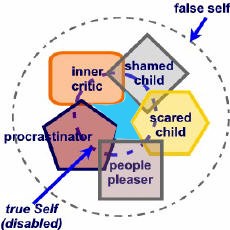
Once formed and functioning, the False Self stifles the growth of the True Self and paralyses it. Henceforth, the ossified True Self is virtually non-existent and plays no role (active or passive) in the conscious life of the narcissist. It is difficult to “resuscitate” it, even with psychotherapy. The False Self sometimes parades the child-like, vulnerable, needy, and innocent True Self in order to capture, manipulate, and attract empathic sources of narcissistic supply. When supply is low, the False Self is emaciated and dilapidated. It is unable to contain and repress the True Self which then emerges as a petulant, self-destructive, spoiled, and codependent entity. But the True Self’s moments in the sun are very brief and, usually, inconsequential.

This substitution is not only a question of alienation, as Horney observed. She said that because the Idealised (=False) Self sets impossible goals to the narcissist, the results are frustration and self hate which grow with every setback or failure. But the constant sadistic judgement, the self-berating, the suicidal ideation emanate from the narcissist’s idealised, sadistic, Superego regardless of the existence or functioning of a False Self.

There is no conflict between the True Self and the False Self.

First, the True Self is much too weak to do battle with the overbearing False. Second, the False Self is adaptive (though maladaptive). It helps the True Self to cope with the world. Without the False Self, the True Self would be subjected to so much hurt that it will disintegrate. This happens to narcissists who go through a life crisis: their False Ego becomes dysfunctional and they experience a harrowing feeling of annulment.

falseself_graphic
Anatomy of the mind of a narcissist.

The False Self has many functions. The two most important are:

1. It serves as a decoy, it “attracts the fire”. It is a proxy for the True Self. It is tough as nails and can absorb any amount of pain, hurt and negative emotions. By inventing it, the child develops immunity to the indifference, manipulation, sadism, smothering, or exploitation – in short: to the abuse – inflicted on him by his parents (or by other Primary Objects in his life). It is a cloak, protecting him, rendering him invisible and omnipotent at the same time.

2. The False Self is misrepresented by the narcissist as his True Self. The narcissist is saying, in effect: “I am not who you think I am. I am someone else. I am this (False) Self. Therefore, I deserve a better, painless, more considerate treatment.” The False Self, thus, is a contraption intended to alter other people’s behaviour and attitude towards the narcissist.
These roles are crucial to survival and to the proper psychological functioning of the narcissist. The False Self is by far more important to the narcissist than his dilapidated, dysfunctional, True Self.

The two Selves are not part of a continuum, as the neo-Freudians postulated. Healthy people do not have a False Self which differs from its pathological equivalent in that it is more realistic and closer to the True Self.

It is true that even healthy people have a mask [Guffman], or a persona [Jung] which they consciously present to the world. But these are a far cry from the False Self, which is mostly subconscious, depends on outside feedback, and is compulsive.

The False Self is an adaptive reaction to pathological circumstances. But its dynamics make it predominate, devour the psyche and prey upon the True Self. Thus, it prevents the efficient, flexible functioning of the personality as a whole.

That the narcissist possesses a prominent False Self as well as a suppressed and dilapidated True Self is common knowledge. Yet, how intertwined and inseparable are these two? Do they interact? How do they influence each other? And what behaviours can be attributed squarely to one or the other of these protagonists? Moreover, does the False Self assume traits and attributes of the True Self in order to deceive the world?

Read the rest of Sam’s article here.

12 weird things you might see a narcissist do.

It’s been several months since I posted this and since I haven’t written anything new about narcissism in a few days (I’m a little burned out on narcissism right now, to be perfectly honest–but I’m sure that’s temporary), I thought I’d repost this one since it seems to be getting some traction and it’s also one of my favorite posts.
These are all red flags not commonly mentioned and you may not know about, but they can help you identify a potential narcissist.

Be sure to also click on the link at the bottom of the article (5 More Weird Things You Might See a Narcissist Do).

luckyotter's avatarLucky Otters Haven

the_color_9

There are some strange things I’ve noticed narcissists do that aren’t usually mentioned as symptoms of their disorder, but seem to be common enough perhaps they should be included as additional criteria for NPD.

If you know someone who does only one or two of these things, it doesn’t necessarily mean they’re a narc, but if they do several of them regularly and also seem to fit the more well-known criteria for NPD, these things could be red flags to watch out for.

1. They don’t blink when they look at you.

googly_eyes

Some narcs have a penetrating, predatory gaze. If a person of the opposite sex looks at you this way, you may take it as sexual interest (and it could be), but watch carefully: if they do not blink this could mean they are sizing you up as prey. Whether they blink or not, if their stare makes you…

View original post 709 more words