Empathy begins at home.

happy_childhood

I know that for a very long time I’ve had issues empathizing with others on a one to one basis (with a few rare exceptions like my children). It’s not that I like seeing others in pain or want to hurt them (I don’t, at all), more that I have had so much trouble connecting to my emotions, especially tender or vulnerable feelings, that this avoidance extends to everyone else. I’ve always felt empathy when it’s “safe” though–therefore I can cry for a character in a movie or novel, or even a TV commercial. I can get quite upset reading a news story about someone who’s been abused, especially if it’s an animal or a child.

But when it comes to real life people, I just can’t allow myself to get that close. I hold everyone at arm’s length. It’s too dangerous to let them in, because they might stir up emotions I haven’t wanted to feel. Of course this means emotional (as opposed to cognitive) empathy goes out the window too. You can’t feel an emotion for someone else if you can’t even access it for yourself.

It’s a common belief that all people who lack empathy are narcissists or psychopaths (or have some kind of schizoid disorder or psychosis, or autism). But a lack of empathy is also a common symptom in people with complex PTSD. Shutting off emotions–including empathy–is a defense mechanism that protects you from further harm. The problem is, this protection also “protects” you from feeling much joy or being able to really love anyone else.

Recently I’ve been feeling a kind of tender regard for my child-self/true self. Right now she’s not integrated and feels far away sometimes, but I can feel her sadness and pain. I can also feel that she’s a good person, a gentle sensitive spirit with so much love to give. I feel a tender protectiveness now where before I felt only shame and wanted to hide her away, just as she had been hidden away by the narcissists who “raised” her. So how was I any different from them, by keeping her hidden, projecting badness and shame onto her, refusing to see her strengths? Sometimes I just want to hold her like my own child. It’s not self-pity; it’s closer to empathy and even love.

Is this where empathy begins? Does it begin with loving yourself–your true self? If you hate your real self, you cannot learn to expand empathy onto others, since you can’t even empathize with yourself. If all you feel is shame, that is going to be projected onto others. That would apply to narcissists and the personality-disordered as well as people suffering from C-PTSD.   The problem for the disordered is it may be too late for some of them.  They are so thoroughly shielded by a false self they cannot even access their real selves or only with a great deal of difficulty that could take years.  There are much stronger defenses to break through.  They may be so shut off they can’t even see the lie they are living and think it’s everyone else–not them–with the problem.

The root of attachment and trauma disorders is is rejection of the self internalized from the people who were supposed to love you and mirror you; to heal, you must be able to develop empathy for your true self. That’s what my therapist has been helping me do.

Ripped to shreds by an alcoholic malignant narcissist.

Hillary-clinton-drunk-600x425

I think I know one of the reasons why I’ve been hating my job more than usual lately.  Two people–a customer and a coworker, both malignant narcissists,  have targeted me, deciding I’d make a particularly tasty meal.

Malignant narcissists have a certain look about them. They seem to all have beady, penetrating eyes. They seem to be able to see right inside your soul, but there is no warmth there. If their eyes are dark, they look black and bead-like. You can’t see their irises. If their eyes are blue, they are cold and steely, sometimes with constricted pupils. I don’t know if others are able to see this, or if it’s just my imagination. I don’t think it is though. The problem is, I’m usually not paying attention to their eyes until after they’ve already decided to turn me into their prey.

They always seem to go after me. I’m an HSP and they seem to have an uncanny way of zeroing in on me and choosing me as their target. I feel so special! 🙄

I have a lovely job cleaning houses. I’m being sarcastic of course. Sometimes it’s okay, though. It’s a good job for a writer because you see just about everything and meet the strangest people you could ever hope to meet. I’ve done whole posts telling anecdotes about the people I meet on this job and the crazy things I see.

About half the time I work by myself. I prefer it that way. As an avoidant introvert, it’s exhausting and stressful to have to adapt my personality to someone new every day, but lately I’ve been being partnered with a random array of newer people, I suppose to “train” them. They never tell you that’s what you’re doing though. We don’t even get yearly evaluations. You get no feedback at all by management. The only “feedback” you get is through the customers, who sometimes call the office to complain or give compliments. But of course customer’s opinions are going to be biased more often than not so it’s not a fair way to evaluate employees.

Last week I was sent with a new girl to go do a “first time in” at the house of a former employee, who I will call Doris. I knew this woman; I never liked her much but I couldn’t quite put my finger on why. I didn’t like the way she looked at me with those beady black laser-like eyes, and I found her manner vaguely condescending. I remember how much Doris had hated her job. She complained constantly about the customers, and she was one of the laziest people I ever met. She skipped doing things because she wanted to go home. She was always complaining about how sick she was (probably hungover). She thought the customers weren’t paying enough (to be fair, some of them aren’t). She also had a serious drinking problem. Sometimes you could smell the alcohol on her breath in the morning.

I was surprised when I got my sheet with Doris’ name and address on it, listing the rooms she wanted cleaned. I thought to myself, she’s either going to take sympathy on us because she used to do this and hated it so much, or she’s going to be hell on wheels. Guess which one she was.

Doris’ house was a disaster. It hadn’t been cleaned in at least six months. Dog hair and dust were everywhere. Empty wine glasses sat on tables. Doris saw me and my partner and the first thing she did was hug me. It was like being hugged by a snake. Then she offered water. But the niceties didn’t last. We looked around her house and realized there was no way we could finish it all in the three hours she was paying for. I told Doris I thought it might take closer to 4 or 5 hours and asked her if that was alright. She would have to pay more though. I told her the office could work things out with her about the price.

She whirled around and stared daggers at me. I felt like a cornered animal.

evil_queen

“I asked for four ladies, not two.” I looked at my partner, who was giving me that “uh oh” look. “Oh, but don’t worry,” Doris purred sweetly, dripping poison honey. “I know that’s not your fault. I’m sure you two can get this done in three hours.” Uh, right.

I called the office and was told they didn’t have enough people to send two more, so let the woman know this and apologized for the mix-up. The office is disorganized and has always been. “You remember how they are,” I said.

Apparently she didn’t. She was the customer now. It was as if she never worked there and her memory went AWOL. She showed no empathy for our plight at all.

I got busy dusting and vacuuming. My partner started on the bathrooms. For the first twenty minutes or so, Doris stayed out of our way. But soon she was back, breathing down our necks, especially mine. She glanced briefly at the bathroom my partner had cleaned and crowed on and on about how perfect it looked. Then she started dusting the bedroom, which I had just finished.

She proceeded to tell me all the spots I missed. Then she started telling me I was using the wrong equipment and should try doing it a different way. I felt myself bristle. I’ve been on this job for two years and I know how to do my job. I resented this nasty, drunk woman doing my job for me and saying I was doing it wrong.

For the next four and a half hours (which is how long it took to clean her filthy house), I had to put up with Doris breathing her alcohol-and-cigarette infused breath down my neck as she continued to get drunker and meaner. She made me do everything over at least twice. She obviously had it in for me, not my partner, who she left alone. For some reason, I had become her prey. I was to be her Cinderella for the day.

You are not allowed to be rude to a customer, even one who used to be an employee, so I bit my tongue the whole time. I put on my best fake-polite self and “yes-ma’am”ed this narcissistic bitch and smiled until I thought my face would crack. I inquired about Doris’ family, her dogs, her new job. I tried my best to be accomodating and friendly, but she was having none of it.

She had told us not to clean the kitchen, only to vacuum and mop it, because there wouldn’t be enough time. So AFTER I finished vacuuming her kitchen, this awful woman changed her mind and started scraping black crud off her stove and sweeping it onto the clean floor. Of course I had to go behind her and vacuum the kitchen again.

Our time was already up. But Doris chose that moment to stand in front of the foyer chandelier that had about 40 removable glass panels, actually tapping her foot and making tsk-ing noises. Cleaning that would take about an hour, and we had already agreed all I would do was dust it with the high duster, not actually remove the panels and wash them individually. But high-dusting them hadn’t removed the yellowish nicotine film from the panels (Doris is a chain smoker). She asked me why I had “skipped” dusting it. I explained that I had done what she asked, but that the panels would have to be washed but it would have to be on another day.

Doris’ mouth formed a thin white line and she hissed, “get the stepladder.” I did. She stood there watching me like a disapproving schoolteacher as I removed each panel one at a time and handed them to her while she rubbed them with a dirty rag and handed them back to me to re-hang. We were way past our time limit. Cleaning those panels took about another half hour and they looked no cleaner than they did when she was standing there tapping her foot and tsk-ing. I don’t know how I managed to hold onto my rage without exploding or walking out because by now I wanted to take a baseball bat to her damn chandelier and maybe Doris’ head too.

My partner had missed something in the half bathroom by the kitchen, and Doris KNEW my partner had cleaned that bathroom but she still started blaming me. “Lauren, you missed this spot on the side of the sink!” I couldn’t say, “it was my partner” without sounding petty and childish, so I just went and re-cleaned what she asked. I was shaking with rage by now.

A few minutes before we were about to leave, Doris told my partner how wonderful her cleaning was and that she hoped she’d come back. She said no such thing to me. Right in front of me, she handed my partner a $20 tip. I got nothing, of course.

As we were leaving, Doris stood in the doorway weaving, holding a wineglass with one hand and the other one clutching the side of the door for support.

drunk_woman

“Oh, I just want to say I’m really not very picky,” she slurred. “It’s my husband.  He was in the military and you know how they can be. He will be inspecting everything.”   Sure, right.  If her husband was so picky, why did he let her house get in that condition in the first place?  The bitch was lying and projecting onto her husband.

The next day, Doris called the office to complain about how I “missed everything” but fortunately they didn’t take her complaint seriously. They know I do my job well and that I don’t normally get complaints. It still bothered me though.

I found out today that my partner went back to Doris’ house again yesterday (who, by the way, hated Doris as much as I did) with the person I worked with today. Doris was drunk again, and spent the first ten minutes complaining loudly about what a horrible job I had done and that everything I’d cleaned would have to be done over. The woman who told me this said that it looked to her like the other girl had skipped a lot of things, and what I’d done looked fine. She said, “I think Doris just had it in for you.” They always have it in for me.

I was going to talk about the narcissistic coworker too (a covert narcissist), but I’m saving that for another post due to how long this one became, and also because in writing this I’ve re-triggered my anger and need to think about something else.
Are HSPs really targets for bullies?

authenticity

(Edited from the original 3/25/15 post)

People who are highly sensitive are often targets for bullies, but it’s not high sensitivity itself that leads to the bullying. It’s because of the dismally low self esteem that tends to go along with being an HSP, especially if we were raised by narcissists. Sadly, for such victimized children, they often find more of the same at school and this only exacerbates their already low self esteem, leaving them open to further abuse.

Narcissists envy and fear high sensitivity.

narcissist_face

Narcissists hate high sensitivity in others for two reasons: 1. They envy it because it’s something they can’t have or may have lost as children and it’s a sign of an authentic person, which is something they aren’t but wish they were; and 2. they fear it, because they know this quality makes it possible for to zero in on the emptiness hiding under the narcissist’s guise.

Their hatred and fear is expressed through love bombing followed by bullying and other forms of abuse meant to weaken the HSP. An HSP’s fragile ego can be destroyed or greatly diminished after years of bullying and abuse.

Sharon: an HSP who carried a can of Narc Repellent.

narc_repellent

I was thinking about a woman I used to know named Sharon.  She was an empathetic young woman who felt everything so deeply–but mostly joy and love.  She’s exquisitely sensitive but is also self confident (she was raised by very loving parents). She is comfortable enough with herself to show her vulnerability openly, allowing herself the liberty to feel all her emotions as well as share the emotions of her friends.

You might think Sharon is a magnet for bullies, but she’s not.  She makes friends easily because she has such a loving and positive presence and and people feel like she cares about them, and she likes herself too (without being at all narcissistic). They are right.

Narcissists avoid Sharon like the plague. Why? They would probably love to get their hooks into her if they could, but Sharon’s confidence in herself and easygoing comfort around all kinds of people scares them right off. While still being emotionally vulnerable, Sharon is invulnerable to narcissists because they sense her strength. She’s indestructible and they know it. As a result Sharon is never victimized and tends to attract other loving people as her friends, people who just want to be around her because she’s a lot of fun but can also cry with you if that’s what you need.

If you’re a highly sensitive adult whose self esteem has been destroyed by narcissistic abuse or a sensitive kid who has become insecure and fearful because of bullying, your high sensitivity will be expressed very differently than someone like Sharon.

Sensitive children do get tested by school bullies, and it’s harder to not let that damage your self image when you’re so young, especially if your parents are also bullies and have already done a number on your self esteem. But for an adult, most people will admire emotional openness and vulnerability or at least respect it–as long as they also know you respect and love yourself. People can sense when you’re comfortable in your own skin and narcs will stay far away, because they’re only attracted to codependent types who are unsure of themselves or their place in the world.

Being highly sensitive: a curse or a blessing?

blessing

A sensitive person who hates herself will tend to act in ways that attract mean people and bullies to them. They are unsure of themselves, fearful, easily depressed or discouraged, easily hurt, easily frustrated, paranoid, hypervigilant, and insecure. They are afraid of everything, and like ravenous wolves, narcissists can smell their fear. They see this–not the underlying sensitivity–as weakness, and they will horn in on such a person for narcissistic supply or bullying because they’re an easy mark who will be too afraid to call them out on their abuse.

Things are very different for a sensitive person with high self esteem. Such a person will be appreciative, insightful, observant, compassionate, forgiving (but not stupidly forgiving), affectionate, creative, a good listener, empathetic, and with a well developed (but never mean or sarcastic) sense of humor. They are not fearful and they know their place in the world. They have a clear sense of their own boundaries (and those of others) and know how to enforce them if they think they’re being violated. They attract people like themselves as friends and lovers and these relationships tend to be self-reinforcing for both parties.

Narcissists know a strong HSP is powerful and dangerous to them.

scare_narcs

Malignant narcissists stay away from self-confident HSPs, because they know they’re much stronger than they are. They know they’re dealing with an authentic person who is happy with themselves and with life, while they are anything but. They know a confident HSP (not the same thing as narcissism) has a laser-like ability to see through their mask without fear and won’t hesitate to call them out when it’s necessary. To a malignant narcissist, a self-confident HSP is a very dangerous and powerful person. That’s why they work so hard to destroy our self confidence and make us hate and doubt ourselves. If we’re crippled by abuse, they can still get what they need from us (supply), without running the risk of having any damage done to them.

As my confidence has grown over these past two years, I’m noticing a transformation of my lifelong high sensitivity from something that made me feel weak and helpless for most of my life into something that makes me feel strong and authentic. I know now that this “curse” and “weakness” I was born with is really a blessing and a strength. I just needed to develop enough confidence to be able to use it effectively.

Learning to love your high sensitivity.

dancing

Here’ a few things I have learned.

1. If you have a talent or skill in one of the arts, use it to express what you’re really feeling. Painting, singing, dancing, writing, poetry–can all be ways we can release our deepest emotions in a “safe” way that’s socially acceptable. Don’t hold anything back when creating art, performing or writing. Allow yourself to be vulnerable even if it feels weird and awkward at first.

2. If you don’t have an artistic talent, take up a hobby that speaks to you or get involved in a sport such as running or take a martial arts class, which can build confidence. Activities that center you and build both inner and outer strength, such as yoga, can be helpful too.

3. Always be 100% honest about your emotions. If you’re very shy or fearful, write down your thoughts and feelings in a private journal. Don’t worry about the quality of writing–that’s all just gravy. The main point is to get your feelings down on paper. Seeing your thoughts on paper (or a computer screen) will give you clarity. If you choose to blog publicly instead, you will gain confidence from expressing your most private feelings to the whole world and from the feedback from others you will get. It can be very scary to publicly post something you wouldn’t tell your next door neighbor (as I have now twice this week!), but believe me, it’s worth it. You’ll be amazed at how much doing such a thing will increase your confidence and sense of inner strength. At first you’ll feel like you’re running around naked in public, but you’ll be amazed by the sense of freedom and liberation running around naked can give you! 🙂

4. Every day, try to do one nice thing for someone other than yourself. If you’re really ambitious, you can try volunteer work to help the poor, homeless, children, animals, or anyone more vulnerable or less fortunate than yourself. In doing so, you will feel like you have a purpose, and that you can help others. Knowing you have made someone happier will raise your self esteem.

5. Listen to music whenever you can.  It’s second only to writing and blogging in my healing journey.

6. Surround yourself with positive people (not the same thing as positive-thinking nazis, who are often narcissists themselves) but authentic, happy people who accept you for who you are and don’t judge you.

7. Get narcissists away from you. No Contact is best, but is not always possible. If you can’t separate from your narcissist, read as much about their disorder as you can, and read about PTSD and complex PTSD and the devastating effects these character disordered people can have on the rest of us. Read books about highly sensitive people. Elaine Aron’s The Highly Sensitive Person is probably the best known (and an excellent book) but there are other books about HSPs too. Write down your feelings in a journal your narcissist cannot access.

8. Try prayer. It does work.

What it feels like to be me some days.

Image

so_tired

HSPs and codependency.

einstein_quote

There’s a lot of discussion on the web about codependency as well as empathy, especially in the narcissistic abuse community. While it’s true people who are codependent to a narcissist also tend to be high in empathy and very sensitive, there seems to be a lot of confusion–people who aren’t too familiar with either term tend to believe empathic people are also always codependent. While codependent people are almost always highly sensitive (which is the quality that attracts their abuser to them and keeps them trapped in a toxic relationship because they believe they can “fix” their narcissist), the reverse is not always the case.

A healthy HSP (highly sensitive person) is simply an emotionally healthy person. They are confident and secure enough with themselves that they can resist the “charms” of an abuser. If a healthy person with high empathy does find themselves being drawn into an abusive relationship with a narcissist, they have the courage and presence of mind to pull themselves out of it and even go No Contact before they fall under the thrall of the abuser and before any damage is done. In fact, having high empathy makes it more likely a person will be able to “see” the red flags before anyone else, giving them a chance to escape and/or avoid the person.

A healthy HSP does not waste time trying to “fix” a narcissist. They know the chance of that happening is about the same as the likelihood they will sprout wings and fly to the moon. If a narcissist is going to change (I’m not one of those people who believes it’s not possible), it must be the desire of the narcissist and they have to work very hard at it, but no one else can “save” them except themselves, and it’s going to be a long, hard road if they decide that’s what they want. A healthy HSP will not allow themselves to fall into a love-bombing trap or be “hoovered” by a narc. Once they realize what they are dealing with, they will cut off any further communication. They know they can’t be nice about it, but must be firm. They may care, but they know they are not going to be the ones doing the fixing, and will be able to move on to a healthier relationship with someone they can actually grow with and who will be able to return their love.

codependency_love

Our society today is also quick to judge those who have high levels of empathy and want to give back to others as being “enablers.” This happens even in the public realm, with the massive cuts in spending to programs that help the most vulnerable people of society and the blanket dismissal by the Powers That Be of those who want to help as “suckers” who are “enabling” the most vulnerable people. I don’t wish to get on a political soapbox but there’s something very wrong with any society that only values how “powerful” you are or how much money you earn. There’s something sick about a society that dismisses its most vulnerable members as “lazy and stupid” or “deserving” of their sad lot. Empathy is a virtue that has become increasingly dismissed as a weakness, but is actually the one thing–maybe the only thing–that could rescue modern society from completely self-destructing. Empathy isn’t a weakness at all–it’s a strength. If you’re a HSP you have this quality and should be proud of it and use it, not hide it away like a shameful thing. The narcissists who run things in the world would like us all to think it’s a shameful thing, but that’s just another lie they tell. It’s needed now more than ever. So, you are not an “enabler” if you want to help others; just be careful who you are helping!

Unfortunately, HSPs have often been abused themselves or have other disorders such as complex PTSD, and they often find themselves targeted by narcissists for abuse. Narcissists are usually attracted to people with high empathy because they know they can get the “understanding” and love they crave and will proceed to feed on the HSP’s emotions much like a vampire feeds on blood. They know it’s hard for such a person to say “no” because they can’t stand to hurt anyone’s feelings, so an HSP person is more likely to stick around and tolerate abuse than someone who is less sensitive.

If you are such a person; if you are very sensitive, cut your losses now! Staying around a narcissist who is actively abusing you is just not worth it, and there’s also a very real danger of being drawn so far into the narcissist’s web of deception and abuse that you could develop Stockholm Syndrome and begin to identify with your abuser. Once this happens, you could even find yourself taking on traits of narcissism yourself and colluding with your abuser. It’s an insidious process but it can and does happen; and it happened to me. Be careful. Your soul is a precious thing and you should not give it freely to anyone until you know that person can be trusted with it. That doesn’t mean you have to become hypervigilant and start seeing demons around every corner, but if your intuition is throwing up a lot of red flags about a particular individual, don’t dismiss them. They could save your life.

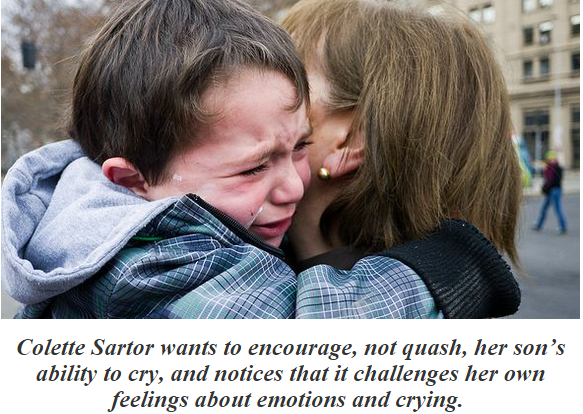
“Why I Am Teaching My Son That Tears Take Courage”

Here’s a wonderful article from The Good Men Project about a mother who is encouraging her young son to express his emotions instead of stuffing them. If only more parents encouraged this sort of thing, we’d live in a world with more empathy and less narcissism.

Why I Am Teaching My Son That Tears Take Courage
By Colette Sartor, for The Good Men Project

sartor_article

My son didn’t cry on his first day of preschool; he cried on his thirtieth. The school was a tiny, progressive place that took a surprisingly stern approach to drop offs: Say goodbye and leave. No looking back or lingering. This was fine by me. I hate to cry in public, and I knew I might, which would scare my three year old and make him cry.

So, that first day, I watched him cautiously pile blocks for a few minutes, then I told him I’d pick him up later, kissed him, and left for work. He barely glanced up. He was absorbed in the newness of everything: new kids, new toys, new sights and sounds and smells.

Every day that month, I repeated the routine. I’d briefly watch him play, kiss his cheek, and leave. Every day, I breathed easier. “He loves his new school,” I told people. How well adjusted he is! How happy! Yay him! Yay me! I thought. Then, on the thirtieth day, he raced to me with outstretched arms. “Mommy, stay!” he sobbed. I gathered him up, buried my face in the talc of his hair. “I’ll be back, honey, don’t worry,” I whispered before his teacher gestured to hand him over. He cried and reached for me, struggling to extricate himself from the teacher’s grasp. “Just go,” she mouthed over his head. I nodded and walked out, my own tears streaming as he sobbed behind me.

♦◊♦
When I was growing up, our family motto was, “If you want to play with the big dogs, don’t piss like a puppy.” Which meant no crying.
♦◊♦

My son cries easily. He gets it from me. I cry over life insurance commercials, sappy movies, real and imagined slights. I usually hide my tears, even from him. When I was growing up, our family motto was, “If you want to play with the big dogs, don’t piss like a puppy.” Girls were puppies by default. They showed the world when they hurt. They cried. To play with the big dogs, girls had to be tough. Which meant no crying. So I learned not to cry. At least, not in public. Still, I try not to discourage my son from crying. I love his sensitivity. I love that he cries when a friend is hurting, that he cries when he feels he’s being treated unjustly, that he cries at all.

See more at: http://goodmenproject.com/featured-content/why-i-am-teaching-my-son-that-tears-take-courage-jnky/#sthash.FTqEhBGI.dpuf

“Fragile Heart”

A friend sent me this video. Have the tissues ready. 😥

Lyrics:

There’s no place for a sensitive soul
In a space where your ego freely roams
And you’re a little bit narcissistic
And I’m a little too understanding, sadly
So you held me like your rose
Only to watch me whither slowly

But there’s no hope for the weaker minds
This, I know

You can’t take me down
For my fragile heart
I’ll start over now
With my fragile heart

Yikes! Does this mean I’m a narcissist?

Almost a year ago, I wrote this slightly jocular post after I read an article describing covert narcissism. It was the first time I’d actually read anything about it. Even back then, I recognized the symptoms as fitting me like a glove, but was far away from awareness. This slightly humorous, false self-deprecating attitude was typical of a lot of my posts at the time. I think somewhere deep inside though, I knew.

I can’t believe how different everything seems now.

luckyotter's avatarLucky Otters Haven

yikes
I just finished reading a Scientific American article that delineates narcissists into two categories: Overt Narcissists and Covert Narcissists:

When most people think of narcissism, they think of the public face of narcissism: extraversion, aggression, self-assuredness, grandiosity, vanity, and the need to be admired by others (see “How to Spot a Narcissist“). But as far back as 1938, Harvard psychologist Henry Murray noticed another breed of narcissist among his undergraduates: the covert narcissist. While the “overt” narcissists tended to be aggressive, self-aggrandizing, exploitative, and have extreme delusions of grandeur and a need for attention, “covert” narcissists were more prone to feelings of neglect or belittlement, hypersensitivity, anxiety, and delusions of persecution [I’ve also seen this referred to as “inverted narcissism,” whatever that means].

Um, I’m prone to feelings of neglect or belittlement, am known to be hypersensitive and anxious, and there are times I believe I’m being persecuted…

But it…

View original post 294 more words

Sensitive Children and the Adult Child in the Abusive Narcissistic Home

Excellent article about the devastating effect narcissistic parents have on the most sensitive children in the family and why they tend to become scapegoats. They grow up into codependent adults prone to repeat the same toxic patterns with others. But this doesn’t have to be a life sentence. Read on.

1solutionfocusedcoaching's avatarSITE FOR CREATIVE SOLUTIONS

flute-player-h7x

In a home affected with an abusive narcissistic parent emotions are repressed and become twisted.  Rules are built on shame, guilt, or fear.  Feelings are often not shared and when they are expressed, it is done in a judgmental manner placing blame on one another.  The narcissistic parent is self-involved and feels no empathy for their children.  They are incapable of mirroring real love and try to get their children to fulfill their unmet dependency needs.  The narcissistic parent’s unresolved drives for attention and caretaking takes center stage as the child’s early developmental needs are ignored and denied.  The self-involved parent shames the child for having desires and makes them feel guilty.  All of the family attention and energy is focused on the demands of the narcissist.

Sensitive children growing up in abusive narcissistic homes build their personalities based on what they have to do to survive.  Many of these children…

View original post 685 more words

Portrait of a non-disordered HSP.

authenticity

It’s a sad fact that many HSPs (highly sensitive persons) develop personality disorders and elaborate defense mechanisms like NPD or BPD just to cope with the world because they feel like they have no normal defenses against being hurt or abused. The double whammy is that so many HSPs have disordered parents who scapegoated or abused them, just because they can see the truth about their parents’ malignancy through their mask of sanity. Of course, this makes it even more likely for an HSP to develop a disorder where they successfully or unsucessfully attempt to hide their high sensitivity (true self). High sensitivity/vulnerability is a wonderful quality and is needed in this unfeeling world, but is not well understood or accepted in a narcissistic, materialistic society. HSPs who have developed NPD or BPD or some other personality disorder are not happy people.

Having the gift of high sensitivity is especially hard on children, who tend to be easily bullied at school, even if their parents are accepting and loving, because these qualities are seen as “weak” or uncool by other kids and sometimes teachers too. Also, since children are naturally narcissistic, HSP qualities in a child tend to manifest as being easily offended or hurt. A child hasn’t yet learned to use their gift of sensitivity for good purposes or to help others. So an HSP child can easily develop a personality disorder, even if it’s less severe than a child who has been abused from early childhood.

But there are rare people who are highly sensitive who seem to come through childhood and adolescence unscathed. I’d like to talk about one such person. It was a young woman I knew at one of my old jobs. Her name was Meghann. I don’t think I’ve ever met a person so attuned to life, so in touch with her emotions, so accepting of others, and so joyful.

Meghann was physically beautiful but never seemed that conscious of her appearance. She dressed casually and wore very little make-up, but she didn’t need it. While not classically beautiful or what most would call sexy, Meghann’s beauty came from within. Enhancing her natural beauty with cosmetics or baubles would be like gilding the lily (although I did see her dressed up on occasion and thought she was equally stunning).

I trained Meghann when she was a new employee at a call center I used to work for. I liked her immediately; so did everyone else. She learned quickly and was quick to laugh but never AT anyone. She just laughed because she found humor in just about anything it was possible to find humor in, and that included herself.

Meghann had a way of attracting people to her. Both men and women loved being in her presence, because it was so loving and positive. Not obnoxious-positive, in the sense of fake-perky “positivity nazis” that pervade our society, but she had a subdued optimism and there was a kind of glow that seemed to emanate from her whenever she walked into a room.

Meghann was one of those rare nice people who rises quickly through the corporate ranks. I’ve found in most places I’ve worked, the most narcissistic and cold people seem to get ahead, but Meghann was so smart, likeable and good at her job that she was promoted to a supervisory position within 6 months of my training her.

As a covert narcissist, I was envious at first. What was this? I had trained her! As it always seems to be for me, I was still stuck in my low level job; no one would promote me there, and this–girl–who was young enough to be my daughter had moved way ahead of me and in such a short time. In fact, she was to be my new supervisor!

But it was strange too–I really didn’t mind. Somehow I was able to forget about my envy because she was just such a genuinely sweet person and I loved her too. You just couldn’t stay angry or envious of someone like that for long. And, I had to admit, she had done everything to deserve her promotion. I realized I was actually happy to be working under her and I told her so. I was rewarded with a dose of supply because she told me that if it wasn’t for me, she wouldn’t have been where she was,because I had been such a great and patient trainer.

authenticity2

Meghann laughed a lot but it was always a musical, natural laugh, never forced or fake, and she never laughed at people in pain or at tragedies. She laughed at herself as well as at all the absurdities the world has to offer if you just look for them. When Meghann laughed, people gathered around her to feel her joyful presence and be touched by it.

But Meghann was also very emotional. She was often in tears, not because she was sad or depressed, but because she felt everything so deeply. It wasn’t unusual for her eyes to become damp when she listened to you talk about some sad thing that happened to you, or even tear up when she was happy. I remember when she had her 26th birthday, and the department had all gone out on gifts and a cake (and we really meant it), she was smiling radiantly and wiping away tears at the same time. Even I felt myself responding and wanted to run up and hug her (I didn’t). She just had that effect on people. I don’t know one person who disliked her. She could tame even the nastiest, most envious people because of her joyful and accepting presence.

Meghann had many artistic talents where she freely expressed who she was. She could sing, paint, and take beautiful pictures. She made a lot of her own clothing which was original and beautiful. She was a person who knew exactly who she was and wasn’t ashamed to show it. You could tell she had enormous self confidence, but it never came off as arrogance, entitlement or grandiosity. In fact, most of the time Meghann was very humble. Not self-flagellating or fake-humble–she just never acted like she was somehow better than you or more deserving. She even blushed adorably whenever she was the center of attention (which was a lot) because she couldn’t hide her true feelings and didn’t try to either.

Meghann wasn’t happy every day. As a sensitive person, she felt everything, and sometimes the things she felt made her cry. When she was sad, everyone knew because she was quieter than usual and stayed in her office. But she was still approachable and never took out her depressed moods on other employees. You knew she’d been crying because her eyes and nose were pink, but she was never over the top about it and never sank into self pity or whining. She just felt her emotions and moved on.

I was in awe of Meghann. I couldn’t stay envious of her, although I had every reason to be (especially because she had been raised in a happy, normal family by loving parents–and I tend to be envious of people who had that). When she finally quit to move to another state, I almost cried along with everyone else. I couldn’t hate Meghann because in her, I saw the kind of person I think I could have been had my high sensitivity not been used against me as a young child and forced me to turn against it and try to be someone I never was.
My memory of Meghann still inspires me, because I want to be like that. I think I’m already halfway there.