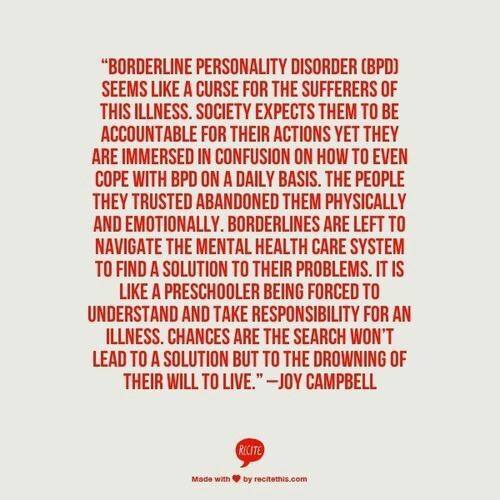
The awkwardness of being a Borderline ACON.

awkward-1

I won’t lie.  It’s incredibly awkward being a blogger who blogs about two things that seem diametrically opposed to many people in the narcissistic abuse community:  being a victim of narcissists, and having a Cluster B disorder (BPD).   To those of you who aren’t familiar with the ACON (adult children of narcissists) blogosphere,  there are a few ACON bloggers (not too many on WordPress, fortunately) who seem to think if you have BPD then you can’t also be an abuse victim and certainly shouldn’t be blogging about it.  Because, you see, if you have BPD then you are one of the soulless abusers.  If you are any kind of “cluster B person” blogging about abuse, then of it follows that you must have an “agenda.”  What that agenda is is never specified though.

I have been accused of many things, none of which are pretty, and few of which are true. Most are crass generalizations made out of ignorance and a refusal to think outside the box or consider that not everything is all black or all white or that all people can be shoved into a box. .   Here are just a few of the things I’ve been accused of.

  1. I have an “agenda” and dishonest motives.
  2. I am not really an abuse victim.
  3. I am being paid off or otherwise compensated  other people (like Sam Vaknin) or psychiatric organizations (like the APA) to promote my “evil” views and blur the lines between Cluster B disorders and complex PTSD caused by abuse.
  4. I’m “evil.”
  5. I’m crazy.
  6. I’m confused.
  7. I only care about being “popular”
  8. As a Borderline, I have “no right” to be writing posts about narcissistic abuse.

To these accusations,  here are my responses:

  1. Um, no.  I’m not clear what “agenda” it is I’d be trying to promote. My only “agenda” is healing for myself, fun (because I love to write), and hopefully, helping a few others along the way.
  2. I guess some people never really read this blog because it’s filled with personal accounts of narcissistic abuse by both my family of origin and my ex-husband.   Oh, that’s right.  I’m just making it all up. 🙄   I couldn’t make up these accounts if I tried.  I try not to dwell too much on the abuse though, because doing that doesn’t help me and only makes me miserable.  That doesn’t mean it didn’t happen, though.
  3. This really makes me scratch my head.   It almost makes me laugh how far a few people are reaching by saying this.  The only monetary compensation I get is about $30 – $40 a month from running ads on this blog.   I still live in poverty and I don’t have any kind of shady business dealings with any organization or person.  I write this blog because I want to.
  4. That’s quite a value judgment there.   You don’t even know me.   I don’t point fingers and call anyone evil unless I have real good reason to, and even then I’m hesitant because I don’t want to be a judgmental person (I can’t stand judgmental people).   I think it’s always better to use the term “evil” for actions, not people.   I guess this idea that I’m evil is because I’m zOMG “Cluster B.”  I’m not a narcissist (even if I do have a few of the traits) and I’m not antisocial and I do have empathy and an almost excessively strong conscience.   But some people have the idea that even if you’re a self-aware borderline who practices mindfulness, you’re still as bad as one of the narcs.  “Sociopath” is another thing I’ve been called but it means pretty much the same thing.
  5. Maybe there’s a bit of truth to this.  After all, I do have four mental disorders–BPD, complex PTSD,  Avoidant PD, and Seasonal Affective Disorder (SAD).  I can act pretty crazy sometimes too.   But at least I’m self-aware crazy and can see myself pretty objectively and control my urges to act crazy when they get out of hand. But just because you don’t agree with me doesn’t mean I’m crazy.  I just have a different opinion than you do.  Deal with it.
  6. There’s also some truth to this.    It is VERY confusing being both an abuse victim and having a Cluster B disorder, even though the Cluster B disorder was caused by abuse!   And like it or not, I DO think BPD and complex PTSD are almost the same disorder.   Of course, this is just my opinion and no one’s paying me off or brainwashing me to “blur the lines.”
  7. No.  My primary motive in blogging is healing myself and helping people.   A secondary motive is fun.    Yes, of course I look at my stats and always get a small thrill when they’re growing, but I don’t write to be popular or famous.  Yes, I’d like to write a book someday and be able to make a living from my writing, but who wouldn’t?   Even if I never make a penny from my writings and even if no one read my blog, I’d still be doing it because it’s something I really like to do.
  8. As a Borderline, I *AM*  victim of narcissitic abuse.  (see reply #6).  ANYONE who was an abuse victim and wants to heal from the damage they endured has EVERY right to blog about it, and yes, that even includes people with self aware NPD!

me_and_my_evil_crazy_me_in_minecraft_by_sonatathesiren-d90wfu7
“Me and My Evil Crazy Me” (Minecraft image by Sonatathesiren)

I know my opinions are sometimes controversial and won’t sit well with everyone, but unless I’m presented with a convincing argument to discard my personal beliefs and opinions, they aren’t going to change.   I ‘m a critical thinker who likes to explore all angles of an issue and then form my own opinions when I’ve gathered enough information.  I’ve always walked to the beat of my own drummer, rather than mindlessly following what other people tell me I “should” do or believe.   Being a “lone wolf” who walks to the beat of my own drummer and refuses to conform to the “popular” view is one of the biggest reasons why I was ostracized by so many people all my life–including my own family.  But you know what?  I don’t care.  This is who I am and I’m going to keep running with it.     I seriously don’t understand why people who dislike my opinions and views so much keep reading my posts anyway if it’s only going to make them angry.  No one is forcing my opinions on those people. Just hit the backspace button!  It’s easy.

I’m aware some people have a problem with this because it doesn’t fit into the almost cult-like mentality I’ve seen among certain (fortunately only a few) ACON bloggers. If you piss them off, be prepared to be mobbed. Maybe they’ll leave you alone on your own blog but make no mistake–they will be trashing you and your character on their own blogs. At the same time, there are so many more people (and bloggers) who appreciate my reluctance to put people into boxes and think in only black and white terms.  There are many beautiful shades of grey in between the extremes.  That’s one of the best takeaways of moving away from BPD black and white thinking and replacing that with critical thinking and mindfulness.  If that’s evil and crazy, then evil and crazy I guess I will be.   But I really don’t think it is.

balance

Many people have told me my more open-minded approach has been refreshing and has helped them come to terms with the abuse they had to endure and move past the rage and anger they felt coming out of their abusive relationships, or when they went No Contact. At the same time, one of my aims has become reducing the awful stigma against people suffering from BPD. It’s a delicate balance, but I don’t think it’s undoable.

Being a borderline and a trauma victim who writes about narcissistic abuse issues as well as my own (and other) cluster B disorders,  it’s sometimes a delicate balance.   But they are not mutually exclusive.   I  feel driven to write  about my disorders as they relate to my abuse and attempt to reconcile them because I need to for my own sanity and healing.
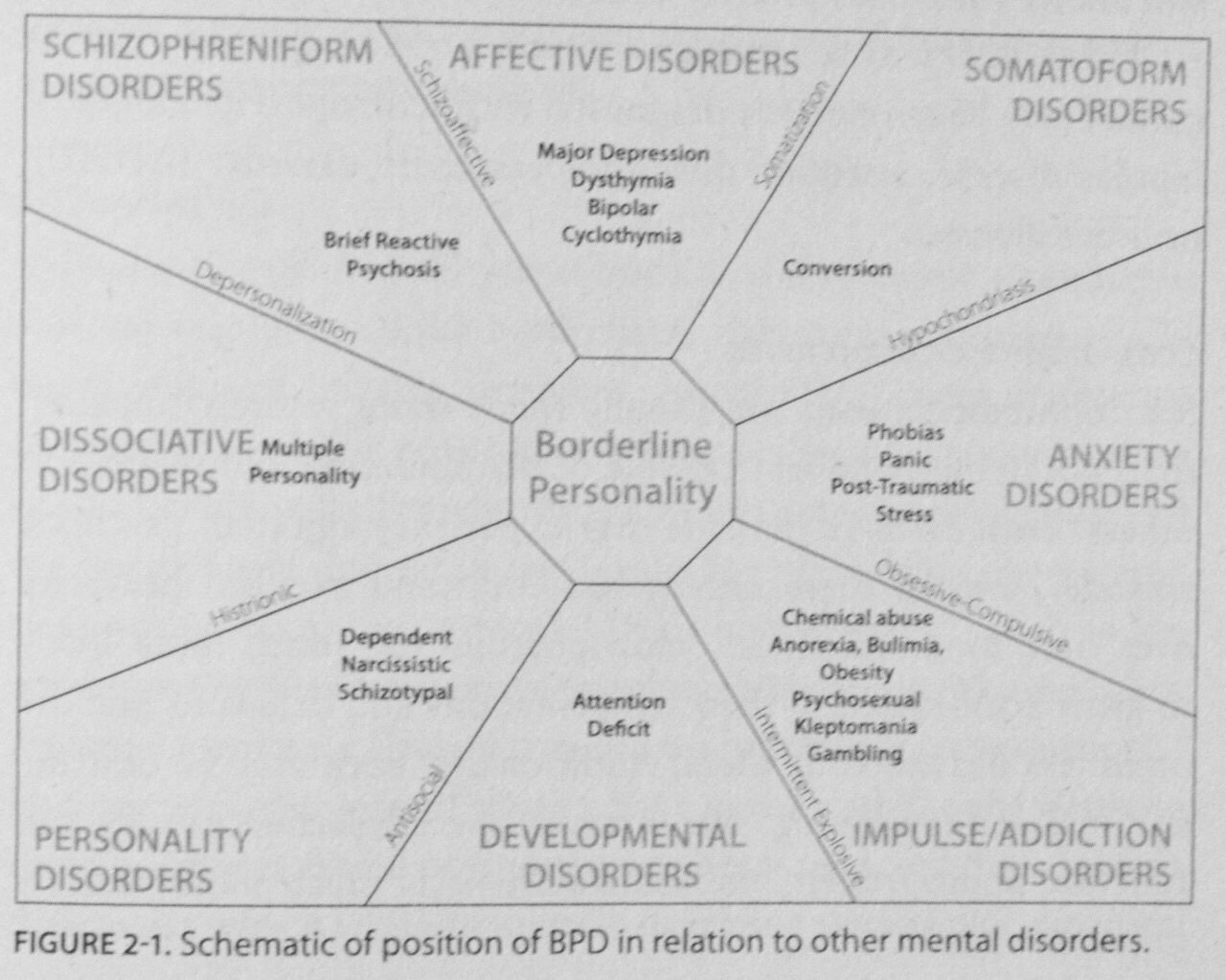
BPD: The fulcrum of mental illness.

It’s like a spinning black vortex sucking in the symptoms of every other mental illness and disorder. We’ve got all the bases covered!  We’re batsh*t crazy!  We need help and understanding, not judgment and fear.

bpdschematic

Borderlines: incurable demons or trauma victims?

complex_ptsd
The symptoms of Complex PTSD are almost identical to those of BPD.

Something has come to my attention during the time I’ve been blogging, which I think is important enough to merit another post about it.

Borderline Personality Disorder (BPD, DSM code 301.83) is classified by the Diagnostic and Statistical Manual of Mental Disorders as a Cluster B (emotional/dramatic/erratic) personality disorder having many similarities to character disorders like Narcissistic Personality Disorder (NPD) and Antisocial Personality Disorder (ASPD). Both NPD and ASPD are characterized by a lack of empathy, entitled behavior, and disregard for the rights or feelings of others. It’s also true that some Borderlines act out in ways harmful to themselves and others. Hence, “Cluster B” has become a pejorative category and some ACONs (adult children of narcissists) and others have demonized people with BPD as being amoral, immoral, and almost inhuman, nearly or as bad as as people with NPD or ASPD. Some even go so far as to lump all borderlines in with the “narcs” and barely make a distinction between them. In their minds, if you’re a Borderline, you’re no better than a “narc” and that’s all there is to it. You’re a bad person and to be avoided.

To make matters even worse, many mental health professionals refuse to treat people with BPD, believing them to be troublemakers, incurable, or both. I remember one therapist I saw years ago for an intake session and seemed to connect well with, called me a few days later after he received my psychiatric records, and told me he couldn’t take me on as a patient. “I don’t work with borderlines,” he said.

It’s true that there are some similarities between the Cluster B disorders, and both BPD and NPD/ASPD have roots in childhood abuse or neglect. But the similarities don’t run very deep. What I mean by that is while both a borderline and a narcissist cn be manipulative or abusive to others, the reasons are very different. There’s also the matter of intention. Borderlines, if they act out against others, aren’t usually aware they’re being abusive and/or manipulative. If their bad behavior is brought to their attention, they normally become very upset and feel terrible about it (unless they have a comorbid NPD or ASPD diagnosis). They act out because of overpowering emotions that they haven’t learned how to control. In contrast, a narcissist or person with ASPD acts out because they can. If their behavior is brought to their attention, they’re likely to become angry and rage against the accusation, make excuses, blame-shift it onto someone else, or deny it.  Unlike most borderlines, they don’t feel remorse, guilt or shame for hurting others.

In addition, many borderlines are much more harmful to themselves than to other people. If they do act out against others, most are as frightened by their own outbursts as others are and sometimes more so. In a nutshell, people with BPD know they have a problem and wish they could be different. Untreated BPD makes a Borderline’s life miserable, while people with NPD or ASPD are usually not bothered by their disorder. That’s why, even though Borderlines can act “crazier” than narcissists, they can get better and are much more responsive to therapy or behavioral treatments such as DBT or CBT.

But we’re still caught in a gray zone, neither here or there.   The stigma against borderlines (in my observation) has grown worse, and most narcissistic abuse sites pretty much regard people with BPD  as the “female or over-emotional version of NPD.”  (actually, Covert/Fragile NPD or Histrionic Personality Disorder would come closer).   If we’re narcissistic abuse victims suffering from complex PTSD, it takes a great deal of courage to admit you also have a BPD diagnosis.  It took me a few months to come out about it on this blog. Fortunately,  I haven’t received too much (or really, any) flack about it.

complex-ptsd-and-bordeline-personality-disorder-36-728
Click to enlarge graph.

The good news is, a number of BPD bloggers are helping to reduce the negative stigma that we’re “bad seeds” with an untreatable disorder just because we’re OMG “Cluster B.” Think about this: have you ever noticed that there aren’t too many people with NPD (or ASPD) blogging about their challenges and insecurities, or fighting to reduce the stigma against their disorder? If they blog about their narcissism or psychopathy, it’s usually to brag about how NPD/psychopathy makes them superior or allows them to have control over others and be successful in the world. That’s because they don’t think they have a problem (They just cause others to have problems). Most Borderlines know they have a problem and struggle with it constantly, since it makes them feel so crazy and lowers their quality of life. I can only think of ONE blogger with NPD who was unhappy with his disorder and successfully treated for it (or so he says). That man probably had low-spectrum and probably covert NPD; a person with malignant or high spectrum grandiose-type NPD will never have enough insight or willingness to admit that THEY are the ones with a problem. In contrast, I can think of about 20 bloggers with BPD who are in treatment or therapy or have even been healed! I’m sure there’s many more that I don’t even know about.

BPD also seems to co-occur a lot with complex PTSD or PTSD. Most BPD bloggers I can think of also have complex PTSD or are in treatment for it. The symptoms of BPD and Complex PTSD are almost the same. The DSM does not recognize Complex PTSD as a diagnosis; it only recognizes PTSD, which is not caused by chronic trauma over a long period of time (such as having been abused as a child), but by one traumatic incident (such as fighting in a war or being raped). Therapeutic treatments for complex PTSD and BPD are also almost the same (for that matter, NPD and other personality disorders are treated almost the same way). Both BPD and Complex PTSD have a higher cure rate than NPD. Since Complex PTSD isn’t recognized as a valid diagnosis, I think a lot of people (especially women) who might have been diagnosed with complex PTSD if it was recognized get slapped with the “Borderline” label instead. Although I accept my BPD diagnosis (and have even become a little attached to it), I wonder if I might never have been diagnosed with it at all had Complex PTSD been recognized by the psychiatric profession. I think in some cases, BPD may not really be accurate, or could even be the same thing as C-PTSD due to their many similarities. At least one blogger (BPD Transformation, who used to comment here but stopped for some reason), doesn’t even think BPD is a valid diagnosis and shouldn’t exist at all.

Further reading:

Are BPD and Complex PTSD the Same Disorder?

Is BPD a Real Disorder or Should it Be Eliminated as a Diagnosis?

The Male Borderline Waif

This is a good article about an overlooked subject–the male borderline. BPD is usually associated (and diagnosed) in women; men are more often diagnosed with NPD. But they aren’t the same disorder, and this article explains what a man with the introverted/fragile sort of BPD can be like. (The more aggressive types of male Borderlines are often mistaken as having Antisocial Personality Disorder due to their impulsivity and acting-out behavior, which sometimes gets them in trouble with the law). There’s a lot of gender bias in the diagnosis of mental illness and BPD is one of the most stigmatized and misunderstood of all the disorders.

MJ's avatarOut of the Mire

I’ve written a lot on borderline personality disorder (BPD) on this blog largely because my mother has the disorder.  It is not something I wish to vilify, and I don’t want to verbally mistreat people who have been diagnosed with it either.  Of all the personality disorders, BPD is the most stigmatized.  Many therapists refuse to treat it or see clients who carry the diagnosis altogether.  That is a hard road to walk when one has the disorder, and it’s also a very difficult situation if you love someone with it.  Where do you turn? What resources are available to you when there are so little available to your loved one with BPD?

Another inherent problem is that of diagnosis.  Many people struggling with BPD are never diagnosed and, therefore, never treated due to 1) treatment resistance 2) refusal to seek help.  The other factor? Gender bias within the clinical…

View original post 1,665 more words

Circling around the maelstrom.

maestrom
Credit: Jim Carson Design

I’ve been thinking a lot more about my parents and my nightmarish upbringing as a hybrid scapegoat/golden child (I was raised as an only child, so I had to be both). It’s worse in some ways than just being a scapegoat, because it’s a topsy turvy hall of mirrors where you can predict nothing. There’s no stability. There’s no security. There’s no consistency in a childhood where you have to serve two roles, and never know which one you’re going to be next, and where both roles you play are a lie.

I started blogging because of my sociopathic NPD/ASPD ex. I was trying to deal with my feelings about going VLC (very low contact, since we have children) with him and cope with being on my own for the first time. Blogging introduced me to myself.

I’ve been through a lot since the day I sat down and started to write. As I progress in my journey, I’m spiraling ever closer around the emotional vacuum that lives in my center, the maelstrom that was born from hurt and pain. I liken it to a black hole in space or a maelstrom in the ocean, because everything disappears there never to return. Falling into it prematurely could obliterate me. But if I’m ever to heal from my disorders, I need to dive into that maelstrom and explore its terrors and maybe its wonders. I’m a lot more courageous now than I ever was before. I think I can do this.

I’m realizing the problem wasn’t really my ex after all. What I mean by that is that we came together because I was programmed almost from birth to become codependent to someone like him. Yes, he made me worse, but I was in bad shape long before he came on the scene. In therapy, I’m beginning to talk more about my childhood, and the pain inflicted on me by disordered parents. I’m still at the point where I explore it from an emotional distance, as if I’m watching a movie. I can’t really internalize and surrender to the pain yet. I feel a vague sadness and anger, but I’m dissociated from it, as if it’s someone else it’s happening to and I’m just watching.

But it’s beginning. I’m starting to trust my therapist enough to take the plunge. He is using reparenting techniques on me, which is what I wanted. He’s empathetic, which is what I needed. I’m thinking about my past a lot, and making some connections. I have some tools to protect me when the time comes to go in. I’m scared but excited. I’m gaining courage.

I’m swirling around the edges of the maelstrom, looking down into an opaque blackness that looks empty but is full of unseen mysteries. I won’t fall into it. I’ll willingly dive into it, just like when I was eight and first jumped into the deep water at the community pool.

Once I dive in, I’ll either disappear forever, or rise from it triumphant. I’m banking on the latter.

Do borderlines have a “false self”?

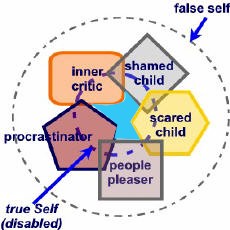
false_self_pic

One of the takeaways I got from my therapy session tonight, was that as someone with BPD, I do have a false self, but it’s not the same kind of false self a person with NPD has.

Actually, almost everyone has a false self. Whenever you’re polite to someone you don’t like, tell a “white lie,” put on your “best face” in a job interview, or act happy at the dreadful office Christmas party, that’s your false self in action. In the non-disordered, it’s called a social self, and is necessary to be able to function in the world. People who have no social self self at all are people who have no idea how to act in social situations, and just say whatever is on their mind. They care nothing about making a good impression or sparing someone’s feelings. There are people like this, but they’re usually living on the edges of society. Most people aren’t very comfortable having to wear this social self, but know they must in order to function in the world.

Narcissistic Personality Disorder and Borderline Personality Disorder are both Cluster B (emotional, dramatic, erratic) disorders and both involve serious disruptions in a person’s sense of self. In both disorders, the true self was compromised at an early age because the parents or caregivers failed to mirror the child’s growing sense of self. The false self is a defense mechanism and stands in for the compromised true self, which in the case of someone with NPD, can no longer be accessed.

falseself_graphic

But there are differences. In a person with NPD, the false self is an intractable, permanent structure and is stable. What this means is that a person with NPD has become someone else. The mask they wear becomes who they are, and any threat of exposure by another for the lie it really is will be viciously attacked or the perpetrator devalued. That’s why you can never criticize a narcissist.

The NPD false self is also stable, meaning it doesn’t change much.  For example, a somatic, grandiose narcissist has built an entire identity around their physical appearance and uses every opportunity to make sure everyone knows how physically perfect they are. Because so much effort has gone into building this identity, the narcissist is unlikely to have developed any other abilities or strengths. A person with NPD pretty much lives full-time as their false self, and rarely, if ever, show others any glimpses of their true self, which in the worst cases, is so inaccessible to them it may as well not exist. If the false self is ripped away (this can be done by denying a narcissist any supply), and there is no more supply to be had (this sometimes happens to elderly narcissists, who can no longer rely on looks, youth, career or financial success to boost their egos), what is revealed is a person so empty, depressed, or dissociated they may require hospitalization or may even attempt suicide. Some may voluntarily enter treatment, but if their fortunes change, they start to feel better and are likely to quit therapy. Schizophrenic symptoms in a degraded narcissist isn’t unusual.

NPD is difficult to treat because the false self is so intractable and all-emcompassing, the person has little to no insight into themselves or even realize it’s they who have the problem. Because they tend to project their unacceptable emotions onto others, they’re far more likely to blame others for things they have really brought on themselves.

In Borderlines, the false self manifests more as a series of temporary masks, adapted to suit certain situations or people. People with BPD are emotional chameleons. Their dramatic mood swings and changeability are due to constant mask-switching and the stress this causes them. The BPD false self is not well developed and it often fails them, causing them emotional distress. The BPD false self (really false selves) is unstable, permeable, and easily shattered, frequently revealing the empty, dissociated, depressed true self. Because it’s not a permanent structure, BPDs don’t require narcissistic supply to keep it “alive” (they’re more likely to become codependent to a narcissist). They can seem “crazier” than people with NPD, but they are more easily treated because they spend at least some of the time without their masks on.

Further reading:

Derealization and Depersonalization in NPD and BPD

Comparing Covert Narcissism and BPD

Borderlines are Human Chameleons

Why Narcissists and Borderlines are Drawn to Each Other

Why DBT and mindfulness is helping me get more out of therapy.

mindfulness_poster_UK

For anyone suffering from BPD who wants to undergo psychodynamic or trauma therapy, I definitely recommend taking some DBT (or CBT) classes first. This also applies to people with complex PTSD, as the symptoms of C-PTSD and BPD can be almost the same (and for Borderlines, usually co-exist together).

I’ve been in therapy many times throughout my life, but I never stuck with it before. I usually would quit, because I either gave up in frustration or things got too intense. My first instinct whenever things in life would get too uncomfortable was to run. I had zero insight into myself or why I reacted (or overreacted) to things the way I did. I always thought everything was someone else’s fault. Yet I was constantly apologizing for things that weren’t my fault. I know that’s confusing, but I was confused. I was ignorant about boundaries and then wondered why others got offended when I unwittingly invaded theirs. Either that or I put up too many boundaries, not letting anyone in or rejecting people who tried to get too close.  I had a martyr complex, always felt picked on and ganged up on, was constantly paranoid and hypervigilant, always feeling like everyone hated me and was out to get me. I was ready to go off on someone or act out at the slightest provocation, believing I was being attacked unfairly. I was much more likely to attack things than people (I was constantly breaking things; self harm was never really my thing) but my violence toward objects and verbal tirades still upset those around me and upset me too after the fact. People always told me I overreacted to everything, but I always felt like it was somehow justified. I couldn’t see the part I might have been playing in all that.

To be fair, I was horrifically abused both as a child and as an adult, so my paranoia and distrust of others wasn’t completely unfounded. I was trained to be a victim and tended to act in ways that ensured I would remain a victim, without knowing I was doing so. I still struggle with this. I still tend toward codependency.  I still find it hard to connect with people in any meaningful way.   I’m a long way from being the person I want to be or that I could have become, and I may never get there completely. But there’s a big difference between the way I am now and the way I used to be. Mindfulness.

mindfulness

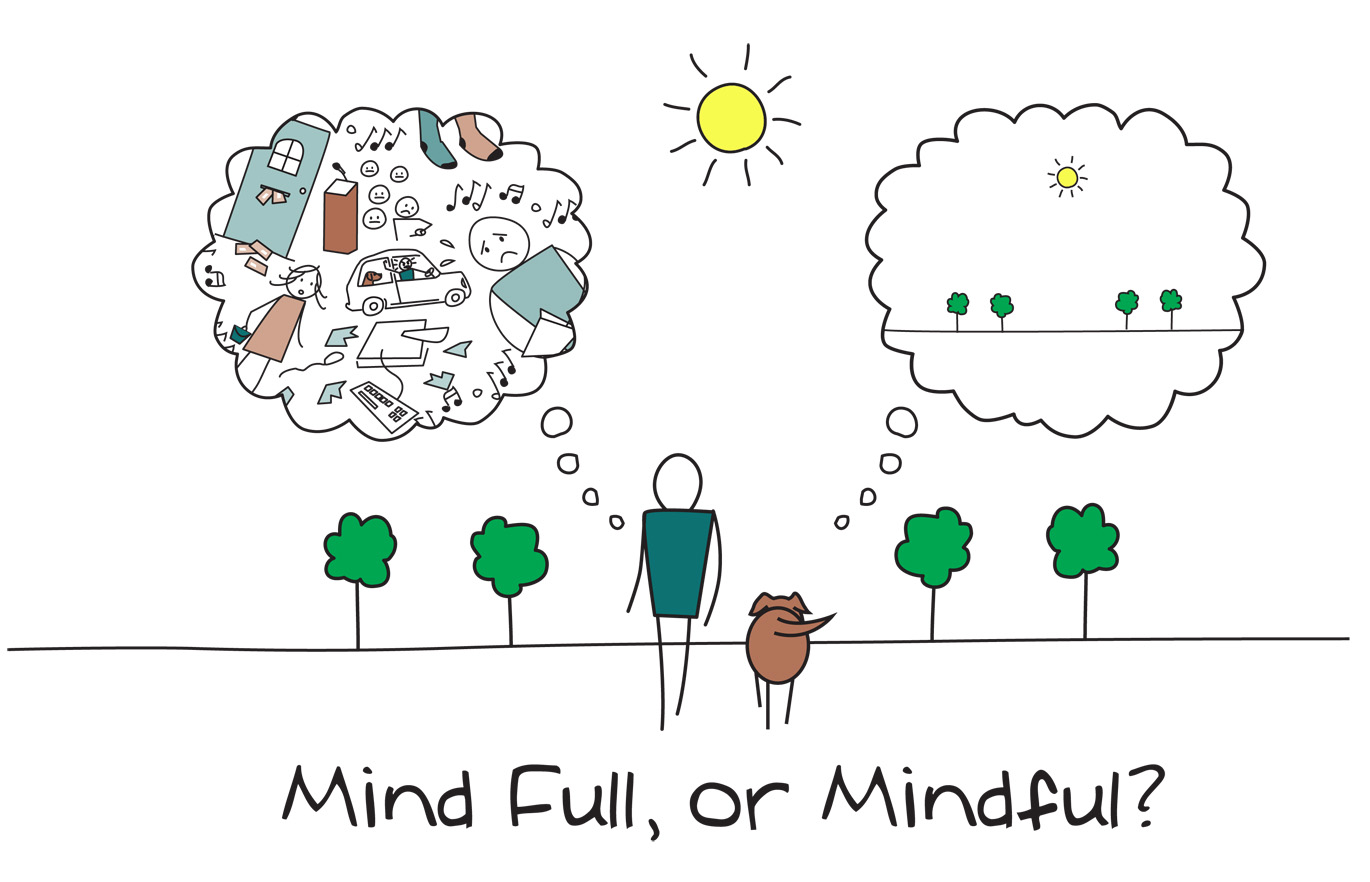
What is mindfulness? It’s the ability to think before you act, be aware of your own actions and reactions, and have insight into your own motives and why you do the things you do. It’s staying in the present, instead of fretting about the past or worrying about the future. It’s being able to step back mentally and see yourself the way others see you. Being mindful keeps you from acting out in ways you might regret later on. You’re not constantly apologizing because you acted out without knowing, because you can stop yourself before you do. Being mindful is like receiving a pair of magic glasses that allows you a view of yourself you never had before. You might think that having this “inner critic” would make you self-conscious, fearful and awkward, but ironically, it does the opposite. Because you have the ability to know how to act before you act, you have more control over yourself, and therefore more control over how others react to you. Slowly, you begin to find that people are reacting more positively to you, and you have fewer reasons to lash out at others or overreact to things. You begin to trust others more, because you trust yourself more.

Mindfulness is a wonderful tool in therapy, and is helping me get so much more out of it than I ever did before. I took DBT classes in 1996, when I was first diagnosed with BPD, and at the time I sort of blew them off. Because I was still in my abusive marriage, I was still very sick and not really ready to do the work. As long as I stayed with my narcissist, I was not going to get any better, but I didn’t know that. My ex had me convinced that I was the problem, not him. Because of his triangulation and gaslighting, he had everyone else convinced I was the crazy one too and he was just the put-upon victim. He’d systematically goad me into a BPD rage, knowing he could, and then with a smirk of satisfaction, tell everyone how insane I was. His personality and manner came off as more cool and collected than mine did, so I probably really did look crazier and more out of control than he did. But he was pulling all the strings.

Anyway, back to mindfulness. It wasn’t until early in 2014, when I finally went VLC (very low contact) with him (and kicked him out of the house), that I started to change. First I started to write and that’s why I started this blog. Writing every day helped me gain insight into myself and my narcissists. After a few more months, I began to realize I needed to make a few changes to myself. I pulled out my DBT workbook (Marsha Linehan’s Skills Training Manual for Borderline Personality Disorder) and began to do some of the exercises. I had already been doing a few of the things, but this time I took it more seriously and tried some of the things I hadn’t before. One of those things was paying attention to my internal, bodily state whenever I felt an unpleasant emotion. By doing this, I was able to begin to name what I was feeling. Emotions are very physical things. By naming an emotion, you can allow yourself to feel it, realize it’s just an emotion and not “you,” and learn to have more control over it.

mindfulness (1)

In therapy, I find I’m constantly focusing in on my bodily state, whether there’s any tightness, pain or strange sensations. There always seems to be pressure or tightness in my stomach, chest and throat that goes away when I can name the feeling and begin to express it. Being mindful this way of my internal state and naming my feelings, I’m much less likely to act out against other people or break things. I’m working now on breaking down the protective emotional wall I’ve developed that overlies softer feelings of sadness, grief, empathy, and connection with others. For many years it seemed the only emotions I ever could access were fear (sometimes straight up terror), shame, guilt, anger, and rage–and mind-numbing, zombielike depressions where all I wanted to do was sleep.

There are many ways to be mindful. Some of them are very simple, like counting to ten before acting. Others require more concentration. We need to learn how to self-soothe, something we never learned how to do as babies or young children. Being mindful allows you room to learn self soothing techniques. The insight you gain into yourself by being mindful also allows you the ability and courage to dig deep when you decide to undergo psychodynamic therapy. You’re going to experience powerful emotions when you’re searching for the root causes of your illness, and being mindful allows you to experience them without overreacting, acting out…or quitting therapy.

Guest Post #1: When My World Shattered

Favim.com-26101
Credit: Unknown artist, Favim.com

I’m thrilled to introduce my first guest blogger, Tessa from Advocate for Mental Illness.   Her blog is about her daily struggles with Bipolar disorder, told from a Christian perspective.  She has recently given her life to Jesus Christ.  Here is her bio from her About page:

ABOUT TESSA

Teresa (Tessa) Smeigh is over 55 and still going strong despite her disabilities affecting both physical and mental abilities. She has bipolar disorder (mental), Fibromyalgia (nerves), degenerative disc disease (spine), and arthritis (joints). Despite that she is active in Mental Health Advocating, writing for http://www.IBPF.org (volunteer for non-profit) and has 5 blog posts already published by them. She is also working on 2 fiction books (mysteries). She keeps her blog filled with useful content, daily devotionals (She is a Christian), stories and poems. Plenty to keep you busy. She has also been interviewed by blogs and had other posts published on many different blogs. She has 2 blogs so far http://www.tessacandoit.com and http://www.finallyawriter.com She is from Deptford, NJ. Her family and blogs keep her busy.
Although she doesn’t focus on it in her blog, Tessa also has Borderline Personality Disorder (BPD) and complex PTSD.  I have asked her to write a guest post about having BPD, because none of my other guest bloggers are writing about BPD but I already have several who will be writing about Bipolar and complex PTSD.
Here is her guest post.
When My World Shattered!
I am a 59 year old female who has suffered mental health conditions since birth. Since I was born in the 50’s people didn’t talk about mental health. Even with a suicide in the family it was not talked about.
As an infant I took anxiety medication in order to keep food in my stomach. I was considered to have a “nervous stomach.” My mother kept a supply of anxiety medicine at hand all through my childhood because anything could set me off into an “anxiety episode” and hysteria. This was common throughout my childhood. My self-soothing unfortunately was considered self-harm by today’s standards.
At a very young age I developed signs of bipolar disorder which at the time we did not know. I got an official diagnosis in my early 30’s after a breakdown. Also by the same procedure, a hospital stay almost 4 years ago picked up on the Borderline Personality Disorder (BPD) and I followed the symptoms back to when I was a child as well, but a little bit later than the bipolar.
Bipolar disorder and BPD are similar in symptoms and are often misdiagnosed. I have officially now been diagnosed with both. The biggest difference between the two is the length between the mood swings. Since my mood swings as a very young child were months apart it is most likely the bipolar disorder started first. Then later when the BPD developed they became rapid even changing during a single day or even hour.
It is difficult to break the symptoms down and say this belongs to bipolar disorder and this belongs to BPD. I will just go into the symptoms I suffer as one. Which is the direct cause, is not really necessary to know at this point.
How about a little history on BPD?
Symptoms usually manifest in childhood, but don’t become serious until a person becomes a young adult. This fits close to my time-line. Only I figure mine started in my teens after a traumatic experience of having been almost raped twice by the time I was 15 years old. I was then emotionally raped at 17 years old where I was told by the young man that either we had sex at that point or he was leaving me (abandonment considered to play a role in BPD) and we had just gotten back together. I couldn’t let him go. I gave in and that was also traumatic. I wasn’t ready. During that time I also suffered a miscarriage although I really didn’t know it at the time. I was totally naive even though my low self-esteem led me to wear sexy clothing and flaunt my body to every man. I didn’t know why I did it. I craved that attention though (promiscuity).
The exact cause of BPD is not know though they suspect brain chemistry plays a role, also genetics and environmental factors, along with the possibility of childhood trauma.
To add to the trauma, the 17 year old played the “I am going to kill myself if you don’t marry me” game when I tried to break up our relationship. I felt stuck, my emotions caused me to give in and marry him. I didn’t love him, but I was married at 19 years old. At 21 I had my first child, 22 I had my second and by 30 I had three children.  By then my weight was out of control due to binge eating.
My self-harm became more severe although I did resist cutting after I tried it and felt it didn’t give me the feelings I needed to soothe myself.
My anger intensified, but I kept it inside. I did not explode into rages unless you really pushed me but those rages were severe. People didn’t listen to my warnings and I flew into rages, shocking people with their intensity.
Paranoia became a constant state of my life. I am always sure people are talking about me. Even today.
Dissociation has been a constant since childhood. I always daydreamed and put myself into my books. I loved to read and my parents would force me outside. That triggered my anxiety and panic.
Severe depression for months on end would cause suicidal thoughts and several attempts and the last one landed me in the hospital for treatment and intense therapy. Luckily I didn’t succeed. The last one was the most serious.
I am currently in severe financial poverty due to low disability payments and reckless spending while I was manic.  Manic episodes are currently considered a symptom of both bipolar disorder and BPD.
I also have had a lot of unsafe sex due to my promiscuity, which is another shared trait.
BPD is difficult to treat. Usually a therapist, especially one trained in DBT (Dialectical Behavior Therapy) or CBT (Cognitive Behavior Therapy), combined with medications such as anti-psychotics, anti-depressants and mood stabilizers will help tone down the symptoms.
***
Please visit Tessa’s blog here. 
My apologies about the wonky spacing.  WP isn’t letting me change the coding and I don’t know CSS.  I hope that doesn’t affect anyone’s reading experience!

BPD Awareness: end the stigma

bpd-pride1

Borderline Personality Disorder is a serious mental disorder with its roots in childhood abuse (usually narcissistic or sexual abuse) and as you can see in one of the memes below, it shares much in common with Complex PTSD and may in fact be a variation of the same disorder.

But BPD is terribly stigmatized, with its sufferers being called everything from evil to incurable.  Many mental health professionals refuse to work with Borderlines because of this stigma.  They’re afraid of us!  While some more aggressive borderlines can certainly do bad things to others and be manipulative, for people with BPD, their actions are caused by an inability to control or regulate their emotions, so they act out instead of thinking before they act. Many Borderlines are more destructive to themselves than to others.  They can seem self-centered and narcissistic not because they lack empathy (many borderlines, in fact have an excess of empathy) but because they get too caught up in their own emotional turmoil to be mindful of others.    Unlike people with NPD, they also don’t have a sense of entitlement.   In fact, they often feel like they deserve nothing.

BPD is much more treatable and receptive to therapy than other Cluster B disorders like NPD or Antisocial Personality Disorder.   Unlike those disorders, too, people with BPD can be helped by medication.


bpdpride2

bpdpride3

bpdpride4

bpdpride6

bpdpride8

bpdpride7

bpdpride9

bpdpride10

Show your pride:

pbdpridebutton

Order one here: 
http://www.zazzle.com/bpd_pride_button-145549130796752314

BPD/mental illness awareness/LGBT bracelets and jewelry: 

Awareness Jewelry Shop

The One Who Got Away

Living with Narcissism is a new WordPress blog written from a man’s point of view. He suffers from C-PTSD and writes about his toxic relationships with character disordered women.

This is a highly readable account of his devastating breakup with a young woman who had Borderline Personality Disorder. While BPD is highly stigmatized, many women with active BPD behave just this way. I’m ashamed to admit I recognized some of Kerry’s behaviors in the ways I used to act in my relationships. This was an excellent post from a wonderful new blogger. Please go visit his blog and leave comments there.

donshelby's avatarLiving With Narcissism

Even after 15 years of marriage there was this one woman who I just never got over completely.  In my mind, she was my soulmate.  The one who got away.  Leaving her was like an addict giving up their drug of choice.  She was my heroine.  My soul was so enmeshed with hers that it literally felt like a tearing apart inside my heart and soul when I finally left her.  After all of those years I still pined for her and yearned for closure.  I had no idea what I’d done wrong or why we couldn’t work out.  I felt like our relationship was just an innocent baby and she killed it.  I should have hated her for that.  If it had really been a child, no doubt, I would have.  But it was a metaphorical child.  I didn’t hate her.  I missed her and still loved her even…

View original post 1,823 more words