Please vote on my new header design

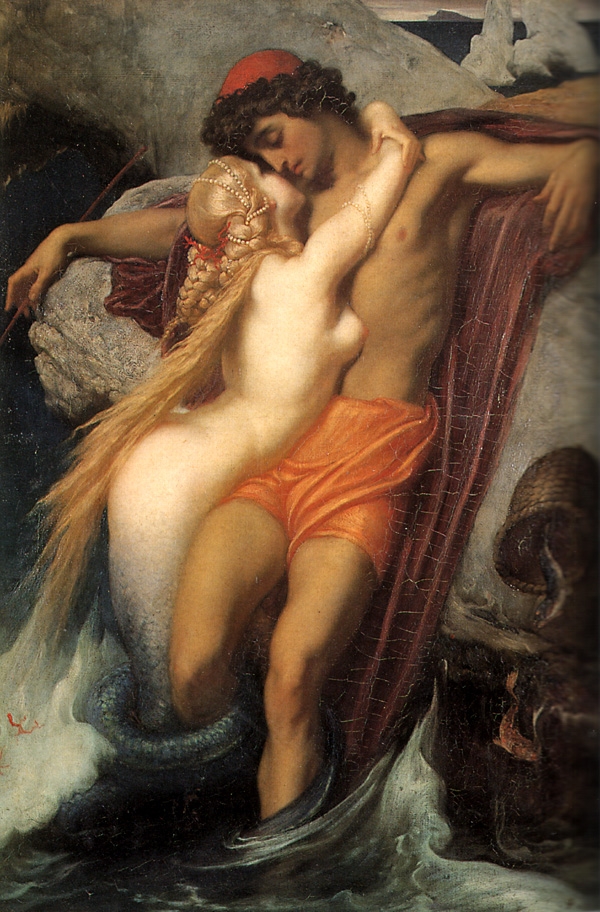
I just changed my header design by inserting the title within the painting itself instead of using the default heading that was above the painting before. I also deleted the stand-alone blurb/description of the blog (which I thought looked awkward and was too long); I shortened it and inserted it into the bottom of the photo. I’m not sure if the new design looks better or not, so I would like everyone to vote. Please be honest! If I get more votes that the previous design was better, then I will change it back.

Here is the old header (click to enlarge):

oldheader

Thanks for your help!

ETA: I also added a tab in the green bar describing why I chose this painting for my header. I am also about to add a “Lighter Side of Narcissism” tab, because those of us who have suffered need a few laughs from time to time.

What Sam Vaknin thinks about Jesus.

He replied to my last article about what he says about Jesus Christ–twice.   Once again he had to clarify a few things by providing links. One of the links provided talks about religion being a perfect way that narcissists can make themselves feel superior to nonbeliever (even though they must “submit” to a higher entity than themselves). They hold their nose and submit to a God or messiah because of the narcissistic thrill of self righteously being able to claim their piety makes them better than everyone else. I’ve seen this sort of thing going on in 12 step programs like AA too. In fact, my mother uses the AA program exactly like a religion and loves to use its slogans and dogma (and yes, it does have a dogma) to prove how righteous and sinless she is compared to non-teetolalers and everyone else, especially me.

I agree with what Vaknin writes in his post. I’ve seen way too many fundamentalist or evangelical Christians use their religion to intimidate (“you are going to hell”), make themselves feel special (“I know I’m going to heaven”), make threats (“unless you do X…you will go to hell”), not take responsibility for their actions (“God told me to do this” or “the devil made me do it”), and show a lack of empathy (“It’s God’s will”) and not acknowledge your concerns or questions (“It’s right here in the Bible or other holy text). This is especially prevalent in religious leaders, but is quite common in other people too.

god

Let me add that not all Christians are like this, and narcissistic behavior definitely applies to followers and leaders of other belief systems too, even atheism! (Self righteous, intolerant atheists are commoner than you would think).

Here is what he writes:

For the Love of God

“1 But know this, that in the last days perilous times will come: 2 For men will be lovers of themselves, lovers of money, boasters, proud, blasphemers, disobedient to parents, unthankful, unholy, 3 unloving, unforgiving, slanderers, without self-control, brutal, despisers of good, 4 traitors, headstrong, haughty, lovers of pleasure rather than lovers of God, 5 having a form of godliness but denying its power. And from such people turn away! 6 For of this sort are those who creep into households and make captives of gullible women loaded down with sins, led away by various lusts, 7 always learning and never able to come to the knowledge of the truth. 8 Now as Jan’nes and Jam’bres resisted Moses, so do these also resist the truth: men of corrupt minds, disapproved concerning the faith; 9 but they will progress no further, for their folly will be manifest to all, as theirs also was.”

(The Second Epistle of Paul the Apostle to Timothy 3:1-9)

God is everything the narcissist ever wants to be: omnipotent, omniscient, omnipresent, admired, much discussed, and awe inspiring. God is the narcissist’s wet dream, his ultimate grandiose fantasy. But God comes handy in other ways as well.

The narcissist alternately idealizes and devalues figures of authority.

In the idealization phase, he strives to emulate them, he admires them, imitate them (often ludicrously), and defends them. They cannot go wrong, or be wrong. The narcissist regards them as bigger than life, infallible, perfect, whole, and brilliant. But as the narcissist’s unrealistic and inflated expectations are inevitably frustrated, he begins to devalue his former idols.

Now they are “human” (to the narcissist, a derogatory term). They are small, fragile, error-prone, pusillanimous, mean, dumb, and mediocre. The narcissist goes through the same cycle in his relationship with God, the quintessential authority figure.

But often, even when disillusionment and iconoclastic despair have set in – the narcissist continues to pretend to love God and follow Him. The narcissist maintains this deception because his continued proximity to God confers on him authority. Priests, leaders of the congregation, preachers, evangelists, cultists, politicians, intellectuals – all derive authority from their allegedly privileged relationship with God.

Religious authority allows the narcissist to indulge his sadistic urges and to exercise his misogynism freely and openly. Such a narcissist is likely to taunt and torment his followers, hector and chastise them, humiliate and berate them, abuse them spiritually, or even sexually. The narcissist whose source of authority is religious is looking for obedient and unquestioning slaves upon whom to exercise his capricious and wicked mastery. The narcissist transforms even the most innocuous and pure religious sentiments into a cultish ritual and a virulent hierarchy. He preys on the gullible. His flock become his hostages.

Religious authority also secures the narcissist’s Narcissistic Supply. His coreligionists, members of his congregation, his parish, his constituency, his audience – are transformed into loyal and stable Sources of Narcissistic Supply. They obey his commands, heed his admonitions, follow his creed, admire his personality, applaud his personal traits, satisfy his needs (sometimes even his carnal desires), revere and idolize him.

Moreover, being a part of a “bigger thing” is very gratifying narcissistically. Being a particle of God, being immersed in His grandeur, experiencing His power and blessings first hand, communing with him – are all Sources of unending Narcissistic Supply. The narcissist becomes God by observing His commandments, following His instructions, loving Him, obeying Him, succumbing to Him, merging with Him, communicating with Him – or even by defying him (the bigger the narcissist’s enemy – the more grandiosely important the narcissist feels).

Like everything else in the narcissist’s life, he mutates God into a kind of inverted narcissist. God becomes his dominant Source of Supply. He forms a personal relationship with this overwhelming and overpowering entity – in order to overwhelm and overpower others. He becomes God vicariously, by the proxy of his relationship with Him. He idealizes God, then devalues Him, then abuses Him. This is the classic narcissistic pattern and even God himself cannot escape it.


Happy Thanksgiving!

thanksgiving1

thanksgiving2

Sam Vaknin thinks Jesus was a narcissist.

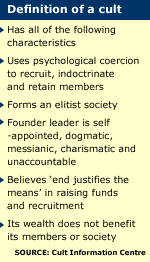
cultdefinition
A true cult’s agenda and operation is definitely psychopathic. (click to enlarge).

Sam Vaknin has a lot to say about religion and cults and how they relate to psychopathy.
On his website, he addresses the problems of religious cults and describes the way they are almost always run by malignant narcissists who use their usual bag of psychopathic tricks to brainwash people into converting and once converted, keeping them in thrall to the cult. The article is here.

Vaknin’s description of cults sounds exactly the way a cult such as Scientology is run (I dabbled in it back in the late 1970s for about 2 years but was fortunate enough to be able to escape before I was completely taken in). I have no doubt Scientology’s founder, L. Ron Hubbard, a hack science fiction writer, was a malignant narcissist (his official bio is full of lies and “accomplishments” that are complete fabrications). Scientology doctrine uses every trick in the psychopath’s book of coercion: brainwashing techniques disguised as “auditing” or “training routines (TR’s), threats to members who threaten to leave the cult (“fair game”), attempts to separate members from their non-Scientologist families and friends, exhorbitant and extortionist prices to move up the “bridge,”
insane doctrine passed off as “truth,” and definitely lots of paranoia and secrecy.

Lronhubbard
L. Ron Hubbard, malignant narcissist

Scientology is the enemy of any legitimate psychotherapy–psychology and psychiatry are held to be the utmost evil, members are required to use underhanded means to attack and even attempt to destroy the careers of professionals in those fields (I have a personal story about this I’ll describe at a later time), and of course Scientology has had numerous problems with the IRS and other government agencies. Anyone who criticizes Scientology is labeled a “Suppressive Person” and is either excommunicated from Scientology or punished by a form of shunning. Members who are influenced by someone who is against Scientology are labeled “Potential Trouble Sources” (PTS) and ordered to cut the “SP” out of their lives, even if it’s a spouse or another close family member.

There’s an excellent and fascinating website about the insane mindgames this “religion” plays and includes case histories of people whose lives were totally ruined by this dangerous and psychopathic cult. The “secrets” of the upper OT (operating thetan) levels used to be unobtainable to anyone who had not “gone clear” and had the money to pay for further “processing” to the OT levels, but those jealously guarded secrets are now available to anyone who has Internet access and is curious enough to Google them. Well, naturally I was curious and the “secrets” are indeed pretty crazy, obviously the ravings of L. Ron Hubbard’s disordered and paranoid mind.

It used to be said that the secrets could not be revealed to members at lower levels because such knowledge would shock them to the point of actually killing them. I remember reading about one ex-Scientologist who suggested that the real reason the upper level secrets were so carefully guarded was not to “protect” anyone from the shock of the “truth” but rather, because the things revealed at the upper levels were so insane that only someone who had spent thousands of dollars and been thoroughly brainwashed could possibly take them seriously (in fact, there are cases of those who did reach those levels and when the secrets were finally revealed to them, they left the Church because they felt their entire journey had been a colossal waste of time and money). Anyone who hadn’t made such a huge mental and financial investment and read about the OT revelations online would die alright: they would die of laughter. And yes, they are that crazy. I read the “revelations” of the OT levels with my jaw glued to the table in disbelief that any sane person would believe such a load of crap.

Vaknin should have used the example of Scientology, a perfect example of a “religion” with a psychopathic agenda and a malignant narcissist “god.” There are many other examples he could have used too–the Branch Davidians, Heaven’s Gate, the Unificiation Church (Sun Myung Moon’s cult), a few “New Age” cults, and many others.

But no, instead Vaknin attacks Christianity. He actually says Jesus Christ was a narcissist. I don’t know what Vaknin’s religious beliefs are, or even if he has any, and I certainly have my own issues with organized religion and fundamentalist Christianity in particular (the God of the Old Testament does come off as quite psychopathic at times), but I think Vaknin is missing the mark by describing Jesus Christ this way (or Christianity in general as a cult). He uses Bible quotes to “prove” that Jesus was a narcissist. Rather than try to paraphrase what he says, I’ll just post it here:

Jesus Christ, narcissist
http://samvak.tripod.com/journal79.html

Note:
Though most of the quotes in this essay are from the Gospel of Saint Matthew, I was careful to compare them with the texts of the other three canonical gospels. Where the gospels disagree, I avoided using the quote altogether.

Illegitimate and adopted children, especially of humble origins, often develop narcissistic defenses to fend off persistent feelings of inadequacy and inferiority. Admittedly, it is highly unlikely that Jesus was an illegitimate child. Adulteresses in ancient Judea were stoned to death. But, equally, there is little doubt that the circumstances of Jesus’s birth were shrouded in mystery. His mother, Mary, got herself pregnant but not by having sexual intercourse with her lawfully-wedded husband, Joseph.

Early on, Jesus developed magical thinking, compensatory grandiose delusions, and fantasies of omnipotence and omniscience. A firstborn, he was much pampered by his doting mother. He was a prodigy, a Wunderkind: highly intelligent and inquisitive and more comfortable in the company of adults than with his peers.

When he was a mere 12 years old:

“(T)hey found him in the temple, sitting in the midst of the doctors, both hearing them, and asking them questions.” (Luke 2:46)

Even at this tender age, he showed a marked lack of empathy and a full-fledged case of pathological grandiosity:

“His mother said unto him, Son, why hast thou thus dealt with us? behold, thy father and I have sought thee sorrowing. And he said unto them, How is it that ye sought me? wist ye not that I must be about my Father’s business?” (“My Father” being God – SV). (Luke 2:48-49)

Gurus at the center of emergent cults are inevitably narcissistic, if not outright narcissists. The self-imputation of superiority, epiphanic knowledge, and infallibility and the assumption that others need and crave the guru’s message are at the heart of an elaborate construct which often borders on the psychotic:

“… (T)he people were astonished at his doctrine: For he taught them as one having authority, and not as the scribes.” (Matthew 7:28-29)

Referring to his 12 disciples, Jesus made clear that: “The disciple is not above his master, nor the servant above his lord.” (Matthew 10:24)

“He that loveth father or mother more than me is not worthy of me: and he that loveth son or daughter more than me is not worthy of me. And he that taketh not his cross, and followeth after me, is not worthy of me. He that findeth his life shall lose it: and he that loseth his life for my sake shall find it.” (Matthew 10:37-39)

Here is how Jesus, the lowly, unmarried, and itinerant son of a carpenter – an abysmal failure by the standards of his society – viewed himself:

“When the Son of man shall come in his glory, and all the holy angels with him, then shall he sit upon the throne of his glory: And before him shall be gathered all nations: and he shall separate them one from another, as a shepherd divideth his sheep from the goats … And these shall go away into everlasting punishment: but the righteous into life eternal.” (Matthew 25:31-32 and 25:46)

“Thinkest thou that I cannot now pray to my Father, and he shall presently give me more than twelve legions of angels?” (Matthew 26:53)

Contrary to his much-cultivated image, Jesus, like the vast majority of cult leaders, lacked empathy and was a heartless and irresponsible manipulator whose magical thinking ruined the lives of many. He instructed his followers to commit acts that must have had harshly adverse impacts on their hitherto nearest and dearest. Jesus monopolized the lives of his disciples to the exclusion of all else and all others:

“For I am come to set a man at variance against his father, and the daughter against her mother, and the daughter in law against her mother in law. And a man’s foes shall be they of his own household.” (Matthew 10:35-36)

“Then one said unto him, Behold, thy mother and thy brethren stand without, desiring to speak with thee. But he answered and said unto him that told him, Who is my mother? and who are my brethren? And he stretched forth his hand toward his disciples, and said, Behold my mother and my brethren!” (Matthew 12:47-48)

“And Jesus, walking by the sea of Galilee, saw two brethren, Simon called Peter, and Andrew his brother, casting a net into the sea: for they were fishers. And he saith unto them, Follow me, and I will make you fishers of men. And they straightway left their nets, and followed him. And going on from thence, he saw other two brethren, James the son of Zebedee, and John his brother, in a ship with Zebedee their father, mending their nets; and he called them. And they immediately left the ship and their father, and followed him.” (Matthew 4:18-22)
Consider the disastrous effects their actions had had on their fathers and their families, now left to starve. To Jesus, evidently, these were irrelevant considerations.

Jesus healed only those who visibly, volubly, clearly, publicly and repeatedly worshipped him. In other words, he extended his gift only to his sources of narcissistic supply. There are numerous instances in the four canonical gospels where Jesus actually bargains with the afflicted and demands – sometimes in anger – their unconditional adoration. He is happiest when acknowledged and affirmed as Christ, the Son of Man (son of God). Those who do not recognize his splendid grandeur, unbounded might, and implied divinity are “dogs” and “swine” (Matthew 7:6)

His much-touted love of the poor was not a match for his malignant self-love. When his disciples upbraided a woman for anointing Jesus with expensive ointment because the money could have been better used to help the poor, the great humanist, Jesus, had this to say:

“Why trouble ye the woman? for she hath wrought a good work upon me. For ye have the poor always with you; but me ye have not always.” (Matthew 26:10-11)

The principles espoused by Jesus were malleable and easily bent. He professed to minister only to the Hebrews (Sons of Israel) and steadfastly refused to heal the Gentiles whom he called “dogs”. When a woman of Canaan beseeched him to cast the devil out of her daughter (“Have mercy on me!”), he retorted, shockingly:

“I am not sent but unto the lost sheep of the house of Israel … It is not meet to take the children’s bread, and to cast it to dogs.” (Matthew 15:24-26)

But he soon forgot and retracted this lofty “principle” when she adulated him:

“Then Jesus answered and said unto her, O woman, great is thy faith: be it unto thee even as thou wilt. And her daughter was made whole from that very hour.” (Matthew 15:28)

Similarly, he cured the servant of a Roman centurion after his master catered to Jesus’s by-now rampant megalomania:

“When Jesus heard it, he marvelled, and said to them that followed, Verily I say unto you, I have not found so great faith, no, not in Israel. And Jesus said unto the centurion, Go thy way; and as thou hast believed, so be it done unto thee. And his servant was healed in the selfsame hour.” (Matthew 8:10 and 8:13)

Jesus’s initial false modesty soon gave way to bragging and outlandish, often confabulatory claims.

Whenever he affected a miracle – such as restoring eyesight to the blind, cleansing lepers, reviving the crippled, and raising the ostensibly dead – Jesus beseeched them to keep mum about the events. One of many examples:

“And their eyes were opened; and Jesus straitly charged them, saying, See that no man know it.” (Matthew 9:30)

But Jesus was not averse to blatant self-promotion when his false modesty failed to elicit narcissistic supply:

“Go and shew John again those things which ye do hear and see: The blind receive their sight, and the lame walk, the lepers are cleansed, and the deaf hear, the dead are raised up, and the poor have the gospel preached to them.” (Matthew 11:2)

“I say unto you, That in this place is one greater than the temple … For the Son of man is Lord even of the sabbath day … behold, a greater than (the prophet) Jonas is here … behold, a greater than (King) Solomon is here.” (Matthew 12)

As a true narcissist, Jesus reprimanded others for his own brand of behavior. This psychological defense mechanism is called “projection”.

This is how he described the Pharisees, the scribes, and the Sadducees (and, inadvertently, himself and his own conduct):

“(T)hey say, and do not. For they bind heavy burdens and grievous to be borne, and lay them on men’s shoulders; but they themselves will not move them with one of their fingers. But all their works they do for to be seen of men: they make broad their phylacteries, and enlarge the borders of their garments, And love the uppermost rooms at feasts, and the chief seats in the synagogues, And greetings in the markets, and to be called of men, Rabbi, Rabbi.” (Matthew 23:1-6)
Narcissists are disruptive, counter-dependent, combative, and resent authority (rebellious and contumacious). They feel that they are above the law, or, rather, that they are a law unto themselves. They hold themselves to be immune to the consequences of their actions:

“Think not that I am come to send peace on earth: I came not to send peace, but a sword.” (Matthew 10:34)

“And Jesus went into the temple of God, and cast out all them that sold and bought in the temple, and overthrew the tables of the moneychangers, and the seats of them that sold doves, And said unto them, It is written, My house shall be called the house of prayer; but ye have made it a den of thieves.” (Matthew 21:12-13)

Narcissists are ill-disposed towards disagreement and criticism. They react to the slightest hint of either with narcissistic rage and fury that knows no bounds and no mercy:

“And thou, Capernaum, which art exalted unto heaven, shalt be brought down to hell: for if the mighty works, which have been done in thee, had been done in Sodom, it would have remained until this day. But I say unto you, That it shall be more tolerable for the land of Sodom in the day of judgment, than for thee.” (Matthew 11:23-24)

“He that is not with me is against me” (Matthew 12:30)

“For I say unto you, Ye shall not see me henceforth, till ye shall say, Blessed is he that cometh in the name of the Lord.” (Matthew 23:39)

Narcissists react particularly badly when their concocted personal myth, their False Self, is directly and effectively challenged and they are consequently discredited and humiliated in public:

“And when he was come into his own country, he taught them in their synagogue, insomuch that they were astonished, and said, Whence hath this man this wisdom, and these mighty works? Is not this the carpenter’s son? is not his mother called Mary? and his brethren, James, and Joses, and Simon, and Judas? And his sisters, are they not all with us? Whence then hath this man all these things? And they were offended in him. But Jesus said unto them, A prophet is not without honour, save in his own country, and in his own house. And he did not many mighty works there because of their unbelief.” (Matthew 13:54-58)

Ultimately, the narcissist pays the price for years of ill-treating others and sucking their energies dry with constant demands for attention, adulation, and affirmation. People get tired of the overbearing and overweening presence of the narcissist in their lives, of his disruptive and destabilizing influence, and of the pernicious effects he has on their nearest, dearest, and communities. Invariably, they seek to banish him and extricate themselves from his cult. The authorities usually are forced to intervene and lock the narcissist up or, worse, crucify him.

Even his closest followers, supporters, and disciples give up on the narcissist:

“Then all the disciples forsook him, and fled.” (Matthew 26:56)

“Then did they spit in his face, and buffeted him; and others smote him with the palms of their hands, Saying, Prophesy unto us, thou Christ, Who is he that smote thee?” (Matthew 26:67-68)

“Peter remembered the word of Jesus, which said unto him, Before the cock crow, thou shalt deny me thrice.” (Peter, indeed, denying knowing Jesus thrice – SV) (Matthew 26:75)

And the fickle “multitude” (the common folk), who were supposed to be the mainstay of Jesus’s power and popularity, betrayed him gleefully and with a clear sense of relief and good riddance:

“Whether of the twain will ye that I release unto you? They said, Barabbas … They all say unto him, Let him be crucified … they cried out the more, saying, Let him be crucified … Then answered all the people, and said, His blood be on us, and on our children … And they that passed by reviled him, wagging their heads, And saying, Thou that destroyest the temple, and buildest it in three days, save thyself. If thou be the Son of God, come down from the cross. Likewise also the chief priests mocking him, with the scribes and elders, said, He saved others; himself he cannot save. The thieves also, which were crucified with him, cast the same in his teeth.” (Matthew 27)

Jesus_with_a_child
Jesus doesn’t look like a narcissist to me.

Vaknin is using the words and deeds described in the Gospels to spin Jesus into a malignant narcissist. I don’t buy it. I have been attending RCIA classes (the classes one takes to become Catholic), and am still on the fence as to whether Jesus was actually the Son of God or just a very good man and prophet, but have lately been leaning more toward him being divine.

If Jesus was actually who he said he was–the Son of God–then he was being truthful and not narcissistic or grandiose in any manner. Jesus was compassionate and empathetic toward the unfortunate and the poor and healed the sick and disabled, and while he does appear to have had a temper, it was a righteous anger toward those who refused to believe who He was. He didn’t reject or disrespect his mother either. He had a great love for Mary as his earthly mother, but if Jesus was the son of God, then God’s desires would naturally have to come first.

In Vaknin’s defense, if he doesn’t believe Jesus was divine (and many people don’t), then I suppose it could be argued Jesus acted in narcissistic and grandiose ways (it could actually more easily be argued he was a paranoid schizophrenic–insisting he was God Himself when he really wasn’t), but I still wouldn’t call him a narcissist. Vaknin is probably not a Christian due to his nationality (he’s from Israel and his mother was Turkish) so it’s understandable that he wouldn’t believe Jesus was the Son of God, but to make such a sweeping accusation against a religious entity whose words have changed the lives of many millions of people for the better is pretty narcissistic on Vaknin’s part (which of course is no surprise).

Some of the more extreme evangelistic and fundamentalist Christian churches (especially those that believe in such unpleasant and elitist doctrines as predestination–a Calvinistic belief that certain “chosen” people have been predestined for heaven even before they were born, making the concept of “free will” and works null and void) are not too far removed from cults and they commonly have psychopathic leaders and use cult-like brainwashing tactics. There are also unfortunately many religious leaders of mainstream churches who are very narcissistic and even psychopathic, but this doesn’t mean Christianity itself is a cult of narcissism or that Jesus was a narcissist.

I still defend most of Vaknin’s writings from his critics, given that as a narcissist who is honest about himself, he is more than qualified to call himself an expert on the disorder and write as much as he wants to about it. Whether intentional or not, he has helped a great number of sufferers and victims of psychopathy. But in this particular discussion about cults, using Christianity as an example of a cult and Jesus as a malignant narcissist not only misses the mark, but to many people would be considered blasphemous. In spite of my own misgivings about Christian doctrine, I just couldn’t let this pass.

A pretty good day

goodday

Alright, so my day didn’t start out very good.

Yesterday I got my settlement check from the insurance company from the car accident Molly was in last month, and this morning had to go to the bank to open a savings account and deposit the rest in checking, so I was an hour late for work because the bank didn’t open until 9 AM and I didn’t want to be toting a huge check around all day.

At 8:30 I received a call from my boss. She screamed “WHERE ARE YOU?”
Rubbing my assaulted ear, I explained I’d left a message on voicemail at 6:30.
“BUT IT WASN’T ON VOICEMAIL! DON’T YOU REALIZE THIS IS OUR BUSIEST SEASON?” The implication that I was lying about leaving a message could not have been more obvious.
“I’m sorry, I did leave a message. I’ll get there as soon as I can. I won’t be more than an hour late.”
“WELL YOU BETTER MAKE IT QUICK!”
Click.

I opened up my laptop and Tweeted: “Today is going to be the day from hell.”
I quickly scanned my blog stats, and found them disappointing.
Mentally I felt my defensive armor going up and my cortisone levels rising. I braced myself for the attack I knew I’d be facing once I got to work.

Although I have nearly perfect attendance and am never late, sure enough, when I arrived at the office, my malignant narcissist boss screamed, “IT’S THE BUSIEST WEEK OF THE YEAR! DON’T YOU REALIZE THAT? YOU ARE RUINING THIS COMPANY!”
Facepalm.

I knew she wasn’t serious, because I do a good job, my attendance is good, and she’s like that with everyone (well, except for her flying monkeys and sycophants), but it still made me feel violated and angry. Narcissists have a way of doing that.

The other bad thing that happened this morning was my daughter Molly went to court and was sentenced to 30 days in jail. She will be out Christmas day (thank goodness for that!). The good thing is that when she gets out, she will owe no more fines (which are far more than she or I can afford) and will have no more probation. She’ll do her time and just has to stay out of trouble after that.

But the day got a lot better. While it wasn’t the day from heaven, it didn’t turn out to be the day from hell either. I made friends with Molly’s older boyfriend, Paul. We were texting each other back and forth about Molly’s day in court and what happened. When I got home from my long day at work, I called him, and we spent about two hours talking. He is very easy to talk to, even for an Aspie like myself–I always feel violated and threatened by the most simple telephone conversations. I always hated the sound of a ringing phone. But talking to Paul was different, and put me at ease.

Paul is not only comfortable to talk to, he genuinely and sincerely cares about Molly. He’s the first boyfriend she’s ever had who has really cared about her wellbeing and wants her to turn her life around instead of all the losers who did nothing but drag her down and use her. We talked mostly about Molly, and what we can do together to help her. He’s older than she is and she listens to him, where she hasn’t always listened to me (I’m her mom–that’s probably why!) He put money into her jail account so she can buy concessions and make phone calls.

The other day I wrote a long depressing post saying I thought Molly was a narcissist (and she may be), but once again I have doubts. Drug addiction and bipolar disorder can also cause a person to act in a narcissistic way. She also has a diagnosis of BPD and PTSD. People with BPD can act very much like narcissists, as can bipolar people in their “manic” phase.

The reason I’m once again doubting she’s a true narcissist is because when she was handcuffed today, Paul was there with her, and she looked at him and said, crying, “I’m so sorry for all the pain I’ve caused everyone. I really want to change. I’m a terrible person.”

I don’t think she would have been faking those tears and those words; for what reason would she do so? Paul told me they have had some deep conversations about her behavior and run-ins with the law over the past decade and how much she doesn’t want to be part of that anymore. I think she was running around with some people who were very bad for her, because she thought she didn’t deserve or couldn’t do any better.

yesterdaysfeelings

Molly is intellectually brilliant and could do anything she wants in life. Once upon a time she was a straight-A student. But her self esteem is so low that she’s mostly associated with people far beneath her, people who do stupid things because they just aren’t very bright. Paul wants her to spend more time with her psychologically healthier friends who aren’t doing drugs, and meet some of his friends who are succeeding too.

Molly has never liked to read much (although she reads and writes very well), but in jail she will have a lot of time for reading (it beats playing cards and watching endless reruns of “Cops”). He told me about a book she had been talking about by the actress Kristen Johnson, called “Guts,” in which she describes her struggles with alcohol and drugs before she turned her life around. This book could be inspirational for her. Molly has always liked biographies and stories about people with substance abuse issues. I remember her favorite book in high school was one that had also been a favorite of mine when I was her age: “Go Ask Alice.”

I don’t have any family to speak of (or rather, none that I speak to), and certainly none in my area, but Paul invited me to his home for Thanksgiving. I invited my roommate to come along, but she declined, so it will just be the two of us. He’s new in this area and has no family here either. He’s cooking dinner and I’m bringing dessert and a bottle of red Merlot wine (my favorite).

Having been burned so many times by narcissists and psychopaths, I don’t trust people easily, so of course there’s a small nagging voice in my head warning me Paul may be a narcissist in the love-bombing phase, but I really, truly don’t think so.

Just the other day, Molly was talking about having kids someday. She’s never shown the slightest bit of interest in having children (she is a bit young still and certainly not emotionally ready), but she told me she would be interested if she was married, and she thinks Paul may be The One. I told her not to rush things and I would like her to attend school first. Paul and I think she just may do this once she is released. He wants to take her to the community college just to have a look around and maybe sign up for one class just to get her feet wet.

After putting most of the settlement in savings, I still have a little over $1,000 left, a nice sum of cash for someone as poor as I am. Some will be used for Christmas, but I decided to order a few books tonight. One was Kristen Johnson’s book “Guts” which I’ll bring to Molly; I also ordered a Wild Republic stuffed raccoon (a Christmas gift for my son (who already has “Alfonso” the river otter, who I wrote about)), and two more books about narcissism: Martha Stout’s “The Sociopath Next Door,” which I have heard great things about; and Sam Vaknin’s gigantic tome, “Malignant Self Love: Narcissism Revisited.”
I love to get things in the mail, especially books.

dancingsnoopy

Any day, no matter how shitty it starts, where I can make a new friend, feel hopeful about my kid, have a little money to spend, realize I won’t be alone on a big holiday after all, and get some new books to read, is a good day. And if I can end that day with a new blog post telling you what a good day it was, then it’s officially a great day.

Who was Narcissus?

narcissus3_mythman

Many artists have depicted Narcissus, the legendary Greek hunter who loved to stare at his own image in pools of water, but eventually realized he could never possess just a reflection of himself, and in deep despair, killed himself. Other versions of the legend have him falling into the pool of water while staring at his reflection and drowning. But there’s more to the legend. For those of you who enjoy mythology or just like love stories, here’s the story in its entirety:

Myth Man’s Echo and Narcissus: a Sad Love Story

Narcissus was so beautiful that both men and women alike desired him, but Echo, a beautiful but overly talkative young woman, loved Narcissus most of all. Unfortunately, her adoration and devotion was unrequited because of Narcissus’ love for only himself. This seems so familiar to those of us who have been the victims in a relationship with a narcissist, doesn’t it?

I wonder if Narcissus would have gained narcissistic supply from knowing a well known and “popular” mental disorder was named after him. Probably.

Here are some of my favorite images of Narcissus (and Echo).

narcissus1_caravaggio
Caravaggio’s painting is my favorite, and I have used this image in a few other posts. Narcissus is so beautiful here, I could stare at him forever (just as poor Echo did). I love how lost he looks in his own reflection. He’s looking at it the way a man looks at a woman he’s fallen in love with.

narcissus2_andecho
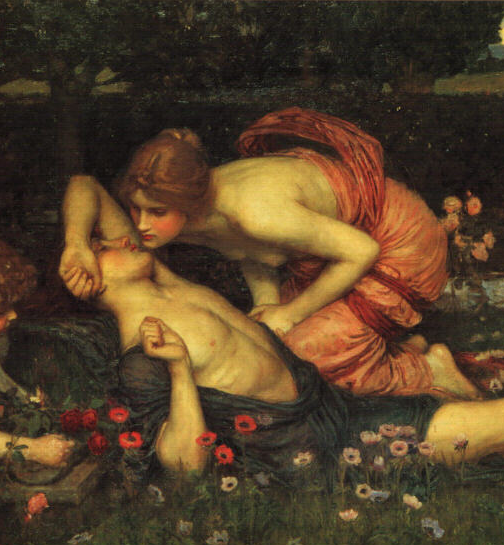
John William Waterhouse’s 1903 painting of Narcissus and Echo is another of my favorites. Narcissus is completely unaware of Echo’s presence. You can tell she’s in love with him but he doesn’t want her. In fact, he doesn’t even know she exists. In his world, only he exists.

narcissus4
Narcissus and 2 women. Artist unknown. (Does anyone know who painted this?)

echoandnarcissus
I do not know who painted this either. But notice how completely Echo is engaged, passionately embracing Narcissus, and yet he is not returning her embrace. He seems to be merely tolerating her. Theirs is definitely an unequal relationship.

echo
Another unknown artist. It appears this image may depict Narcissus after his death, or maybe he’s just asleep or pretending to sleep so he doesn’t have to engage with the adoring Echo.

deviantartecho
A modern take: Esstera’s Echo and Narcissus on Deviantart. I love Echo’s almost angry expression and body language in this.

narcissusrevoy
Another modern take, moved to an urban environment (looks like a NYC subway)–“Narcissus and Echo” by David Revoy. I love this!

narcissusflower
The Narcissus flower, related to the daffodil, according to legend bloomed on the banks of the pond where Narcissus died.

There are many other images and paintings of Narcissus and Echo, but these are the ones that really capture my imagination and I think are the most beautiful.

This song pretty much nails it.

This was one of my very first posts (my 3rd one in fact), but I’m reblogging it because “Liar” by Henry Rollins describes the evil mind games the malignant narcissist plays in a most effective and creepy way. For the record, Rollins is no narcissist–he’s a multitalented man who is not only a spoken word poet, actor, and musician, but is also deeply involved in many great causes that make our world a better place. But he sure acts the part of a psychopath well here!

NOTE: You will need to click on “view original” at the bottom of this post to view the video. Sorry for the inconvenience.

luckyotter's avatarLucky Otters Haven

Here’s a song from the ’90s that nails the evil mindset of the malignant narcissist.

View original post

Beware of narcissists posing as victims in the narcissistic abuse community

wolvesinsheeps

I came across this post today on PsychForums. It’s by a woman who’s the moderator of a site for victims of abuse (she does not specify which site). She talks about how she is triggered and angered by forum members who she perceive as “better” in some way–smarter, prettier, richer, what have you–and then proceeds to play head games with them, make it difficult for them to log in or even bans them, without ever giving a reason. This poster admits getting pleasure from making the forum members suffer and thinks it’s a fun game. She admits her own life is a shambles and she is deeply miserable. The fact she posted this on a psychological forum indicates she is are aware this is a problem and knows it’s wrong, but she says on the forum she feels like “God” and doesn’t seem to want to stop playing so cruelly with the forum members.

I’ve read a number of blog posts and articles that discuss this problem, which is much more prevalent than you might think. It’s disturbing and scary. It’s hard enough for victims of narcissistic abuse to trust other people, and they come to blogs and forums to find a haven of like minded people who have been through the same shit they have and find support. But not everyone they meet in these online havens are who they say they are. Some may be psychopaths out looking for prey, and what better prey is there than the members of a website for victims of abuse?

Psychopaths and malignant narcissists are attracted to blogs and forums focusing on narcissism and abuse, because these are places where the “prey” is abundant. They can have a field day playing with the minds of vulnerable, hurt victims, especially if they are the admin or owner and have created a website for the abused. I’m not talking about someone like Sam Vaknin here–at least he’s upfront and honest about his narcissism, and he’s actually helped many victims of abuse (I still can’t quite figure out what his true motives are–they must be primarily self-serving, but his writings have helped many). Rather, I’m referring to website and blog owners who focus on narcissism and psychopathy but are malignant narcissists themselves, yet they pose as victims or sympathetic “gurus” who only want to help but do anything but.

Bloggers and forum admins, by nature, are probably at least a little narcissistic, but as long as it’s not used to hurt or manipulate or be used against members of the community, then it’s not a problem. But there do exist those who run sites for the abused who pretend to be caring survivors but are anything but. In fact, they hate and envy those who post on their sites.

flyingmonkey

How can you tell if a forum or blog owner is really a malignant narcissist–a wolf in sheep’s clothing? How do you know that when they talk about “their psychopath” or “their MN” that THEY are really the MN or psychopath and the “abuser” is the real victim?

Unfortunately, there’s no sure way to tell. Narcissists have very tender feelings. They are easily hurt and love to whine about how they’ve been “victimized” by other people who have had the guts to call them out, retaliate, or complain about their evil behavior. They fail to take into account that they had it coming and deserved the “abuse.” When you can hide behind the anonymity of the Internet, it’s all too easy for a narcissist to leave out pertinent facts–such as what THEY might have done to deserve the “abuse” they had coming to them. Their lies and half-truths about their victimization may seem very believable. They can make their victim sound like a raging psychopath should they choose to do so. It’s a form of online gaslighting and they are very good at it.

While there’s no foolproof way to tell, especially online, who’s a malignant narcissist posing as a victim and who’s a real victim, there are some red flags to look for.

1. Does the forum or site owner ban people easily, delete posts, or not approve posts? (I’m not talking about trolls or abusive posts here)
2. Is there a lot of infighting and antagonism between the members? If so, suspect an admin or a person with power on that site playing a “divide and conquer” game with the members to turn them against each other.
3. Is there a member who constantly complains about their victimization but never seems to do anything about it, does nothing but trash their abuser’s character, or never seems to get any better? You could be dealing with a narc posing as a victim.
4. Is there anyone who seems envious or resentful of another person’s recovery or improvement, or even just fails to acknowledge that person’s good fortune, or changes the subject?
5. Is there a self centered person who only talks about their own case, but never offers support or encouragement to other members? That person could be a narc.
6. If there is someone who is openly critical or judgmental of another person’s case or behavior, that person is almost certainly a narc.
7. Is the site owner uninvolved with the members and never seem to interact with them? If so, you may be dealing with someone who is looking to achieve Internet “fame” and really isn’t interested in the subject or its members.
Narcissism and psychopathy are hot topics these days, and blogs and websites about these disorders are almost guaranteed to get a lot of hits and views. Someone who wants to achieve Internet “fame” may start a blog or site about narcissism or psychopathy just because it’s popular and trendy, even though they don’t have much interest in the topic. These blog owners probably own other blogs and sites, and those sites will focus on other “hot topics.” But if the owner is really that detached or disinterested, the site will eventually lose members and fizzle out. It’s hard for members to stay involved, when the owner isn’t even interested.

****

Further reading (with my personal experience):

9 Ways to Tell if the Victim Blog You Read is Run by a Narcissist 

Black Friday Cometh

I was going to write something about Black Friday, the scourge which threatens to take over Thanksgiving with its spirit of greed instead of thanks, but this rant is so well written, I’m just going to reblog it here.  I couldn’t have said it better myself.

Trey Willis's avatarFlakes of Cynicism

Or: Ready, Set, CONSUME.

Thanksgiving is upon us, which can only mean one thing – Black Friday is back, ready to blow your sanity to bits with door-buster deals. Don’t get me wrong, I love a bargain as much as anyone else, and have found myself wading through rabid crowds in the cold dawn more than I would care to admit. I don’t really take issue with Black Friday. The way in which it has usurped Thanksgiving and what that says about our culture is what I find problematic.

Look, a dead horse!

I’ve never been one for crowds, so perhaps that is the root of my general disdain for this holiday of consumerism. Thanksgiving has been my favorite holiday since I was a child. I have all kinds of warm and fuzzy memories of giant family Thanksgiving meals long past. As an adult, more often than not, my wife and I host our families for…

View original post 591 more words

My “lucky” bamboo plant

I don’t have a green thumb. At all.  I love plants, but usually, no matter how well I care for them, or how closely I follow the instructions on the little plastic card they come with, my plants still shrivel up and die.

The fact I also have cats doesn’t help either. Plants and cats in a house do not usually mix.

But my lucky bamboo plant is different.  And my 4 cats are indifferent.  I guess bamboo doesn’t have a smell or something.

I purchased this little bamboo plant as a tiny 3 inch seedling about a year ago.    As you can see from the photos below, the pretty little grass-green ceramic planter it came in is now far too small for it.  It needs a new home soon.

bamboo1 bamboo2

Still, the bamboo continues to thrive. Its leaves are glossy and bright green, and it keeps throwing off new shoots. Maybe the muted light from the fake stained glass in the kitchen window (really a clear plastic decal from Home Depot I cut to size and stuck on the glass to cover the ugly hardened sap stains from the poplar tree that used to drip its effusions before it was finally chopped down) helps. Like people with sensitive eyes or allergies to the sun, bamboo doesn’t like bright, in your face sunlight. Or maybe it’s the tiny Laughing Buddha who’s sitting there in front of the planter, throwing off little sparks of positive energy, that’s keeping the plant so hale and hardy.

bamboo3
Another view of the bamboo without all the background distractions.

2 images of my Laughing Buddha (turn him upside down and around and he grins instead of laughs!)
laughingbuddha2 laughingbuddha1

Unlike my other plants, there is no soil in the little planter the bamboo lives in. Instead, there are squishy round spheres that look like clear marbles, but adding water to them makes them expand and diffuses water through the plant’s tissues–so it always gets just the right amount of water. It’s like a self-feeder for cats, only it’s for plants. Since I will have to rehome my bamboo soon, I purchased this jar of “Water Gems,” the name of the little squishy spheres that keep my plant healthy and thriving. when I repot it (I hope I can find something as cute as the pot it came in), these will go into the new planter.

watergems

In case you’re wondering, the glass, mirror and tile baubles hanging from the window sash are a couple of the suncatchers I made for awhile. The one on the right is broken but it’s still pretty there in the kitchen window.