Narcissists with Aspergers?

lonely_guy

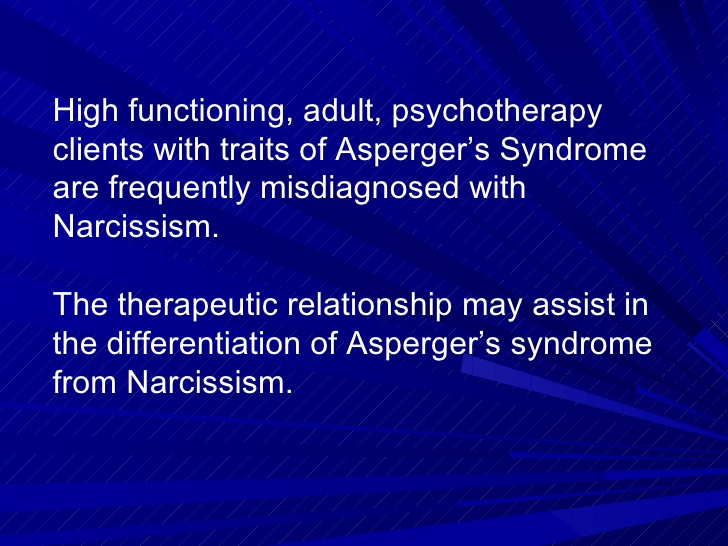
There’s been much written about the relationship between Aspergers syndrome and narcissism, mostly about the way they are often confused with each other (or misdiagnosed as the other disorder) due to the belief that people with Aspergers lack empathy (which is not true). I wrote about this false belief in my article, “People with Autism Do Not Lack Empathy!”

People with Aspergers may SEEM unempathic, because they are not always very good at expressing emotions or knowing how to react when other people share their emotions with them. But an Aspie’s lack of appropriate social reaction to the emotions of others doesn’t mean they can’t FEEL the emotions around them. In fact, some may feel other’s emotions MORE keenly than neurotypicals, and they can be easily overwhelmed, which may cause them to withdraw from the situation and partly account for why they may seem less engaged emotionally or uncaring about the feelings of others.

aspie_misdiagnosis

Narcissism as an Autism Spectrum Disorder?

question2

Psychology Today had an interesting article comparing narcissism to high functioning autism (Aspergers) and at least one psychologist thinks they may be the same disorder!:

Khalid A. Mansour (the British Arab psychiatrist), has proposed in an article in the Pan Arab Journal of Psychiatry (link is external) that narcissistic personality may merit classification as an autistic spectrum disorder.

Dr. Mansour writes, “There is now significant level of agreement that emotional processing problems like: lack of empathy, poor self-awareness, self-centredness, poor reciprocation of emotion, poor ability to maintain emotional relationships, anxiety and anger outbursts are more or less central features of autism (10, 50,51).”

Interesting. When I first read the above paragraph, I though Dr. Mansour was writing about severe narcissism. His description fits both narcissism and autistic spectrum disorders. Hmmm.

Dr. Mansour similarly quotes from the ICM-10 listing these features of autism:

–Self-centeredness; inappropriate to developmental level and cultural expectations
–Poor self-awareness, poor ability to develop remorse or learn from mistakes
–Poor empathy or appreciation of others feelings
–Poor ability to reciprocate emotions.
–Hostile dependency on safe relations.
–Failure to develop emotional relationships appropriate to developmental level and social norms
–Treating people as objects or preferring objects over them
Again, this list certainly sounds a lot like narcissism.

Dr. Monsour concludes: “… it is noticeable that people with NPD, do not show a major degree of functioning problems in stress free environment or when they are supported (except that they are perceived as “not pleasant characters” to deal with). However under stress and without support they can become quite dysfunctional in a way not far from what we usually see in Asperger’s syndrome. “

I don’t buy it. This is the opinion of one psychiatrist. While it’s true that on the surface these two disorders may appear similar, the mechanism behind the behaviors are vastly different–in fact, almost the opposite. For the narcissist, their lack of empathy and failure to engage the emotions of others is due to their inability to feel the emotions of those around them, but they can FAKE empathy fairly well, even if they choose not to. If they are trying to obtain supply, they can be pretty good at it. Their social skills are not the problem–their inability to feel other’s emotions are. They are like actors in a play. In contrast, a person with Aspergers or high functioning autism DOES feel the emotions of others around them strongly, but lacks the social skills necessary to be able to convey this to others effectively. Unlike the narcissist, people with Aspergers are very bad actors.

But the question was, can Aspergers and narcissism occur together?

aspie_narcissist

But we’re talking here about comorbidity. The question I’ve raised is whether Aspergers and Narcissism can be comorbid with each other–that is, can someone have BOTH disorders?

The answer appears to be yes. I found this on Yahoo Answers, from a man who claims to be both a high functioning autistic AND a sociopath:

[…] people with Asperger’s can be sociopaths and or narcissists as well. “CO-MORBID” is the medical term used to describe a disability or group of disabilities that exist another disability in a single individual at the same time. It is possible to be autistic and have cerebral palsy or have aspergers and diabetes. Likewise it is also possible to have both Aspergers and mental disorders including sociopath and narcissism. Asperger’s does not exist in a bubble that protects it from co-morbid disabilities and mental defects.

I have High Functioning Autism and I also have antisocial tendencies I must always keep properly managed. I see my psychiatrist regularly. I take my medications as needed and I have trained myself to always be mindful of my darker instincts to insure they do not express themselves in disastrous ways. I have high functioniong autism but; thanks to early intervention by family, doctors and others I was made keenly aware of my antisocial ways and taught how to manage them in ways that kept everyone safe. It is the single most difficult thing I do in life to keep my antisocial ways well managed but; having seen the monster I become when enraged is motivation enough to keep me always vigilant.

There’s no reason why the disorders couldn’t exist together. Personally, I’ve never known anyone with both disorders, but that doesn’t mean they don’t exist. Using a fictional example, I’m going to speculate here what the behavior of a narcissist with Aspergers might be like.

The Case of Mark F.

Depressed Forty Year Old Man Drinking Alone

Mark F. always had trouble making friends. In grammar school he was bullied due to his inability to fit in with others or show empathy. He was socially awkward and never seemed to know the right thing to do or say. Mark not only was unable to show appropriate reactions in social situations, but rather than suffer in silence and wonder why others didn’t understand or like him (as most Aspies do), he didn’t care about the feelings of those around him. He was easily hurt by the bullying, but reacted in rage due to these narcissistic injuries to himself. He’d lash out at those who injured him and didn’t care if he hurt someone else.

As Mark grew older, he had difficulty keeping a job, not only because of his inappropriate, almost schizoid affect that was very offputting to those around him, but also because he deliberately caused pain to others with his frequent insensitive insults. Due to his Aspergers, Mark lacked the social skills to be able to effectively use the more subtle narcissistic “tools” such as gaslighting or triangulation against others, but he was very good at blame-shifting and projecting his character defects onto those around him. Lacking the social skills to know what behaviors were appropriate, he’d “go off” on those in authority, and was frequently fired from his jobs for insubordination, gossiping openly about his coworkers, missing work due to debilitating hangovers (more about this in the next paragraph), and starting fights.

Mark never married. Though good looking, due to his poor social skills and openly hostile attitude (he was unable to mask his anger, resentment and envy of others), his dates never developed into relationships. No woman would stay with him longer than a few weeks. He had no friends and resorted to frequent drinking to cope with his loneliness.

As you might imagine, Mark was miserable. He constantly felt victimized. He was frequently depressed and wondered why he couldn’t get others to cooperate with his need to use them for supply. In his frustration and envy of all those around him for their “better social skills,” Mark tried to self-medicate by drinking heavily and his frequent drunkenness only served to exacerbate his rages and cause his work attendance to be poor.

Having both disorders would be a recipe for extreme misery. Mark’s behavior is just one way narcissism comorbid with Aspergers could manifest itself. An effective narcissist must possess good social skills to be able to charm others into trusting them and to use their “bag of tricks” in an effective way, and therefore an Aspie with narcissism wouldn’t be particularly dangerous, just very unlikeable. Therefore, I don’t think it would be probable that an Aspie could be a “malignant narcissist” but they certainly could be suffering from NPD. A person with both disorders would have zero charm and therefore not have many opportunities to use others the way a narcissist with good social skills could. My feeling is substance abuse would be a huge problem for such a person, in their attempt to make life more bearable. For those not resorting to substance abuse or alcoholism, severe depression or even suicidal ideation could result.

Notes of first therapy session with Sam V., male, 43, diagnosed with Narcissistic Personality Disorder (NPD)

samvak3

The following is about ten years old, I think. I’m not going to editorialize this further, but let the therapist’s words speak for themselves. (I do not know who the therapist was). Pretty interesting stuff and a vivid picture of how NPD can manifest itself in one person, in this case a well known author who writes about his own disorder. Sam Vaknin suffers from the cerebral form of narcissism; the other type is somatic.

Notes of first therapy session with Sam V., male, 43, diagnosed with Narcissistic Personality Disorder (NPD)
http://www.narcissistic-abuse.com/personalitydisorders65.html

Sam presents with anhedonia (failure to enjoy or find pleasure in anything) and dysphoria bordering on depression. He complains of inability to tolerate people’s stupidity and selfishness in a variety of settings. He admits that as a result of his “intellectual superiority” he is not well placed to interact with others or even to understand them and what they are going through. He is a recluse and fears that he is being mocked and ridiculed behind his back as a misfit and a freak. Throughout the first session, he frequently compares himself to a machine, a computer, or a member of an alien and advanced race, and talks about himself in the third person singular.

Life, bemoans Sam, has dealt him a bad hand. He is consistently and repeatedly victimized by his clients, for instance. They take credit for his ideas and leverage them to promote themselves, but then fail to re-hire him as a consultant. He seems to attract hostility and animosity incommensurate with his good and generous deeds. He even describes being stalked by two or three vicious women whom he had spurned, he claims, not without pride in his own implied irresistibility. Yes, he is abrasive and contemptuous of others at times but only in the interests of “tough love.” He is never obnoxious or gratuitously offensive.

Sam is convinced that people envy him and are “out to get him” (persecutory delusions). He feels that his work (he is also a writer) is not appreciated because of its elitist nature (high-brow vocabulary and such). He refuses to “dumb down”. Instead, he is on a mission to educate his readers and clients and “bring them up to his level.” When he describes his day, it becomes clear that he is desultory, indolent, and lacks self-discipline and regular working habits. He is fiercely independent (to the point of being counter-dependent – click on this link: http://samvak.tripod.com/faq66.html ) and highly values his self-imputed “brutal honesty” and “original, non-herd, outside the box” thinking.

He is married but sexually inactive. Sex bores him and he regards it as a “low-level” activity practiced by “empty-headed” folk. He has better uses for his limited time. He is aware of his own mortality and conscious of his intellectual legacy. Hence his sense of entitlement. He never goes through established channels. Instead, he uses his connections to secure anything from medical care to car repair. He expects to be treated by the best but is reluctant to buy their services, holding himself to be their equal in his own field of activity. He gives little or no thought to the needs, wishes, fears, hopes, priorities, and choices of his nearest and dearest. He is startled and hurt when they become assertive and exercise their personal autonomy (for instance, by setting boundaries).

Sam is disarmingly self-aware and readily lists his weaknesses and faults – but only in order to preempt real scrutiny or to fish for compliments. He constantly brags about his achievements but feels deprived (“I deserve more, much more than that”). When any of his assertions or assumptions is challenged he condescendingly tries to prove his case. If he fails to convert his interlocutor, he sulks and even rages. He tends to idealize everyone or devalue them: people are either clever and good or stupid and malicious. But, everyone is a potential foe.

Sam is very hypervigilant and anxious. He expects the worst and feels vindicated and superior when he is punished (“martyred and victimized”). Sam rarely assumes total responsibility for his actions or accepts their consequences. He has an external locus of control and his defenses are alloplastic. In other words: he blames the world for his failures, defeats, and “bad luck”. This “cosmic conspiracy” against him is why his grandiose projects keep flopping and why he is so frustrated.

#25 – Who Was The First Borderline? – From Cavemen and Dinosaurs to Creationism and the FSM

A very funny look at how BPD might have made it into the gene pool. Who was the culprit? Cavemen? Apes? Dinosaurs? Single celled organisms? Can creationism and a “young earth” explain BPD better than evolution and its “old earth”? Or is BPD it simply a construct invented by mental health professionals to label a group of people with a certain subset of psychiatric behaviors that aren’t particularly adaptive.
A great read!

bpdtransformation's avatarBPD Transformation

Where did BPD come from, and how was it passed down to modern humans? This is one of the more vexing questions of our age. For an answer, we must turn to the all-knowing wisdom of American psychiatry, which proclaims:

Grandparent1

“BPD is strongly inherited.” This seems like an answer to where BPD comes from. But is it? According to psychiatry, BPD is mostly in the genes. But how could this dreaded disease have originally developed? It didn’t magically appear out of thin air. This begs the question:  From whom was BPD first inherited? Who – or what – was the real “first borderline”?

In this essay, I will take psychiatry’s thinking to its logical conclusion. If BPD is “inherited”, we should be able to track down the ultimate source of this nefarious malady…

View original post 2,653 more words

Not every narcissist has NPD.

narcissist_continuum

As has been done with autism spectrum disorders, it’s becoming increasingly common to think of NPD as falling on a spectrum of narcissism, ranging from normal or healthy narcissism (which most of us have to some degree) all the way to psychopathy/sociopathy (variations of Antisocial Personality Disorder or ASPD) at the top. What we call malignant narcissism is actually NPD shading into ASPD.

Narcissism is a normal trait that helps us survive, but it becomes pathological when there is too much of it. On the narcissism spectrum, just below NPD and above healthy narcissism is a disorder called The Destructive Narcissistic Pattern, or DNP. It’s not included in the Diagnostic and Statistical Manual of Mental Disorders (DSM-IV), but Dr. Nina Brown has written books about the disorder, which I haven’t read yet (I never even heard of DNP until a few days ago), but here is a description of DNP:

The destructive narcissistic pattern (DNP) is a term used to describe a constellation of characteristics generally associated with pathological narcissism, but which are fewer and less severe. Nonetheless, these characteristics negatively impact relationships. The destructive narcisist’s typical interaction produces negative reactions in others. For example, the individual devalues others, lacks empathy, has a sense of entitlement, and is emotionally shallow. He may function very well and be successful economically, but is unable to form and maintain stable relationships, as evidenced by numerous partners or marriages. The DNP, Brown asserts, is often unrecognized. Although others may find him frustrating and difficult, the individual with DNP can be charming when charm is perceived to be to his benefit.

Dr. Brown’s book “The Destructive Narcissistic Pattern” can be purchased on Amazon.

The blogger CZBZ has also written about DNP on her blog, “The Narcissistic Continuum” and has devised a detailed graph that shows the placement of disorders on the narcissistic spectrum: http://n-continuum.blogspot.com/2013/11/narcissism-key-from-healthy-to.html

DNP is probably much more common than full-blown NPD. These people can be very difficult to deal with but because their symptoms are less severe they would be more likely to respond to (and seek) therapy and may not be completely without empathy and have a stunted or limited conscience instead of an absent one.

The only problem I have with this continuum is that almost everyone would be on the narcissism spectrum, since most people (except for those whose self esteem has been all but obliterated) have some degree of healthy narcissism.

Maybe we throw around the N label too freely.

Hand with pointing fingerletter_N

I’ve written about this before, but I think it’s something important we ACONs need to remember that can save us and others untold heartache.

We need to be careful about labeling someone a narcissist until we have gotten to know them well enough to be sure. I think ACONs and other victims of abuse are sometimes very quick to label people narcissists who may actually have some other, less malignant disorder such as Borderline Personality Disorder, OCD (some people with OCD can seem very cold), Histrionic Personality Disorder, or even Aspergers (Aspies are often accused of being unempathic just because they don’t express their emotions very well). Some conditions are easily confused with NPD because the behaviors shown may be similar.

Narcissists are actually a small minority of the population, but when you’re a codependent, high empathy type of person, they can seem to be everywhere because we attract them like flies to honey. That being said, the times we live in and a society that rewards narcissistic behavior have probably made NPD more common than it used to be.

Whenever we do pin the N label on someone, it’s our own subjective opinion. In most cases, the person in question probably does have NPD (we are all adults here and it isn’t that hard to see the red flags), but remember it’s an informal diagnosis, not a bona fide diagnosis made by a mental health professional.

A narcissist in therapy (Kohut’s Self Psychology Model)

heinz_kohut
Heinz Kohut, psychoanalyst and pioneer in treating people with NPD

The following is a pretty fascinating scholarly article from one of Sam Vaknin’s sites about a patient named Michael who underwent psychotherapy (using Heinz Kohut’s Self Psychology Model) for his NPD.

Being as interested as I am in possible healing and therapy methods for people with NPD, this article was right up my alley. For a scholarly article, it’s not a difficult read.

Psychotherapy with a Narcissistic Patient Using Kohut’s Self Psychology Model
Jamie McLean, MD, corresponding author

Abstract

According to Kohut’s self psychology model, narcissistic psychopathology is a result of parental lack of empathy during development. Consequently, the individual does not develop full capacity to regulate self esteem. The narcissistic adult, according to Kohut’s concepts, vacillates between an irrational overestimation of the self and irrational feelings of inferiority, and relies on others to regulate his self esteem and give him a sense of value. In treatment, Kohut recommends helping the patient develop these missing functions. Kohut proposes that the therapist should empathically experience the world from the patient’s point of view (temporary indwelling) so that the patient feels understood. Interpretations are used when they can help the patient understand his sometimes intense feelings about any empathic failure on the part of the therapist, and understand why he (the patient) needs to restore solidity and comfort after being injured by any failed empathic (self object) ties. As insight develops, the patient begins to understand why he might experience these apparently small empathic failures so deeply.
In this article, therapy with a narcissistic patient is approached from the point of view of Kohut’s self psychology theory, and the successes and problems that were encountered with this approach are described and discussed.

Read the rest of the article here.
https://groups.yahoo.com/neo/groups/toxicrelationships/conversations/messages/3640

My brilliant friends also have Aspergers

Gale Molinari http://www.galesmind.com just wrote an amazing article about her Aspie friends, where she points out the ways Aspergers has made these two women even better friends to her than they might otherwise be.

It’s so wonderful to see someone write about the positive aspects of Aspergers and how this “mental disorder” gives its “victims” a depth and understanding and focus neurotypicals do not have.

There is a growing community of people with Aspergers who have started an “Aspie rights” movement who’s aim is to get Aspergers removed from the DSM and psychiatric and medical literature as a mental illness and also lobbies for it to stop being considered a handicap, disability, or even a form of mental retardation (which its more severe forms are often confused with). Aspies are not retarded. They also lobby for a more Aspie-friendly world, where for instance, instead of a face to face interview for a job, another kind of application system, such as a Instant Message interview or a written essay can better serve an Aspie applicant and show a potential employer their true talents.

Many if not most Aspies have brilliant minds and high intellectual capacity but can do little or even nothing with their minds because in order to get ahead in the western world (things apparently are easier for Aspies in places like Japan, which doesn’t rely on social gregariousness and aggression), a person must have great social skills and the ability to “think on their feet,” “network” and “schmooze” with higher ups–and always know the right thing to say at the right time.

Aspies have difficulty doing these things, and can come off as awkward, weird, lacking affect, painfully shy, lacking empathy (see my rant about THAT!), or even “slow,” so they are often overlooked for promotions or higher level work. Many people assume because they don’t communicate well verbally and sometimes seem lost in their own world, that they are stupid. But that is just one big fat lie.

Even low functioning people with autism –the ones who have to be institutionalized and cannot care for themselves (and are what most people still think of when they think of autism)–are probably extremely intelligent–but have focused ALL their attention and thinking on ONE OR TWO THINGS. They may be focusing so intensely on their topic of fascination and encyclopedic knowledge (the so-called “idiot savant” phenomenon) to the point they literally are not living in the physical world and must be cared for by others.

Higher functioning people with autism (Aspies) still tend to focus intensely on things and can become obsessed (to a point neurotypicals find weird or unhealthy) with whatever fascinates them. They hate to be interrupted by outside things or people when mentally engaged in their interests or hobbies. But since their autism is much less severe, they can still attend to the outside world if they must. But they aren’t very good at it and prefer not to.

Most Aspies were also bullied as children due to their differences and lack of ability to socialize the way others do (and their high sensitivity), and may have been bullied by their own families (especially if, as I did, they had one or more narcissistic parents or siblings) and frequent bullying can destroy any self esteem a child with Aspergers may have, making things even harder for them when they try to get a foothold in the professional world as adults. Studies have shown that high self confidence is a far better indicator of adult success in life than high intelligence is. Ever wonder why your boss is stupider than you are? Maybe he just likes himself more than you like yourself. This is why narcissists (except the needy type, who thrive on pity and handouts) usually do so well in the working world (though they fail miserably on the relationship/family front).

But I digress.

Some of the most brilliant people in history have had Aspergers (Einstein himself) and were thought to be unintelligent as children because of their slowness in learning social skills. Einstein didn’t talk until he was 3 and his teachers thought he was retarded. Anyway, my point is, because of the Internet (on which Aspies thrive–more so than in the physical world; see my article “Aspies Rule the Internet”), Aspergers is slowly losing its status as a mental illness and being recognized as a variation, much like LGBT was considered a mental illness as recently as 1973, but now hardly anyone thinks of it that way anymore, even people who are opposed to it.

Read on!

Gale A. Molinari's avatargalesmind

Aspergers girl

Aspergers another form of autism is not well understood. Because people with Aspergers can have trouble communicating they can be assumed to be unintelligent and strange. The exact opposite is true. Because of social media I have had the pleasure of meeting two wonderfully talented women that also happen to have Aspergers. One on Word Press who has been a mentor and great supporter, the other a fabulously talented kind young lady on Facebook. Because of the nature of social media they can be more comfortable and are really able to portray themselves as they truly are without the shadow of preconceived ideas.
asperger bullies
Some of these ideas are hateful, harmful and untrue and also damaging to the psyche.

Aspergers In Adults

Here is a website among many explaining Aspergers syndrome. While Aspies (as they refer to themselves) may have challenges they also excel in other things that take intense concentration…

View original post 113 more words

Video: A Brief History of Psychopaths and Antisocials

Sam Vaknin posted a new video yesterday, “The Morally Insane Psychopath: A Brief History of Psychopaths and Antisocials.” I decided to repost it on this blog because it’s such a fascinating subject that isn’t widely known or easy to find information about in one place. I never really looked into the history of the field of psychopathy and narcissism before, and whether or not you agree with Sam and his views about narcissism (or are on the fence like I am), Mr. Vaknin does have encyclopedic knowledge about this field of psychology.

So much has changed!

Sam looks like he’s lost weight.

Could “reparenting” actually cure a narcissist?

depression

Almost all professionals who deal with narcissists and psychopaths insist they cannot be cured, but say that Cognitive-Behavioral therapy can help “train” them to act in more prosocial ways. Of course, this isn’t going to work unless there’s something to be gained for the narcissist in doing so. Most won’t even enter therapy. Cognitive-behavioral therapy isn’t a cure though and does nothing to address the underlying problem or access the “true self” which even the narcissist has obscured from their consciousness with their elaborate series of masks.

I was thinking about a much more intense form of therapy, that would be costly and difficult, and takes into account several different methods of treatment, that may actually be able to cure narcissism. This therapy would take place in several stages:

Stage One: The Narcissistic Crisis/Narcissistic Injury
I was skimming through Vaknin’s book and toward the end he has a chapter about curing a narcissist. He believes these incorrigible people can actually be cured (which of course begs the question, why isn’t he cured? Or is he?) However, in order to be open to being cured they must have undergone a “narcissistic crisis” or “narcissistic injury”–that is, his or her sources of narcissistic supply must have been removed (such as after a divorce or the death of their primary source of narcissistic supply, loss of a career, financial ruin, incarceration, what have you).

In a state like this, without anything to prop them up or continually affirm their “greatness,” a narcissist will usually sink into a deep depression, and will do ANYTHING to make themselves feel better, even voluntarily entering therapy.

The tricky part would be identifying the depressed patient as a narcissist, but there should be enough signs in the way they talk about the glory of their “former life” and they will still lack remorse and empathy and blame others for their sorry condition rather than themselves. So identifying a severely depressed narcissist shouldn’t be too difficult for a trained professional.

The therapist cannot, under any circumstances, give the narcissist any sources of narcissistic supply or affirm them in any way, or give them any sympathy, at least not at first. In other words, they cannot mirror them. That will just make the narcissist feel good enough that their masks will go back up and they may think they’re “cured” and leave.

Stage Two: “Cold Therapy:” Deny the narcissist any narcissistic supply!
In order to force the narcissist to face what’s inside, it’s important the therapist does not affirm or mirror the narcissist. Instead, the therapist should stay nearly silent at first and make sure the narcissist is forced to confront his own emptiness. This will be extremely painful to them. They may leave, but if the narcissist is desperate enough he will probably stay. However, he will likely become angry at the therapist (transference) and rage. Still, the therapist must not show any reaction. When even their rage fails to elicit a response, the narcissist has no choice but to regress to the infant he really is.

Stage Three: Catharsis/”Remothering”
This would be a breakthrough point, and the point at which some real therapy could possibly be done. Becoming an infant will turn the narcissist into a blubbering, sobbing, needy, vulnerable mess. And this is where I can begin to see why in “People of the Lie,” M. Scott Peck, in his chapter about “Charlene” (a narcissist who entered therapy voluntarily because of her inability to maintain a relationship), wanted her to become vulnerable and baby-like so he could become her surrogate “mother” and give her the maternal nurturing she never had as a child. This might have worked too, had Charlene been ripped of all her sources of narcissistic supply and been undergoing a narcissistic crisis. Dr. Peck’s mistake was affirming her too much in the beginning of therapy and engaging her fantasies. By the time he realized his mistake, it was too late.

At the time I read Dr. Peck’s thoughts about how he should have “mothered” Charlene and held her in his arms (in a nonsexual way), I thought it sounded very odd and even unethical. But knowing more about narcissism than I did when I read that book, and more about why they’re the way they are, I can understand why Dr. Peck’s wish to “mother” Charlene may have worked. But not only did Peck start out all wrong, Charlene was not depressed enough to be open to such a technique.

So a vulnerable narcissist stripped of all their elaborate defense mechanisms, reduced to a dependent infant, is going to be going through an emotional catharsis as the true self (which was arrested in infancy and is still an infant) begins to emerge. They are going to be in unbearable terror and pain. A good (and very strong) therapist can offer maternal support through holding the patient during catharsis, stroking them in a nonsexual manner, but still must not tell them anything they want to hear, such as how they’re not a bad person, how they don’t deserve their pain, and the like. The therapist must remain quiet and let the patient go through the catharsis and only offer support by their mere presence.

smashingmirror

Stage Four: Retraining and Internalizing the Conscience
I’ve elaborated a lot on what Vaknin says about curing a narcissist in this post, and I’m going to elaborate even further. Because the narcissist, while rendered virtually harmless at this point in therapy, still doesn’t have a conscience. They would still go right back to their old ways if they stop therapy now or their circumstances suddenly improve. Psychologically, they are infants and an infant has no conscience: they must be taught by their parents and caregivers the difference between right and wrong.

So after a few sessions of this cathartic crisis (however long it lasts–by its nature it will eventually exhaust itself), I would propose something like the sort of treatment that was given to 6 year old Beth Thomas in the documentary “Child of Rage,” who at first wanted to kill her parents and brother and who tortured animals, but was cured of incipient psychopathy early enough that she was still able to develop a conscience and become an adult with normal levels of empathy and no desire to hurt anyone.

The narcissistic patient, if at all possible, should be in a setting, such as a hospital or residential treatment setting, where they are closely monitored and supervised by trained professionals. Any good behavior is to be rewarded, any bad behavior punished. Any privileges at all would have to be earned. Just like a small child, reward and punishment will train their brain to develop a conscience. This is basically the same thing as the cognitive-behavioral therapy currently used on narcissists, but it cannot cure a narcissist who hasn’t first been broken down by a narcissistic crisis and catharsis, because all their masks are still on. A narcissist who has been through the process of crisis and catharsis has lost their masks, and therefore cognitive-behavioral retraining would become internalized rather than just a “positive” mask they can wear to make them more bearable to others.

Disclaimer:
I am in no way a professional (though I did major in psychology in college). I’m certainly not qualified to propose new methods of treatment, but this process I’ve described isn’t one I made up: it’s basically a combination of Vaknin’s proposed method of breaking down all the narcissist’s defenses so they become infantile (with a little M. Scott Peck thrown in), followed up with cognitive-behavioral techniques for retraining the patient’s conscience in a highly supervised setting.

It would be a difficult and expensive therapy at the very least, but I really think it could work. Of course, it also requires the narcissist to voluntarily enter therapy, which means they would have to have suffered a grave loss that threw them into deep depression in the first place (the narcissistic injury or crisis).

I’d be interested to hear your thoughts.

A match made in hell: Narcissists and HSPs

bullies

Two of the hottest psychological topics on the Internet right now address two personality types that are virtually on opposite ends of the behavioral spectrum: narcissism/psychopathy (or more specifically, NPD), and HSPs (highly sensitive people). I think there’s some significance to this. For reasons no one seems to understand, Highly Sensitive People seem to be thrown together with Narcissists more than you would expect by chance alone.

Neither personality type is especially common: people with Malignant Narcissism (NPD) comprise approximately 4% of the population in the United States; HSPs comprise about 20% making them somewhat more common–though they may seem less common than they really are because they’re often hiding in the shadows and rarely call attention to themselves. Many HSP persons have learned to stuff their sensitivity and emotions because (besides having been shamed for it), high sensitivity doesn’t work very well in the narcissistic and materialistic society we are currently living in–a society where qualities like aggression, social gregariousness, bluntness, impatience, and indifference to the suffering of others are far more valued than qualities like civility, deference, intuition, shyness, and empathy. Aggression and gregariousness are especially valued in the worlds of business and politics. Face it, you’re not going to find a great job (or any job at all) if you call attention to the second group of qualities and may well be regarded as weak and ineffective. Politicians who appear too empathetic, tolerant, gentle, or soft spoken rarely win elections. That’s why liberals keep losing elections. It’s my observation that those with more liberal ideologies are usually better educated, but also by nature are more empathetic and care more about the plight of the less fortunate. Let’s face it: narcissism wins elections, and that’s why the country’s in such a huge mess.

But this isn’t about politics, and I don’t care what your ideology is. I don’t want to stereotype political ideologies based on personality, because there are conservatives who are also sensitive, and liberals who are anything but. I’m referring more to the people in powerful political positions, not the people who vote for them.

Highly Sensitive People have a number of characteristics that make them vulnerable, especially to people with NPD, and all too often HSPs find themselves either being raised by psychopaths, or married or otherwise in serious relationships or friendships with them.

You may be an HSP if…

1. You were bullied in school; the bullying may have become a pattern throughout your entire schooling. Maybe even as an adult, people like to “mess with you” to see if they can get a rise out of you.
2. You had imaginary friends or spent a lot of time in “imaginary worlds” of your own making, or you were often accused of daydreaming by your teachers.
3. As a child and perhaps later into life you cried easily and often. You may have been a “difficult” or sickly baby or toddler. HSPs do seem more prone to serious allergies and childhood illnesses more than other people.
4. You never were “popular” but prefer to have deep friendships with one or two like-minded people who may also be HSPs.
5. You dislike crowds and may not really like parties or other large social gatherings.
6. You’re a deep thinker and enjoy reading and studying about whatever interests you
7. You may prefer to spend time alone over social activities
8. Family is important to you, insofar as you have a workable relationship with your family.
9. You are very easily hurt and sometimes can’t let a cruel joke or comment roll off your back the way others can
10. You dislike negative or chaotic environments because you feel like you can pick up on the negative emotions of others around you.
11. Your own family may not understand you, thinking of you as a black sheep or a failure. They may even reject or bully you if there are Narcs in your family who have chosen you as the family scapegoat.
12. You feel overwhelmed easily when you’re forced to deal with others, especially negative people.
13. You may feel you relate better to animals than to people and that they even understand you better than most people.
14. If bullied or scapegoated by Narcs, you may approach life with a hypervigilance that may border on paranoia.
15. Because of your giving, empathetic nature, you find yourself attracted to those who abuse you or use you.
16. You put the needs of others before your own, and may sabotage your own happiness or success in the process.
17. You get very upset when you hear or read news stories about children, animals or adults who have been abused or killed.
18. You may have decided to stay away from reading or listening to the news because so much of it is negative and upsets you.
19. You may have reached the point where you feel no one can be trusted (but it’s in your nature to still want to trust others and give them the benefit of the doubt).
20. You are prone to deep depressions and feelings of despair (sometimes this manifests as irritability and grouchiness), sometimes these depressions are not explainable by any personal situation; you also have the ability to feel the heights of pure joy when you feel in balance with the world around you or with those who truly care for you and love you unconditionally.
21. You may be attracted to the performing or visual arts, or to poetry or creative writing.You may well have a talent in these endeavors. You also may have a strong interest in spiritual and metaphysical matters.
22. You may have an intuition so strong it borders on psychic ability–you may be able to “read” the emotions of people you have never even met before, or even deduce what type of situation they are facing in their lives.
23. You may feel you can detect the presence of the supernatural
24. You may feel strongly you do not fit in the world very well and that you have poor survival instincts.
25. Most importantly, when dealing with a narcissist, you may have the ability to hone in on their true nature, and see how horrifying it really is, both to the Narc and to others.

I want to extrapolate more on #25, because it’s at the core of why Narcissists (the natural bullies of the world) are so attracted to HSPs (the natural empaths) and why they so often wind up in their unholy psychological death dance together.

It’s a Love/Hate dichotomy.

Narcissists have a love/hate relationship with the HSP. What the narcissist sees in the HSP is a person who wants to trust, is easily manipulated (because they always like to give the benefit of the doubt), easily taken advantage of, and shows their hurt when wronged. They see a person who has insight into why other people tick, and are self-aware and introspective. More than other people, they can easily be coerced into blaming themselves if things go wrong because they can be shamed or embarrassed so easily. They are unlikely to attack the narcissist (at least at first) and they crave love and acceptance.

What the HSP sees in the Narcissist is a person who seems strong and in control of things; at first this may make the HSP feel safe and validated when the Narcissist is love bombing them to woo them into a relationship. Since Narcissists are usually quite aggressive when trying to rope in the HSP into commitment, making all sort of promises to the HSP that sound wonderful at the time. Soon, the HSP falls in love with the Narc and the match from hell is conceived.

The dynamics in a family with an HSP child raised by a narcissistic parent are different, because no love-bombing phase is required (except when the child is an adult and threatens to leave or go No Contact with the Narc parent). Shortly after a HSP child is born, the Narc parent quickly realizes this child is vulnerable and can be used as their narcissistic supply to boost themselves up at the expense of that child. Often, the Narc parent will coerce other family members (often siblings of the HSP) to act as “flying monkeys” in the bullying of that child. Unfortunately, such children are so sensitive they are often bullied at school as well, and the child may feel there is no safe place of their own. As a result, they may turn inward, creating imaginary friends or worlds in which they can escape. My mother hated it when I went inside my head into my imaginary worlds, and punished me for acting “spooky.” I couldn’t help it though: it was the only “place” where she could not get to me.

Narcissists live in terror of being exposed.

Narcs hone in on high sensitivity and are both attracted to it and despise it. The vulnerability of an HSP and the Narc’s ability to bully them temporarily makes them feel better about themselves (the only way they can feel good about themselves is by putting others down because they know they have no “true self”–more on this later), but they also hate it and envy it, because it’s this very quality of high sensitivity and empathy they know they do not possess, and worse yet, they know it’s possible the HSP could one day use that quality to expose the narcissist. Narcissists do not feel anxiety the way most people do, but the prospect of being “outed” one day for the monsters they actually are behind their mask of normality and sanity is incredibly terrifying to them.

But why is the psychopathic narcissist living in such terror of being exposed? After all, they think they’re better than everyone else, so why would it bother them?

The answer is horrifying. If they are exposed or “outed,” they are forced to look into the mirror–and what looks back at them in that mirror is not a monster, not an ideal self, not a demon, but something worse: a black, endless void of nothingness. There is nothing there, under the mask they wear. In effect, the masks they wear are what they have become, because inside they don’t exist. And yes they are evil. Evil isn’t badness; it isn’t the opposite of good. Evil is the opposite of somethingness; evil is pure black nothingness. In their desperate attempts to fill the void, they take on superficial behaviors and attitudes they think they “should” show the world–but they are fake. There is no real self there. Ergo, everything they think they are and everything they say is a lie. They are the People of the lie.

Are Narcissists born that way, were they made that way, or did they choose their path?

I don’t believe psychopathic narcissists were born this way. I don’t believe in “bad seeds,” like the demon child Damien in “The Omen.” In fact, I think all children start out as blank slates with the potential to become good (or bad). I think Narcs often have abusive or neglectful parents who fail to mirror the child in a positive way when they are very young, and as a result, not being able to mirror the parent in return, they don’t develop a true self and spend their lives trying to mirror the people they come in contact with and HSPs make this mirroring easier for them. Unfortunately by this point it’s far too late for them to internalize the mirroring of the other person, and so it never infiltrates beyond the surface. This explains why the Narc will act like they are the most understanding and caring person in the world when the HSP first meets them, but since they never internalized the behavior, it’s not really part of them and they quickly move on to abusing the HSP because deep inside they envy and hate the same behaviors they have so recently “mirrored.” Narcs cannot be helped in traditional therapy because in order to reach them, there has to be a self there to be reached, but Narcs have lost their true self, or it’s become so deeply buried it can never be accessed in any normal way, if ever.

There’s another way a person can become a psychopath. Some people cross a line at some point in life, a line where they seriously violate some inner (but maybe not fully developed) moral code. For example, in “People of the Lie,” Dr. Peck talks about a man who almost became evil. The man, who was by all accounts a good man, a devoted husband and father, suffered terrible panic attacks when crossing certain bridges as a requirement of his job. To help alleviate his anxiety attacks, the man made a deal with the Devil: he told the Devil if he could make it across the bridge without a panic attack, then he’d give the Devil permission to allow something terrible to happen to his son. The man said he didn’t really believe in the Devil, so he knew nothing would actually happen and therefore really wasn’t that bad a thing. But it’s still a deal with the devil, and Peck was horrified. The fact the man felt remorse and shame (and confessed his “sin” to Dr. Peck) saved him from crossing the line into becoming evil himself.

We have all heard stories of group violence, situations where people who otherwise would never partake in violent crime by themselves, enthusiastically take part in looting, mass violence and killing when part of a large group. In a way these people have also sold out to evil and have crossed a moral line. Soldiers in wars are obliged to kill innocent victims, sometimes women and children, and the deep guilt and shame they feel after doing something so alien to their own moral code could be a big reason why so many of them become mentally ill or suffer from the more severe forms of PTSD.

As an HSP (and also Aspie) child raised by a Narcissist mother, I was at a huge disadvantage. I suffered the whole gamut of psychic insults visited on the hypersensitive: bullied in school, bullied at home (and sometimes filled the role of the Golden Child too, since I was an “only”), and bullied by most of my serious boyfriends and finally my ex-husband.

Into the void.

blackhole

I could see “through” my mother at an early age, and knew her occasional professions of “love” were utter bullshit. When I was about 6, I remember a very vivid dream that she came into my room, and instead of a loving face, all I could see was solid black eyes–the kind of demon eyes seen in horror movies, coupled with a sneer so full of hate that I felt like I turned to ice inside. Even after I awoke, I couldn’t shake the feeling that my mother was evil, and I acted especially “spooky” that day, something my mother hated and punished me for, because she knew my “spooky” moods meant she knew that I knew what she really was, and it scared her to death.
I had the same experience with my husband years later–same sneer, same opaque black eyes.

It sounds crazy I know, but I have no doubt I actually saw this–and know that what I saw was what they really were. The blackness in their eyes was not a manifestation of a demon inside them–it was a mirror that reflected back the nothingness inside. An endless, black hole where nothing can enter, nothing can be reflected back, and nothing can escape, not even the light of truth. Around a narcissist, just as around a real black hole, all reality becomes distorted and eventually sucked into its depths to become something…else.

If psychopathic narcissists were ever confronted with what they really are–a fake “person” without a true self–I believe it would drive them insane or even to suicide. They would not be able to face the horror of knowing in a sense they really are dead. They are vampires who must stay alive by sucking the lifeblood from the living. HSPs, by feeling everything as deeply as they do, and having the ability to tap into the life force and zero in on the inexplicable like a psychic laser beam, are extremely “alive” and thereby more powerful than the narcissist. The malignant narcissist hates that. He wants those abilities and powers for himself–so badly he is willing to destroy those qualities in those who have them, even slowly killing people they observe possess these coveted qualities they both envy and know may expose and destroy them.

It’s also why narcissists in positions of power (and they are all too often in positions of great power) denigrate, hate, and fear scientific research, critical thinking, the arts, and spirituality (as opposed to dogmatic religion). These are things that, just like the HSP’s intuitive powers, can hone in on Truth and expose the lies narcissists like to tell to keep their subjects under their control.

Can Narcissists ever be cured?

Probably not, because they either no longer possess a true self (and in a real sense are really soulless) or it’s so deeply buried and obscured it can never be accessed and brought to light. If there is a self there, I suspect it’s greatly diminished or nearly destroyed. It may sound woowoo, but I believe in the chakra system–those 7 points of concentrated energy that run down the spine and that correspond closely with the physical endocrine system. Most if not all of us suffer from imbalanced chakras or chakras that are weak (or too strong), but I think in the psychopath, while their chakras exist (if they didn’t they would be dead), they are almost nonfunctional and disconnected from each other instead of working together the way they should. I also think if you could see the aura of a psychopath it would be thin and dark, probably almost black.

But even the most evil psychopath is not entirely hopeless. We are all children of God or a Higher Power (or however you choose to understand him), and as long as their is life, there is hope. I believe even the most psychopathic, narcissistic soul-murderer has rare moments of truth and clarity, where they become aware of what they really are, and feel great shame and horror when they do. Unfortunately these moments of clarity are so frightening and painful for them that they almost always escape back into their narcissistic ways and deny the truth. If they are to ever be helped, it must be during these rare moments of clarity, and only God can help them, and only if they are willing to submit to His power. We can pray for the psychopaths, but we can never change them. They must make the decision to change on their own, and unfortunately that isn’t something we can count on happening very often.

The psychopathic narcissist is really a pretty weak and pathetic character, and as easy as it is for us to hate them, we can also pity them for the lost souls they really are.

ETA: Please see my latest article, “My Son’s Father Turned from a Loving Dad into a Monster” for the story of how my highly sensitive son became his malignant narcissist’s father’s scapegoat once his father realized my son could “see through” his mask.