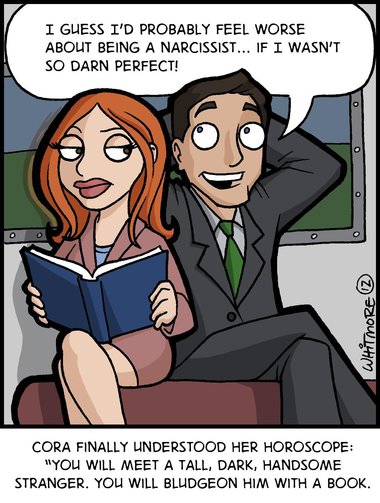
10 great things about narcissists.

1. You will never be bored because of all the drama they provide!

drama_queen

2. They can be a lot of fun when they’re reeling you in.

evil_fisherman

3. They can hone your spelling skills! I probably wouldn’t know how to spell narccisist narssist narcisist narcissist if I wasn’t so inspired to write about them all the time.

spelling_bee

4. They generated renewed interest in old movie classics like “Gaslight” and “The Wizard of Oz.”

flying_monkeys2

5. You should be flattered they have chosen you to be their source of supply.

i_want_you

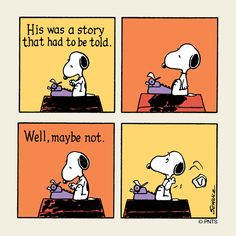
6. If they didn’t exist, those of us who write about them would have to find something else to blog about.

snoopy_story

7. They test our anger management skills!

controlling_anger

8. They are always full of surprises!

jackinthebox

9. Their delusions can be hilarious.

narcissist_zombie

And finally (on a more serious note):

10. They can teach you things about yourself (once you have disconnected). In fact, they can be our greatest teachers we ever had (if they haven’t destroyed our souls first).

I_passed

What a narcissistic parent sounds like.

Here are two Youtube videos that graphically show exactly how a mother with a bad case of NPD (malignant narcissism) operates. These videos are entertaining in a scary and disturbing way, like watching a train wreck.

Pay close attention to what the mother says–she uses every trick in the narcissist’s book of tricks: blame, insults, changing the subject, interrupting, raging, mocking, “talking over”, gaslighting, projecting, invading boundaries, not taking responsibility, showing no empathy, and just about every other “tool” the narcissist uses to get their own way or avoid taking responsibility for their behavior and actions. Notice how childish the overall effect is–the mother sounds like a four year old having a temper tantrum.

The daughter who made the videos is trying hard to get her mother to listen, but her words seem to fall on deaf ears. She might as well be talking to a wall, for all the good it does.

12 more songs about narcissists–part 2!

Due to the enormous popularity of my previous articles about this topic (both of which now appear at the top of page one of Google–thanks everyone for making these so popular!), I’m adding 12 more songs about narcissism. Music and narcissism go together well– that’s one good thing narcissism has going for it, I guess. 🙂

The Songs.

1. “The Backstabbers” — The O’Jays

It’s very difficult to find songs about narcissists/psychopaths prior to the 1980s, but here’s an excellent one from the early 1970s.

2. “Ain’t It Fun” — Paramore

Catchy pop offering a badass challenge to a narcissist’s gameplaying.

3. “You Don’t Own Me” — Lesley Gore

Here’s another oldie (from the early ’60s) about a young woman involved with a narcissistic man.

4. “Mr. Know It All” — Kelly Clarkson

A modern take on Lesley Gore’s lament.

5. “Shadowboxer” — Fiona Apple

Apple’s musical poetry eloquently describes the way narcissistic mind games make you feel. Thanks to Amanda for suggesting this.

6. “Trouble” — Taylor Swift

The intro is pretentious and badly written, but Taylor does seem to have a way of attracting abusive and narcissistic men, at least in her songs, and this one is catchy as anything else she’s done.

7. “Black Sun” — Death Cab for Cutie

Alternative rock song about divorcing a narcissist. Thanks to Sachi for suggesting this one.

8. “Words as Weapons” — Seether

A man’s view on trying to deal with a narcissistic woman.

9. Disney’s “Tangled (Rapunzel)–Mother Knows Best”

Song from the Disney movie sung by Rapunzel’s narcissistic mother, who has made Rapunzel her “golden child.”

10. “Out of the Blue” — Julian Casablancas

Good indie rock about a narcissistic relationship.

11. “Mirrors” — Justin Timberlake

Thanks to Quixie for suggesting this one to me. Seems like a nice love song, doesn’t it? Oh, but it’s not. Listen to the lyrics.

12. “Hard to Love” — Lee Brice

A warning to his lady that he’s hard to love. Listen to the lyrics–sounds like a narcissist to me. At least he’s nice enough to warn her in advance.

I hope you enjoyed these.

For more songs about narcissists, see my previous articles:
1. 20 Songs About Narcissists (#11-20): https://luckyottershaven.com/2014/12/12/20-songs-about-narcissists-part-two-of-two/
2. 20 Songs About Narcissists (#1-10): https://luckyottershaven.com/2014/12/12/ten-songs-about-narcissists-part-one/
3. 12 More Songs About Narcissists, part 1: https://luckyottershaven.com/2015/01/05/10-more-songs-about-narcissism/

Narcissists A-Z

Narcissists A – Z
Reblogged from Life, Light, Love and Laughter After Narcissistic Abuse

narcissism_cloud

Arrogance
Attention-seeking
Bad boundaries
Blacklisting
Blackmail
Blame
Boot Licking
Bragging
Bullying
Can dish it out, but can’t take it
Character Assassination
Criticism
Coldhearted
Conniving
Controlling
Crafty
Cruel
Cunning
Cutting remarks
Deceitful
Demands
Dictatorial
Disdain
Dishonorable
Disinterest
Does not tolerate criticism
Double standards
Drama-baiting
Egomania
Engulfing
Entitlement
Envy
Faking
False Apologies
Fragile Egos
Gaslighting
Grandiose
Greed
Haughtiness
Holier than thou
Hurtful
Hypersensitivity
Ignoring
Immaturity
Imperious
Insecurities
Insensitivity
Invalidation
Irreciprocity
Jealous
Judgment
Lack of empathy
Lying
Manipulating
Martyrdom
Name Dropping
Needy
Oppression
Oversensitive
Pettiness
Phoniness
Plays victim
Possessive
Power plays
Prejudices
Projection
Punitive
Pushy
Put-downs
Rage
Retaliation
Rudeness
Scapegoating
Self-centered
Seething
Setups
Small-minded
Smarmy
Smug
Snobby
Spitefulness
Swindling
Takes all the credit
Tantrums
Threats
Triangulation
Tricks
Two-facedness
Ultimatums
Uncooperativeness
Unempathic
Vanity
Vicious
Vindictiveness
Wheedling
Whining
Yelling
Zealotry

6 Signs of Narcissism You May Not Know About (Psychology Today)

Interesting article about the lesser-known indicators of narcissism from Psychology Today. Contrary to popular opinion, narcissists do not love themselves, only their image.
I agree with Dr. Seltzer that these six traits should be added to the official diagnostic criteria for NPD.

6 Signs of Narcissism You May Not Know About: How can you recognize the fragility behind the narcissist’s grandiosity?
Post published by Leon F Seltzer Ph.D.

narc_lovers

The recently published 5th edition of the Diagnostic and Statistical Manual of Mental Disorders (DSM) lists precisely the same nine criteria for narcissistic personality disorder (NPD) as did the previous version, published 19 years earlier. So these longstanding diagnostic yardsticks are by now quite familiar—not only to professionals but to interested laypeople as well. Because only the extreme, or “classic,” narcissist fits all of these criteria, DSM specifies that an individual need meet only five of them (barely more than half) to warrant this unflattering label.

As a starting point, I’ll reiterate these selected criteria—before, that is, adding six important ones of my own, which either complement or extend these “official” yardsticks. My particular measures for identifying pathological narcissists are based not only on my exposure to the voluminous writings on this character disorder, but also on 30+ years of clinical experience. This experience includes doing personal, couples, and family counseling with such troublesome individuals. But it also involves working independently with those involved with narcissists—whether their distressed children, spouses, parents, friends, or business associates—who repeatedly express enormous frustration in trying to cope with them.

To begin, however, here are DSM’s requirements (link is external) (slightly condensed, and with minor bracketed amendments) for “earning” the unenviable diagnosis of Narcissistic Personality Disorder:

1. Has a grandiose sense of self-importance.
2. Is preoccupied with fantasies of unlimited success, power, brilliance, beauty, or ideal love.
3. Believes that he or she is “special” and unique and can only be understood by, or should associate with, other special or high-status people (or institutions).
4. Requires excessive admiration [regularly fishes for compliments, and is highly susceptible to flattery].
5. Has a sense of entitlement.
6. Is interpersonally exploitative.
7. Lacks empathy: is unwilling [or, I would add, unable] to recognize or identify with the feelings and needs of others.
8. Is often envious of others or believes that others are envious of him or her.
9. Shows arrogant, haughty [rude and abusive] behaviors or attitudes.

So what’s left out here? Actually, as regards identifying descriptors, quite a bit. And I’ve no doubt that other therapists could add further to the six additional characteristics I’ll provide here—features that, although regrettably minimized or omitted from DSM, I‘ve routinely seen displayed by the many dysfunctional narcissists I’ve worked with. So, to enumerate them, such individuals:

1. Are highly reactive to criticism.

grinch

Or anything they assume or interpret as negatively evaluating their personality or performance. This is why if they’re asked a question that might oblige them to admit some vulnerability, deficiency, or culpability, they’re apt to falsify the evidence (i.e., lie—yet without really acknowledging such prevarication to themselves), hastily change the subject, or respond as though they’d been asked something entirely different. Earlier for Psychology Today I wrote a post highlighting this supercharged sensitivity called “The Narcissist’s Dilemma: They Can Dish It Out, But . . . ”. And this aspect of their disturbance underscores that their ego—oversized, or rather artificially “inflated”—can hardly be viewed as strong or resilient. On the contrary, it’s very easily punctured. (And note here another related piece of mine, “Our Egos: Do They Need Strengthening—or Shrinking?”). What these characteristics suggest is that, at bottom and despite all their egotistic grandiosity, they…

2. Have low self-esteem.

narcissists_hate_themselves

This facet of their psyche is complicated, because superficially their self-regard would appear to be higher and more assured than just about anyone else’s. Additionally, given their customary “drivenness,” it’s not uncommon for them to rise to positions of power and influence, as well as amass a fortune (and see here my post “Narcissism: Why It’s So Rampant in Politics”). But if we examine what’s beneath the surface of such elevated social, political, or economic stature—or their accomplishments generally—what typically can be inferred is a degree of insecurity vastly beyond anything they might be willing to avow.

That is, in various ways they’re constantly driven to prove themselves, both to others and to their not-so-confident “inner child” self. This is the self-doubting, recessive part of their being that, though well hidden from sight, is nonetheless afflicted with feelings and fears of inferiority. Inasmuch as their elaborate defense system effectively wards off their having to face what their bravado masks, they’re highly skilled at exhibiting, or “posturing,” exceptionally high self-esteem. But their deeper insecurities are yet discernible in their so often fishing for compliments and their penchant for bragging and boasting about their (frequently exaggerated) achievements. That is, they’re experts at complimenting themselves! And when—despite all their self-aggrandizement— others are critical of them, they…

3. Can be inordinately self-righteous and defensive.

right_wrong

Needing so much to protect their overblown but fragile ego, their ever-vigilant defense system can be extraordinarily easy to set off. I’ve already mentioned how reactive they typically are to criticism, but in fact anything said or done that they perceive as questioning their competence can activate their robust self-protective mechanisms. Which is why so many non-narcissists I’ve worked with have shared how difficult it is to get through to them in situations of conflict. For in challenging circumstances it’s almost as though their very survival depends on being right or justified, whereas flat out (or humbly) admitting a mistake—or, for that matter, uttering the words “I’m sorry” for some transgression—seem difficult to impossible for them.

Further, their “my way or the highway” attitude in decision-making—their stubborn.competitive insistence that their point of view prevail—betrays (even as it endeavors to conceal) their underlying doubts about not being good, strong, or smart enough. And the more their pretentious, privileged, exaggeratedly puffed-up self-image feels endangered by another’s position, the more likely they are to…

4. React to contrary viewpoints with anger or rage.

rage2

In fact, this characteristic is so common in narcissists that it’s always surprised me that DSM doesn’t specifically refer to it among its nine criteria. Repeatedly, writers have noted that angry outbursts are almost intrinsic to both narcissistic and borderline personality disorders. And although (unlike the borderline) it’s not particular fears of abandonment that bring out their so-called “narcissistic rage,” both personality disorders generally react with heated emotion when others bring their deepest insecurities too close to the surface.

The reason that feelings of anger and rage are so typically expressed by them is that in the moment they externalize the far more painful anxiety- or shame-related emotions hiding just beneath them. When they’re on the verge of feeling—or re-feeling—some hurt or humiliation from their past, their consequent rage conveniently “transfers” these unwanted feelings to another (and see here my PT post “Anger—How We Transfer Feelings of Guilt, Hurt, and Fear”).

The accompanying message that gets communicated through such antagonistic emotions is “I’m not bad (wrong, stupid, mean, etc.), you are!” Or, it could even be: “I’m not narcissistic, or borderline! You are!” (Or, in slightly milder version, “If I’m narcissistic, or borderline, then so are you!”) And if the mentally healthier individual has no clue as to what provoked their outburst in the first place, such a sudden explosion is likely to make them feel not only baffled but hurt, and maybe even frightened. But what cannot be overemphasized here is that narcissists…

5. Project onto others qualities, traits, and behaviors they can’t—or won’t—accept in themselves.

635223192958830312Projection2

Because they’re compelled from deep within to conceal deficits or weaknesses in their self-image, they habitually redirect any unfavorable appraisal of themselves outwards, unconsciously trusting that doing so will forever keep at bay their deepest suspicions about themselves. Getting anywhere close to being obliged to confront the darkness at their innermost core can be very scary, for in reality their emotional resources are woefully underdeveloped.

Broadly recognized as narcissists by their fundamental lack of self-insight, very few of them (depending, of course, on how far out they are on the narcissistic continuum) can achieve such interior knowledge. For in a variety of ways their rigid, unyielding defenses can be seen as more or less defining their whole personality. And that’s why one of the most reliable ways for them to feel good about themselves—and “safe” in the world they’re essentially so alienated from—is to invalidate, devalue, or denigrate others. So they’ll focus on others’ flaws (whether or not they really exist) rather than acknowledge, and come to terms with, their own. And in many curious ways this habit causes them to…

6. Have poor interpersonal boundaries.

space_invasion
Space invasion!

It’s been said about narcissists that they can’t tell where they end and the other person begins. Unconsciously viewing others as “extensions” of themselves, they regard them as existing primarily to serve their own needs—just as they routinely put their needs before everyone else’s (frequently, even their own children). Since others are regarded (if they’re regarded at all!) as what in the literature is often called “narcissistic supplies”—that is, existing chiefly to cater to their personal desires—they generally don’t think about others independently of how they might “use” them to their own advantage. Whatever narcissists seek to give themselves, they generally expect to get from others, too (which is yet another dimension of their famous—or infamous—sense of entitlement).

Even beyond this, their porous boundaries and unevenly developed interpersonal skills may prompt them to inappropriately dominate conversations and share with others intimate details about their life (though some narcissists, it should be noted, can display an extraordinary, however Machiavellian, social savvy). Such private information would probably focus on disclosing facts others would be apt to withhold. But having (at least consciously) much less of a sense of shame, they’re likely to share things they’ve said or done that most of us would be too embarrassed or humiliated to admit. Still, with an at times gross insensitivity to how others might react to their words, they’re likely to blurt out things, or even boast about them, that others can’t help but view as tasteless, demeaning, insulting, or otherwise offensive.

They might, for instance, share—and with considerable pride!—how they “chewed” someone out, and expect the other person to be impressed by their courage or cleverness, when in fact the listener may be appalled by their lack of kindness, tact, or restraint. Additionally, they may ask others questions that are far too personal or intimate—again unwittingly irritating or upsetting them. And such a situation can be particularly difficult for the other person if the narcissist is in a position of authority over them so that not responding could, practically, put them in some jeopardy.

To conclude, I can only hope that these additional characterizations of the pathological narcissist (vs. those with less pronounced narcissistic qualities) may be helpful in enabling you to identify them before their “malignancy” does a number on you. And if you’ve already been duped by their machinations or manipulations, perhaps this piece will be a “heads up” for you to prevent them from wreaking any further havoc in your life.

NOTE 1: I’d be remiss if I didn’t point out that the narcissism addressed here centers on its most maladaptive, or “toxic,” forms. Unlike DSM (the standard diagnostic reference tool for mental health professionals), the Psychodynamic Diagnostic Manual (link is external)(PDM, 2006)—respected, but much less well known than this official volume—explicitly notes that the disorder exists “along a continuum of severity, from the border with neurotic personality disorders to the more severely disturbed levels.” And additionally, that “toward the neurotic end [these] narcissistic individuals may be socially appropriate, personally successful, charming and, although somewhat deficient in the capacity for intimacy, reasonably well adapted to their family circumstances, work, and interests.”
All my narcissistic lovers.

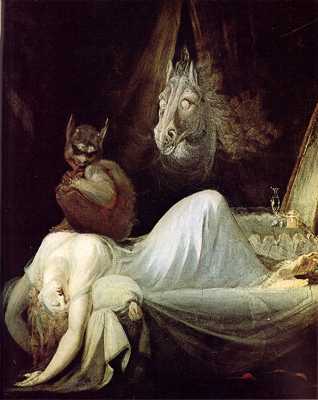
johann_heinrich

Not long ago, when I started studying narcissism in depth for this blog, I came to a shocking and disturbing realization: Every single one of the men I had relationships with or fell in love with were narcissists. It’s because I was trained by my family to be Narcissistic Supply, and as a Borderline, these relationships tended to be stormy.

Having BPD means I’m not the ideal codependent doormat, and when I felt violated–even though I’d allow the abuse to continue because after all, I was trained that way–I’d still try to fight back, at least for awhile. This led to lots of drama and some truly terrible fights with narcissistic men who I could never fix, no matter how hard I tried. I sure wish I knew then what I know now.

I have always been attracted to narcissistic men and they have always been attracted to me. I’m easily taken in by their elaborate displays of romance and promises in the beginning–there’s no one more romantic than a narcissist trying to procure you as supply. It’s fun while it lasts, but as soon as they know they have conquered you, the abuse begins. One red flag to watch out for: a man who moves in too fast, or starts talking about a permanent commitment or marriage only weeks after you met them.

Here’s a list of the narcissists I was seriously involved with (or married to). Only one wasn’t a narcissist, but he was severely bi-polar. The names are made up.

narcjoke

Steve P: my first serious boyfriend in high school. Steve called constantly (like 8-10 times a day at first), wanted to be with me all the time, regularly sent flowers, was very passionate and loving at first. He actually would cry because he “loved me so much.” After a while he became physically and mentally abusive, insulting me, questioning me about other boys, what I was doing when he wasn’t around, calling me names, and finally becoming physically abusive. One day, with absolutely no warning, he called me and told me he was dumping me because he met someone else. I was enraged at the nerve of this but actually relieved to be rid of him finally.

Mark S: my second serious lover during my college years. Mark was very cool–knew everything there was to know about art, music, theater, and he had offbeat, interesting friends. He used to take me to the East Village in New York City where we’d attend all the punk and new wave clubs and shop in funky vintage clothing and record stores. We had a lot of fun. But he was also an intellectual snob and looked down on my “pedestrian” tastes in music, movies, etc. He looked down on my friends, whose intellectual abilities he felt were beneath him. Mark saw himself as a rogue and a cultural rebel, and after awhile his constant put downs became annoying and we’d fight. He also never wanted to have sex (he was a cerebral narcissist), thinking it was a huge waste of time that could be better spent feeding his mind with new cultural experiences. After about a year, he told me I was too boring and my tastes too commercial and pedestrian, and he dumped me for a woman who looked exactly like me but was apparently much more hip and “in the know” about what was cool and cutting edge than I was. He wound up marrying her.

new_wave_guy

David B: David was not a narcissist; he was bipolar and suffered from severe depressions and substance abuse. He drank heavily to self-medicate and was always in and out of the psychiatric ward. He regarded me as a sort of mother figure and I liked the idea of being needed so much. But his neediness and clinginess became cloying and suffocating, he was constantly drunk, so eventually I left him, not without a little guilt in doing so. But he was really driving me crazy.

Michael B: The malignant narcissist I married. He is actually a psychopath. Michael acted very much like Steven in the beginning–showering constant attention and gifts on me, moving in very fast, talking about marriage just three months after we met. Being that I was in my mid-20s, I was open to marriage and he seemed perfect. I should have seen one HUGE red flag: the expensive engagement ring he insisted I have was purchased with my own credit card, because he had already maxed all his out. He always lived way above his means. He’d take me to expensive restaurants and insist I pay (and of course, he would pay me back later, but he never did). The rest of our story can be found in the articles under “My Story” in the header. Let’s just say the man is a psychopathic monster with serious substance abuse issues and a parasitic monster at that.

rottencard

Daniel S: The only lover I’ve had since the divorce. Well, okay, we were actually still married. (I’m not proud of this). But my marriage was already long over and I was desperate and miserable and not thinking straight (not that it’s an excuse to cheat). Daniel was actually a worse malignant narcissist than my ex, if that can be believed. He had that intense predatory stare, which I took to mean sexual and romantic interest, but was really his way of sizing up me as his prey. Of course I found him irresistably attractive. Unfortunately Daniel was another cerebral who had very little interest in sex. After a huge show of ardent romance and all that goes with it, he started the abuse, which included insulting me and comparing me (unfavorably) with his past lovers and what he saw as an “ideal woman.” He said he wanted babies with me but constantly criticized my parenting skills (as if he could know, since he never met my kids). He raged a lot although he never actually became physically abusive. He sulked and gave me the silent treatment when I didn’t do things his way or wanted to spend time with my family. He was stingy and although he had a lot more money than I did, he always made me pay my own way on dates. He obsessed about money. He would buy me things and constantly remind me how much those things cost him. He also would give me gifts and then ask for them back later, telling me he was only letting me “borrow” them. I am serious about this. After I ended our relationship (due to guilt at least as much as his abusive treatment), he still continued to call me constantly “as a friend.” After several of these phone calls, I finally worked up the guts to tell him to bug off and blocked his number.

ucallthislove

I have not had one lover or husband who was a just a nice regular guy. There have been a few of these men who seemed interested in me, but I always found them boring and rejected their attentions because I didn’t feel any “chemistry” with them.

I think it’s time to change all this. I want to start dating again soon. I know what red flags to look out for now so I think I can avoid the narcs, but can I fall in love with a normal man who will treat me well?

Who’s “too sensitive”?

sensitive_jason

“You’re too sensitive!”

This seems to be a phrase many ACONs have heard their entire lives. And yes, many of us are more sensitive than the average person, which is why we were targeted, scapegoated, and bullied in the first place.

Narcissists know being sensitive means we can see the truth about things, that we can see through bullshit and lies. They don’t like that because it exposes them for what they really are, so they turn a quality that gives us intuition and insight into something that makes us seem weak and defenseless.

If our parents were narcissists, we were trained to be ashamed of this quality and turn it against ourselves, rather than learn to refine it and develop it into the powerful gift it really is. Society doesn’t help much with that either. Sensitivity is generally thought of as a weakness rather than a strength. It’s not something you would want to admit on a job interview when the interviewer asks you what your “worst quality” is. I actually did that once, and was shown the door. They want to hear “I’m too impatient” or “I’m too greedy,” or “I obsess too much about power and control,” not “I’m too sensitive.”

sensitive_quote

I think narcissists also like to pull out the “you’re too sensitive” card because they’re projecting what they see as a fault in themselves onto us. They’re good at that. Narcissists are incredibly hyper-sensitive–but only about themselves; no one else ever benefits from their hypersensitivity.

It’s my opinion that narcissists, before they adopted narcissism as a defense mechanism, started out life as extremely sensitive children and in some cases even had the potential to be empaths. Abuse and neglect turned them into narcissists. Narcissism is an elaborate defense mechanism that obscures, buries and eventually can nearly destroy the sensitive true self. It almost would take an act of God for a narcissist to ever shed their swagger and their “I’m a big mean unfeeling badass” mask and let their sensitive true self come to light. Most of them couldn’t do it even if they wanted to.

But narcissists can’t hide from themselves–not completely. Most of them have exquisitely tender feelings and are easily hurt. It’s very easy to insult a narcissist. They have no sense of humor about themselves and are unable to take a joke at their own expense. They are big crybabies who will whine, sulk and complain loudly should you hurt their feelings (and it’s almost impossible not to). Most will show their hurt as rage–because raging makes them seem big and tough, something they really aren’t but wish they were. Or they will retaliate by ignoring you, abandoning you, cutting you off, or giving you the silent treatment–because those things make it look as if they don’t care. You’d be wrong though. They care alright, and when you have caused them narcissistic injury they are off licking their wounds in silence where you can’t see. Or loudly complaining to others about how
mean and narcissistic YOU are.

sensitive_people

They call us too sensitive because they’re unable to own their own hypersensitivity. They turn it into a bad thing because they know they have lost that part of their sensitivity that would have made them able to feel for others and empathize. They’re crippled people. They can’t ever feel sorry for someone else–but as far as self-pity goes, no one can beat them at that.

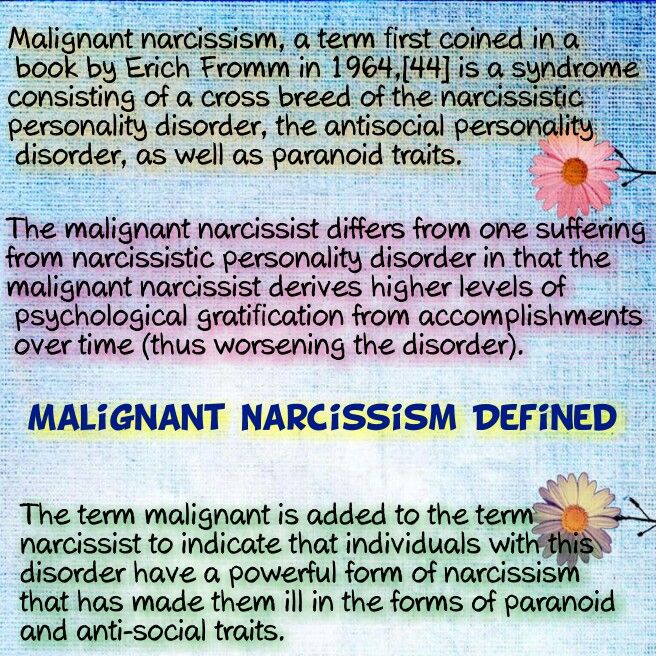
So what the hell IS malignant narcissism anyway?

The term “malignant narcissism” seems to be everywhere these days, especially on the Internet. But what exactly makes it different from “normal” narcissism?

Here’s a very good definition of how it differs from garden-variety NPD. I had no idea the term has existed this long!

malignant_narcissism_defined
Click to enlarge.

Can narcissists feel empathy for a pet?

dyed_dog

I wonder.

Earlier today I posted Sam Vaknin’s story about his goldfish Ned. He seemed to be feeling something close to empathy for the tiny creature’s suffering when it became ill and something closely resembling grief when the end finally came. Rather than watch the fish continue to suffer, he decided to take matters into his own hands. Did he do this to end the fish’s suffering–or to end his own suffering?

But even if he only desired to end his own suffering, watching the goldfish suffer was causing him pain. So either way, he cared about the fish, even if he only did what he did because watching Ned continue to get sicker was too painful.

This made me think about other narcissists I know who own pets. Do they really care about their pets, or are their pets, like their children, just extensions of themselves?

I think the answer is both. Yes, many narcissists who own pets regard them as extensions of themselves. I think of a neighbor of mine, an insufferable, conceited malignant narcissist if I ever saw one, who has a purebred Bichon Friese. She said she would never own a “mutt” from the pound. Oh, no. Only a purebred dog who makes HER look good will do. She puts bows in Fifi’s hair and gets her toenails painted at the groomer’s. She takes her everywhere and shows her off, as if she’s showing off a new car. Narcissists treat their children the same way–as accessories to make them look good, but because a dog isn’t supposed to have a mind of its own, it’s more acceptable and far less damaging to a dog to be treated this way than it would be for a child.

Yet it’s clear she loves that dog. She spoils Fifi rotten, and the little dog seems happy enough. Again, it’s a dog, not a child, so being objectified is probably okay. I know if anything were to happen to Fifi, this woman would be devastated with grief, at least until she found a new source of canine narcissistic supply. She’s the type who would probably have a funeral for her dog and a custom made urn with Fifi’s likeness painted on it to display on her mantel.

But she would also not hesitate to have Fifi put down were she to become ill. Some may say this is the humane thing to do–that anyone with a conscience and a heart would not want to see a pet suffer needlessly, and that’s true if the pet is truly ill and has little to no chance of recovery or is in a great deal of pain. But to a narcissist, a sick pet is also an inconvenience and a burden. A sick pet is no longer an acceptable extension of themselves; it becomes a separate being who has needs of its own that do not fit the narcissist’s agenda. A sick pet no longer makes them look good.

How much will a narcissist sacrifice before having an ill pet put down? Most people won’t euthanize a pet unless everything else has been tried first. It’s a last resort, something none of us want to do, but at some point it becomes more selfish to try to keep a sick pet alive than to put an end to its suffering. I remember years ago a narcissistic woman I knew had her cat put down because it had worms. The cat was suffering severe diarrhea and was losing weight. The worms could have been easily treated, but she didn’t want to be bothered. Cleaning up the cat’s messes was too much of a chore, and apparently so was taking the cat to the vet to be treated. So she had her cat put to sleep. It’s pretty obvious this woman didn’t have the cat euthanized out of humane compassion, but because it was more convenient than trying to keep him alive. To her, the cat was not a living creature, but a toy to be tossed away the minute it was no longer so much fun to play with or required maintenance.

golden_retriever

It can work the other way too. I knew a narcissistic man who also had a dog, a beautiful Golden Retriever named Bruno. When Bruno was about 12, he developed cancer. The man was very attached to Bruno, and used to tell everyone he was the only friend he had. Even when Bruno got to the point where he stopped eating and slept most of the time, the man refused to have him euthanized. The animal was clearly suffering, and everyone told him it was the only humane thing to do, but the man still refused. Bruno finally died at home in an emaciated state. Clearly, this man cared nothing about Bruno’s suffering even though he appeared to love the dog. He obviously was attached to his pet, but if he truly loved him, he would have put the animal’s needs first, even if it hurt to do so. Real love–whether for a pet or another human being–requires sacrifice and putting the other’s needs first. This man may have “loved” his dog, but he was putting his own needs first.

Most narcissists claim to be attached to their pets, and most of the ones I know truly are. But is attachment love? Or does attachment to a pet just mean the animal is another source of narcissistic supply–a creature who is never going to judge them, disagree with them, insult them, or abandon them?

Sam’s grief over his goldfish appears to have been real, and I think he did the right thing because that fish was most likely suffering (as much as a goldfish can suffer) and wasn’t going to make it. Would he have been the same way with a cat or a dog–or a child? We can’t answer that. Maybe it’s easier for a narcissist to feel empathy and act in unselfish ways for a simple creature–a reptile, fish or invertebrate–who is very unlike a human (unlike a cat or dog, who resemble human children in many ways) and therefore make fewer emotional demands on them. Maybe narcissists just can’t empathize with other humans or highly evolved animals who resemble them too closely or make too many emotional demands.

Cluster B personality disorders and the emotional thermostat.

If you think of the Cluster B (“dramatic”) disorders (characterized by either too much emotion or the masking of true emotions) as malfunctions or problems of the sufferer’s “emotional thermostat,” their differences make more sense. The emotional thermostat determines how a person handles their own emotions or reacts to those of others.

emotional_thermostat

Borderline Personality Disorder (BPD): inability to regulate emotions (a thermostat that works but is having problems–cutting on the heat or air when it isn’t needed or shutting it off when it is, but half the time works perfectly). This explains their ambivalence in relationships (“I hate you…don’t leave me,” “go away, come closer.”)

Histrionic Personality Disorder (HPD): inability to control emotions (a thermostat that is always on High and blasting heat even when it’s already too hot). That’s why they overreact to everything.

Narcissistic Personality Disorder (NPD): inability to access true emotions (a thermostat that sets to “cold” and turns on the air conditioner when heat is needed, and “hot” and turns on the heat when the air conditioning needs to be on). This explains their lack of empathy and show of fake emotions that may not fit a given situation.

Antisocial Personality Disorder (AsPD–psychopathy, sociopathy): total inability to empathize or respect the rights of others (a broken thermostat that doesn’t work at all.) People with ASPD are unable to feel any emotions except rage.