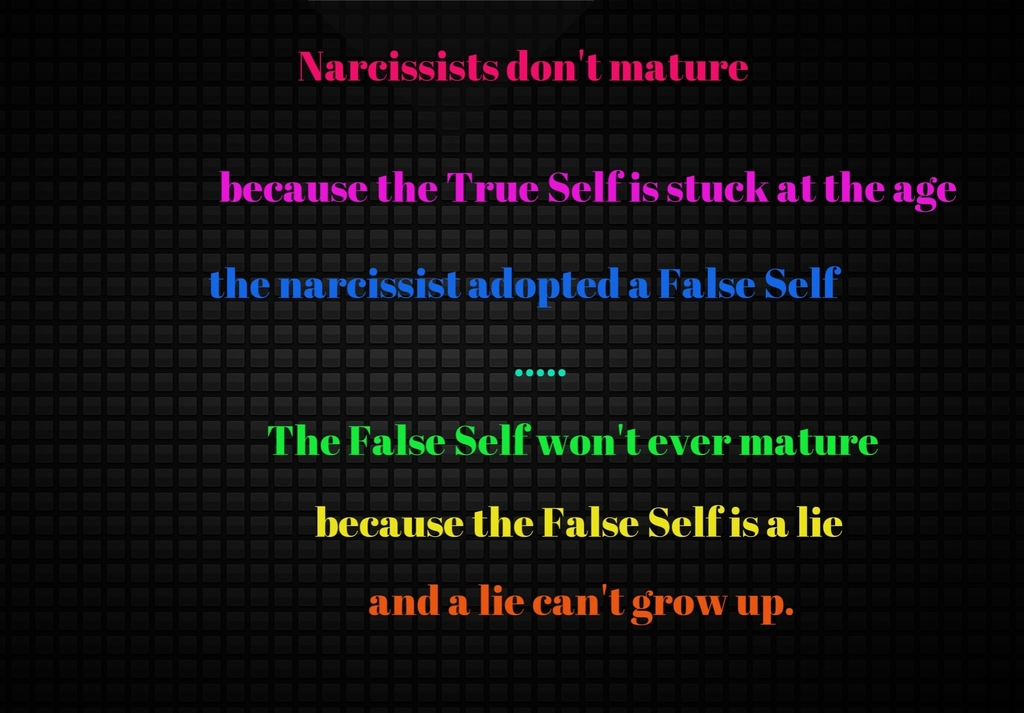
Why narcissists will never grow up.

I just created this meme. Feel free to use it, but please credit me.

narcs_dont_mature
Click to enlarge.

“Splitting” and idealization/devaluation.

splitting1

Splitting–more commonly known as black and white or all or nothing thinking–is a primitive defense mechanism used by both narcissists and borderlines when they observe a threat–that someone doesn’t agree with them or is challenging them in some way, or when they fear abandonment (borderlines) or exposure/loss of supply (narcissists). In narcissism, splitting is usually referred to as idealization/devaluation, but other than the unconscious motive (fear of abandonment for borderlines, fear of losing a source of supply for narcissists), the phenomenon is really the same thing.

Splitting is normal in a very young child. When Mommy is present and hugging the child, Mommy is perceived as “good.” When she denies the child another cookie or she goes to work, the child throws a tantrum, and Mommy is now “bad.” Because the child still doesn’t see himself as a completely separate person from Mommy, when Mommy does something that makes the child unhappy or fearful, the child rejects her and thinks of HER as all-bad. The child is not yet capable of the concept that Mommy is an individual who can be both good and bad at different times and to different degrees depending on the situation.

The fairy tales we read to young children engage them at a level they can understand: fairy tale characters are all-good or all-bad, heroes or villains, with no in between. Only an older child can fully understand that people come in varying shades of grey, and pure black or pure white in one person is exceedingly rare. Realizing that most people are both evil and good at the same time is a sign of maturity and indicates the child has come to see himself as a completely separate person with his or her own identity who can afford to see others as individuals too, rather than one-dimensional cardboard cartoon characters.

Narcissists and borderlines never make that transition. Due to early attachment issues arising from neglect, abuse, or sometimes maternal smothering, they continue to see others as extensions of themselves, not separate people with their own identities, interest and opinions. If someone is an extension of yourself, of course the other person must be seen as “all good.” If the other person fails to provide adequate supply (for the narcissist) or disagrees with them or has differing opinions, they are perceived as a threat and must be rejected, devalued, and demonized as “other.” The only way a narcissist or borderline can see another person as a separate entity is when they have become “other” and are demonized and seen as “all bad.”

splitting

Splitting is common in today’s political landscape. Candidate A believes in health care reform, the legalization of marijuana, the cessation of the outsourcing of jobs, raising taxes on the wealthy–and that a woman has the right to choose whether or not to terminate a pregnancy. Candidate B believes in health care reform, the legalization of marijuana, the cessation of outsourcing of jobs, raising taxes on the wealthy–and that abortion should be outlawed. Candidates A and B, rather than focusing on what they have in common and using that to help improve people’s lives, instead go on smear campaigns against each other focusing on the only thing they don’t agree on: abortion. Candidate A accuses Candidate B of being a throwback to the “unenlightened” 1950s, while Candidate B accuses Candidate A of wanting to legalize murder. Neither acknowledges the many things they agree on–all either can see is that the other is a “murderer” or a “throwback troglodyte.” (Notice too how the accusing labels have become exaggerated and more abusive). That many politicians are narcissistic by nature makes splitting come second nature to most of them. Unfortunately, splitting has become standard in political campaigning and is intended to garner more votes (narcissistic supply) for the accuser while taking them away from the opposing party.

Robin and Tim are madly in love with each other. Robin idealizes Tim–she thinks he is the most perfect man she ever met, and she can’t imagine a life without him. He is the most handsome, smart, funny, sexy, and interesting man in the world, and she can’t believe her luck in having met him. Recently they have started talking about getting engaged. Tim thinks Robin’s wild mood swings are rather charming–but he hasn’t been the target of them yet.

On Tim’s birthday, Robin cooks him a lavish dinner and has a bottle of champagne ready to pop open and enjoy. He is supposed to be home by seven. Eight o’clock comes, and he isn’t home yet. At eight-fifteen, Tim calls and says he got held up. He is in the door by nine, apologizing profusely about his lateness–he was called into an emergency meeting by his boss and couldn’t get out of it. Rather than accepting his apology at face value and proceed to have a nice dinner together, Robin goes on a rampage. She accuses Tim of having a lover and never having loved her. The champagne bottle gets smashed against the wall and the dinner thrown in the trash. After fighting for hours, Robin tells Tim to leave and that she never wants to see him again and that he’d make a terrible husband to any woman who would have him anyway.

In the course of two hours, Robin has turned Tim, a normal man who really did love her but couldn’t get out of a meeting, from “the most perfect man in the world” into an unfeeling monster who is cheating on her and would “make any woman miserable.” Because he disappointed her and she couldn’t handle it or see him as a separate person with his own life and his own needs, she must demonize him and make wild accusations against him, accusing him of doing things he never did and saying things he never said. She has turned the good into the evil, and rejected Tim because he is “all bad” now. Both the “angelic” Tim and the “evil” Tim are creations of Robin’s all-or-nothing, black or white, thinking. Both are fiction.

Splitting is really a kind of blindness–the failure to be able to see any shades of grey in an individual, situation, religion, ideology, belief system, or really, anything at all. It destroys relationships, creates hate and discord, kills community spirit, leads to war and killing, and ruins lives.

5 reasons why you should never tell a narcissist they’re a narcissist.

narcissus

In my dealings with narcissists, it’s sometimes been tempting to tell them to their face that they’re narcissists, thinking maybe it could be the wake up call they need. It’s a nice fantasy to think they might take a look at their obnoxious, abusive, insufferable selves and try to make some changes, but unfortunately that’s just a fantasy. It won’t work, because narcissists cannot feel remorse for their actions or empathy for hurting you. In fact, they may take pleasure from it.

The following reactions are far more likely if you “out” a narcissist to their face:

1. They might rage. Or give you the silent treatment. Or laugh at you. Or deny it. Or abuse you. Or call you names. Or tell you you’re crazy or deluded. Narcissists hate the truth, and if they know you have their number, they feel threatened and will attack like a cornered rattlesnake. It’s in their nature.

2. It might give them twisted narcissistic supply. Some narcissists may actually take a perverse pride in being called narcissistic. Rather than making them feel shame and remorse, telling a narcissist they’re a narcissist may flatter them and inflate their ego even more, which could lead to them becoming even more narcissistic and abusive than they already are.

3. They might project it back onto you. This is surprisingly common. Projection (attributing their own bad behaviors to their victims) is one of the more common red flags of a narcissist, so if you call a narc a narc, don’t be too surprised if they start telling everyone YOU are the narcissist.

4. They might learn more to hone their weapon. Taking #2 a step further, some bright narcissists may actually decide to learn more about their disorder–but not to learn how to control it or improve the way they treat people, but rather to educate themselves about abusive narcissistic mindgames they haven’t already tried in order to use them against you. I actually know someone this happened to when she called her ex a narcissist. He started reading every book he could get his hands on about NPD and narcissistic abuse, and systematically started using the information to “prove” his girlfriend had NPD and that he was the real victim (see #3).

5. They might not be a narcissist. There is always a possibility (even if small) that the person you think is a narcissist really isn’t. If you’re not a mental health professional qualified to make a diagnosis based on standardized testing and interviews, your own bias, lack of knowledge, or just plain dislike of a person could be influencing your judgment of them. Perhaps they are having a bad day (or a bad life), or suffer from some other disorder that can mimic narcissism. Even non-disordered people can act like narcissists at times. All of us can. So if you’re certain someone is a narcissist, you may be right, but it’s still best to keep that information to yourself–or only tell your close friends.

Psychopathy and malignant narcissism: what is the difference?

hannibal_lecter

I have been reading a blog written by a self-confessed Psychopath (who scored 36.8 on Hare’s Psychopathy Checklist) who writes engaging and well-informed articles about his disorder. I’ve always wondered myself about what it is exactly that distinguishes Malignant Narcissism from Psychopathy, because a MN can be every bit as cruel and callous as a psychopath. The primary difference is the Psychopath is not an attention-seeker, but the malignant narcissist is still trapped by his or her need for approval, attention and adulation from others. That is also one of the things (along with impulsivity–which ASPD has in common with BPD–as well as the likelihood of law-breaking) that distinguishes Antisocial Personality Disorder (ASPD) from NPD/malignant narcissism.

There are those who believe that ASPD is on the same spectrum as NPD (but is at the top of the scale, while NPD is in the middle), but I’m not sure if it should be because there are qualitative, not just quantitative, differences. My opinion is that malignant narcissism is high spectrum NPD with ASPD traits. But they still need narcissistic supply. Psychopaths do not.

This writer has an interesting observation–that perhaps the only type of person able to control and/or take down a narcissist is a psychopath. He has little respect for narcissists due to their need for others (even as supply) and emotional sensitivity to rejection and criticism.

psychopathy_diagram
The anatomy of a psychopath. Malignant narcissists share with psychopaths the Factor 1 traits, but not Factor 2.

I think this article will explain these differences better than I can.

Narcissism or Psychopathy–Differences?
http://www.psychopathicwritings.com/search/label/Narcissism%20and%20Psychopathy

A Reader asks:

I would be interested in reading anything you wrote on psychopaths need for attention/acceptance. Have you? Like, how would they react to rejection?

Basically the need for attention and acceptance, if it’s a prominent and dominating aspect of what drives a person, is a distinctive trait in Narcissism. As such it is not exclusively something psychopaths are known for.

It is often said that psychopaths have strong narcissistic tendencies, and the statement isn’t completely wrong. But I also often see statements saying Malignant Narcissism and Psychopathy are the same, and this is not the case. There are some very important fundamental differences between psychopaths and malignant narcissists.

Narcissists may be callous and abusive – malignant narcissists definitely are callous and abusive! – and they lack empathy. These are things they have in common with psychopaths. But narcissists have a very strong emotional need for attention or Attention Seeking, Acceptance and Admiration. Their self esteem depends on whether or not they receive these things, and this makes them very vulnerable to rejection and other forms of negative attention such as humiliation, being out shined by someone else, or of being deliberately or naturally ignored.

Psychopaths do not need attention and we certainly do not need acceptance, at least not just for the sake getting it. Their emotional well being does not depend on whether or not they get these things, but they do play a part for most psychopaths’ sense of satisfaction. In this we’re probably not that different from normal people: We like to get attention, to be admired and respected just like everybody else, but we do not feel bad if we don’t get these things.

For psychopaths getting attention and respect from others is most of all a technique to get what they want without having to resort to coercion – threats, blackmail, and physical violence, i.e. – with the same frequency as we otherwise would. Having attention and respect – and acceptance – from others is really only paramount for as far as it is necessary to avoid the risks associated with the more negative techniques. In short: Attention and acceptance to psychopaths are not goals or ends, they’re means to ends.

When we (psychopaths) do care about whether or not we get attention it is not because we have an emotional dependency on being recognized or confirmed by our surroundings. It doesn’t matter to us that people speak badly about us, or that they try to avoid us. Being feared makes an opening for controlling those who fear you, and control leads to possible power.

Making sure you get a lot of attention is also a kind of control, it is a potential opener for gaining power, and it is the central, and often the only, reason why we seek to get it.

This is a well known fact, and the entertainment industry – just to mention one – knows and uses it: Make yourself known, make sure people notice you and that they can’t overlook you, and you have the basis for influencing how people respond to you.

If people like you, there’s a greater chance that they’ll support you or help you in other ways, especially if it’s mutual. <– This is what I've chosen to do, but I certainly did not always use a friendly approach. I've been very abusive in the past, and it has worked very well for me too. – But I've changed in many ways, and I find the mutual idea much more interesting now – and that is good, because it keeps me out of prison, and it has created a good possibility for me to actually do something valuable that others can benefit from… But that was a side note.

Narcissists seek attention and acceptance for it's own sake, and are miserable if they don't get it.
Psychopaths seek attention and acceptance because it is part of a technique to get something else. Attention and/or acceptance for it's own sake doesn't matter to how a psychopath feels.

A Narcissist, opposite a psychopath, is very vulnerable to Social Rejection and rejection in general. If you deny them admiration and respect, and – more important still – if you humiliate them publicly, you can crush a narcissist completely (provided you do it right and with timing).

Narcissists get very hurt when they get rejected.
Psychopaths do not feel any emotional pain or discomfort when they get rejected.

No narcissistic person can go through public humiliation and not feel emotionally very disturbed by it. With this knowledge one can destroy a narcissist quite easily… This is the typical area of most psychopaths' expertise, and it is why we so easily can control most narcissistic people. For the same reason most psychopaths have a lot of contempt for narcissistic people. We see individuals who love to abuse and humiliate, but who are even more vulnerable to these things themselves, and it's hard to find it in your heart to respect such people…
– I suspect we may have this in common with most neurotypicals.

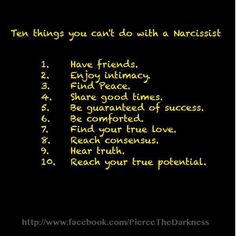
10 things you can’t do with a narcissist.

Image

10_things

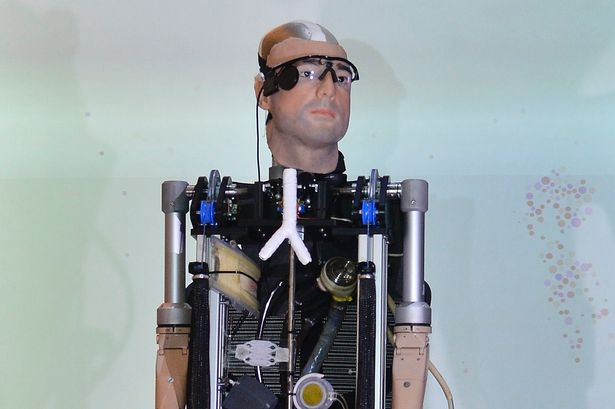
The chilling mental landscape of a high spectrum narcissist or psychopath

bionic_man

I read this chilling post from a man who says he is a narcissist. Based on his description of what it’s like to be him, I would say “narcissist” is probably an understatement. My guess is he’s a very malignant (high spectrum) narcissist and a probable psychopath. Most people with NPD do have emotions, but can’t access them easily or only feel emotions when they pertain to themselves. When someone claims to have no emotions at all, that indicates psychopathy to me. This man could also be “suffering” from Schizoid Personality Disorder, another disorder where the “sufferer” feels nothing–or he may have a combination of psychopathy and SPD. It’s scary and sad to read something like this. It’s as if some people have lost every shred of humanity and seem to have no soul. They are reptilian. At least this writer is self aware though, so I guess that’s something. (Post has been edited for brevity).

Certain passages in this post would make me suspect Aspergers (social awkardness, etc.) but Aspies do have emotions and empathy, even if they don’t always express them well or at all, so I’m suspecting this man has Schizoid PD mixed with psychopathy/malignant narcissism.

Also striking are the dissociative episodes and feelings of unreality this man claims to experience. I have seen these sort of near-psychotic behaviors (talking to himself in public, strange expressions on his face, etc.) in most of the malignant narcissists and psychopaths I have known. These people are so deluded they really aren’t in touch with reality at all. They live in a barren, hellish dreamworld of their own making.

psychopath_emotions

[…]I just discovered that I’ve had pathological NPD for most my life. Reading this […]has been both very frightening and a major relief. […] It’s a relief to know that many of the strange decisions I’ve made were not entirely my fault. [This material] has completely changed how I view my past. It’s like I was in a dark room and then someone finally turned the light on.

For several years, I would occasionally wake up in the early morning with a feeling that something was very wrong. I couldn’t explain the feeling but it was similar to guilt. But I couldn’t pinpoint what I had done to feel so guilty about. This has been clarified […] along with everything else about my strange life. Everyone posting on this site describes the Narcissisist as a monster, which I agree with, but it’s also a horrible disorder to have.

[…]There’s so much I want to say, but it would turn into a novel about as long as the book itself. I’m a male in my 30’s and fit every characteristic of someone with pathological NPD.

I have no emotions. When my Father left our family to fend for ourselves, I felt nothing. When my Grandmother died, I felt nothing. When I witnessed my roommate seriously injure his neck, I felt nothing at all. These events were only slightly negative, as if someone had dropped and broken a dish.

I have technical degrees from elite universities which makes it easy for me to secure employment, but when I’m at work, I hardly do anything at all because I can’t concentrate for more than a couple minutes at a time. I’m constantly day dreaming and people notice that I have strange expressions on my face when I’m supposed to be working or paying attention to a lecture. I constantly talk to myself, but I’m not sure if that’s a characteristic of NPD.

I have no social skills and am socially inept. As far as personality goes, I wouldn’t even say its a poor one, more accurate would be to say it’s nonexistent. I don’t greet anyone unless they greet me first. If someone asks “How are you?”, my reply is “Fine” and that’s about as far as the conversation goes. I can feel myself creating hatred where I work by ignoring social norms, but I don’t care how much people hate me. I feel like I’m a plague that creates pain and destruction where ever I go, and I like it. I have no friends except the ones from childhood, but I don’t feel I need them anyway. I’m more comfortable just sitting at home and playing on the Internet.

As far as looks go, I’m a 10, which makes me a somatic narcissist. I often get compared to male celebrities and women often audibly gasp when I enter a room for the first time. I’m in my 30’s but everyone assumes I’m in my 20’s. Despite this, I haven’t had a relationship with a woman my entire life (being a devout catholic when I was younger also had an influence on this). Through techniques I’ve learned from the pickup manuals available on the Internet, and by dressing fashionably, I’m able to create a huge amount of initial attraction from women. This has kept me in school much longer than necessary since there’s a huge amount of narcissistic supply in a school environment, especially in classes with many women. Despite this huge initial attraction, I always reject the (very attractive) women when they come after me, which only increases their attraction to me. I justify rejecting them by telling myself “when they see what my personality is like, they would just reject me anyway”, which is probably true considering my social ineptness. However, sometimes I will talk to a girl a few times and she still hasn’t rejected me despite my personality. At this point, I would reject her, and have no idea why I rejected her. I now know it’s due to EPIM (emotional involvement prevention disorder). It’s ironic, I’m the guy every woman in the school wants to be with, but I don’t even have a girlfriend.

I feel completely omnipotent. I will make long eye contact with girls right in front of their boyfriends, even if their boyfriends look like bodybuilders. I can hold my own in a fight with most anyone, but even if a guy is twice my size, I have no fear. I will try to seduce women who I know are engaged just to make them feel pain. I have no empathy so I don’t care about their pain and actually enjoy it. When women look at me in class and try to get me to look back, I will ignore them just to humiliate them in front of the class. Or if an attractive woman is trying to make eye contact with me, I’ll pretend I’m interested in a less attractive girl. Needless to say, I hate women. However, I also badly want to have a girlfriend. I feel this is one of the many conflicting states of the narcissist […].

Not having emotions is a powerful tool in attracting women because women are attracted to guys who don’t want them. Women want what they can’t have. It’s easy for me to play hard to get and I can easily outlast a woman who’s playing hard to get, which most men can’t do. I know I’ll never actually be able to have a relationship with these women, so it doesn’t bother me if a semester ends without having pursued a relationship. So I have many “victims” from my school years, but the biggest victim is myself since I’ve spent years upon years alone.

[…] I see women as predators who are only interested in draining a man of his money while offering as little as she can get away with in return. After the man has been consumed, he is decapitated (divorced) while she runs off with another man. I’m not sure if this view is due to NPD or what I’ve seen my friends (colleagues) go through. There is a book called “The Predatory Female” that probably helped cement this view. I’ve also noticed that in times when I’ve had no money, I didn’t exist to women.

I now realize I quit my previous well-paying job due to a lack of narcissistic supply. A somatic narcissist needs attention from women, and they were pretty much non-existent where I worked. The most abundant place for narcissistic supply is a university, and after receiving a degree, the cerebral narcissist can receive more NS because of it.

When I saw the movie Batman “The Dark Knight”, I was intrigued by the character of the Joker. He had no fear, didn’t care about anything (even money), and caused havoc ever where he went. His actions made no sense and he was unpredictable, but he wasn’t stupid. He was omnipotent because he didn’t care if he was caught, or if he was killed, and was capable of doing anything. He had no empathy caused havoc for the fun of it.

My mentality is very simple and childlike and I don’t like speaking with other adults. If someone spoke with me for 10 minutes, they would think I’m a normal person, but it’s just a matter of time before I say something factual but very insensitive, which causes the person to hate me. The only emotions I feel are jealousy and rage. When I see a guy with an attractive women, I want to attack him and have daydreams of attacking him while the woman watches in horror.

[…] the chance for healing from NPD is bleak. Even if I were to get into a relationship with a woman, I would probably just cause her a lot of pain before dumping her when she’s no longer a source of NS.

The Early Warning Sign Of A Toxic Person You Never Hear About

A very important (but rarely talked about) early warning sign you are dealing with a narcissist.

Bree Bonchay, LCSW's avatarFree From Toxic

imageThe Department of Homeland Security has a color-coded terrorism alert system. Red, the highest level, means severe risk of terrorist attacks. The lowest level, green, means low risk of terrorist attacks. Between those are Blue (guarded risk), yellow (significant) and then there is orange (high). There is a lesser known and very subtleearly warning sign you may be dating a toxic personthat you never hear about. It’s not quite the level of a red alert, but it is definitely in the orange to red range andit should put you on high alert that you are in danger ofbeing at the very least, emotionally abused, bya toxic person, narcissist or sociopath. It’s a tacticcalled Subtle Ignoring. It is generally a precursor to full-blown narcissistic abuse and the frequent use of the silent treatment.

View original post 555 more words

Can an adult turn into a narcissist?

crossroads1

I believe the answer to this is yes. While most cases of NPD are formed during childhood as a reaction to abuse or neglect, there are situations where a person who is not a narcissist can later become one, even as an adult. It can happen because of narcissism being, essentially, a choice. Even a small child makes a choice to become a narcissist, even if they’re not really conscious of that “decision.” In an adult, it may be more conscious, but once made, the personality can change dramatically.

An adult who becomes a narcissist is probably more easily healed, because the disorder is less deeply ingrained in the personality, but I think there are certain situations where if someone makes a choice to walk in darkness, something evil grabs hold of the soul and there is no turning back to a normal way of relating to others. Here are four scenarios in which I think a person can acquire NPD.

1. Abandonment or abuse starting during adolescence.

teenage_depression

Teenagers are narcissistic by nature and vulnerable to peer pressure, so they often act out in risky ways and experiment with the illicit and unhealthy. This is normal to some degree. But for a few, if familial abuse or abandonment begins during the teen years, the narcissistic behaviors of adolescence may become a lifestyle and coping tactic that the person will not let go of as they enter adulthood. I believe my ex is an example of a psychopathic malignant narcissist who did not become one until the age of 13, when he found his father dead in the bathroom in the middle of the night and his mother refused to do anything and left it to him to take care of his father’s body. Although his mother had always been a malignant narcissist, my ex was a good kid until that point; after that he changed.

In most cases though, I think narcissism starting during adolescence is likely to be fairly mild. I have been in communication with a young man who believes he is a narcissist. He explained to me that he was raised by loving parents but his mother became severely depressed when he was in his early teens, and began to ignore him due to her depression. He didn’t understand it was her depression causing her sudden coldness; he thought she she didn’t love him anymore. He explained that’s when his narcissistic behavior patterns began. In such cases, I think the narcissism that develops is actually a condition called DNP (destructive narcissistic pattern disorder) which lies below NPD on the narcissistic continuum, and is a more easily treatable form of narcissism where the person does retain some ability to feel empathy, love, and remorse.

2. Choosing evil.

fearofbridge

M. Scott Peck talks about a man who almost became evil in his book “People of the Lie.” A family man who loved his wife and children suffered from severe panic attacks, especially when driving over a certain bridge. Although he didn’t believe in the devil, he made a “deal” with Satan that if he could pass over the bridge without suffering a panic attack, that Satan could do what he wanted to with his favorite son. He didn’t think it really counted since he didn’t believe in the Devil (and nothing happened to his son), but he realized later that if he hadn’t repented, his own soul would have been seared. I think when a person knowingly chooses evil over good, the soul can be damaged or destroyed. It’s even possible that making such a choice allows an entryway for an evil entity that works to destroy all goodness in that person. The change can be dramatic and happen almost overnight.

3. Severe reaction to trauma.

ptsd_soldier

Related to the above, I think sometimes a person can engage in evil through no choice of their own. Victims of Stockholm Syndrome, who identify with their abusers and cannot escape, will sometimes be forced to commit evil acts or help their abuser carry them out, such as Patty Hearst back in the early 1970s. It sometimes happens in war, too. A normal person forced to kill innocent civilians will often develop PTSD, but for some soldiers, in order to protect themselves from their unbearable guilt, they learn to shut off all their emotions and any feelings of empathy or remorse, and come to regard other people as less than human. Unfortunately, a few veterans have their hearts hardened during war, and become cold-blooded narcissists.

4. Overnight success.

narcrealityshows

Celebrities and other people who achieve overnight success or fame have to be careful not to let their success go to their heads. Many celebrities are narcissistic, which begs the question: were they narcissistic in the first place and that led to them becoming rich and famous, or did becoming rich and famous turned them into narcissists? I think both come into play, depending on the individual. Certainly narcissistic personality types are the most drawn to fame and fortune, but I’ve heard of cases where a highly successful person was kind to others until fame and success went to their heads. I think though, since evil wasn’t chosen by the person under these circumstances, that a celebrity who didn’t already have NPD can discard their acquired narcissism if their arrogance and sense of entitlement is pointed out to them, or they realize they have hurt someone. So a celebrity’s narcissism may not be true NPD, but a condition called “situational acquired narcissism” which may be temporary.

Building a narcissist

brick_man

I was browsing and NPD forum and came across this post by a woman who claims to be a narcissist or possibly a borderline (she is undiagnosed) and is begging to be healed (she is apparently undergoing a narcissistic crisis–which usually happens after a loss of a major or primary source of supply). What’s interesting is her memory–presented as a kind of list– of the events that led to her choosing narcissism as a coping strategy. It is a choice, after all–usually made in childhood, though the choice can be made as an adolescent or adult too. It may or may not be a conscious choice.

This could, of course, all be fabricated by someone who knows the psychology of NPD fairly well, but if it isn’t a fabrication, it’s a textbook case of how this personality disorder begins and evolves. It also illustrates my ideas about narcissists beginning life as highly sensitive people (HSPs) and how painful this illness can be for its sufferers.

In a most narcissist way I want to ask you how I can heal.
🙂

Working mom
Parents divorced at birth
Father disconnected.

Sensitive child. (nature/animals/people)
left at 8 weeks with babysitters constantly
LOVING MOTHER
over indulged (spoiled)
only child
childhood trauma at 4 (seeing something with animals)

I tipped and decided that all people were cruel.
I shielded myself for years from TV, movies and news articles that I deemed disturbing.

I learned pedophiles were real and a problem at age 40.
That is how well I shielded myself.

Now, today I am 52 years old. My husband divorced me. I changed when I was put on Prozac. I had a bipolar episode and life went downhill for 14 years. I came off all medication 2 years ago.

No help with detox. No therapy as I don’t trust people.

Now, I am having problems and after reading your articles believe that I am a narcissist, possibly borderline personality.

Depression overwhelms me when I think of offering myself to the world.
I don’t want to be rejected.

I understand this fear is from perceived trauma.

How do I get passed this?

How do I resolve anger after (feeling like) I lost 14 years of my life due to mis management of psychotropic medication.

I have searched for a therapist, I have called therapists and interviewed them. I get confused and really don’t know with whom I should place my trust.

I don’t need your damn fake apologies.

narc_apologies

My sociopathic ex was never sorry for anything. Oh, yes, he “apologized” sometimes, but it was only to get me to shut up or because he knew he’d already lost the argument or knew I was right (but he wasn’t really sorry.) It was insulting how stupid he must have thought I was to believe these “apologies” were sincere.

Unless they are incredibly good actors and are hoovering you (trying to reel you back in, like a Hoover vacuum sucks up dirt) or love-bombing you (stalking you as prey), no apology coming out of a narc’s mouth is going to sound sincere. Of course, it’s easy to fall for those “sincere” apologies when they’re feeling needy, but there are always other red flags you can look for, such as crowding you, moving too fast, or trash-talking all their exes (make no mistake, he or she will eventually trash-talk you too).

Once they have you trapped in their web of deception, a narcissist’s “apologies” are going to sound more like the following (if they even bother to apologize for anything at all). Some of them are actual “apologies” I got from my MN ex.

Gaslighting, projection and devaluation/invalidation are embedded in almost every narcissistic “apology,” as is lack of empathy. The “shut up” apology or the “I will not take responsibility for my actions” apologies are common too. All of them are represented here. So, without further ado, here’s a list of what you might hear.

Narcissist “Apologies”

bullshit

1. “I’m sorry, but you always get so hormonal and overreact to everything when you’re on the rag.” (invalidation; devaluation)

2. “I’m sorry you have no sense of humor.” (projection and gaslighting)

3. ” I’m sorry you overreact to everything I say.” (projection and gaslighting; devaluation)

4. “I’m sorry your family gave you such horrible examples of how to be a compassionate person and made you so self-centered and narcissistic.” (it’s true about my FOO but this is blatant projection!)

5. “I’m sorry, but I always talk loudly and you just take it the wrong way.” (denial of truth–it wasn’t that he was “too loud,” but that he was saying hateful things in an angry tone of voice).

6. “It’s your responsibility you feel hurt by that.” (a favorite of my mother’s)

7. “Your feelings are not my responsibility.” (this gives them carte blanche to say whatever they want)

8. “I’m sorry, but you are driving everyone here crazy with your constant whining.” (projection, gaslighting, possible triangulation)

9. “I’m sorry you are mentally unstable and can’t understand what I said.” (projection and gaslighting; there may be veiled sarcasm there too.)

10. “Alright, fine. I’m SORRY!!!!!!” (said sarcastically or in an angry tone of voice–this is the classic “shut up” apology)

11. “(HUGE sigh) I’m sorry. Are you happy now?” (another version of the “shut up” apology)

12. “I’m sorry but it’s not my problem.” (lack of empathy; taking no responsibility)

13. “I already apologized.” (said when they didn’t). Gaslighting and denying the truth.

14. “I’m sorry about arguing with you, BUT you started it.” (this may or may not be true, but they always have to take a jab at you anyway. Their apology feels hollow.)

15. “I’m sorry I forgot your birthday, BUT I had to be at that meeting. You know how important my job is.” (that job is more important than you, and he or she wants you to be aware of that).

16. “I’m sorry I hit you, BUT you deserved it.” (why even bother saying you’re sorry, asshat?)

17. “I’m sorry I got drunk and threw up all over you, BUT I told you to not let me have any more drinks.” (dead if you do, dead if you don’t–he would have handed you your head if you had actually told him not to have another drink).

18. “Apologies are for wusses, but whatever, fine, I’m sorry if that makes you happy.” (another “shut up” apology)

19. “I’m sorry you think I’m such a horrible person.” (guilt-tripping, possible projection)

20. “I’m sorry you hate everything I ever do for you.” (see #19)

21. I have no idea what I did to upset you, but whatever it was, I’m sorry. (They know damn well what they did and are trying to play “innocent” or “dumb.”)

22. “I’m sorry. Now get over it.” (a shut up apology)

23. “I’m sorry, but nobody’s perfect.” (this is just a cop-out apology; they are not taking responsbility)

I think we’ve heard enough of these. I feel kind of sick now. Their fake apologies are just another weapon narcissists can use to hurt you.

sincere_apologies
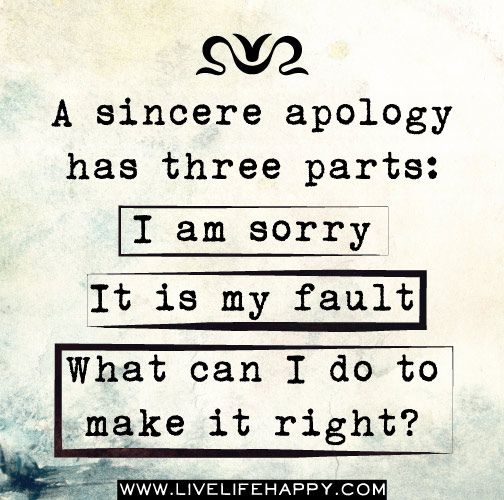
See the difference?