Gaslighting.

I’m pretty sure more people in 2017 know what gaslighting means than they did in 2016 or earlier.   It’s left the domain of the narcissistic abuse community and become a household word now that we have a leader who does it on a daily basis, largely via Twitter.   I see this term everywhere now.  In one sense, it’s a good thing, since people are becoming educated about what it (and malignant narcissism) looks like in a leader.    But it’s very bad that the whole world is being gaslighted now.   It’s even worse that so many people fall for the lies and act as flying monkeys who call those of us who value the truth ‘snowflakes.’

gaslighting_def


Donald Trump & Ayn Rand

Really good article about Ayn Rand (who many hardline Republicans seem to emulate, including many in Trump’s cabinet), Donald Trump, narcissism, and psychopathy. Was Rand a psychopath? Many people think she was, but there’s just as good an argument made by the author of this article (who is a psychopath) that she was really a narcissist. In my opinion, she was both.   As for Trump, he’s clearly a narcissist, but he’s so high on the spectrum his behavior and actions seem sociopathic (a word I prefer to use over psychopathy in most cases, because it’s a behavior pattern associated with malignant or high-spectrum NPD — while psychopathy is a condition one is born with and is not caused by early trauma).   In any case, lack of empathy is a feature of both narcissists (especially those as high on the spectrum as Donald Trump) and psychopathy.   You can think of psychopathy as “bad seed syndrome,” except a psychopath can actively choose to do good things or even be altruistic, if it suits them to do so.

Comments here are disabled; please leave comments under the original post.

nowve666's avatarCLUSTER B

—Psychopaths or Narcissists?

trumpaynOn November 8th of this year, the “unthinkable” happened. Donald Trump was elected president. Although his campaign sounded more populist that free-market fundamentalist, his choices for cabinet tell a different story. Liberals and progressives and just plain poor people are deeply concerned about the future. Alternet has an article whose title spells it out: It’s Ayn Rand’s America Now: Republicans Have Stripped the Country of Its Last Shred of Morality. Now Trump is hardly the ideal of Objectivists or Libertarians. He doesn’t embrace freedom for the individual, not with his “pro life” and anti-immigrant stance; certainly not with his intention to punish anyone who burns the flag. But the Republican Party representing the 1%, may well make the country Ayn Rand’s America.


aynaspsychoMany enemies of Ayn Rand’s philosophy (and there are many) like to call her a “psychopath.” Of course, many of these same people call…

View original post 1,205 more words

“This could never happen in America.”

thingsthathappen

But it is.

I’m talking about the increasing feeling of unreality and foreboding under this new administration, run by a sociopath that even ten years ago wouldn’t have had a snowball’s chance in hell of becoming president.

I sat, frozen in horror on election night, as I watched more and more states turned red, even states that have traditionally been blue.    I was upset, but I tried to talk myself down, almost convincing myself for a short time that maybe a Trump presidency wouldn’t be so bad.

But the days since his inauguration have been horrifying — and there have only been 7 of them.   One week of a four year reign.

Every day seems worse than the last.   As a nation, we seem to be on the fast track toward fascism, circling around  a looming black hole with little to no chance of escape.   Trump has been compared to Hitler. This is not hyperbole.  The comparison is being made even by intellectually respected sources who don’t usually stoop to sensationalism and fearmongering (or Godwin’s Law) to make a point.   If you doubt me, Google “Trump – Hitler.”    The similarities in both the men themselves and the tactics they are using to rise to power are chilling.

I’ve tried to stay away from the news, but I can’t.   I feel compelled to watch.  I know what this compulsion is:  it’s hypervigilance, a feeling I’m very familiar with.    I no longer feel safe here in America.   I feel like America no longer stands for what it once did, and its Constitution is being undermined a little more every day.  I am terrified, and feel like I have to scan the horizon for danger all the time.    But now I finally realize how someone like Hitler was able to rise to power.  I always wondered how that could have happened.  Now I know.  Along with the horror and feelings of dissociation, is a feeling of helplessness.   It’s incredibly triggering for someone already suffering from C-PTSD — only now it’s on a nationwide, maybe a worldwide, scale.

I can’t come home anymore and just relax.  Nothing is normal anymore.   I feel this NEED TO KNOW what Trump did or said.  During the day, I feel the same undercurrent of fear and hypervigilance I felt being raised by, and then married to, abusers.    And, like being married to an abuser, I never know what to expect.    With each new day, Trump seems to be getting bolder.  His outrageous comments, executive orders, lies, and hatred seem to know no bounds.   I’m very afraid.   I don’t think it’s exaggeration to admit that as a nation, America is in deep shit.

There seems very little that can be done.  We’re careening toward civil war, the removal of any civil liberties or even the right to protest, blatant discrimination and profiling of immigrants from “targeted countries,” even the possibility of nuclear war.   Information that has been freely available to the public is now being silenced, and facts are being denied.  We have a president who truly believes climate change is a myth and ordered the removal of climate change information, smack dab in the middle of the warmest winter on record — beating even 2016, which until this year held that record.

We have a president who lies constantly, who uses Orwellian “newspeak” to his own and his supporters’ advantage,  twisting language so that “lies” are now “alternative facts” and criticism and balanced reporting is “fake news.”    There’s no need for me to list all the insane, hate filled, and untrue things Trump has said, and all the unbelievably heartless and stupid things he is attempting to do, or wants to do.  He only seems to care about keeping his false self inflated, not at all about the American people or the country he’s systematically gutting from within as he claims to “make it great” again.   He is normalizing racism, sexism, authoritarian rule, and even the use of torture on immigrants under the guise of “rejecting political correctness.”

The man’s obvious malignant narcissism makes it possible for him to obsess over the small size of the crowd at his inauguration and then lie about it, and actually have the gall to order an investigation (paid for by the taxpayers) as to why was he didn’t win the popular vote.   Wah wah!   I guess winning the presidency wasn’t enough.   The man is an emotional ticking time bomb, and we should all be very concerned right now.

But I didn’t write this as a rant against Trump.   I don’t hate him because he is a mentally ill person who should never have come within 1000 yards of the presidency.   We allowed that to happen because of our complacency and apathy — and the way we have come to worship those who attained material wealth, no matter how they attained it.     I’m writing this because I’m scared to death. I know I’m not alone.   Every day I grow more afraid.  For all its faults, I never felt unsafe in this country before.   Like everyone else, I guess I took it for granted.  There were certain things that just wouldn’t happen in America — but they are happening now. Blatant fascism is becoming the new normal.   Things that would “never happen” are now more likely to happen than not.

Nothing can be predicted anymore.  Anything could happen.  There’s a new feeling of uncertainty and foreboding–and that awful helplessness–I never felt as an American.    There’s also a surrealness, a sense of dissociation and unreality.    It’s similar to the way I felt after 9/11, only this time it’s not an isolated event; it’s something that’s actually happening and will only grow worse if a miracle doesn’t happen, and soon.  This time we aren’t being brought closer together;  it’s a paradigm shift that will tear us even further apart.    Divide and conquer, is, of course, part of a malignant narcissist’s agenda to gain even more control and power. If 9/11 caused Americans to suffer nationwide PTSD,  a Trump presidency will cause a nationwide epidemic of C-PTSD.

We are so screwed.

5 Howling Wildernesses

This post has haunted me for months and I was thinking about it again today. Enter the inside of a malignant narcissist’s mind — a vast and bleak howling wilderness — if you dare. This is one of my favorite posts by HG Tudor, who is a brilliant and poetic writer.

HG Tudor's avatarHG Tudor - Knowing The Narcissist - The World's No.1 Resource About Narcissism

Five reasons it cannot work

1. Nothing about the golden period is real

It feels like every day is summer doesn’t it? Warm and wonderful. No rain clouds anywhere, just a cornflower blue sky. Not a cloud to be had. Everything is fantastic. We do everything together. We match on every conceivable level. I like what you like. We laugh at the same things. We enjoy the same books and films. I know what you are about to say. We like to cook together, try new wines and explore interesting places. Whether it is forest or foam, city or village we both enjoy going to these places and do so together. We are soulmates. I do not want anyone but you. You have finally met the person that you have wanted all of your life. You still cannot believe how lucky you are to have found someone like me, someone…

View original post 1,082 more words

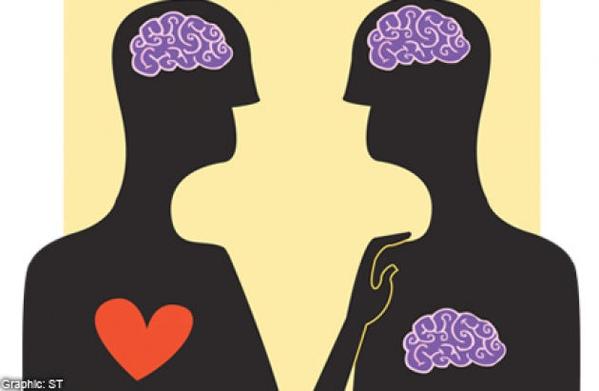
Why empaths and narcissists seem to need each other.

narcissist-and-empath
Credit: Let Me Reach with Kim Saeed

The concept of narcissism and HSP (highly sensitive person) or empathic traits coexisting in the same person is a matter that has very little research behind it, but I definitely think there is a strong case to be made for it. Hear me out before you hit the backspace key. I actually think it’s at the core of why empaths and narcissists are so uncannily drawn to each other.

In my article A Match Made in Hell: Narcissists and HSPs, I wrote about the tendency for narcissists and HSPs to form trauma-bonds with each other–that’s really just a fancy way of saying these two seemingly opposite types of people are often attracted to each other and form codependent relationships.

The trauma bond.

The narcissist is both attracted to and envious of the empath’s vulnerability and high empathy. They are attracted to it for a very simple reason:  they need it badly. As children, narcissists failed to be mirrored or loved unconditionally by their parents, and are love-starved, even though they’d rather die than ever admit it.   The empath, in turn, is able to love the narcissist without condition, to the point of allowing themselves to be sucked dry.

Narcissists also envy the empath’s ability to love unconditionally because on some level, usually unconsciously but sometimes consciously, they know they jettisoned their own ability to love and feel empathy a long time ago in order to survive.  Most were highly sensitive children but shamed for it.  Many were bullied.   So they learned to bury their emotions behind an invulnerable facade because continuing to be so vulnerable hurt too much. Empathy may be a gift, and I think most narcissists were born with that gift, but were never shown how to use it and were punished for having it.  It became a curse instead of a blessing, so they sent the gift into exile and shored up a false self to make sure it never saw the light of day again.

Knowing they jettisoned their ability to access their own vulnerability, combined with a continued starvation for unconditional love and acceptance, is what draws narcissists to empaths. They abuse the empath, either consciously or unconsciously, because they hate the fact they need their love so badly, and the empath’s sensitivity also unconsciously reminds them of their own sensitivity that caused them so much pain. It’s a constant reminder of the shame they felt as children for being so sensitive, but they also can’t live without it. So they punish the empath for reminding them of their own “weakness” and making them feel so needy.

The narcissist, in their neediness and simultaneous resentment of being so needy, feeds off the empath like a vampire. If they are malignant, they don’t care that they’re destroying the very person who gives them a reason to live. They may even get some satisfaction in knowing they are punishing them. If the narcissist is not malignant, they may feel some guilt over what they do to  the person who gives them so much love, but be unable to stop doing it. Or more often, they aren’t even aware they are doing it. They just seem like a bottomless well that can’t get enough and keeps on demanding more.

Of course such a relationship is extremely unhealthy, even deadly, for the empath, who will eventually either leave the narcissist or be completely sucked dry or in the worst cases even destroyed. But the empath does gets something important out of the relationship too. They truly believe that through their unconditional love, they are saving the narcissist from him or herself.

Common roots.

Empaths and narcissists often both come from abusive or dysfunctional families. Both started life as highly sensitive children. But at some point they diverged. While the empath embraced their own vulnerability and learned how to use their gift to help others and find joy and authentic connection with others, the narcissist rejected it because it seemed more like a curse and made them feel too much pain. If they were never shown any empathy or were shamed for being too sensitive, it’s understandable why they might have rejected their own empathy and covered it over with a facade of toughness.

Why are empaths drawn to narcissists?

Empaths, like narcissists, often have narcissistic parents, and are unconsciously drawn to those who remind them of their parents or perhaps a sibling or other close family member.  They are naturally drawn to those who seem to need healing, and in embarking on a relationship with a narcissist, they are unconsciously attempting to heal their parent or other family member. This is why empaths so often become codependent to narcissists.

Empaths are able to see through the facade the narcissist presents to the world, to their hidden true self. They can see the hurt, abandoned child that lives inside every narcissist. They truly believe they can “fix” them and transform them into authentic, feeling humans capable of returning what they have been given. Of course, this belief is almost guaranteed to end in disappointment (if the empath is lucky), and possibly much worse. For a narcissist to change and stop the pattern of abuse, the desire to do so must come from inside of them. They must be willing to drop their mask of invulnerability and do the hard work of reclaiming the vulnerability they were born with and gave up a long time ago. The empath can’t make a narcissist want to change. Just because they can see through to the sensitive true self doesn’t mean they will be able to draw him or her out. They can die trying, but it probably won’t work. The unwilling, un-self-aware (or malignant) narcissist is likely to punish them for trying.

Failed empaths?

There may even be a genetic connection between narcissism and those who become empaths. I’ll go out on a limb and even speculate that they might even be the same thing–the narcissist being a “failed empath.  It’s ironic but I definitely think there’s a connection.

But how can that be? Narcissists are incapable of empathy, have problems feeling and expressing deep emotions, and are incapable of loving anyone but themselves. Isn’t that the opposite of being an empath?

Well, yes and no. The explanation is complicated, so I hope you stay with me here.

As I’ve explained before, I think most narcissists began life as highly sensitive people who at an early age suffered trauma due to abuse. This caused them to shut off their too-vulnerable true (authentic) selves from the world and in its place construct an elaborate defense mechanism–the false self–initially meant to protect the vulnerable true self from further harm, which has no defenses at all. Even empaths who are not narcissists have some protective psychological armor, so they did not need to construct a false self to take the place of the true one. Healthy empaths are truly authentic people who feel deeply and are emotionally honest with themselves and others. Narcissists were born with no emotional defenses at all; the false self replaces the true one and appears invulnerable. But this is only an illusion. When you face a narcissist, you will never know who that person really is because all they will show you is the protective mask they have created. They are so terrified of being hurt again that they will attack with vicious ferocity if they think you pose any threat to its flimsy underpinnings. It must be a terrifying way to live.

The high sensitivity of a narcissist is retained in the way they react to personal insults or slights. They overreact when they feel like they are being attacked, ignored, or they perceive their source of narcissistic supply may be in danger. They are paranoid, touchy, and often lack a sense of humor about themselves. They may try to appear as if they don’t care, but if you know narcissism, it’s usually not too hard to see the emotional fragility behind their defenses and acts of false bravado. When it comes to other people, they can seem incredibly insensitive.

Narcissists who aren’t high on the spectrum and become self aware may be able to reclaim emotional empathy toward others, because empathy is a skill that can be learned.  A forum member on the NPD board I read (who has NPD) described something that happened with her husband that warmed my heart.  She said he had hurt her feelings, and she caught herself about to attack him.  She felt her defenses go up, but instead of acting out, she decided to NOT act out and just allow herself to feel the hurt.  Instead of attacking him as she normally would have, she cried.   He put his arms around her and she allowed herself to be held and comforted, to feel vulnerable and cared for.   She said at first she felt awkward and uncomfortable, but the next time it happened, she felt less uncomfortable.  Now allowing herself to be loved is becoming second nature and she says she is starting to feel some tenderness toward him too, and even moments of a new feeling that she thinks is real love, a warm feeling not based on getting supply from him or bolstering her ego.   So I think empathy takes practice.  If you were born with it, you don’t lose it, but it may be hard to access and takes a conscious effort to learn to reclaim and use.

But before a narcissist can really get better and feel empathy toward others, they first need to develop self-compassion (this is NOT the same as self-pity, but is actually empathy for the rejected child-self). They must also be courageous enough to stay in treatment and confront and release the traumatic feelings that lie hidden beneath the mask.

This usually only happens when the narcissist hits rock bottom and suffers a massive loss of supply, sending them into a depression.  At that point they may enter therapy or realize the problems they have are because of themselves.   The problem with this is once things begin to improve or they begin to feel better again, they are likely to leave therapy because the work to get to their authentic self is too painful.    It takes an enormous amount of motivation, courage and positive thinking for a narcissist to stay in therapy long enough to begin to access their true self and embrace their own vulnerability.  It can be done, but it’s not easy.

For malignant narcissists though, things are very different.  Stay with me here because things are about to get complicated.

The connection between malignant narcissism and high sensitivity.
warm_cold_empathy
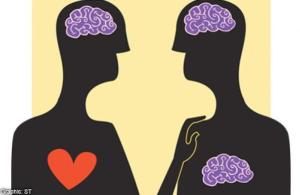
Warm and cold empathy.

In my research about NPD, there has been a lot of discussion about a concept called “cold” empathy.   Most of us associate narcissism with a lack of empathy, but this isn’t exactly the case. Most narcissists–especially malignant ones–do have empathy, but it’s not emotional or affective empathy; it’s cognitive or “cold” empathy. What this means is that a narcissist KNOWS what you are feeling, and may use what they know you are feeling against you. Cold empathy is “felt” on the cognitive (thinking) level, but not as an emotion, and that is why the narcissist can feel no compunctions about turning your feelings against you in order to punish or hurt you.

An extreme example of this would be the sadistic, psychopathic rapist. The rapist “smells” your fear and uses that against you to become even more sadistic. It *is* empathy, but it’s “cold”–the rapist understands exactly what you are feeling and your fear makes him feel powerful, so he increases the level of torment. He feeds off your fear like a vulture feeds on carrion. You don’t need to tell him you’re afraid; he KNOWS. He just doesn’t care and even derives pleasure from it.

Cold empathy is the twisted mirror image of warm empathy, which non-pathological people are capable of feeling on an emotional, not just a cognitive level. HSPs and empaths have an excess of warm empathy.  Here’s where things get complicated. If a narcissist is also a failed empath, their high sensitivity could morph into a quality that seems almost supernatural and is utterly chilling–a cold, sadistic form of “empathy” where they seem to be able to see into your mind. A non-sensitive person would not be able to detect your emotions without you telling them how you feel, and therefore not have that creepy, unsettling way of “seeing into your soul” that the malignant narcissist does. So, the higher the sensitivity a narcissist has (and the more the “warm” empathy has been shut out or turned “cold”), the more malignant they will be.
narcautism_spectrum
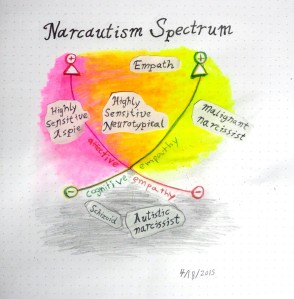
Malignant narcissism is high on the HSP spectrum.
Credit: http://dondepresso.rujic.net/post/116940034025/manic-chart-narcautism-spectrum

This idea was actually illustrated in the humorous-but-true graph (shown above), where initially I wondered why malignant narcissism was showing so high in empathic/HSP traits. But actually it makes perfect sense. An empath who adopts narcissism as a way to cope and whose warm empathy all turns cold will become malignant. A less sensitive person (or a highly sensitive person who still retains some warm empathy) may still become a narcissist, but they won’t become malignant. Of course, at their core, all narcissists are highly sensitive. They just don’t want you to know.

In summary, then, empaths and HSPs can be the most kind and caring people you can ever hope to meet–or the most dangerous. A narcissistic empath is definitely someone you’d want to avoid.

They are two sides of the same coin. The tragedy is that a malignant narcissist can destroy a previously healthy empath, but it doesn’t work the other way around: a non-narcissistic empath can’t change a malignant narcissist into a good person.

*****

Further reading:

Narcissists and Empaths: The Ego Dynamic
Maybe Trump’s election is the BEST thing that could have happened!

narcissist_trump

I know what you’re probably thinking.  You probably think I must have finally snapped.  That I’ve given into Stockholm Syndrome and now identify with the enemy.   You’re  maybe even thinking about hitting the “backspace” key,  writing me off as a traitor to my left wing ideals — or at the very least writing me off as a typical unstable, waffling Borderline  who blows hot and cold depending on my mood and can’t stick to my beliefs.

None of these are actually true (though I do feel a little crazy!)

Please hear me out.   It’s not what you’re probably thinking at all.   I still can’t stand Trump.  I can’t stand his personality, his racism, his sexism, his entitlement, his malignant narcissism, the way he insults those who aren’t exactly like him.   Hell, I can’t stand his FACE.  I can barely stand looking at his smug orange mug, his bloated body, and his ridiculous peach-colored toupee.

But more than anything else, I can’t stand his LACK of any real principles or ideals.   Donald Trump is a man who cares about nothing.  He has waffled on everything from abortion to Planned Parenthood to gay rights to roles of women to Obamacare to globalism.    The only thing he seems to have any passion about is keeping foreigners OUT.  And even that could change tomorrow.

Why?  Because Donald Trump is a textbook case of NPD.   Narcissists at his level of malignancy have no ideals or real beliefs of their own, because they don’t care about ideals and beliefs.   Donald Trump has no God; he regards himself as God.  Hell, he even admitted he has never asked God’s forgiveness because he doesn’t need to.   Yet evangelical churches are threatening their congregations with hellfire if they didn’t vote for him.

Although I’m a die-hard liberal (not necessarily a Democrat, more of a democratic socialist, third-party voter type, although I did cave in and vote for Hillary at the end), I can still respect a man or woman who has opposite views to my own, no matter how conservative, as long as they truly believe that what they stand for is right.    If they believe that their ideologies are the best thing for all Americans, even if they aren’t.    I didn’t agree with Ronald Reagan’s or George W. Bush’s policies AT ALL, but I believe that deep down, these were good men, trying to do what was best for the country.   They CARED.  They weren’t promoting their policies for their own glory and fame (or at least not completely), but because they believed in those policies.   So I can respect someone like Reagan or Bush, even if I disagreed with them.

Donald Trump is a man with NO principles, NO real beliefs (except in himself), NO ethics, no true ideology.   He stands for nothing.  He is a man without a conscience, without empathy, who thinks nothing of insulting entire populations of Americans who are different than he is.   He has shamelessly pandered to the Christian right knowing they would vote Republican no matter what (especially when he uses the anti-abortion and anti-homosexuality rhetoric to get those votes), but he himself is not a Christian (although he says he is, I do not believe him).  His actions, deeds and words are anything but Christian.    Donald Trump believes in nothing, except perhaps, that he is the Second Coming.

Psychiatrists have broken their own rule to never diagnose anyone they haven’t met in person and given a formal psychiatric evaluation.  The media and Internet is abuzz with respected mental health professionals declaring that Donald Trump is a textbook case of NPD.  One psychiatrist even said there was no better example of a high-spectrum narcissist than Donald Trump, who he believes possesses all nine DSM criteria.  This psychiatrist has actually used clips of Trump’s speeches to use in his graduate and college psychology classes to show what someone with a bad case of NPD acts like.

The exciting week ahead and my fears about that.  

On Sunday night, through Thursday, I will be attending a conference in Chapel Hill and Raleigh that will cover Christian principles in dealing with and healing disorders caused by trauma, such as PTSD, C-PTSD, DID, and personality disorders.

As I described in this post, it’s truly uncanny how every obstacle I was facing to be able to attend  this conference (and there were a LOT of obstacles — the possibility of my being able to attend seemed very remote) were moved aside.    Donations came out of nowhere.   Even my boss gave me her blessing, even though I have no vacation time coming up.   I’ll even get my lost pay replaced by a kind donation.     I prayed a lot about this beforehand and then suddenly all these obstacles were lifted.  I couldn’t believe how easy it was.

But I still had a lot of doubts and misgivings.  Even after I researched the program I’ll be attending (HeartSync) and found nothing negative written about it, other worries began to plague me.   I’m socially awkward and shy in person; what if I didn’t fit in?  What if the other attendees (most who are probably more well to do than me) didn’t like me?   What if they regarded me as too low-class, too poor, too shy, or just too weird?   What if they didn’t like my rather shabby clothes, my unstyled hair, my old car, my cheap baggage?

I also admit I felt nervous about staying in a hotel room for 4 – 5 days with a woman I have only talked to a few times on the phone and in email.   What if we didn’t hit it off, in spite of her incredible generosity and kindness?  Maybe she would change her mind about me and decide we had nothing in common.  As someone who has often been disappointed by others and has often been bullied, dismissed, or rejected by other people, I’m hypervigilant and nervous about those things happening, about not being accepted or included.    I’ve been programmed to think this way, and although it’s slowly changing as I begin to like and respect myself more, I still fall back into that way of thinking so easily, especially when I’m triggered.

I decided that instead of holding my feelings to myself, to approach my new friend with with my concerns.   I felt it was better to get all that out in the open and talk about it, than worry and fret that I might be an outcast or not fit in (and then act in ways that might bring on rejection).  I was reassured that this was a healing seminar, with plenty of people suffering from PTSD and other disorders that caused their self esteem to take a nosedive, and there are Christian therapists there to talk to should I feel triggered in any way.

Mind.Blown.

All this was very reassuring, but when my new friend told me she was happy about Trump’s election, I was initially tempted to tell her to forget the whole thing, return her generous donation, because no way could I room with a Trump supporter when I’m still so triggered by his election a few days ago.

But then my friend told me something positively mind-bending.  What she said was something I don’t think I would ever have thought of on my own, but I believe she’s onto something big here.

She said she couldn’t stand either of the candidates (which I couldn’t either) and like many, didn’t vote for either of them.   She assured me she does not like Trump and agrees that he is a malignant narcissist without principles who doesn’t really believe in anything except himself.

Mass education about NPD is the way out of this mess.

But she said that his election was a wonderful thing, because it will–and already is–educating the general public about NPD and malignant narcissism.   As of right now, only mental health professionals and people who read narcissism blogs on the Internet really know anything about this disorder.  Trump is, by default, going to make narcissism a household word–not in the current misguided belief that it means taking selfies — but the true meaning of NPD–a person so damaged they must project their pathology onto others, develop a false self to fool others and puff themselves up, can tolerate no criticism, and attack anyone they believe is against them.

As Trump progresses during his presidency, we are going to witness Trump’s obvious mental and emotional instability as he attempts to fill a role so over his level of experience it’s laughable.  He will almost certainly fail.   My friend believes there are still enough checks and balances to keep him from doing any real damage.   Most narcissists are all talk and no action anyway.   As he blunders about and rants and rages,  we are going to be hearing and reading more and more about NPD and how it was the rise of narcissism that brought this country to where it is and finally allowed its poster boy–Donald Trump–to be elected.

Trump is likely to accomplish nothing except one very important thing: his unstable, borderline-crazy behavior will begin to make people realize that we have sunk so low as to elect a sociopathic narcissist as our president.   That in itself might be a wake up call for us all, and could start the pendulum swinging back toward the support of candidates showing more empathy, compassion, and a sense of fairness and justice, who have real beliefs and care about America and the world.   We are all going to be learning a lot about narcissism.  There is still a lot of ignorance and misunderstandings about this personality disorder.

As the tide begins to turn, and people realize we have elected someone who does not care about anyone but himself,  people will begin to give each other what they hope to see in a leader during other times — compassion, caring, and helping each other.

Education–in this case a worldwide crash course in malignant NPD and its devastating effects when one is allowed to rise as far as Trump has–is what is so sorely needed right now.    Perhaps without Trump’s election, we would never get that far-reaching education and people would remain ignorant.

As depressed as I’ve been over the past several days over Trump’s win, I’m looking at things now in a whole new light and feel completely ready to attend this seminar, which in some way I don’t understand right now, has everything to do with what I just learned.

How does malignant narcissism differ from NPD?

demonic

There’s a lot of talk about the narcissistic spectrum — the idea that narcissism runs on a spectrum from “normal” narcissism (healthy self esteem) all the way through malignant narcissism at the top. Somewhere in the middle, “normal” or “healthy” narcissism shades into Narcissistic Personality Disorder (NPD).

While I do think narcissism runs on a spectrum, I don’t think “healthy” narcissism has much, if anything, to do with pathological narcissism. Healthy narcissism is what makes us stand up for ourselves when we are being attacked. Healthy narcissism is what makes us feel proud of ourselves when we’ve accomplished something good. Healthy narcissism is what makes us want to look our best when we’re going on a date.

People who are narcissists, on the other hand, have little to no self-esteem. They either hate who they really are, or they don’t know who they really are, so they develop a false self to stand in for their real one. The false self can only survive by feeding off the reactions of others (narcissistic supply). That’s why narcissists can be so manipulative and dangerous. Since they are usually in their “false self,” and can’t risk exposure of their vulnerable real one, they will go to extreme measures to keep their false self intact, which includes projecting any bad traits onto others, denial, lying, gaslighting, and other tactics meant to deflect attention away from any flaws and transfer them onto others.

To a narcissist, you are not a real person, since a false self can’t acknowledge your humanity, only your usefulness to them. Like an infant who hasn’t yet realized they are a separate entity from their mother, your only purpose is to serve them and keep them alive. Narcissists, like babies, are emotionally unable to recognize that you are a human being who has needs and desires of your own.

You can be a pathological narcissist without being a malignant one, though. Malignant narcissism isn’t a person with NPD who is “more” narcissistic; it’s a person who has both Narcissistic and Antisocial Personality Disorder (ASPD)or an NPD with ASPD or sociopathic/psychopathic traits. Malignant narcissists are very dangerous because they combine the traits of narcissism with the traits of a sociopath or psychopath.

From Wikipedia:

The APA’s Diagnostic and Statistical Manual of Mental Disorders, fourth edition, text revision (DSM IV-TR), defines antisocial personality disorder (Cluster B):[19]

A) A pervasive pattern of disregard for and violation of the rights of others, occurring since age 15 years, as indicated by three or more of the following:
–failure to conform to social norms with respect to lawful behaviors as indicated by repeatedly performing acts that are grounds for arrest;
–deception, as indicated by repeatedly lying, use of aliases, or conning others for personal profit or pleasure;
–impulsivity or failure to plan ahead;
–irritability and aggressiveness, as indicated by repeated physical fights or assaults;
–reckless disregard for safety of self or others;
–consistent irresponsibility, as indicated by repeated failure to sustain consistent work behavior or honor financial obligations;
–lack of remorse, as indicated by being indifferent to or rationalizing having hurt, mistreated, or stolen from another.
C) There is evidence of conduct disorder with onset before age 15 years.
D) The occurrence of antisocial behavior is not exclusively during the course of schizophrenia or a manic episode.
Antisocial Personality Disorder (ASPD) falls under the dramatic/erratic cluster of personality disorders, the so-called “Cluster B.”

I probably don’t need to define NPD here, since so much of this blog is about that.  While several of the traits of NPD and ASPD overlap (lack of empathy, aggression, and dishonesty), there are some differences too.   Conscience isn’t entirely lacking in a narcissist (though empathy, which is different from conscience, probably is).  In fact, some narcissists are overly concerned with “right” and “wrong” (of course, they’re always right) and never do anything remotely illegal and may seem concerned about “morals.”   That’s why so many of them are so judgmental and they can so commonly be found in churches and the helping professions.   Narcissists are also over-sensitive to criticism and care very much what others think of them, since the mask they wear requires the approval or at least attention of others.   People with ASPD and psychopaths (the latter are merely people who were probably born without a conscience or the ability to feel empathy) have no need for narcissistic supply from others since they aren’t wearing a mask.     They just want to do what they want to do and don’t care what you think of them.   They are not what anyone would call “sensitive” but most narcissists are incredibly sensitive (about themselves).   Unlike narcissists, who have strong emotions which are hidden due to shame, people with ASPD seem to not have any emotions, or their emotions seem limited to anger or boredom.    People with ASPD are also much more impulsive than narcissists, and don’t plan their actions ahead of time.  They act on whim, according to whatever strikes their fancy at the time.   They are also much more likely than people with NPD to break the law and be incarcerated (so there are a lot more narcissists walking around than antisocial people, which makes them more dangerous).

Malignant narcissists are a deadly combination of antisocial and narcissistic traits.   Because they are still narcissists, they are oversensitive to criticism, but unlike garden-variety narcissists, they have no conscience or sense of right from wrong.  Or if they do, they don’t care.  They are sadistic and enjoy the suffering they cause others.   They go out of their way to hurt others, because hurting others makes them feel good.    If you cause a malignant narcissist to suffer narcissistic injury, they will react in very antisocial ways.  They are spiteful and seek revenge when they are hurt.  They also tend to be extremely paranoid and act out against others pre-emptively to prevent injury.  A garden variety narcissist, when injured, may annoy you to death, demand reassurance, project, gaslight, or disappear, but won’t deliberately seek revenge just to hurt you.   They are broken people desperately trying to keep their false self intact but are almost always unaware of this.  They may be paranoid, but not to the point of pre-emptive attacks to avoid narcissistic injury.   Malignant narcissists also like to create chaos and tend to thrive in chaotic environments, where other people (including non-malignant NPDs) would just fall apart.  They may not be criminals or do anything against the law, but they like to cause upheaval, chaos and suffering.

Non-malignant narcissists are manipulative and dangerous too, but they don’t go out of their way to hurt others.   They are probably unaware of the pain they cause other people, and just think they are always right and that others are just extensions of themselves.   They may truly believe they are doing the right thing, truly believe you are at fault, or truly believe the person they are victimizing is really victimizing them.   Some non-malignant narcissists, if they ever become aware of the harm they cause to others, suffer from feelings of guilt and shame and even remorse.    Not so with malignant narcissists, who are usually fully aware of the pain they cause to others and derive sadistic pleasure from it.

Malignant narcissists, outside of an act of God, probably can never get any better.  They will never voluntarily enter therapy because they don’t think they have a problem; it’s everyone else who has the problem and deserves their wrath.   If there are evil people in the world, people with malignant narcissism would fit the bill better than anyone else.  Non-malignant narcissists may be extremely disordered, but they aren’t evil.  They may have moments of humanity and even emotional empathy.  They may be very difficult to cure (NPD is probably the most difficult personality disorder to cure outside of ASPD) but sometimes they voluntarily enter therapy, especially after a great loss.  A malignant narcissist would never be caught dead in a therapist’s office.

Was Betty Broderick really a victim of narcissistic abuse?

thebrodericks
Dan and Betty Broderick at their wedding, 1969

Sometimes the delineation between being a narcissistic abuser and having been a victim of narcissistic abuse is not very clear.    A famous example is Betty Broderick,  the jilted wife who broke into the home of her ex-husband, Dan Broderick, and his new wife, Linda Kolkena, and shot them both to death as they slept.

The entire story is documented in Bella Stumbo’s excellent true crime book, Until The Twelfth of Never, which I read a number of years ago. The story of this tragedy haunted me for weeks, but Dan’s treatment of Betty prior to the murders haunted me even more.  In fact, it downright bugged the bejeezus out of me.

Betty was eventually prosecuted and her appeal for parole was denied.   She will probably spend the rest of her life in prison.

Did Betty murder in cold blood?  Absolutely.   Did she ever admit guilt or show any remorse for her actions? No, she did not.  Was she manipulative and did she show self-centered behaviors?  Yes.  Did she use her children as pawns in her one-woman crusade against her cheating ex husband?  Again, yes.  Was the diagnosis of Narcissistic Personality Disorder she was given by the prosecuting psychiatrist correct?  Very likely. (She was also diagnosed with Histrionic Personality Disorder).

I’m not defending what Betty Broderick did.   She is a pre-meditated murderer who killed in cold blood as her victims slept and showed no remorse for her crime.   She used her children as pawns against her ex in their hostile, drawn out divorce, not thinking or seeming to care about their needs, only her own.   Two of her four children don’t speak to her and one has written a book against her and testified against her in court.

But even taking all this into account, I always had a huge problem not seeing Betty as the real victim, in spite of her heinous crime.   From their marriage in 1969 until 1983, when her husband’s affair (which he had lied to her about) came out in the open (and the shit hit the proverbial fan),  Betty was by all accounts a loyal and faithful wife, very much bound by her strict Catholic religious upbringing (and probably, how she appeared to others).   She was a typical 1950s-early 1960s-style housewife, whose main interests in life seemed to be marriage and family.    She wasn’t a go-getting feminist or a a dissatisfied wife who longed for a career or an outside life; she was perfectly happy taking care of the house and playing second fiddle to her successful attorney husband Dan (who had both a law and medical degree), proud of being seen with him at the many functions he attended, and dutifully raising four children (a fifth one died shortly after birth).   If she really had NPD, perhaps much of this was for show or to be well regarded in the community, but Stumbo’s true-crime book described a woman who, if anything, was doing everything she thought she had to do to be a good wife and mother,  who never cheated on her husband or showed any interest in expanding her interests outside their family.   Granted, she was never easy to live with, and could be very demanding, needy, and high maintenance, but I wouldn’t say she was malignant, at least not in the beginning.  If she was a narcissist, she was a covert one with a lot of borderline traits.

I think it was her husband who was a much more grandiose and obvious (if not more malignant) narcissist.   He was charming, overly concerned with his image and status, wildly successful, cold and unfeeling to his wife and children, and seemed to lack any empathy for his wife’s many emotional needs.  She did seem to be the more emotionally unstable of the two of them, but such is often the case with the partner who is being victimized–especially if the abuser has flying monkeys (and Dan had a whole community of them due to his power and reputation).

thebrodericks2
Dan Broderick and Linda Kolkena, circa 1983

When Betty was in her 40s, she had gained some weight (as many women do around that age) and Dan began to show how little he valued his wife and their marriage, now that she was no longer young and beautiful.  He started an affair with an attractive young woman in his office named Linda Kolkena, who he promoted to his personal assistant.  He spent less and less time at home and even took his new assistant on vacation (saying it was a business trip).  Betty suspected something was going on and asked Dan about it.  He lied to her and said there was nothing and she was imagining things (sound familiar)?     Eventually the truth could no longer be hidden and he admitted he’d been having an affair with Linda all along.  But it didn’t stop there.  He also told Betty he had fallen in love with Linda and wanted to marry her, and told Betty coldly that he wanted a divorce.  Shortly after he left her, Linda fell pregnant.  They flaunted their happiness cruelly in front of Betty, who always had self esteem issues.

The divorce was drawn out, dramatic, and ugly.   Betty became increasingly deranged, and showed stalking behaviors and began to involve her children in her one-woman crusade against her cheating ex.   But Dan and Linda also ganged up against Betty and made fun of her, leaving abusive phone messages where they could be heard laughing together and making fun of Betty’s age, weight and intelligence.    Such a thing would certainly make ME see red!  For Betty, an insecure woman whose entire identity had been tied up with being Dan Broderick’s wife and the mother of his children, his cruel and malicious behavior must have been unbearable and something eventually snapped.

Dan was able to convince everyone that Betty was insane–not to mention fat, stupid and old.   He was expert in gaslighting and triangulation, turning most of their friends and even their own children against her.

What Betty did was wrong.  There’s no way around that.    She was spiteful, manipulative, and completely out of control.  She lied in court.   She didn’t seem to have much, if any, empathy for their children (by that point, I would completely understand if she had no empathy for her ex and his new wife, given their shabby treatment of her during the divorce proceedings).

betty-broderick-8
Betty Broderick during the trial.

But I wonder how much she may have been driven to act as she did.   Dan seemed cold-hearted and emotionless from the get-go, almost psychopathic.   For 14 years, Betty put up with this b*stard and obediently played the role of the trophy wife that he wanted.  When she was too old, he unceremoniously dumped her for another woman.

In my opinion, Betty Broderick was a victim of narcissistic abuse who was driven to become a narcissist.  Even if she was already a narcissist, I don’t think she was malignant or that she would have gone to the extremes that she did on that horrible day in 1983 had she not been driven to to the brink of insanity by her arrogant, compassionless, egotistical cheater of a husband.

This case has always fascinated me, in part because I think so much was brushed under the rug during the divorce proceedings and the trial. I always felt a bit of sympathy for her, in spite of her horrible crime. Here’s another article I found in defense of Betty Broderick.  Betty was certainly no angel, but I don’t think Dan Broderick was as good a guy as the press and popular media liked to make him out to be — not even close.

Betty Broderick: Victim or Victimizer

The real reason why my attitude toward narcissism changed.

My ex might be dying.

redemption

My MN ex may have cancer.   He’s been coughing up blood a lot and has been a heavy smoker for years, and also smokes a lot of weed too.  He’s also been losing a lot of weight.  He tells my daughter he doesn’t think he has much time left.

He’s covered by Medicare (SSDI), but he’s terrified to go see a doctor.    I don’t blame him actually.  I’d be terrified too.

He told my daughter if he has cancer, he just wants to let nature take its course and doesn’t want treatment.  He’s a very high spectrum malignant narcissist, but he hates himself and his life.  What he lives is not a life, it’s an existence.   He’s just marking time until death, and he’s not even that old (he’s 55, but looks 70).

Although I can’t stand him anymore and refuse to have further contact with him, this development makes me feel very sad.   It makes me sad that he allowed his own narcissism to destroy him (as well as almost destroy the people who loved him, including our children).  It makes me sad that he’s isolated himself from his family by driving the people who loved him away, one by one–and will probably die all alone with no one to really care.  His parents are both dead and he has no other close relatives.

It makes me sad that he, like my mother, will most likely die without ever being free of his narcissistic prison.    I am praying for him because although I don’t like him, I know he’s living in a self imposed hell of his own making and his life is without any joy or lightness or love or hope.  He’s the most negative person I’ve ever met.

I would love to see him at least become self aware enough to make amends to both his children, and realize that what’s happened to him is his own doing, not the fault of those who were close to him.    Not because I want to see him suffer the pain of self-discovery (I’m not a spiteful person seeking revenge), but because I feel like that could possibly redeem him in God’s eyes, even if it’s at the 11th hour.

No, he doesn’t have enough time to be cured of NPD (or ASPD, or whatever he actually has), because that can take years that I don’t think he has, but at least some kind of redemption may be possible and he can have a moment to reconcile with his family before he finally shucks off this mortal coil.

I would also love to see him accept the love of Christ and allow himself to be comforted in His arms during his last moments.   He needs that so badly.  I’ve felt the love of Christ very keenly lately, and when I feel overwhelmed or discouraged or depressed, I ask Him to take me in his arms, and I can feel that he really does and that brings me great comfort.   I felt his presence strongly during my spiritual awakening (of sorts) in the Gulf of Mexico a couple of weeks ago.   I feel it whenever I fall onto my bed and weep after therapy, and he just rocks me and holds me like the parent I always wanted and tells me everything will be alright.  He was always there but I refused to see.

My daughter does still speak to her father sometimes, but after stealing all her money last month, there’s definitely a rift between them now, and she’s starting to realize what sort of person he really is and that he’s utterly incapable of loving anyone.   He told her he wants her to have a baby before he dies so he can have a grandchild for a short time, but she’s smart enough to not do that until she’s actually married (she’s with a very good man now who I think might be “the one”–and there are no red flags that I can see).

Maybe this man, being so physically ill (even though there’s no proof it’s cancer it probably is), will begin to look at himself in a different light and begin to develop some self-awareness.  I’m praying, and I know God listens.  So I’m not without hope that at least that could happen.