Family estrangement.


scapegoating

Psychology Today has an interesting article about why family members become estranged.  In most cases, it’s an adult child between the ages of 25 and 35 who initiates the severing of the parent-child relationship.

https://www.psychologytoday.com/blog/domestic-intelligence/201512/the-persistent-pain-family-estrangement.

“A difficult parent is that which the daughter or son experiences as being at the cusp of rejecting the child, or casting them out as a result of disapproval, disgust, or disappointment. When a daughter or son made the difficult decision to sever the relationship, it was usually because they felt that maintaining it was too emotionally costly, that they had to distort their soul into shapes that did not feel right to them in order to please or pacify a parent.”

In other words, No Contact.   I think most cases of an adult child severing their relationship with their parent(s) are due to feeling as if they have already been rejected or emotionally abandoned by the parent, so there isn’t as much guilt over severing contact as there might otherwise be.   But there is still sadness and grief involved, especially during holidays and possibly on birthdays.  The grief isn’t over what was lost so much as what never was or what could have been.

Tragically and unfairly, there is stigma against adults who lack family support or relationships.  Most people don’t really sympathize with you if you are estranged from your family, because they don’t understand it.  Most people think family will always be there for you through thick and thin, and in an ideal world, that is how it should be.  We are tribal creatures, wired for attachment, even as adults.

So when things go wrong and your family has cast you out of their midst, either because you became the scapegoat, or your values or lifestyle are disapproved of by the rest of the family, people from normal, loving families think the problem must be with YOU.  They can’t imagine that any family would cast out or reject one of their own, so you must be the one at fault.    If you have gone No Contact, they think that is a cruel and unusual thing for any adult child to do to the people who gave them life.   But because they weren’t the children of narcissistic parents, and have no clue what being the family scapegoat is like, they cannot understand the pain of staying involved with people who cannot love you unconditionally and are rejecting and abusive toward you even if they haven’t outright cast you out.

Many estranged ACONs are financially vulnerable due to having dismally low self esteem that kept them from acquiring the confidence and drive to be successful in a career or the self esteem to build satisfying, healthy relationships.  Many ACONs are divorced (often from other cold and rejecting abusive or narcissistic types much like their parents), unmarried, impoverished, and lonely.  Many also find it difficult if not impossible to build a surrogate family of close friends, because of their difficulties making friends for the same reasons their other close relationships don’t last.  They simply don’t have the self esteem or social skills needed for that.   A rejecting family who then turns around and blames you for your “failures” (due to not having given you the tools that most children got from their families to do well in life)  is like salt rubbed in an already gaping and infected wound.   It’s beyond unfair.  Add to that the sad fact that scapegoated adult children are usually left out of any will, if there is one.

Social service agencies and charities don’t help much.  They are temporary measures at best, and have limited resources.  They don’t love you unconditionally like a family would; in fact, they don’t really care.   So scapegoated and marginalized adult children often have no resources to which they can turn when things are rough (and they usually are).  They are vulnerable in every way it is possible to be vulnerable, due to poor mental and often physical health and without the means or the tools or the friends and family to give them support when they most need it.   Then, much like their own families did, society blames them for their failures and poverty, telling them it’s their own fault they have so few resources and insults them by calling them worthless drains on society.  It wouldn’t surprise me if it turned out that most homeless people were the scapegoated children of narcissistic families.  Having been dealt such a lousy hand in life’s lottery, you’d think there’d be more suicides among estranged adult children.   But the survival instinct is strong with us.   It had to be, or we wouldn’t still be here.

The price of being the most emotionally honest member in a narcissistic family is a high one.

Nothing makes me angrier than this.

seeing_red_by_cosmohibdon-d4o6hzv
Seeing Red by cosmohibdon, Deviantart.

This came up in the comments section of my last post.  Nothing makes me angrier than people who tell you, “why don’t you ask your family for help?” when something bad happens and you mention you are in need of financial or emotional support.

I’m not in that situation right now, by the grace of God, but I have been.  Many times.  And I could never ask my family for help, either emotional or financial, because they’d either (a) say no; or (b) tell me all the reasons why I was being “entitled” and put me on a guilt trip for asking.  And the answer would still usually be no.   If it wasn’t no, there were always strings attached.  But that was as rare as blue diamonds.

Whenever I’ve asked my family for support in the past, they made me feel about 2 inches tall, like how dare I ask for help at my age.  At my age, I should be self-sufficient and never have to rely on family for anything.  I’ve taken care of myself my whole adult life, and have hardly leaned on them more than I absolutely had to.   I avoid asking them for anything and have not in years, even when most people would have.   The shame involved in asking is too painful.   Even if, say, I was about to become homeless or was terminally ill, I still wouldn’t ask them for anything.   I’d rather die first, and that’s not an exaggeration.  I doubt they’d care much.  Once I turned 18, their responsibility to me was done.   No one even paid for my college education, though my parents were far from poor and could have afforded it. I had to work full time and take out student loans. I didn’t  even qualify for grants because I wasn’t living at home with my parents.  They wouldn’t allow me to.

I remember when I was temporarily homeless during my divorce, and my mother told me to go live in a homeless shelter.  With the kids.  That’s how “caring” and “loving” these people are.   She also sent an email to my father talking about how “she never learns from her mistakes” but she accidentally sent it to me!   When I confronted her about her “mistake” (I think it was intentional), instead of apologizing or attempting to explain (of course there was no good explanation for this), she laughed and said “well, maybe it’s for the best you saw that.”   She laughed!  Talk about no empathy.  Another time she told me I should become a nun and go live in a convent and get my needs met that way.   She wasn’t joking.

Yet, oddly, she was there for me when my kids were born, helping out when I was recovering from my C-sections.  She seemed genuinely caring and concerned too, and was wonderful with the babies.  I appreciated her help then and actually believed she might have changed.    But soon after I returned to work, it was back to business as usual.

Now I’m No Contact with her, I still hear about how she badmouths me to her other relatives (I’m a “loser” who “never learns from my mistakes.”)  If I died, I bet she would blame me, saying things like, “well, she never could get it together and just got what she deserved.”   She always found a way to take everyone else’s side but mine, even for things that weren’t my fault.  She just always assumed it was me at fault and never gave me the benefit of the doubt, no matter what the situation. She’s a terrible human being but I still don’t hate her.

Maybe people who assume you can go to your family when you need help are well-meaning, and because THEY have supportive, loving families, who always have their back, they assume everyone else does too.  Well, that is not the case, not everyone does.  Especially when you’re the family scapegoat.   People should realize that and not ask.   It’s rude.

When people ask me why I don’t ask my family for help or support, I just look them dead in the eyes and say, “my family’s all dead.”   That usually shuts them up pretty fast.

I hate tailgaters almost as much as people who tell me I should rely on my family for support, but not quite as much, and that’s saying a lot because I think all tailgaters should be lined up and shot.

Family estrangement.

estranged-family-520w

Wikipedia has a good, in depth article about the sad phenomenon of family estrangement, which is related to shunning or ostracism.  Family members who have been estranged (ostracized or scapegoated) are likely to develop PTSD and have dismally low self-esteem.

Family estrangement occurs for a number of reasons, and is most common in societies that value individualism over the family, tribe, or community, so it’s more common in the United States than in other countries.    It’s also my personal opinion that it’s more common in upper middle class families who value material and financial success over loving relationships.  An adult child who fails to toe the line and make the family “look good” becomes an embarrassment to the family’s upwardly mobile aspirations, and becomes the scapegoat or is even rejected from the family.   They are also likely to be disowned.  The ostracized adult child, lacking financial and emotional support and a healthy sense of self worth (because nothing is more devastating to a person’s sense of self esteem than being rejected by one’s own family), often falls into poverty, illness, or mental illness, further shaming the “perfect” family.

The sense of shame of having been rejected by the people who are supposed to love you unconditionally is emotionally, spiritually, and even physically devastating.  It’s the worst kind of soul murder.  To make matters worse, it’s often the “truth teller” (the one who sees through the toxic family dynamics) or the most sensitive or vulnerable child who is shunned in this way.  The scapegoated or ostracized adult child is then blamed for their “failures” and told they brought their hard luck on themselves.

Cluster B personality disorders are very common in families where members become estranged, scapegoated or ostracized, because people with these disorders tend to lack empathy, which is the glue that holds families, tribes and societies together.   Substance abuse is also a common factor and may be co-morbid with Cluster B disorders (substance abuse being a very common but maladaptive coping tool among people with these disorders).

https://en.wikipedia.org/wiki/Family_estrangement

To my Mom’s “Credit”

Comments are disabled; please make comments on the original post.

3 questions to ask yourself if you raised kids in a dysfunctional home.

Nobody’s perfect, and that goes for parents too.  There’s no such thing as a perfect parent. There’s something called a “good enough” parent though, which means that you are going to make mistakes raising your kids, no matter how much talent you have for the task or how well adjusted you are.  Children don’t come with instruction manuals, and some of the mistakes you make might even be pretty bad ones.    But overall, you’re “good enough” if your kids know you love them no matter what mistakes you made, and they turn out to be functioning, reasonably happy adults.

But for survivors of narcissistic abuse, things are a little more dire.   Because many of us suffer from mental disorders caused by abuse–C-PTSD, BPD, OCD, anxiety, depression, and a host of other mental maladies–we probably entered parenthood with less of a sense of ourselves and our place in the world than the “normals” who had “good enough” parents.  Our narcissistic parents were not “good enough” and we were emotionally handicapped because of that.  Even if we aren’t narcissists ourselves, our children still suffered the fallout of our own abuse.    This could have manifested in many ways:

— we may have “parentified” our children (looked up to them as parental figures and shared things with them that should not be shared with children)

— we may have neglected them more than we should have, or put our own needs first

— we may have been unfaithful to our spouses or had affairs

— we may have overindulged in alcohol or drugs to ease our pain

— we may have had health problems due to trauma that interfered with our ability to be there for our children

— we may even have assigned the “scapegoat” or “golden child” role to our kids, albeit with less intensity than narcissist parents would have

— we may have been hospitalized for mental illness, which took time away from us being able to be there for our kids

— we may have been emotionally unstable, clinically depressed, always angry or quick to lose patience

— we may have been too permissive with our kids, in a misguided attempt to make up for our own miserable childhood, if our parents were very strict and controlling.

— we may have slept our days away out of depression, ignoring the needs of our kids

—  there may have been constant arguing and fighting in the home

— we may have stayed with an abuser, knowing the danger to the children

— we may have failed to protect our kids from an abusive spouse

I wasn’t guilty of everything on this list, but I was guilty of some of them.   I have a lot of guilt and regret over that, of course.   I beat myself up a lot over what I should have done differently.   And of course, I should have, but I was also at the time in a highly codependent marriage to an emotionally abusive malignant narcissist who gaslighted me and projected every bad thing he could onto me every chance he got. He was slowly but effectively driving me insane, and he tried to turn our kids against me too (in the end, he did not succeed).

same_number

Somehow, my kids turned out alright.  Sure, they have problems.  But so does everyone.     Neither has NPD that I can tell.   I worry about them constantly though, frequently “seeing” pathology in them that in reality doesn’t exist.  I think it’s my guilt over my less than ideal parenting that makes me do this.  Because I was unintentionally under-protective of my kids when they were very young, sometimes I think I’m trying to “make up” for that now, when they are young adults and over-protectiveness is no longer appropriate or even healthy.

If you know you were a less than ideal parent due to our own trauma, ask yourself the following three questions:

  1. Do you have a good relationship with your children today?
  2. Are they functioning adequately in the world for their age group and mental ability?
  3. Do they have the capacity for empathy, friendship and love?

If the answers to these questions is “Yes,” then in spite of how bad a parent you think you were, you were “good enough” under the circumstances of simply not having the emotional tools that would have made your job as a parent easier.

If you know your parenting left a lot to be desired, encourage your adult child to talk to you honestly about what it felt like to be raised by you.  Listen to what they tell you, without interrupting, judging, or criticizing, even if what they tell you isn’t what you want to hear.  Chances are, even if your relationship with them has been damaged, allowing them to open up to you this way without fear of judgment is a step toward healing your relationship and building a healthier, more loving one.

Child roles in dysfunctional families.

dysfunctional-family
Credit: Artist unknown.


Wikipedia has an excellent, detailed article about dysfunctional family dynamics. Here I am just going to talk about the roles various family members play, and the kinds of families that become dysfunctional. If you’d like to read the whole article, click on this link:

https://en.wikipedia.org/wiki/Dysfunctional_family

Dysfunctional families are usually of two types:

1. One or more of the parents are active alcoholics or addicted to drugs.
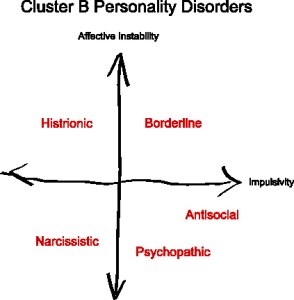
2. One or more of the parents have a Cluster B disorder, usually Narcissistic Personality Disorder but sometimes Borderline Personality Disorder, Antisocial Personality Disorder, or Histrionic Personality Disorder (or a combination of any of these).

The Cluster B Connection.

Outside of alcoholics and drug addicts, dysfunctional family dynamics are most prevalent when one or both of the partners suffer from a Cluster B disorder, especially Narcissistic Personality Disorder or Malignant Narcissism.    After NPD, BPD is the most common disorder seen in the head of a dysfunctional family, though because it’s more common in women and Borderlines have more empathy than narcissists, BPD is most often seen in the codependent, passive partner.

ASPD (psychopathy or sociopathy) rarely appears by itself in dysfunctional families, as antisocial people and psychopaths tend to not be raising children at all (either because they’re incarcerated, their children have already been removed from the home, or they simply have no interest in raising children,) but a parent could have Malignant Narcissism, which is a combination of NPD and ASPD.   Also, people with pure ASPD, though more likely to be criminals or involved in illegal activities, tend to be less emotionally abusive than people with NPD or even BPD. They are merely selfish and lack empathy, and they are manipulative to get what they want, but they don’t care about getting emotional supply from others so they don’t engage in mind games like gaslighting, triangulating, projecting, and scapegoating (unless there is a material reward involved or they are trying to avoid culpability). However, some people with ASPD are sadistic and enjoy tormenting family members for fun.

Of all the Cluster B disorders, HPD is probably the least toxic (Histrionics are shallow, attention seeking, and dramatic, but not usually that abusive), but HPD is usually comorbid with another Cluster B disorder, such as NPD.
cluster_b_chart

In some cases, a non-Cluster B mental illness (such as Bipolar disorder) that causes abusive acting-out behavior may be the culprit, but it’s less common because most other mental disorders are less easily hidden from others and the person appears “crazier.” Non-Cluster B disorders are also more easily treated with drugs or therapy, and except for psychotic disorders such as Schizophrenia, the afflicted person knows they have a problem and are more likely to seek help.

Cluster B and addictive disorders. 

Parents of dysfunctional families can also be both mentally ill and addicted to drugs or alcohol. The two often go together. In fact, alcoholism and drug addiction are extremely common in people with Cluster B disorders. Alcohol and drugs are their attempt to fill the emptiness they feel inside themselves.

Even if an alcoholic or drug addict doesn’t have an underlying Cluster B disorder, the behavior of an active addict/alcoholic is very similar to someone who has NPD. The only difference in the behavior of a narcissist and someone with active alcoholism is that for the narcissist, the “fix” is emotional; for the alcoholic, it’s chemical. A non-Cluster B active addict or alcoholic can be every bit as emotionally abusive, self-centered, and manipulative as someone with NPD. Only getting their next fix is important. (As an aside, it’s interesting to me that the 12 steps of AA and other 12-step programs almost all address the problem of narcissism by encouraging humility, responsibility, and amend-making. A person on a so-called “dry drunk” is basically a sober person acting out in narcissistic ways, which may be their nature).

The Codependent Partner.

Sometimes only one partner has a mental disorder or addiction, but the non-afflicted parent is always going to be codependent to them. The codependent parent, whether they have a disorder or not, almost always suffers from PTSD or Complex PTSD. If both parents have a Cluster B disorder (which I think is usually the case), the one who has NPD or Malignant Narcissism is almost always going to call all the shots and dominate the other family members. If a Borderline is paired up with a Narcissist, the Borderline is almost always going to be codependent to the Narcissist, colluding in the abuse but also being abused themselves. Similarly, if a Covert Narcissist is paired up with an Overt Narcissist, the Covert one is going to be codependent to them and possibly abused. Such a scenario can lead to the Borderline or Covert Narcissist developing Stockholm Syndrome (identifying with and colluding with their abuser). Non-Cluster B codependents can also develop Stockholm Syndrome, because it’s a complication of C-PTSD. The codependent parent often (but not always) has a high degree of empathy, which is what drew them to the narcissist in the first place, in a misguided belief that they could “fix” them or they were led to believe that the narcissist could “rescue” them.

The Roles of the Children.

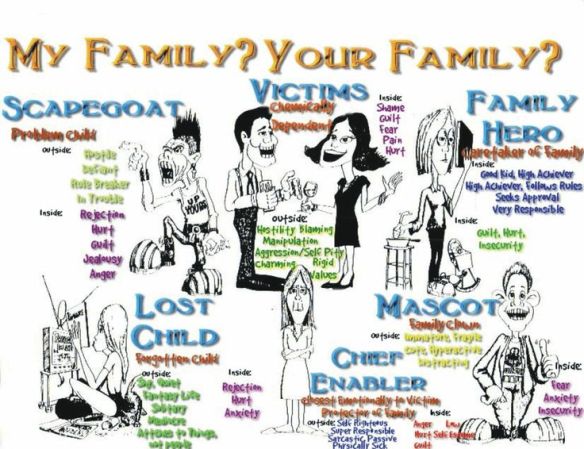
In the ACON community, there’s a lot of talk about Scapegoats and Golden Children, but there are other roles children can play in a family that are rarely addressed. In a two child family, most likely there will be a scapegoat and a golden child, but in larger families, there can also be a Lost Child, a Clown, and a Rescuer (codependent). It’s unhealthy for a child to be in any of these roles, but the Scapegoat and Golden Child role are probably the most dangerous to a child’s mental and emotional health, for different reasons. Even in a two-child family, the roles can shift back and forth (according to the Wikipedia article, families in which the children’s roles change and shift are called Balkanized families–this alludes to the constantly shifting loyalties and borders of the Balkan countries in Eastern Europe).

1. The Scapegoat.

scapegoat

Both this and the Golden Child role are the soul-killing roles, but for different reasons. The Scapegoat is the child who is targeted by the narcissistic (or alcoholic) parent. The parent often is able to get the rest of the family to serve as flying monkeys and gang up on that child, projecting anything they don’t want to “own” onto them. Like the sacrificial goats described in the Bible who were banished to the wilderness and tormented by villagers, the Scapegoated child carries all the shame the rest of the family doesn’t want to confront or deal with. All the unwanted emotions and bad qualities are unloaded and projected onto them, so the abusers don’t have to confront or deal with these problems in themselves.

Usually it’s the most sensitive child of the family who becomes the Scapegoat, because that child tends to be the Truth Teller, the only family member who can see the dysfunction and may even react against it. The most sensitive child, being the child who shows the most emotion, is also a threat to the narcissists in the family because emotional expression is such a frightening thing to them. In many, if not most dysfunctional families, the expression of emotion is not allowed. So the most emotional or sensitive child becomes the scapegoat, especially if they rebel against the dysfunction or criticize it.

The Scapegoat may be assigned the role of Bad Child, the Loser, the Stupid One, the Ugly One, the Crazy One, the Weak One, or any combination of these. No matter what they do, they cannot please the parents (or the siblings who have been turned against them). Scapegoat Children usually develop severe C-PTSD or possibly another mental disorder, and having been trained to be victims and never given the emotional, financial or other tools to succeed in life, tend to fulfill their families’ predictions of being “losers,” so then their families can say to others, “See? This child really is worthless.”

Scapegoated children also tend to attract other abusers throughout their lives and are at risk for being targeted for bullying even as adults and for entering into abusive relationships. If the adult child doesn’t go No Contact, the abuse continues, usually through some form of isolation, silent treatment, or exclusion. Scapegoated adults are talked badly about by the family and not invited to family functions. They are given no emotional or financial support, even though other members of the family are given these things. It’s not unusual for a scapegoated adult child to be living in poverty, even if their families are wealthy–not only because they were denied financial support when they needed it, but also because their self esteem took such a terrible beating that they have no confidence at all and never take any risks that could improve their lives. Severe C-PTSD can also cause a person to have an inability to focus or concentrate or set realistic goals.

A Scapegoat isn’t always a child. It can also be a parent, in which the children are turned against that parent by the abusive one.

2. The Golden Child.

girl with a gold medal and cups.

The Golden Child, often (but not always) the eldest child, is the parent’s trophy, pride and joy. The parents may seem to love that child, but being incapable of real love, their “love” is conditional and is based on their fantasy of what they want that child to be, not on who the child really is. The child is assigned to be a Mini Me of the narcissistic parent.

The Golden Child, basking in constant approval, showered with toys and gifts, never held accountable for any wrongdoing (which may be projected onto the Scapegoat), and often recruited as a co-abuser in the abuse of the Scapegoat, grows up entitled, grandiose, and spoiled. Because their Real Self has never been appropriately mirrored and their less than perfect traits are ignored or projected onto someone else, and because they were rewarded for playing a the role of the Perfect One, a Golden Child in a family is the most likely to develop NPD and become a clone of the abusive parent. In this way their souls are destroyed even more than the Scapegoat’s. To continue to be the parent’s favorite, they had to play a role which became internalized. This becomes their False Self. After awhile, they are no longer able to access their Real Self at all. Golden Children who have become narcissistic continue their entitled, bullying, manipulative, grandiose behavior into adulthood and are likely to head dysfunctional families themselves, continuing the cycle.

A non-Golden Child, even a Scapegoat, can become a narcissist too (usually the covert form of NPD), for self-protection, but Golden Children tend to develop the grandiose, malignant form of narcissism and as such, are the least likely to ever seek help for their disorder or admit they have become abusers themselves.

3. The Lost Child.

lostchild

In larger families (three or more children), one child is likely to be ignored and treated as if they don’t exist. This isn’t a form of silent treatment; it’s as if the parents don’t notice the child is there at all. The Lost Child isn’t victimized like the Scapegoat, but they aren’t spoiled either. They may or may not be recruited to assist in the abuse of the Scapegoat, but they won’t necessarily be punished if they don’t cooperate; they will simply be ignored. The Lost Child tends to be quiet and shy, and not make any waves. They are probably aware of the family dysfunction and may sympathize with the scapegoat (but don’t let anyone know this). As they grow older, they may crave attention or develop addictions, or they may remain shy and retiring throughout their lives. They tend to avoid confrontation and drama, and may become extremely introverted.

4. The Clown/Mascot.

classclown

The Clown/Mascot attempts to divert attention away from the family dysfunction (and also get attention for themselves) by making light of everything. Everything becomes a joke to them, and they even use their own families as sources for humor. Clowns can be disruptive in class as children, to get attention, but because of their ability to see the humor in things, they tend to be outgoing and develop a large circle of friends during adolescence and adulthood (even if they are never taken very seriously). Family Mascots are almost never scapegoated, because they entertain everyone and take the focus off the family problems.

David Sedaris, a writer and humorist, is a good example of this dynamic at play.  Several writers in the ACON community (and even outside that community) were outraged by Sedaris’ callous essay (“Now We Are Five,” which appeared in the New Yorker after his younger sister, Tiffany, committed suicide).   Tiffany was clearly the family scapegoat and had evidently gone No Contact with the rest of the family. At the time of her death, she was living in poverty and only had, as her father put it, “two lousy boxes” of belongings. I don’t know all the details, but it seems as if she was offered no support, either emotionally or financially, in spite of the family’s wealth and Sedaris’ success as a writer. She was probably mentally ill, but her mental illness may have been due to being the family reject.

In a candid interview Sedaris gave for Vice, he describes Tiffany and her relationship with the rest of the family. His words are very telling.

Even as a child I looked at my sister and wondered what that would be like, not to feel the warmth of my mother’s love. Tiffany didn’t. There was always a nervous quality about her, a tentativeness, a desperate urge to be in your good graces. While the rest of us had eyes in the front of our heads, she had eyes on the sides, like a rabbit or a deer, like prey, always on the lookout for danger. Even when there wasn’t any danger. You’d see her trembling and think, You want danger? I’ll give you some danger

It’s been suggested that David Sedaris is himself a narcissist (possibly the golden child) and that could certainly be true, but I also suspect he served a secondary role as the family Clown/Mascot. His callousness toward Tiffany in his famous essay (and grandiosity about how great the rest of the Sedaris family was–it’s very common for narcissists who were golden children to hold their dysfunctional families up as paragons of perfection) seemed to be drawn both from narcissism and from a need to hide his anger and pain behind a wall of humor. Here’s a link to his essay (it’s heartbreaking and may be triggering):

Now We Are Five

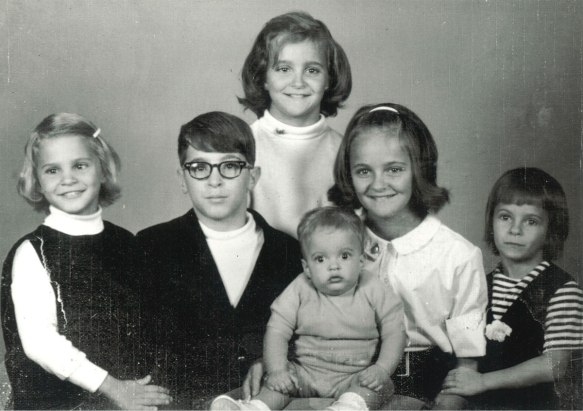
The accompanying photo is interesting. Tiffany, the second to youngest child in a family of six children, sits in the bottom right hand corner. Her hair is cut short and unkempt, and she looks very unhappy. David, wearing the glasses, stands above her. Actually, none of the kids look very happy. Not a smile in the bunch.  Something’s definitely not right about this family.  It’s common to see family portraits where no one is smiling in the 18th or 19th centuries,  but not in the late 1960s, when this photo was taken.   Here’s another photo, from the Vice interview, where only Tiffany (again in the bottom right hand spot) looks desperately unhappy and disconnected from her siblings.
tiffany_sedaris
Credit: Vice.com / Left to right: Amy, David, Gretchen, Paul, Lisa, and Tiffany

I used to enjoy Sedaris’ writings and looked forward to his books and essays, but after this essay, I just can’t read him anymore. (Augusten Burroughs is a better alternative and doesn’t seem to be a narcissist).

In spite of their raucous and jovial manner, Clowns are likely to be depressed because they have never learned to confront or deal with their true feelings.  They hide behind a wall of laughter.  Their sense of humor is really just a cover for their pain. Many Clowns become addicted to drugs or alcohol, and a few become suicidal. Many of our great comedians served the Clown role in their families. I don’t think it’s a coincidence that so many of them had drug issues or killed themselves.

5. The Rescuer.

superman_child

This is the codependent child who attempts to “fix” the family dysfunction by being obedient, always good, non-confrontational, overly generous, and self-sacrificing. The Rescuer may be highly empathic. The Rescuer tries to serve all the needs of the narcissistic/addicted parent, which of course is not possible. They will never argue with or criticize the narcissistic parent, and are always trying to get everyone to get along, which also is not possible. They may be the only family member who doesn’t abuse the Scapegoat, but they might if they feel like it’s required. However, even if they do collude in the Scapegoat’s abuse, they will be less abusive than the other family members, tending to take a back seat or even sympathize with the Scapegoat in private. In trying to please everyone, they please no one, and grow up feeling impotent and helpless. It’s a no-win situation.

When Rescuers become adults, they tend to unconsciously look for other abusers to “rescue,” having failed to do so in their families of origin. Like Scapegoats, Rescuers are likely to become abused themselves as adults, but it’s hard for them to leave an abuser because of their high level of empathy which keeps them tied to the abuser in their attempt to want to “help” them. They also tend to fall for an abuser’s promises to change and are easily “hoovered” back into a codependent relationship.

Shifting Roles.

In Balkanized families, the child roles can shift. The most common situation is a Golden Child becoming a Scapegoat, often upon reaching adulthood, if they fail to fulfill the unrealistic expectations put on them. (“You were such a disappointment to me!”) If a Scapegoat goes No Contact or leaves the family for some other reason, another child, possibly the Lost Child, becomes the new Scapegoat. Someone has to carry all the family shame.  If the family only has two children, the Golden Child may find themselves suddenly scapegoated or serving both roles.

Children who serve as both Scapegoats and Golden Children (very common in only children)  often develop Borderline Personality Disorder as well as severe C-PTSD and possibly other mental disorders like Dissociative Identity Disorder (almost always the result of severe emotional abuse).

Serving as both a Scapegoat and Golden Child is the ultimate mindf*ck because there isn’t even any consistency. The child never knows if they will be punished or rewarded from one minute to the next. Their only advantage (if they are an only child) is that they don’t have siblings who have been turned into flying monkeys who collude in the abuse.

If the family ever develops a need for a new Scapegoat (if the Scapegoat goes No Contact, dies, or disappears), the Lost Child is usually picked as a replacement, due to their non-confrontational, malleable temperament and lack of any real pre-existing role in the family.
My nostalgia obsession: standing in for my lost past.

memory_lane

I’m a nostalgia junkie.  I’m nostalgic about the ’60s, ’70s, ’80s, and ’90s.  I can’t decide what my favorite decade of those four is.  They were all pretty awesome in their own ways.   Hell, I think I’m even beginning to drum up a little nostalgia for the ’00s (what do we call that decade anyway?) even though it pretty much sucked (will it suck as much in 20 years when it seems a lot less recent?)   I’ve even been known to get nostalgic over decades I didn’t even live through–the ’20s, ’40s and ’50s come to mind.

I don’t know if some people are more prone to be drawn to nostalgia than others. Maybe it’s something that happens to you when you get older, but I know plenty of twentysomethings who are REALLY into the ’90s, which if they remember any of it at all, they only remember it from the viewpoint of a very young child.   Most twentysomethings were BORN in the ’90s, for heaven’s sake.   But compared to today?  The ’90s seem innocent, even quaint.   Maybe they’re pining for that last breath of societal innocence before all hell broke loose after 9/11 which coincided with the massive shipping of good jobs overseas while those here became increasingly uncaring about their workers.  Making things worse was the complete loss of any sense of privacy due to new technologies that made it possible for anyone who wished to spy on you or find out things about you you’d rather no one know.

Some cynics who look askance at those of us drawn to nostalgia think it means we’re depressed or unhappy and must always escape to the past to cope with present life.     I don’t think that’s true, and let’s be honest, the past WAS better than the present.   At least for those of us in our second half of life, in the past not only was everything better, WE were better, at least physically.  We were still young and attractive and healthy and the future seemed filled with endless possibilities.   The older you get, the more your options seem to narrow.  The more you find that age discrimination is a very real problem.

nostalgia_obsession

Time seems to speed up the older you get.   The gap between say, 1974 and 1994 seems like an eternity, while the same gap between 1996 and 2016 seems like a blip.   The strange thing is, even Millennials are saying time is speeding up for them too.   Like us oldsters, they also think of hardly any time passing since Y2K when it’s actually been 16 years.

One possibility is that things really haven’t changed that much since 2000–or 1996 for that matter–and that’s what makes it seem like time isn’t moving.   Or at least not the popular culture and the way people dress.  The outer trappings may have changed very little, but if you look deeper, there have been massive changes in technology and the overall way we live.   In 1996, the Internet was brand new, so new most people weren’t online yet.   Being online was nothing like being online today.   It was an entirely different experience, and a lot more exciting for being so new, even if what was available online was limited and not all that interesting.   In 1996, hardly anyone had a cell phone, no one sent texts, there were no GPS devices; Facebook, Twitter and all other social media we take for granted did not yet exist.  People still used Usenet and Telnet (DOS based) chat and gaming rooms.  You had to get off the Internet to use the house phone.

Connecting with my younger self.

old_swing

I think for me, my attraction to nostalgia is a way of attempting to connect to my past, so I can connect with my younger child-self.   Raised in a fractured, dysfunctional family that constantly moved, where nothing was permanent, where people shun and disown each other and don’t speak to each other for years, where family pictures–even entire photo albums and lovingly drawn child-portraits–are thrown away as if they’re nothing more than out of date newspaper circulars; where old toys, magazines, books, and records were callously given to The Salvation Army because it was just “clutter,” where the past had no meaning or sacredness, where reminiscing is haughtily dismissed as “wallowing.”

Unlike in normal families, where an adult child can often count on returning to their childhood room while visiting the home they were raised in, where their old toys and photos are lovingly kept stored away but can easily be retrieved for reminiscing, my past was as temporary as the homes we lived in, something to be forgotten and tossed out with the trash.    I might as well have been a foster child.

I have exactly 15 photos of myself as a child and teenager that I managed to salvage.  Right, just 15.  (I have a few more of me in my 20s).   At one time there were probably hundreds of pictures, since I remember my dad took pictures any opportunity he had, but neither of my parents have any idea what happened to them.   None of my toys, books, schoolwork, awards, or records were saved; what I didn’t take with me got given or thrown away.  A very large pastel portrait drawn of me at age 6 has somehow been “lost.”  Really?  I wonder about that.  How does a family “lose” such a large object that once meant so much that it hung over the mantel in the living room?

So, you see, my connections to my past are extremely sparse.  Besides those 15 photos and a few odds and ends (a newspaper article about me and a few other kids in a “silly hat contest” when I was about 6, a few letters from summer camp ’71 addressed to my parents, a mimeographed day camp newsletter in which I remember being so excited to be a “published author” because they published a single sentence I wrote about an arts and crafts project I had done; a single framed lithograph of my zodiac sign I’ve had since I was 12; and bizarrely, a sterling silver and mother of pearl baby rattle given to my mother by someone when I was born), I have nothing from my distant past, no tangible reminders of my early years.   I’ve noticed since I’ve been in therapy having more desire to have these long-lost things, I think because having these visual reminders would help me remember key events and bring them into the present for me so they can be worked on.  Maybe that’s another way my family sabotaged me–by making my journey to wellness more difficult by eradicating anything I could connect to my past.

I often look at nostalgia sites, reading about music, fashion, news events, old ads, and popular culture from when I was young or younger.   Lately, I’ve been doing it more frequently than I ever have.    I don’t think it’s really because things today are so much worse or because I’m getting old; I think my fascination is my attempt to find an alternative route to connect with myself at an earlier age. In leiu of being able to do this through personal mementos and old family photos, I have to resort to public nostalgia sites and old TV and music videos.   It’s still lots of fun though, even if the presence of useful triggers that could be used in my therapy are missing.

New post on my Facebook wall.

If you are a member of my family who happens to read my blog, I am not going to apologize for anything I have said regarding certain family members (you know who you are). I feel perfectly justified in saying what I do, because it’s the truth.  I am sorry if anything I have said hurts anyone’s feelings, but there have been grave injustices done to me by certain family members that deserve to be called out.   Yes, I know…the truth hurts.  I do not use anyone’s real names, so if it bothers you it’s your own guilty conscience. If you don’t like what I have to say then don’t read my blog. No one held a gun to your head telling you to. So if you don’t want to get burned, keep your hands off the stove. It’s my blog and I say whatever I please because doing so helps ME. I need to take care of ME now and stop worrying about what certain members of the family think of me. My blog is a wonderful adjunct to therapy, which I have been in for a year now. I will carry these wounds for the rest of my life but I am getting better. I’m finally realizing I’m a valuable, worthwhile person with a LOT to offer the world and to others. A lot of wonderful people do value me and like what I have to say, even if they’re not the people who should have loved me unconditionally without judgment and derision. I write my blog because it helps ME. So it you don’t like it, I suggest you don’t read it.

Oh, one more thing. If I am disinherited (as I suspect I am), I have plans to write a book a la Christina Crawford. That’s not a threat, it’s a promise. The chickens WILL come home to roost. Justice WILL be done. There will be no more forgiveness. If I write that book, it’s going to be successful and I will be successful after all (no longer the impoverished loser you all think I am), but it will be at your expense! How’s THAT for poetic justice?

One thing this whole sorry mess surrounding my dad’s death has done is give me COURAGE to stop hiding the truth about my awful family. So there is a hidden blessing.

A dicey situation.

dicey_situation_by_johnnycorduroy
“Dicey Situation” by Johnny Corduroy, Deviantart

I always hesitate before posting anything about my N mother, because I know she reads this blog. But then I think about two things: 1. what can she do? and 2. no one ever asked her to read this blog. It’s mine. If you don’t want to get burned, keep your hands off the stove. So here goes.

Yesterday when I talked to my mother about my dad, she said she wants to come visit me in the fall. She cannot afford a hotel room, and I can’t afford to put her up in one. She pretty much invited herself, saying, “Well, I will have to stay at your place.” Immediately I felt my self-protective shackles kick in: Danger! Danger! Boundary violation!

In most families, letting your mom stay with you fore a few days wouldn’t be a problem. But my family isn’t most families.  My mother is very judgmental of me and my lifestyle, which, although I’m satisfied with it, is less than glamorous and I know she would not/does not approve of the way I live (which really isn’t my fault anyway because I don’t have the financial resources to live better).  Even if she says nothing about my mismatched furniture, the sagging, stained couch, the buggy old-fashioned kitchen with its tiny 1970s electric stove, an old summer camp steamer trunk used as a coffee table, the box TV in the living room, the ancient windows that don’t open, and the black mold on one side of the house (which my landlord has yet to do something about), I know she will go back to her extended family and tongues will wag. I know she has devalued me to the rest of the family and puts me down, disapproving of the way I live. She cloaks these criticisms with “concern,” saying things like, “I just don’t know why Lauren always makes such bad choices,” or “it’s so sad the way she lives but she made her own bed.”  Or she talks about how mentally unstable or immature I am. Even though my mother is far from wealthy and even borders on as poor as I am, she has always put on airs of being of a higher social status than she actually is, and to be fair, she does a good job of it. Even if I was of a social class she approved of, our tastes and interests are vastly different. I’m far too “bohemian” for her liking and I’m pretty sure I still would be even if I was rich.

I also know she wouldn’t approve of my housemate, and they would get in each other’s way. The idea of the three of us having to share a roof, even for a few days, gives me the willies.   I wouldn’t be able to tolerate feeling like I have to apologize for the things I do while she is here.   If I tell her no, she can’t come, I know she will go back to the extended family and tell them I’m “hiding something.” She seems to think I still have my ex living with me and am saying nothing about it. This is of course ridiculous, but I know it’s what she’ll tell everyone. She can’t understand why I wouldn’t be thrilled to put her up on my couch for several days and I don’t have the courage to be honest with her. The fact she reads this blog and knows I’ve pegged her as a narcissist (even though I don’t think she is malignant, she is a textbook example of a woman with intractable NPD) doesn’t seem to faze her in the slightest. Being the narcissist she is, she simply is incapable of understanding why I wouldn’t be jumping for joy for the “opportunity” of putting her up on my couch for a few days.

I had no time to prepare for this, so I said weakly, “well, you will have to sleep on the couch then, because my roommate has the other room.” She responded with, “oh, you have a roommate?” As if this is some life choice of mine and isn’t a matter of financial necessity.  It’s also interesting to me that I have never been invited to see her where she lives.  The one time I suggested going to visit her there, she told me my half sister didn’t want me there (they share a townhouse).   I think she was lying, because my half sister barely knows me.  I haven’t seen her since 1986.   I think it’s actually my mother who doesn’t want me to come there, because I would “embarrass” her in front of the family, so she put words in my sister’s mouth.    Even if my sister doesn’t want me there, it was probably my mother who turned her against me.

I’m in a dicey situation, and I’m praying she changes her mind about coming. Just in case she isn’t, I guess I’ll have to start saving enough money between now and then to put her up in a local motel, which I should be able to do given the time frame. Then all I need to do is think of some reason why she can’t stay at my house (repairs? haven’t cleaned it?) She would like a motel better anyway with its pool, sterile rooms, flat screen TV, and a real bed. The fall is still a few months away but it will be hard for me to save the money because I’m trying to save enough money to go see my son in Florida in September. I think she might know this too, but she doesn’t care.

I think my brain just exploded.

This is just all kinds of wrong. A mother KNITTED a replica of her golden child son, because he doesn’t want to cuddle with her anymore (he’s a teenager). The replica requires a human wearer to bring it to “life” though. The mother’s younger son (who I bet is the scapegoat) has the “honor” of wearing the replica and pretending he’s the older son.

http://americanoverlook.com/when-her-teenage-son-didnt-want-to-cuddle-with-her-anymore-she-did-this-i-cant-stop-laughing/79203

Scroll to the bottom of the article to view the video.