Am I that annoying or am I just paranoid?

paranoidmind

There are days I feel like I have to apologize for my existence. Today was one of those days.

The woman I was teamed up with today to clean houses is someone I’m used to working with. We don’t have a whole lot in common, but normally we get along well enough and we work well together. I know what to expect and she doesn’t have to check my work because she knows I know what I’m doing.

She usually drives (because my car is very old and is starting to have transmission problems, which I refuse to worry about right now) which is fine by me, but that also means I’m forced to listen to the music she wants to listen to, which means Christian contemporary music all day, whenever we work together. The music isn’t so bad really, but it can get annoying after a while, when every song played starts to feel like a sermon. Give me some Nirvana, give me some U2, Rolling Stones, or Jimi; hell, even Lady Gaga will do. Or play some damned country. But it ain’t gonna happen, not with her.

Now that it’s the Overhyped Season of Greed and False Cheer again, she’s switched over to one of the pop stations, which plays Christmas music 24/7, starting the day after Thanksgiving. Bleccchhh. While there are a few carols I have nostalgic childhood memories of, as a whole I can’t stand Christmas music. If I hear “Jingle Bell Rock” one more time, I think I’m going to put my head through the dashboard. Especially because she SINGS ALONG to it. That, along with “Little Drummer Boy” are my two least favorite Christmas songs EVER, but for some reason I can’t possibly begin to fathom, they play those two ALL THE TIME. It’s pure torment. Shoot me please.

makeitstop

So anyway, we get along alright even though we’re never going to be Thelma and Louise together. But today I thought I was getting on her nerves. I have no idea what I did or said, but she wasn’t speaking to me and snapped my head off if I asked her the most innocuous question or even said anything at all. After several hours of this treatment (and being silent right back), I finally couldn’t take it anymore. I had a little hissy fit.

“You haven’t spoken to me all day,” I fired at her. “It’s obvious you’re mad about something. I have no idea what I said to make you act so angry, but whatever it was, I’m sorry.”
I was apologizing for nothing at all really, because as far as I knew, I hadn’t done or said anything wrong, but I just wanted this to be over with. I hate it when people are angry with me, I hate it when I just imagine they are angry with me. Because as an Aspie, I can’t tell the difference.

Still she said nothing. She just harrumphed and kept on working as if I wasn’t there.
I didn’t say another word about it, because I sensed that would annoy her more, but I still felt sulky and wounded so back in the car, I pretended to sleep.
After another hour or so, my work partner suddenly became friendly again. She said she was tired. So that’s all it was, I guess. Another day ruined by my stupid paranoia and hypervigilance.
everyonehatesme

WELL, WHY COULDN’T SHE JUST HAVE SAID SO BEFORE? She KNOWS about my disorder, she KNOWS I can’t read social cues, and she could have at least TOLD me she was tired this morning. That would have prevented hours of interpersonal tension, and my stupid paranoia and babyish hissy fit over nothing could have been avoided. But that’s not how she is.

This sort of thing happens to me so often. If people don’t think I’m stupid, they think I’m annoying. Sometimes they think I’m both. Or at least that’s what I think they think. They probably don’t think that nearly as often as I think they do. But I worry about it.

I have a related problem right now that’s probably just my hypervigilance but I’m not sure, and that uncertainty is what’s driving me crazy.

I have a friend in the narcissistic abuse community, a woman I seem to have a lot in common with. Our backgrounds are so similar it’s downright scary. We started e-mailing each other, but she never replied back to the last email I sent her, which was quite long. It’s been four days and every time I check my inbox, there’s nothing new there from her. After two days of no reply, I sent a friendly reminder asking simply if she got my email. I didn’t want to appear too concerned, but I was.

Another day passed. I emailed her again, asking if she was getting my emails. Maybe they’re going in her spam folder. But that little disapproving, judging voice that lives inside my head and I wish would go away was saying, no, no! It must have been something you said in your last email, something that made her not want to be your friend anymore.

I went back and analyzed my email, trying to pinpoint what it was I must have said to make her avoid me. It could have been anything. Or nothing. I’ve been ruminating over it and worrying myself almost sick over it. Again, why do I care so much? It’s not like I don’t have other friends in this community, other people who read my blog and like what I have to say.

There is probably a perfectly reasonable answer for her silence–maybe she’s been busy, maybe she’s been sick (she does have health issues), maybe she can’t access her email, maybe she’s just lazy about replying to emails (like I can sometimes be). But of course, it’s never the reasonable, mundane, logical explanation I look for; it’s always something terrible and dire, it’s always because of something I did to upset them and make them hate me. It’s always because I’m such an annoying person they want nothing to do with me. My hypervigilance and paranoia is crazymaking and even…well, narcissistic. Why do I torment myself like this? It’s stupid.

nomail

A few people (almost always neurotypicals who don’t get me) have actually told me I’m annoying. No doubt my annoyingness is due to my tendency to interject comments at inappropriate times during my rare pathetic attempts to appear “normal” in social settings–or making some other embarrassing social gaffe due to my high-functioning autism.

I analyze and brood about people’s reactions to me way, WAY too much. I’m hypervigilant and paranoid. Maybe I’m not really coming off as annoying and stupid to others as I believe others think I am. I am my own worst enemy sometimes.

I care too much about what people are thinking about me. But why does it even matter? Are these people I want to be best friends with? Do I really want to attend a backyard barbeque at their McMansion with a bunch of their friends and relatives I have nothing in common with except the fact we’re all of the human species? Would I pay any of these people $100 apiece to like me? NO, I WOULD NOT. So why do I CARE so much what others are thinking about me? Why do I care if they think I’m annoying? Or stupid? Or weird? Or fat? Or ugly? Why do I want to be approved of? AM I A FUCKING NARCISSIST?

Probably not, but I was raised by a family of N’s and as the scapegoat, I WAS NEVER GOOD ENOUGH FOR THEM. I questioned myself and everything I did; it seemed I could do nothing right. I felt awkward and defective even in my own family. My parents were bullies, especially my mother. Later I was bullied at school too, especially in the 3rd – 5th grades. I remember during 4th grade, I was followed home every day by a group of kids who laughed and jeered at the way I walked and imitated my walk, as my tears welled and threatened to overflow (no wonder I hate mimes). The bullies would call out to me and sometimes even throw things to get my attention, but I wouldn’t turn around. I just kept on walking. I knew I couldn’t let them see me cry because that would make everything so much worse.

My third grade teacher, Mrs. Morse, was a psychopath with arms like Jello who always wore sleeveless dresses, so whenever she wrote on the board, all that quivering, pale freckled flab hanging from her bare arm made me want to throw up, but I still couldn’t take my eyes off it. It was mesmerizing in a horrible way, like a car accident.

Mrs. Morse knew how sensitive and scared of everything I was. She knew I was bullied by most of the other kids. But she had no empathy for my plight. She was a sadistic bitch from hell. She deliberately called on me whenever I was daydreaming, which was often (no kids got diagnosed with Aspergers back in those days) and always made me stand in the front of the room and answer a question or solve a math problem. She never did this to the other kids, who were allowed to answer from their seat.

meanteacher

One time I couldn’t solve the math problem on the board (which was my worst subject), and she berated and belittled me in front of the class.
“You never pay attention. You’re always daydreaming. Do you have a mental problem?”
The class laughed.
My tongue was in knots and I felt the blood drain from my face. I felt tears burning the backs of my eyelids like acid.
I swallowed hard and tried with all my might not to let a tear loose but they started to flow anyway. I hung my head in shame and rubbed away the tears with my grubby fists as I turned away toward the wall. My narrow back and bony shoulders heaved with silent sobs.
That was exactly the moment this sadistic malignant narcissist who passed for a teacher was waiting for.
“Look everyone! Lauren is crying! Look at the tears! Cry, cry, cry, baby.”
The class burst into screams and hoots of laughter.
“Cry, baby, cry!”
I stood there in front of the class, staring at the floor, snot mingling with my tears, and longed to melt into those scuffed green-gray linoleum tiles, and never return.
In today’s anti-bullying environment, this “teacher” would have been fired for that shit. She might have even lost her teaching license. That kind of thing isn’t put up with anymore.

Not too many years after this, I stopped being able to cry. I stopped being able to talk to people. I stopped being able to feel much of anything.

I still worry that people won’t like me, even though I’ve learned to hide my sensitivity pretty well. Too well, in fact. It’s hard for me to show my true feelings, but lately I’ve been opening up, getting better at it. I need to start feeling confident enough in myself, that other people’s opinions of me won’t make or break my day.

dontlikeme

Take your office Christmas party and shove it.

officeparty
Get out of my face with your absurd fake smiles and stupid Santa hats.

So tomorrow night is the annual office Christmas party. I will not be attending. It’s not like I have some high level job where my presence is expected or necessary anyway. I doubt anyone will even notice my absence or care.

As an Aspie, I have never been able to tolerate the forced upbeat perkiness and all the small talk and chit chat about nothing in particular that abounds at these events. Too much social input coming in from all directions overwhelms my oddly wired brain, causing it to short circuit. I wind up in a state of near panic and to compensate, I become mute to avoid reading a social cue wrong and say something out of context that causes people to look at each other knowingly and roll their eyes at my social ineptness.

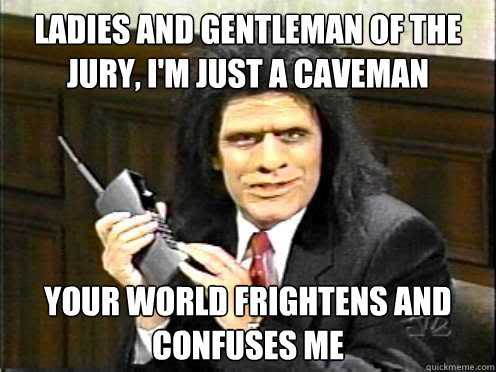
I feel like the old Saturday Night Live character Unfrozen Caveman Lawyer, whose mantra was “your world frightens and confuses me.” The world of neurotypicals, a world of people who love to socialize in groups, attend parties and engage in small talk, has that effect on me.

yourworld

Whenever I’ve attended one of these things, I leave as exhausted as if I just spent the day digging holes in dry packed mud. Because I’m nearly silent at these events, people don’t even attempt to talk to me. More often that not, I wind up sitting there at the table alone, picking at my plate of stuffed mushrooms and baby carrots, feeling as self conscious and awkward as the school geek in a roomful of popular kids, because I can find no one to talk to and apparently no one really wants to talk to me either.

Small talk is utterly boring to me. Aspies tend to like “deep” talk, but I learned that serious, in depth conversations about things that matter is verboten at parties, especially office parties, where you are forced to spend an evening acting like people you probably wouldn’t give the time of day to if you didn’t have to work with them are your best friends. It’s all so fake and stupid to me.

I don’t get jokes a lot of the time, especially if they’re inside jokes that, because I don’t have close friends at work and am not part of a clique, I haven’t been filled in on the background that makes these jokes funny to others. It’s hard to laugh at a joke you don’t get. But you must laugh anyway so people don’t think you’re cold and unfriendly or worse, didn’t get the joke, which implies stupidity. But telling jokes is de rigeur for office Christmas parties.

The other thing that drives me crazy is everyone talking about their upcoming holiday plans. Most neurotypicals have lots of friends and love to talk about the gifts they are buying and the parties and other events they will be attending with those friends. Most people also have loving families and nearby relatives and all the talk about what toys they are buying little Isabella and Caleb at Sam’s Club makes me want to stick hot pins in my eyes. Being a person with hardly any money to buy gifts for anyone in a world that seems full of people who are living in two income households and have disposable income to throw around drives me mad too.

The only way I could cope with this type of an event would be if I had a few drinks ahead of time, but that wouldn’t be worth it either and besides, I’d still have to drive. I don’t really need a DWI on top of all the other shit I’m dealing with.

I’m no Scrooge, but you can keep your office Christmas party. I have better things to do, like socialize with my cats who don’t give a damn how awkward I am, or write more blogs posts.

People treat me like I’m stupid

stupid

I wonder if it’s common for people with Aspergers or high functioning autism to come across to others as lacking basic intelligence.

I get that from people all the time and I hate it. In social situations, such as at work, where I have to interact with neurotypicals (NTs) who I don’t know too well, I’ve noticed people patronize me, they repeat things to me as if I didn’t understand them the first time, or just respond to me in a condescending way, as if they’re talking to a two year old. I am paranoid but I don’t think it’s my paranoia because they don’t act that way to everyone

I think people’s behavior toward me is because as an Aspie, it’s so difficult for me to process the things people tell me in a normal way, especially when I’m forced to deal with people in a group setting. I am also almost silent due to my shyness and unwillingness to get involved in social conversation. That probably makes me seem a little dim too.

I don’t hear that well either (I have only 20% hearing in my left ear due to having severe ear infections as a child), so that makes it even harder for me to understand what people say. I often have to ask them to repeat what they just said, which irritates both me and others. I’ve told people I have bad hearing, because being asked to repeat something annoys people less if they know there is something wrong with my hearing.

I find social chatter and small talk overwhelming and it’s not fun for me at all. It’s a lot of work for me to process all that. Of course there are some people who just intimidate me anyway (probably narcs) and I totally clam up around them and act really stupid and inappropriate when I’m forced to talk to them or ask them a question. Socializing is just so difficult! NT’s love it. I don’t.

It makes me so angry that I’m treated as if I’m a mental lightweight by people who know very little about me. I so want to say this to people who talk down to me or ask me the infuriating, “Did you get that?” :

“Look, you don’t have to act so condescending toward me. I’m not an idiot. I understand what you say. I understand a lot. I may look stupid to you because I have Aspergers, and that makes it almost impossible for me to process verbal communication and body language very well or deal with people in a group, or know how to act when you’re yammering at me. I also have Avoidant Personality Disorder, which exacerbates my discomfort in social situations. I get very anxious. But I want you to know I’m actually very smart, probably smarter than you. My IQ is above 150 but I know you probably think I’m lying. If you could see the way I write, you would be shocked at how intelligent and insightful I am. I see a lot of what goes on, I notice everything, I know a lot about a lot of things. I just don’t know how to communicate that well except in writing, or react appropriately when you tell me something. So please stop thinking I’m borderline retarded, because I am not.”

Of course I’ll never say this. But I wish I could!

Having Aspergers and Avoidant personality disorder combined with only partial hearing really is a handicap to dealing with the NT (neurotypical) world.

People who love me and know me well, and people who read what I write know I am not stupid.

Besides, Einstein had Aspergers too, and all his teachers thought he was retarded! 😀

I still won’t blog about my secret, but…

emptybook

I did tell one person, a very good friend of mine–another blogger in the psychopathic/narcissistic abuse community, the exact nature of my secret. My confession was satisfactory enough to ease the itch I had to blog about it. She advised me not to, for basically the same reasons I had for not doing so.

We Aspies sometimes don’t say things even when we should. We know how awkward we seem to others and feel like it’s better to stay silent than sound like idiots, especially in the real, flesh and blood world of face to face communication.

Other times we say too much, especially on the Internet, a place where Aspies and INFJs and INTJs like myself abound (I’m either one of those depending which Myers-Briggs test I take), because we feel more comfortable socializing behind the anonymity of a computer and like the fact we can edit what we say before we say it. But there are times we Aspies still can get carried away with our candor and our filter goes on a Caribbean vacation. We just don’t know when to STFU. And we can find ourselves in a world of trouble because of that failure to censor our real feelings.

Back in 2008 and 2009, I was an active member of a certain entertainment related forum. At first I was a respected and popular member and then my virtual mouth developed a bad case of diarrhea. I had developed a crush on a person on the forum and was way too honest about it. Inevitably, a group of bullies and trolls on the forum smelled blood. They decided to use me for target practice, and soon even regular members started to join in. I was openly mocked and even started having problems with the forum administrator. I was nearly banned but wound up leaving of my own accord because posting there was no longer fun. My username became a pejorative, and to my horror, when I Googled my username, I discovered I was being quoted and mocked on two different but related sites, and their members were having a field day making fun of everything I said. I was mortified. It was as bad as being the school pariah all the bullies went after. It didn’t matter that I was essentially still an anonymous person on the Internet and no one knew my real name–I hadn’t felt that shamed or embarrassed since my days as the school dartboard.

The secret I have is actually not what it appeared to be at first. Now I understand the real reasons for it, and to my relief they are normal, healthy ones. It was really a springboard to something else. Strange things happen when you begin to journal publicly about something so personal as narcissistic abuse. One important side effect of blogging was I developed a closer relationship with God, who I rely on now to guide me in all my decisions, including what I blog about. I have prayed about this thing, this secret–and God is providing me with answers–including one I never expected.

An idea is beginning to form in my mind, an huge idea that could totally change my life and maybe the lives of others as well if I play things smart. Or it could lead to nothing other than an interesting venture into unknown territory. Doing this thing requires self-discipline, hard work, passion, and dedication. I’ve never stuck with anything before. I’d become intensely interested in something, and then drop it when it became too hard or frustrating, or when my interest in it burned itself out. That’s one of the reasons I’m still floundering through life like a teenager even though I’m over 50.

That’s all changing. I’ve stuck with blogging now for three months and show no signs of stopping. I’m passionate about blogging. It’s my new drug of choice. Because it’s become so much more than just a way to journal publicly about my experiences with narcissism. Watching my blog do so well and watching it grow and knowing it’s helping others besides just me is raising my self esteem so I no longer hear my N mother’s accusation of “loser” or “you can’t succeed” bouncing like a poisoned ping pong ball inside my brain anytime I tried something new. My entire viewpoint on life is different. I feel like I can do things, accomplish something important, and even help others while I make myself happy. Hey, I might not even have to remain poor and underemployed the rest of my life, something I had actually become resigned to. For years I’ve taken it for granted that I would die in great pain, alone and destitute, and no one would care.

There’s a certain topic related to narcissism I desperately want to write a book about. After I wrote my “Secrets” post, after a few days this book idea began to form. I tossed the idea around in my head for a few days and am waiting for some further information before I start, but even if I don’t get the information I’ve requested, I still want to write the book. It will make it harder but I can still do it. I feel like it’s something I must do, but not only that, I’m convinced it’s also what God wants me to do. I have no idea what his reasons would be for my writing this book, but then again, God doesn’t usually explain his reasons. It isn’t until later on that we find ourselves surprised to be in places we never dreamed we’d be in our wildest fantasies.

I have a good feeling about this. Not an unrealistic, grandiose fantasy that never sees the light of day because you either don’t have a real passion for it or have no practical plan to carry it out–this time it’s a real plan that I know I can fairly easily turn into reality. I think I can stick with it this time too, because it’s where God has been trying to lead me my entire life–but I couldn’t hear him because of all the noise inside my head.

The last time I wrote a book–a novel–I made the mistake of letting my MN mother read it. She hated it, so it went in a box in the back of my closet and I didn’t write another thing (except forum posts) until I started this blog. Recently I pulled the manuscript out of its box and read parts of it. It really was cringe-worthy, but in 2003 I was coming from a very unhealthy mental space and besides, fiction writing isn’t really my thing, so.

I know this post doesn’t make much sense, because I’m trying to write about something obliquely and it’s hard to be clear when you’re being oblique.

But the important thing is I have decided to use the writing ability God gave me and use it to write a book about something I’m deeply interested in. I still have self doubt, a lot of it, but I won’t let anyone or anything let me give this up.

PS: my laptop was acting weird while I wrote this, and I just realized I typed the whole thing in airplane mode. 😀

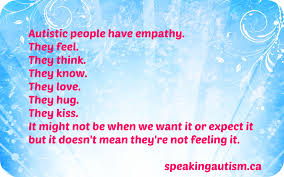
People with autism do not lack empathy!

autism

Autism and narcissism have a few things in common: First, they are both spectrum disorders. With autism, the spectrum runs from mild (Aspergers, colloquially known as “geek syndrome”) to full blown autism so severe the patient seems retarded and cannot even perform the most basic self-care or live without full time supervision. With narcissism, the spectrum runs from “benign” narcissism (people who are self-centered and vain but not completely lacking empathy or a conscience and don’t deliberately want to hurt anyone) to full blown malignant narcissism/psychopathy (which are basically one and the same).

Second, they are both at least partially (in the case of autism, probably totally) due to a miswiring or malfunction in the brain. One can be born without the ability to love or feel empathy (though abusive parenting does seem to exacerbate an inborn tendency), and almost all persons with autism were born with it (although there does appear to be a suspicious correlation between Aspies and narcissistic mothers, which probably exacerbates the Aspergers symptoms).

In one important way, autism and narcissism are mirror-images of each other. Narcissists cannot feel empathy for others, but can fake empathy quite well if they wish to. They can be very good actors. People with Aspergers (or mild autism) have the opposite problem. They can feel the emotions of others around them (very keenly in fact) but due to their inability to read social cues and difficulty acting “appropriately” in social situations, they can seem unempathic because they can’t express their emotions well.

Due to their difficulty showing empathy (people with Aspergers can seem aloof, cold or just awkward) it’s become popular to believe that people with Aspergers or autism, just like narcissists, do not have empathy. M. Scott Peck’s book “People of the Lie” is one of the best books I’ve ever read about malignant narcissism (it wasn’t called that when the book was first written in the early ’80s), but there was one thing that really bothered me: Dr. Peck used the term “autism” a number of times to describe the psychopath’s inability to feel empathy.

Nothing could be further from the truth. Here is an excellent article that makes mincemeat of this popular notion. If anything, people with mild autism/Aspergers empathize too much. I would even go out on a limb and say most of them are also Highly Sensitive People (HSPs). HSPs worry excessively about the impression they are making on others and whether or not they’ll be liked–and that sort of anxiousness itself can be socially disabling, even if no autism is present.

My stupid hypervigilance again.

paranoia

On Thanksgiving, I wrote about the lovely dinner my roommate and I had at my daughter Molly’s boyfriend’s home (which is where she’s living now when she’s out of jail). It’s a pretty big place–an older home, probably built in the ’60s, 2 stories, with a spiral staircase, large open rooms, a living room lined with floor to ceiling windows that face a view of the mountains, and two large decks. It’s really beautiful. My daughter really lucked out.

I also was surprised how intelligent and nice Paul is. We talked a lot, about many things, and he admitted he loved Molly. It’s obvious to me he’s the first boyfriend she’s ever had who really cares about HER, and isn’t just using her. I think this relationship can be great for her, and she’s happy with him too. So what that he’s 38 years old? He’s mature and has a good job and income, wants her to resume her education, and if things work out, they can have a good life together. Hell, I’d much rather her date a 38 year old who has all his shit together than some 22 year old do-nothing meth-head with no goals or prospects living in his parents’ basement or crashing on a friend’s couch because he can’t even keep a job as a gas station attendant. Which is the type of loser she dated before. She actually didn’t think she deserved any better, but she’s finally realizing she deserves so much more.

Meanwhile her MN father, Michael, has been living at the Salvation Army and hasn’t learned jack shit or changed one iota. He’s the same whiney, entitled, obnoxious, demanding, parasitic, gaslighting, narcissistic jerk that he was when he leeched off me for seven years after our divorce. He nearly sucked me dry, financially, mentally, emotionally, and every other way you can think of. Until February this year I didn’t have the guts yet to tell him to get a life and get the hell out of my house.

I understand why Molly feels bad for him (after all, he’s her dad and she loves him), but she shouldn’t feel guilty about his unfortunate circumstances. He’s done it to himself. And yet, he has made her feel like she’s responsible for his well-being. From the time she was 12, he was treating her like his personal therapist and drug buddy, and attempting to use her to triangulate against me. His actions, among all the other obnoxious and evil things he did, damaged her psyche badly. I still can’t quite determine if she has low-spectrum NPD or severe BPD, but she definitely suffers from both bipolar disorder and PTSD.

But she’s getting better. Things have come to a head these past few months, between her squandering her trust fund, her car accident, and now having to serve time in jail for 30 days (she will be out the day before Christmas). She’s learning some hard lessons about consequences.

So what do her N father and her new apparently mentally healthy boyfriend have to do with each other? Well, Michael is moving in with Paul. Paul’s house is large enough that he will have his own floor, and Paul and Molly will be on the downstairs level. This worries me. Michael always seems to luck out. Narcissists usually do. I’m not envious of him (and am sort of glad he’s no longer homeless because I’m not a total heartless bitch), but this development worries me for two reasons:

1. He has an uncanny ability to turn people against me, even people who have been my friends. I know he trashes my character behind my back, projecting his own character flaws onto me, making ME out to be the narcisistic abuser. If he’s living in the house with them, in my dark fantasies I can imagine him turning Molly against me again, and Paul too. I hate the idea of the only family I have in this state turning against me due to my malignant narcissist ex husband who is living with them.

2. When Molly is around him, he has proven to be a bad influence on her. It’s true he has no car and no way to get around or drive her anywhere this time, but in the past he has been involved in buying drugs with her. Paul doesn’t do drugs so there’s probably nothing to worry about. But Michael’s influence is still a negative one, and his constant presence will push Molly’s buttons in ways that will make it more difficult for her to become independent of his malignant influence.

paranoia2

Probably nothing will happen though. Paul’s doing him a favor and he is paying rent (out of his disability). The intention is not for him to stay (but getting rid of him is easier said than done, I should know!) Molly is okay with this arrangement. Michael has his own floor, and will probably stay busy ranting on political forums like Huffington Post and trolling on conservative websites. The rest of the time he’ll be watching the news or blasting his awful music. It’s more likely someone like Paul may tire of his presence and after a while want him out. It’s also possible Michael may just stay to himself and not bother them much.

As a person with Aspergers and an ACON (and one who was bullied both at home and by my peers during most of my childhood), I’m terribly jumpy and hypervigilant, always expecting the worst, never seeing the cup as half full, always expecting everyone will hate me, and worrying myself into a hair-pulling, twitching frenzy over the the most innocuous things. Every day I worry I will hear bad news, that one of my kids will die, that I’ll find out people are saying bad things about me, or even plotting against me.

I could be on the most beautiful, serene beach in the world, and instead of enjoying the sand and sun, I’ll fret about getting skin cancer even though I’m wearing SPF 4587 sunblock on every inch of my body. I could be in a room filled with people I love, and only be able to think about the one person who didn’t say hello and let that ruin my day. That’s where my head is at. The world seems so dangerous and hostile. I’m extremely paranoid. I find it very hard to relax and just enjoy things.

I know I must not worry and try to let this thing go. I think Paul is too smart to allow Michael to convince him I’m a narcissistic bitch even if he trash talks me 24/7, which he will probably do (or maybe not). Paul already knows me and Molly has told him good things about me. Besides, I already warned Paul that Michael will probably tell him all sorts of horrible stories about what a terrible wife and mother I was. Paul laughed and assured me if that happens he will tell him to stop talking that way, because he doesn’t want to get involved in our family drama and wasn’t a witness to it. So I guess I just need to stop worrying and being so hypervigilant and paranoid.

Let go and let God is good advice. I need to get in the habit of trusting my friend God more. Everything will work out. It always does, somehow.

My day in Aspie hell

workweek

Aspies sometimes have problems getting ahead in life. We may be intelligent and creative, but because we don’t really play well with others and are easily stressed and overwhelmed by social situations on the job and most of us aren’t good at schmoozing with higher-ups and playing the political games that are required to move up in an organization, many of us overlooked for promotions or just treated badly, as if we are mentally deficient. Many Aspies are underemployed, especially those of us who have an exceedingly low self image due to having been badly damaged by our psychopaths. If we were cursed with psychopathic parents, we were never given the tools other children were blessed with to succeed in life. Someone with Aspergers entering the workforce without life skills and survival tools is severely handicapped. It seems like some sort of cosmic joke that Aspies and malignant narcissists seem to be thrown together so often. It happens often enough that there has to be something more there than sheer coincidence, but I’ll save that thought for another time.

I read a study recently (I will find the link later) that found that people who are quiet and don’t talk very much are seen as less intelligent than gregarious, outgoing people. Many people with Aspergers are painfully shy and don’t make small talk easily. When forced to socialize, our attempts can be awkward and sound stilted or just weird. Unfortunately that probably makes us seem kind of slow. Socializing and engaging in small talk are extremely draining for someone with Aspergers, because it’s hard work. It just doesn’t come naturally.

In a way Aspies are like narcissists in that we have to “rehearse” how to act. The difference is a matter of conscience and emotion. The narcissist has no problem assessing a social situation and the appropriate way to behave, but for them it’s all cognitive. They are chameleons. When it comes to empathy and emotion, however, they are at a total loss. Since they can’t feel anything, they have to first decide which emotion is appropriate and then “act” like they feel that emotion. Aspies have the opposite problem. We can feel empathy and compassion, but have trouble expressing it. We are not good at putting on masks. We might seem cold and aloof but we are not. That’s why so many of us prefer solitude, where we don’t have to be “on” all the time.

Currently I work part time in a company where we are sent out in teams (or sometimes alone) to clean houses. It is a low level, grueling job, but I chose this over other service jobs because it seemed to require less social interaction than most of the others. I could just go to a house, clean it, and leave. I wouldn’t have to deal with customers in my face all day, or with office politics. It’s a good set up if I’m working alone (which I prefer) but most of the time I’m sent as part of a two person “team.” My regular partner is great, and respects my odd personality and knows I do a good job. I still get to work independently and she never has to check up on me.

Today I had the worst day an Aspie can have. My regular partner was off, and I was assigned a “special” (first time cleaning) that requires a lot more than a regular spiffing up. These specials can take all day. I don’t mind the extra work (and they do pay quite a bit more), but I was partnered with someone I knew I was going to have a problem with. She’s a very loud, extremely outgoing, rather aggressive personality and she is only 19 so she isn’t very mature either. Just being in her presence was triggering and causing mental overload. She just kept talking, and talking, and talking. I really didn’t know what to say, so I made polite noises and felt very triggered and overwhelmed. My stress levels were reaching dangerous levels–when I become sufficiently stressed, not only do I get pounding headaches, but sometimes my natural passivity and agreeableness breaks down and I snap and say something I regret. I wanted to jump out of the car and run away. By the time we got to our assignment, I was almost ready to quit my job. It didn’t help that I hadn’t been able to smoke in her car, and was having a major nicotine fit.

stress

When we got inside the house, I started with the master bathroom, attempting to stay out of her way while she did the dusting. I let my mind wander to other things as I cleaned, such as what I might blog about tonight, and what I could cook for dinner. But my partner kept coming in and asking questions, or worse, telling me I was doing my job wrong. She is not my boss, but I’ve noticed some of these young girls act like they know everything even when they don’t, and try to tell people what to do when they have no business doing so.

Like most Aspies, I dislike confrontations, so I let this pass the first few times. But by the 3rd or 4th time, I had enough and snarkily told her I knew how to do my job and she wasn’t my boss. She didn’t seem to like that, and whined that she was “just trying to help.” That made me wonder if she is a narc.

She kept talking and talking and talking. I wasn’t even listening to what she was saying. I had a pounding migraine and I felt like a raw nerve. The car ride back to the office was painful. She seemed like someone with ADHD, with all the fast talking and jarring topic changes in mid-sentence. But even worse was that she was constantly checking her phone WHILE SHE WAS DRIVING. She kept asking if her driving scared me. When I told her no (which was a lie), she started talking about how she likes to deliberately scare this other girl when she drives because she acts so afraid. Yep, I think this girl is definitely a narc.

I was so stressed and keyed up on the ride home that all the muscles in my face and back of my neck hurt and I thought I was going to throw up. For an Aspie, having to deal with a person like that all day feels like a day on the battlefield. It’s very debilitating.

Things I’ve learned lately

In writing this blog I’ve learned a lot about myself and my FOO and how it has affected my life and relationships. In reading back over this blog and thinking about narcissism so much, I’m shifting my views on some things. Not all of these discoveries are easy to swallow and I’ve been in denial about a few of them.

— My mother is by far the most malignant narcissist in my family with the most profound effect on me and others who have had the misfortune to be in a close relationship with her. She has managed to recruit almost all of her extended family and even some on my father’s side to do her bidding as her flying monkeys. I am her prime target, although not the only one. She is a powerful psychopath without a soul. If she could get away with murder, I think she would.

— My ex, asshat and parasitic loser though he may be, is a drug addict and alcoholic and though definitely a narcissist, is less malignant than I had thought (or at least not as bad as my mother). I’m not making excuses for him because there is no reason to, but being at a safe distance now, I can see him as a sort of hybrid of a narcissist and a mentally ill victim of one (is this possible?) This realization is based on some of his behaviors that do not indicate narcissism but rather, plain old mental illness and addiction (although narcissists are likely to become drug addicts and alcoholics). One thing that definitely doesn’t fit the narc profile is the fact he has always sought therapy (although his motives for doing so might have to do with narcissism). His diagnosis of PTSD and Bipolar aren’t entirely off base. His mother was a malignant narcissist though, and he learned a lot of those behaviors from her. I’ll write a longer post about him at a later time.

— My father is also on the narcissist spectrum, and he has always been in thrall to malignant narcissist women. At times he has been their victim, but mostly he enables and makes excuses for what they do. I feel sorry for him.

— I was set up to fail.

— I am pretty sure my daughter is on the narcissist spectrum but she is also an intractable drug addict. It really hurts to realize her “conscience” may be fake and she really doesn’t care about anyone but herself, because I love her so much, but I can’t hide from what some of her behaviors point to. Drug addiction can cause a person to act in narcissistic ways, too, especially if they’re desperate for a fix. I’ll write more about this another time. It’s pretty hard to deal with.

— I wasn’t a very good mother. I put my own needs first a lot of the time, and always treated my son like the golden child, and still do. Of course, he is making better choices than my daughter, so I don’t have to worry about him as much. Ten years ago I was much less self aware and more self-involved than I am now. I think that was because I was under my ex’s thrall (even though he’s not as high on the spectrum as I had thought).

— I have a lot of narcissistic tendencies, but I used to be worse. Envy is something I have struggled with my entire life. But even though I may envy people who seem to have more life blessings and sometimes (secretly) feel bitter about feeling so deprived in comparison, it’s never occurred to me to sabotage them or try to take what they have from them. I’m not proud of having this character flaw. Narcissists don’t feel shame about being envious, and think nothing of trying to take away what others have. I also deal with feelings of guilt and shame a lot in general so that reassures me I’m not on the spectrum.

— I find it hard to be 100% candid about my feelings on this blog. I’ve noticed I write in an intellectual way and seem to avoid emoting on this blog too much. Some of my posts sound like I’m writing about someone else. Distancing myself and intellectualizing everything is how I’ve managed to remain fairly sane. This isn’t really a good thing though because it blocks me from digging deeper to the source of my pain and in so doing, keeps me trapped in a state of numbness and ineffectuality. Multiple Personality Disorder and other dissociative disorders are just more extreme ways of distancing from “I.” This probably indicates PTSD. I’ve become too good at hiding my sensitivity behind a mask of detachment. When I was younger, everyone said I was too sensitive, now no one does. Even my mother has gone from calling me “too sensitive” to calling me much worse (and I always hear about this second hand from her flying monkeys and other family members she has “confided” in). In real life, I don’t trust anyone and am painfully shy. Hardly anyone knows anything about me. I hardly ever cry and smiling doesn’t come naturally either. I blend into the scenery because I’m so quiet and people assume I’m just not very friendly. Some people think I am stupid because I never have much to say and because I’m too afraid to take a side in any argument and also because I get so lost in my head I don’t always seem to be aware of what’s going on. I long to reach out, but my Aspergers, PTSD and lack of trust combine to make me almost mute in social situations.

–I took the Myers-Briggs test online on two websites and came out as INFJ on one, INTJ on another. Both of these seem to fit. But I think inside I’m definitely leaning more to (F)eeling but use (T)hinking as a mask.

The spectrums of autism and narcissism

einsteintedbundy
Einstein is known to have been autistic, and Ted Bundy was a malignant narcissist of the worst kind.

Most people today are aware that autism runs on a spectrum, but many people do not know that narcissism (psychopathy) also can be found on a spectrum, running from mild to the most severe just like autism.

In autism, the spectrum looks like this:

Severe autism: The patient seems profoundly retarded–may not even be able to dress themselves, eat, or go to the bathroom without assistance–but may have a special ability, such as having a photographic memory of dates, or baseball scores, or a talent for art or music. Here you will find the “idiot savant” phenomenon, which I think is really just that the autistic person has focused ALL their intelligence into one or two narrow interests. As is true of all people with autism, they do not “connect” with caregivers the way neurotypicals do, and avoid physical touch or interpersonal contact, even from infancy.

Moderate autism: The patient can function and may be attracted to repetitive tasks and routines, and becomes easily upset if their routine is disrupted. They may engage in repetitive actions such as headbanging or echolalia, but is able to learn if given special instruction to suit their unique learning needs and can possibly be mainstreamed into regular education later. They may focus all their energy and intelligence on the things that interest them to the expense of anything else, but they can be very knowledgeable about the things they like. Keep in mind, people with moderate or severe autism are NOT retarded, but for whatever reason have shut themselves off from the world and from social interaction.

Mild (high functioning) autism; sometimes known as Aspergers Syndrome: Aspies function more or less normally in most things, and don’t usually need to be placed in special education programs, but they are likely to be very awkward socially. This can range from completely avoiding contact with others, to odd behaviors like one-sided conversation where there is no awareness the other person may have lost interest, interrupting the other person, or just having an odd, formal or pedantic way of speaking. The reason for this is Aspies cannot read social cues the way neurotypicals can, and as a result are likely to be shunned by their peers and bullied. Most Aspies however, are very intelligent, and many of not most “nerds” are actually high functioning autistics. They can be successful if they are encouraged to develop skills and knowledge in whatever interests them and can find a career that doesn’t require a lot of social contact. Cognitive behavioral therapy can help them improve their social skills even though being able to read social cues will always elude them. Albert Einstein was an extremely high functioning person with autism, but he didn’t learn to speak until he was three years old and his teachers and parents thought he was retarded.

In Narcissism, the spectrum looks like this:

Mild narcissism: People who are mildly narcissistic should probably not be considered psychopaths. They may not even fit the criteria for NPD. Many people with Cluster B personality disorders such as Borderline personality disorder, can be quite narcissistic but because they have the capacity to feel some remorse and empathy, they’re not true Narcissists, but they have enough N traits to belong on the low end of the spectrum. In some cases, however, they can become psychopathic.

Moderate narcissism (NPD): People with moderate NPD can be psychopathic. They are dangerous lovers, friends, and family members who care very little about others, although there may be occasional times they can feel remorse (usually this “remorse” is more because they got in trouble, not true concern about the person they have hurt). Unlike those with Antisocial Personality Disorder (sociopathy), Narcissists are unlikely to engage in criminal behavior, or at least not the sort of heinous crimes that will land them in prison. However, they are immoral and their actions may border on the illegal or they may commit a crime if they think they can get away with it. But because they want to maintain a squeaky clean image and gain others’ trust, they may avoid committing crimes altogether.

Malignant Narcissism (psychopathy): These are the true psychopaths, who think nothing of using, abusing, and hurting those close to them. They are expert liars and manipulators, and not only do not feel shame and remorse, they may also have sadistic impulses and actually enjoy watching their victims suffer (moderate narcissists just don’t care). These are extremely dangerous people but because they are also attractive and charming (at first) they are good at getting others to do their bidding before completely destroying them. Victims of the MN can suffer all sorts of severe mental disorders such as major depression, C-PTSD and may even attempt or commit suicide. My ex-husband falls into this category.

Psychopath or Sociopath?
There is some confusion (and it confused me for awhile too) as to what the difference between a sociopath and a psychopath is. They are very similar, but a sociopath is basically someone with Antisocial Personality Disorder rather than narcissism. APDs can be very narcissistic, and they are similar to Narcs in other ways too, especially in their lack of a conscience. Like narcissists, they show little to no remorse.

The person with APD is much more impulsive and not as skilled or savvy in planning out their actions. They do not think before they act. Hence they are far more likely to break the law and be in prison than a person with NPD.
You will find NPDs in the top echelons of business, government, and religious organizations and they all too often weild great power, which further boosts their already inflated self-image. APDs will rarely if ever reach the top of these “respectable” professions because they are too impulsive and lack the self-discipline to attain those levels. Many if not most people with APD are in prison or have at least had some trouble with the law. There has been some speculation that while the person with NPD knows the difference between right and wrong but just doesn’t care, the person with APD may have trouble distinguishing right from wrong. Does that mean if they could learn the difference, they would become narcissists instead?

Serial Killers.
Serial killers may be either sociopathic (APD) or psychopathic (Malignant Narcissists). Narcissistic killers are far less likely to be caught than sociopathic killers.

Ted Bundy presented a very good impression to his victims (even working in a rape crisis center) and was good looking and well educated. He had a law degree and a charming, trustworthy demeanor. He also planned his crimes in a manner where it was difficult for him to be caught for a long time, and even after he was caught and sentenced, passed himself off as an expert in serial murder, and before his death, his theories were actually used by police and forensic specialists to help identify and profile other killers of this type. Ted Bundy was a narcissist and a psychopath.

Ed Gein was a sicko who didn’t take care of his appearance, didn’t make a good impression, lived in a filthy hovel filled with body parts, and did not plan his crimes in a very organized manner. He basically acted on impulse. When he was overwhelmed by the urge to kill and cannibalize again, he would just go out and do it. Of course, like Bundy, he didn’t feel remorse and even took pleasure from the torment and horror he caused in his victims, but his actions were impulsive and strictly done to fulfill an immediate need. Ed Gein was a sociopath who probably had APD.

Survivor hypervigilance and the danger of false labeling

labelkit

Earlier today I wrote that I thought my daughter may have NPD because she had taken my phone when she lost hers, and seemed uncaring that I had no way of contacting her or anyone else. About an hour ago, she returned with my phone, and seemed very apologetic and remorseful.

Granted, my daughter does have some narcissistic traits, but she is also Borderline, and most Borderlines do have some narcissistic behaviors–after all, they’re still in the Cluster B group of personality disorders (Cluster B disorders are those characterized by excessive dramatic behavior and/or lack empathy). But she’s not a Narcissist. She does have a conscience and can show empathy, and she’s also self-critical, something true Narcs are not.

My point here is this. I think we survivors have a problem with lack of trust. Having been hurt too often by those with malevolent character, sometimes even by our own parents, we tend to be hypervigilant and quick to label people as NPD if they show even the slightest self-centered behaviors. Since we all can be self-centered and narcissistic at times, then we can falsely pin the NPD label on almost anyone.

Hypervigilance and paranoia is a huge problem for survivors. We have learned not to trust anyone, or even trust our own instincts (since all too often we seem to be attracted to those who are narcissists). Many if not most of us suffer from C-PTSD (PTSD resulting from having been the victim in an abusive relationship). We are quick to jump to conclusions and overreact to behaviors that trigger us, even if no malevolent intent is involved, and even imagining narcissistic behavior where none actually exists. This can cause misunderstandings and result in an inability to become close to anyone and sometimes even make it impossible for us to allow anyone to be our friend. We don’t believe anyone has our best interests at heart.

Here I am going to attempt to describe some behaviors that really are narcissistic, and also differentiate other disorders that may be mistaken for NPD. This list is not exhaustive; there are many other symptoms of NPD I may have neglected to list, but here are the ones I am most familiar with from my own relationships with narcissists. For convenience, I am using the masculine pronoun, but of course all of these could apply to females as well.

How to Spot a Narcissist.

1. Does he come on strong in the beginning, love-bombing you with gifts and words, giving you his undivided attention, but does he also try to rush the relationship toward commitment? If he does, he wants the “courtship” phase over with quickly, because once he knows you’re his, he can revert to his true narcissistic self and you become his narcissistic supply. A huge red flag is if he talks about past relationships in a way where he paints himself as blameless and the ex as a blackhearted villain.

2. Is his “teasing” sadistic and cruel? Does he keep doing it after you’ve told him to stop, and even after you’re no longer laughing?

3. Does he like to put you down in front of others, and then call you “too sensitive” or “lacking a sense of humor” if you rightfully object?

4. Does he play mind games? These can include any of the following: gaslighting (trying to make you believe you are crazy or are losing your memory by denying actual incidents you have called to his attention); triangulating (creating drama between two other people by telling each person lies about the other one–example: he tells a friend of yours you were saying bad things about them even though you were not, and then tells you your friend said they really don’t like you). This is crazymaking stuff.

5. Does he lie even when there’s no reason to lie? Does he deny any wrongdoing even when the evidence is in his face?

6. If he cannot deny the wrongdoing, does he make excuses as to why it wasn’t wrong? True narcissists can never apologize.

7. Does he have one or more “flying monkeys” (people he has won over to his side in his campaign against you)? If he can get other people to side with him (sometimes other family members) and ALL of them are saying YOU’RE the crazy one, that’s the cruelest form of bullying and gaslighting imaginable. RUN! Narcs are very glib and have a lot of charm, and it’s easy for them to make others believe YOU are the one with the problem, and they are just blameless victims. If they’ve read up on narcissism, they may even say YOU are the narcissist.

8. He has a black and white view of the world. If you’re the least bit critical, he concludes you’re against him. If you’re not 100% in agreement, that’s reason to attack.

9. Is he condescending, sarcastic, talks down to you, or otherwise make you feel belittled and diminished, especially when others are present?

10. Does he bring up your most personal matters in front of others, in an effort to embarrass you?

11. Does he trash you behind your back, and then deny he ever said anything (perhaps “gaslighting”–telling you you are imagining things?)

12. Does he steal from you, and then deny it?

13. Does he make you engage in behaviors that are illegal or go against your morals?

14. Does he seem to never have anything nice to say about anything or anyone? Narcissists are excessively negative, unless they are in the “love bombing” phase (when they’re trying to woo you, or when they feel there’s a threat you may leave and they may be deprived of their “narcissistic supply”)

15. Not all, but many narcissists have co-existing addictions to alcohol, drugs, or gambling. This can be a red flag, but not all Narcs have substance abuse problems (and certainly not all those with addictions are Narcs).

16. Does he act entitled, expecting to be given things and treated in a special way, without doing anything to deserve the special treatment, and never giving anything back in return?

17. Does he lack empathy or become upset or enraged of he believes someone else is getting more (attention, material goods, love, etc.) than he is?

18. Does he seem to be nice to everyone but you? Narcs are chamelions who can change masks at the drop of a hat.

19. Do you ever get the odd feeling there is “nothing there” or even get a sense of evil from the person? I saw this black void in both my mother and my ex husband, and it scared the daylights out of me both times. If you get this sense, or see the solid black eyes, RUN as fast as you can. People who are HSPs or empaths are more likely to “see through” a psychopath this way, and HSPs are also most at danger of becoming their victims, not just because of their vulnerability, but also because the narcissist envies and hates the quality of high sensitivity because of the potential it has to “out” them for what they really are, and that terrifies them.*

20. Does he blame-shift, that is, projecting things that go wrong onto you? For example, if he loses his wallet, he finds a way to blame you for it. If your kid becomes sick, it’s because you were “careless” in allowing them to be exposed to others who were sick.

21. Does he project his own character flaws onto you? For example, telling you (and anyone else he wants on his side) that YOU are selfish and lack empathy? My ex actually did this to me, making ME the narcissist. It’s enough to make you batshit crazy.

22. They overreact and are hypersensitive to insults. The poor things are so easily hurt *bring out the tiny violins* Actually, for them it’s just hurt pride. Insult their pride and they’re likely to fly into a narcissistic rage.

23. They have no respect for boundaries. They’ll rummage through your personal belongings, invade your space, blast their music (and get mad at YOU if you ask them to turn it down), talk loudly when you are trying to sleep, and generally just be in your face all the time.

24. Finally, is your psychopath attracted to “dark” or “evil” things? I noticed my NPD ex-husband liked a lot of things that gave me the heebie jeebies: images of demons, zombies, vampires, slasher movies, and he was also attracted to the occult. His taste in music was also very dark: he listened to a lot of death metal. I’m not judgmental about music and can appreciate all genres (even if it’s not something I would listen to), but much of the music he listened to just gave me bad vibes. Granted, some narcissists are “paragons of virtue” and they can often be found in churches, schools, and unfortunately, government. Our current government and the top echelons of large corporations are filled with narcissists, and this is why the United States is in such sorry shape today. Be that as it may, many people with NPD are attracted to the dark underbelly of things.

There are other behaviors typical of NPDs and psychopaths, but the ones I listed are the ones my psychopaths used most frequently in my victimization. After being subjected to these crazymaking behaviors for so long, it’s not surprising survivors can become hypervigilant and automatically label any triggering behavior from anyone as being psychopathic. We have to be careful not to jump to conclusions.

Look for Patterns.

It helps to look for a pattern–if the behavior happens over and over again, and is combined with other narcissistic behaviors I have listed, that’s a red flag. If it’s an isolated incident, and it isn’t part of a regular pattern, chances are that person is not narcissistic. It’s hard for a survivor of abuse to give anyone the benefit of the doubt, but observation before judging is important to avoid the problem of false labeling and possibly rejecting a person who may actually be good for us.

Other disorders that can mimic Narcissism and Psychopathy.

Antisocial Personality Disorder (sociopathy): This is similar to NPD/psychopathy, except the person with APD is far more likely to engage in criminal behavior (narcissists like to maintain their blameless image, although they may break the law too in more subtle ways), and although they too show no remorse or empathy, their behavior tends to be more impulsive and there is some evidence that people with APD have difficulty telling the difference between right and wrong.

Borderline Personality Disorder: These are people whose personalities have never “come together.” Like the narcissist they can be very charming and attractive at first, but they tend to be emotionally intense and overreact to everything, especially slights. Borderlines are the true “drama queens.” Their relationships are unstable and stormy, and they are high-maintenance and very demanding. Many people with BPD have issues with addiction. They are likely to have narcissistic traits, but unlike someone with NPD, they are capable of empathy and remorse. They act impulsively, think later.

Obsessive Compulsive Disorder (OCD): Some people with OCD are very controlling and get very upset if their routines or rituals are disrupted. People with severe OCD can seem unempathic and self centered, but they act the way they do because of the overwhelming anxiety that underlies their control freak appearance.

Schizoid Personality Disorder: People with this disorder are not narcissistic or psychopathic, but are asocial and live very much inside their own heads. Their behavior may be odd or eccentric. They seem to lack empathy, but are really just not very aware of what other people may be feeling or how their odd or aloof behavior may upset those close to them.

Aspergers/autism: People on the autism spectrum, like the schizoid personity type, are likely to be asocial and keep to themselves–or when forced to socialize, their behavior can seem awkward. Because they cannot read social cues, they may say or do hurtful or inappropriate things, which can make them seem narcissistic. But if their hurtful behavior is called out to them, most of these people do feel shame and remorse.

* My next article will be about HSPs and why they’re so often targeted and bullied by psychopaths,