This blog has existed for nearly a year and I’ve come to care about all of you who read it. I hope some of you have found it helpful in navigating your world after narcissistic abuse. But more than anything, this blog has been a journey of self discovery since I left my malignant narcissist ex. It’s been a wonderful tool, but part of the process of self discovery is learning things about yourself you didn’t want to know. That’s why I’m writing this article.
It’s the hardest article I’ve ever had to write.
For several days I’ve mulled over how I was going to talk about it. I know it’s not going to go over too well for some. I fully expect some of you to leave and if that’s what you decide to do, I can’t say I blame you and it’s okay. I understand. For what I’m about to say will probably shock some of you as much as it shocked me.
But to say nothing would be to misrepresent myself so rather than take down this blog (which would be akin to giving away a pet you love), I’m going to stick to my original vow to be honest, no matter how much it hurts and regardless of the consequences. It’s the only right thing to do; to continue blogging about narcissism without writing this post would make a fraud out of me.
A little background.
Here’s a quick background for those of you who may be new to this blog. A year ago I started journaling on WordPress as self therapy because my life was shattered after 27 years of abuse at the hands of a malignant narcissist after having been raised by one (and possibly two). In 1996 I was hospitalized with major depression and anxiety and diagnosed with BPD while in the hospital. I took the DBT classes but at the time didn’t take it very seriously and didn’t use the tools as well as I should have. I kept the workbook though, and last year after I got out of my abusive relationship with my ex, I started to use the tools again and they do help but it’s no cure.
Several things have led to the breakthrough I’m about to describe–writing a LOT about my feelings and recovery from narcissistic abuse, reading as much about narcissism, BPD and PTSD as I could get my hands on, trying my best to always be honest no matter how painful or embarrassing (but not always succeeding), and finding God and prayer. It’s been an incredible roller coaster ride.
I’d been praying daily for the ability to regain the easy access to my emotions I had as a child, only tempered with the wisdom and restraint of an adult. I kept reading, writing, and trying to elicit emotion through music, movie-watching, and self-reparenting. This required making myself as vulnerable as possible. I even took myself to see “Inside Out,” which loosened something inside me but not quite enough. It was like one of those almost-sneezes that never quite comes out and leaves you wanting to punch a wall in frustration. Nothing much happened after that. I was growing impatient.
Emerging awareness of a horrifying truth.
This week has been very difficult for me emotionally. It started with an unnamed, free-floating but intense anxiety and panic, to the point I could barely function. A few days ago I plummeted into a black depression that seemed different somehow in quality from my prior zombie-like apathetic depressions when I was living with my ex. This depression felt more alive and more proactive in some way. I’m pretty sure I had an idea all along of what was about to happen but it hadn’t quite bubbled into conscious awareness yet. Its rising through the murky swamp of my unconscious caused me to panic and then a kind of grief took over but I still couldn’t name what its source was.
A week ago, I fell into a panicky, anxious, almost dissociated state and this was followed by a “wet” depression (that included tears instead of my usual catatonic apathy). I didn’t even know what I was crying about. I lost my motivation to write (in retrospect, I think this as a form of self protection when I needed it). I was snappish and irritable on the job but would come home and set aside alone time so I could just let everything out without fear of embarrassment or shame. I knew instinctively something important was about to make itself known and that scared me, but I felt a kind of excitement too.
During this time, I had trouble sleeping and when I did sleep my dreams were upsetting and I had this overwhelming sense of aloneness and separateness. I rarely have nightmares but woke up shaking and close to tears twice.
A few months ago I began to worry I might have NPD. I could tell because of an expressed grandiosity that had always remained hidden in the past (except in my BPD rages which I learned to control) due to my blog being somewhat successful and attaining the attention of a few important people in the field of narcissism. A few people suggested I was narcissistic (not on this blog but elsewhere) and I took this to be bullying (and some of it may have been). So what did I do? DENY IT LIKE HELL! It wasn’t lying–I still didn’t believe I really was one, but I was beginning to question and think it wasn’t impossible and comments like those told me something I did NOT want to hear. Because inside, I already knew.
I think that’s why recently I’ve been writing a lot about covert narcissism. I didn’t make the connection though until the other night.
My “Aspergers”
You might have noticed I took “Aspergers” out of my blog’s graphic and my profile.
There’s a reason why. For as long as I can remember I’ve been painfully shy, socially awkward, and always seem to be a target or victim no matter where I am. I obsess intensely over my hobbies and interests and have trouble making eye contact, which is another symptom.
I don’t function well in work situations because of my low self esteem, kick-me demeanor, and lack of confidence. I’m always passed over for promotions, raises and other perks that others seem to get with ease. Underlying all this self-hatred and always feeling unworthy, is this sense of grandiosity. I’ve always had a seething, hidden resentment toward others who seem to be doing better or have more (which is almost everyone). It’s mellowed with age but hasn’t gone away. I know I shouldn’t feel that way but it just comes over me and I always feel this…bitter resentment and envy. But I don’t have any desire to ruin anyone’s life or take away what people have. I don’t have ill will and don’t want to hurt anyone, but just I feel so envious and defective, and then I feel guilty and beat myself up over having these evil thoughts.
I’m an underachiever and have been my entire life, in spite of a high IQ and a college education. Things seem to come so easily to everyone else and I’m constantly comparing myself to others, and always coming up short. I can’t seem to help comparing myself to everyone all the time, even though I know rationally that these sort of comparisons are poison to my soul and aren’t going to make me feel any better.
I never was able to stand up for myself and resented how disrespected I got by everyone. I felt like, how dare they treat me that way–they’re just a bunch of dumb neurotypicals and I’m too good for them anyway. But at the same time I longed to be included and treated like everyone else.
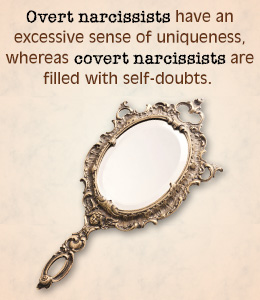
Lately I’ve been reading a lot about covert narcissism and have posted a few articles. Covert narcissists are almost always painfully shy and sometimes awkward. Their social ineptitude is also a kind of social cluelessness, VERY similar to Aspergers–only rather than having a developmental/cognitive source, a covert narcissist’s social cluelessness and obtuseness is due to the great effort of trying to keep the mask of sociability up so as to not risk being “exposed” as the empty shells we feel ourselves to be, and that is exhausting. This is taken as a lack of empathy but actually it’s obtuseness–like it is for Aspies. After speaking to a lot of covert narcissists over at Psychforums over the past few days and reading their experiences, I think the caring is actually there (not for malignants though), but they can’t SEE that they should care because their defense mechanisms keep them from seeing it.
And there you have it. I’m a covert narcissist.
Some of this could be explained by my Avoidant PD of course, especially the social awkwardness and avoidance of others, but cNPD explains it too. I had no idea. I’m not sure if I have comorbid Avoidant PD or not, but I sure as hell don’t have Aspergers.
These are all symptoms of covert narcissism. Although cNPD is not yet recognized by the DSM, I think it will be in future editions. There is a lot of talk on the web about it, a lot of scholarly articles. While our outer behavior can resemble Aspergers, and had both me and even a psychiatrist I was seeing fooled, the reasons underlying the Aspie-like behavior is nothing other than narcissism. When I found this out the other day, I was blown away but spooked out of my mind. The shock of the truth can take your breath away.
Problems with empathy.
All my life I’ve difficulty making lasting friendships because I lack the ability to really be able to empathize with anyone. Oh, I can empathize in a kind of distracted, disconnected way–like if I hear about an abused child or animal I feel bad and sometimes even tear up. I can empathize with fictional characters in books or films. I hate hearing about injustice and abuse. But no matter how hard I try, it’s almost impossible for me to be able to really share the feelings of a real life, flesh and blood person. I don’t want to see anyone suffer, but it’s just all seems so foreign and I have trouble relating. If someone tells m a problem, I can sort of empathize, but it’s a cold, intellectual sort of empathy and I feel like I’m acting, so as soon as they leave, I move on with my life and it’s as if they never told me. I used to wonder why most people didn’t like me that much but now I realize how self-involved I really was. Everything was always about me. I isolate myself because it’s hard to keep up the appearance of truly caring when there’s nothing inside except a yawning black hole and fear of being discovered.
I also was almost as abusive (emotionally) to my ex as he was to me, but again, at the time I couldn’t see the part I played in all this. I was very self-involved and manipulative in our marriage and although it probably would have ended anyway (a good thing), I sure didn’t help by being the way I was. I thought of myself as codependent until my sudden epiphany a few nights ago. Yes, I was a victim, but covert narcissists, when paired up with grandiose/classic narcissists, are almost always the victims. But I was far from an angel myself.
Mental blindness.
I always thought my BPD explained any “narcissism” I showed.
But all my life I’ve been accused of being narcissistic in various settings, and I never could understand why, because it seemed like I was always giving, giving and giving some more. I never made waves, never stood up for myself (except in sudden rages that used to scare people but I got that under control more or less using DBT tools).
I never set out to hurt anyone or play manipulative games. At least not consciously. But it seemed that I was always hurting people. Then I’d genuinely surprised when I was called out on it. I’d feel terribly guilty and filled with shame and apologize profusely (and mean it). I slowly began to see the passive aggressive things I was doing that I *thought* were just passive or things anyone would do. One hand never knew what the other one was doing. I came to not trust myself, and this added to my social awkwardness and shyness, because I couldn’t hurt anyone if I remained silent and disconnected.
I only become overt/grandiose when I’m getting a lot of supply (it makes me cringe with shame to use that word about myself). I’ve become more grandiose recently. Not aggressive. It makes me cringe to read some of my older articles that make me sound so arrogant and conceited. Even before I knew what I know now, I was trying to curb those kind of articles. I didn’t want to come off like a conceited asshole. IRL, though, nothing changed. I was still my same painfully shy, awkward self.
I control my borderline symptoms with DBT tools and that helps with some of the cNPD ones too (in clinical settings, DBT skills which were developed for BPD, also work for some people with NPD).
But my problem is, I don’t feel the things I want to feel — and I’m so cut off from everyone and avoid people because I don’t want them to see the void inside. My deep emotions simply are not accessable to me under normal circumstances.
Down the rabbit hole.
Nearly 11 months from the day I started this blog, I had a mind-bending breakthrough. It happened about a week after my inexplicable anxiety followed by depression began. One night I could’t fall asleep and finally gave up trying. At about 3 AM I talked to 2 close Facebook friends for awhile. They’d been a bit worried about me because my mood had been so erratic.
I logged off Facebook at around 4 AM.
And then…I read this article:
http://www.researchgate.net/publication/275665641_Narcissistic_Personality_Disorder_Diagnostic_and_Clinical_Challenges
It fit me like a glove. I saw myself described in one of those vignettes and…and went down the rabbit hole…
I could not deny it anymore. I was a fucking narc.
I’ve probably already read about 50-100 articles about covert narcissism (cNPD) so I don’t know why this particular one had the effect it did. Maybe I was finally ready. While reading, I recognized myself. It was a deep and horrifying knowledge that hit me like a tsunami. It was like that lightbulb moment. And getting punched in the gut HARD at the same time. I almost threw up. I cried like a child for over an hour. For a few terrifying minutes I felt like I couldn’t catch my breath. I felt hot and cold flashes and started to shake.
No. No, it couldn’t be. I could not have NPD. I frantically tried to fight the truth. It just seems absurd and you’re sitting there with your tongue hanging out when the connection is made. “Huh? wut? But I’m a victim of narcisisstic abuse! I’m an ACON! I’m a nice person! I have low self esteem! How on the name of God can I be a narcissist?
And then….at least for me…you freak out.
I could not deny the truth anymore.
The shock of realization broke through my emotional zombitude. I’ve been on the verge of tears now ever since my epiphany. There may be an element of grief involved. I feel like one of my layers of defense fell off.
It’s funny because this was hardly the first time I’d read anything about covert NPD. I never connected it with my own problem. BPD was bad enough.
Sudden clarity.
Everything suddenly made sense and I felt like I was seeing my situation and all my relationships—hell, over 50 years of my life–with eyes that had been closed since I was very young. I remembered, vaguely, that someone told me something when I was four years old. I couldn’t remember what was said or who said it but I did know whatever it was had been the catalyst when all my problems started that would not abate for over 50 years. One day when I’m ready I’ll remember what actually was said and who said it. I cried harder than I’ve cried since I was about 12. Realizing I am a covert narcissist is something that although its discovery is incredibly upsetting, it’s also something I needed to have in my conscious awareness before I could really start to do the hard work necessary for real healing.
I have faith God works on all of us if we reach out with a sincere heart and ask for help. Now that I know I’m a covert narcissist, the next step is to figure out what to do with this information. Right now I still feel shell shocked. I have to be gentle with myself while I work through and try to understand everything that happened. I’m working on finding a therapist to help me sort it out because I think it’s too big for me to handle all by myself anymore (I can’t afford on though and finding one who works for free or on a sliding scale with NPDrs is going to be a huge challenge to say the least). All I can do right now is keep on praying and writing every day and working on myself and being as mindful as I can until I find someone appropriate. I know the work ahead of me is going to be harder now than it has been and that’s okay. It may take a long time and that’s okay too. I feel like I graduated from something. This might have been the best moment of my life because now it means I can work toward ridding myself of it. I’m both excited and scared to death. I know I can do this thing. But for the love of all that is holy, WHY DID IT TAKE SO LONG?
Coming to the realization that you have NPD is an enormous step, but they sure aren’t lying when they tell you how painful it is, and you’re just sitting there shocked and crying, with the emptiness that’s inside you just yawning open like a black hole. It’s incredibly scary but I’m not backing away. I don’t want this disorder. I want to be able to feel real emotions and real empathy and have satisfying relationships and be a normal, happy human being instead of this terrified, angry, envious, and constantly scared person who feels like they deserve nothing but at the same time resents everyone for having what I don’t. It’s a hell of a way to live and I’m over it.
My take on the genesis of covert narcissism.
An interesting thought started to play around in my mind–covert narcissists have TWO false selves: the outer meek, deferent, “nice” one that everyone sees, that cloaks the grandiose, entitled false self just under that (you know, the one that seethes with resentment and envy because you feel “entitled” to be regarded better or have more, and why should THEY get what I need? )
My little theory about this is that a covert narcissist is born when a narcissistic parent is especially abusive–or the child is especially sensitive. My MN mother scared the daylights out of me–I mean I actually saw those *black eyes* on her. She hated my “spooky” moods when i was about 4-6 and used to punish me for them. The “spooky” moods I had were when I’d go inside my head where she couldn’t reach me, especially when she was punishing me. That’s why she hated them, because she couldn’t penetrate these trances. I don’t know when I became a narcissist, but I’ve been this way as long as I can remember. My guess is it happened around the same time I had the weird “spooky” moods, probably around age 4. I don’t remember actually making a conscious “choice” to become one.
I think the covert form develops when a child is afraid that being too grandiose or aggressive will result in punishment. The child learns it’s not safe to challenge the parent in any way or be “better” than them, so although already a narcissist, they add the additional mask of being an obedient, deferent person. They grow up unable to stand up for themselves or express their opinions because of fear of punishment but inside they are anything but what they present to the world and hate being corrected or told what to do. It doesn’t go away either and leads to a life of misery and loneliness. The good thing though, is that covert narcissists are more easily cured because their disorder is so ego-dystonic and they’re so unhappy that they’re more likely than overt/grandiose narcs to get help.
I think it can also develop when a child is both a scapegoat and a golden child, which is common in only children. I would bet there’s a correlation there between only children and covert narcissism. I wonder if any studies have been done.
Narcissism is an effect of prolonged abuse from early childhood. (So is BPD). I’ve sometimes wondered if BPD/NPD may be a form of complex PTSD so deeply ingrained that it’s very difficult and sometimes not possible to dislodge. BPD symptoms in particular seem almost identical to complex PTSD but the DSM doesn’t recognize complex PTSD (C-PTSD) because it’s due to prolonged trauma rather than a single traumatic event, like a car accident or a war.
I agree all those effects are due to abuse, and are part of covert NPD/borderline PD (I have both).
For awhile I thought I had NVS (narcissism victim syndrome), which can show many of the same traits as narcissism. Basically it’s the “fleas” a narc leaves on you. In my case, the fleas were so many and lasted for so long that my case of fleas turned into full blown narcissism. I didn’t know this until a few days ago. I could still have NVS too; most narcissists probably do. After all, their disorder is caused by abuse. NVS is another diagnosis that is not recognized and is still largely an Internet meme.
The other side of the mirror.
Since my epiphany, things are weird. I’ve been a bit dissociated and things seem a little unreal to me right now, almost dreamlike. It’s as if with one layer of defenses gone (denial), my body seems lighter somehow. I’m not feeling grounded at all. I’m also almost constantly on the verge of tears. Just a lot of emotion filtering through, neither good or bad. I think this is a good thing.
I’ve been posting on a forum about NPD and a lot of narcs post there. I’ve found several of them to be welcoming and supportive. These people don’t seem very narcissistic at all. They’re like me; they want to change. I can relate to some of their stories too. I know I have to be careful though. I’ve had a few surreal moments where I wondered if somehow, I’d shifted to “the dark side” and evil was taking over and was starting in the insidious manner of having open and honest conversations about narcissism with other narcissists.
I always wondered why it was that, whenever I wrote an article about why narcissists became that way, or the ways they suffer, that I’d always get so emotional. I know these articles enraged some ACONs. Why was it so important for me to “understand” narcs? Why couldn’t I just accept they were these evil, inhuman demons who had no capacity to change? There was one article in particular, “Letter from a Narcissist’s True Self,” that made me so emotional I was in tears while writing it (even though the fictional narcissist is far more malignant than I am).
Why?
Why did I feel a kind of warm empathy for a few narcs who wrote to me telling me they hated the way they were and hated themselves?
Why did I feel somehow personally insulted when narcissists were demonized (even though I still agreed much of the time)?
Why did I get into a blog war with people who hated the fact I suggested that maybe narcissists get too much hate and not enough understanding. That they were victims too?
Why did I care at all about…these toxic people?
Now I know why. I was trying to understand myself.
Other strange things have happened too. Bizarre coincidences and “signs” that all of this discovery had meaning and that my assessment of myself was correct. Describing these things would take too long and this article’s already long enough, so I’ll spare you the metaphysical woo-woo for now. Suffice to say that almost everything I thought I thought was true was a lie, and everything I thought was a lie was the truth. It’s disorienting. I’m on the other side of the mirror, looking inside.
Where to go from here?
Immediately following my epiphany, I realized I needed to make a decision about this blog, for to continue it as it was and say nothing about my realization would make me a fraud and a liar and that flies in the face of the honesty I made a commitment to a year ago. So I had three choices.
–Take this blog down. (That was out of the question–it would be the equivalent of having a beloved pet put to sleep).
–Shift its focus to say, a general purpose blog? (Eh. That idea didn’t excite me).
–Bite the bullet and “come out” about my narcissism and take my chances?
Yes I would lose readers if I did that (and of course the “supply” is nice), but what would be the right thing to do?
I decided to go with being honest. I think I made the right decision, as difficult as writing this post is.
Whatever I shift the focus of this blog to (and it may not change that much), it has to be coming from a sincere place fueled by honesty and candidness. I’ve already had practice having haters, and I’m prepared for that again (well, sort of). I’m prepared to lose readers. It’s okay.
I’ll continue this blog for those of you who want to stay, because I love doing this so much. But I can’t be the new Sam Vaknin, nor would I want to be. There’s only room for one of him and there’s plenty of blogs out there for victims of narcissistic abuse written by non-narcs. So although I’ll continue to write about narcissism and the effects it has on its victims, I’ll be shifting this blog’s focus, though I’m not sure what direction that will take.
I’ve also decided to start a second blog, which is intended to be a supportive environment for people like me–self aware narcissists/BPDs who need to talk about it and want to heal.
I have a lot of anger toward the narcissists who infected me with their disorder. You can’t spend an entire lifetime at the mercy of malignant narcs and not develop at least a bad case of fleas yourself. I never asked for this and I reject it. I do have a conscience (a well developed one actually) and now finally awareness, so those things are in my favor. I’m not malignant, thank God. At least I hope not. But I’m on the spectrum whether I want to be or not. I want to get off.
I think my life will be changing for the better now. I don’t have to be a narcissist if I don’t want to be. That’s what I’m working toward now. I know I can do this thing. Wish me luck.
And now I’m going to hit “Publish.” My heart’s in my mouth right now.
I hope my friends here can understand.
ETA: I started the new blog: https://luckyotter.wordpress.com/






 Lucky Otters Haven