Gifts a scapegoat brings to the world

I thought Katie was gone, but she came back just when I needed her posts like a starving person needs a nourishing meal.

For the past few weeks, I’ve been depressed and resentful about my scapegoat status in my family and repeated throughout my life (especially in the workplace), sinking into resentment, envy,  and self pity. These are bad emotions for me, they are bad for anyone! These emotions poison your soul. In fact, last night I told my wonderful therapist that I didn’t think therapy was working, because I felt like I’ve taken 3 steps back and failing to make any more progress. He reminded me that a lot of negative and self defeating emotions got triggered starting with my father’s death last month. He’s right, of course, but I still wasn’t buying it.

Reading Katie’s latest two posts made me realize that my unhappy upbringing, continued tendency to be the target of abusers, and lifelong, seemingly intractable poverty as an adult didn’t just happen in vain. I feel strongly, like Katie does, that those of us who were scapegoats and have suffered so much must be very spiritually strong for us to have been chosen for such difficult and harsh training–training for something far more wonderful than having the latest SUV or European vacation.    If that sounds grandiose, then so be it, but I simply won’t and can’t believe that what happened to us happened for no reason at all.

There should be no “shame” in having a Cluster B diagnosis.

noshame

Yes, another potentially controversial post.  Please hear me out before judging.

There are some (actually, many) people in the blogosphere who believe that people with disorders like Borderline or Narcissistic Personality Disorder made some kind of conscious choice to have their disorder.   With unusual exceptions (which I’ve discussed in others posts), I think this is wrong.

Bad seeds?

People with Cluster B disorders, in spite of what you probably read or heard, aren’t inherently evil or “bad seeds.”   Certainly, some become evil, because they’ve been programmed for a psychological need to obtain narcissistic supply in order to feel like they exist.  In order to get that supply, they became abusive and manipulative.   People addicted to drugs or alcohol are also abusive and manipulative, in order to get their chemical fix.

People with psychopathy may have been born without the brain capacity to feel empathy or have a conscience, but I don’t think Psychopathy should even be categorized as a Cluster B disorder at all, since it seems to have its roots more in brain chemistry than in early trauma.   Plenty of psychopaths came from normal, loving families.  The jury’s out as to whether Antisocial Personality Disorder is the same thing as psychopathy.  I think they may coincide often and their symptoms are similar, but I’m not at all sure they’re the same thing.    I don’t know a whole lot about ASPD, but I think it, too, usually has its roots in trauma as a child.   I know almost nothing about its treatability, but it’s my understanding it’s very difficult to treat, even more so than NPD.    But I digress:  talking about ASPD or psychopathy is not the point of this post.

Another blogger who commented on a post of mine today mentioned that she may have undiagnosed, recovered BPD.   I sensed from the tone of her admission that this might be something she’s  ashamed to admit.   I wondered why.   BPD, like NPD, has a terrible stigma, although in its favor, there’s a movement in the BPD community to reduce its stigma as “evil” and “incurable.”    Their efforts seem to be working, because BPD is seen today as being less of a “mark of the beast” than NPD is, although the stigma certainly still exists.

Why no anti-stigma movement for NPD?

I’m not sure why there is no grass-roots movement among narcissists to change the stigma against NPD, but from everything I’ve read from self-aware narcissists (and you’d be surprised how many of them there are online), they’re either: (a) proud that they are narcissists and wear the “evil” stigma like a badge of honor (these tend to be malignant, overt narcissists with antisocial or sociopathic traits), or (b) *this is a shocker* so ashamed of their narcissism that although they hate the stigma, they seem resigned to it and and seem to hang their heads in shame, quietly accepting how “bad” they are.  “I deserve it,” they say.   It may seem hard to believe, but some of them even defend the narc-haters.  Remember we are talking about self-aware narcissists.  Most narcs never get to that point.   Their grandiosity keeps them from having enough insight to do that.

Ego-dystonic vs. ego-syntonic.

Because people with BPD are almost always ego-dystonic about their disorder (they aren’t happy with themselves), and because generally BPD doesn’t lend itself to self-delusions  (in other words, having a false self) the way NPD does, BPD has a higher cure rate than NPD,  which also helps reduce its stigma.    NPD is usually more ego-syntonic, but not always.  Narcissists who are ego-dystonic (usually covert narcissists) tend to be frustrated, lonely, and depressed, and although they can be highly manipulative, entitled acting, and lack empathy, they lack the grandiosity and false pride that keeps them stuck in the delusion that their narcissism has worked for them.

I don’t see a whole lot of difference between BPD and C-PTSD.  Actually, BPD is like C-PTSD on steroids.  I’ve written about this subject before–the symptoms of both are nearly identical, and both Borderlines and people with C-PTSD are very prone to become codependent to malignant or overt narcissists.   They are also prone to self-harm, wild mood swings, and are sometimes suicide risks.  People with C-PTSD–especially women–often get slapped with the stigmatizing BPD label simply because the DSM doesn’t recognize C-PTSD as a legitimate disorder (and PTSD, while similar, applies more to those who suffered a single, intense trauma rather than the victims of chronic, long term abuse starting in childhood, so the treatments for someone with PTSD would be different).

Moving back to narcissism…

Many people believe NPD cannot be successfully treated, much less cured.   I admit I’m skeptical about its curability, though I do know there have been a few cases where it’s happened.   I also know there are narcissists who are ego-dystonic and unhappy with what they’ve become, once they realize they are narcissists.   I don’t think the adage that “if you think you have NPD, then you don’t” is necessarily true.    I have met a few here and on forums who desperately want to change their behaviors, usually because they’ve realized that they’ve missed out on things like knowing how to love and receive love, or having a healthy relationship with their spouse or children.   They want to know what love and vulnerability in a relationship feels like.  They want to know what real joy and empathy feels like.   They forgot how.   They’ve come to realize their lives are empty and shallow, and they are constantly under the stress of always having to act a part in a play.   They forgot who they were a long time ago.   Most narcissists did not have happy childhoods and most had parents who either abused or spoiled them (spoiling is a form of abuse because it fails to mirror who the child actually is, so the “love” they get is conditional).

As a mental illness.

I’m in no way defending narcissists or the way they act.   But as a cluster B disorder,  it started as a defense mechanism to cope with unbearable pain and feelings of emptiness. Many people believe narcissists love themselves, but nothing could be further from the truth.  They only love their false self.  Scratch any narcissist and you find a person who doesn’t even know who they are.  BPD is much the same that way, except Borderlines don’t have a functional or strong false self.    I’m not suggesting sympathizing with active, unrepentant narcissists or condoning their toxic behaviors. I’m not suggesting staying with one either!   But I think the stigma against NPD has hurt those people with the disorder who sincerely want to change.  These people do exist!  I don’t think they’re lying when they say they want to become non-narcissists–why would they? What would be their motive in doing so?   Much as with people with BPD, therapists refuse to treat them, insurance won’t cover them, and they are frequently demonized as non-human creatures or worse.

Maybe the treatment rate for NPD is so abysmal because they are given up on so easily by therapists who lose patience with someone who doesn’t show immediate improvement or acts aggressively or in a confrontational way.    NPD is a very difficult disorder to treat, but that doesn’t mean it isn’t possible.  Even if a narcissist can’t be cured, CBT and other mindfulness therapies have had good results on some narcissists who really want to change the way they treat others and have more mutually fulfilling relationships.  DBT (dialectical behavioral training), a mindfulness therapy similar to CBT traditionally used on people with BPD, has also been shown to be effective on some people with NPD.

As a Borderline myself (my therapist thinks I’m recovered, but I’m not at all sure about that), and having personally experienced the stigma against Cluster B, I have a great deal of empathy for anyone with a Cluster B disorder who is self aware and genuinely sorry about the way they’ve treated others or the choices they’ve made, and who sincerely wants to do the hard work needed to make changes in themselves.   People with Cluster B disorders didn’t choose to become that way; like people with C-PTSD, they have a mental illness caused by trauma and C-PTSD is almost always at the core of any cluster B disorder.

While it’s true that some will never get to the point of self awareness or even if they do, may not be interested in finding new and better ways of relating to others and the world, there are many who do, and we shouldn’t judge them or hate them just because of their stigmatic diagnosis (and the diagnosis could be wrong anyway!).  That’s why I don’t run a “narc free” blog.  I allow people with Cluster B diagnoses–including NPD–to post comments on this blog and share their experiences along with others who do not have those disorders and were abused by people who do.  As long as they don’t attempt to upset or trigger non-Cluster B abuse victims and remain civil and add to the conversation, they are always welcome here.

The Narcissist’s Fan Club

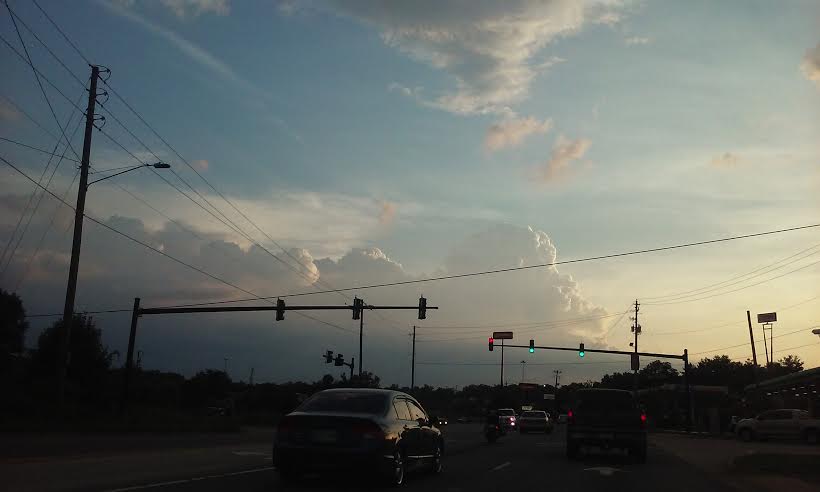
Distant storm.

I love weather photography. There are so many different types of clouds, but cumulonimbus (thunderstorm clouds) are the most fascinating to me.  If these clouds become developed enough, tornadoes can result, but tornadoes are rare where I live.

We got pummeled with another heavy downpour and some small hail late this afternoon, and storms continued to dot the region into the early evening, although no more storms actually hit.   Here are two photos of a distant storm that was moving south, away from where I live (thank goodness).

distant_storm1

distant_storm2

Fun with Spam

spam

I’ve had my spam set to be automatically deleted for some time now, because I was just getting too much of it.   But WordPress still lets some spam come through.  Usually I just delete these without bothering to look at them, but sometimes I glance at them when I have nothing better to do.

Most of my spam comments are unreadable, as if they’ve been translated from Mandarin to Greek to Bulgarian to Bantu to Korean and then back into English by someone with third grade writing skills.   Or they’re so generic you’d know they’re spam even if they weren’t marked as spam because they could apply to any post–like the way newspaper horoscopes can apply to any zodiac sign.   I’m talking about this:

“Great article!  I’ll definitely bookmark this for future reference.”

Or they’re telling you all about how your Google ranking sucks and you need to purchase their SEO help.   I will never pay for SEO.   A little patience and dedication is all you need to get a decent search engine ranking.

The funniest ones are the ones that sound like they’ve been translated several times, and the subject matter is always completely random and has nothing to do with what you posted.   Here are two entertaining spam comments I’ll share before I delete them for good.

I agree with your statement because chapter 14 talks about how he wakes up every morning with a cheerful matter. when he so explains, ” To be awake is to be alive. I have never met a man who was quite awake.” Thoreau seems like a man with hope in nature. He  wakes up every morning and takes his time to observe the morning with a nature view.
adidas yeezy 350 boost low

I copied and paste the loader into the bin folder, ran it, got asked for license key, not sure what to do there, typed random things in didnt work either. Does the license key thing suppose to show up when you run the loader?

Here’s one of those generic spam comments.  What makes it hilarious is it was posted under a cartoon.

I think this article is very helpful for people,it has solved my problem,thanks!

Monday Melody: Major Tom (Peter Schilling)

I’ve posted about this song before, but oh, drat–I can’t find the post now.

Oh, there it is–playing Peekaboo down there in the “Related” posts.  Oh well.

Anywho…this one-hit Europop wonder by German musician Peter Schilling–intended as a sort of “answer” to David Bowie’s “Space Oddity,” never became that popular in the United States when it was released in 1983 but it did get a little airplay here, especially on the dance circuit, and remains one of my favorite 1980s tunes.

The beautiful, haunting chorus still gives me chills every time.   Does “coming home” mean coming home to earth…or “coming home” to the afterlife?  I think it’s most likely the latter.

Standing there alone
The ship is waiting
All systems are go
Are you sure?

Control is not convinced
But the computer
Has the evidence
“no need to abort”
The countdown starts

Watching in a trance
The crew is certain
Nothing left to chance
All is working
Trying to relax
Up in the capsule
“send me up a drink”
Jokes Major Tom
The count goes on

4, 3, 2, 1…
Earth below us
Drifting, falling
Floating weightless
Calling calling home…

Second stage is cut
We’re now in orbit
Stabilizers up
Running perfect
Starting to collect
Requested data
“What will it effect
When all is done”
Thinks Major Tom

Back at ground control
There is a problem
Go to rockets full
Not responding
“hello Major Tom
Are you receiving
Turn the thrusters on
We’re standing by”
There’s no reply

4, 3, 2, 1…
Earth below us
Drifting, falling
Floating weightless
Calling calling home…

Across the stratosphere
A final message
“give my wife my love”
Then nothing more

Far beneath the ship
The world is mourning
They don’t realize
He’s alive
No one understands
But Major Tom sees
Now the life commands
This is my home
I’m coming home

Earth below us
Drifting, falling
Floating weightless
Coming home
Earth below us
Drifting, falling
Floating weightless
Coming home
Earth below us
Drifting, falling
Floating weightless
Coming coming home…
Home…..(x8)


Narcissist Zombie.

Image

narcissist_zombie

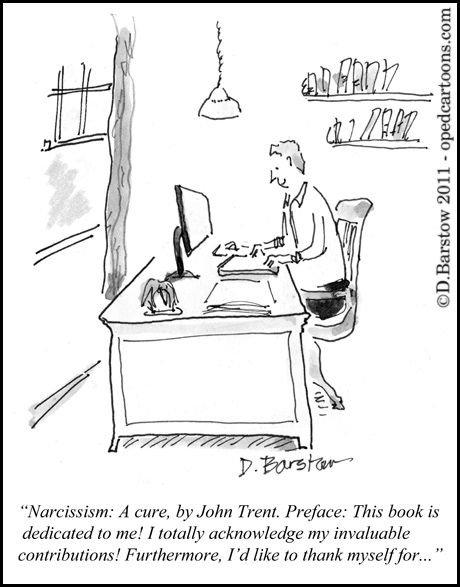
Narcissism: A Cure!

Image

narcissism_acure

Surrender.

Image

lettinggo_quote

Art therapy: recycling an old seat cushion.

This morning I had two small first-world problems.

1. I needed a new piece of art for my hallway wall, which was bare.
2.  My favorite outdoor needlepoint seat cushion had turned black and moldy from three weeks’ of rain, and the stuffing was coming out of it anyway.

I’m glad I didn’t throw away the seat cushion, which was my first temptation. I didn’t think it could be salvaged.   But I decided to take it apart and see if I had some kind of  brainstorm that would save it because the design is so pretty.

I tore out the stuffing, and the needlepoint part of the cushion, which was on the top only, tore away easily as the fabric was nearly rotted. Carefully, I washed the needlepoint panel in the tub with mild detergent and just a little bleach to make the colors bright again, then dried it indoors.

Now I had a nice little piece of needlepoint tapestry, with a very antique look about it (even though it’s actually only about ten years old), but what could I do with it?

Finally I decided it would make a wonderful art piece for my blank wall, solving my first problem.  I measured the piece–it was 17.5 x 15 inches, wider than it is tall. I had to find some kind of frame that would fit.  I went to the dollar store and purchased a large piece of royal blue poster board for mounting.

I looked at their frames. All were way too small, intended for family photos, not artworks. But next to the photo frames were some cheap decorative photos and pictures already in frames. I finally found a framed photo of a shoreline whose dimensions fit almost exactly. The frame was plain black plastic, which was fine.  The hook on the back was in the right place too, so it would hang with the longer side horizontal and the shorter side vertical.

I took my equipment home, removed the backing and the cardboard photo inside (actually the photo is rather nice, so I might put that somewhere else like my bathroom or kitchen), and then carefully cut the poster board to the same dimensions as the cardboard photo. Then I glued the tapestry onto the poster board and set it back inside the frame, and used some masking tape to secure it there.

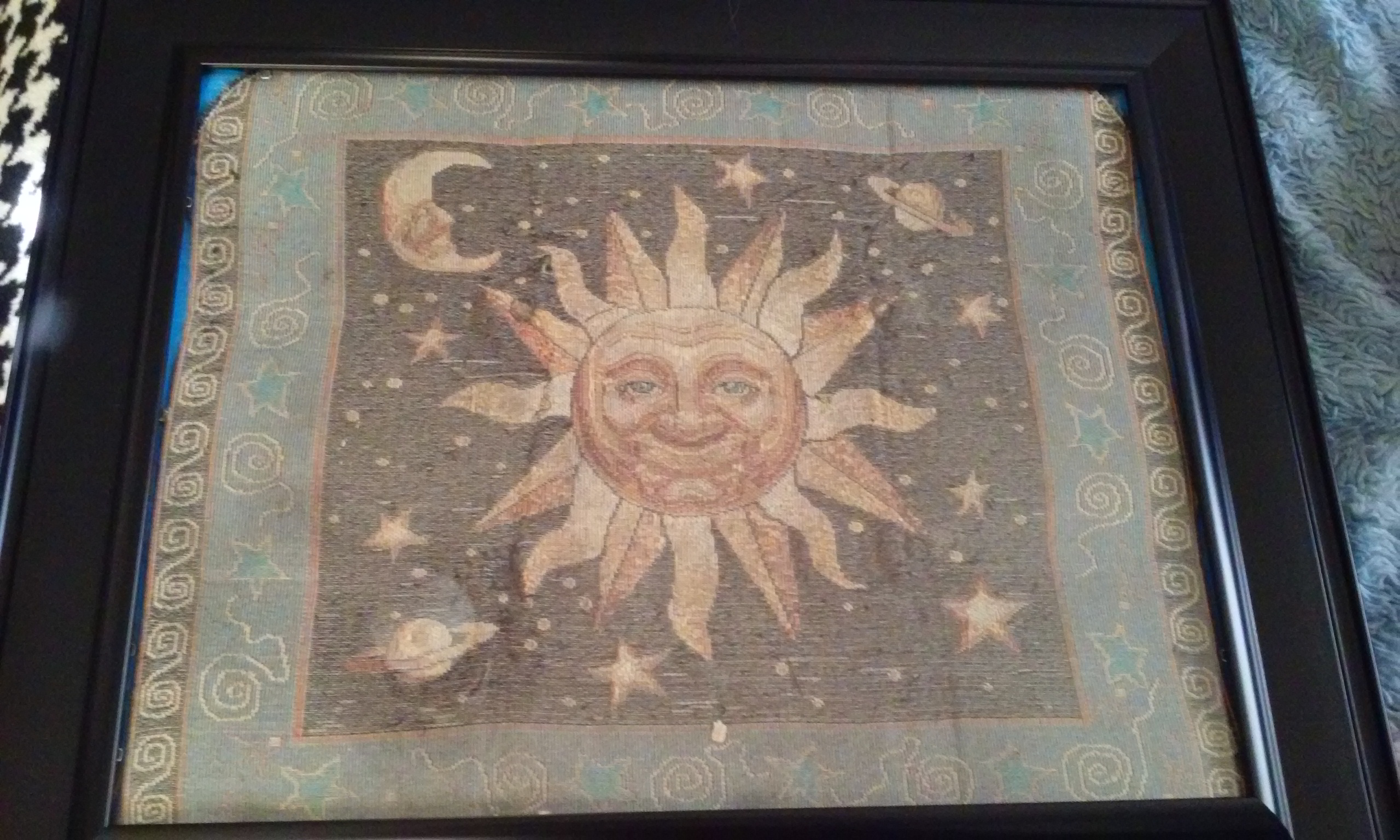
Here is a picture of the finished result.  I think you’d probably pay a lot if you were to buy something like this.

tapestry1

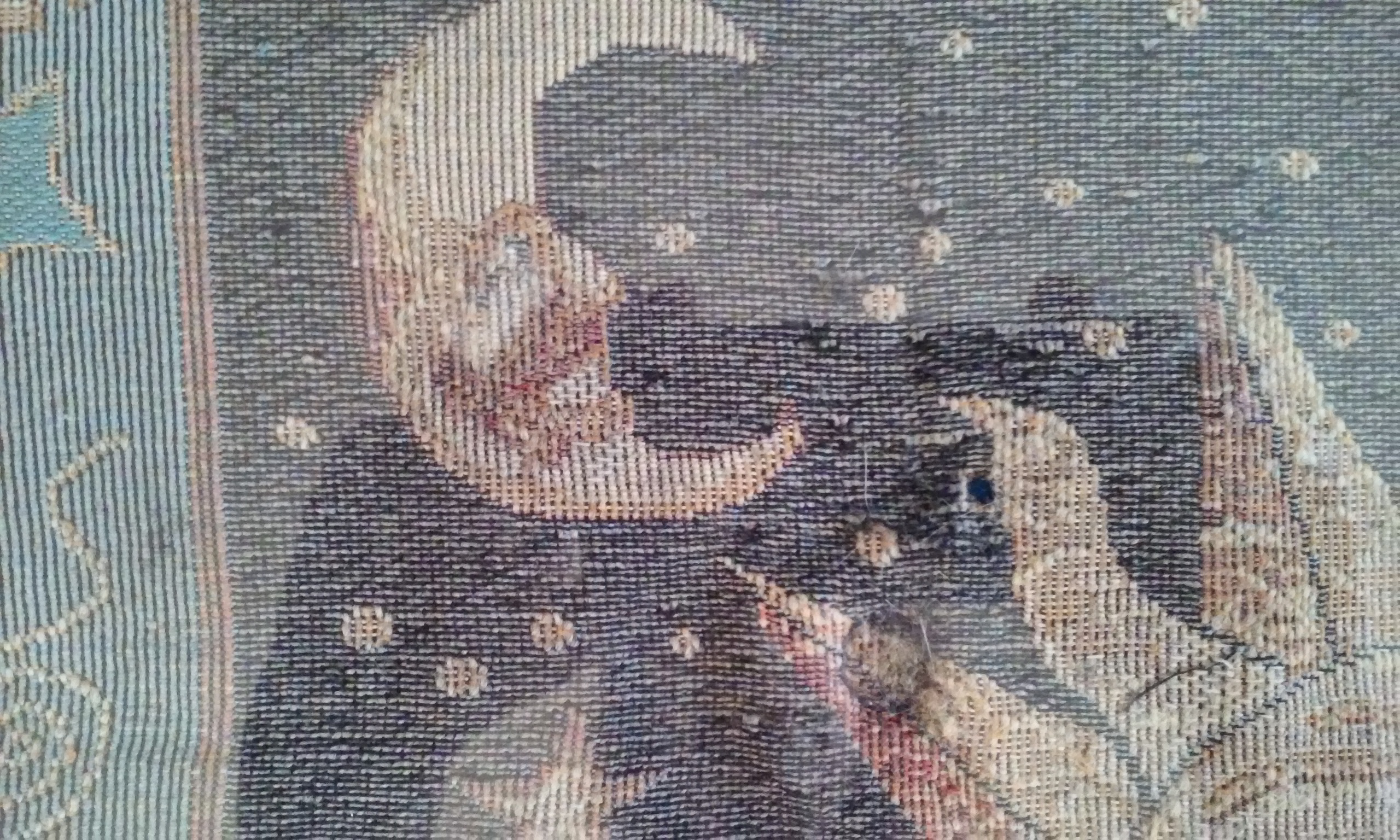
A closer look at the detail:

tapestry2 tapestry3

I find these sort of creative activities relaxing and fun–and very therapeutic.  My house is filed with such things I made myself out of odds and ends, or things that I was able to recycle into something exciting and new.    And I always finish these projects with my mood improved too.