Emotions and authenticity.

brene_brown_quote2

Emotions are the first language we ever speak. Their expression is a pre-verbal language that is gradually replaced with words as we grow out of infancy. All emotions are really just energy moving through the body (though I think they originate in the soul). This movement is expressed through various physical reactions as the emotion moves out of us–laughter, crying, sighs, various non-verbal sounds, wiggling or jumping up and down with joy, trembling, and various expressions of anger (of course we need to be mindful of this one). This idea of emotions as a language isn’t my own; it’s been suggested by others, but I think I would have come to that conclusion on my own sooner or later.

Babies and animals (especially higher level mammals like dogs or monkeys) don’t have words, but they are very good at communicating their feelings and needs. In fact, they are better at this than adult humans, because there is no pretense and no words to mask or obliterate visceral emotion. With a baby or an animal, what you see is what you get.

We don’t begin to have problems with this until adolescence or sometimes later childhood, when spoken language has become fluent. You don’t see a toddler or a dog presenting a false self or hiding their real feelings. Unless abused early on, there is no shame in their emotional expression. An animal or an infant will not lie to you, manipulate you, or tell you they are happy when they’re anything but. That’s because they don’t have the language behind which it becomes possible to hide.

Babies cry to communicate. We may not like it when they do, but it’s the most important way they communicate. It’s really just a pre-verbal language that helps them get their needs met. Of course they could be crying because they’re uncomfortable or in pain, but they also cry when they need nurturing and just need to feel attached to Mom. Most of us are naturally drawn to comfort a crying baby, but really, they are just telling us about their physical and emotional needs that in a few years might be expressed by, “I’m hungry” or “I’m angry” or “I need a hug” or “I feel lonely.” It’s not always “bad” when a baby cries, although it seems so to us, and we want them to stop. Babies also use their whole bodies when they cry. As the emotion moves through them, their entire body responds. They kick their legs, punch the air, and howl. When an adult expresses strong emotion, such as crying (and sometimes laughing), they tend to hold themselves back to some extent, only letting part or none of their body respond to the emotion. Babies also wiggle when they’re happy. Do you know of any adult who wiggles or jumps up and down with joy? It’s something we outgrow as adult, but is that really necessary? What’s really wrong with wiggling or running around the room with happiness or sobbing with abandon?

When a dog sees its owner, it will bark excitedly and jump up and down with joy. If it has misbehaved, it will show its guilt (and I’m convinced that dogs DO feel guilt and shame). If it’s sad or afraid, it whimpers and its whole body trembles. It doesn’t need to say “I’m sad” or “I’m happy” or “I feel ashamed.” Its body and face says it better than any words ever could. That’s why I think people relate to dogs so well. Dogs represent our own emotional natures, that to a greater or lesser extent, almost all of us keep behind wraps most of the time.

I’ll never forget the time I was helping a friend pet-sit. The owners had a dog and a cat, and while we were there, the owners came home. When the dog heard the key in the lock, he began to bark excitedly and jump wildly at the door, intermittently spinning around in circles, wagging his tail crazily and practically tripping over his own oversized feet in his excitement. When the owners came in, he practically knocked them to the floor, licking both their faces happily. Even the cat went nuts with happiness, rolling around ecstatically on the floor in front of them. He also ran up to the owners, purring loudly and meowing. Do you know any people over the age of 6 or 7 who act like these animals did during a reunion?

Of course we don’t want to become babies or pet dogs and cats, but they have a lot to teach us about authenticity and the courage to be emotionally vulnerable.

I’m in no way trying to imply that language isn’t a good thing. We evolved it for a reason. Language makes it possible for us to use more of our minds and make new discoveries. It’s the reason we can write a symphony, a novel, or make new scientific discoveries. Good language skills are an indicator of high intellectual ability. Words can also be great tools for genuine emotional expression. But when we grow up and start to use language completely in place of bodily emotional reactions to communicate, we throw out the baby with the bathwater. I think schools are responsible for a lot of this. Schools–like work environments–discourage the honest expression of emotions. We begin to hide our true feelings.

Of course, bad parenting that fails to mirror a child’s true feelings does the same thing and is even more damaging because it happens when the child is still pre-verbal.  A child whose emotional needs have not been met and who isn’t mirrored when very young becomes ashamed of their emotions and tries to hide their vulnerability.  In some cases the damage is so great the person develops complex PTSD or a personality disorder.  We need to find ways to be emotionally honest without reverting to a preverbal, infantile state. I think we’d also be not only more emotionally healthy, but also more physically healthy if there weren’t so much shame attached to emotional expression.  Numerous studies have shown that chronic illness later in life is linked to repressed emotions.  I think what happens is when they’re not allowed to move through the body naturally, they get trapped in the body and can make you sick.

To help us get there, I recommend watching anything by Brene Brown, an author and public speaker who thinks that vulnerability and authenticity are things we modern humans need a lot more of. Her most popular video is “The Power of Vulnerability.” Many people have said it has completely turned their lives around.

4 awesome reasons to cry.

awesome

One of the things my therapist and I have been working on is getting me to cry in session.   I’ve talked before about how hard it is for me to cry, except in private, and even then it isn’t always easy.   As a child I cried all the time.  Because I was usually shamed for my tears, sometime during my teens or early 20s, I pretty much stopped being able to cry and outbursts of anger, seething resentment, or “freaking out” seemed to replace the tears.  Rage and anger, while they have their place, is often destructive to others and yourself, and if used as an outlet where tears would be more appropriate, isn’t really very healing.  Freaking out is never adaptive because it just makes you appear crazy.   Before I learned mindfulness in DBT, I’d act out against others or freak out without thinking about the consequences, and usually feel regret, embarrassment, and shame later, much more so than if I had just cried instead.

Sure, tears can be manipulative.  Narcissists cry to get attention or to manipulate others into pitying them or giving them what they want.   Babies and young children do this too.  That’s the kind of crying that has given tears such a bad reputation.     But if a child is crying for other reasons–because they are hurt, because they are sad or overwhelmed with any other emotion (ANY strong emotion, not just sadness, can cause tears)–parents should never tell them “big boys (or girls) don’t cry” because that just teaches them to stifle their emotions, and stifling emotions is bad for you and can even affect your physical health.  If a child is shamed out of crying often enough, they may learn to turn off the tears and become unable to cry as adults.  This is especially common for boys in a culture that has traditionally frowned on men and boys crying because it’s a sissy or “weak” thing to do.  But this no-crying policy applies to women as well, especially in the business and professional world, where showing softer emotions is a big no-no.

People cry for many reasons, but I think there are four basic reasons for genuine emotional (not manipulative) tears: (1) need for help or care; (2) connection, empathy and love;  (3) awe, gratitude and joy; and (4) stress relief.   I’ll go through each of these and explain why each one is awesome.

1. Need for help or care.

babycrying

When a baby cries, it’s usually because they need something.   They may be wet, in pain, hungry, tired, or just lonely.    A baby’s cry brings mom running to give the baby what it needs, after which the baby stops crying.   We are born into the world crying; tears are a pre-verbal language and the first language we ever learn. When we are born, we cry to communicate our distress or other needs, and get what we need to survive.   If healthy attachment is achieved, a baby learns more sophisticated ways to get their needs fulfilled later on, but there are still times when needy tears are appropriate and NOT manipulative, even for grownups.

It’s always healthy and appropriate to grieve after a devastating loss, such as the death of a friend, family member or beloved pet.  It’s appropriate to cry when hearing very bad news or when in great emotional or physical pain.     There are survival reasons for this.  A crying person usually draws people near them and attracts sympathy.  If we have normal levels of empathy, we have an instinctive urge to touch or physically comfort a crying person.     A person who has just found out their best friend has cancer or Fluffy died needs the comfort of others.  They need to be held and hugged and have their back stroked and their hand held.   They need physical contact.  They need to be able to pour their story out to another person.   It would be cruel to deny someone in great physical or emotional  pain that kind of succor.  Some societies understand this need, and that is why there are public rituals such sacramental wailing in some cultures, or sitting shiva in the Jewish faith after a loved one dies.  Only when it becomes excessive or is done to attract attention to yourself does this type of crying become annoying to others.

2.  Attachment, empathy, and love.

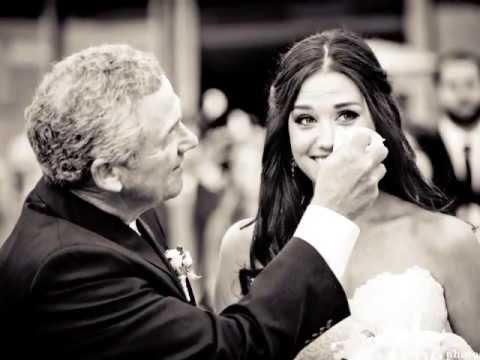
crying_bride

This is closely related to the above, but a bit different because the tears shed aren’t intended to draw help or comfort, but to connect with others or with the world.   Many new mothers find that they become very emotional during pregnancy and for a few months after their babies are born.   Even though as an adult I’ve always found crying difficult, an exception was made when I was pregnant or lactating.  My emotions went into overdrive!   I remember when I nursed my babies, sometimes I became overwhelmed with pure emotion I couldn’t name or explain, and silent tears began to run.  It wasn’t unpleasant at all.  It just felt natural and real.  I think those tears connected me more deeply with my children.   Tears are words an infant can understand instinctively, and when a young infant sees his or her mother’s tears, they understand this means attachment and love with her has been achieved, and a good mother responds to and feels her baby’s emotions too.

Grownups, even men, sometimes just feel overwhelmed with emotion, sometimes very positive emotion.  People who are deeply in love sometimes find as they gaze into their lover’s eyes, their own well up.  It can happen at any moment when the love they feel seems bigger than they are.   This is why sudden tears are common in lovemaking that isn’t merely for sexual release, but to more deeply connect with the lover.

Tears of attachment and connection indicate high levels of empathy.   A person who is able to feel the emotions of a friend who is sad can sometimes actually cry with their friend, and this serves to connect them on a deeper level.  A world in which we can’t share the emotions of those around us–either negative or positive–is a world where no one cares and everyone is out for themselves.    Any society that regards empathy as a weakness is a sick and dangerous one.  If the human race is doomed to self destruction, I’m pretty sure the growing lack of empathy and care for others we see around us today would be the primary culprit.

3. Awe, joy, and gratitude.

KellyClarkson
Kelly Clarkson learns she won American Idol, 2002.

Tears of awe are the kind you shed when you are blown away by an incredible sunset or magnificent landscape.   Some people get very emotional in church or when hearing a certain piece of music or reading a certain poem.   I think these are the kind of tears we shed when moved by something we perceive as being greater than ourselves.  They are humbling and remind us of our insignificance, but not in a bad way, because at those times, though we feel humbled, we also feel more connected to the universe or to God.  Tears of awe connect us with the divine.

People shed tears of joy when something wonderful happens to them, usually a great surprise.  Winning the lottery, winning a contest, your team winning the Superbowl, walking into your house to a surprise birthday party, hearing your baby’s cry for the first time…all these things make people cry.    They’re anything but sad or manipulative!   Tears of joy may also be a form of stress relief, as in some cases, there’s often an element of relief, which I’ll explain more in the next section about stress relief. For example, contestants in singing or dance competition shows or in pageants almost always cry when they win.   For many months, they’ve been under enormous stress.   The moment of winning not only validates all the hard work they’ve done, it’s also a sudden release of months of the built up stress of heavy competition.   It’s okay to let go!

Related to tears of joy are tears of laughter–those times we laugh so hard we begin to cry.  Crying and laughter are physiologically very similar and serve a similar purpose of relieving stress, so it’s not too surprising that sometimes our bodies get laughter confused with tears!

Finally, there are tears of gratitude.  Sometimes we are taken by surprise when someone does something nice for us.   Especially when it’s unexpected, kind words or deeds can bring on tears.   Colloquially, this is known as being touched, which differs from being moved because it’s more human and less spiritual/humbling than being moved.     Tears of gratitude connect us with each other.

4.  Stress relief.

cry_in_shower

Some unpleasant emotions aren’t normally expressed through tears.  For example, people don’t usually cry when they’re afraid or anxious or angry.   To do so wouldn’t be in our best interests survival-wise.  When we’re in danger or there’s some kind of threat facing us, showing vulnerability might get us killed.   So when we’re angry, we want to attack.  When we’re afraid, it’s fight-or-flight.   When we’re worried, we want to remove the source of worry or solve the problem.   But once the danger or stressor has passed, and we feel a measure of relief, it’s common for people to break down in tears.   A child who has become lost doesn’t usually cry while they’re looking for their caregiver, because that’s too dangerous.   They cry the minute they see Mom or Dad’s arms reaching out to them (and very often Mom or Dad cries right along with them!)

Sometimes people cry even when the danger hasn’t passed, when they just feel overwhelmed and have given up trying to fight or escape or trying to solve their problem.   In those cases, crying is a last-ditch effort to solve the problem.   If all else has failed, then crying may bring help or comfort from others.   It’s not necessarily manipulative if everything else has been tried first and nothing has worked.

Sometimes even when the threat is gone or the issue resolved, or the horrible outcome we expected didn’t come to pass, we still cry, because it’s finally safe to do so. The tears shed at those times are really tears of relief because they help release all the emotion that was pent up while we were in danger.  When thought of this way, it makes no sense to tell someone not to cry, because it doesn’t mean they’re upset, it means they’re relieved and finally feel safe enough to release all that bottled-up stress through tears.

And then there are those times when you just need to have a good cry, and you don’t even know why. After a few minutes or hours of sobbing, pouring out snot and tears, you come away feeling like a million dollars. So if you want to cry, go ahead and let it out. It’s good for your body, mind and soul.

My letter to a fellow ACON who wants to take her blog down.

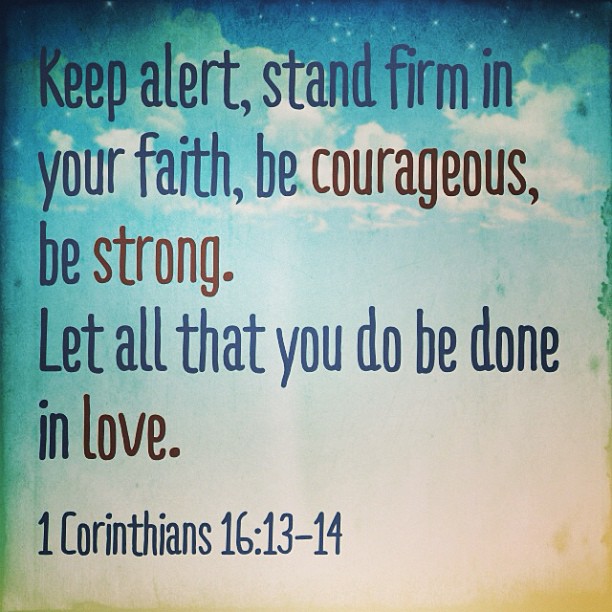
courage_biblequote

A good friend of mine in the ACON community has just announced she wants to take her blog down and remove herself from all social media. She isn’t depressed or angry at anyone, but just feels like she wants to hide. She also said that she feels like maybe God wouldn’t approve of her exposing her abusers, even though she has never used any real names. I was a little alarmed by this, so I just sent her an email, which I’m going to post here (and remove any identifying information). I think the feelings she described are common in abuse survivors, who have been trained by their abusers that nothing they do is ever right and that exposing their abusers is some kind of mortal sin. I beg to differ.

Here’s my letter in response to her post.

I just read your latest post about wanting to hide. At first I was surprised you said you were allowing comments, but after I read it I understood why. When you said you were thinking about taking down your blog, Twitter, etc. I thought to myself, No! she can’t do that! We need _______ ‘s blog!

I’ve sometimes felt like hiding too and been tempted to disable comments several times. Once (and you will remember this) last May, I was VERY close to taking down my blog or setting it to private because of some criticism I got over a post I wrote. I also felt very exposed when my blog was found by a few people I didn’t want to find it (including family members), but after an initial “Oh, shit” panic reaction, I decided to keep plugging away because to do otherwise would be the coward’s way to handle things, and I’m sick of being a coward who never stands up for myself.

I think as survivors of abuse, we ACONs can be very easily triggered. It’s scary being out there and being so vulnerable for the public to see. But that’s exactly what we are trying to reconnect with through blogging and sharing our stories with each other. We need to regain our courage to BE vulnerable. We’ve been trained by our narcissists THAT IS NOT OKAY, but that is a big fat LIE. We look at those who haven’t been so damaged and marvel at their openness, but when we try to do it, it can be very scary.

I think that’s why you feel like running away and hiding. It’s your fear that you might be hurt again that’s causing you to take such drastic action. I know, because I feel that way often myself.

____, DON’T DO IT. Don’t take down your blog. It’s understandable you might need a break, but don’t be rash. Set it to private for awhile and focus on other things, or just let it stand as is, and just don’t post in it for awhile. Give yourself a break, that will give you time to be mindful instead of doing something you might regret, like removing your blog.

We’ve been lied to and made to believe that exposing our narcissistic parents, spouses, etc. is not okay. I believe in the 10 Commandments too, but I don’t believe God wants the narcissists to get away with what they do, and I don’t believe a narcissistic mother or father really qualifies as a true parent. They certainly haven’t lived up to their end of the responsibility, have they? You are not using any real names, so you are not damaging them personally. What you are doing instead, is giving a voice to the oppressed survivors that have felt all alone because they thought no one could ever understand. We are inundated with sappy, sentimental images of Mothers, but our mothers never fulfilled that stereotype. For us, that image is a lie.

Narcissists, no matter whether they are biological parents or not, deserve to be exposed for what they are, and for how they have abused us. By sharing your story, you have no idea how many other people who have been in your boat you are helping. You have helped me, and you have helped many others.

Also, don’t think for one second that your story isn’t interesting enough to write about. You have one of the most interesting stories I have heard. You are helping and giving hope to countless abuse survivors. No names are mentioned, you are not hurting anyone, and I am sure Jesus approves of what you are doing. It’s all for the greater good. Your blog helps so many. God has led you to where you are for a reason.

Please think about what you’re doing. If after a month or so, you still want to take your blog down, then go ahead. But I would wait, and leave it up anyway for others to read and find hope from in the meantime, and just focus on taking care of yourself for a while.

***

I forgot to put this in my email, but I think that as a Christian, my friend should subscribe to Smakintosh’s Youtube Channel (Gospel Underground). He is a survivor of narcissistic parents, and has many videos that explain why it isn’t unbiblical to expose and go no contact with narcissistic parents. Here it is for any other interested persons: https://www.youtube.com/user/smakintosh

Anonymity.

I was thinking about how strange it is that I’m not afraid to reveal my innermost feelings to total strangers I have never met, but it’s so hard to share those same feelings with the people who are closest to me. There are things I’ve written here on my blogs that I couldn’t even tell my therapist yet.

Emotional blockages.

emotional_blocks

I think my challenges in really feeling my emotions are due to blockages of energy within my body. I discovered this simply by focusing on how my body felt in my therapy sessions or when I feel an emotion bubbling to consciousness. There’s a definite tightness in three parts of my body, which actually correspond to three of the chakras. If the emotion is strong, there can be a dull pain, as if the pain of the emotion is trying to get out and can’t. I can never fully let go, because of my fear that if I do, I might completely lose control.   I’m learning that ironically,  I have less control by holding negative emotions inside because when I do that, they continue to act as a slow-acting poison long after their job is done, instead of passing out of me like the release they’re supposed to be and freeing my soul to be able to experience more positivity in my life and more able to access my creative spark.

I think I’ve grown to trust my therapist enough that I’ve begun to let go just a little.

There are three places where my emotions are blocked:

The middle of my abdomen. This corresponds to the third, or solar plexus, chakra, which represents competence and power. I’ve always felt so powerless and incompetent.

My chest. This corresponds to the fifth, or heart chakra. This is where the higher emotions such as agape love, empathy, all kinds of (nonsexual) connectedness, and gratitude reside. It’s always been so hard for me to really connect with others, due to fear and lack of trust.

The middle of my throat. This corresponds to the 6th, or throat, chakra, which represents the ability to communicate with others. I’ve always been a shy person afraid to speak up, even if it’s for my own rights as a human being.  Blogging has helped, but it’s not nearly enough.

I think by focusing in on bodily sensations and becoming mindful of your feelings, you can zero in on which ones you need to work on and focus on relaxing and breathing deeply into the blocked areas to be able to feel it fully enough so you can purge it.

Letting go of fear.

fear_dreams

Sometimes I have funny thoughts when I’m just lying on my bed half asleep. It’s at those times my subconscious mind sometimes bubbles into consciousness (which makes the half asleep state similar to meditation). Anyway, the thought I had was simple and profound. I was just lying there with random thoughts drifting through my head, and thinking about how “small” my life is, how little I have both materially and emotionally. But it wasn’t self pity, it was just an observation of reality. Suddenly another thought bubbled into awareness: you only get what you put out.

“You only get what you put out.” Suddenly I was wide awake and almost shocked by the simplicity of this message. I thought about how little I put into anything–I have very little interest in most things, don’t join anything, don’t take any action, don’t reach out to people, don’t look for new opportunities (or even recognize them when they are staring me in the face), always make excuses, always allow things to just “happen.” And then I wonder why I feel like life controls me, rather than the other way around. I realized that my life isn’t *horrible* really (many people have it much worse), it’s just extremely unsatisfying and seems empty and devoid of any color or life. That’s because I approach it with very little enthusiasm and don’t want to make the effort to take on more or reach out to other people.

And why is this? It’s because of fear. I’m afraid of..everything. To let go of fear, somehow..and replace that fear with love…that’s the remedy for all my problems.
To become comfortable with myself and allow vulnerability into the equation requires letting go of fear. Recognizing and embracing vulnerability is the most courageous thing any of us trapped by fear and its outer trappings (narcissism, irrational anger, avoidance, all the personality disorders, etc.) will ever have to do. But it’s the only way.

It sounds easy…but it’s not. Letting go of fear is the hardest thing I’ll ever have to do. I’m used to it. I’ve had it all my life. I don’t know how to live without it. It’s a dysfunctional relationship, the one I have with fear, and I’m codependent to it.

The case of the missing purse: a dream.

February 1946, Ohio, USA --- Woman in Straitjacket at a Psychiatric Hospital --- Image by © Jerry Cooke/Corbis

February 1946, Ohio, USA — Woman in Straitjacket at a Psychiatric Hospital — Image by © Jerry Cooke/Corbis


Sometimes I feel this crazy.

I just had an especially vivid and detailed dream and posted it over at Psychforums immediately on waking so I didn’t lose the details and “feel” of the dream. I asked people to try to interpret it for me so I’m going to include those responses too.

I just woke up very upset and angry from a very intense and vivid dream. I’ve been trying to figure out what it means because I feel like it’s important but there are parts that just make no sense if the central theme is correct.

It started out wonderfully. I was in some psychiatric hospital program and had a received a great deal of help in it. Later in the dream it seemed I was an inpatient but at the time the dream started I was an outpatient because my son had to drive me there (for some reason I wasn’t driving my own car or maybe he just wanted to drive) to attend some awards dinner where I was going to receive an award. I was incredibly popular among the other patients and I had a bearded psychiatrist (aren’t they all bearded?) that I loved. I felt like he had saved my life.

So my son and I made several trips, first to a cheap chain restaurant (I don’t know why I was eating dinner twice) and then to another store, then finally to the hospital awards dinner, where he dropped me off. I got a lot of hugs and congratulations and support from everyone. I had many friends in the program. I had no idea what sort of award I’d won and none were given out but I was having a great time. At one point two of my friends (both dx’d BPD) pulled me up on the stage to join them in an impromptu song and dance from a musical. I kept along as if I’d been rehearsing for weeks. At one point it became a medley and we broke into the theme from “Hair” (why?!?) and started throwing flowers everywhere and at each other. It was a great deal of fun and I wasn’t at all self-conscious even though I was dressed in a hospital gown (like an inpatient?). I’d never felt freer or happier. I felt love all around me from the audience and the other people on stage.

My son came to get me later but when I got in the car I realized I couldn’t find my purse. As in real life when this has happened, I panicked. My purse is like my life–and I had special medications in there that eased my psychiatric symptoms too (and that had been hard to obtain), as well as my house keys, car keys, credit cards, ID, money, and the zillion other important things women keep in their purses. I didn’t remember having it at all at the hospital function so we first went to the store and the first restaurant to ask if they’d seen it. They hadn’t so we went back to the hospital and asked the woman at the front desk if she had seen it. She said she had to go talk to someone and to wait a few minutes. After a little while, my psychiatrist came out and said they had found it, but couldn’t just give it to me. I would have to pass a “character test,” of the type they sometimes give candidates applying for jobs to make sure they’re honest or aren’t going to steal or lie or whatever.

Missing Purse

I looked at the test, which was about 40 pages long. None of the questions had anything to do with my purse or even with being “honest.” The questions made no sense and I couldn’t think. I was too upset by not having my purse and angry that I had to pass a stupid irrelevant test to get my own property back. I kept getting distracted by other things and couldn’t focus. After about an hour my psychiatrist asked me if I was done yet but I had only answered 4 questions. I was almost in tears by now and told him how upset and hurt I was that he didn’t trust me. He said he didn’t make the rules and could do nothing. He said don’t worry about passing, just answer the questions the best you can. One of the questions was a multiple choice “story problem” like an elementary school math test and the story was about someone with both my first and last name. I was impressed by that and showed everyone around that my name was used on the test letting them know I’m the only person in the country that has my name. I still couldn’t focus and the questions still didn’t make sense. I finally gave up and took the mangled sheets of paper with holes from too much erasing and rewriting to the person who was scoring, a cold woman in charge of testing. I was so angry and upset I ran down a long hallway into the psych unit and saw people there–really crazy people–dressed in straitjackets and lying around on gurneys and in wheelchairs. They were making strange sounds and babbling incoherently and didn’t seem like they knew what was going on. But then I saw one of my friends and told her what happened, then started crying hysterically. I knew the crying was mostly to get attention and sympathy. It was definitely manipulative, but I was extremely angry and upset so it was a way to vent my frustration too. My friend held me and the other people didn’t even seem to notice or care about my OTT behavior, because they were so out of touch with reality or what was going in.

I went off running to look for my psychiatrist to beg him to let me go and take my purse, after all he knew me and I was the recipient of an award. I finally found him and stood there in the doorway of his office in my hospital gown, sobbing but without tears. He looked at me coldly and said there was nothing he could do, it was hospital policy, and they were still working on the results.

Finally he and the woman who did the scoring came out together and told me I’d failed. I screamed at them that they told me I didn’t have to “pass.” They just looked at me. “What am I supposed to do?” I screamed in frustration. They told me I’d have to keep taking the test (and paying $100 each time to take it) until I passed before they could give me back my purse. I told them I didn’t have the time or the money for doing that and they had my car keys too. Again, they just looked coldly at me. They showed no empathy for my situation whatsoever. I felt so betrayed by this psychiatrist who I’d thought cared so much about me.

In frustration and rage, I ran out of the building and found myself in a slum area of a large city. I was running the wrong way. I’d apparently forgot my son was supposed to wait for me but I’d been in there for hours and maybe he’d left. I wasn’t thinking straight. I ran the other way and suddenly was running through a dark garage but that had neon-sparkly floors and walls and there were young gang members in there just hanging out. They looked threatening but I was too enraged to be afraid. I ran right past them and kept running. I jumped into a hole in the ground and found myself in someone’s slum apartment in the projects, cockroaches running everywhere. I kept running through and climbed out the window on the other side and ascended the fire escape. More gang members were sitting around but I kept running. I don’t even know where I was running; I wasn’t thinking at all, but I just had to run.

I woke up feeling incredibly angry and sad at the same time and decided to write all this down before it dissolved away the way dreams tend to do. I have no idea what it all means but I’m getting a few ideas.

My “purse” could have been my false self I’d recently shed in therapy (in the dream) and have had moments without through blogging and even at random times in real life, but that doesn’t explain why my therapist turned out to be such an asshole and betrayed me. It doesn’t explain the ridiculous test I had to take to get it back. I can certainly understand why I would have wanted the purse/false self back though, because although in the hospital I felt happy and free without it, in the real world I felt naked and victimized and crazy.

My psychiatrist could have represented my family, my mother in particular, who I felt betrayed me a long time ago. The slums represented a bleak and impoverished future that I fear so much. I always feel like I’m running frantically–but never sure if it’s toward or away from something.

I’m going to be thinking a lot more about the dream today, but I wanted to write it down while I was still in the dream-feel that follows awakening from such a vivid dream. I feel like this was really important and I need to understand what was really going on.

crazy_quote

Here are the two responses I’ve received so far.

1. What I get from it is that you are wanting a healing and are proud of yourself for recognizing your problem and work toward the healing, but it isn’t coming. You sometimes say you wish you could go to a facility, and your purse can’t afford it(?) Or, like me, sometimes you feel more normal, your true identity which your purse contains (but you can’t quite hold reliably). The trouble or conflict you are having is reaching the emotions (or cognitive acceptance) which you still haven’t, which is the test with your name on it. It perplexes you. You recognize it but can’t understand what it is you’re still controlled by (what you haven’t accepted yet).

I think the running through the ghetto(?) is your fear of an impoverished future without even the healing (if you give up trying because you leave the hospital, throwing away the test, living without your identity)?

There was a new video [Spartanlifecoach] which you might relate to. It is about he lizard, monkey and human parts of the brain and how the human part can become constricted (his theory, I don’t believe this is science.). And, it is unable to process emotions/memories. The monkey part of the brain (amygdala) being more reactive controls us. (Which matches my self-perception.). He says the human part can be exercised and process more easily things that it couldn’t. Maybe like re-parenting. But, he gives examples. And, mentions how it doesn’t have to be an emotional breakdown, just an acceptance “yeah, that happened.” There could simply be things you couldn’t realize. They were out of your view, yet when you realize them they’re relatively simple?

(I think that’s what happened to me a few months ago when I realized I had been projecting my mother at my ex. I thought it was going to be the worst thing I had realized yet — and it immediately turned into “yeah, that is it.” It seemed anti-climactic compared to what I braced myself for.).

Maybe it *is* just a cognitive test that you need to take. Not the emotional breakdowns (which sound like what I call dysphoria, and have come to see as not healthy to my TS. They can be fake, I think, where I’m sucking emotions out of myself for an unproductive purpose. Which sounds like after you threw the test away, and went to another ward where you spoke to a friend and cried, but not genuinely.).

*****

2. First of all the dream is symbolized in splits, the hospital is the same as the slums, the “two friends” are the same as the psychiatrist and the nurse. it is unclear who the son is, it does seem important though that he drove the car. same goes for the hospital and store. The contents of the purse seems to be your identity, on a deeper level a purse seems to be quite an obvious womb symbol.

So the dream goes from narcissistic perception of a family home, being in the phase of being praised and happy about your good looks (Hair, god.) and awesome achievements to this break with the restaurants and the purse and then suddenly your identity is lost and your parents have (found) your identity, but only want to give it to you when you prove to them that you are “honest”.

You have to pay them for giving you (back) your identity, you feel instead of enriching, they impoverish you. so when you cant pass this mysterious honesty thing you give up and land in an inner world with neither the narcissistic sparkle, nor an identity. everything seems impoverished and youre just running aimlessly.

“Why I Am Teaching My Son That Tears Take Courage”

Here’s a wonderful article from The Good Men Project about a mother who is encouraging her young son to express his emotions instead of stuffing them. If only more parents encouraged this sort of thing, we’d live in a world with more empathy and less narcissism.

Why I Am Teaching My Son That Tears Take Courage
By Colette Sartor, for The Good Men Project

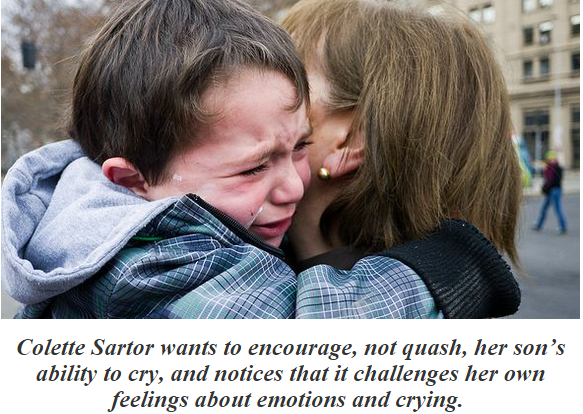
sartor_article

My son didn’t cry on his first day of preschool; he cried on his thirtieth. The school was a tiny, progressive place that took a surprisingly stern approach to drop offs: Say goodbye and leave. No looking back or lingering. This was fine by me. I hate to cry in public, and I knew I might, which would scare my three year old and make him cry.

So, that first day, I watched him cautiously pile blocks for a few minutes, then I told him I’d pick him up later, kissed him, and left for work. He barely glanced up. He was absorbed in the newness of everything: new kids, new toys, new sights and sounds and smells.

Every day that month, I repeated the routine. I’d briefly watch him play, kiss his cheek, and leave. Every day, I breathed easier. “He loves his new school,” I told people. How well adjusted he is! How happy! Yay him! Yay me! I thought. Then, on the thirtieth day, he raced to me with outstretched arms. “Mommy, stay!” he sobbed. I gathered him up, buried my face in the talc of his hair. “I’ll be back, honey, don’t worry,” I whispered before his teacher gestured to hand him over. He cried and reached for me, struggling to extricate himself from the teacher’s grasp. “Just go,” she mouthed over his head. I nodded and walked out, my own tears streaming as he sobbed behind me.

♦◊♦
When I was growing up, our family motto was, “If you want to play with the big dogs, don’t piss like a puppy.” Which meant no crying.
♦◊♦

My son cries easily. He gets it from me. I cry over life insurance commercials, sappy movies, real and imagined slights. I usually hide my tears, even from him. When I was growing up, our family motto was, “If you want to play with the big dogs, don’t piss like a puppy.” Girls were puppies by default. They showed the world when they hurt. They cried. To play with the big dogs, girls had to be tough. Which meant no crying. So I learned not to cry. At least, not in public. Still, I try not to discourage my son from crying. I love his sensitivity. I love that he cries when a friend is hurting, that he cries when he feels he’s being treated unjustly, that he cries at all.

See more at: http://goodmenproject.com/featured-content/why-i-am-teaching-my-son-that-tears-take-courage-jnky/#sthash.FTqEhBGI.dpuf

“Fragile Heart”

A friend sent me this video. Have the tissues ready. 😥

Lyrics:

There’s no place for a sensitive soul
In a space where your ego freely roams
And you’re a little bit narcissistic
And I’m a little too understanding, sadly
So you held me like your rose
Only to watch me whither slowly

But there’s no hope for the weaker minds
This, I know

You can’t take me down
For my fragile heart
I’ll start over now
With my fragile heart

Portrait of a non-disordered HSP.

authenticity

It’s a sad fact that many HSPs (highly sensitive persons) develop personality disorders and elaborate defense mechanisms like NPD or BPD just to cope with the world because they feel like they have no normal defenses against being hurt or abused. The double whammy is that so many HSPs have disordered parents who scapegoated or abused them, just because they can see the truth about their parents’ malignancy through their mask of sanity. Of course, this makes it even more likely for an HSP to develop a disorder where they successfully or unsucessfully attempt to hide their high sensitivity (true self). High sensitivity/vulnerability is a wonderful quality and is needed in this unfeeling world, but is not well understood or accepted in a narcissistic, materialistic society. HSPs who have developed NPD or BPD or some other personality disorder are not happy people.

Having the gift of high sensitivity is especially hard on children, who tend to be easily bullied at school, even if their parents are accepting and loving, because these qualities are seen as “weak” or uncool by other kids and sometimes teachers too. Also, since children are naturally narcissistic, HSP qualities in a child tend to manifest as being easily offended or hurt. A child hasn’t yet learned to use their gift of sensitivity for good purposes or to help others. So an HSP child can easily develop a personality disorder, even if it’s less severe than a child who has been abused from early childhood.

But there are rare people who are highly sensitive who seem to come through childhood and adolescence unscathed. I’d like to talk about one such person. It was a young woman I knew at one of my old jobs. Her name was Meghann. I don’t think I’ve ever met a person so attuned to life, so in touch with her emotions, so accepting of others, and so joyful.

Meghann was physically beautiful but never seemed that conscious of her appearance. She dressed casually and wore very little make-up, but she didn’t need it. While not classically beautiful or what most would call sexy, Meghann’s beauty came from within. Enhancing her natural beauty with cosmetics or baubles would be like gilding the lily (although I did see her dressed up on occasion and thought she was equally stunning).

I trained Meghann when she was a new employee at a call center I used to work for. I liked her immediately; so did everyone else. She learned quickly and was quick to laugh but never AT anyone. She just laughed because she found humor in just about anything it was possible to find humor in, and that included herself.

Meghann had a way of attracting people to her. Both men and women loved being in her presence, because it was so loving and positive. Not obnoxious-positive, in the sense of fake-perky “positivity nazis” that pervade our society, but she had a subdued optimism and there was a kind of glow that seemed to emanate from her whenever she walked into a room.

Meghann was one of those rare nice people who rises quickly through the corporate ranks. I’ve found in most places I’ve worked, the most narcissistic and cold people seem to get ahead, but Meghann was so smart, likeable and good at her job that she was promoted to a supervisory position within 6 months of my training her.

As a covert narcissist, I was envious at first. What was this? I had trained her! As it always seems to be for me, I was still stuck in my low level job; no one would promote me there, and this–girl–who was young enough to be my daughter had moved way ahead of me and in such a short time. In fact, she was to be my new supervisor!

But it was strange too–I really didn’t mind. Somehow I was able to forget about my envy because she was just such a genuinely sweet person and I loved her too. You just couldn’t stay angry or envious of someone like that for long. And, I had to admit, she had done everything to deserve her promotion. I realized I was actually happy to be working under her and I told her so. I was rewarded with a dose of supply because she told me that if it wasn’t for me, she wouldn’t have been where she was,because I had been such a great and patient trainer.

authenticity2

Meghann laughed a lot but it was always a musical, natural laugh, never forced or fake, and she never laughed at people in pain or at tragedies. She laughed at herself as well as at all the absurdities the world has to offer if you just look for them. When Meghann laughed, people gathered around her to feel her joyful presence and be touched by it.

But Meghann was also very emotional. She was often in tears, not because she was sad or depressed, but because she felt everything so deeply. It wasn’t unusual for her eyes to become damp when she listened to you talk about some sad thing that happened to you, or even tear up when she was happy. I remember when she had her 26th birthday, and the department had all gone out on gifts and a cake (and we really meant it), she was smiling radiantly and wiping away tears at the same time. Even I felt myself responding and wanted to run up and hug her (I didn’t). She just had that effect on people. I don’t know one person who disliked her. She could tame even the nastiest, most envious people because of her joyful and accepting presence.

Meghann had many artistic talents where she freely expressed who she was. She could sing, paint, and take beautiful pictures. She made a lot of her own clothing which was original and beautiful. She was a person who knew exactly who she was and wasn’t ashamed to show it. You could tell she had enormous self confidence, but it never came off as arrogance, entitlement or grandiosity. In fact, most of the time Meghann was very humble. Not self-flagellating or fake-humble–she just never acted like she was somehow better than you or more deserving. She even blushed adorably whenever she was the center of attention (which was a lot) because she couldn’t hide her true feelings and didn’t try to either.

Meghann wasn’t happy every day. As a sensitive person, she felt everything, and sometimes the things she felt made her cry. When she was sad, everyone knew because she was quieter than usual and stayed in her office. But she was still approachable and never took out her depressed moods on other employees. You knew she’d been crying because her eyes and nose were pink, but she was never over the top about it and never sank into self pity or whining. She just felt her emotions and moved on.

I was in awe of Meghann. I couldn’t stay envious of her, although I had every reason to be (especially because she had been raised in a happy, normal family by loving parents–and I tend to be envious of people who had that). When she finally quit to move to another state, I almost cried along with everyone else. I couldn’t hate Meghann because in her, I saw the kind of person I think I could have been had my high sensitivity not been used against me as a young child and forced me to turn against it and try to be someone I never was.
My memory of Meghann still inspires me, because I want to be like that. I think I’m already halfway there.