The day Sam Vaknin knew he was a narcissist

Vector illustration of a man lock up in prison

I’m going to go ahead and confess part of the big secret that I alluded to in an earlier post. I’m writing a book about Sam. I can’t say too much else about it right now because the book’s focus hasn’t completely gelled in my mind yet. Right now I intend for it to be a biography, focusing on NPD from the inside–that is, what the disorder FEELS like. Sam is a controversial figure, and has enemies within the narcissistic abuse community and even more so among professionals who specialize in NPD (mainly because in their minds he lacks the proper qualifications), but there are also a great many people he has helped–even if helping wasn’t his intention, which it most likely wasn’t if he really is the malignant narcissist he says he is.

I took on this project because I need to come to my own conclusions without being influenced by others, either positive or negative. I do feel like Sam’s been more maligned that he deserves over the brouhaha over his “paper mill” degree, among other things. He’s an interesting character, and to my way of thinking, deserves to have a book written about him. I realize it will probably be a small market, but that’s okay–his story needs to be told. I also realize this will most likely be a feast of narcissistic supply for Sam, but I can live with that. Of course, I’m not going to sugar coat anything–but narcissists even consider negative attention to be satisfactory supply. In fact, some even prefer it. I think my book will be balanced, and there are good reasons to defend him from his haters but there are many things I don’t know about him yet either. If he’s really that malignant, I could wind up hating him myself when I’m done with this project. Or maybe not. Whatever happens, I know it will be very educational and mind-expanding and I feel that one way or another, writing this book will change me in some profound (and good) ways.

So anyway…Sam gave me the go ahead for this project after I emailed him wanting to do it. I’m trying to figure out how to go about getting an interview with him (I would have to go to Macedonia), but for the time being, I emailed a woman who did interview him who has some tapes and who may be able to share those with me. I’m waiting for a reply. Sam also sent me a long list of links to his writings, most which I have never seen before but which are publicly available here. These are his personal journals, poetry and short stories. I have a lot of reading to do!

Sam’s disordered mind fascinates me because he has two qualities in spades that both fly in the face of the typical narcissist (and he insists he is a malignant narcissist; of that I still have my doubts but that’s another thing I need to find out on my own): he is completely and brutally honest, and he has incredible insight into his disorder.

I’ve rambled on long enough about why I want to write this book. In reading Sam’s journal entries, I came across this one that left me gutted, breathless and nearly crying. It’s hard to wrap my mind around how a narcissist–a machine-like being with the inability to feel–can write about themselves with so much raw and searing emotion. There’s something else going on there. He’s a wicked good writer, but I believe with the certainty that the sun will rise tomorrow that there’s not one shred of fiction in this journal entry. I can smell bullshit from a mile away by now, and there’s no bullshit here. For the record, Sam’s poetry is just as gut-wrenching as his prose.

It’s about the day he became aware he was a narcissist. Until that day he had no insight into his disorder; he gained all his insight after the incidents leading up to that day. In some ways, the way he describes it, NPD seems much like a dissociative disorder, like MPD (multiple personality disorder). I have written before about how taking away a narcissist’s supply would send them into a “narcissistic crisis” of severe depression, forcing them to confront their own emptiness, which in turn results in emotional catharsis; this is exactly how it happened here for Sam.

Unfortunately, he got to that point, but was either unable or unwilling to seek further treatment to attempt to rewire his brain to have empathy or a conscience. A cure may not be possible. Maybe you can’t retrain the adult brain to have a conscience the way it was done for a child like Beth Thomas; I just don’t know. That’s one more thing I need to find out more about. I sure have my work cut out for me.

How I “Became” a Narcissist

prisonman2

I remember the day I died. Almost did. We were in a tour of Jerusalem. Our guide was the Deputy Chief Warden. We wore our Sunday best suits – stained dark blue, abrasive jeans shirts tucked in tattered trousers. I could think of nothing but Nomi. She left me two months after my incarceration. She said that my brain did not excite her as it used to. We were sitting on what passed as a grassy knoll in prison and she was marble cold and firm. This is why, during the trip to Jerusalem, I planned to grab the Warden’s gun and kill myself.

Death has an asphyxiating, all-pervasive presence and I could hardly breathe. It passed and I knew that I had to find out real quick what was wrong with me – or else.

How I obtained access to psychology books and to Internet from the inside of one of Israel’s more notorious jails, is a story unto itself. In this film noire, this search of my dark self, I had very little to go on, no clues and no Della Street by my side. I had to let go – yet I never did and did not know how.

I forced myself to remember, threatened by the immanent presence of the Grim Reaper. I fluctuated between shattering flashbacks and despair. I wrote cathartic short fiction. I published it. I remember holding myself, white knuckles clasping an aluminum sink, about to throw up as I am flooded with images of violence between my parents, images that I repressed to oblivion. I cried a lot, uncontrollably, convulsively, gazing through tearful veils at the monochrome screen.

The exact moment I found a description of the Narcissistic Personality Disorder is etched in my mind. I felt engulfed in word-amber, encapsulated and frozen. It was suddenly very quiet and very still. I met myself. I saw the enemy and it was I.

The article was long winded and full of references to scholars I never heard of before: Kernberg, Kohut, Klein. It was a foreign language that resounded, like a forgotten childhood memory. It was I to the last repellent details, described in uncanny accuracy: grandiose fantasies of brilliance and perfection, sense of entitlement without commensurate achievements, rage, exploitation of others, lack of empathy.

I had to learn more. I knew I had the answer. All I had to do was find the right questions.

That day was miraculous. Many strange and wonderful things happened. I saw people – I SAW them. And I had a glimmer of understanding regarding my self – this disturbed, sad, neglected, insecure and ludicrous things that passed for me.

It was the first important realization – there were two of us. I was not alone inside my body.

dualman

One was an extrovert, facile, gregarious, attention-consuming, adulation-dependent, charming, ruthless and manic-depressive being. The other was schizoid, shy, dependent, phobic, suspicious, pessimistic, dysphoric and helpless creature – a kid, really.

I began to observe these two alternating. The first (whom I called Ninko Leumas – an anagram of the Hebrew spelling of my name) would invariably appear to interact with people. It didn’t feel like putting a mask on or like I had another personality. It was just like I am MORE me. It was a caricature of the TRUE me, of Shmuel.

Shmuel hated people. He felt inferior, physically repulsive and socially incompetent. Ninko also hated people. He held them in contempt. THEY were inferior to his superior qualities and skills. He needed their admiration but he resented this fact and he accepted their offerings condescendingly.

As I pieced my fragmented and immature self together I began to see that Shmuel and Ninko were flip sides of the SAME coin. Ninko seemed to be trying to compensate Shmuel, to protect him, to isolate him from hurt and to exact revenge whenever he failed. At this stage I was not sure who was manipulating who and I did not have the most rudimentary acquaintance with this vastly rich continent I discovered inside me.

But that was only the beginning.

Narcissists and cleanliness

joancrawfordwirehangers

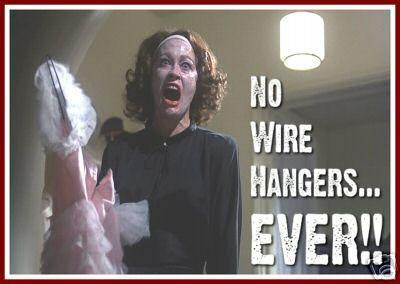
I read an interesting post about Joan Crawford over at Five Hundred Pound Peep’s blog. Crawford was definitely a histrionic malignant narcissist even though most sources say she had BPD (another Cluster B disorder that can mimic and is easily confused with the histrionic form of narcissism). The issue of Crawford’s obsession with cleanliness and order was raised.

There seem to be two kinds of narcissists: those, like my ex, who are complete slobs who refuse to lift a finger around the house and expect everyone else to pick up their mess for them; and those, like my MN mother (and Crawford), who are obsessed with cleanliness and order.

I’m going to talk about the second type.

My mother’s house was like a museum–it was all for show. Even magazines on the coffee table were forbidden because it was “clutter.” Family photos were consigned to bedrooms only because she felt they looked “tacky” in public rooms. She vacuumed, scrubbed, polished and dusted every day, in addition to hiring a weekly housekeeper to keep things spruced up. She invaded boundaries too–every day she came into my room (without knocking of course), and would start straightening up and criticizing my teenage sloppiness. She’d go into my closet and rearrange my clothes, making it hard for me to find what I was looking for (because I had everything in an order that made sense to me). When cooking, she’d wash dishes while she cooked, so there were no dishes inthe sink after dinner (actually, I picked up this habit from her and do it myself).

My mother loved beige, white and eggshell. Everything in the house was in those boring colors, with no bright spots of color to liven things up. I read somewhere once that beige is the devil’s color, not black. I think that person was onto something. I hate beige. It’s the most boring color on the planet. Is it even a color at all?

The glass tables in the living room with their chrome legs and edges were spotless and free of any clutter: what was the point of having tables at all if you weren’t going to put anything on them? The television was tucked inside a cabinet because a visible TV in the living room was gauche and low class and offended my mother’s upper class pretensions.

Even our Christmas tree (after my parents divorced) would be decorated in white lights only, with red and silver balls and bows–no other colors or shapes allowed. She always hated the colored lights, tinsel, and varied ornaments my father bought for our tree when they were still married. Me? I happen to love lots of colored lights. Tacky or not, they seem much more homey and Christmassy to me than the all-white lights you see in offices and banks. Another thing she did after their divorce was refuse to hang any ornaments I had made at school, because again, they were too tacky. My father, though certainly far from perfect, always took pride in my childish little creations, and proudly hung them from our tree, while my mother held her nose in distaste.

whitelights

When company came over, she became an obsessive basketcase, zooming through the house with the vacuum and duster, and woe to you if you didn’t match her level of obsession and jump in and help out.

But of course, it was all for show, intended to impress. Narcissistic cleanliness is another way they can control everyone around them. I also think it’s an unconscious attempt to hide the “dirtiness” inside them. That’s why they’re so obsessed with it and rage whenever they see dirt or disorder.

I’ve also noticed how many of them (especially women, but some men too) are obsessed with bodily functions. I’ll warn you right now we’re getting into the ick factor here, but I’ll try to spare you too much detail.

I’m acquainted with a narcissistic woman who told me she douches every day. Not just after intercourse or after her period, but every freaking day. I mentioned to her how unhealthy that is and how it can rob her vagina of healthy bacteria that prevents infection, but predictably, she looked at me like I was crazy and said I didn’t know what I was talking about.

I know other narcissists (both men and women) who are obsessed with keeping their bowels clean. They are big fans of enemas, cleansing drinks, diuretics, fasting, and laxatives. They obsess over these things and even talk about their rituals in public, with no sign of embarrassment. If you know someone who goes in for colonic irrigation sessions on a regular basis, and then talks about it to everyone as if they were discussing the weather, it’s a good bet they’re a narcissist. I had a narcissist boss once who made his colon cleansing sessions a regular topic of conversation and would describe the process in the most intricate, intimate detail, even in front of customers. He didn’t care who heard and seemed to want everyone to know about it. The ick factor was off the charts with that one. It made me want to throw up.

Cascade Treatment

They’re also obsessed with their children’s bowel functions. This is a little embarrassing but I’ll talk about it anyway because it’s so typical of the type of abuse (and it is a form of abuse) some children of narcs are forced to put up with.

When I was a child, my mother obsessed over whether I had a daily BM. If I skipped a day, out came the big rust-red rubber enema bag with its snakelike black hose. It was an adult sized contraption and not meant for children, but she’d fill that unholy thing up all the way with soapy water and make me lie down on the bathroom floor on a towel while she shoved that thing into me.

Of course it was extremely painful and my small body wasn’t equipped to hold all that water. If I cried or had an accident, she’d get mad and shove that medieval instrument of torture up me even more and hold my butt cheeks together with her cold hands, her long sharp nails digging into my tender buttocks like thorns from Hell.

It was much worse than the yardstick or any other punishment ever inflicted on me. I developed terrible constipation due to my terror of that thing, but of course that just made the enemas even more necessary and frequent. When it wasn’t in use, that evil device hung on the back of the bathroom door, facing the toilet, like a constant threat of what would happen if I didn’t produce.

You see, I wasn’t a real person, but merely an extension of my mother’s mask of narcissistic perfection, her little baby doll she could do whatever she wanted to with, her mini-me. Like an infant, she couldn’t seem to tell where she ended and I began. She obsessed over my hair, my clothes, my weight. She dressed us in mother/daughter matching outfits. In the morning before school she made me sit at her dresser while she took a hard bristled brush to my fine hair that tended to tangle and form knots. If she couldn’t undo a tangle, she’d angrily yank it out, making me scream in pain while my scalp felt like it was on fire.

matchingoutfits
Mother-daughter outfits like these were the rage in the ’60s, but were tailor-made (pun intended) for mothers like mine who wanted to make their daughters into their own image.

When I was five, she decided she wanted my fine, straight hair to be curly. So she gave me a home permanent and while rinsing my hair under the kitchen faucet with a glass milk bottle, the bottle accidentally slipped from her soapy hands and broke. A shard of glass buried itself into my forehead, and I had to get stitches. She didn’t try to perm my hair again after that but always complained about how flat it was and insisted on keeping it short.

I never got to choose my own clothes until my teens. Until I started going to Catholic school and had to wear a uniform, she’d lay out the clothing she had chosen for me to wear the night before. Most of the time it was some frilly frock I hated. But if I complained, I was immediately silenced. I wasn’t allowed to be myself, have opinions, or an identity of my own. All she cared about was the image I presented to make her look better in her own mind.

As a teenager, I rebelled by wearing the sloppiest, grungiest clothes I could find, refusing to have my hair cut and styled (even though I really don’t have the type of hair that looks best when it’s too long because it’s so thin), and even gaining weight on purpose just to spite her. I wore a lot of black even though it wouldn’t be fashionable for another few years (I probably would have been a Goth kid had I been a few years younger) because my mother hated black. Part of this was normal teenage rebellion (and in the ’70’s, dressing in unisex, sloppy clothes such as workshirts hanging over beat up jeans was the fashion) but for me it was also a way to say “fuck you” to my mother’s obsession with image at the expense of my growth as an individual.

Obsessive housekeeping and obsession with their own and their children’s bodily functions is another way narcissists can exert control and dominance, as well as a desperate and sad unconscious attempt to hide or try to “clean out” their own spiritual filthiness.

Can narcissists feel empathy for fictional characters?

clown1

There is a question I have wondered about for a long time that was brought up on another post.

Narcissists are exquisitely sensitive. They are very easily hurt. But their hypersensitivity is limited to themselves (this is called narcissistic injury). Any insult, no matter how minor, will send them flying into a narcissistic rage or cause the “needy” type to break down like the babies they are.

But as we all know, when it comes to others, they have no empathy. They cannot feel your pain, share your sadness, or rejoice with you. On this level, they are incredibly insensitive.

But there’s something I wonder about. Because narcissists are “fictional people” themselves (what you see is not their true self but a mask), can they feel empathy for fictional people, such as characters in a sad or touching movie? Can they cry when reading a sad book or when they hear a sad song?

I’m leaning toward yes, because my MN mother never could feel pain for anyone but herself (and never expressed even her own narcissistic injury in any manner other than rage), yet I remember she could cry a river of tears when we went to a sad movie or watched a touching love story on TV. Hell, she could even turn on the eye-faucets when a maudlin commercial came on. My N ex used to get all weepy when he watched sad movies too.

For a narcissist, it’s “safe” for them to feel empathy for fictional characters on a movie screen or in a book, because those are not real people. There’s an interesting article written on the blog Let Me Reach by Kim Saeed about this subject, in which the author concludes that narcissists definitely do cry at movies, and it has to do with cognitive dissonance. Read Kim’s article for a more in-depth look at how this works for narcissists, because she explains it much better than I do.

Joel Osteen worships himself.

joelosteen

I found this intriguing article at Salon.com about the famous megachurch leader, Joel Osteen, a proponent of the peculiarly American “prosperity gospel,” a belief that God will reward you with material wealth if you are a True Believer. The article is a bit old, but is still relevant and I never saw it before, so, well, it gets added to the Museum of Narcissism.

If Mr. Osteen makes people feel better about themselves, fine, but Mr. Osteen is like a heroin addict getting his fix of narcissistic supply from his many followers, who worship him as if he were God himself. Frighteningly, Big Religion is full of such people who really only care about their own glorification.
What would God think?

Here is the article (written by Chris Lehmann at Salon.com):

If history is told by the winners, then Joel Osteen — the relentlessly upbeat spiritual caretaker of the national attitude — is history’s designated chaplain. In a marathon Sunday faith rally in the heart of the nation’s capital, Osteen, who presides over America’s largest megachurch congregation, the nondenominational Lakewood Church in Houston, exhorted the tens of thousands of believers amassed in Nationals Stadium to “live in victory,” to seize their “destiny moments,” and to fulfill God’s plan for their personal, financial and emotional success.

The Washington rally — billed as “America’s Night of Hope” — had gone a bit afoul of its own victory plan, however. It had originally been scheduled the night before, but as a persistent afternoon drizzle gave way to some spirited cloudbursts, the event’s organizers rescheduled it for the following afternoon. As I approached the centerfield box office outside Nationals Park on Saturday, the marquee overhead bore what had to be the glummest rainout announcement of the young 2012 baseball season: “Night of Hope postponed until 4 p.m. Sunday.” And since the Osteen message involves a lot of merchandising, the imposing tables hawking T-shirts and other commemorative swag seemed suddenly off-kilter. One prominent Night of Hope T-shirt was emblazoned with the inspirational divine message “I can do all things” — all things, that is, but summon the faithful to stand out in the rain.

But the Osteens were not about to let the intervention of the elements become any sort of setback. As the megachurch pastor — turned out in a blue suit and a beatific grin, looking for all the world like a fitter Tim Allen, fresh out of rehab — took his spot at the second-base perimeter of the infield, before the bank of TV cameras set up on the pitchers mound, he called out, “Isn’t it great to be here? It’s another great day the Lord has made!” He paused to note that, yes, “we had some rain last night,” but that the event’s reshuffled schedule could well mean that some people who couldn’t have made the evening version of the prayer gathering might well have turned up serendipitously today. In any event, Osteen declared his certitude that “God put the right people here right now.”

That confident assertion of — and indeed, identification with — the divine will is one of the calling cards of the Osteen faith. Amid all the spirited self-affirmations and folksy homilies that stud an Osteen sermon, it’s easy to miss the oddly deterministic invocations of divine prerogative summoned up by the preacher, who belongs to the “Word Faith” tradition of Pentecostal belief. Osteen’s serene depictions of God’s eternally uptending designs for the fates of individual believers are a sort of inverted Calvinism. Where the Puritan forebears of today’s Protestant scene beheld a terrible, impersonal Creator whose rigid system of eternal reward and punishment dispatched many an infant and solemn believer to the pit of damnation, Osteen’s God is an intensely personal presence, guiding believers out of pitfalls into inevitable glory and joy — not so much a raging Patriarch as a genial cruise director. “God’s dream for our own life is so much bigger than our own,” went one frequent refrain at the D.C. rally. “Let’s not put any limits on God.” Osteen characterized the Deity as a “running-over” and “abundant” God. “Have you ever been to a fast-food restaurant, and they ask you if you want to supersize this? Well, God is a supersizing God,” who is determined, Osteen assured the crowd, to “supersize your joy.”

It stands to reason, in this arrangement of cosmic fate, that the stubborn human weakness for anxious introspection and downbeat self-doubt is something of an affront to the author of being. “When you are criticizing yourself,” Osteen announced, “you are criticizing God’s creation. The next time you think something negative, turn that around, and say, ‘I am God’s masterpiece.’”

The talismanic faith in positive utterance is another key article of belief in the Word Faith tradition. Some Word Faith devotees are devout believers in faith-healing, and one of the key episodes Osteen cites in his own account of his faith journey is the miraculous recovery of his mother from an apparently terminal case of liver cancer in 1981. Faced with the prospect of losing his mother, the young Osteen — then a communications student at Oral Roberts University with no ministerial ambitions — turned to prayer, saying to God, as he now recounts, “I know you can do what doctors can’t do, what medical science can’t do.” Sure enough, Osteen’s mother, Dodie, went on to be cancer-free, and took to the podium on Sunday after her son’s testimonial. She reprised the story of how she fought off the specter of death by seeking out the “most healing” passages of scripture, which she assembled into a digest she still consults regularly: “Like American Express, I don’t leave home without it,” she said. Then she issued a disclaimer for her listeners contending with severe illness: “I don’t advise you not to seek treatment — get treatment any way you can.” Such cautions sounded a bit rushed and legalistic next to her own account of her recovery: When she and her preacher-husband both sensed the end was near, she recalled, “We lay on our faces … He said, ‘I need you, the church needs you, the children need you … And now, almost 31 years later, I won the battle and so will you!” God, after all, “delights in answering the prayers of his children,” and “loves everybody the same, but he can do for you what he did for me.”

The Word Faith image of the wonder-working, healing God is discomfiting to ponder, and not just because he might tempt desperately sick believers to go rogue beyond the dictates of medical science. The constant recitation of God’s transcendent goodness and the deference paid to his ironclad ability to lift believers magically out of suffering and woe both subtly downgrade the divine presence into a glorified lifestyle concierge. This God has no real way of accounting for the age-old paradoxes of theology, such as the tolerance of personal and historic evil, or the deeper ironies and unintended consequences of the believing life. Even less does the Osteen family’s success gospel encompass a sustained social ethic — even though the D.C. event featured an appeal on behalf of the World Vision ministries to adopt a needy child in the developing world. The believer’s chief task is to ratify the preexisting divine script of success in his or her individual life — and then to bear testimony to that joyous transformation in a community of like-minded success believers.

It’s a curiously childlike vision of faith — a point driven home in a homily offered up by Joel’s wife, Victoria, who serves as a kind of co-pastor of the separate domestic sphere at the couple’s revival meetings. When she finds herself assailed by cares, anxieties and negative thoughts, Victoria reported, “I visualize a bouquet of helium balloons in my hands, and I literally hold those balloons out and release them to the heavens … And as I release those balloons to Him, I say, ‘I may not have the power to change my circumstances, but God has that power to change our circumstances.’” In a later homily on the properties of unconditional love and forgiveness, Victoria delivered an extended gloss on what was apparently one of the few remotely traumatic moments in her suburban Texas upbringing — a time when, as a freshly licensed driver, she had taken out her dad’s car and negligently instructed a friend to roll down a passenger-side window that was malfunctioning, thereby breaking it once and for all. When she finally summoned the nerve to fess up to her dad, she found him to be disappointed but gloriously forgiving; he “didn’t judge my future from that one mistake” — and neither will the indulgent dad of the Osteen heavens. “You may not have been shown unconditional love in your life,” Victoria announced, “but God loves you unconditionally.” The problem, of course, is that even those of us who did survive unhappy childhoods are no longer 16 — and as a result, we need a God who can meet the challenges of the new responsibilities we’ve taken on as we’ve matured, not a figure of undifferentiated sentiment, handing our forgiveness and love like lottery tickets.

The other childlike quality of the Lakewood account of divine grace has to do with the past — which, together with negative thinking, represents the closest thing to evil in the Osteen’s scheme of salvation. The past is bad because it mires believers in remembered hurts and slights, and thereby obstructs God’s grander design for their lives. “When we hold on to the past, when we don’t go to God, that just puts more baggage in our suitcases,” Victoria exhorted, in a not-altogether-wieldy metaphor.

This spiritual hostility to the past was an all too frequent refrain in the event’s musical selections — a monotonous offering of anthemic, bombastic Christian rock, all composed without the benefit of a single minor chord or any discernible melody. “I’m moving forward,” went the lyrics to one of these intra-sermon studies in Journey-esque hymnody. “I’m not going back / I’m moving ahead / I’m here to declare to you that the past is over.” An American idol contestant named Danny Gokey also offered testimony about how the Osteens had helped him conquer his depression in the wake of the untimely passing of his wife. Gokey then performed a Christian rock number of his own, “My Best Days Are Ahead of Me,” which seemed to make short work of his once-debilitating grief: “I don’t get lost in the past or get stuck in some sad memories,” he sang, rather creepily; the song’s bridge announced that “Age isn’t nothing but a number,” and then resolved on a Successories-style upgrade of a well-known Army recruiting slogan: “If I keep getting better / I can be anything I want to be.”

There’s a term from the psychiatric clinics that neatly captures the outlook of someone possessed of grandiose fantasies about the imperial reach of the self, and a principled refusal to acknowledge anything poised to diminish such fantasies — such as the passage of time. That term is “narcissistic personality disorder,” and it does nothing to detract from the positive features of the Osteen gospel — the injunctions to persevere in the face of adversity, or the appeals for donations to World Vision — to note that this is a system of faith tailor-made to sustain narcissistic delusion. To grasp the overweening self-absorption of the Osteen faith, one need look no further than the frequent recourse Osteen makes to his own success story in sealing the case for God’s providential plan for the believer’s own life. Now, unlike other well-known evangelists, Osteen can’t lay much claim to a hardscrabble Horatio Alger-style life story. His 1920s forebear in Pentecostal media preaching, Aimee Semple McPherson, was a single-mother missionary before coming into fame and fortune as an evangelical celebrity in the Radio Age; Billy Graham was the son of a poor North Carolina dairy farmer. Osteen, by contrast, was a second-generation evangelical leader, who’d been working as a TV producer for his father John Osteen’s growing ministry before he succeeded to the elder Osteen’s pulpit after his father’s death. His personal biography tracks closer to fellow Pentecostal TV preacher Pat Robertson’s background: Robertson was the son of a U.S. senator before finding his own adult spiritual calling.

Nonetheless, Osteen repeatedly cites his own success presiding over the spiritual flock he inherited as the prime exhibit of God’s ready transposition of divine grace into worldly success. When he first acceded to the pulpit, he recalled from his riser above second base, he felt no special aptitude for ministering; he’d heard that Lakewood church leaders were raising doubts about his vocation, and the church needed to move into a bigger, upgraded new facility. “At one point,” Osteen preached, “it seemed like everything was coming against me. The enemy was fighting me not from where I was coming, but from where I was going … He didn’t want Lakewood to be in the Compaq Center” — the former home arena for the Houston Rockets, and now home to the Lakewood congregation of nearly 50,000 souls. The Compaq Center deal is a frequent touchstone in Osteen’s faith reminiscence; it occupies a good stretch of his blockbuster best-selling self-improvement tract, “Become a Better You,” which also finds evidence of divine favor in a home-flipping deal Joel and Victoria struck at the height of the housing bubble, as well as in such mundane votes of divine confidence as setting the pastor up with a premium parking space. Indeed, the steady parade of testimonials from the wider Osteen clan on the Night of Hope risers bespeaks a family-wide penchant for casting one’s commonplace personal biography as a sort of infomercial version of the Christian faith. (In addition to mother Dodie and wife Victoria, Osteen’s brother Paul, who runs a medical charity in Africa, took to the stage Sunday to relate a more responsible story of healing, in which due medical diligence properly preceded the broader appeal to faith; Joel’s two children, Alexandra and Jonathan, are respectively a vocalist and guitarist in the ministry’s Christian rock ensemble.)

Now, it may very well be that in a certain kind of conviction of grace, believers feel themselves suffused with the divine presence, and find their most quotidian activities reflect celestial favor; the 14th-century Saint Julian of Norwich recorded a vision in which she beheld the entirety of creation in an object no larger than a hazelnut, cupped in her hand. Perhaps, in this view of things, a converted sports arena or excellent parking spot is no great stretch when it comes to testifying on behalf of a God for whom all things are possible.

Still, the claustral feel of Osteen’s success gospel paradoxically works exactly the same effect that he warns believers to resist: It imposes limits on God, by largely confining his workings to the dominant American culture of success. If the Osteen-coached believer does not reap abundant and large reward in career, family life or creative pursuits, they are not necessarily going to curse their God, as Job’s comforters had counseled him to do amid his notorious personal setbacks. But neither are they going to make the key connections that earlier Protestant divines have preached, going back to Jonathan Edwards and John Calvin: that the divinity does not, in fact, have your own personal happiness occupying pride of place on his exhaustive to-do list. The universe is ultimately about a larger set of concerns, and faith concerns a much vaster striving toward justice than believers are wont to see in their personal affairs, their social conquests or their annual paychecks. This is why Edwards, for all of his better-known hell-and-brimstone sermons, urged onto believers a stoic “consent to being in general” — not a plan for individual life advancement.

This disjuncture between Protestantism’s more humbling counsel and the feel-good Word Faith gospel became most painfully evident during one of Osteen’s closing perorations. In chilling detail, he recounted the story of a young Tutsi Christian woman who’d hid out in the bathroom of her church pastor’s office at the height of the 1994 Rwandan genocide. The machete-wielding Hutu killers who pursued her returned to the pastor’s office every day for 91 days, usually calling out for her by name. At one point, Osteen said, a Hutu militia man was poised to turn the knob on the door to the tiny bathroom where the woman was quartered alongside six other Tutsi believers — but at the last moment, he became distracted and walked away. Finally, when the genocide had been contained, the woman was free, and has been traveling with ministers ever since to testify to the amazing story of her survival. “Nearly 1 million Rwandans were killed in this genocide,” Osteen said as he wound up to the story’s larger moral. “It was very sad.”

Well, no. The Rwandan genocide was something far more than sad — it was a colossal failure of moral and political agency, going back to the German and Belgian colonial partition of the country that set up artificial power conflicts between the nation’s two main tribes. This horror also most certainly came about thanks to the wretched failures of the Clinton administration and other Western powers to arrest a well-documented string of massacres, even as senior U.N. officials such as Lt. Gen Romeo Dallaire, the leader of the agency’s Rwandan peacekeeping mission, implored them to.

For Osteen, of course, the story of this woman’s survival was a divine miracle. But if this one survivor was enjoying the loving favor of an omnipotent God, what are we to conclude that this same God thought of the more than 800,000 Rwandans murdered in the genocide? Was their faith wanting? Was God planning unparalleled new successes and joys for their surviving family members? Are these the people Osteen has in mind when he exhorts his listeners not to be victims, but victors?

It’s something of an obscenity even to frame such questions. Yet they are the inevitable outcome of a theology-free success gospel, pitched exclusively to tales of individual triumph. Osteen’s sermons all begin with a self-empowering chant from believers. “This is my Bible,” it goes in part; “I am what it says I am. I have what it says I have.” But there are legions of dead — now confined by definition, it’s true, in the hated past — who come bearing the testimony that the Bible is not actually about you.

A narcissist’s entitlement.

entitlement

It’s already happening.

I talked to my daughter’s friend Paul last night, and he sounded a little grumpy. Hypervigilant as always, in my black, paranoid mind I imagined my MN ex Michael, who just moved in Paul’s house a few days ago, had already convinced Paul I was an evil, treacherous, narcissistic, selfish female troglodyte not worth the time of day (because he projects all his character defects onto me), and that was the reason for the grumpiness. Of course! What else could it be!? Of course it was narcissistic of me to assume Paul’s grumpiness had anything to do with me anyway, but that’s how hypervigilant and paranoid an Aspie victim of narcissistic abuse can get.

Moving on, it wasn’t that at all. Of course it wasn’t. How silly of me to think it was. If I had a quarter for every time my stupid hypervigilance makes an idiot of me, I would be a wealthy woman instead of a poor one.

No, Paul was grumpy because of Michael. He asked me if Michael always acted so entitled, which caused me to burst into fits of uncontrollable laughter. I had already warned Paul the way Michael wanted what he wanted when he wanted it, and that he never lifted a finger around the house, expecting to be waited on like some sort of golden God. After the peals of laughter subsided, I asked him what happened.

Paul said Michael had offered to order Chinese food for dinner (with Paul paying, of course, because Michael was broke as always), so Paul gave him the money to give to the driver and didn’t cook anything. Then Paul went out for awhile, expecting Chinese food when he returned.

??????????????????????????????????????????????????????????????????????????????????????????????????????????????????????????????????????

Instead, when Paul returned at 9:30, he found Michael fast asleep on the couch. There was no Chinese food anywhere in sight. Paul woke Michael up and asked where the food was. Instead of apologizing and acting embarrassed, Michael said, “I thought you were picking up the food.”
“I gave you the money. Why would I pick up the food if I gave you the money?” was Paul’s reply.
The money was balled up in a wad on the table, next to a ashtray overflowing with cigarette butts, debris from Michael’s jeans pocket, and a pot pipe. Besides being lazy and entitled, Michael is also a slob.
Paul was angry.
“I thought you said you had to eat right away because of your diabetes. But here you are sleeping instead.”
“It’s not my fault. I should have eaten hours ago. When I don’t eat, I can’t stay awake.”
“But I gave you the money to order Chinese food.” He pointed to the money on the table.
“Well, SORREE, you don’t have to give me attitude about it. Go ahead and order it then.”
“That’s not the point. You said YOU were going to order it. I would have picked it up myself if I knew this would happen. Now they’re closed and it’s too late to go back out.”
Michael sat up and lit the pot pipe. “Here, have some pot. You need to chillax.”
“I DON’T WANT ANY DAMN POT. I’m hungry. I want something to eat.”
“Well, then why don’t you cook something?”
Paul looked at Michael like he had three heads. “No. I’m tired. You promised to order in but you didn’t. Why don’t YOU cook something?”
“I can’t,” whined Michael. “I have a headache because I haven’t had anything to eat.”
Paul stormed out of the room and went into the kitchen to start dinner, while Michael settled back down on the couch and switched on the TV.

The first thing Paul saw was a sinkful of dirty dishes, soaking in soapy water. When Michael leeched off lived with me for 7 years after our divorce, he probably actually washed the dishes three times in that amount of time. His idea of “washing dishes” meant piling them in the sink with water and Dawn, leaving me with the fun job of actually washing them. If I refused to wash them, they would sit there for up to three days, until the funky smell of the cold, dirty dishwasher forced me to start from scratch, emptying the sink and starting over.

washing dishes

Paul stormed back into the living room. “You said you would wash the dishes, but they’re still sitting in the sink.”
“But I have to soak them first. I filled the sink with soap to loosen the dirt.”
“But that’s not WASHING them.”
“Whatever.”
Paul wound up washing the dishes and cooking dinner. And that’s why he was grumpy.
I don’t expect Michael to last long there. He will probably be living at the Salvation Army again even before Molly returns home. I can tell Paul won’t put up with his shit for long.

The story is funny, but it’s also illustrative of the mindfuckery a narcissist uses to get their own way. As always, Michael refused to take responsibility or do anything he didn’t want to do. When questioned or called out on his refusal to pull his weight, he either shrugs it off as if others are making a big deal over nothing, or shifts the blame to the other person. Because that’s what narcs do best, even though in their deluded minds they think they are demigods entitled to have their servants wipe their butts every time they take a dump.

People with autism do not lack empathy!

autism

Autism and narcissism have a few things in common: First, they are both spectrum disorders. With autism, the spectrum runs from mild (Aspergers, colloquially known as “geek syndrome”) to full blown autism so severe the patient seems retarded and cannot even perform the most basic self-care or live without full time supervision. With narcissism, the spectrum runs from “benign” narcissism (people who are self-centered and vain but not completely lacking empathy or a conscience and don’t deliberately want to hurt anyone) to full blown malignant narcissism/psychopathy (which are basically one and the same).

Second, they are both at least partially (in the case of autism, probably totally) due to a miswiring or malfunction in the brain. One can be born without the ability to love or feel empathy (though abusive parenting does seem to exacerbate an inborn tendency), and almost all persons with autism were born with it (although there does appear to be a suspicious correlation between Aspies and narcissistic mothers, which probably exacerbates the Aspergers symptoms).

In one important way, autism and narcissism are mirror-images of each other. Narcissists cannot feel empathy for others, but can fake empathy quite well if they wish to. They can be very good actors. People with Aspergers (or mild autism) have the opposite problem. They can feel the emotions of others around them (very keenly in fact) but due to their inability to read social cues and difficulty acting “appropriately” in social situations, they can seem unempathic because they can’t express their emotions well.

Due to their difficulty showing empathy (people with Aspergers can seem aloof, cold or just awkward) it’s become popular to believe that people with Aspergers or autism, just like narcissists, do not have empathy. M. Scott Peck’s book “People of the Lie” is one of the best books I’ve ever read about malignant narcissism (it wasn’t called that when the book was first written in the early ’80s), but there was one thing that really bothered me: Dr. Peck used the term “autism” a number of times to describe the psychopath’s inability to feel empathy.

Nothing could be further from the truth. Here is an excellent article that makes mincemeat of this popular notion. If anything, people with mild autism/Aspergers empathize too much. I would even go out on a limb and say most of them are also Highly Sensitive People (HSPs). HSPs worry excessively about the impression they are making on others and whether or not they’ll be liked–and that sort of anxiousness itself can be socially disabling, even if no autism is present.

I’m sorry I keep bringing this up, but this is driving me crazy!

I just read a comment on this post, which really got me questioning things again.

owl says:
December 1, 2014 at 7:25 am (Edit)
I watched one of his videos tonight and learned that if the narcissist doesn’t involve himself with the public in some ways, it will lead to a much bigger psychosis; it will increase his psychopathy, he will become even worse. So my thought is that he is using his own desire to talk about himself as a way to involve himself in the world, a way to force himself to interact with people, thus setting up a stopgap and preventing a further slide into psychosis. He has already admitted that he has very few sadistic tendencies and in that way he has lucked out bc it could be worse.

I haven’t seen the video Owl has, but I have read the first 100 or so pages of Mr. Vaknin’s book, and must say I’m amazed by this man’s insight into NPD as well as his insight into its victims! After seeing how many pages of testimonials/qualifications are included in the book when I received it the other day, I decided once and for all he was a narcissist (and wrote a post saying so). But now I’m once again not so sure. I just can’t figure it out. He is such an enigma. I don’t know why it even matters but the mystery is driving me nuts.

Owl brings up the fact that Vaknin believes engaging with the public is a way to lessen psychopathic tendencies, and does so to avoid becoming psychopathic or more psychopathic. Which means there must be goodness in him, and possibly even empathy? I still can’t wrap my mind around his motives for writing a self help book for the victims of narcissists–does he have ulterior, dishonest motives, like greed, glory, fame, or just because he wants to show what an expert he is–or maybe it’s possible that he really does want to help survivors heal–which can only indicate the man has empathy! And if he has empathy, then how can he be a narcissist? Unless he’s a very low spectrum one.

Good Lord, I’m just so confused. I wish I could decide if he is or isn’t. I’ll tell you this much though: if Mr. Vaknin IS a narcissist, he must be getting so much narcissistic supply if he’s still reading everything I’ve written about him–and how many comments there have been about him–that I should probably stop this before his head explodes!

I’m a little embarrassed I’m obsessing so much about this thing which really doesn’t matter in the grand scheme of things, but as someone with Aspergers, we tend to do that!

Why do I feel so guilty?

guilt2

For my daughter’s 21st birthday she was informed a trust fund was being set up in her name by her grandfather (my father) but she would not be able to access it until she showed more maturity and interest in attending college. My daughter, feeling it was unfair that her brother got to access his right away (because he has made better choices and had “proven” himself) found a way to access the money anyway. Apparently there was some loophole she found out about (I have no idea how) where she could override the stipulations put on the fund. It wasn’t illegal what she did, but was probably unethical.

While I understood her feeling like she was being treated unfairly, at the same time I understood my father’s concerns and agreed with him she wasn’t mature enough to handle such a large sum of cash and it would have been better to wait until she was older.

We were right. She wasn’t ready to handle it. Within less than two months, almost all the money was gone and she can’t even really say what happened to it. My father’s wife (my “evil stepmother”) is impossible to deal with–cold, condescending and intimidating (although she does take good care of my dad). She is a narcissist who scares both me and my children to the point we are all hesitant to call my father. She acts as a kind of gatekeeper and talking to him means going through her first, so none of us ever call him, although we’d like to. She also intercepts any mail or email that is sent to him. Nothing gets to him unless it goes through her first.

Anyway, after Molly accessed the funds, my stepmother was so livid that she wrote me a letter letting me know she would never speak to my daughter again. I think her rage was not only due to my daughter’s dishonesty (anger which I can understand), but also because, as a narcissist, she hated knowing she’d been “outsmarted” by an upstart kid. My stepmother has always taken great pride in thinking she knows more than everyone else.

It’s incredibly sad that this malignant, heartless woman has managed to separate me and my children from my father (and their grandfather) through her intimidating, condescending words of judgment and disapproval. But that’s what narcissists do–they divide and conquer. Unfortunately this sort of thing is nothing new in my family: my entire family is splintered and fractured like a broken platter, with factions of relatives not speaking to or intensely disliking other relatives due to the rampant narcissism that runs like a cancer throughout the bloodline.

A few of us, such as my son, yearn for unity and healing in the family. My son, very touchingly, recently expressed to me his wish to initiate a huge family reunion one day when he can afford to do that. I didn’t want to tell him this would probably never work, since even if everyone attended (which everyone would not), the drama would be as thick as tar. He is so naive sometimes! But he has also made contact with some distant cousins that even I barely know through social media and is now good Facebook friends with one of them. I commend and admire him for this.

This morning I received an email from my father, which I’ll paraphrase. First of all he thanked me for my Thanksgiving wishes (I didn’t dare call him because I’d have to deal with his wife, so I just sent him an email). Next, he told me I would be receiving a check in the mail soon (I have no idea for how much). That made me wonder if he is about to pass on (no one in the family informs me of such things). After all, he is in his 80s and suffers from worsening Parkinson’s disease and is almost completely physically disabled. He also has had heart issues. His wife is his full time caretaker and narcissist or not, he would be in a nursing home without her. Although his mind appears to be intact, he sometimes has trouble translating his thoughts into coherent words, and he physically he is completely dependent on her.

Frankly, I was gobsmacked I would be getting anything at all. Although I believe he does love me in his own way, I was under the impression I was being totally cut out of any will (due mostly to his wife’s influence and her ability to turn others against me, the same way my real mother does).

But the next part of his email made me feel like I’d been punched in the stomach. In it, he said my daughter (his granddaughter) is a slimey, sneaky liar and will never change. He said his wife wants nothing to do with her (which I already knew but makes me wonder if he feels the same). While I already knew how my stepmother felt about my daughter, seeing the child I love described this way hurt me A LOT. I can understand their anger toward her, (and I myself have often wondered if she is a narcissist herself but I don’t think so) but seeing these words in print was not only horrible but also, inexplicably, made me feel overcome with guilt and shame. Sure, I wasn’t a perfect parent (and sometimes a pretty lousy one), but I tried my best. Her father is an MN and I believe he really did a number on her mentally. But I still feel guilty as if her behavior is MY FAULT. I feel a shame so deep I didn’t even answer his email — I simply didn’t know what to say.

Since my divorce, I’ve been in terrible financial straits. I work extremely hard and hate living like this, but due to my Aspergers, PTSD, and pervasive self esteem issues that keep me from being able to “pull myself up by my bootstraps,” I constantly struggle to just keep the bills paid, never mind having any disposable income to do the sorts of things that normal, middle class people do. So the news I will be receiving money that might relieve some of these problems should make me happy. *

But it doesn’t. It’s not because I don’t think I “deserve” an inheritance or gift, but because of how ashamed these two make me feel as a human being: ashamed for having a daughter who has “wronged” them and keeps getting in trouble and never seems to learn from her mistakes (although I think that is changing), as well as for other mistakes I have made that were unacceptable to them (such as allowing my MN ex-husband to move back in with me for 7 years, until I finally gained the courage to kick the malignant jackass to the curb last year). They are extremely judgmental people and judge me and my daughter harshly for our poor choices, but I have not gotten much credit for anything I’ve ever done right.

It’s very complicated and I can’t even talk about my feelings in a coherent way. I feel like I’m in some kind of emotional labyrinth I can never escape. It’s all so confusing. I feel so guilty right now and I don’t even know why. I long to call or write my father and ask him about his health (because I do love him and care very much) but am terrified of my stepmother’s interception and harsh judgment and how profoundly he’s been influenced by her. He may pass away soon, but I’m afraid I might not even be informed when that happens. Somehow, I feel like I’ve been bought off…maybe I am wrong. I can only hope.

But on the bright side, at least I can reassure myself that feeling this much guilt and shame means I have a conscience and am not a narc. Because sometimes I think I inherited the family disorder too.

guilt

I really need to stop caring so much what my FOO thinks of me. It really doesn’t matter, does it? I just need to approve of myself.

* This really didn’t belong in this article because of its focus, but I want to use the money (or some of it) to take classes in web design, CSS, SEO and how to blog professionally. I would love to be able to quit my day job to be able to write full time.

Followup: The email I wrote back to my father.

What Sam Vaknin thinks about Jesus.

He replied to my last article about what he says about Jesus Christ–twice.   Once again he had to clarify a few things by providing links. One of the links provided talks about religion being a perfect way that narcissists can make themselves feel superior to nonbeliever (even though they must “submit” to a higher entity than themselves). They hold their nose and submit to a God or messiah because of the narcissistic thrill of self righteously being able to claim their piety makes them better than everyone else. I’ve seen this sort of thing going on in 12 step programs like AA too. In fact, my mother uses the AA program exactly like a religion and loves to use its slogans and dogma (and yes, it does have a dogma) to prove how righteous and sinless she is compared to non-teetolalers and everyone else, especially me.

I agree with what Vaknin writes in his post. I’ve seen way too many fundamentalist or evangelical Christians use their religion to intimidate (“you are going to hell”), make themselves feel special (“I know I’m going to heaven”), make threats (“unless you do X…you will go to hell”), not take responsibility for their actions (“God told me to do this” or “the devil made me do it”), and show a lack of empathy (“It’s God’s will”) and not acknowledge your concerns or questions (“It’s right here in the Bible or other holy text). This is especially prevalent in religious leaders, but is quite common in other people too.

god

Let me add that not all Christians are like this, and narcissistic behavior definitely applies to followers and leaders of other belief systems too, even atheism! (Self righteous, intolerant atheists are commoner than you would think).

Here is what he writes:

For the Love of God

“1 But know this, that in the last days perilous times will come: 2 For men will be lovers of themselves, lovers of money, boasters, proud, blasphemers, disobedient to parents, unthankful, unholy, 3 unloving, unforgiving, slanderers, without self-control, brutal, despisers of good, 4 traitors, headstrong, haughty, lovers of pleasure rather than lovers of God, 5 having a form of godliness but denying its power. And from such people turn away! 6 For of this sort are those who creep into households and make captives of gullible women loaded down with sins, led away by various lusts, 7 always learning and never able to come to the knowledge of the truth. 8 Now as Jan’nes and Jam’bres resisted Moses, so do these also resist the truth: men of corrupt minds, disapproved concerning the faith; 9 but they will progress no further, for their folly will be manifest to all, as theirs also was.”

(The Second Epistle of Paul the Apostle to Timothy 3:1-9)

God is everything the narcissist ever wants to be: omnipotent, omniscient, omnipresent, admired, much discussed, and awe inspiring. God is the narcissist’s wet dream, his ultimate grandiose fantasy. But God comes handy in other ways as well.

The narcissist alternately idealizes and devalues figures of authority.

In the idealization phase, he strives to emulate them, he admires them, imitate them (often ludicrously), and defends them. They cannot go wrong, or be wrong. The narcissist regards them as bigger than life, infallible, perfect, whole, and brilliant. But as the narcissist’s unrealistic and inflated expectations are inevitably frustrated, he begins to devalue his former idols.

Now they are “human” (to the narcissist, a derogatory term). They are small, fragile, error-prone, pusillanimous, mean, dumb, and mediocre. The narcissist goes through the same cycle in his relationship with God, the quintessential authority figure.

But often, even when disillusionment and iconoclastic despair have set in – the narcissist continues to pretend to love God and follow Him. The narcissist maintains this deception because his continued proximity to God confers on him authority. Priests, leaders of the congregation, preachers, evangelists, cultists, politicians, intellectuals – all derive authority from their allegedly privileged relationship with God.

Religious authority allows the narcissist to indulge his sadistic urges and to exercise his misogynism freely and openly. Such a narcissist is likely to taunt and torment his followers, hector and chastise them, humiliate and berate them, abuse them spiritually, or even sexually. The narcissist whose source of authority is religious is looking for obedient and unquestioning slaves upon whom to exercise his capricious and wicked mastery. The narcissist transforms even the most innocuous and pure religious sentiments into a cultish ritual and a virulent hierarchy. He preys on the gullible. His flock become his hostages.

Religious authority also secures the narcissist’s Narcissistic Supply. His coreligionists, members of his congregation, his parish, his constituency, his audience – are transformed into loyal and stable Sources of Narcissistic Supply. They obey his commands, heed his admonitions, follow his creed, admire his personality, applaud his personal traits, satisfy his needs (sometimes even his carnal desires), revere and idolize him.

Moreover, being a part of a “bigger thing” is very gratifying narcissistically. Being a particle of God, being immersed in His grandeur, experiencing His power and blessings first hand, communing with him – are all Sources of unending Narcissistic Supply. The narcissist becomes God by observing His commandments, following His instructions, loving Him, obeying Him, succumbing to Him, merging with Him, communicating with Him – or even by defying him (the bigger the narcissist’s enemy – the more grandiosely important the narcissist feels).

Like everything else in the narcissist’s life, he mutates God into a kind of inverted narcissist. God becomes his dominant Source of Supply. He forms a personal relationship with this overwhelming and overpowering entity – in order to overwhelm and overpower others. He becomes God vicariously, by the proxy of his relationship with Him. He idealizes God, then devalues Him, then abuses Him. This is the classic narcissistic pattern and even God himself cannot escape it.


Beware of narcissists posing as victims in the narcissistic abuse community

wolvesinsheeps

I came across this post today on PsychForums. It’s by a woman who’s the moderator of a site for victims of abuse (she does not specify which site). She talks about how she is triggered and angered by forum members who she perceive as “better” in some way–smarter, prettier, richer, what have you–and then proceeds to play head games with them, make it difficult for them to log in or even bans them, without ever giving a reason. This poster admits getting pleasure from making the forum members suffer and thinks it’s a fun game. She admits her own life is a shambles and she is deeply miserable. The fact she posted this on a psychological forum indicates she is are aware this is a problem and knows it’s wrong, but she says on the forum she feels like “God” and doesn’t seem to want to stop playing so cruelly with the forum members.

I’ve read a number of blog posts and articles that discuss this problem, which is much more prevalent than you might think. It’s disturbing and scary. It’s hard enough for victims of narcissistic abuse to trust other people, and they come to blogs and forums to find a haven of like minded people who have been through the same shit they have and find support. But not everyone they meet in these online havens are who they say they are. Some may be psychopaths out looking for prey, and what better prey is there than the members of a website for victims of abuse?

Psychopaths and malignant narcissists are attracted to blogs and forums focusing on narcissism and abuse, because these are places where the “prey” is abundant. They can have a field day playing with the minds of vulnerable, hurt victims, especially if they are the admin or owner and have created a website for the abused. I’m not talking about someone like Sam Vaknin here–at least he’s upfront and honest about his narcissism, and he’s actually helped many victims of abuse (I still can’t quite figure out what his true motives are–they must be primarily self-serving, but his writings have helped many). Rather, I’m referring to website and blog owners who focus on narcissism and psychopathy but are malignant narcissists themselves, yet they pose as victims or sympathetic “gurus” who only want to help but do anything but.

Bloggers and forum admins, by nature, are probably at least a little narcissistic, but as long as it’s not used to hurt or manipulate or be used against members of the community, then it’s not a problem. But there do exist those who run sites for the abused who pretend to be caring survivors but are anything but. In fact, they hate and envy those who post on their sites.

flyingmonkey

How can you tell if a forum or blog owner is really a malignant narcissist–a wolf in sheep’s clothing? How do you know that when they talk about “their psychopath” or “their MN” that THEY are really the MN or psychopath and the “abuser” is the real victim?

Unfortunately, there’s no sure way to tell. Narcissists have very tender feelings. They are easily hurt and love to whine about how they’ve been “victimized” by other people who have had the guts to call them out, retaliate, or complain about their evil behavior. They fail to take into account that they had it coming and deserved the “abuse.” When you can hide behind the anonymity of the Internet, it’s all too easy for a narcissist to leave out pertinent facts–such as what THEY might have done to deserve the “abuse” they had coming to them. Their lies and half-truths about their victimization may seem very believable. They can make their victim sound like a raging psychopath should they choose to do so. It’s a form of online gaslighting and they are very good at it.

While there’s no foolproof way to tell, especially online, who’s a malignant narcissist posing as a victim and who’s a real victim, there are some red flags to look for.

1. Does the forum or site owner ban people easily, delete posts, or not approve posts? (I’m not talking about trolls or abusive posts here)
2. Is there a lot of infighting and antagonism between the members? If so, suspect an admin or a person with power on that site playing a “divide and conquer” game with the members to turn them against each other.
3. Is there a member who constantly complains about their victimization but never seems to do anything about it, does nothing but trash their abuser’s character, or never seems to get any better? You could be dealing with a narc posing as a victim.
4. Is there anyone who seems envious or resentful of another person’s recovery or improvement, or even just fails to acknowledge that person’s good fortune, or changes the subject?
5. Is there a self centered person who only talks about their own case, but never offers support or encouragement to other members? That person could be a narc.
6. If there is someone who is openly critical or judgmental of another person’s case or behavior, that person is almost certainly a narc.
7. Is the site owner uninvolved with the members and never seem to interact with them? If so, you may be dealing with someone who is looking to achieve Internet “fame” and really isn’t interested in the subject or its members.
Narcissism and psychopathy are hot topics these days, and blogs and websites about these disorders are almost guaranteed to get a lot of hits and views. Someone who wants to achieve Internet “fame” may start a blog or site about narcissism or psychopathy just because it’s popular and trendy, even though they don’t have much interest in the topic. These blog owners probably own other blogs and sites, and those sites will focus on other “hot topics.” But if the owner is really that detached or disinterested, the site will eventually lose members and fizzle out. It’s hard for members to stay involved, when the owner isn’t even interested.

****

Further reading (with my personal experience):

9 Ways to Tell if the Victim Blog You Read is Run by a Narcissist