“The Narcissist in Chief” (New York Times article)

Republican presidential candidate Donald Trump gestures and declares “You’re fired!” at a rally in Manchester, New Hampshire, June 17, 2015. REUTERS/Dominick Reuter TPX IMAGES OF THE DAY – RTX1GZCO

The Narcissist in Chief
By Scott O. Lilienfield and Ashley L. Watts, for The Opinion Pages, The New York Times, September 4, 2015

WITH the presidential campaign in full swing, a perennial question has resurfaced: How much weight should voters give to candidates’ personalities? The political rise of Donald J. Trump has drawn attention to one personality trait in particular: narcissism. Although narcissism does not lend itself to a precise definition, most psychologists agree that it comprises self-centeredness, boastfulness, feelings of entitlement and a need for admiration.

We have never met Mr. Trump, let alone examined him, so it would be inappropriate of us to offer a formal assessment of his level of narcissism. And in all fairness, today’s constant media attention makes a sizable ego a virtual job requirement for public office. Still, the Trump phenomenon raises the question of what kinds of leaders narcissists make. Fortunately, a recent body of research has suggested some answers.

In a 2013 article in Psychological Science, we and our colleagues approached this question by studying the 42 United States presidents up to and including George W. Bush. (The primary data were collected before Barack Obama’s presidency.) First we took a data set compiled by the psychologists Steven Rubenzer and Thomas Faschingbauer, who for an earlier study asked experts on each president to complete personality surveys on the subjects of their expertise. Then, using standard formulas from the research literature on personality, we produced estimates of each president’s narcissism level. Finally, we correlated these personality ratings with data from surveys of presidential performance obtained from independent panels of historians.

We found that narcissism, specifically “grandiose narcissism” — an amalgam of flamboyance, immodesty and dominance — was associated with greater overall presidential success. (This relation was small to moderate in magnitude.) The two highest scorers on grandiose narcissism were Lyndon B. Johnson and Theodore Roosevelt, the two lowest James Monroe and Millard Fillmore.

Grandiose narcissism was tied to slightly better crisis management, public persuasiveness and agenda-setting. Presidents with high levels of this trait were also more likely to assume office by winning election in a landslide (55 percent or more of the popular vote) and to initiate new legislation.

Read the rest of this article here.

Here is a bonus quiz on political ideology and your best candidates that was suggested by Linda Lee–it can be taken here: http://www.isidewith.com/political-quiz?utm_source=outbrain&utm_medium=cpc&utm_campaign=q_us_hrvd1
I’m 91% Bernie Sanders. 🙂

The N vibes are strong with this one.

wolf-cartoon

A few weeks ago I did some work for my landlord, clearing out one of his properties where the tenants were being evicted so he could get it ready to sell. The landlord is craggily attractive, about my age. He told me he is divorcing his wife. He didn’t say why, and I didn’t ask. I felt embarrassed when he told me this. I really didn’t want to know why. At first I didn’t connect this news with his recruiting of me to help him clear out one of his properties.

I got paid well to help him clean up the place, which was a disaster. The first day I wore a Hazmat suit (due to meth dust and dog fleas). The second day I wore skinny jeans and a tank top. He complimented me on the dragonfly tattoo on the back of my right shoulder.

He didn’t touch me but I noticed the way he kept looking at me, like a dog looks at bowl of food. I didn’t have a problem, in fact I barely registered this. Otherwise, he was perfectly fine. He didn’t try to touch me or make suggestive remarks. We actually had a good time clearing out the place.

He took me out to lunch while the flea bombs were working, an expensive place with excellent Greek and Italian food.

I didn’t hear from him again until this morning. When I saw his name on my phone, I assumed it was about the rent, part of which is late again. But the text said he liked the outfit I wore the last time we worked together, and could I please text him a photo of me in it.
I did not reply to this text.

I know this guy’s a player and probably a narc too. I get strong narcvibes from him. Especially because he’s flirting with me before he’s even divorced. But I don’t want to get on his bad side, because I don’t want to lose my apartment! When your landlord begins to flirt with you, things can get pretty dicey.

I’ve had enough experience dealing with narcissists and am pretty well educated about them too. If he’s really just love bombing me because he sees me as good potential supply, I think I know how to disarm him without angering him: appeal to his ego, while at the same time making the rejection MY fault, putting no responsibility on him. Like a razor blade wrapped in a sugar cube. He’d barely register that it’s a rejection at all. I’d say something like, “I’m really flattered you liked my outfit that day, but I was in an abusive relationship for years and am not over it yet. I’m still just trying to work on myself, find out who I am. I do find you attractive (that would not be a lie, because he is) but right now, I couldn’t handle anything more than just friendship. I’ll be happy to be your friend, but that’s all I can be right now. Besides, you’re not divorced yet. Wait until that happens and then we can talk about this more.” I still have no problem doing work for him should he ask again.

I would not be leading him on or saying anything that would cause narcissistic injury (assuming he is a narcissist at all). It’s also leaving a window of opportunity open, on the off chance that in the future I find he’s not a narcissist at all and someone who might actually be good for me.

6 Sure Signs of Narcissism (quiz from Psychology Today)

This quiz measures traits that underlie both covert and overt narcissism, so a covert narcissist should still be able to “pass” this test.
Amazing that narcissism can be assessed in 6 questions.

https://www.psychologytoday.com/blog/resolution-not-conflict/201210/are-you-narcissist-6-sure-signs-narcissism

I scored 35. 😳 At least I’m not in the “severely narcissistic” category.

20 Signs That You Are Dealing with a Covert Narcissist

I love Spartan Life Coach’s videos and this one is as great as all his others. Find out what you need to know to identify whether than sensitive introvert you’re with is really a narcissist in disguise.

host's avatarNarcissism Experts

View original post

Is narcissism a product of confirmation bias?

confirmation_bias

I just read a very well written post on Psychforums (written by a self-proclaimed empath) suggesting that NPD could be a product of confirmation bias. In simpler terms, a happy, normal person became that way because from an early age, they perceived their caregivers as good and kind, and the world as a friendly, welcoming place. In contrast, a narcissist became a narcissist because they perceived, from an early age, that the world was full of pain and terror, people were hostile and untrustworthy, and life in general sucks.
People give back what they they get.

Confirmation bias also explains why most narcissists hang onto their narcissism the way a shipwrecked person hangs onto a block of wood to keep from drowning.

According to Wikipedia,

Confirmation bias, also called myside bias, is the tendency to search for, interpret, favor, and recall information in a way that confirms one’s beliefs or hypotheses while giving disproportionately less attention to information that contradicts it. It is a type of cognitive bias and a systematic error of inductive reasoning. People display this bias when they gather or remember information selectively, or when they interpret it in a biased way. The effect is stronger for emotionally charged issues and for deeply entrenched beliefs. People also tend to interpret ambiguous evidence as supporting their existing position. Biased search, interpretation and memory have been invoked to explain attitude polarization (when a disagreement becomes more extreme even though the different parties are exposed to the same evidence), belief perseverance (when beliefs persist after the evidence for them is shown to be false), the irrational primacy effect (a greater reliance on information encountered early in a series) and illusory correlation (when people falsely perceive an association between two events or situations).

thinking-conf-bias

So, here is that post:

I wonder if NPD might largely be a product of confirmation bias. I guess a less pretentious way of saying that would be that people tend to hear what they want to hear or what they expect to hear.

I was raised in a supportive environment by truly loving people. I was very lucky; like, winning-lottery-number lucky. I first experienced the world as a benevolent place, and so I now tend to approach it with love and warmth and openness. (I hate how sugary that sounds, but I have to accept that it’s true — it’s who I am.) I trust people. I believe they’re basically kind and well-intentioned and that their flaws don’t make them less beautiful. Generally, I feel safe and good and happy to be around them.

But meanwhile, if you’re a narcissist, you first experienced people as sources of abuse, neglect, manipulation. You are born into this cold, threatening world, and the people tasked with protecting you from it are capricious, deceitful, cunning, selfish. That’s bad enough, but what’s far crueller is that there’s a world of happy-looking people out there, and none of them — not one — seems to give a $#%^ about what is happening to you. No one comes to help. Everyone totally buys into your parents’ facade of being just the best parents ever. So you learn the importance of facades. You learn it again, later, when — as a consequence of your nightmare of a childhood — you start getting into trouble. This time it’s cops or doctors teaching you the lesson, but it’s the same: the inability to maintain a facade of normalcy can cost you everything.

(######6 Christ. As an aside, if anyone is wondering what having empathy feels like, it feels like wanting to throw up/cry/punch walls while writing the above paragraph.)

But right, okay: confirmation bias. Since my emotional experience of the world is positive, I tend to seek out and remember things that confirm and validate that worldview. I.e. in relationships I tend to remember the good things people do and forget the bad, and I tend to believe that the kind/honest/giving aspects of people’s personalities are “who they really are.” And I guess narcissists do pretty much the opposite: they dismiss the good stuff you do, but the bad stuff stays so front-and-center it’s as though you’re doing it fresh, day after day, every time they remember it. When they ultimately find out you have flaws, they take this as evidence that they were always right: people are basically evil & untrustworthy & disappointing.

I’m not saying narcissists are necessarily wrong. There’s ample evidence that people really are monstrous (just open a newspaper). I’m also not saying my tendency to be compassionate/forgiving makes me some kind of saint, because I’m pretty sure some of it is ego protection. Seriously, you can smash me over the head a dozen times with a blunt instrument and I will still stupidly, doggedly believe you didn’t mean it or it was an accident or you were just hurt so it’s okay. I believe that in part because I need to believe that. If I allow that some people simply view others with hate or callow indifference or cold, calculating self-interest, then I have to revise the whole framework on which my understanding of the world and my place in it is built. And I really don’t want to do that. That $#%^ is so core and so central it feels like changing it would destroy everything.

But it would be so much worse for someone with NPD trying to revise their worldview in order to “get better.” Because in my case I’d be moving from a place of trust to a place of distrust, which some animal part of me knows how to do: you get hurt and so you withdraw, harden, your eyes get cold. It’s not fun but it feels familiar and safe. Whereas I guess a narcissist would have to do exactly the opposite. Move from a place of distrust to a place of trust. Which…how would you even do that? How would you surrender the only thing that ever made you feel protected or safe or stable? That would be so terrifying I can’t even imagine it. And what would ever inspire you to do it? Except for trust that there really are kind, well-meaning, loving people out there, which trust a narcissist, by definition, does not have?

How my ex became a malignant narcissist.

I thought I’d repost this article again, because it shows exactly how narcissism can be passed from one generation to the next, due to emotional abuse of a child that stunts or halts their healthy development of a sense of self.

Since this article was written back in February, my ex was diagnosed with Antisocial Personality Disorder (ASPD) and due to his “unemployability due to possible homicidal tendencies,” he got $31K in disability back pay AND an increase in disability payments. Commenting on this outrage is beyond the scope of this article and I’ve already ranted enough about it anyway. He has already gone through all the money, as I suspected he would. It still doesn’t sit well with me that his monthly income due to being a narcissistic, antisocial jackass who games the system and freeloads off others so he never has to work again exceeds mine.

luckyotter's avatarLucky Otters Haven

Martin-Luther-King-Good-vs-Evil

I’ve talked about several of my own family members and how narcissism has infected other family members with NPD and/or made them victims, but I haven’t focused too much on how my ex husband Michael, as malignant as they come, got that way.

So I am doing that now.

Michael, like most narcissists, wasn’t born that way. He was the only child of a machinist who was rarely home and when he was, stayed in the background, believing raising a child was “woman’s work.” The household was blue collar but back in the early ’60s, blue collar didn’t mean poor. A working class man could adequately support his family, buy a home, have two cars, and his wife didn’t have to work to help make ends meet.

From all accounts, Michael’s father loved him in his rough-around-the-edges macho way, but he spent hours every day in bars or at the…

View original post 1,593 more words

What exactly is Narcissistic Personality Disorder?

For those of you who follow this blog, this question probably seems like a no-brainer, but this is one of the most informative and readable articles I’ve ever read on the subject, and I even learned a few new things I didn’t know, so I wanted to share it.

What Exactly Is Narcissistic Personality Disorder?
By Christine Louis deCanonville, author of The Three Faces of Evil: Unmasking the Full Spectrum of Narcissistic Abuse

deviantartecho
Narcissus and Echo by Esstera, Deviantart

Explaining the Many Facets of Narcissism!

Narcissistic Personality Disorder, what exactly is it? Trying to explain exactly what narcissistic personality is takes some doing, the reason being that there are so many facets of behaviour involved. However, Narcissism, roughly translated means “love of oneself”. The term itself refers to a set of character traits that involve self-admiration, self-centeredness, and self-regard; to the point where the narcissistic person becomes very grandiose, arrogant, aggressive, lacking in empathy for others, superior to everybody else, and sporting a sense of entitlement that leaves them in constant need for attention and admiration in all their relationships. The term was coined by Sigmund Freud who picked the myth of Narcissus as a symbol of a self-absorbed person whose libido is invested in the ego itself, rather than in other people. There are several versions of the myth, but roughly translated Narcissus, in Greek mythology, was a beautiful Greek boy who found himself to be so attractive, that he falls in love with his own reflection. The term narcissistic personality disorder, also taken from the myth, describes a self-loving character with grandiose feelings of uniqueness.

The Spectrum of Narcissism is on a Continuum.

Narcissism is a spectrum of behaviour that is prevalent in the human condition universally. What this means is that we are all narcissistic to a degree, and the narcissistic traits can range on a continuum from 1 – 10, from what we call Healthy Narcissism (being a 1), all the way to a pathological form, called Narcissistic Personality Disorder or NPD (being a 10), with varying degrees in between. When narcissism reaches a stage called “Malignant Narcissism” the person consistently manifests at least 5 of the 9 criteria necessary to put it into the category of being a mental disorder.

To the casual observer, telling the difference between a normal range narcissistic personality and a narcissistically disordered personality may not be very evident to begin with, because the difference is the difference between the individuals “intentions”. The healthy narcissistic personality operates from a place of good will towards another person, while the unhealthy malignant disordered personality operates from a place of ill will towards another person, which naturally enough puts a chasm between them.

Healthy Narcissism Style vs. Unhealthy Narcissism:

Every human being craves approval. This need for approval is driven by the ego in order to make us feel loved, important, powerful and in control, and perhaps even more importantly, to steer us away from any criticism, which can lead to feelings of inferiority. Adler (psychologist) believed that it was the pain of inferiority that motivated all human action to strive for a sense of superiority and perfection. This is natural, and is healthy narcissism in action, a normal defense that is essential for psychological health. It is this action that protects us from painful disappointments, failures, and keeps us away from feelings of helplessness. This boosting of our morale (Healthy Narcissism) is what motivates us to do better with our lives.

Read the rest of Christine’s article here.

Sensitive Children and the Adult Child in the Abusive Narcissistic Home

Excellent article about the devastating effect narcissistic parents have on the most sensitive children in the family and why they tend to become scapegoats. They grow up into codependent adults prone to repeat the same toxic patterns with others. But this doesn’t have to be a life sentence. Read on.

1solutionfocusedcoaching's avatarSITE FOR CREATIVE SOLUTIONS

flute-player-h7x

In a home affected with an abusive narcissistic parent emotions are repressed and become twisted.  Rules are built on shame, guilt, or fear.  Feelings are often not shared and when they are expressed, it is done in a judgmental manner placing blame on one another.  The narcissistic parent is self-involved and feels no empathy for their children.  They are incapable of mirroring real love and try to get their children to fulfill their unmet dependency needs.  The narcissistic parent’s unresolved drives for attention and caretaking takes center stage as the child’s early developmental needs are ignored and denied.  The self-involved parent shames the child for having desires and makes them feel guilty.  All of the family attention and energy is focused on the demands of the narcissist.

Sensitive children growing up in abusive narcissistic homes build their personalities based on what they have to do to survive.  Many of these children…

View original post 685 more words

Do narcissists fall in love?

thelovers

Narcissists can’t love but they can and do fall in love. All the time. What they feel is a state Dorothy Tennov has called “limerence,” more commonly known as infatuation or colloquially known as a crush.

According to Wikipedia,

Limerence (also infatuated love) is a state of mind which results from a romantic attraction to another person typically including compulsive thoughts and fantasies and a desire to form or maintain a relationship and have one’s feelings reciprocated. Psychologist Dorothy Tennov coined the term “limerence” for her 1979 book “Love and Limerence: The Experience of Being in Love” to describe the concept that had grown out of her work in the mid-1960s, when she interviewed over 500 people on the topic of love.

Limerence has been defined by one writer as “an involuntary interpersonal state that involves intrusive, obsessive, and compulsive thoughts, feelings, and behaviors that are contingent on perceived emotional reciprocation from the object of interest”. Limerence has also been defined in terms of the potentially inspirational effects and the relationship to attachment theory, which is not exclusively sexual, as being “an involuntary potentially inspiring state of adoration and attachment to a limerent object involving intrusive and obsessive thoughts, feelings and behaviors from euphoria to despair, contingent on perceived emotional reciprocation”.

In other words, the state of limerence is much like being high on a drug. The “LO” (limerent object) is the person fixated on, and this person is a mirror for the infatuated narcissist. When a narcissist falls in love with you, they can be the most romantic people you could ever imagine. They’ll gaze longingly into your eyes, bring you flowers, want to spend every moment with you, tell you they want to be with you forever.

But it’s not you they are seeing. What they are seeing is a reflection of themselves that you are showing them by reciprocating. You make them feel good about themselves because you are giving them supply and attention, and letting them know how wonderful you think they are. You’re basically nothing more than a mirror, and your narcissist, when he gazes into your eyes, is really gazing at his own false self you are feeding.

This doesn’t mean that only narcissists experience limerence or infatuation. Most people do at some point in their lives. It’s much more common for teenagers and young adults to have a “crush,” but it’s a temporary state. I think it’s more common in young people because they are still rather narcissistic and trying to find out who they are. Mature adults can “fall in love” too, but will normally move from the initial state of limerence with all its heady excitement and intensity, into a more stable state of deep love, which is less emotionally intense but much more rewarding for both partners.

psyche
Psyche Revived by Cupid’s Kiss. Antonio Canova (Italian, 1757–1822) – Eric Pouhier (May 2007)

Limerence only lasts an average of 1-2 years (in evolutionary terms, this is just enough time for a relationship to result in the birth of offspring, and is also about the length of time of an average engagement). But limerence isn’t love. It’s what Tennov calls a state of “cognitive obsession.” You can be “in love” with someone you don’t even know or have never met (like a celebrity for example), so how can that be real love? It isn’t. It’s obsession. You may be projecting what you want to see onto the limerent object, rather than seeing what’s actually there. That’s why later, after you’re “over” the object of your infatuation, it’s common to wonder, “what did I ever see in her?”

A narcissist can certainly fall in love (unless they’re the commitment-phobic type), but once you begin to express your own needs, and begin to show cracks in your armor that mean you’re only an imperfect human, you are no longer mirroring the narcissist as they want to be mirrored, and that’s when the abuse and manipulations will begin–or in some cases they will begin to devalue you before the final discard.

A narcissist cannot move from a limerent state into real love, as a normal adult can. Real, lasting love requires mutual give-and-take, empathy, sacrifice, compromise, and a lot of hard work–all things that narcissists simply can’t handle. That’s why their marriages and relationships usually don’t last that long–or if they do, become such hotbeds of misery and discord.

If you’ve been discarded by a narc and they’ve moved onto someone else, don’t feel too bad. Before you know it, that new “perfect” lover will seem not so perfect to them anymore, and they will be abused or discarded too, joining their long list of conquests.

“Some days I just want to crawl into a hole and make myself very small.”

This article embarrasses me now, but I think it’s a great example of how narcissistic I can be sometimes, even online. I just thought I ought to call myself out about this whiney, self-pitying, falsely-humble, yet grandiose post that’s like wearing a neon sign flashing the words “I can’t take criticism! Waaaaahhh!” This is covert narcissism and BPD in a nutshell. Narcissistic injury. We’re always so butthurt over everything.

It’s interesting. At the time I wrote it, someone called me on this post being very narcissistic, and that upset and angered me (of course!) I actually couldn’t see anything wrong with this self-indulgent post and thought the person was being a bully. They were, but that doesn’t mean the article wasn’t narcissistic.

Seeing myself this way is like having glasses after years of being almost blind.
But I’m being careful not to beat myself up either. The past can’t be undone, but you can make your own future.

luckyotter's avatarLucky Otters Haven

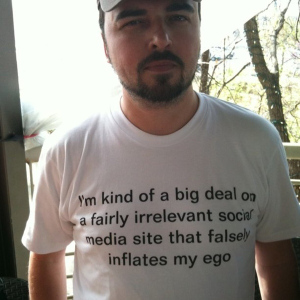
internet_fame

DISCLAIMER:
I feel like a disclaimer is needed, though the above photo should be enough of a disclaimer, because it says it all. Someone made a sarcastic remark about how I think I’m a celebrity because of this post, so I let their comment make me set this post to private, because I don’t have a thick skin and am too chicken to come out with a snappy or snarky comeback. I always think other people can get away with doing that, but I won’t be allowed to. It’s because of my past. I was never allowed to speak my mind or have a voice. Now I’ve internalized that and don’t allow myself a voice sometimes. I’m getting better but I’m not out of the woods yet.

In no way do I put myself in the same category as celebrities (who are just people who get wrinkles, have morning breath…

View original post 1,301 more words