Guest Post (by Anonymous): Thoughts About Suicide and Selfishness.

depression2

The following is a guest post from another blogger who kindly asked me if I would post this.  She is hesitant to link to her blog here, since her blog tends to focus on much lighter content, but still wanted to share her thoughts about this dark subject that’s a real issue for so many people who feel like all hope has been lost, as well as the people who love and care for them.     This blogger is not suicidal, but has been in the past.  I think most of us have considered it as an option at some point in our lives.   We need to stop judging them for it!   It isn’t helpful.

Thoughts about Suicide and Selfishness.

By Anonymous.

depression

The word itself can be quite triggering to some people… It is taboo and disturbing. What better proof of that, than the fact that I didn’t find the courage to speak out loud in my own blog?

Suicide is something that makes people uncomfortable. One shouldn’t even think about it. It scares, especially if you’ve had depressive episodes in the past. Doesn’t thinking about taking your own life mean you might be thinking about actually doing it?

I don’t think so. I don’t think you have to be a professional, working on serious research to give it a thought or two. I know a lot of people think about it, but just don’t share their thoughts. I am willing to open that door today. But I don’t encourage you to keep reading if you are not comfortable with the subject.

I’d like to point out that I am no professional about the matter. I am not a doctor, or a psychiatrist. I’m just a woman, who went through severe depression at some point in her life, and who had to deal with the idea of ending her days. I’m just the close friend of a good man who did take that step while he was living “The Life.”  But I think my view is worth being shared all the same. The following are just opinions, that you might agree with, or not.

From my experience, most people seem to see suicide as a cowardly act. You’ll often hear the classic “He chose an irreversible solution to a temporary problem”. But when you talk to someone who has just lost a loved one to suicide, the first thought resembles more “How could he do this to me?”

As a society, we tend to blame people who commit suicide of robbing us from someone we cherish. How dare that person be so selfish, that they would choose to leave their family and friends mourning them behind?

When I look back those dark days when I struggled between staying one more day or putting an end to my misery, I see things quite differently. I remember how much I thought about all the people that love me. Going through depression doesn’t mean forgetting your surroundings. If anything, those people were the only reason I hesitated. Had I been truly alone, I would have jumped in a second.

imfine

But I didn’t want my mother, my father and my brother to have to mourn me. Even if I seriously thought living without me would be a good thing in the long run. I knew no letter, no matter how long or how well penned would get them to understand I was right. No matter what I’d leave behind, they would end up suffering. And I could not stomach that.

I lived so they wouldn’t suffer. As simple as that. I ached and fought my demons, day by day, night by night, just so they wouldn’t have to wonder why I chose to rest, at last. Even to this day, I sometimes wish there were words that could explain the pain that rips my very soul when depression hits.

Mental distress is as painful if not worse than physical pain. People who haven’t felt it can’t imagine how real the hurt is. It is not “just” a matter of dark thoughts you can chase away or wait to see go away. And although some people can go through therapy or use medication to make the pain lessen, I believe some others will suffer all their lives.

In some countries, laws give the possibility to people suffering from chronic physical diseases that leave them with no quality of life to choose to end their life with doctors’ help. It is even considered an honorable way to leave this world. I agree that people shouldn’t be forced to live, when the suffering is too much to take. We put down our pets so they won’t have to go through unbearable pain, why should we force people to put up with agony?

I am not encouraging suicide. I think it is a terrible way to die. To hurt so much that you’d rather face mankind’s worst fear is horrible. But I don’t understand why we still tend to blame those who get to that point. No one would blame a cancer patient for losing their fight against that illness. Why do we do so, with mentally ill people?

“They should have asked for help!” you might think…. Which doesn’t make sense to me either. Would you blame your mom for dying from an undiagnosed heart failure?

Some people struggling with mental pain do seek help. But from my experience, a lot of doctors don’t measure the depth of the problem. They can’t see it on a scan, a physical exam, or on an X ray. It is not really their fault, but treatment is often lacking, even if people reach out for help.

I think my point here is just that maybe we should consider suicide a loss like that of any other disease. Families and friends shouldn’t have to deal with shame, and shouldn’t have to play the blaming game. The deceased should be able to rest in peace…

Just rest in peace.

PTSD & the Blindness of the Just Man

A friend wrote this thought provoking post (closely related to the one I posted earlier today). Comments are disabled; please leave comments on the original post.

Little Shepherd Girl's avatarUnraveled and the Birth of Joy

blog image YodaLove will find a way where wolves fear to thread.
– Lord Byron

Recently I took part in a research study regarding OIF and OEF veterans with post-traumatic stress disorder, that was designed to examine how a vet’s PTSD affects present and past relationship partners.  Psychiatrists are discovering that the failure by our government to provide effective deprogramming to combat vets, and their resulting emotional suppression, disregulation, and too often infantile personality syndrome, is now resulting in widespread PTSD in “dependents” (wives, husbands, and children) and their romantic partners as well.

Seems incorrectly treated (or untreated) PTSD in combat vets is contagious.

The shameful truth is, this country keeps its soldiers ready for deployment – by medical suppression of symptoms and emotions (utilizing anti-depressants, anti-anxieties, and stigma propaganda) but largely does not make us of trigger normalization and cognitive therapy, known world-wide to help heal PTSD, and necessary for a…

View original post 1,318 more words

Mental Illness and Lethal Medical Neglect

We may not use concentration camps, but in America today, we are still practicing eugenics and the mentally ill are one of the main targets for extermination. The proposed “healthcare bill” and Trump’s horrifying budget that targets social programs that help the most vulnerable, including the mentally ill, is nothing less than a social Darwinist way of weeding out the “unfit.”   Eugenicists believe it’s our moral responsibility to allow natural selection to take care of the “unfit” and the weakest, eg, let them die and refuse them any support.   How ironic that so many who deny science and evolution are using  a “law of nature” described by Darwin himself to get rid of people who don’t “contribute to society.”   Or is it just hypocrisy, which they are well known for?

Let’s not sugar coat things.  The ugly truth is that what this administration is trying to do is slow mass genocide.   They have declared war on us.

Beauty from Broken Pieces

There’s beauty in brokenness.

Comments here are disabled; please visit original post to comment.

Depression is happiness.

I’m so depressed I had to call in sick at work and set up an emergency therapy session this afternoon.  I couldn’t sleep last night at all.   I’m crying almost all the time.    This is more than just SAD.  That never got THIS bad before, even though it’s probably contributing to it.  My therapist thinks I’ve slammed headlong into the “void” and have lost all my usual defenses without anything to fill the hole yet and that’s why I feel like I’m losing my mind.    I know this is probably “good” and means I’ve made more progress but it sure doesn’t feel that way right now.   I have to keep telling myself this is not permanent.   I feel like what’s happening is some sort of grieving process.  But what exactly I’m grieving I’m not sure.

I did see this post this morning and it made me feel a tad better.   Maybe it can help someone else too.

http://www.youngandtwenty.com/depression-is-happiness

Guest Post #12: The Journey Inspired (Coping with Depression with Severe Fatigue)

Amanda, from the blog Mandibelle16, is a frequent commenter on this blog. Her own blog features her poetry and creative writings as well as articles about mental illness and her walk with depression. Amanda has suffered from Depression with severe fatigue since 2009. The following describes her first episode of severe Depression (which also featured auditory hallucinations) and its aftermath, and her long journey to wellness. But I’ll let her About page speak for itself. She is a talented writer and poet.

Mandibelle16 – About the Author
https://mandibelle16.wordpress.com/about-the-author/

mandibelle16

Amanda is a writer, blogger, and student from Edmonton, Alberta, Canada. She began blogging four-years ago to improve her writing skills and share her thoughts on several topics including, her experiences with mental illness.

Over time, Amanda’s blog has developed into much more than it’s original use. She has taken Editing and Creative Writing courses from Simon Fraser University and the University of Alberta to improve her writing and editing skills, in addition to her Bachelor of Arts Degree in English Literature received in May 2007. Her next step educationally, is developing a portfolio for the University of British Columbia for a Master’s in Fine Arts in Creative Writing. Only twenty-five percent of students make it in this online program and Amanda is hoping to be one of these students in May 2017.

Amanda also has taken blogging, poetry, writing, commenting, and photography courses through WordPress. She looks to improve her writing anywhere she is able. Amanda enjoys poetry and has been learning various forms of poetry from the website Shadow Poetry. Each new type of poetry is fun and challenging. She writes poetry from WordPress The Daily Post, word prompts and her own experiences, as well as participating in National Poetry Writing Month each year in April.

Amanda has been expanding and fine tuning her writing skills in fiction. She has recently been writing short stories and submitting them to literary magazines (etc.) as well as writing Flash Fiction for four different photo and/or word prompts each week. Amanda also participates in other writing prompts or challenges called 3 Line Tales; she also writes a different themed list each week; and participates in a photography prompt called Echoes of My Neighbourhood.

Moreover, Amanda is writing up her first draft of her first novel called How Was Last Night For You. The novel has been in process for a few years but is close to completion of the first draft. After the first draft, she will be working on corrections offered by another already published writer (with great thanks!) to complete a second draft, before hiring an established editor. Whether the book will be self-published or not is yet to be determined.

In addition, Amanda enjoys the Edmonton sports scene. She is a huge Oiler’s fan (NHL) even though the team seems to only be picking-up great draft picks and not making it to the playoffs since 2006. She is also a huge CFL fan of the Edmonton Eskimos who won the Grey Cup this past November 2015. Amanda also enjoys walking and doing yoga. She loves dogs, reading, shopping, and spending time with her wonderful friends and family.

Amanda also has suffered from a Mood Disorder (Depression) since 2009. She has tried countless medications and few have worked for her due to sensitivities and allergies to many medications. Amanda was in hospital when the she initially fell ill in 2009 for three-weeks and this last Summer for three-weeks to do a major medication change. The latest medication change was successful and Amanda is feeling more energy then she has in years.

Amanda suffers from severe fatigue due to her depression as well as insomnia. Her new medication has helped her in both areas. If you would like to talk to her about her mental issues or your own, please feel free; she is always willing to provide what help she can in that area with her experience over the past eight-years.

THE JOURNEY INSPIRED: COPING WITH DEPRESSION WITH SEVERE FATIGUE
By Amanda, Mandibelle16

depressed_woman

My story begins when I was twenty-three-years old. I had my first ‘real’ job after university and I had recently advanced from the role of receptionist to construction administrative assistant at the commercial development company where I worked. I had been in the administrative role in construction three-months before I became ill. It was Christmas time and I felt worn out. I thought I simply needed to take a few days off work to rest. Although I had no idea what was happening to me, I began to experience the onset of a psychotic episode in December 2008.

My episode began with a person from work (for instance) talking to me as they usually would and then afterwards I would hear an echo after they finished speaking. This echo consisted of this person’s voice altering and them saying something to me that was extremely mean. I knew something was not right with what I was hearing, but I had no idea what was happening to me. My current psychiatrist and I still don’t know the reason I had a psychotic episode. I wasn’t unusually stressed, using drugs, and I wasn’t grieving or experiencing emotional loss.

Work became extremely difficult for me to attend. Often, I would end the day crying. I also had difficulties concentrating on my work because my thoughts were going around in my head at such a rate that I couldn’t organize my thoughts properly.

At home I was having difficulty sleeping and I had begun to lose weight because I refused to eat much. I told my parents what was happening to me. My Mom kept track of my symptoms as they occurred. She had some experience with mental illness from an extended family member.

My second last day of work, we had a fun office party at a delicious restaurant. Later, we went to a different restaurant at night for drinks. The day had been a better one for me but it ended in tears. I thought I overheard a guy in my work saying something mean about me and I left the second restaurant crying.

I came back to work one last day but I couldn’t control my emotions which were all over the place. A lady at work drove me home and since that time I have not been able to return to work. I’m still embarrassed how I broke down that day. I had no control over myself and despite the fact my episode was eight-years-ago now, I still feel ashamed for how I acted that last day.

scream

On December 24, 2008 my Dad and I sat waiting to get into a Doctor at a clinic. The Doctor prescribed me Ativan to aid me with sleep and for anxiety. My parents also took me to the University of Alberta free psychiatric clinic. I went there a few times and they diagnosed me with having a psychotic episode with auditory hallucinations.

Eventually, I ended up with help from my Dad and the U of A clinic, admitting myself to the hospital because I was hearing suicidal voices. I didn’t want to kill myself but I was hearing voices whom were telling me to end my life.

Before I went into hospital, I spent three-weeks at home hallucinating and the thoughts in my head kept going round. I would sit down on the couch and for hours become immersed in my thoughts. Then suddenly, it would be lunch time and my Mom would be home from work to check on me and ensure I would eat some lunch and take my medication.

I was under several delusions and one delusion was that food didn’t belong to me so I wouldn’t eat because I thought that was stealing. During my episode I lost about twenty pounds in a month. I also began to feel physical sensations at times moving up my arms.

Additionally, I stopped taking care of myself. It was difficult to force myself to take a bath or shower and often the moment I thought about it, I would forget I needed to accomplish that small task. I didn’t understand why I wasn’t taking care of my appearance and hygiene because I’ve always been finicky about taking care of myself.

I was in hospital three-weeks and when you are hearing voices from people, the hospital is a terrifying place to be. Hearing voices occurs in a person experiencing a psychotic episode because the synapsis in their brain misfires.

If you can recall any thought or idea in your head that you’ve ever learned, seen on TV, or read about, these ideas or thoughts become misdirected in your brain. A person’s worst thoughts come through as voices they hear coming from other people, the TV, Radio, or out of nowhere. For instance, when I was ill I would hear the announcers on a Basketball game on TV and it would sound like they were only talking about me and not the game.

The Doctor I had in hospital took me off the antipsychotic I had been on from the University of Alberta clinic, and slowly put me on a newer antipsychotic drug called Invega. Suddenly, my thoughts were clear and I wasn’t hearing any voices echoing a person talking to me. The thoughts in my brain stopped circling. I have never had a psychotic episode since, and I pray I never do.

When I returned home, I experienced a depressive episode. I lost my energy and began to have severe fatigue. Although, my fatigue levels have changed from awful to manageable, they are something I still deal with today. Fatigue is different than being sleepy. It has a physical and mental aspect and once you run out of energy a person can do nothing but lie down until they have more energy from resting. In this time, I developed a mood disorder that is likely depression.

fatigue
Severe fatigue is a common problem with severe depression.

I also lost some cognitive function which I would later regain. My handwriting for example, was childlike. It took me three-days to fill out my application to my insurance company for disability which was thankfully approved. Reading a simple young adult chapter book such as Twilight or Harry Potter, was extremely challenging at first. It was a couple of years before I could read more than simple adult books and longer still to work back up to being able to read for long periods and read difficult material such as textbooks and literary novels.

I met my present psychiatrist in April 2009 and she took me off of the Invega once we knew I was safely out of the psychotic episode. My psychiatrist switched me to a new antipsychotic because my old one left me with intense muscle pain in my shoulders and neck. For eight-years my Psychiatrist and a Psychiatric Nurse, helped me try tons of medications such as anti-psychotics, antidepressants, stimulants, and sleep medications. I participated in psychiatric testing so we could measure my improvement up to three-years after the episode occurred. We tried an array of medications but the majority had little effect.

Moreover, I had a consultation with a sleep psychiatrist whom I saw every six months. The sleep medications he gave me were a short-term solution to a sleep-disorder that had developed. I had insomnia and had both trouble falling asleep and staying asleep.

The results of trying all this medication was excess weight gain. At first, because I had lost weight in my psychotic episode, I needed to gain a few pounds but now I’m thirty-five pounds over a healthy body weight.

My severe fatigue doesn’t allow me to do cardiovascular activity intense enough to burn fat. I was extremely fit before my episode so being overweight is something that has always upset me because I don’t have much control over it. I eat healthy and in small portions but it doesn’t make much difference. Not to mention, when my mood disorder became worse, it was even harder to exercise.

I believe my health improving this last year, is due to letting myself be admitted into hospital for a medication overhaul. Sleeping at night had become nearly impossible. My Doctor had me go off my sleeping medications and on a new antipsychotic called Clozapine which makes a person extremely sleepy when they take it. Clozapine has to be monitored closely in patients because it can cause increased heart rate and increase white blood cell count.

I worked my way up slowly to the right dose of Clozapine for my body and it wasn’t easy. The second and third day after going on a new dose of Clozapine, I would feel awful. Then my Doctor would increase the dose and the cycle would repeat until we reached the correct dose for my body.

I spent a miserable weekend at home in a hot house in July on too large a dose of Clozapine. Surprisingly, that’s how we found my perfect dose. Now I only have to go for blood work to check my white blood cell count every so often. But Clozapine allowed me go off of a larger dose of antidepressants and sleeping pills. I can sleep amazingly well at night, even though I sleep to 11:00 am because of the medication.

By November 2015, my energy had increased and I was reading plenty again, writing more, and able to take my last Residential Design class. I could last at night for four or five hours meeting with friends. By January I noticed my concentration had substantially improved. Even though my physical stamina is low, I’m able to do yoga and go for a short walk at times which is a huge step up for my physical health from the last two or three years.

A wonderful aspect of Clozapine is that it is the only antipsychotic that actually heals your brain. I don’t know if I’ll ever be as carefree and able as I was at twenty-three-years-old, but each month I experience improvements to my health. Combined with a supplement program that is helping me to lose weight, I’m doing fantastic for a woman who suffered such a terrible psychotic episode and has lived with mental illness for eight-years.

My goals of late have been entering my writing into writing contests for different magazines to have my writing published. I write fiction, poetry, nonfiction and a bit of everything. I have been blogging for four-years as well. In the beginning, it was to improve my writing skills back to what they were when I finished my English BA.

Now I focus on improving my writing creatively. I’m writing a fictional novel on a curse, a sea witch, and two main characters who fall in love. I’m also participating in National Poetry Writing Month in April. You can check out my blog at: http://www.mandibelle16.wordpress.com.

I have gone back to my roots, to my love of literature and the written word. I adore writing and it makes me whole. It’s what I’m meant to do. I’m looking at applying for an online MFA at UBC in creative writing. I believe my family and friends, creativity, positivity, and faith in God, have lead me through difficult times in my life. They have allowed me to find light when everything seems dark.

Mandibelle16.(2016) All Rights Reserved.

Guest Post #7: How hypersexuality plays a role in Bipolar disorder

infidelity

I’m honored to introduce my 7th guest blogger, Jess Melancholia from The Bipolar Compass, a blog about her experiences living with the manic-depressive form of Bipolar Disorder. In her post, she will be discussing how hypersexuality can be a symptom of the manic (or in Jess’s case, hypomanic) phase of this disorder. I applaud Jess for her courage in openly sharing this delicate but surprisingly common symptom of the manic phase of Bipolar disorder.

From her About Page:

Jess Melancholia is a bpHope Magazine blogger who resides in San Diego, California with her husband and cat. She was diagnosed with Bipolar Disorder 2 in May 2014 after suffering a 6 month bipolar depression triggered by extreme family medical stresses. Through medication and a strong support system, she works tirelessly to live a “normal” life and keep her hypomanic and depressive episodes under control. Her hobbies include playing horror video games and wine tasting. Her daytime profession is a molecular biologist at a biotechnology company.

HOW HYPERSEXUALITY PLAYS A ROLE IN BIPOLAR DISORDER
By Jess Melancholia, The Bipolar Compass

I know what you’re thinking; if I’m writing about bipolar 2 disorder, then why am I talking specifically about sex? No one in their right mind would talk about sex to promote their mental illness blog. Why risk chasing away followers? Why not make it easy on myself and just talk about the other bipolar symptoms of mania such as anxiety, overspending, and feelings of grandiosity? Because that’s what everyone else talks about. And while those are important to me, the one that impacts my life the most is what I want to focus on. And if that makes you uncomfortable then stop reading. But I think that we are all adults here and that things like this need to be addressed. There are countless people out there that want me to talk about this. That need me to be their voice. And I want to be there for them, because they deserve to have their story told.

What in the world is hypersexuality?
That would definitely be my first question if I was reading this post. Well I’m glad you asked. I’m actually very excited to talk about such a delicate subject with you. Please be aware that this is not a joke and that I’m being completely serious about this. If you need more information, please refer to the links in the article and my personal blog for more details. If you are experiencing bipolar hypersexuality, then please contact your doctor immediately to get some help. I’ll start off by giving a little bit of background on this topic.

Hypersexuality is essentially, from my personal experience, an overwhelming desire and obsessive preoccupation with sex and sexual content caused by the presence of a manic episode. In the DSM-IV (Diagnostic and Statistical Manual of Mental Disorders, Fourth Edition), it’s listed as a primary symptom of bipolar under the category of “sexual indiscretions.” bpHope.com is a fantastic resource when it comes to articles and expert advice on what the symptoms look like as well as professional opinions from leading experts in bipolar disorder. The technical content I relate to in this post is accredited to them.

According to some studies, hypersexuality can occur between the range of 25 to 80 percent of all patients with mania! Recent studies suggest around 57 percent! For something that prevalent, it’s amazing that such a subject is rarely if ever talked about.

There are varying opinions as to the cause of the symptom. One such opinion pioneered by Louis J. Cozolino, PhD, a professor of psychology at Pepperdine University in southern California, and leading bipolar disorder guru, says that it’s akin to sexual addiction. He goes on to say that people who are manic with this symptom display “vulnerability to a ‘disinhibition’ of social restraints during manic periods.” In fact, there are studies to suggest that there is more blood flow to the left part of the amygdala (almond-shaped part of the brain that deals with fear and panic) in bipolar patients than in other people. Furthermore, feelings of pleasure and arousal are related to a sort of calming effect. Sort of like taking painkillers.

For me, it IS essentially a painkiller. Whenever I’m hypersexual, I stress the need for sexual satisfaction as a top priority. With being happily married to a wonderful husband, this kind of symptom tends to get me in serious trouble. Last year, I had a terribly bad manic episode that lasted several months. During that time period, I lost complete control of myself and acted out sexually towards some stupid college kid I met chatting online. He seduced me into cybersex and phone sex with him along with eventually meeting up a few times. As many times as I told myself and him no, that I can’t and won’t do this, he always managed to get inside my head and change my mind. Under normal circumstance, none of his tricks would’ve worked on me. However, when I was manic, all I did was focus nonstop on sexual satisfaction. The worst part was nothing was ever enough. I needed more and more. Nothing would satiate me. It took over my entire brain and wouldn’t let go until the mania finally died. Despite the fact that I fought fervently against my overwhelming urges, I still was constantly unable to stop myself from falling into temptation.

Now that the clouds have parted and the dust has settled, I can think clearly and work around the triggers that caused me to lose control. My husband and I educated ourselves thoroughly on hypersexuality and he has now forgiven me for my actions. Whereas I was and am still responsible for all actions I take, I understand now that my behavior was a symptom of an illness. A common symptom of bipolar mania. Armed with this information, him, my best friends, and my healthcare professionals have all agreed on a strategic prevention plan to help minimize my triggers and prevent any future mistakes.

Although I do feel guilty everyday for what I did, I no longer feel ashamed of myself. What happened was a terrible mistake but I’ve learned considerable information from it. With knowledge comes power and I’m trying every single day to bring that power back into my own hands. Hopefully I’ll regain it fully one day.

Don’t be ashamed of your actions. Learn from them and grow.

Please visit The Bipolar Compass:
http://bipolarcompass.com/

Guest post #4: You Are Empowered (Just Plain Ol’ Vic)

I’m happy to introduce my 4th guest blogger, Just Plain Ol’ Vic.  Vic’s blog is one of my favorites.  I’ve been following it almost from the very beginning of my blogging journey and have found it always inspiring and thoughtful.    Vic has helped me through many of my own rough moments and is a regular commenter on this blog too. Be sure to stop by his blog!

This is from his About page:

Just Plain Ol’ Vic

plainolvic

Bio: Thanks for taking a look at my blog. I am Just Plain Ol’ Vic, however Vic will do just fine. I originally started this blog as a form of writing therapy. I am happily married, with kids but my wife suffers from bi-polar disorder, clinical depression, has an eating disorder and is a recovering alcoholic. Needless to say it is quite a bit for one individual to handle, thus my blog. I started this blog to connect with others that suffer from mental health issues and/or have loved ones that have mental health challenges. This is a way for me to connect, discuss and educate myself about my wife’s condition and perhaps in turn, allow me to be a better spouse. Perhaps too, in hearing my story, others will know that they are not alone and there is help, empathy and resources out there. My blog has since developed beyond just talking about mental health (although that is still a priority). I pretty much discuss what is on my mind or happening in my life. I am not afraid to spout verbal diarrhea, give unsubstantiated opinions and generally exercise my 1st Amendment rights. Along the way I hope to provoke some thoughts, get you interactive with my blog…perhaps even make you crack a smile and belly-laugh every now and then. So if by now you are still interested and willingly join me on my journey, thanks for coming along and don’t forget to buckle up! http://justplainolvic.wordpress.com/2014/07/19/tempting-fate-taking-a-leap-of-faith/

Here is his guest post, not really about himself, but about all the wonderful things he’s learned from living with his wife, who suffers from Bipolar disorder.   Through their relationship, joys and struggles, Vic says he has developed a level of empathy and understanding for the mentally ill he might not have otherwise had.  I thought his story was very touching and inspirational and I even got a little misty-eyed reading it.

YOU ARE EMPOWERED

By Plain Ol’ Vic (http://justplainolvic.com/ )

bandaid_heart

Introduction:

Hello there, my name is Vic and first of all I would like to thank Lauren for giving me this wonderful opportunity as a guest blogger.  I don’t think my story makes me any more special than the next person, thus my moniker of “just plain ‘ol” seems very appropriate.  I am just a guy, husband and father that is trying to make sense of his world and do right by my family. There are days that this is harder than it sounds; as my wife has bi-polar disorder, has attempted suicide, has had multiple hospitalizations, is a recovering alcoholic and recovering from an eating disorder.  Guess what?  She is and will always be a wonderful woman and I am lucky to be married to her.

 Instead of telling my story and the trials and tribulations we have faced as a couple and family, instead I would like to talk about some of the positive things I have learned as I have become more educated and empathetic to the challenges my wife faces on a daily basis. As tough as the challenges have been, as daunting and insurmountable as the obstacles seem to be – we are still here, engaged in the moment and are as strong (perhaps stronger) than we ever were.

***

It is so easy, when someone suffers from a mental illness, to have it consume their lives and allow it to define who they are, how their perceive themselves and become the cornerstone of their existence.  I am here to tell you that does not have to be the case!  You ARE empowered to be who you CHOOSE to be, should EXPECT people to treat you the way you DESERVE to be treated and you should NEVER SETTLE for anything less.

YOU ARE BEAUTIFUL

I know it is hard to look in the mirror and not “see” your mental illness.  I challenge you to look beyond the physical and see your spirit within.  See the inner beauty, the inner resilience and the inner fighter that you have become.  “Normal” and “perfect” do not exist, they are made up abstractions.  Who you are, your uniqueness is what makes you beautiful.  If you can embrace that inner beauty, it is the first crucial step to learning to love yourself.

YOU ARE WORTHY OF LOVE AND AFFECTION

Having a mental illness does not make you “less deserving” than the next person. Despite the challenges you may face every day, you are deserving of a partner that will love you for who you are – not what they want you to be.  While a relationship can and will be challenging at times, you can find someone that will accept and love you the way you are.  The key to this is communication:  being open and honest from the first moment.  Making sure you have a partner that you can talk to, confide in and lean on is critical.  No relationship is ever perfect but it can work for you as long as you are willing to work for it.

YOU ARE POWERFUL, STRONG & CAPABLE

Having a mental illness does not make you less of a person, less capable than someone that is “healthy.”  Indeed you may actually be much stronger than a “healthy” individual because you have to endure so much more.  Never doubt your ability to lead a full and productive life.  You are capable of achieving whatever you set your mind to.  Now I am not going to deny that it may be tough, that there may be setbacks – however you are powerful, strong and capable – you can take back your life.  Your life and your contribution is just as important and relevant as anyone else, so shout your message from the rooftops and embrace all that makes you unique.

I would like to show you this video where I drew inspiration from for this post.  Now I have made it clear that while I am not religious I am a spiritual individual, however despite that I cannot deny the power of this message.  Please also understand that I think is message (and my message) is geared for both men and women.  Take the time to listen to some of the words that are said and understand that this IS you or CAN be you If you so choose.  There are so many things misunderstood when it comes to mental illness, so many stigmas out there.  However if you empower yourself, share and communicate your story then you too can help other see what makes you so wonderful, so unique and so human.

I wish everyone the best.  Be well.  Take care of yourself and each other.

Just Plain ‘Ol Vic.


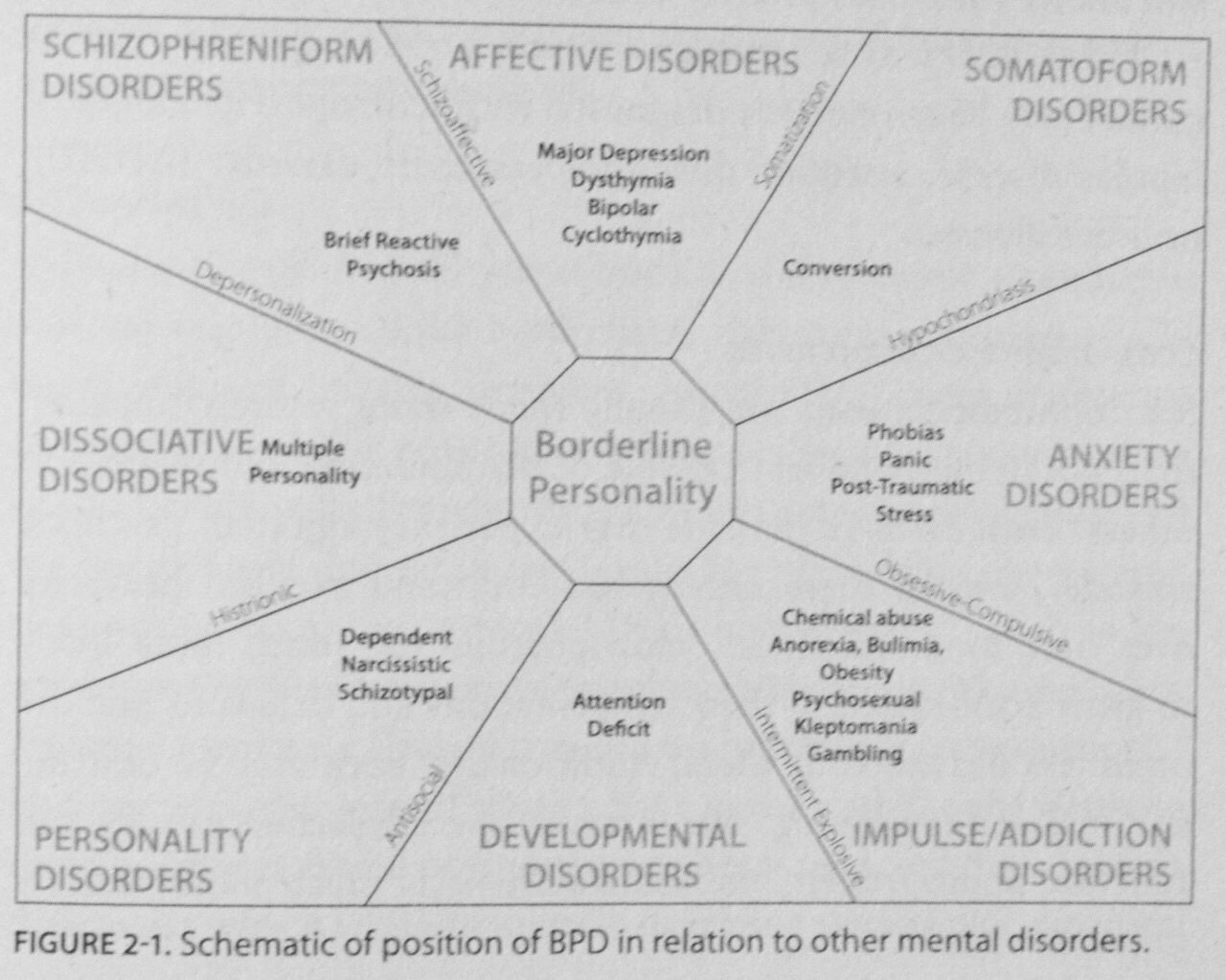
BPD: The fulcrum of mental illness.

It’s like a spinning black vortex sucking in the symptoms of every other mental illness and disorder. We’ve got all the bases covered!  We’re batsh*t crazy!  We need help and understanding, not judgment and fear.

bpdschematic

Guest post #3: Facing Complex Post-Traumatic Stress Disorder

I’m happy to introduce my third guest blogger, Alisha, who has a blog about living with Complex PTSD (C-PTSD) and chronic pain. She was kind enough to write this powerfully written guest post for this blog. I loved reading it because it ends with a message of hope, no matter how bad things might seem. Please visit Alisha’s blog, The Invisible F.  She has another blog featuring her fantasy writing, including her novel, The Return of the Key.

From her About page:
alisha

Hi, my name is Alisha. I’m a proud alumnus of the University of Westminster where I did my MA in International Journalism. I love parrots, singing, drawing, sharing stories, fantasy movies, games and books, and people who like fantasy movies, games and books.

I live with a number of chronic health conditions including fibromyalgia, clinical depression, anxiety, & Complex Post-Traumatic Stress Disorder, and for much of my life have suffered from debilitating symptoms. I want to raise awareness to help people understand but moreso to share and engage with all those whose lives are touched by fibromyalgia and mental health problems in one way or another, so they know they’re not alone.

Facing Complex-Post-Traumatic-Stress-Disorder
By Alisha, The Invisible F.

pain

I was sitting in a small room at hospital when the psychiatrist’s voice called me away from the brilliant white walls that were pulling me in.

“You’ve had a very difficult life Alisha” she said, looking at my notes. After asking me to recount some of my ordeals, she said “From your symptoms, I would say you have Complex-Post-Traumatic-Stress-Disorder (C-PTSD).”

I had to ask her how C-PTSD differed from PTSD, which many of us associate with soldiers who have served in warzones or conflicts. She explained that C-PTSD tends to occur in people who have suffered repeated traumas for a prolonged period, with no chance of recovering from each incidence.

The more she told me about it, the more I felt like she was telling me about myself.

I had a long history of abuse starting in childhood, when I honestly believed I wouldn’t live to see the age of 18. I survived, thankfully, but I continued to endure traumas past my teenage years and into my twenties. I can’t say which incident was worse, because I felt the enormity of each one added to the already heavy weights that I carried. At 16 I was diagnosed with depression and anxiety, suffering terribly painful anxiety attacks that made my chest hurt so much I thought I would die.

I tried to ignore the feelings my past stirred up, because I lived in a society that stigmatises mental health conditions. I thought I was fine. It was only years after my stepfather and friend were brutally murdered, that I started getting glimpses of the brokenness I had masterfully hidden from the world and myself. I packed my bags and left everything and everyone I loved behind, moving to the other side of the world. Surely pain wouldn’t follow me there. But we can’t unknow things, and there was a lot of pain etched on my heart and mind. These parts of me would not let me forget.

C-PTSD manifesting

The C-PTSD diagnosis made sense but I was still surprised. Mostly because I wasn’t expecting another label. I already lived with fibromyalgia, depression and anxiety and several months before had been slapped with borderline personality disorder, which I was still struggling to come to terms with. I could say very clearly what some of my symptoms were, but I couldn’t always say which diagnosis was responsible for what I suffered on any given day.

As time passed and I connected the dots, I understood more about how deeply C-PTSD had been affecting my everyday life, unknown to me.

Days before I met the psychiatrist at hospital, I was sitting in Accident & Emergency having a meltdown, unable to cope with the avalanche of emotions tumbling through me. I wanted to give up again and almost did. I didn’t understand why the smallest upsets felt like utter catastrophes, or why I seemed to attract bullies or why getting close to people terrified me so. The doctor was most empathetic about it.

“Well you’ve had a lot of bad experiences with people so that is going to shape your outlook. It doesn’t mean your outlook is wrong. It only means your experiences have shaped your perspective” she said.

If only other people were that understanding. Not too long before I had encountered very unsympathetic people in a shared flat where I resided. Just when I thought I was recovering from the dark feelings that led to two close calls on my life, I discovered that approaching the close of my twenties, I was having night terrors. I had never even known there was such a thing until it was googled by a flatmate who constantly complained about my screaming at night. I couldn’t believe that I was screaming while asleep with no recollection of it the next morning. I didn’t believe it until my own screams woke me in the dead of the night. Frightened and panicked, I searched around my room until reason returned, and I questioned what it was that I was looking for, and so terrified of.

Nightmares

I have a long history of nightmares, which started in childhood. The kind that leave you so terrified you’d do anything to keep yourself from drifting off, anxious of what’s waiting for you in the realm of dreams. Consequently, I developed insomnia from a young age. Generally, my anxiety tends to get worse at night. It’s not uncommon to find me wide awake in the wee hours of the morning when most people are getting their best sleep. I’ve always slept better in the day, when the sun is out and it somehow feels safer. When I (reluctantly) have to go to sleep at night, I clear my room to make sure there’s no clutter that might form awkward shadows, that may frighten me when I wake in between my cat naps.

My flatmates couldn’t understand the nature of night terrors, and I was accused in person, by email and text like a perpetrator. I felt bad about it, truly. The accusations though, only distressed me more, and increased the frequency and severity of the night terrors.

Recently, I started sleeping walking, and I often wake up running towards my bedroom door terrified, with no recollection of my dreams.

Living with C-PTSD has been like sitting in a prison inert, long after the doors have been opened. I have wanted so badly to walk through, tending to avoid things and places that remind me of past traumas. I think of all the positive things I’ve managed to achieve through my beleaguered time here. I spend my waking hours keeping extremely busy so I rarely have time for stray thoughts, and it works; but everytime I go to rest, my subconscience reminds me of the many demons I’ve buried and hidden away.

In my dreams I am always running, looking for an ally, and an escape that is rarely found. I often run in different directions, only to end up right back in the place where my captors are waiting by the prison doors. When I am not shut away, I am violently murdered, again and again, like a broken cassette sticking in the same sickening place.

The things I said I’d never do

I suppose I never realised how my past traumas were affecting me until my late twenties. People would say, ‘it’s the past, just leave it behind and move on.’ Or worse ‘everyone has problems.’ If only it were that simple. I’d give these people a chance to walk in my shoes if I could, and silence any doubts. I want to forget, and I do everything possible to move forward, but the mind is such a powerful thing. All my efforts have been no match for my mind which digs up torments when I am asleep.

Owing to C-PTSD, I’ve done a lot of those things I said I would never do. You know when we watch others suffer and silently judge, telling ourselves, ‘that will never be me’? At 17 I remember watching my 30-something year old friend elaborately explain how she avoided the doctor’s questions when he asked how she accidentally cut her arm again, needing stitches. When I asked her directly, she brushed it off, and I sat there thinking I will never understand this.

I didn’t think of my friend when I first hurt myself. All I remember thinking was how good the external pain felt, taking the focus away from my internal turmoil. Months later I diverted from my healthy diet and found myself facing bulimia. The first time I felt confused, wondering why I kept eating though I was satisfied. But I craved the food badly, I ate and I ate, until I felt so physically upset I had to empty my stomach. I cried & cried every time because I wanted to badly to stop but I had no control, and that was the part that got me. I didn’t even have control over me.

It’s sad that after everything I’ve suffered I’ve also had to deal with bullies who have targeted me because they know they could. I try to build myself up, to be stronger and braver in the face of this. I do psychotherapy and I’m not sure it helps. Maybe? Doctors say I will likely need therapy for the rest of my life. I’m not sure how I feel about that.

Every day is a challenge. But I wake up and set out to do my very best. I try to practise mindfulness and celebrate my successes. Whether they are publishing a new book, managing to stay out of hospital or simply getting out of bed when I feel like shit, I celebrate them all equally, because I know what it is like to be crippled by depression and C-PTSD. I know very well what it’s like to lie in bed unable to will myself up; to want to shower or make a cup of tea and not be able to do so. I know what it’s like to feel that it’s safer to stay alone than get close to people…to stay indoors for days, unable to set a foot outside the front door. So every day I achieve something, no matter how small, I pat myself and say ‘well done, you’ve done it today so when you think you can’t do it tomorrow, just remember you did it today.’

The one dream

I’ve told you what many of my nightmares consist of. But it would be remiss of me not to mention the one dream that overshadows every nightmare that comes.

In this dream, I carry a heavy babe in my arms as I climb a tall, rickety winding staircase leading to a wall. With every step I take, the child becomes heavier. When I’m almost to the top, the staircase crumbles like dust in the wind. This part of the dream ends abruptly, like a director’s cut in a poorly edited movie, and when I open my eyes I am on the sea front, surrounded by people who cannot see me. The rippling turquoise waters beckon me and I do not resist. I walk into them and as I float farther in, the waters envelope me, washing away every heavy burden my soul bears. I embrace the waters filling me up as I begin knowing a kind of peace. It almost feels…like home, where my soul will find rest, so I let it consume me. But as my consciousness ebbs, a hand reaches through the veil of the waters, and pulls me out. And again, the scene ends abruptly. I awake as a child, amongst the laughter and play of my fair cousins.

My aunt, an interpreter of dreams says the heavy child I carry represents the burdens I bear; the seaside scene is the deception of suicide and my subconscience believing that it is there I will find rest from the pain that plagues me. She says the hand pulling me out of the waters, is the truth that I am not lost, that redemption can, and will be found…that even when I am drowning, no matter how close I come to death’s doors a power higher than any torment and death will lift me up.

I press on, finding strength in my faith and true friends who embrace me, imperfections and all. I am encouraged by sharing with others in the same boat, by bringing a good word to those who need it. Maybe doctors are right…maybe I will need therapy for the rest of my life. Maybe. All I know is I’ve managed to make it this far, when I didn’t think I could. You could have told me a thousand times that I’d make it, but I wouldn’t have known if I didn’t walk this road myself.

A million hugs & prayers for your courage & peace of mind.

Love Alisha