I think age of NPD onset correlates with malignancy and curability.

kids_different_ages

Because of a recent conversation I was having on Psychforums about age of onset and prognosis for a cure for different levels of narcissism, I’ve been doing a lot of thinking about this.

I do think how old a narcissist was when Ground Zero occurred–that would be the primary traumatic event that forced the child to create a False Self–determines the difficulty/ease of healing, and also how low or high the narcissist falls on the spectrum.

Here’s what I came up with.

Age of onset of Trauma/stage of child development (Piaget, Freud):

0-2 (Piaget’s Sensorimotor stage; establishing boundaries, physical and comfort needs met; Freudian Oral/Anal stage):

toddler_bear

High spectrum, malignant narcissism and/or psychopathy/sociopathy (if as an infant)– not curable except under extreme circumstances in very rare cases. May be self aware but has no incentive to change.

3-6 (Piaget’s Concrete Operations; Freudian Anal–Oedipal/Electra stage )

childabuse

Mid-high spectrum narcissist who may or may not be malignant. May become self aware but will be resistant to a cure. In unusual circumstances (total loss of supply or primary supply), a narcissist this high on the spectrum might seek therapy. They are unlikely to be willing to do all the work required for healing due to its difficulty for someone this high, but there might be a few exceptions.

7-11 (Piaget’s Formal Operational stage; abstract learning, competence; Freudian “latency” period)

sad_girl2

Mid-spectrum narcissist. Could become self aware and if so, there’s a good chance of them seeking therapy or treatment. They’re more likely to be cured, but it’s not a guarantee.
Therapy would be difficult at the higher end (onset before 8-9), moderately easy at lower end (onset between 9-11).

12-21 (adolescence)

sadness

sadness

Low-mid spectrum narcissist. Likely to become self aware and good chance of being cured.
Low spectrum at the higher ages (onset after 15/16), mid spectrum at the lower ages (younger than 15).
Good prognosis for a cure and self awareness. If very low, may be able to heal him or herself without outside help

21 +

How's my hair?

How’s my hair?

A person cannot become a true narcissist after age 21 or so. They may instead have a lot of narcissistic traits, have DNP (Destructive Narcissistic Pattern disorder–just below NPD on the spectrum), or in rare cases they could develop “acquired narcissism” (this is something a lot of celebrities and famous people get) which is temporary and lasts only as long as the adulation or fame lasts.

ETA: I got a rebuttal to this on Psychforums. I think this poster’s argument may be valid too, so I’m going to post it:

I believe the PD occurs in the first 5-6 years due to abuse/trauma, the critical level of which differs for each person depending on genetics (temperament, sensitivity).

I think NPD-like traits resulting from abuse/trauma after age 6 would be cPTSD to a normally developed personality.

I suspect traits from coddling/overvaluation after age 6 would be easier to “return to earth” from than something like sexual abuse and humiliation (say, having to testify in court) after age 6. I think the former might be unwind’able to a level of stable narcissism. I think the latter could be a more permanent scar/condition.

left-out_child

But, I don’t know much about. That’s just the way I think of it. It doesn’t seem feasible that PD could occur after the P(personality) is developed. I thought the whole point of a PD was that the P stopped developing, became a defective structure. Not merely unresolved trauma (like PTSD is?) but structural and permanent.

Basically his argument is that after age 6, true narcissism won’t develop but complex PTSD (C-PTSD) could. This could mean a child acquires a lot of narcissistic traits (what ACONs call “fleas”) that could resemble NPD in many ways but is more treatable/curable. I think this would be the same thing as the spectrum condition called the Destructive Narcissistic Pattern (DNP)
This would also take into account type of abuse inflicted and level of severity.

Derealization and depersonalization in NPD and BPD.

Worlds_Collide___Phaeton___by_Meckie
Worlds Collide-Phaeton: by Meckie at Deviantart.com

A common symptom of both NPD and BPD is dissociation: a splitting or fragmenting of the personality not very different from what occurs in the Dissociative disorders such as DID (Dissociative Identity Disorder) and Psychogenic Fugue. It usually happens in response to a severe loss of supply or major narcissistic injury, or a sudden awareness of oneself as not oneself (realizing your false self is not who you really are–which happens when a narcissist becomes self aware). These disorders themselves, especially NPD, are dissociative in nature because a split in the personality has occurred. In the narcissist, it’s a substitution of the original personality for a false one.

Borderlines, rather than having a false self per se, are more like chameleons, adapting their personalities to fit the people and situation around them. That’s why Borderlines can seem so changeable.

I first started to experience dissociation as a young child. I remember at age 4, waking up for breakfast and walking down to the kitchen where my parents were already eating, and seeing colored specks like glitter falling all around me. When I asked my parents if they saw the “glitter,” they just looked at me like I was crazy. I also had dreams that would continue after I awoke and often felt I was living in a dream. Maybe that’s the case with most young children though. I also remember hearing music from TV shows late at night after everyone was asleep that couldn’t possibly be coming from anywhere, as this was in the 1960s and no one had the capability to record a show on VCR yet, nor was there TV after midnight or so–all we’d get in those days was a test pattern until morning.

I remember at around the same age, banging my head against the wall in the family room to relieve some kind of congestion in my head. I think it may have been to relieve those odd feelings of unreality–not much different than the way a Borderline will sometimes cut herself to “feel alive.” In fact, this may well have been an early symptom of my BPD (and I always thought it was autism).

Most people have probably experienced dissociation, perhaps under the influence of a drug. Sometimes people experience it on hearing shocking news that could be either tragic or fortuitous–like hearing one’s child just died, or winning the lottery.

But for people who have certain personality disorders (as well as people with various dissociative disorders and psychotic disorders like schizophrenia, and also those with PTSD and C-PTSD), dissociation is both common and chronic. It’s also severe enough to sometimes interfere with functioning.

Q: So what does dissociation FEEL like?
A. Because something so ungrounded in the tangible and everyday reality is so hard to explain in words, I’m not sure if these descriptions of what it feels like will make a lot of sense, but I’ll try.

Derealization.
I’ve actually experienced this the most. The world seems odd and dreamlike. Reality seems somehow “off” the way things are in a dream. In a dream, a familiar scene can look the same as it does in reality, but at the same time there’s this feeling of offness and otherworldiness about it. When I was younger and used to ride the subway, sometimes I couldn’t look up at the people because they all seemed like masks…sinister, somehow. It’s a very weird feeling but not always unpleasant. Sometimes that dreamlike oddness about everything is sort of compelling and interesting.

Depersonalization.
This definitely causes me serious panic attacks. I first had episodes of this at about age 9 or 10 and thought I was going crazy. I felt oddly disconnected from my body, like I was floating. People talking to you sound like they’re coming from either a great distance or out of a tube. You can’t focus on what they’re saying because you’re freaking out and panicking but trying to hide it to keep from appearing as crazy as you feel.

I think people with NPD and BPD (as well as the Schizoid, Schizotypal and Paranoid PD’s) who do not improve or try to change, are probably at high risk for developing psychotic disorders and even schizophrenic like conditions when things are going badly for them, there’s been a massive loss of narcissistic supply, or when the person becomes gravely ill or very late in life.

Fear breeds narcissism; the antidote is vulnerability.

I think this article applies to anyone trying to heal from any personality disorder, PTSD, or the fallout of narcissistic abuse, so I’m posting it here too.

Are BPD and complex PTSD the same disorder?

age_3_1961_2
Me at age 3 in the zone. Was the template for my BPD already laid down?

Ruji, a new commenter on this blog, made an interesting observation–that BPD should be divided into at least two subtypes: Empathy Challenged/Character Disordered (closer to NPD/ASPD) and Highly Sensitive Person with Emotional Dysregulation (closer to the type I have, although at different times in my life or when extremely stressed I have displayed the more character-disordered subtype). I agree with her. Ruji’s idea is remarkably similar to The World Health Organization’s two subtypes of BPD:

1. F60.30 Impulsive type
At least three of the following must be present, one of which must be (2):

–marked tendency to act unexpectedly and without consideration of the consequences;
–marked tendency to engage in quarrelsome behavior and to have conflicts with others, especially when impulsive acts are thwarted or criticized;
–liability to outbursts of anger or violence, with inability to control the resulting behavioral explosions;
–difficulty in maintaining any course of action that offers no immediate reward;
–unstable and capricious (impulsive, whimsical) mood.

2. F60.31 Borderline type
At least three of the symptoms mentioned in F60.30 Impulsive type must be present [see above], with at least two of the following in addition:

–disturbances in and uncertainty about self-image, aims, and internal preferences;
–liability to become involved in intense and unstable relationships, often leading to emotional crisis;
–excessive efforts to avoid abandonment;
–recurrent threats or acts of self-harm;
–chronic feelings of emptiness.
–demonstrates impulsive behavior, e.g., speeding, substance abuse

Psychologist Theodore Millon has gone even further, proposing that BPD should be divided into four subtypes:

1. Discouraged (including avoidant features): Pliant, submissive, loyal, humble; feels vulnerable and in constant jeopardy; feels hopeless, depressed, helpless, and powerless.

2. Petulant (including negativistic features) Negativistic, impatient, restless, as well as stubborn, defiant, sullen, pessimistic, and resentful; easily slighted and quickly disillusioned.

3. Impulsive (including histrionic or antisocial features) Capricious, superficial, flighty, distractible, frenetic, and seductive; fearing loss, becomes agitated, and gloomy and irritable; potentially suicidal.

4. Self-destructive (including depressive or masochistic features) Inward-turning, intropunitively angry; conforming, deferential, and ingratiating behaviors have deteriorated; increasingly high-strung and moody; possible suicide.

Millon’s Types 1 and 4 would correspond to the Highly Sensitive Person/Emotional Dysregulation type mentioned above (and therefore closer to the Avoidant/Dependent PDs); Type 2 sounds very much like NPD; and Type 3 seems closer to ASPD or Histrionic PD.

complex_ptsd
BPD symptoms are almost identical to those of Complex PTSD.

There are so many diverse–almost opposite–symptoms that can appear with this disorder that one person with BPD can be very different from the next. In fact, you can take 10 borderlines and they will all seem very different from each other, with barely any similarities in their behavior at all. One will be shy, fearful and retiring, never making waves, acting almost like an Aspie or an Avoidant; while another may break the law, lie constantly, and act obnoxious and rage whenever things don’t go their way. A borderline could be your raging boss who drinks too much and ends every annual Christmas party with one of his infamous rages, or it could be the sweet and pretty schoolteacher who goes home every night and cuts herself. She could be the come-hither seductress or the nerdy computer programmer. He may have few or no friends or a great many.

This diversity is not the case with the other personality disorders, which have more cohesiveness in the symptoms their sufferers display. So I wonder–is BPD really a personality disorder at all? Does it even exist, or is it really just a group of trauma-caused symptoms the experts in their ivory towers stuck in a single box called “BPD” because they didn’t know how else to classify them?

In fact, all these diverse subtypes have one thing in common–they are all very similar or identical to the symptoms of someone with complex PTSD (C-PTSD). People with C-PTSD are often misdiagnosed as Borderlines because their behaviors can be just as baffling and manipulative, and both disorders also include dissociative, almost psychotic episodes. Extrapolating from that, I wonder if ALL borderlines actually have C-PTSD.

Earlier today I posted an article outlining 20 signs of unresolved trauma, and I was struck by how similar these were to the symptoms of BPD. And there is also this article that Ruji just brought to my attention that also describes how remarkably similar the two disorders are, but that the idea of fear of abandonment (which is recognized as the root cause of BPD) is not recognized as a factor in causing PTSD and that may be part of why they have been kept separate.

The BPD label, like any Cluster B label, is very damaging to its victims because of the “evil and character-disordered” stigma it carries. One psychologist has even included us, along with narcissists, among the “People of the Lie”!

Yes, it’s true some borderlines do act a lot like people with NPD or even Malignant Narcissism or ASPD, but most probably do not, and are really much more similar to people with Avoidant or even Dependent personality disorders, which hurt the sufferer more than anyone else. But if you have a BPD label, people start backing away from you slowly due to the stigma. Therapists are reluctant to treat you because they assume you will be either difficult and hateful in therapy sessions, or will never get better. Insurance companies won’t pay claims where there is a BPD diagnosis, because it’s assumed there is no hope for you. I’ve had this problem when I’ve tried to get therapy. I remember one therapist who I had seen for the intake session, who told me he needed to obtain my psychiatric records before we could proceed. The session had gone smoothly and I felt comfortable with him. A few days later I received a phone call and was told he did not treat “borderline patients” and wished me luck. So that’s the kind of thing we’re up against if we’ve had the BPD label slapped on us.

Also, as an ACON blogger who works with a lot of victims of narcissistic abuse, my BPD label sometimes makes people wary of me and they begin to doubt that my motives here are honest. At first I was reluctant to talk about my “Cluster B disorder” here, because I knew it might be a problem for some ACONs, who think borderlines are no better than narcissists. But I eventually decided that to hide it away like an embarrassing family secret would be misleading so I “came out” about having BPD (I never actually lied about it, but played it down in the beginning and rarely mentioned it). I’m glad I fessed up, but there have been a few people who left this blog after I came out about it or began to doubt my motives. So there’s that stigma and it’s very damaging.

Both C-PTSD and Borderline PD are caused by trauma. Both are complex defensive reactions against future abuse and both involve things like splitting, dissociation, psychotic episodes, self-destructiveness, wild mood swings, and behavior that appears to be narcissistic and manipulative.

The way I see it, the only real difference between C-PTSD and BPD is that the traumatic event or abuse happened at an earlier age for someone with BPD, perhaps during toddlerhood or infancy, while all forms of PTSD can happen at a later age, even adulthood. But the symptoms and defense mechanisms used to avoid further trauma are the same for both.

20 Signs of Unresolved Trauma

Here is a fascinating article about how trauma due to abuse can lead to a post-traumatic condition that resembles Borderline Personality Disorder in almost every aspect. I wonder if this could mean I don’t actually have BPD. I have a lot of these symptoms, although they’ve improved over the years. I was diagnosed with BPD twice but maybe my therapists were wrong. These are symptoms of C-PTSD (which I have seen compared with BPD which it closely mimics). I thought I had recovered from my PTSD but maybe I have not. I’m still going to assume I’m borderline for now, but this makes me wonder. Borderlines have most of these traits, including dissociation.

I am also adding this website to my blogroll because I think it could be of great help to survivors of trauma and abuse. A social worker friend of mine just told me about it. She does not think I’m borderline. Now I’m REALLY confused.

Kathy Broady, Trauma Consultant's avatarDiscussing Dissociation

Unresolved Trauma

Many people enter the therapy process with minimal awareness of their trauma history.  When the trauma survivors are dissociative, they have the ability to block out an awareness of their trauma.  They may know that their family had problems, or that their family was dysfunctional, etc, but they may believe they were never abused.

child abuse child abuse (Photo credit: Southworth Sailor)

However, blocking out conscious awareness of trauma does not mean that the survivors have no effects of that trauma.  Using denial and dissociative skills does not mean that the abuse did not happen.  Denial means that the person simply is refusing to acknowledge or accept the fact that they were traumatized.  They are pretending they were not hurt, when they were actually hurt very badly.

Even if the memories of abuse are hidden from the survivor’s awareness, blocked trauma / unresolved trauma creates very noticeable and obvious symptoms that…

View original post 646 more words

Is BPD a real disorder or should it be eliminated as a diagnosis?

bpd_treatments
The myriad ways experts “see” borderline personality disorder. (click to enlarge)

There’s a great deal of confusion and disagreement in the professional literature about the nature of Borderline Personality Disorder. The blogger BPDTransformation (whose blog is excellent if sometimes a little on the scholarly side), who was cured of BPD, thinks the label should simply be done away with and that BPD doesn’t really exist at all–the label being merely a placeholder for a group of symptoms that are widely variable, and that experts can’t even agree on. He believes BPD is categorized as a Cluster B (dramatic/emotional) disorder only because mental health experts can’t decide where else to put it.

The stigma of BPD as a Cluster B disorder.

borderline_stigma

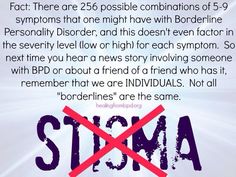
The problem with labeling BPD in the Cluster B category of personality disorders is the stigma that classification carries–that people with BPD (like those with NPD or ASPD) are evil, untrustworthy, selfishly manipulative, grandiose, dishonest, lack empathy, and really no better than people with malignant narcissism or even ASPD. (It sure doesn’t help any that an obviously sociopathic criminal like Jodi Arias has a diagnosis of BPD, when she more likely fits the criteria for high spectrum [malignant] narcissism, at the very least.) Insurance companies assume anyone with a Cluster B disorder is incurable, and therefore will not pay claims where a person is diagnosed with a Cluster B disorder. This is very damaging to those of us with BPD who have either successfully learned to modify and control our symptoms–or have even been cured, as BPDTransformation has been. People continue to believe we are lying about the success of the treatments or therapy we have received. Borderlines who have never been treated may find it difficult to find a therapist willing to work with them.

BPD is far more amenable to deep insight therapy than NPD (which is extremely difficult to cure but not impossible for non-malignants) and light years away from a disorder like ASPD (antisocial personality disorder), which can probably not be cured. Because the symptoms of BPD are so disagreeable to the sufferer (and not just to others), it is common for borderlines to present themselves for therapy, unlike people with NPD or ASPD. The vast majority or borderlines are unhappy with themselves and the way their lives have turned out. But many therapists won’t work with borderlines (other than with behavior modification treatments like DBT) because they know insurance companies will not pay such a claim.

What are borderlines on the border of, anyway?

tightrope

The name “borderline” itself is confusing. What are borderlines on the border of anyway? Neurosis and psychosis? A normal sense of self and Narcissism? Mexico and the United States?

The experts are all over the map on this, with some recent theories stating that BPD is actually a less adaptive, more ego-dystonic form of narcissism. But the original term “borderline” actually referred to the belief that the disorder was on the “border” between psychosis and neurosis:

[…]It is called borderline because it was originally thought that people were on the ‘border’ of psychosis and neurosis. BPD is also sometimes called Emotionally Unstable Personality Disorder (Borderline type). Approximately 75% of people given this diagnosis are women and 50% have experienced physical and/or sexual abuse.

Because BPD is more commonly diagnosed in women than in men, it’s also been referred to as the female form of narcissistic personality disorder (which is more commonly diagnosed in men than in women).

Psychotic, neurotic, both, or none of the above?

bpd (1)
Credit: Judgybitch/Dzhokhar Tsarnaev

The reason why BPD is sometimes regarded as the midpoint between neuroses (mild and easily treated anxiety or depressive disorders) and psychoses (disorders where the victim is out of touch with reality, such as schizophrenia and the manic-depressive form of bipolar disorder) is because people with BPD can, when emotionally upset, display psychotic or delusional symptoms such as splitting (black and white thinking), dissociation (feelings of unreality either about the self or the environment), magical thinking, severe paranoia, delusions of grandeur or persecution, and sometimes even hallucinations and disorganized speech or thought. However, for a borderline, these psychotic symptoms don’t last and as soon as the emotional crisis has passed, the borderline’s “sanity” normally returns. Antipsychotic medication can be helpful, but isn’t always necessary, as it usually is for a truly psychotic individual.

Others have speculated that BPD is really a severe form of PTSD or C-PTSD caused by trauma, and should be treated the same way as PTSD. Personally, I think it’s more long-standing than a reactive disorder like PTSD and is a true personality disorder, but it does make sense that BPD may have originally begun as a form of PTSD at an early age, often due to sexual abuse.

There is so much confusion and contradiction in the literature about BPD that I’m slowly coming around to BPDTransformation’s way of thinking that it should possibly be removed from the Diagnostic and Statistical Manual of Mental Disorders (DSM) until mental health professionals can get a better handle on what BPD actually is, and whether it’s even a valid diagnosis (or simply a group of symptoms that could indicate several other disorders). There should at least be more agreement among the professionals at any rate.

Surviving the holidays

charliebrown

I relate to Charlie Brown. As a kid, “Peanuts” was my favorite comic strip (I owned all the Peanuts books too), and Charlie Brown was a lot like me–fearful of what others thought of him, frequently bullied and taken advantage of, and often pessimistic. But he also had a good heart, and his faithful dog Snoopy brought joy to his life when he was ready to give up. So I have used some photos from the classic “A Charlie Brown Christmas” in my post.

The holidays are a rough time for many people, but they are especially hard on those of us who have been victims of narcissistic abuse and been cut off (or have gone No Contact) with our families. It sure doesn’t help either that I have SAD (seasonal affective disorder) and become very depressed during the shortest and coldest days of the year.

I have described the way my MN mother has systemically, through triangulation, scapegoating and gaslighting of me as well as making good use of the flying monkeys in her own extended family, has cut me off from all my relatives who I never knew very well anyway. She has even recruited some of the relatives on my father’s side into her evil campaign against me. I am the family embarrassment and black sheep.

Even though I have gone No Contact with my mother and several other family members, I feel I would have been eventually cut off completely from them anyway. I’ve almost certainly been written out of both her and my father’s wills. My mother’s extended family and friends don’t know me; they only believe the vicious lies what she tells them about me–what an ungrateful and selfish daughter I am (and how narcissistic I am too), what a pathetic loser I am (because I’m poor and haven’t achieved a high status career the way they all have), what stupid choices I make, and how emotionally unstable and crazy I am. It’s obvious she’s projecting some of her own character defects onto me (a red flag for narcissism if there ever was one), but knowing this doesn’t make her hateful comments and lies hurt any less–and some of them have a grain of truth–especially the picture she’s painted of me as an impoverished “loser” and that I was always destined to fail (because I was programmed and trained to fail).

It hurts like hell to know how hated I am by my own family. Even as a child I sensed my mother hated me, because I was an exceedingly sensitive child and she could never understand that. She also knew I could see right through her, even when I was a toddler. Knowing that my family hates me has done enormous damage to my self image and crippled me in succeeding in life. I was programmed by her to fail. My being a success would have been a huge danger to her.

Because of my C-PTSD and suspiciousness and lack of trust of others (and due to being naturally introverted), I  find it very hard to socialize and make friends because I have so much trouble reading social cues and knowing the right thing to say at the right time (for years, I thought I had Aspergers). It seems that my only social life is on the Internet. I’m afraid to get close to people because I’m afraid they might hate me if they knew me too well. So I spent most of my time alone, reading, blogging, and interacting with my sweet and loyal pets, who never judge me and accept me for who I am. I actually prefer it that way. I relish my time alone, without the stress of having to be “on” in social situations. I’m never really lonely, and I’m free to be myself without fear of judgment.

CHARLIE BROWN TRIES TO PERK UP THE FORLORN LITTLE CHRISTMAS TREE

But the holidays are hard because I am so alone in the world. Thanksgiving is coming up this week, and I’ve made absolutely no plans, because there is no one to make plans with. My only immediate family that has anything to do with me (or are still alive) are my son and daughter. But my son lives several states away and there is no way either he or I can afford to travel to be together, and my daughter has moved in with her boyfriend, and although she says she will be around on Thanksgiving, her word is about as reliable as a Nigerian email scam. She will probably find some excuse to not show up.

It’s very difficult for me to listen to people all around me talk about their big holiday plans–plans that involve boatloads of relatives, extravagant gifts, preparing huge meals for the extended family and their large circles of friends, planning plane or road trips to see beloved family and friends. I admit I envy these people, and really have a hard time dealing with their holiday chatter. It makes me feel so cheated and drives home how unfair life can be. Holiday commercials are even worse, and their images of the idealized, big extended, functional families sitting around a huge table groaning with food while the kids happily open gifts under a 12 foot tree feels like a kick in the teeth. It feels like the universe, or God or whatever, is taunting me:
“This is what everyone else has and you do not. You don’t deserve what they have. Nyah, nyah! Suck it up, loser.”
That’s really what it feels like. And it’s so, so hard. It makes me want to crawl into a large cardboard box and die.

I have a roommate, but she will be with her own family on Thanksgiving, and frankly, she isn’t someone I want to spend much time with. So it looks very likely I will be alone on Thanksgiving. Should I cook a small turkey just for me? I might–just to go through the motions of doing something special, and because I enjoy cooking and baking. I thought of going to the Catholic church I’ve been attending lately for their free Thanksgiving dinner–but that just seems so desperate and pathetic. I can’t help but associate people who go alone to such events as being the rejects of society, those without families or friends to be with. Well, that’s exactly what I am though, isn’t it? What makes me think I’m better than those people? Still, I don’t know if I can bring myself to go.

Christmas will be even worse. I think I’ll just skip Christmas this year. I’ve said that every year though since my kids became adults, and I haven’t skipped it yet. I may put up a small pre-lit tabletop tree from the dollar store. I have an antique mirror I can put behind it to make it appear brighter and bigger. But I don’t know. For me, giving gifts is far more fun than receiving, and Christmas is no fun if you’re too poor to give anything. I can make some of my glass and mirror suncatchers and give those (they were well received last year) or bake cookies and wrap them in attractive packages and inexpensive colorful tins.

Or maybe this can be the year I decide to stop feeling sorry for myself and give someone who is even worse off than me a few hours of joy. I could volunteer at the church, or the soup pantry, or even invite a homeless person or someone with no one to be with out to dinner for Christmas. Even a total stranger! At least I have a home, and a little bit of money; many people don’t even have that. In a week or so I’ll be receiving a several thousand dollar settlement from my daughter’s car accident back in October; I think I should use a little of that money to try to bring some joy into someone’s life who doesn’t have any at all. But will I do it?

snoopycharliebrown

The holidays sure are a challenge, and every year I dread them and wish I could just hibernate until spring, but maybe this will be the year I can give to someone else what I don’t have much of myself.