People who Capitalize random Words for no Reason.

randomcapitalwords

I’ve noticed something a lot of people do on social media: capitalizing random words.   There doesn’t seem to be a reason for these words to be capitalized since they are not proper names, place names, or titles.   The people who write sentences containing randomly capitalized words seem educated and intelligent otherwise, so I wonder if it’s just some new Meme or trend that’s circulating the web.  (See what I did there?)

Many people find the random capitalization annoying, and I can understand why, especially if you’re one of those sticklers for grammar (the politically incorrect term is Grammar Nazis).    I appreciate good grammar, but I don’t consider myself a grammar nazi.    When it comes to these Randomly capitalized Words, I find it amusing, even hilarious. I really don’t know why.   Perhaps it’s the silliness of capitalizing an Unimportant Word that I find so incongruous and therefore funny.   After all, humor always arises from the unexpected.

johngreenquote

Examples I have seen lately:

My weimeraner* dog tried to eat my Cat.

The Russian Mob that has overtaken the white house* needs to be rounded up and sent to Siberia.   (*aside here:  another thing I’ve noticed is people NOT capitalizing words that SHOULD be capitalized, and that seems deliberate too).

My therapist tried to put me on Crazy Pills but I refused and walked out.   (is ‘Crazy Pills’ a new brand name? Should I ask my Doctor if they are right for me?)

My wife just purchased a Shit ton of new Throw Pillows.  What are they good for, except throwing around because they’re always in the way.

I don’t understand why so many people want to act like Sociopaths, like it’s Cool or something?

I have to admit, I’ve been Guilty of capitalizing Random words myself, just because I think it’s Funny and I always wonder if anyone will Notice.

Here’s a thread from the Straight Dope Message Board that delves more deeply into the phenomenon:

http://boards.straightdope.com/sdmb/showthread.php?t=355786

How do you feel about people capitalizing random words?

The best-tasting healthy stuff I ever drank.

nakedgreenmachine1

I love smoothies, but I’m too lazy to ever make them myself.   I’m not the home juicer type of person.  I hate cleaning up the mess.

Most grocery stores sell Naked brand smoothies, and they are delicious!   Bolthouse is good too, but a little too thick for my taste, and I have never tried Odwalla.

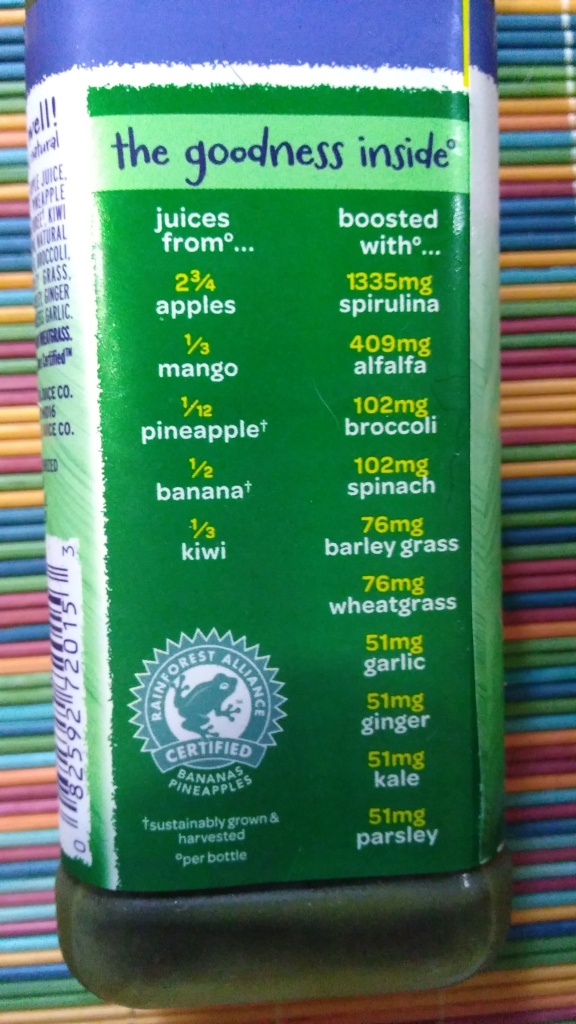
My favorite flavor is this one, called “Green Machine.”    It looks hella weird, kind of a muddy green color not unlike algae, but it tastes incredible.  It has spirulina and veggies in it, along with all kinds of fruits, and no added sugar or HFCS.    I feel healthier every time I drink it.  I’m not sure if that’s just some kind of placebo effect (because I believe it’s doing me good) or if I’m really feeling all those vitamins and minerals doing their work in my body.

Blue Machine, stuffed with blueberries and blackberries, is my second favorite, but sometimes it gives me heartburn.   Green Machine doesn’t do that.

I took photos of both the front and back of the bottle, so you can see exactly what’s in it!

nakedgreenmachine2


Meet and Greet: 7/14/17

How DARVO could prove which of us is telling the truth (reblog)

darvo

This is a good article I reblogged from Nyssa’s Hobbit Hole.  I think this information about determining accountability is not only useful on a personal level for those of us who have had to deal with narcissists, but as a useful way to decipher who are the real liars and truth-tellers in the current political mess we’re in.   Narcissists and sociopaths use all kinds of tactics such as gaslighting, smear campaigns, and playing the victim while making the real victim the “enemy.”    Of course, in our current political situation, both sides accuse the other of the exact same things, so it can be hard to determine who are the real victims and perpetrators.    Personally I think a quick determination of who are the real liars and truth-tellers can be made by observing who protesteth too much and which side acts more aggressive.    This can also be applied to dealing with people on a personal level and is very effective if you’re paying attention.

I have left Nyssa’s links in place.  Her ongoing tale about narcissistic abuse by two former close friends who sunk to new lows by stalking her blog is riveting and educational.

How DARVO Could Prove Which of Us is Telling the Truth

By Nyssa McCanmore, Nyssa’s Hobbit Hole

DARVO refers to a reaction perpetrators of wrong doing, particularly sexual offenders, may display in response to being held accountable for their behavior.

DARVO stands for “Deny,, Attack, and Reverse Victim and Offender.” The perpetrator or offender may Deny the behavior, Attack the individual doing the confronting, and Reverse the roles of Victim and Offender such that the perpetrator assumes the victim role and turns the true victim into an alleged offender.

This occurs, for instance, when an actually guilty perpetrator assumes the role of “falsely accused” and attacks the accuser’s credibility or even blames the accuser of being the perpetrator of a false accusation.  –Jennifer J. Freyd, What is DARVO?

While re-reading this article on Shrink4Men, I came upon a section which hit me as proof to my readers (who can read Tracy and Richard‘s bizarre, intimidating and remorseless e-mail to me in the “Now I’m Being Stalked” post, and how they’ve been trying to stalk and intimidate me online and off for the past few weeks) of which of us is telling the truth:

Of course, not everyone who denies wrong doing is engaging in DARVO. Many partners and exes of abusive women are accused of things they didn’t do or of things that never happened.

Naturally, when this happens, you deny the accusation and perhaps feel a little (or a lot) bewildered. How do you know if an individual’s denial is the truth or an instance of DARVO? Freyd (1997, pp. 23-24) proposes:

“It is important to distinguish types of denial, for an innocent person will probably deny a false accusation. Thus denial is not evidence of guilt. However, I propose that a certain kind of indignant self-righteousness, and overly stated denial, may in fact relate to guilt.

I hypothesize that if an accusation is true, and the accused person is abusive, the denial is more indignant, self-righteous and manipulative, as compared with denial in other cases.

Similarly, I have observed that actual abusers threaten, bully and make a nightmare for anyone who holds them accountable or asks them to change their abusive behavior.

This attack, intended to chill and terrify, typically includes threats of lawsuits, overt and covert attacks, on the whistle-blower’s credibility and so on.

The attack will often take the form of focusing on ridiculing the person who attempts to hold the offender accountable. The attack will also likely focus on ad hominem instead of intellectual/evidential issues.

Finally, I propose that the offender rapidly creates the impression that the abuser is the wronged one, while the victim or concerned observer is the offender. Figure and ground are completely reversed. The more the offender is held accountable, the more wronged the offender claims to be.”

Please click on this link to read the full article.

My Twitter debate with a Trump supporter.

debate

I had an interesting evening on Twitter last night.  I’d tweeted to Bernie Sanders about something he had said about single payer healthcare, and soon got into it with a Trump supporter, who seemed belligerent at first.  It started off with this comment:

Medicaid is evil. It takes money from some who rightfully earned it to give to someone who didn’t. #freemarket#FullRepeal#capitalism

I refuted this tweet hotly, and before long, me and this guy were engaged in a heated debate that went on for over two hours and ran into hundreds of tweets.

I rarely enjoy debate, and I’m not the type to try to convince people to change their views.   I’ve never liked confrontation.  Perhaps that’s due to my lack of self-confidence.  I’d rather try to change minds by writing a blog post, even though it’s more likely all my anti-Trump posts fall into an echo chamber of other people who agree with me.   Many people who disagree with my political beliefs on my blogs tend to be too aggressive, so I usually either delete their comments if they resort to personal attacks or general abusiveness, or just let them stand without replying if I do approve them.  The safe echo chamber of yea-sayers is a lot more comfortable for me than a pitchfork-carrying army of scary nay-sayers.

Verbal political discourse and debate just aren’t my thing and I feel like it’s not what I’m strong at, even when I’m sure I have my facts straight and am certain my view is the correct one.  I’m the sort of person who likes to “live and let live.”  If you support Trump and his policies, I’m far more likely to accept that and ignore you than to argue with you.

But last night was different.  I stepped out of character and engaged in a heated debate with this Trump supporter for two hours.  Not only that, but I also had fun doing it.   Although the conversation was heated, neither of us resorted to name-calling or personal attacks.    I felt like my brain was working at its highest capacity and I was able to come back at him with snappy and factual refutations to all of his (what I thought of as) lame excuses for his wrongheaded beliefs.

Engaging with this Trump supporter was fun, but still exhausting.    His tweets came faster than I could keep up with and finally my brain began to slow down.   He wasn’t going to change his mind; he just wanted a debate, which is something I find unusual in Trump supporters.   He wasn’t a complete idiot, but for moral reasons I disagree with his no-government libertarian viewpoints, even if his rationale made a type of sense, and I told him this.  He seemed to respect my right to feel morally offended by his beliefs but he stuck by his guns.

What I did find interesting was that after awhile, there were long silences from him before he’d tweet his next refutation to something I’d said.  I took those silences to mean he was thinking about what I’d said, especially since his arguments became weaker over time (or at least it seemed that way).   I don’t know whether I planted a seed in his mind or not, but I decided at that point I’d had enough and told him I had to run.  I also thanked him for his time, saying I appreciated the fact he engaged in real debate without resorting to insults or aggressive rhetoric.   He responded in kind and said he looked forward to a future debate.

When I checked my Twitter account this morning, there were several more tweets from him, replying to other things I had said.  Seems like he wants more, but I’m not sure I’m ready right now.

This was a lesson to me that not all Trump supporters are idiots who can’t engage in intelligent debate or don’t want to have their minds challenged.    It’s never a good idea to resort to stereotype, because there are always exceptions.

The last thing he said to me last night was to suggest a conservative book he had read that he thinks will change my mind (I doubt I’ll read it).   Hey, at least he reads.  I told him I hoped he’d think about some of the things I’d said.   Who knows, maybe he will.

I feel like this experience was a boost to my self esteem.
“Get out of my yard!”

One of the funniest signs I ever saw (taken by someone else).

pokemon

Why isn’t a mental health assessment required for a new president?

danzcolorplus7013

Credit: Increasing Number of Psychiatrists Challenge The Goldwater Rule / FFRF Maine


My son is applying for a job as a police dispatcher.  Like all government jobs, it’s a good paying job, with great benefits, including comprehensive health care, dental, and an actual pension.   He’s already passed two of the tests and the pool of candidates is down to just a few.   He thinks he has a good chance of snagging this job, but he still has to pass a mental health examination, since a dispatcher’s job can be incredibly stressful.  You have to be able to act quickly and make life and death decisions.  You can’t let your own emotions get in the way if you get a frantic call from someone threatening to kill themselves, or from a terrified woman whose ex-lover is holding a gun to her children’s heads.    You can’t dissolve into a handwringing puddle of indecision when you get a call from someone saying their husband is having a heart attack.   You must be able to act efficiently and quickly, and keep your wits about you at all times.    The job, though it pays well and is stable compared to many other jobs, has a lot of turnover because many people find they can’t handle this type of life-and-death stress for very long.  There is good reason then, to give a candidate like my son a mental health assessment, to make sure they are emotionally stable enough to be able to handle the type of situations that will come up without snapping, becoming depressed, or even blaming themselves if something goes wrong (because sooner or later, it will: some who threaten suicide will succeed; some who have a gun pointed at their head will actually be shot).

But the job of police dispatcher is far, far beneath that of President of the United States.  Only one or two individuals will be affected at a time by the choices a dispatcher makes, while the President’s decisions have the potential to affect an entire country, or even the entire world.

We have a president who obviously has a severe mental illness.   He appears to fit ALL of the 9 DSM-IV-TR criteria for Narcissistic Personality Disorder:

A pervasive pattern of grandiosity (in fantasy or behavior), need for admiration, and lack of empathy, beginning by early adulthood and present in a variety of contexts, as indicated by five (or more) of the following:

(1) has a grandiose sense of self-importance (e.g., exaggerates achievements and talents, expects to be recognized as superior without commensurate achievements)

(2) is preoccupied with fantasies of unlimited success, power, brilliance, beauty, or ideal love

(3) believes that he or she is “special” and unique and can only be understood by, or should associate with, other special or high-status people (or institutions)

(4) requires excessive admiration

(5) has a sense of entitlement, i.e., unreasonable expectations of especially favorable treatment or automatic compliance with his or her expectations

(6) is interpersonally exploitative, i.e., takes advantage of others to achieve his or her own ends

(7) lacks empathy: is unwilling to recognize or identify with the feelings and needs of others

(8) is often envious of others or believes that others are envious of him or her

(9) shows arrogant, haughty behaviors or attitudes


If that’s not bad enough, Trump shows signs of severe paranoia and even a possible degenerative illness like Alzheimer’s.     It doesn’t take a trained psychologist to be able to see what is obvious:  Donald Trump’s behavior is not normal.    At best, he’s incompetent and unfit to lead a nation; at worst, he’s a clear and present danger to the planet.

Armchair psychiatrists’ speculations aside, no official diagnosis of NPD or anything else has been made for Donald Trump.   That’s because of The Goldwater Rule, which was instituted by the American Psychiatric Association to address the idea that diagnosing a public figure (Barry Goldwater’s fitness to run for president in 1964 was in question) without an official psychiatric assessment was unethical.

It’s my opinion (and that of some mental health professionals) that an exception to the Goldwater Rule should be made for Donald Trump, who is visibly mentally ill enough to pose a real danger to America and to the world.   But why wasn’t he given a psychiatric examination to determine his fitness to lead our country in the first place?

Personally, I don’t understand why a psychiatric assessment isn’t required for all incoming presidents, or even for anyone who makes the final two candidates in any election.    If my son has to take one to qualify for a job as a police dispatcher, then I definitely think it should be a requirement for any incoming head of state.

HSPs and codependency.

Originally posted on November 8, 2015

einstein_quote

There’s a lot of discussion on the web about codependency as well as empathy, especially in the narcissistic abuse community. While it’s true people who are codependent to a narcissist also tend to be high in empathy and very sensitive, there seems to be a lot of confusion–people who aren’t too familiar with either term tend to believe empathic people are also always codependent. While codependent people are almost always highly sensitive (which is the quality that attracts their abuser to them and keeps them trapped in a toxic relationship because they believe they can “fix” their narcissist), the reverse is not always the case.

A healthy HSP (highly sensitive person) is simply an emotionally healthy person. They are confident and secure enough with themselves that they can resist the “charms” of an abuser. If a healthy person with high empathy does find themselves being drawn into an abusive relationship with a narcissist, they have the courage and presence of mind to pull themselves out of it and even go No Contact before they fall under the thrall of the abuser and before any damage is done. In fact, having high empathy makes it more likely a person will be able to “see” the red flags before anyone else, giving them a chance to escape and/or avoid the person.

A healthy HSP does not waste time trying to “fix” a narcissist. They know the chance of that happening is about the same as the likelihood they will sprout wings and fly to the moon. If a narcissist is going to change (I’m not one of those people who believes it’s not possible), it must be the desire of the narcissist and they have to work very hard at it, but no one else can “save” them except themselves, and it’s going to be a long, hard road if they decide that’s what they want. A healthy HSP will not allow themselves to fall into a love-bombing trap or be “hoovered” by a narc. Once they realize what they are dealing with, they will cut off any further communication. They know they can’t be nice about it, but must be firm. They may care, but they know they are not going to be the ones doing the fixing, and will be able to move on to a healthier relationship with someone they can actually grow with and who will be able to return their love.

codependency_love

Our society today is also quick to judge those who have high levels of empathy and want to give back to others as being “enablers.” This happens even in the public realm, with the massive cuts in spending to programs that help the most vulnerable people of society and the blanket dismissal by the Powers That Be of those who want to help as “suckers” who are “enabling” the most vulnerable people. I don’t wish to get on a political soapbox but there’s something very wrong with any society that only values how “powerful” you are or how much money you earn. There’s something sick about a society that dismisses its most vulnerable members as “lazy and stupid” or “deserving” of their sad lot. Empathy is a virtue that has become increasingly dismissed as a weakness, but is actually the one thing–maybe the only thing–that could rescue modern society from completely self-destructing. Empathy isn’t a weakness at all–it’s a strength. If you’re a HSP you have this quality and should be proud of it and use it, not hide it away like a shameful thing. The narcissists who run things in the world would like us all to think it’s a shameful thing, but that’s just another lie they tell. It’s needed now more than ever. So, you are not an “enabler” if you want to help others; just be careful who you are helping!

Unfortunately, HSPs have often been abused themselves or have other disorders such as complex PTSD, and they often find themselves targeted by narcissists for abuse. Narcissists are usually attracted to people with high empathy because they know they can get the “understanding” and love they crave and will proceed to feed on the HSP’s emotions much like a vampire feeds on blood. They know it’s hard for such a person to say “no” because they can’t stand to hurt anyone’s feelings, so an HSP person is more likely to stick around and tolerate abuse than someone who is less sensitive.

If you are such a person; if you are very sensitive, cut your losses now! Staying around a narcissist who is actively abusing you is just not worth it, and there’s also a very real danger of being drawn so far into the narcissist’s web of deception and abuse that you could develop Stockholm Syndrome and begin to identify with your abuser. Once this happens, you could even find yourself taking on traits of narcissism yourself and colluding with your abuser. It’s an insidious process but it can and does happen; and it happened to me. Be careful. Your soul is a precious thing and you should not give it freely to anyone until you know that person can be trusted with it. That doesn’t mean you have to become hypervigilant and start seeing demons around every corner, but if your intuition is throwing up a lot of red flags about a particular individual, don’t dismiss them. They could save your life.

The real reason highly sensitive people get bullied.

It was time to pull this one out of the archives!

luckyotter's avatarLucky Otters Haven

authenticity

I had an “Aha” moment today.

The reason highly sensitive people get bullied so often isn’t because of our sensitivity. It’s because of the dismally low self esteem that tends to go along with being that sensitive, especially if we were victimized by malignant narcissists and bullies when young.

Narcissists envy and fear high sensitivity.

narcissist_face

Narcissists hate high sensitivity in others for two reasons: 1. They envy it because it’s something they can’t have or may have lost as children and it’s a sign of an authentic person, which is something they aren’t but wish they were; and 2. they fear it, because they know this quality makes it possible for to zero in on the emptiness hiding under the narcissist’s guise.

Their hatred and fear is expressed through love bombing followed by bullying and other forms of abuse meant to weaken the HSP. An HSP’s fragile ego can be…

View original post 1,304 more words

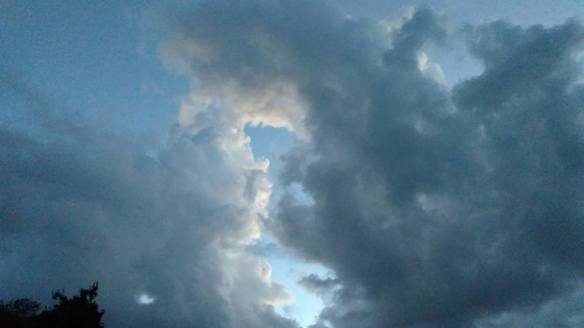
Twilight clouds.

twilightclouds1

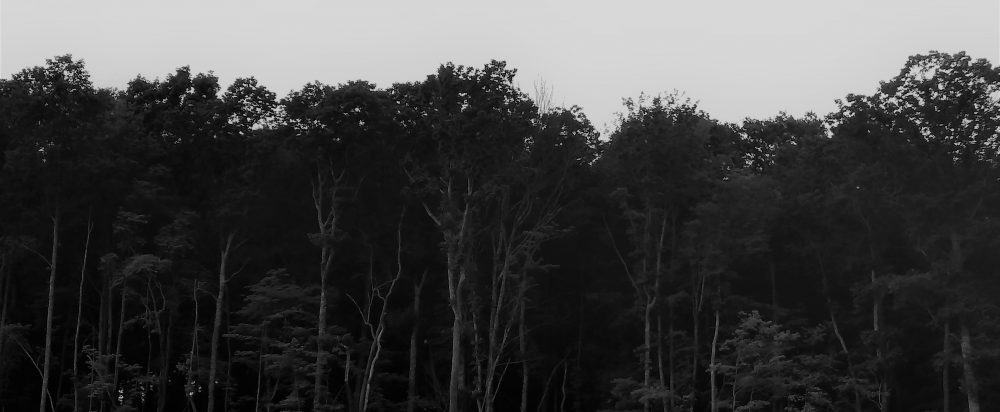
I took these photos at around 9:15 PM, so it was darker outside than it appears here.  I think the light after sunset (or before sunrise) is more interesting than daylight.

twilightclouds2

twilightclouds3

9:25 PM:

twilightclouds4