Learning to become the mother I wish I’d had

Amazing and insightful post written by a diagnosed NPD (non-malignant) who has been working hard to stop the generational transfer of NPD and raise an emotionally healthy and empathic son, while she works on herself. They are learning together, and she may have prevented her child from developing a personality disorder by using the techniques discussed in this post.

I sure wish my mother had become self aware enough to do this with me.

Donald Trump & Ayn Rand

Really good article about Ayn Rand (who many hardline Republicans seem to emulate, including many in Trump’s cabinet), Donald Trump, narcissism, and psychopathy. Was Rand a psychopath? Many people think she was, but there’s just as good an argument made by the author of this article (who is a psychopath) that she was really a narcissist. In my opinion, she was both.   As for Trump, he’s clearly a narcissist, but he’s so high on the spectrum his behavior and actions seem sociopathic (a word I prefer to use over psychopathy in most cases, because it’s a behavior pattern associated with malignant or high-spectrum NPD — while psychopathy is a condition one is born with and is not caused by early trauma).   In any case, lack of empathy is a feature of both narcissists (especially those as high on the spectrum as Donald Trump) and psychopathy.   You can think of psychopathy as “bad seed syndrome,” except a psychopath can actively choose to do good things or even be altruistic, if it suits them to do so.

Comments here are disabled; please leave comments under the original post.

nowve666's avatarCLUSTER B

—Psychopaths or Narcissists?

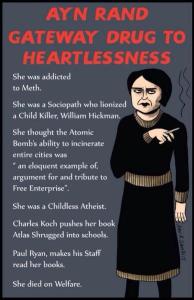
trumpaynOn November 8th of this year, the “unthinkable” happened. Donald Trump was elected president. Although his campaign sounded more populist that free-market fundamentalist, his choices for cabinet tell a different story. Liberals and progressives and just plain poor people are deeply concerned about the future. Alternet has an article whose title spells it out: It’s Ayn Rand’s America Now: Republicans Have Stripped the Country of Its Last Shred of Morality. Now Trump is hardly the ideal of Objectivists or Libertarians. He doesn’t embrace freedom for the individual, not with his “pro life” and anti-immigrant stance; certainly not with his intention to punish anyone who burns the flag. But the Republican Party representing the 1%, may well make the country Ayn Rand’s America.


aynaspsychoMany enemies of Ayn Rand’s philosophy (and there are many) like to call her a “psychopath.” Of course, many of these same people call…

View original post 1,205 more words

Trump and his impressionistic speech: HPD or NPD?

make_america_great

I’m engaged in an interesting conversation in a Facebook group about Cluster B disorders. Someone raised an interesting point about Trump possibly having HPD instead of, or in addition to, NPD.   His “impressionistic speech,” which is a symptom of HPD, is a clue, but based on his inability to accept blame or criticism (and not just projecting it onto others), that seems a lot more NPD.

I’ll just let the actual conversation speak for itself because it raises some interesting points.  (There were more replies, but I’m leaving out the ones not relevant to the topic raised, which is Trump).

Someone in the group posted this question (who I will call Participant A) :

Random thought: Donald Trump initially appears NPD. But that fucking hair… the orange tan, and the impressionistic speech…makes me wonder if he’s not HPD, or at least comorbid. The one HPD I’ve known was basically a narc in a series of crazy outfits. And she sounded JUST like him with her wild lack of details, inappropriate sex talk and constant attention seeking behavior. Thoughts?  

Participant B:

I think a person with HPD might respond to all of the criticism a little differently than he does. He seems to hold tight to his grandiosity, a person with HPD would be more wounded and emotional. He ignores the fact that nobody wants to join his inauguration and even lies and pretends It’s sold out, inauguration dresses are sold out, etc. That looks like NPD to me.

Participant A:

The HPD I know did this exact thing though. I worked for her and while planning a conference she made me send out an email to supporters saying we had this amazing star studded line up (we had no one) and the tickets would soon be sold out (we had like 10 people signed up so far). As an NPD I personally would be too nervous to publicly fail, so I would opt to undersell the event, in case no one showed up, to save myself embarassment. If people show up, bonus points, because I look humble. She just threw wild shit out there with seemingly no concept of reality. Constantly contradicted herself too.

Participant B:

People with HPD are supposed to be more uncomfortable with criticism and more uncomfortable not being the center of attention. I think people with NPD have mental blocks up that sometimes don’t allow them to see when they’re disliked or unpopular. Maybe on a subconscious level they get it. I think a person with NPD might be better able to answer this though

Me:

I think it’s easier to have ASPD than NPD — NPDs and BPDs care very much what you think (even if they never admit it) while psychopaths and ASPDs generally don’t give a shit.

Participant B:

People with HPD are more easily influenced, they typically blame failure on others. He doesn’t even admit to any failure existing.  Superficial emotional displays or a little more agreement with the majority might be more HPD too…

Me:

That’s a good point. He could also be a somatic narc — with extremely tacky taste! Cluster B disorders often appear together, so it’s entirely possible he could be both NPD and HPD too. But no way is he *just* HPD — like Participant B said, he doesn’t admit to failure — ever.

Me (replying to Participant A):

I’ve heard that HPDs have “impressionistic speech” but I never understood exactly what that means. Can you give an example of Trump using this kind of speech? I’m not doubting you, but I’m just not sure what it is. Sort of a vagueness? Because he talks and talks and never actually says anything. Or it’s like word salad and makes no sense. Is that what you mean?

Participant A:

Earlier today, “It’s going to be Huge! We’re going to turn things around”. Ok, Donald, how are we going to do that? ” We will make America great again!” Lol. Literally just now: “My cabinet is so smart. We have the highest IQ of any cabinet ever assembled.” Oh ok, based on what fucking data? No explanation.

Definition and example of impressionistic speech: “A term used to describe a person’s speech when it consistently lacks in detail and emphasizes emotions. For example, if you asked someone what they thought of something, and they said that the thing was “just wonderful, fabulous”.”

Does he not consistently fit the bill, or what?

Me:

Ah, I see. My NPD mother (who I always suspected was HPD too) talked that way. “Everything was fabulous!” “Oh, I feel marvelous!” A lot of hyperbole, but no substance. At all. Yes, Trump does talk exactly like that and never can back up his grandiose claims. And people think he’s pissing gold.

HPD doesn’t seem to be that common for some reason. Or it gets diagnosed as BPD or NPD.


The childhood origins of narcissism.

This is a very informative video explaining how narcissism develops during childhood.

Deconstructing Cluster B stereotypes.

clusterb

This is a cute drawing circulating Facebook depicting the “typical” person with each of the four Cluster B personality disorders (I cannot give credit for it since I have no idea who drew it or where it originated).   While I understand it’s meant to streamline the overall feel of each of these disorders, they’re still stereotypes. Stereotypes certainly may have a grain of truth behind them, but it’s important to realize they are convenient shortcuts at best, and quite negative and damaging at worst.

Obviously, not everyone with these disorders is going to act the way they’re depicted in the cartoon.  Human beings, even those with personality disorders, are complicated creatures, and just as there are many variations in the general population, so there are many variations among any group of people with one of these disorders.

Here’s another cartoon (which I have used in several posts) that also depicts these disorders in much the same way as the above drawing.

cluster_b

ASPD:

I think it’s interesting that in both of these cartoons, the person with Antisocial Personality Disorder is a criminal type of individual making threats, either with a weapon or he is already in jail.   Both wear a sadistic expression.  Both are also male figures.    The reality is, not all people with ASPD are criminals or in prison.   They aren’t all serial killers.  Some have never committed a crime (or at least have never been caught).  In fact, the other group of people statistically most likely to have ASPD (or psychopathy) are the very high functioning CEOs of big corporations.   Many people with ASPD are in high profile careers like politics or entertainment.  Their lack of conscience and guilt feelings, coupled with a nearly non-existent lack of empathy (even narcissists have more empathy than a person with ASPD), make it easy for them to rise high in their fields and have no compunctions about firing people or “downsizing.”  Other people’s feelings are much less important than the “bottom line.”  Many high ranking people with psychopathy or ASPD are actually women.

It’s fascinating to me that the two groups of people most likely to have ASPD/psychopathy appear at each extreme of modern society: the low functioning ones locked up in prison and/or running from the law, and the high functioning ones running everything from giant companies to powerful countries.

NPD:

The person pictured with NPD is also a male in both cases, and both guys are dressed up in business suits.   One is holding a wad of cash, and the other is just arrogant, with a PhD (of bullshit!) on his wall.   Both are wearing arrogant expressions.  The reality is, many women also have NPD–females may constitute as much as half of all people with NPD, and I think it’s becoming more common (why else would there be so many narcissistic mothers and websites about them??)

Also, not all narcissists are of this grandiose, arrogant, showoffy stereotype.   Many narcissists are the fragile, vulnerable or covert type, and use their “altruism” or “niceness” to get supply (or put others on a guilt trip).  Or they present themselves as pathetic, put-upon victims who never take any responsibility for themselves and blame others for their miserable lives and failing relationships.    Granted, the vulnerable or covert type of narcissist is probably more likely to be a woman, but this isn’t always the case.   My mother was quite grandiose and arrogant, and so are many women you meet in business.

HPD:

Histrionic Personality Disorder (HPD) and BPD are both depicted by women in these cartoons.  In both cases, the woman with HPD is a femme fatale, exuding sexuality and demanding attention using her body and come hither expression.    Some histrionics are men though, and just act dramatic and over the top for attention.  It’s not always sexual attention they’re after.   I’ve seen many men with what appears to be HPD in the gay community (this is in no way meant to disrespect gay men, it’s just something I’ve noticed).   HPDs do tend to be more extroverted than the average person.

BPD:

The BPD women in the cartoons vary the most.  In the first drawing she is crying; in the second, she is split between devaluation and idealization.   The emotional instability of a borderline is a fact; but not all borderlines are female.   Males with BPD can act a lot like men with ASPD, due to their tendency to act on impulse and have hair-trigger tempers and fly into violent rages.  Borderline males are more likely to be imprisoned or have a criminal record than men with NPD, who prefer to keep their hands and reputations clean.  BPD women with this disorder can also be abusive toward others or even criminally-minded.  Or they can be codependent, or primarily self-destructive (this is probably the more common type in females).    There are so many manifestations of BPD that it’s a hard disorder to diagnose, probably harder than the other three.   Many people with BPD have addiction issues or eating disorders and hurt themselves more than they hurt others.  .

The narcissist-elect begins to implode.

winning_temperament

Trump is already losing his shit over perceived insults against him on social media.  I knew this would happen if Trump got elected.  The poster boy for NPD is finding out that sometimes it’s prudent to be careful what you ask for because you might get it.

The U.S. presidency is not like running a business.  It’s not like being a reality TV star either.    It’s an incredibly difficult job with enormous responsibilities that requires someone who is knowledgeable in world and domestic affairs and can hold their own in the political sphere and among world leaders.    It requires someone with the ability to be diplomatic even among enemies and critics.  It’s a job that requires nerves of steel and you can’t afford to let personal slights get to you.   In other words, you can’t be oversensitive.

Trump is incredibly oversensitive and too emotionally unstable for a job like the President of the United States.    His NPD keeps tripping him up and he is showing just how oafish he is as he blunders and flails about trying to make sense of something he just can’t handle.

Every president we’ve had in recent years ages quickly while in office.  Four or eight years isn’t that long a time; but Obama, G.W. Bush, and Bill Clinton–all two-term presidents–all looked much older than eight years older by the end of their terms.   The job ages you because it takes so much out of you.

Now we have someone who not only has NPD, but is pathetically unqualified.  Since his election, there’ve been articles describing the way Obama has had to “hold Trump’s hand” and train him for his new job.   I don’t doubt it, and I’m sure Trump hates  every minute of it.

Not surprisingly, Trump has been overreacting to slights and criticisms against him on social media, especially Twitter.   Here’s a screenshot of his latest drama with the New York Times, who  apparently offended him.    Notice the way he keeps taking potshots at the Times, making sure everyone knows they are “failing.”   This is called gaslighting.

trumptweets

Here’s the article about it on Salon.

http://www.salon.com/2016/11/22/donald-trump-backs-out-of-meeting-with-new-york-times-because-they-wanted-to-be-on-the-record-announces-it-on-twitter/

He had a similar meltdown a few days earlier, when his VP Mike Pence was raked over the coals by the cast of Hamilton. Once again, notice the way Trump not only demands an apology,  but throws in a barb about the way he “hears Hamilton is overrated.”   So much drama already, and he’s been president-elect for what, two weeks?

trumptweets2

Watching Trump try to take on the presidency is like watching a petulant child try to do a grown-up’s job and then lose their shit because they can’t get it right and someone points out their mistakes.  You almost have to feel bad for him.   But he wanted this!

Ladies and gentleman, there’s a new reality show:  “Trump Takes On the Presidency.” Watch him implode as he realizes he bit off way more than he could chew, because he just had to have that title and the “glory” that comes with it.    He’s like a little kid dressed up in a plastic king’s crown and sceptor, ordering his “subjects” to do his bidding before he’s called downstairs by mom to empty the trash.  He’s not too much better than a figurehead.

Maybe Trump’s election is the BEST thing that could have happened!

narcissist_trump

I know what you’re probably thinking.  You probably think I must have finally snapped.  That I’ve given into Stockholm Syndrome and now identify with the enemy.   You’re  maybe even thinking about hitting the “backspace” key,  writing me off as a traitor to my left wing ideals — or at the very least writing me off as a typical unstable, waffling Borderline  who blows hot and cold depending on my mood and can’t stick to my beliefs.

None of these are actually true (though I do feel a little crazy!)

Please hear me out.   It’s not what you’re probably thinking at all.   I still can’t stand Trump.  I can’t stand his personality, his racism, his sexism, his entitlement, his malignant narcissism, the way he insults those who aren’t exactly like him.   Hell, I can’t stand his FACE.  I can barely stand looking at his smug orange mug, his bloated body, and his ridiculous peach-colored toupee.

But more than anything else, I can’t stand his LACK of any real principles or ideals.   Donald Trump is a man who cares about nothing.  He has waffled on everything from abortion to Planned Parenthood to gay rights to roles of women to Obamacare to globalism.    The only thing he seems to have any passion about is keeping foreigners OUT.  And even that could change tomorrow.

Why?  Because Donald Trump is a textbook case of NPD.   Narcissists at his level of malignancy have no ideals or real beliefs of their own, because they don’t care about ideals and beliefs.   Donald Trump has no God; he regards himself as God.  Hell, he even admitted he has never asked God’s forgiveness because he doesn’t need to.   Yet evangelical churches are threatening their congregations with hellfire if they didn’t vote for him.

Although I’m a die-hard liberal (not necessarily a Democrat, more of a democratic socialist, third-party voter type, although I did cave in and vote for Hillary at the end), I can still respect a man or woman who has opposite views to my own, no matter how conservative, as long as they truly believe that what they stand for is right.    If they believe that their ideologies are the best thing for all Americans, even if they aren’t.    I didn’t agree with Ronald Reagan’s or George W. Bush’s policies AT ALL, but I believe that deep down, these were good men, trying to do what was best for the country.   They CARED.  They weren’t promoting their policies for their own glory and fame (or at least not completely), but because they believed in those policies.   So I can respect someone like Reagan or Bush, even if I disagreed with them.

Donald Trump is a man with NO principles, NO real beliefs (except in himself), NO ethics, no true ideology.   He stands for nothing.  He is a man without a conscience, without empathy, who thinks nothing of insulting entire populations of Americans who are different than he is.   He has shamelessly pandered to the Christian right knowing they would vote Republican no matter what (especially when he uses the anti-abortion and anti-homosexuality rhetoric to get those votes), but he himself is not a Christian (although he says he is, I do not believe him).  His actions, deeds and words are anything but Christian.    Donald Trump believes in nothing, except perhaps, that he is the Second Coming.

Psychiatrists have broken their own rule to never diagnose anyone they haven’t met in person and given a formal psychiatric evaluation.  The media and Internet is abuzz with respected mental health professionals declaring that Donald Trump is a textbook case of NPD.  One psychiatrist even said there was no better example of a high-spectrum narcissist than Donald Trump, who he believes possesses all nine DSM criteria.  This psychiatrist has actually used clips of Trump’s speeches to use in his graduate and college psychology classes to show what someone with a bad case of NPD acts like.

The exciting week ahead and my fears about that.  

On Sunday night, through Thursday, I will be attending a conference in Chapel Hill and Raleigh that will cover Christian principles in dealing with and healing disorders caused by trauma, such as PTSD, C-PTSD, DID, and personality disorders.

As I described in this post, it’s truly uncanny how every obstacle I was facing to be able to attend  this conference (and there were a LOT of obstacles — the possibility of my being able to attend seemed very remote) were moved aside.    Donations came out of nowhere.   Even my boss gave me her blessing, even though I have no vacation time coming up.   I’ll even get my lost pay replaced by a kind donation.     I prayed a lot about this beforehand and then suddenly all these obstacles were lifted.  I couldn’t believe how easy it was.

But I still had a lot of doubts and misgivings.  Even after I researched the program I’ll be attending (HeartSync) and found nothing negative written about it, other worries began to plague me.   I’m socially awkward and shy in person; what if I didn’t fit in?  What if the other attendees (most who are probably more well to do than me) didn’t like me?   What if they regarded me as too low-class, too poor, too shy, or just too weird?   What if they didn’t like my rather shabby clothes, my unstyled hair, my old car, my cheap baggage?

I also admit I felt nervous about staying in a hotel room for 4 – 5 days with a woman I have only talked to a few times on the phone and in email.   What if we didn’t hit it off, in spite of her incredible generosity and kindness?  Maybe she would change her mind about me and decide we had nothing in common.  As someone who has often been disappointed by others and has often been bullied, dismissed, or rejected by other people, I’m hypervigilant and nervous about those things happening, about not being accepted or included.    I’ve been programmed to think this way, and although it’s slowly changing as I begin to like and respect myself more, I still fall back into that way of thinking so easily, especially when I’m triggered.

I decided that instead of holding my feelings to myself, to approach my new friend with with my concerns.   I felt it was better to get all that out in the open and talk about it, than worry and fret that I might be an outcast or not fit in (and then act in ways that might bring on rejection).  I was reassured that this was a healing seminar, with plenty of people suffering from PTSD and other disorders that caused their self esteem to take a nosedive, and there are Christian therapists there to talk to should I feel triggered in any way.

Mind.Blown.

All this was very reassuring, but when my new friend told me she was happy about Trump’s election, I was initially tempted to tell her to forget the whole thing, return her generous donation, because no way could I room with a Trump supporter when I’m still so triggered by his election a few days ago.

But then my friend told me something positively mind-bending.  What she said was something I don’t think I would ever have thought of on my own, but I believe she’s onto something big here.

She said she couldn’t stand either of the candidates (which I couldn’t either) and like many, didn’t vote for either of them.   She assured me she does not like Trump and agrees that he is a malignant narcissist without principles who doesn’t really believe in anything except himself.

Mass education about NPD is the way out of this mess.

But she said that his election was a wonderful thing, because it will–and already is–educating the general public about NPD and malignant narcissism.   As of right now, only mental health professionals and people who read narcissism blogs on the Internet really know anything about this disorder.  Trump is, by default, going to make narcissism a household word–not in the current misguided belief that it means taking selfies — but the true meaning of NPD–a person so damaged they must project their pathology onto others, develop a false self to fool others and puff themselves up, can tolerate no criticism, and attack anyone they believe is against them.

As Trump progresses during his presidency, we are going to witness Trump’s obvious mental and emotional instability as he attempts to fill a role so over his level of experience it’s laughable.  He will almost certainly fail.   My friend believes there are still enough checks and balances to keep him from doing any real damage.   Most narcissists are all talk and no action anyway.   As he blunders about and rants and rages,  we are going to be hearing and reading more and more about NPD and how it was the rise of narcissism that brought this country to where it is and finally allowed its poster boy–Donald Trump–to be elected.

Trump is likely to accomplish nothing except one very important thing: his unstable, borderline-crazy behavior will begin to make people realize that we have sunk so low as to elect a sociopathic narcissist as our president.   That in itself might be a wake up call for us all, and could start the pendulum swinging back toward the support of candidates showing more empathy, compassion, and a sense of fairness and justice, who have real beliefs and care about America and the world.   We are all going to be learning a lot about narcissism.  There is still a lot of ignorance and misunderstandings about this personality disorder.

As the tide begins to turn, and people realize we have elected someone who does not care about anyone but himself,  people will begin to give each other what they hope to see in a leader during other times — compassion, caring, and helping each other.

Education–in this case a worldwide crash course in malignant NPD and its devastating effects when one is allowed to rise as far as Trump has–is what is so sorely needed right now.    Perhaps without Trump’s election, we would never get that far-reaching education and people would remain ignorant.

As depressed as I’ve been over the past several days over Trump’s win, I’m looking at things now in a whole new light and feel completely ready to attend this seminar, which in some way I don’t understand right now, has everything to do with what I just learned.
“How to Spot a Collapsed Narcissist”

archie-bunker

The following is is a very interesting article I found on a site called  Flying Monkeys Denied, that explains how to identify a narcissist who has “collapsed” –in other words, a narcissist who has been denied adequate supply (leading to narcissistic injury), perhaps by having failed to meet his or her goals or obtain the admiration they thought was their due.    He (or she) will spiral into “pit bull” attack mode in their last ditch efforts to force others to provide them with supply.   They become hypersensitive, hateful, rage filled, tantrum throwing, angry, snappish, intolerant, and sometimes even violent.   Any pretense of niceness or charm they might have formerly displayed when things were going better for them disappears and the rage just underneath the mask of pleasantness comes out full throttle.

They still cannot accept any blame or criticism of themselves.    They project their self hatred onto the “targets” they have selected (people of another race, religion, ethnic group, gender, or people with a non-traditional lifestyle).  It’s as this level the narcissist displays bigotry and small-mindedness.   It’s at this level you see xenophobia and intolerance toward viewpoints outside their narrow worldview.   It’s at this level the collapsed narcissist may batter his wife or girlfriend so badly she winds up hospitalized or dead.

Archie Bunker in the ’70s hit TV show, “All in the Family” was a narcissist who was painfully aware he was at or very near the bottom rung of the socioeconomic ladder.   Fearing he’d sink to the even “lower level” of the minorities and various ethnic groups he looked down on with so much contempt, Archie hung onto that one thin thread of hope: his whiteness, his conservative values, and his blue-collarness.

There’s another narcissist in the public eye right now, similar to Archie Bunker in many ways (only with a lot more money),  who is running for president.  This narcissist also displays all the signs of having collapsed or being in the process of collapsing, perhaps due to the pressure of running for the highest office you can obtain but deep down knowing he really isn’t qualified, so he attacks those who question  his competence or criticize his agenda.   His bigotry, sexism and racism ensures that should he fail (lose the election, win the election but become the most hated president ever) he will still be “above” these other groups who he has deemed are beneath him.

The next stage in the narcissistic collapse (if getting supply through aggression, threats and intimidation fails) would be a descent into depression, suicide, or even psychosis (when a narcissist reaches this point of having hit rock bottom, they may become so desperate  as to voluntarily enter therapy, and this is when inroads into their psyche are most likely to be made).   Such a massive blow to the narcissistic ego could also result in complete loss of control  called “going postal.”   It is this possibility I think many of us sense in The Donald that makes his possible presidency so terrifying.    Should he collapse that far, he could start a nuclear war or turn America into a police state or order the extermination or deportation of all the groups of people he dislikes.  Gay people, people of color (particularly Muslim-Americans),  even women are at risk should that happen.

My apologies for applying Godwin’s Law,  but I believe this is how Hitler went from winning an election as a smooth talking populist who promised to “make Germany great again,” to the monster who became responsible for the extermination of 6 million Jews and other groups he disliked.   I could see this happening with Donald Trump all too easily.    There aren’t enough checks and balances any more to keep him at bay should he decide to unleash his narcissistic fury.   This is one angry and disordered man who is coming undone on national TV and I wouldn’t put anything past him.

I didn’t intend for this intro to be so long.   Here is the article I’m linking to:

How to spot a Collapsed Narcissist

The elimination of NPD from the DSM would be a disaster

narcissus

Apparently, the removal of Narcissistic Personality Disorder (DSM-V code 301.81; ICD-10 code F60.81) from the Diagnostic and Statistical Manual of Mental Disorders is still being considered.   Sam Vaknin talks about it in this video.

I think its removal would be disastrous. It already scares me that narcissism seems to be increasingly regarded as an advantage in today’s winner-take-all society and that we even have a potential US President who is a poster boy for malignant NPD. Trump has even been given the NPD label by many mental health professionals. Yet he still remains popular and is a serious contender for our next President.

But narcissism (not the healthy, but the pathological type) is definitely not a positive thing. Narcissists are actually miserable people even if they become successful (and many of them do not). These are people without a real sense of self, who have constructed a false one to compensate and must feed off others like vampires to keep their false self intact. They do others a lot of damage, even if they think they don’t have a problem. Under the facade, these are people who have a vast well of emptiness inside and if the false self is removed through loss of narcissistic supply, will become deeply depressed, possibly psychotic, and even suicidal. NPD is a serious mental illness, but I think people tend to forget that, because on the surface, people with this disorder can seem so functional. SEEM is the operating word here.

Many self-help books, especially those that tell you how to be successful, encourage you to develop narcissistic traits. I think these books are dangerous, not only because they encourage people to become narcissists, but also because they have caused a shift in thinking about NPD to the point that many no longer consider it a mental illness and in fact think of it as something to strive for. We need to stop pretending narcissism isn’t a problem. More attention needs to be paid not only to the damage narcissists cause others, but also to the internal world of the NPD, which is a painful and bleak one. NPD is a serious mental illness, not a “personality type.” Its removal from the DSM would cause untold damage to the world.

We also need more mental health specialists who are actually trained to treat people with NPD. I think part of the reason why it’s under consideration for removal is because most therapists don’t want to treat people with NPD. If you have the diagnosis, you are shown the door. They don’t want to deal with you and assume you are incurable. Hence, there are more narcissists walking around doing damage to themselves and others than ever before. I don’t think the non-malignant type of narcissist is as incurable as people think; it’s just because it isn’t an easy disorder to treat and therapists don’t want to be bothered working with people who have it. Old-school psychiatrists and psychologists such as Kohut, Kernberg, Masterson, and Lowen treated people with NPD successfully in their practices, but we seem to have forgotten that and just assume it’s incurable and worse, that it’s not even a mental illness but a personality type. This needs to change!

There should be no “shame” in having a Cluster B diagnosis.

noshame

Yes, another potentially controversial post.  Please hear me out before judging.

There are some (actually, many) people in the blogosphere who believe that people with disorders like Borderline or Narcissistic Personality Disorder made some kind of conscious choice to have their disorder.   With unusual exceptions (which I’ve discussed in others posts), I think this is wrong.

Bad seeds?

People with Cluster B disorders, in spite of what you probably read or heard, aren’t inherently evil or “bad seeds.”   Certainly, some become evil, because they’ve been programmed for a psychological need to obtain narcissistic supply in order to feel like they exist.  In order to get that supply, they became abusive and manipulative.   People addicted to drugs or alcohol are also abusive and manipulative, in order to get their chemical fix.

People with psychopathy may have been born without the brain capacity to feel empathy or have a conscience, but I don’t think Psychopathy should even be categorized as a Cluster B disorder at all, since it seems to have its roots more in brain chemistry than in early trauma.   Plenty of psychopaths came from normal, loving families.  The jury’s out as to whether Antisocial Personality Disorder is the same thing as psychopathy.  I think they may coincide often and their symptoms are similar, but I’m not at all sure they’re the same thing.    I don’t know a whole lot about ASPD, but I think it, too, usually has its roots in trauma as a child.   I know almost nothing about its treatability, but it’s my understanding it’s very difficult to treat, even more so than NPD.    But I digress:  talking about ASPD or psychopathy is not the point of this post.

Another blogger who commented on a post of mine today mentioned that she may have undiagnosed, recovered BPD.   I sensed from the tone of her admission that this might be something she’s  ashamed to admit.   I wondered why.   BPD, like NPD, has a terrible stigma, although in its favor, there’s a movement in the BPD community to reduce its stigma as “evil” and “incurable.”    Their efforts seem to be working, because BPD is seen today as being less of a “mark of the beast” than NPD is, although the stigma certainly still exists.

Why no anti-stigma movement for NPD?

I’m not sure why there is no grass-roots movement among narcissists to change the stigma against NPD, but from everything I’ve read from self-aware narcissists (and you’d be surprised how many of them there are online), they’re either: (a) proud that they are narcissists and wear the “evil” stigma like a badge of honor (these tend to be malignant, overt narcissists with antisocial or sociopathic traits), or (b) *this is a shocker* so ashamed of their narcissism that although they hate the stigma, they seem resigned to it and and seem to hang their heads in shame, quietly accepting how “bad” they are.  “I deserve it,” they say.   It may seem hard to believe, but some of them even defend the narc-haters.  Remember we are talking about self-aware narcissists.  Most narcs never get to that point.   Their grandiosity keeps them from having enough insight to do that.

Ego-dystonic vs. ego-syntonic.

Because people with BPD are almost always ego-dystonic about their disorder (they aren’t happy with themselves), and because generally BPD doesn’t lend itself to self-delusions  (in other words, having a false self) the way NPD does, BPD has a higher cure rate than NPD,  which also helps reduce its stigma.    NPD is usually more ego-syntonic, but not always.  Narcissists who are ego-dystonic (usually covert narcissists) tend to be frustrated, lonely, and depressed, and although they can be highly manipulative, entitled acting, and lack empathy, they lack the grandiosity and false pride that keeps them stuck in the delusion that their narcissism has worked for them.

I don’t see a whole lot of difference between BPD and C-PTSD.  Actually, BPD is like C-PTSD on steroids.  I’ve written about this subject before–the symptoms of both are nearly identical, and both Borderlines and people with C-PTSD are very prone to become codependent to malignant or overt narcissists.   They are also prone to self-harm, wild mood swings, and are sometimes suicide risks.  People with C-PTSD–especially women–often get slapped with the stigmatizing BPD label simply because the DSM doesn’t recognize C-PTSD as a legitimate disorder (and PTSD, while similar, applies more to those who suffered a single, intense trauma rather than the victims of chronic, long term abuse starting in childhood, so the treatments for someone with PTSD would be different).

Moving back to narcissism…

Many people believe NPD cannot be successfully treated, much less cured.   I admit I’m skeptical about its curability, though I do know there have been a few cases where it’s happened.   I also know there are narcissists who are ego-dystonic and unhappy with what they’ve become, once they realize they are narcissists.   I don’t think the adage that “if you think you have NPD, then you don’t” is necessarily true.    I have met a few here and on forums who desperately want to change their behaviors, usually because they’ve realized that they’ve missed out on things like knowing how to love and receive love, or having a healthy relationship with their spouse or children.   They want to know what love and vulnerability in a relationship feels like.  They want to know what real joy and empathy feels like.   They forgot how.   They’ve come to realize their lives are empty and shallow, and they are constantly under the stress of always having to act a part in a play.   They forgot who they were a long time ago.   Most narcissists did not have happy childhoods and most had parents who either abused or spoiled them (spoiling is a form of abuse because it fails to mirror who the child actually is, so the “love” they get is conditional).

As a mental illness.

I’m in no way defending narcissists or the way they act.   But as a cluster B disorder,  it started as a defense mechanism to cope with unbearable pain and feelings of emptiness. Many people believe narcissists love themselves, but nothing could be further from the truth.  They only love their false self.  Scratch any narcissist and you find a person who doesn’t even know who they are.  BPD is much the same that way, except Borderlines don’t have a functional or strong false self.    I’m not suggesting sympathizing with active, unrepentant narcissists or condoning their toxic behaviors. I’m not suggesting staying with one either!   But I think the stigma against NPD has hurt those people with the disorder who sincerely want to change.  These people do exist!  I don’t think they’re lying when they say they want to become non-narcissists–why would they? What would be their motive in doing so?   Much as with people with BPD, therapists refuse to treat them, insurance won’t cover them, and they are frequently demonized as non-human creatures or worse.

Maybe the treatment rate for NPD is so abysmal because they are given up on so easily by therapists who lose patience with someone who doesn’t show immediate improvement or acts aggressively or in a confrontational way.    NPD is a very difficult disorder to treat, but that doesn’t mean it isn’t possible.  Even if a narcissist can’t be cured, CBT and other mindfulness therapies have had good results on some narcissists who really want to change the way they treat others and have more mutually fulfilling relationships.  DBT (dialectical behavioral training), a mindfulness therapy similar to CBT traditionally used on people with BPD, has also been shown to be effective on some people with NPD.

As a Borderline myself (my therapist thinks I’m recovered, but I’m not at all sure about that), and having personally experienced the stigma against Cluster B, I have a great deal of empathy for anyone with a Cluster B disorder who is self aware and genuinely sorry about the way they’ve treated others or the choices they’ve made, and who sincerely wants to do the hard work needed to make changes in themselves.   People with Cluster B disorders didn’t choose to become that way; like people with C-PTSD, they have a mental illness caused by trauma and C-PTSD is almost always at the core of any cluster B disorder.

While it’s true that some will never get to the point of self awareness or even if they do, may not be interested in finding new and better ways of relating to others and the world, there are many who do, and we shouldn’t judge them or hate them just because of their stigmatic diagnosis (and the diagnosis could be wrong anyway!).  That’s why I don’t run a “narc free” blog.  I allow people with Cluster B diagnoses–including NPD–to post comments on this blog and share their experiences along with others who do not have those disorders and were abused by people who do.  As long as they don’t attempt to upset or trigger non-Cluster B abuse victims and remain civil and add to the conversation, they are always welcome here.