My verbal processing problems and not getting jokes. .

jokes

Today a co-worker told me why people tend to not respect me and why they talk down to me.  I already knew the reasons why, but hearing it from another person, even when it’s not said in a mean or patronizing way, still stung a lot.  She said when people talk to me, I seem to not understand what they are saying,  and I don’t process verbal directions as well as most people.  Unfortunately, what she said is absolutely true.  Even though I know I’m well above average intelligence, I’ve always been sensitive about this and afraid people will think I’m stupid because of this problem I have processing verbal communication.

This is typical of someone with Aspergers or autism, and I also suffer from the social awkwardness of an Aspie.  Both result from failing to process verbal communication in a normal (some would say “neurotypical”) way.   Although I was never diagnosed with Aspergers, for many years I was sure I had it, because I certainly act and think in Aspie-like ways.   I’ve had this problem since childhood.   There’s never been any proof I don’t have Aspergers though, so who knows–I could be on the autism spectrum.  But I actually think my problem is due to complex PTSD mixed with Avoidant Personality Disorder.    I’m usually slightly dissociated or “off in space” somewhere when people are telling me things.  I also am highly uncomfortable in groups of other people (or people I don’t know well) and the ensuing self-consciousness makes me clam up and do and say awkward things.  I can’t really focus on what others are saying because I’m so obsessed with not looking stupid or weird.    I get so nervous that I might not understand what the other person is telling me, that my brain stops working and makes the problem even worse.    The fact I also have very poor hearing (I only have 20% hearing in my left ear) exacerbates this problem.

I have a similar problem when people are telling me jokes.    I’m so afraid I “won’t get it” that instead of listening to the joke, I’m worrying that I might not get it and the person telling the joke will think I’m stupid.  So what happens?   Ding ding ding!  I don’t get the joke!    That’s why I prefer jokes that don’t require any “getting.”  Goofy or silly humor, or “random” humor is much more my speed.

My malignant narcissist ex used to exploit my discomfort with joke-telling for his own sadistic entertainment.  He did this by deliberately telling long, involved jokes when others were present, and then pointedly look at me, asking, “Did you GET it?”   If I didn’t (which was often the case when I was put in this nerve-wracking situation), I could do one of two things:  (a) I could lie and say I did get it, but this didn’t work because he’d then ask me to explain the joke; or (b) admit I didn’t get it.   Either way, he was turning my insecurities against me in order to make me appear stupid in front of others.  He’d rub salt in the wound by telling me I had no sense of humor because I was unable to get his jokes, even though this actually isn’t true at all and I think I have a very well developed sense of humor (just not a traditional one) and many people find me funny. What that sociopath did was an especially subversive and vicious form of gaslighting that exploited my differently-wired brain and my self-consciousness.   I still find situations where people are telling jokes very triggering.
Like Chinese water torture.

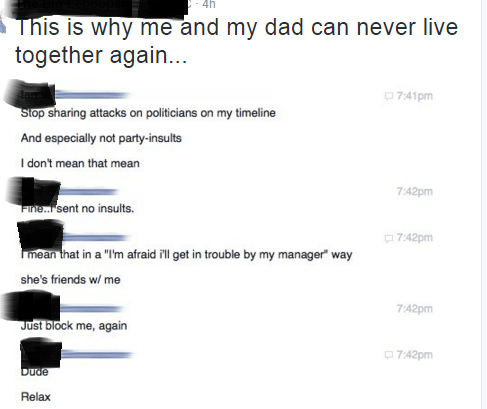
This is also the reason why I could never live with my ex again (well, one of many!) In this short conversation, my son was asking his father to please stop spamming his Facebook timeline with negative opinions about certain political candidates, because people my son works with, including his boss read his Facebook page. He’s also friends with his boss in spite of their opposite political leanings. He has asked his father to stop doing this in the past, and has had to block him before because he wouldn’t stop. Watch the way his father takes NO responsibility for his inappropriate behavior and then tries to turn my son into “the bad guy” by making him block him AGAIN. I know EXACTLY what he’s talking about because I also went through this same sort of crap with him over and over again (and he finally blocked ME–good riddance, I say!)  He’s the king of subtle gaslighting, blame shifting and denial.

It seems like a small thing,  maybe if this was an isolated incident it wouldn’t be a big deal–but imagine this type of irritation happening over and over and over, many times a day.  It was crazymaking in the extreme!  I like the way my son handled it:  “Dude. Relax.”


convo_22216


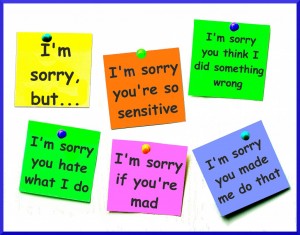
I don’t need your damn fake apologies.

I’m still not taking any of their crap. It’s time to roll this ball out of the back of the closet and toss it around again.

luckyotter's avatarLucky Otters Haven

narc_apologies

My sociopathic ex was never sorry for anything. Oh, yes, he “apologized” sometimes, but it was only to get me to shut up or because he knew he’d already lost the argument or knew I was right (but he wasn’t really sorry.) It was insulting how stupid he must have thought I was to believe these “apologies” were sincere.

Unless they are incredibly good actors and are hoovering you (trying to reel you back in, like a Hoover vacuum sucks up dirt) or love-bombing you (stalking you as prey), no apology coming out of a narc’s mouth is going to sound sincere. Of course, it’s easy to fall for those “sincere” apologies when they’re feeling needy, but there are always other red flags you can look for, such as crowding you, moving too fast, or trash-talking all their exes (make no mistake, he or she will eventually trash-talk you too).

View original post 623 more words

I’m pretty sure I just got gaslighted.

My daughter doesn’t have NPD (for awhile I thought she did) but she does have BPD and PTSD like I do and some narcissistic traits (what 22 year old doesn’t, though?)    In general her behavior’s gotten a lot better the past two years,  but I just got off the phone with her and think she gaslighted me.

I had called her this morning to make sure she got home from work safely last night (because the roads are very icy due to all the snow we had, which is now mostly melted).   She just called me back but was in the middle of having a conversation with a friend at the same time.   I don’t care for phones, and I HATE when someone is talking to someone else instead of talking to me if they’re on the phone with me.   It’s incredibly rude.  She kept saying “Wait, Mom,” while she was listening to her friend tell her a joke.  I sighed impatiently and told her I thought she was being rude.  Instead of apologizing or stopping to give her attention to me, she said to her friend, “My mother doesn’t know how to talk on the phone,” which is sort of true because I’ve always hated phones and am awkward on them, but in this case, she was just wrong and I told her so.   Sarcastically she said, “FINE, Mom,” at which point I thanked her for letting me know she was okay but that I had nothing else to say until she was ready to stop conversing with her friend.  I told her I was hanging up and I hung up.    UGH, I’m annoyed at her right now.   She mostly does that when she’s with her friends.  I guess she thinks it makes her look cool. 🙄

Five types of gaslighting narcissists.

Gaslight-2

I haven’t written an original narcissism article in awhile, and I was thinking about gaslighting today, so I thought I’d write a post about it.

Gaslighting is a defense mechanism commonly used by narcissists in order to diminish their victims and make them doubt and question their own reality.  The term comes from the 1942 movie “Gaslight,” in which a young wife is abused in this manner by her husband, who almost succeeds in driving her insane by telling her she is imagining the gaslights in their house going on and off, even though he has been secretly playing with the gaslights himself to make her think she’s going insane.  Gaslighting is one of the most sinister and crazymaking things a narcissist can do, and over time your self esteem and even your grip on what is real and what isn’t begins to erode.   Dealing with a gaslighting narcissist is like looking into an endless hall of mirrors.  It’s common for victims of such mindf*ckery to develop PTSD or complex PTSD.

Here are five common types of gaslighters, with examples that show what these darlings do to make us feel like we’re going crazy.

1.  The “You’re Insane” gaslighter.

maybe_your_crazy

This type of gaslighter, when confronted with the truth about their disgusting and unacceptable behavior, accuses you of insanity, stupidity, or (in the case of women) your terrible PMS (gaslighting with a little misogyny thrown in for good measure).

You:  I don’t think you should have told all our friends that you think I’m cheating on you, especially because I’m not.

Gaslighter:  You’re imagining things as usual.  Have you taken your meds today?

You:  I hate it when you use that tone of voice.

Gaslighter:  Oh, please, not this again.   You must be on your period.


2. The “I never said that” gaslighter:

never_said_that

This type of narcissist is so far into their lies and denial he/she would sell you down that river in Egypt.

You:  Why did you tell my mother I can’t keep a job?

Gaslighter:   I never said that.  This may be followed by a “you’re insane” elaboration to drive home their case that you’re the deluded one.

You: You promised me I could have some money to buy the kids new school clothes.

Gaslighter:  No, I never agreed to that.  I told you I don’t have the money.  What part of “I don’t have the money” did you not understand?


3.  The “Everyone’s Against You” gaslighter:

nobody_likes_you

This  is an especially mindfucking type of gaslighting, in which the narcissist draws other people into their attack on you, which may in fact not be the case but they can definitely convince you no one is on your side.  If actual flying monkeys are being used, then a different tactic, triangulation, has become part of their arsenal of weapons they use against you.

You:  Why do you always talk to me like you hate me?

Gaslighter:  That’s just your overactive imagination again, but to be honest, I was talking to [names of friends, associates, or family members] the other day, and they all told me they think you’re very difficult to be around [or insane, stupid, etc], so put that in your pipe and smoke it.

This type of abuse can also be very subtle:

You:  You are driving me crazy!

Gaslighter:  Well, I wasn’t going to tell you this, but [name of friend, family member or associate] and I were talking, and we are all very concerned about you (“I’m/we’re concerned” is narc-ese for “I/we think you’re batshit crazy.”)

This next type of gaslighter is probably the most infamous and well known to most narcissistic abuse survivors:

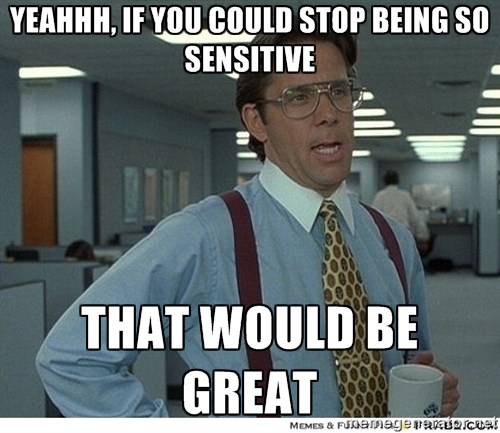
4. The “You’re Too Sensitive” Gaslighter:

your_too_sensitive

Narcissists love to call out the sensitivity of their victims as if it’s a character defect (and if we were raised by narcissists, we have probably learned to hate and be ashamed of our high sensitivity).   It’s true that many abuse victims are highly sensitive, in fact some of us are HSPs.  Narcissists are drawn to sensitive people because of their high empathy and tendency to become codependent and thereby good sources of narcissistic supply.   At the same time they need us, they also hate and envy those qualities they seem to be so attracted to, and don’t miss an opportunity to take hurtful potshots.  Even if they do or say something that would even hurt the feelings of someone as coolheaded as Star Trek’s Mr. Spock, they somehow make it your fault if you’re bothered by it because you’re just too damned sensitive.”  It’s really just a variation of the “you’re crazy” tactic.

You:  I wish you’d talk to me more respectfully when we’re out in public.

Gaslighter (dramatically rolling eyes):   I do talk to you respectfully (lie).  Your oversensitivity is really getting tiresome.


5.  The “I Was Just Joking” Gaslighter.

cant_take_a_joke

Similar to the “You’re Too Sensitive” gaslighter, this one calls your sense of humor (or lack thereof) into question, even when their “joke” is clearly anything but.

Gaslighter: That dress makes you look fat.

You: (looking hurt):  It does? But I’ve been trying to lose weight for you.

Gaslighter:  Jesus, don’t you have any sense of humor?  You can never take a joke.

To rub salt in the wound, they might even toss a little “Everyone’s Against You” into the mix and say something like, “Maybe it’s because you can’t laugh at anything that no one really likes you.”

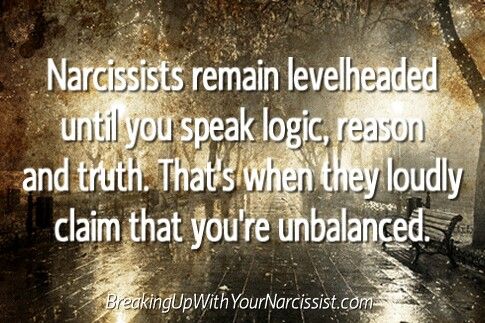
There’s one more type of gaslighter that’s incredibly dangerous because they manipulate reality itself and then tell you there’s something wrong with you because you noticed.  The abusive husband in “Gaslight” illustrates this well, by manipulating things around the house and then telling his wife she’s unbalanced and imagining things.   This was a favorite technique of my ex, who often deliberately misplaced things I needed, such as my car keys, then when I wasn’t looking, he’d return them to their rightful place and chided me for being “careless.”   He did this for shitz and giggles.

When you’re dealing with a gaslighting narcissist, nothing you do or say is ever right.  They always have to have the upper hand and they always have to make you feel about 3 inches tall, because that’s the only way they know how to keep you weak and in your place so they can continue to prey on you for supply.  They do this because their own egos are so fragile they need to put you down in order to make themselves feel better.    He or she isn’t going to change.   Arguing isn’t going to help, it will only make things worse.  The best way to handle a gaslighting narcissist is to leave and never look back.

Gaslighting therapist.

lion

I was reading a blog about bad or unethical therapists, and there were over 700 replies! Some of the stories told were truly horrifying. While most therapists are probably good people who genuinely want to help, there are a good number of narcissists who go into the profession because being a “guru” feeds their egos. Here’s a somewhat humorous example of an exchange where the narcissistic therapist continually gaslights his patient.

Psy: “I can’t talk to you if you’re aggressive or angry. ”

Me: “But I’m not acting that way, what behaviors do you deem agressive or angry?”

Psy: “Just the agressive ones like you arguing is being aggressive.”

Me: “Well, I’m not arguing”

Psy: “Just letting you know I’m not going to argue with you” (silence for the remainder of my session)

OR the time he actually just outright told me to shut up (you know, the “talk therapy” where the counselor tells you to shut up)

OR another conversation:

Me: “Dr. (blank) I really need to tell you something, could you please listen”…

Psy: “go ahead, I’m listening”

Me: “the other day…(him interrupting me)

Psy: “just letting you know I’m listening”

Me: “well, as I was saying, the other day”… (2 seconds later-him interrupting)

psy: “yes, I’m listening”

Me: “well, the other day” (2 seconds later-him interrupting)

psy: “go ahead”

Me: (silence)

Psy: “go ahead”

Me: (silence)

then my next session a week later he states: “you really need to open up more”
YES, I did report Dr. Douchebag to the ethics board.

The patient went onto say he hoped his therapist would get eaten by a lion. I don’t blame him–that therapist’s behavior is incredibly crazymaking.

“Narcissism–Living without Feelings”

narcissus1_caravaggio

I just read one of the most detailed and comprehensive articles about NPD I’ve ever come across, and also one of the scariest. It’s very long so you’ll need to set aside an hour or so to read all of it, but it’s definitely worth your time.

Some (but not all) of the issues discussed are the difference between healthy and unhealthy narcissism; how the borderline differs from the narcissist; childhood origins; the dynamics of narcissistic families (scapegoats, golden children, and bystanders); the 23 characteristics of narcissism (which take into account the less obvious Covert Narcissist); the development of the false self;  the physical characteristics of narcissists (this is new to me); and narcissism in modern society.

Narcissism by Richard Boyd, Perth WA – Energetics Institute, Copyright 2010
Narcissism – Living Without Feelings
http://energeticsinstitute.com.au/narcissism/

The word narcissism is one that has in recent years has been increasingly used in popular press to describe personalities and lifestyles. One form of Narcissism is however a little understood personality disorder which is increasingly showing up in our leaders across political, business, sporting, psychological and spiritual institutions(Behary:2008).

Indeed narcissism and narcissistic is increasingly being used to describe the mass cultural shift to a “self” obsessed culture where there is rampant consumerism, the pursuit of power, excesses, and the abuse of others in the pursuit of these ends, notes Martinez-Lewi(2008).

The word narcissism comes from the Greek mythological figure, Narcissus, who upon seeing his own reflection in a pond, fell obsessively in love with himself and his own image. As you will see in this article, the true unhealthy narcissist we see today, while maintaining a false self or “mask” of achievement, perfection, and the attainment of all the symbols of success and power, hides underneath a self hating, insecure, fragile real self, which fears being uncovered and exposed at any moment.

The key point here is we all need a healthy dose of Narcissism, as else we would not back ourselves in life, nor have a healthy sense of self. There are healthy forms of narcissism. However unhealthy narcissists do not have a healthy sense of self but instead have learnt to live life from a false self.

narcissus2_andecho

Unhealthy Narcissists are not in touch with their true self, instead becoming a chameleon type of personality who seek to project an idealised image to others, and then seduce and control all others that have some value or utility for them, until that persons utility value is exhausted, and then they are dumped and abandoned without remorse by the narcissist.
In some ways unhealthy Narcissism is seen by some schools of thought as a form of depressive disorder as the narcissist underneath the false mask, moves between depression and aggression. The aggression is most prevalent where there is a threat to being uncovered or exposed as being false, wrong, corrupt, or exploitative(Ransky:1998).

The narcissistic person may be male or female, and is obsessive in their primary pursuit of satisfaction, whether that be power, money and other resources to prop up the false self. Another common term for the narcissist in the business context is the Corporate Psychopath, notes Paul Babiak(2006), a noted specialist on the corporate version of this pathological individual.
According to body-mind researcher and M.D, Alexander Lowen, in his book, Narcissism – Denial of the True Self, narcissists share many common traits with bullies, but due to their ability to project a compelling false, idealised self image, and high intelligence, are more likely to “get away with it”, and escape accountability.

Some narcissistic people are “healthy” in their approach to life and achievement, but they are not of the type to be discussed throughout this article. A healthy and productive narcissistic person goes about their lives in a passionate way, achieve their goals, but retain empathy, consideration for others, and often a mindset of contributing to their community. Healthy Narcissism has more of the following characteristics according to Lewi-Martinez(2008) and Meir(2009):
Life is not all about them;
They are able to have stable and enduring marriages, relationships and business careers;
They are often are involved in charity and community service;
These people make and keep promises to others and to themselves;
They can give and take from a grounded place;
They are usually empathic and engaging;
A determined leader who seeks recognition where due and earnt;
Confrontational and accountable to self and others;
Wisely fearful and knows limits;
Self possessed but not selfish;
Very competitive and likes a challenge;
Vain in their achievements but the achievements are real and earnt;
In contact with own inner needs and wants and the difference of each.

cslewis_quote

This article concerns itself with the unhealthy forms of narcissism. Narcissists are found in all walks of life. After reading this article you may identify your spouse, co-worker, friend, relative, parent, boss, therapist, spiritual mentor, favourite athlete, or local or international political figures as potential unhealthy versions of narcissists. They key aspect of these individuals is their grandiosity, and their overstated sense of self entitlement in life often despite often not working hard to earn any such rewards.

Some unhealthy narcissists will be seen to be hard working and have their own achievements to own. Normally these types of Narcissist will also overstate their own achievements and minimise others and their achievements(Lowen:1986). There is often an arrogance in their personality.
Achieving Narcissistic personalities normally have a strong rigid-perfectionistic streak which gives them the discipline to set goals, focus and achieve, but there is a clinical coldness or unfeeling aspect to their natures(Lowen:1986). Many unhealthy Narcissists appear to achieve but in fact are predators who feed off victims they encounter in life, using their victims’ efforts, skills, and hard work, which get assumed and taken by the narcissist as their own, without remorse, recognition or meaningful reward for those around them(Babiak:2006).

In a narcissist’s world, It’s all about them, as Narcissists possess no real empathy, they feign or act empathic, while they delude themself that they are entitled to special treatment, and to not having to bother with detail or drudgery(Babiak:2006). These narcissists often gather a following of helpers or “sidekicks” to manipulate into doing any effort based work for them. Instead they spent their time managing their “image”, being a “visionary”, being “strategic”, establishing key “contacts”, that they argue only they are able to successfully do(Lewi-Martinez:2008).

gaslighting2

Some narcissistic personalities have an obsessive base in the personality where they micro-manage their own life, from work tasks to how they groom and dress, as they do not trust others or their standards of work. Other less rigid types are more focussed on positioning themself as indispensable, yet at the same time try to be unaccountable, being hard to track down, hard to get them to put things in writing, and they will avoid team roles where they are not the leader(Meier:2009).

Where possible they will delegate the work to a co-worker or “sidekick”. Narcissists hate mundane jobs and tasks that are “beneath them” and avoid them by manipulating others where possible to do such jobs on their behalf(Babiak:2006). Narcissists necessarily include others in their life so as to get the other person to do what they are unable to do, do not want to do, or what they feel is beneath them to do.

Read the rest of this article here.

My animal hoarder ex.

cat_hoarding1

My ex, a malignant narcissist who has been diagnosed with Antisocial Personality Disorder, is an animal hoarder.

When we were married, at one point we had 15 cats. I was always too embarrassed to tell anyone how many we had because it was way too many for us to afford or care for properly, and it just sounded crazy to say you had that many cats.

I’ve always loved cats and always kept a few around whenever I could, but my ex thought it was his duty to bring home any stray kitten he found–and he always seemed to find them (or maybe they found him). I really think it was about control though, not a real love for animals. He knew I disapproved of having so many cats (and the lion’s share of their care and litter box cleanup fell on my shoulders, of course) so he’d bring them home just to annoy me. When I objected, he’d gaslight me by telling me I was an animal hater, which is far from the truth. I tried to reason with him, telling him that we weren’t helping these animals by having so many and that we were unable to give them the proper care and attention.

As much as I love cats, in the double digits (or even upper single digits), they are no longer much fun. Cats hate being overcrowded and cat fights in our house were a daily occurrence. On top of this, “Michael” wouldn’t allow them to go outside (though sometimes they escaped anyway, probably just to get some space). We kept 7 litter boxes (about 1 box per 2 cats) and they had to be cleaned daily and changed every other day. Vacuuming was constant; I had to vacuum the entire house twice a day due to the enormous amounts of cat hair and the litter tracked in from the litter box area on the screened in porch. In the summer, because the porch would get so hot, the boxes would be swarming with flies and sometimes I even found maggots in them. The cats hated that and several began to do their business outside the litter boxes, requiring a lot of poop pick up.

The cats were unhappy and several didn’t look too healthy either. We didn’t have the money to take them all to the vet, so we started reading on the Internet about how to give vaccinations and medical care ourselves. Veterinary supplies, including injections, were purchased at a local feed store that catered mainly to farmers and people who kept domestic livestock.

cat_hoarding2

The house smelled terrible, no matter how much I tried to keep on top of it. I couldn’t invite anyone to the house. Many times I tried to talk to Michael about the situation, but he always refused to listen and we always wound up fighting. Our kids were small at that time and of course since kids love animals (and Michael tried to turn them into miniature flying monkeys against me anyway), they’d cry when I threatened to give some of them away.

After our divorce in 2005, Michael moved in with his girlfriend, a pillhead who had 2 large dogs–a pitbull and a mixed breed. Soon they had 8 dogs, most of whom were kept in large cages most of the time since they both worked and the dogs were never housetrained. When you went to their house, you had to make sure you didn’t step in dog poop. It smelled like hell. On top of that, Michael had brought along the 5 remaining cats (I wasn’t allowed to have them in my apartment at the time) and then adopted several more. He also became interested in bearded dragons but had no idea how to care for them properly and most of them died.

When Michael lived with me, he adopted a Jack Russell/Beagle mix he named Barnaby. I told that story in my article, How My ASPD Ex Used a Dog to Gaslight Me. Again, I had no say over the dog even though it was the worst behaved, most destructive dog I ever met. We only got rid of him because Michael himself decided he didn’t want the dog anymore (after we were threatened with a fine for the dog disturbing the neighbors for the third time in a row).
He always had to have the last word. He’s a class A control freak.

He’s hoarding animals again. He already has 4 cats and a dog. That’s not so bad, but I’m sure there will be more as time goes on.

A malignant narcissist’s rage in action.

I’m not going to review the movie “Boogie Nights” here but there’s a scene I want to talk about because of how powerful it is.

“Boogie Nights” is a 1997 film that starred Mark Wahlberg as Dirk Diggler, young man who fled his mother’s abuse and became successful as an adult film star during the late Disco era. The soundtrack consists of disco and dance hits from the late 1970s and early 1980s.

This was actually a very good film, and the acting by his mother (Joanne Gleason) in this scene (set in 1977, when the story begins with Dirk leaving home), is terrific. She is like a lower-middle-class version of Mary Tyler Moore’s character in “Ordinary People.” She shows more “emotion” because of her social class, which doesn’t require her to “stuff” over-the-top emotion, but she’s every bit as malignant as the mother in “Ordinary People,” and Dirk is obviously her scapegoat. She may have BPD rather than NPD, but it really doesn’t matter either way, because sociopathic, soul-murdering behavior like this is possible with either disorder.

Notice the way she gaslights and blame-shifts, while at the same time is freaking out because Dirk is refusing to provide her the supply she needs and is leaving her. This is one of the things that can happen when you inflict injury on a high spectrum, malignant narcissist. Wahlberg’s character is a somatic narcissist himself, but it’s hard to see that in this scene.

Marriage counseling is another weapon a narcissist can use against you.

marriage_counseling1

If you’re still with your narcissist, you may be tempted to insist they attend marriage or family counseling with you. It’s a common error to believe and hope the counselor or family therapist can help the narcissist understand your point of view and, seeing the light, stop their abuse of you or the children.

This is a mistake. Don’t do it. Don’t drag a narcissist to a marriage counselor or family therapist. I have my own horror story about this, and I’ve heard many similar stories to mine.

My ex, “Michael” (not his real name) and I had not been getting along for some time. I won’t go into the details in this article, because I’ve documented his abuse elsewhere in this blog. Whenever a malignant narcissist (in his case, full-blown ASPD!) pairs up with a Borderline or a low spectrum covert narcissist (I believe I am both), the Borderline or covert N is almost always going to be in the supplicating, codependent, people-pleasing victim role. They will be gaslighted, projected onto, triangulated against, given the silent treatment, insulted, used, taken advantage of, stolen from, lied to, and possibly physically abused as well. A Borderline will rage and lose their composure under such treatment, while a covert N will try to “fight back” using more underhanded means such as passive aggression or the silent treatment. If you’re not disordered, staying around someone who’s doing those things to you long enough, you can actually become a narcissist yourself, or at least pick up a lot of narcissistic traits as well as severe PTSD.

Enraged by Michael’s constant insults, disrespect, and gaslighting using the children as flying monkeys, I’d react by giving him the silent treatment or make sarcastic remarks. Neither of these weak weapons made a dent in the impenetrable armor of this professional malignant narcissist, and the abuse just escalated. As a BPD, another thing I’d do was rage. I’d hold in my anger for days, and finally explode into a mighty dish-smashing, profanity spewing temper tantrum. Of course it was then that Michael told everyone–including our young children–that I was an insane c__t and bitch who should be locked up and the key thrown away.

Sure, we were both disordered, but in that relationship I was definitely the victim. I remember a couple of friends even told me on meeting him that they got “bad vibes” and thought there was something “evil” about him and to be very careful.

At one point I suggested we see a marriage counselor. At first Michael resisted, but he finally relented when a friend of his told him he should go just to get me to STFU. So he agreed to go, on the condition that HE got to pick the therapist we’d be seeing. The therapist he chose was a woman and she did seem very nice. I actually felt comfortable with her, which surprised me.

One of the issues we’d been having was the volume at which Michael played his music. He listened to music I did not enjoy–mostly death metal, thrash, and riot girl punk/metal (this was in the late 1990s). Now I’m an eclectic and open minded music lover, but those particular genres acted like assault weapons on my ears. He also liked to blast this noise late at night when the kids and I were trying to sleep. But whenever I asked him to turn the music down, he’d tell me to shut up and deliberately increase the volume.

So this was one of the topics that came up in marriage counseling. I was the one who brought it up. Michael always seemed calm and reasonable on the surface (he had a lot of charm back in those days which he never showed me when we were alone together) while I always seemed stressed, on edge, a raw nerve about to snap like a violin string (this was in fact the case–his manipulations and cruelty to both me and the kids were systematically driving me insane). After I told the therapist about how loud he played his music whenever we were trying to sleep and refused to turn it down when asked, Michael turned on the charm, smiling and in a very reasonable and calm tone of voice explaining to her that I was a “control freak” and hated music in general. He told her I never let him play anything, even during the day, which was a lie.

The therapist turned to me and told me I needed to stop trying to control my husband and allow him to pursue his interests. I looked over at Michael, wearing his most smug, self-satisfied grin. I wanted to walk over and smack him hard upside the head. I started to shake with rage. I couldn’t hide my frustration and anger the way he could. It took everything I had not to throw something at him or throttle him. I looked down at my clenched fists and my knuckles were so white their bones seemed to have popped through my skin.

marriage_counseling

Back in those days, my BPD symptoms were in full force, and so to the therapist, I probably did seem a little crazy. Michael, in contrast, had the composure of an attorney (I always used to tell him he should have been a lawyer because he always won every argument).

Other things came up too. But it always came back to the same thing–that I was trying to control HIM and he was just a reasonable man confused by my emotional instability and craziness. Michael had that therapist wrapped around his little finger. Once I tried to explain to her the way he acted in our sessions was not the way he acted at home, that he wasn’t showing her his cruel, callous and disrespectful nature. Of course he called me a liar, telling the therapist I had “mental issues.” Once again I got scolded by the therapist for trying to control him and making up stories to make him seem worse than he was. She asked me if I had delusions often.

Finally, sick of the two of them ganging up on me and blaming me for everything wrong in our marriage, I walked out in the middle of a session, which only convinced that therapist I wasn’t “serious about counseling” and should seek psychotherapy for myself (this is what Michael told me later).

I’ve heard this sort of thing happening to so many victims of narcissistic abuse. They go to marriage or family counseling, thinking it might help, and instead, the therapist gets turned into a flying monkey siding with the abuser and joining in the gaslighting and projection against the abused.

Malignant narcissists and psychopaths like Michael are good at convincing people they are perfectly sane and they will lie very convincingly. The real victim, probably suffering from PTSD and high stress levels, is more likely to “lose it” or act out, making it seem as if they are the one causing the problems with the relationship.

Based on this experience and those I’ve heard from others, I don’t recommend marriage counseling if your spouse or partner is a narcissist. But if you do decide to try it, make sure YOU choose the therapist, and pick one who has a background in Cluster B personality disorders and has a working knowledge of the way narcissists operate.

Even better, if it’s at all possible, lose the narc who’s making your life such a hell.

For more on this subject, please read my article, Narcs Who Use Therapy to Gaslight Their Victims.

For another blatant example of the type of gaslighting my ex liked to use against me (and get his way at the same time), see my article How My ASPD Control Freak Ex Used a Dog to Gaslight Me