Late November GLOOM

Spring can’t come fast enough, but that’s still a long time to wait.

Yeah, it’s cold too.

novembergloom

Thanksgiving 2018: We were all immigrants once.

Happy Thanksgiving!

marlettecaravan


Why did decades stop having personalities?

decades

I saw this quote today and it made me think.

The 60’s, 70’s, 80’s, and 90’s seem to have all separate, unique personalities, but these last 18 years seem to just be one big chunk of time that has no significant meaning.

Personally, I think decade “personalities” reach back all the way to at least the 1920s.  Although I have no real point of reference for chunks of time earlier than that,  I suspect the growth of mass popular culture (movies, radio, mass produced clothing, magazines, etc.) due to the advance of technology during the early to mid-20th century had a lot to do with the decades developing their own unique “feel.”

It wasn’t just music, entertainment and fashion that defined decades from each other; decades even had their own unique fonts.  You can pretty much tell the vintage of a magazine or paperback book heading or a movie poster by its font.  Colors (and color combinations) and patterns are also telling:  1940s: dark jewel colors; 1950s: aqua and pastels, gingham and boomerang patterns; 1960s: DayGlo colors, paisley, and psychedelic patterns; 1970s: earth colors (specifically, all shades of brown, harvest gold, avocado, and rust); 1980s: mismatched DayGlo colors and clashing abstract patterns, and of course, mauve and hunter green (for home decor); 1990s: the “distressed” look for furniture,  plain white walls, black clothing, tiny floral prints on black backgrounds, heather gray, brown, and lots of plaid flannel.  The 2010s do seem to be defined by the popular “lattice” and oversize houndstooth patterns you find on everything from throw pillows to blankets,  but I can’t think of much else that defines it, other than political statements like MAGA caps or pink pussy hats.

The decades as we think of them don’t generally (or ever) start on January 1 of a new decade.  They could start early, or it could take several years for the next decade to really get underway.  It also isn’t until some years after it began that we actually notice that things changed (that’s why the decade you’re currently in doesn’t seem to have its own personality).

For example, the “sixties” didn’t start until about 1964, with the rise of the Beatles (or possibly, in late 1963, with the assassination of JFK); the “seventies” didn’t begin until sometime in 1974, when early Disco/Philly sound emerged out of earlier funk and R&B; and bell bottoms, Earth shoes and sandals, long straight center parted hair, and long peasant dresses (all more associated with the sixties) suddenly gave way to platform shoes, polyester leisure suits, and sexy Lycra  “disco dresses” in jewel colors.    But it wasn’t until the end of the ’70s, or even the early ’80s, that we realized exactly when the “seventies” started and the “sixties” ended.

The “eighties” started more or less on time (or even early), because disco and its culture had a short run and was replaced with New Wave and power pop music as early as 1978 or 1979.  The eighties ran until the fall of 1991.  The rise of Nirvana and other grunge bands from Seattle commenced the nineties.  Overnight, Generation X was cool and Boomers were just old.  I remember the switch to the nineties well, since I gave birth to my son the very same month “Smells Like Teen Spirit” was released, and I remember telling my husband on first seeing the video on MTV, “That song is going to change everything.”  I have no idea how I knew that.

But what happened since the new millennium began?  Why, almost two decades after the year 2000 began, does that decade still seem to have no personality of its own? Why does there seem to be no clear cut off between the late ’90s, the 2000s and 2010s?

Obviously, we are far enough into the 21st century that at least its first decade’s personality would have emerged some time ago.  So it’s not because we haven’t waited long enough.  Now, that could be the case for the 2010s (which we are still in but not for much longer) but not for the 00’s.  But I suspect the reason is something else entirely.

Since 9/11, there’s been a change in the national zeitgeist, a darkening of the overall mood.   People are more suspicious of each other and of the government, and the overall mood is one of distrust and dread.   That distrust and dread, sparked by 9/11, is what led to Trump and the rise of hatred and nationalism, and the disintegration of American democracy.   Pop culture — music, fashion, movies, art, and youth movements — all the things that have traditionally defined the decades take a secondary role to survival itself.   A society that is not thriving doesn’t really care about frivolities, pop culture, and being entertained.  During dark times, people tend not to create a new culture; instead they draw from the past and become nostalgic for happier, more stable and prosperous times.

There’s another reason for the lack of definition of recent decades, one which may be even more important than the darker national zeitgeist.   Technology has continued to advance, to the point that every person can customize their own entertainment.   Up until the 1990s, people tended to listen to the same songs on the radio, watch the same music videos, and shop at almost identical malls scattered across the country.  A mall in Miami was pretty much the same as a mall in Minnesota.  There weren’t 1000 different cable channels.  People bought physical records or CDs because of what they heard on the radio.  In general, there was less choice in entertainment (though many believe the quality was much better).   There was no internet or social media to influence individual opinion or create tiny niche cultures, the way we have today.   Now anyone can start a Youtube channel, anyone can create their own music video or short film and get their own small group of fans or followers.  Anyone can start a blog and sometimes gain a modicum of internet fame from doing so.   Your friend may listen to a band, watch a movie, or be a fan of a comedy series you have never heard of because they have only a tiny niche following on Youtube or Vimeo.   There’s also the isolating nature of today’s entertainment.   People watch videos and listen to music on their phones or iPods instead of turning on the radio for all their friends to enjoy.

And of course, many of us, overwhelmed by too many choices and not enough quality, escape into the past for our entertainment, indulging our need for nostalgia.   The unifying sense of solidarity people once experienced through enjoying a common zeitgeist is almost completely gone.  Now it’s everyone for themselves.   The disintegration of that kind of solidarity may actually have something to do with why Americans stopped caring about each other.

Hypermasculinity and Trumpism.

hypermasculinity

Credit: N/A

I’ve been noticing a huge and (to me) obvious difference between Trump supporters and those who oppose him.  Much has been said about the tendency of Trump supporters to have more authoritarian personalities than the norm, and that is true, but why is authoritarianism so attractive to them?  Why do they hate democracy?  Don’t they want to think for themselves?  Don’t they want to live in a free and inclusive society that values empathy for others and the Golden Rule (which we were all taught in kindergarten)?

The other day I was following a Twitter convo between some Trump supporters talking about Matt Whitaker, Trump’s new Acting Attorney General.  They were all talking about how Whitaker looked like a guy who wouldn’t take crap from anyone, and would rule with an iron fist. They admired Whitaker’s pumped up, hypermasculine physique, his cold, expressionless features, and were almost reverently comparing him to Mr. Clean (who would, of course, clean up “the swamp”).

The kind of people I observed conversing on Twitter, like all Trump admirers, don’t seem to care about the lack of checks and balances and the deep corruption in Trump’s administration.  In fact, they love the idea of Trump having as much power as he desires (which is unlimited as his need for power and adulation is insatiable), so he can push through his cruel and destructive agenda.  In Whitaker they see a tough, merciless enforcer. And yes, they actually used the word “enforcer.”

This same group was making fun of Rod Rosenstein, Jeff Sessions’ deputy Attorney General (who seems to have been demoted since Sessions was fired and Whitaker came on the scene) for his “girlish, wimpy” appearance.  One of the group even posted a meme of Rosenstein as a 90 lb weakling getting sand kicked in his face by (you guessed it) an exaggeratedly muscled Whitaker who looked like he was pumped up on massive doses of steroids.  This group was not all males.  In fact the person who posted the meme was a woman.

proudboys

Far right paramilitary groups like the Proud Boys embody Trumpist hypermasculinity.

Trump supporters see the exaggerated stereotype of the “macho man” as what a “real” man should be.  Someone like Rosenstein (or any man who believes in doing the right thing, has empathy or humility, or who opposes Trump for lacking those qualities), they see as weak and  feminine, an affront to patriarchy.   Trump supporters believe a real man shows no “soft” emotions, never apologizes, is never at fault (or at least never admits fault), can break the law or do cruel things to other people as long as they get away with it or it’s a means to an end they believe is “good,” and dominates everyone who they perceive as beneath them, which is just about everyone.

In a leader, Trump supporters regard “soft” traits such as empathy or mercy, as undesirable because they are stereotypically “womanly” traits, and women are believed to be inferior to men.  I suspect most Trumpers had authoritarian fathers who demanded girls act like girls and boys act like boys.  That would explain Trump/Whitaker’s appeal among right wing evangelicals, who celebrate authoritarianism and patriarchy.   This same mindset also explains the hard right’s obsession with guns, and the primacy of the Second Amendment over all other rights bestowed to Americans in the Bill of Rights and Constitution.

Trump supporters seem to find nothing wrong with Trump’s bullying, cruel insults and namecalling and in fact seem to think it’s a plus.   Yesterday, in one of his increasingly unhinged tweets, Trump deliberately mangled Adam Schiff’s (D-CA) last name into a profanity (no need to repeat the word since I think it’s pretty obvious).   Another Trump fan tweeted this in response:

Some might say this isn’t becoming of a President. That’s ok…I didn’t vote for him because of his impeccable decorum skills. Give me a Commander in Chief that cuts thru the bull, gets things done, has a backbone, is a Patriot thru and thru, & actually keeps his word anyday [sic].

You’re not imagining things.  Trump’s followers are actually praising Trump for his puerile butchering of Schiff’s last name. They find ways to spin his worst traits and most immature, childish, and cruel actions and statements into actual virtues and good deeds.  It’s really rather remarkable the way they can so glibly make excuses for his worst behaviors.

My conclusion is this:  the values of Trump supporters involve a deep admiration, even worship, of “strongmen” figures:  hypermasculine, even abusive, men; physically pumped up, emotionless, violent, without mercy, dictatorial, punishing, and bullying.  They don’t want a president of the people, a president who brings us together as Americans;  they want a president who “sticks it to the libs” and others they don’t like. Trump shares their hates and fears, and they love him for it, even if he destroys the country we all share in the process.

“Republican Jesus.”

republicanjesus

Related to the above, I’ve often seen Trump supporting evangelicals talk about “Christ as a warrior,” rather than a compassionate friend. The “Republican Jesus” memes are, unfortunately, not exaggerations.  Dominionist and far right evangelicals depict Jesus Christ not as a loving figure of grace and forgiveness, but as an angry warrior out to avenge sin using the most terrifying and violent methods imaginable.  He is especially enraged by sexual sins like abortion and homosexuality (strangely, rape and adultery don’t seem to be issues, given “chosen one” Trump’s immoral sexual behavior and failure to repent or humble himself before God).  Of course, the sins of greed, wrath, exploitation, cruelty and indifference to the “least of these,” destruction of the earth, and bearing false witness are all considered fine since they are just a means to an end (establishing God’s kingdom on earth, a heretical teaching which doesn’t even appear in the Bible they’re always thumping).

Their hyper-Calvinist God favors his “elect” who apparently can do no wrong, and as a reward, he showers them with wealth and power.   For the rest of us, God exists only to mete out punishment and condemn us to eternal hellfire.   Even Jesus is seen as a violent, warlike, avenging figure, and this explains extremist evangelicals’ infatuation with Old Testament legalism and punishment over the Gospels.   The caring, compassionate Jesus of the New Testament isn’t an appealing figure for them.  A few weeks ago, at a “Religious Liberty” meeting full of extremist evangelical Republicans, a Christian preacher was taken out in handcuffs for quoting New Testament scripture (specifically, the Sermon on the Mount, Jesus’ most important and famous sermon).

Trump supporting evangelicals believe both Trump and Whitaker were sent by God to do his holy bidding (at least according to the group I observed on Twitter, who said they believed Whitaker, like Trump, was anointed by God).  The goal is to destroy all of “the liberal establishment” and by logical progression, all liberals (who I think are hated not so much because of what they believe, but because they are associated with softness and all traits they regard as “feminine” and also include a great many more women leaders and nonwhite people).

So, I finally changed my theme.

Wow!  I changed to the Twenty Eleven theme!  Granted, it’s a similar theme to the Twenty Ten theme I was using.   But I’m proud of myself for taking this scary step.

It took me two years to work up the courage to change my theme at all.  I didn’t dare try anything too drastically different from Twenty Ten.  I was terrified of losing all my information, post counts, etc.

It wasn’t so bad.  In fact, I think it’s a much cleaner look, especially since I changed the color theme and background photo to something less dark and depressing, and more soothing and oceanic.   I changed the font as well.    The only thing I’m displeased with is the header menu.  I can’t seem to change the font in that.  I think it’s clunky looking, so I may get rid of some of the topic headings to make it more streamlined at least.

I was able to replace most of my old widgets (they do disappear when you change your theme, so you have to put them in again) but chose to leave a few out.  Again, I’m going for a cleaner looking, more readable blog.    I also changed the Sharing buttons to the stylized logos, which I think look better.   It appears my post counts weren’t lost, which I was afraid of, so that’s a relief.

I hope you all like my blog’s new look.  Please leave your (honest!) opinions in the comments.  Even if you hate the new look, please let me know.

Changing things that already work — beetleypete (reblog)

Quote

I have just been reading a post on another blog about the forthcoming ‘Gutenberg Editor’ change from WordPress. In case you are unaware of the impending change, here is a link to Worpress’s take on it. https://wordpress.org/gutenberg/ As you will see, it is quite technical, at least to someone with my level of computer knowledge. […]

via Changing things that already work — beetleypete

I couldn’t agree with this post more.  I do not want the Gutenberg Editor.   I like the Classic Editor just fine.  Why can’t we have a choice?  But we don’t.  As soon as Gutenberg is rolled out,  the classic editor will no longer be available (that’s what I hear anyway).  Hopefully WordPress takes the needs of ALL its users into consideration.

I really dislike the way WordPress continually makes changes without seeming to care about what its users think.    I’m really not keen on having to learn a new interface, especially when the current one is perfectly serviceable.

If it ain’t broke, don’t fix it!

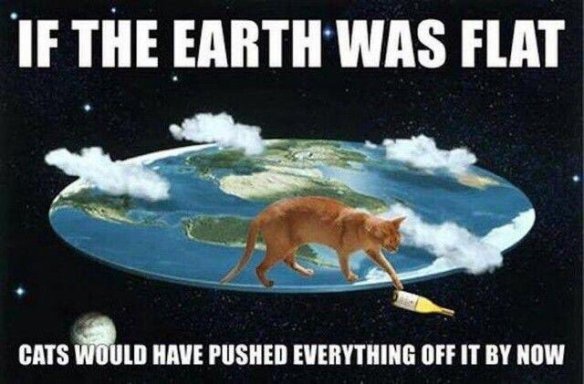
If the earth was flat.

Image

catsmeme

The mystery ship.

This is quite possibly, my favorite post I ever wrote, or it’s in my Top Five anyway. Enjoy! Let me know what you think in the comments.

luckyotter's avatarLucky Otters Haven

ssjameslongstreet4

Credit: Unknown photographer.  This haunting photo is very similar the way the old battleship appeared to me as a child.

I have a vivid memory of myself as a mosquito-bitten, golden-tanned and skinny little girl of seven and eight years old happily playing and exploring on the the tidal flats of  East Brewster, along Cape Cod Bay in Massachusetts, where my parents had rented a vacation beach cottage for two weeks during two consecutive summers in the late 1960s.

The sandbars and  network of warm tidal pools and rivulets left behind by the retreating tide stretched far, far into the distance–so far that the deeper water where the sand was never exposed was only a thin royal blue line against the horizon and sometimes was not visible at all  (I read recently that the Brewster tidal flats actually can extend up to two miles at low tide).

I played out…

View original post 1,285 more words

John Lewis 2018 Christmas commercial featuring Elton John

I don’t usually get obsessed about commercials, but this is one I fell in love with.   It’s a commercial for the British department store chain John Lewis and Partners.

It’s rare to find a commercial with real meaning and depth, a compelling story that tugs at the heartstrings without being too cheesy — and also features one of the greatest rock & roll pianists/singers of all time.

Here we see Elton John playing “Your Song” over flashbacks of his career, the receding decades finally giving way to his childhood, when his mother, who recognized musical talent in her son, gave him a piano for Christmas — the very same piano he was playing as an older man reflecting on his life at the beginning of the commercial.

It gives me chills, in a good way.  It’s amazing the way one special gift at the right time can change the entire course of a person’s life.   Elton’s mom understood.

Enjoy! And please tell me what you think in the comments!


Narcissistic mothers never really change.

I started this blog over four years ago partly because of my discovery that I had been spending more than five decades of my life trying to please and win the unconditional love of a mother who simply wasn’t capable of giving me that kind of healthy love a normal parent has for a child.    Emotionally, I was still a child trying desperately to please a parent who could never be pleased, and in fact, resented me because of who I was.

I went No Contact with her at the same time I went No Contact with my malignant narcissist ex husband.  During the first two years of starting this blog, I wrote extensively about both of them, and learned so much about myself and also how to heal from the narcissistic abuse both of them had inflicted on me.

Distance made me think over a few things.    I also came to understand exactly what a malignant narcissist is, and after some time, I realized my mother is not one.    Malignant narcissism is a mixture of NPD and Antisocial Personality Disorder with paranoid or sadistic traits.   My mother, while highly narcissistic, is not at all antisocial or sadistic, but she does check off most of the criteria for NPD (narcissistic personality disorder).  She also fits much of the criteria for Histrionic Personality Disorder.

Unlike a malignant narcissist, my mother does have a conscience and knows the difference between right and wrong.  She doesn’t “think like a criminal” and would never do anything illegal.  She has a sense of ethics.   She’s not sadistic and doesn’t enjoy seeing people suffer.  She likes animals and children.  She doesn’t have much empathy, even for her loved ones, but she isn’t the sort of person who enjoys watching others suffer or tries to cause them suffering;  she is mainly just cold and indifferent to the troubles of others, and fails to take responsibility when she has emotionally hurt someone.

Even so, as a parent, she was still very damaging.   Along with my borderline/narcissistic dad, who also was an active alcoholic during most of my childhood and adolescence (addictive disorders and alcoholism tend to exacerbate Cluster B personality types), there was lots and lots of drama, instability, fighting, screaming, accusations, gaslighting, hiding the truth from others, and abuse both physical and emotional while I was growing up, and it was mostly directed at me.  Needless to say, my growing up years were painful and traumatic.  As the only child in their marriage, I was constantly scapegoated and gaslighted and held to impossible standards, the implication being that I was never good enough and could never measure up.

Things could have been worse, but the damage was done.   I never felt like a full adult, and my self esteem took a beating.  I came to believe I wasn’t capable of very much in life.  My high sensitivity was used against me, treated like a defect or a weakness, instead of something that would ultimately become one of my greatest strengths.  I never really found my niche career wise, and I married an abusive, sociopathic husband who in many ways mirrored the emotional abuse I had suffered at the hands of both my parents as a child.

I felt especially uncomfortable, impotent, and childlike whenever I was with my mother, and this lasted into my fifties.  I’m not sure why this was so.  Perhaps because of my parents, she was the more narcissistic one, the one who seemed to always disapprove of me no matter what I said or did.   She would constantly gaslight me, give me “left handed” compliments that were really criticisms, find ways to embarrass or shame me in front of others (and then say I was being too sensitive or “imagining things” when I objected to this treatment), or blame me for things that weren’t actually my fault.   She never seemed to empathize whenever I was victimized at work or bullied at school and would instead tell me why I was bringing those things upon myself.

Going No Contact with her was necessary and freeing, and as I wrote about our relationship, I discovered many things about myself I never knew.   I discovered that I was not the failure and loser she’d always led me to believe I was, but my emotional growth had been stunted.   Anger followed but that passed.  Once it passed, I started to realize she was who she was because of the abuse she had suffered as a child.    I didn’t want to resume contact, but the more I read about narcissism, the more I realized she was simply a garden variety narcissist (which in a parent, is still very bad!) and did not meet the criteria for Malignant Narcissism.

For four years I avoided her phone calls (after awhile she stopped calling) and only sent cards on her birthday and Christmas.   But one day a few months ago, I took a phone call from her.   I figured it must be important since she rarely tried to call me anymore.  After all, she’s in her late 80s and it could be an emergency I needed to know about.   So I took the call (it turned out to be something pretty unimportant, though I can’t remember the specific reason she called).  She might have just been love bombing me, though there’s no way to know for sure.

Rather than tell her I had to get off the phone (as I would have earlier in my recovery), I decided to find a neutral subject that wouldn’t lead to an argument and we might be able to find some common ground on (a kind of grey rocking).  Since I was so caught up in (and disturbed by) the Trump presidency, I sent this up as a trial balloon and asked her what she thought about the latest debacle (which at the time was the cruel child separation policy at the border).   Politically,  we’re on the same side, and like me, she is horrified by Trump and what’s happening to this country (this is another way I can tell she’s not a sociopathic or malignant narcissist).   So for about half an hour, we actually had a pleasant (well, if you can call a conversation about the current political situation pleasant) conversation without any arguments or putdowns or gaslighting.    For once, I didn’t feel like a defective five year old.  For perhaps the first time, I felt like she was treating me like a fellow adult capable of thinking for myself.  It felt good!   We spoke for almost an hour, and right before we hung up, she said something she had never said to me before.

She said, “I have really missed you.  I love you so much.  You are such a good person.”

“You are such a good person.”   Whoa!  That’s simply not something a narcissistic mother would say to her child.   Nothing about my external appearance or my financial status, social class, worldly “success” or lack thereof.    Not only that, she sounded sincere, almost on the verge of tears.  I began to think that perhaps, I had misjudged her, and she wasn’t actually a narcissist at all.  Maybe she was just a borderline or maybe she had changed with age and was no longer a narcissist.

I didn’t speak to her again for another few months, but I began to toy with the idea of cautiously breaking my No Contact rule and going Low Contact.    It took me a long time to call her again, but the night before last week’s election, I finally shored up the courage to give her a call.

I decided to use the impending election as a way to start the conversation, since politics had worked the last time.    And it’s true we agreed about who we wished to see win the midterms and how much we both hated Trump and the GOP.   But this time the conversation wasn’t the same.   It felt forced and tense.   She kept interrupting me to say I was being too negative and dwelling on negative things too much, just like the old days before I went No Contact.   She seemed to want to change the subject, and kept asking me personal questions about myself.  I talked to her a little about the kids (her grandchildren) but when she asked me about myself, I clammed up.  I felt like she was prying and I didn’t want to tell her about myself (not that there’s much to tell).    Then she started saying she wanted to come visit me in the spring.  I don’t want her to come visit in the spring, or at all.   Just like in the old days, I felt diminished, put down, like a defective five year old again.   I realized nothing had really changed at all.

But that begs the question, what had made her say, with tears evident in her voice no less, that  I was a ‘good person’?  That’s just not something you hear someone with NPD say.   She seemed to mean it; I don’t think it was love bombing (though it could have been).    Perhaps for a fairly low level narcissist who isn’t malignant (but is still dangerous to others due to their disorder), the clouds occasionally part and they can actually see things clearly, the way they really are, without lying to themselves or others about what they see.     Perhaps she envies the fact I care about others, and am politically involved, and while normally such qualities might make her resent me,  at that particular moment, her guard was down and she realized she actually admired those qualities in me.

I’m pretty sure that on some level, my mother does love me.  At least I know she means me no harm.  And I love her too; she is my mother, so how can I not?    But the truth is, she is still a narcissist, and I simply can’t have any kind of serious relationship with anyone on the narcissism spectrum, especially someone I have so much unresolved childhood baggage with.   So it looks like it’s going to be just us exchanging cards on birthdays and Christmas, and we’ll see what happens as far as any future conversations go.  I just know for my own mental health, staying Very Low Contact is best.