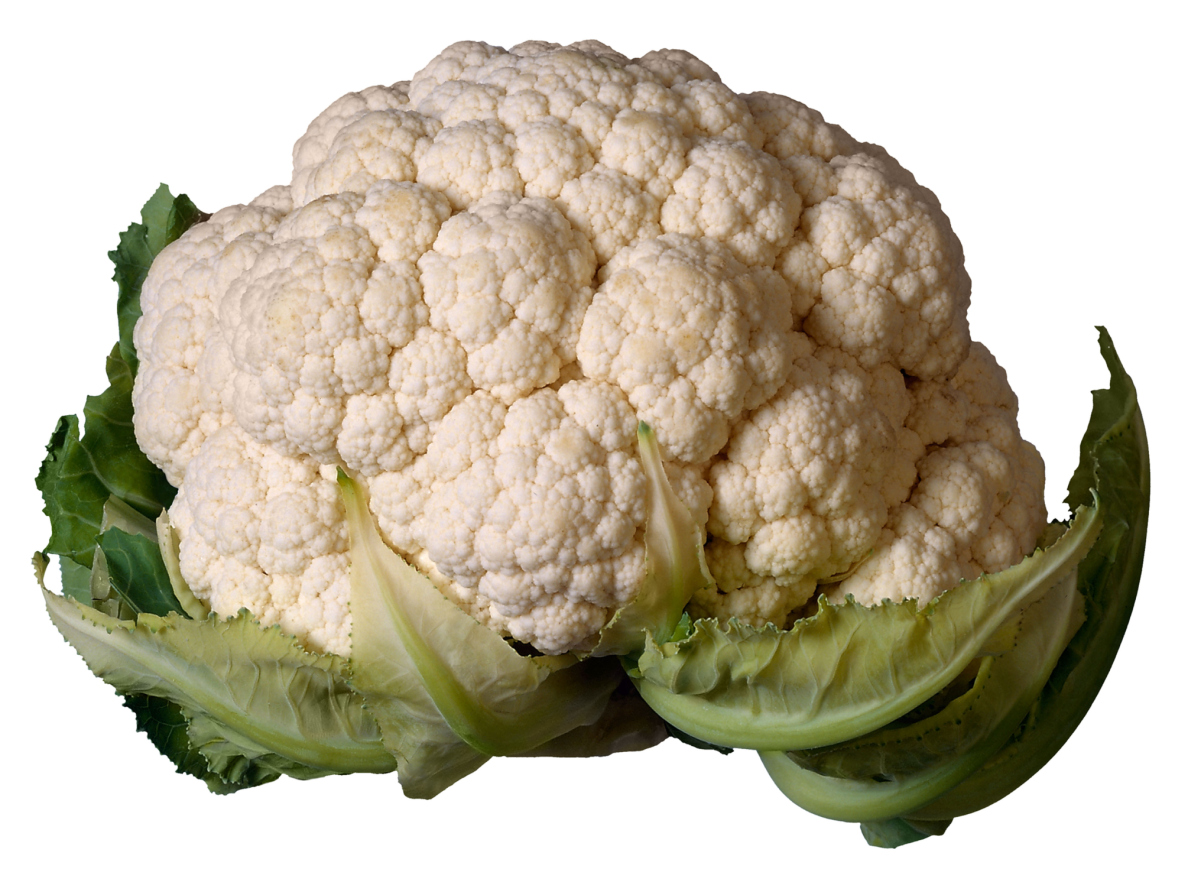
Cauliflower. No thank you. I can’t eat a vegetable that’s just wrong on every level. A vegetable should not be snow white and look like a cancerous tumor and smell like garbage. I don’t know why cauliflower is so popular. It doesn’t even taste like anything. It’s horrible. Give me Brussels sprouts instead. Everyone else seems to hate them (I saw the referred to once as “little balls of Hell”) but not me. Even as a kid, I’d gobble them up as if they were cookies. Smothered in butter, they’re yum. They’re also cute as f*ck.
The worst toy I ever had.
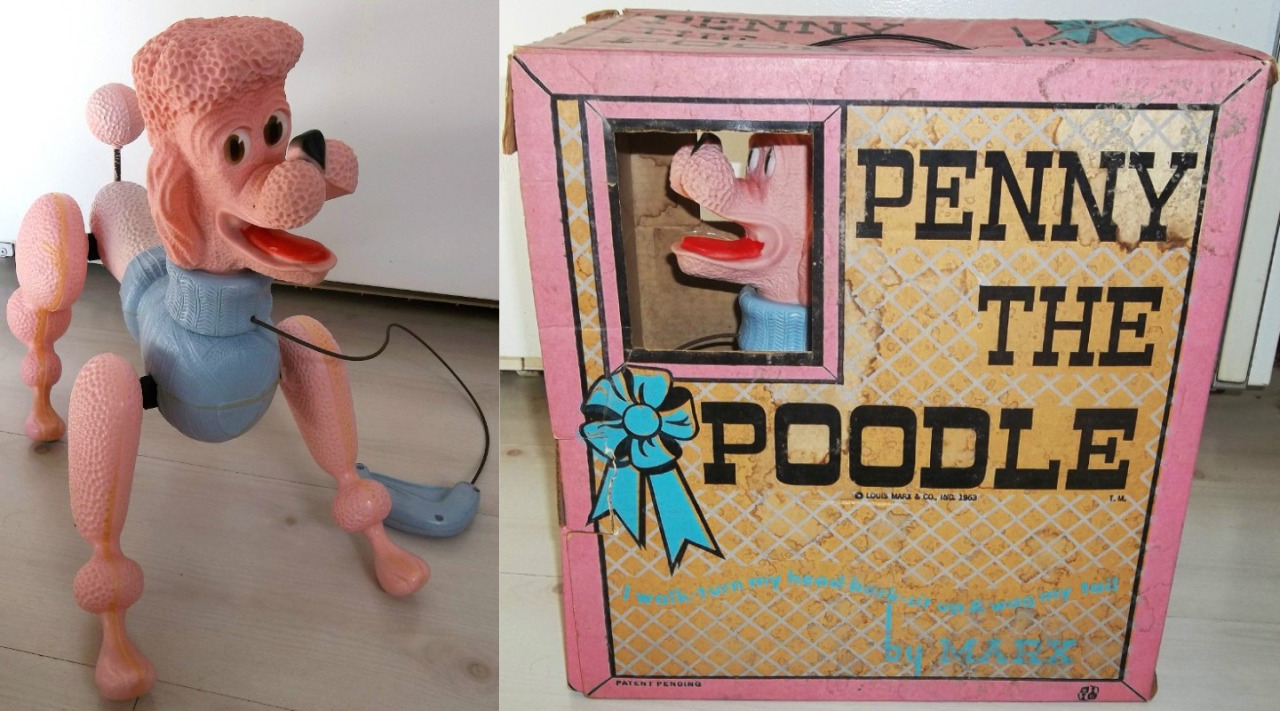
Christmas, 1966. For months I’d been begging my parents to buy me the hottest new toy the commercials were telling me I just had to have: a walking, barking dog called Penny the Poodle. Even if you’re old enough to remember this horrible toy, you may not, because it was quickly forgotten after the initial pre-Christmas hype. I’m sure millions of small children spent that Christmas Day in tears of disappointment and frustration when they realized Penny the Poodle did NOT live up to the hype.
Here’s the commercial, which in retrospect, was pretty creepy, even for those days:
I remember unwrapping the large box with joyful anticipation, ripping off the green and red foil paper and bows to reveal the “Penny the Poodle” logo and the see-through window on the side of the box that revealed Penny’s Pepto-Bismol pink head.
Eagerly, I pried her out of the box with my small sweaty hands and tried to get her to work. No batteries were necessary. Penny was supposed to stand, walk, wag her tail, bark, and turn her head. She was supposed to do everything a real dog does except poop and pee.
She did nothing. Instead, she lay on her side on the floor, twitching as if she was having an epileptic seizure. I tried to right her and squeezed the little remote control to get her to walk, wag her tail, do SOMETHING, but no dice. She fell over again. This time she didn’t even twitch and convulse. I righted her again and manually tried to make her legs move. Her right leg fell off and lay there on the rug like a turkey drumstick covered in pink gravy. Penny was DOA.
I was heartbroken. I opened the rest of my presents apathetically, because Penny the Poodle was the toy I had REALLY wanted for Christmas. I cried on and off for most of the day.
My parents returned Penny to whatever store they had got her from and brought me home a replacement, this one powder blue instead of Pepto Bismol pink. But this one wouldn’t work either. Back to the store it went. My parents refused to get me a third Penny, but by then, I’d given up and was happily playing with my Barbies and Wishnik troll dolls.
Penny the Poodle has curiosity value to toy collectors. You can find a few on eBay, but none of them seem to be in working order, and probably never were.
Thanks to my readers who voted for me to post a funny true story tonight in the poll I posted earlier. I know this story’s a little sad, but there’s always humor in pathos. Or pathos in humor. Or something like that.
Search terms that make the hairs stand up on the back of your neck.
I just read a short post by another blogger who wrote that in her search terms, she found her full (real) name followed by “bad parent.”
That’s pretty alarming and would suggest this blogger may be being stalked by someone she knows. I’ve been lucky that way I guess, but I remember a few months ago, I did see a search term that said “Lucky Otter is an idiot and a psychopath.” That made me sort of cringe a little inside. I hate it when people hate me. I have no idea who used a search term like that, nor do I want to know. Probably someone I pissed off in a blog post. Who cares? Much more creepy than that was the time I found this in my list of terms: “I want to f*** Lauren Bennett.” (That isn’t even my real name). This was followed by a few more words describing doing something that was even more unmentionable on a blog like this one. I bet I’m twice the age of whatever sociopathic basement dweller searched for this blog that way.
Most of my search terms are pretty boring. So boring that I stopped making posts listing the “funny” search terms because there really aren’t any funny ones. They’re all about as interesting as staring at a beige cinder block wall.
Ouch!
I just stubbed my toe! &%$#S*(%GT#%#*@!!!!!!
Man, that HURTS!
Aaaaannnnddd… to make matters WORSE, while I was looking for an accompanying graphic on Google images for this post, I came across some of the grossest, most disgusting, most GRAPHIC, photographs of mangled feet and toes I’ve ever seen. Now I feel like THROWING UP too!
My poor toe is STILL throbbing.
What should I write about today?
WordAds: Advertising on WordPress
If you blog and are interested making some money from your blog, WordPress has a program called WordAds that makes this possible. You probably won’t be able to quit your day job (my earnings last month were about $40 but are going up each month in small increments based on number of “impressions”) but it’s definitely worth it, if you qualify. I don’t blog for money obviously, but it is nice to have the extra cash.
This post about the WordAds program is the most imformative I’ve seen. I can’t think of one question here left unanswered.
Borderline Personality traits linked to lowered Empathy
A new study found that people with BPD may have lowered or limited empathy, and that it may be biochemical. I sometimes think I’m a bit empathy challenged, though not in a general sense. For example, I feel just awful when I see or read about someone’s suffering (especially if it’s an animal or a child) but it’s hard to me to empathize on an interpersonal, emotional level with another person (which could be due to my introversion and social awkwardness, and also my complex PTSD). I do have cognitive empathy (KNOWING how another feels), even if its sometimes hard for me to feel WITH someone else. This is something I want to change and am working on in therapy.
I’ve known other Borderlines who seem to almost have too much empathy, and are very profoundly affected by the moods of those around them. The problem for BPDs, whether they have too much or too little empathy, is that we get so caught up in our own problems we can seem to be oblivious to what others are feeling. Usually when we’re called out on our selfishness though, we feel pretty badly about it and try to make up for it.
I think a lot more research needs to be done on this matter before any blanket judgments are made. Unlike people with NPD or Antisocial Personality Disorder, I don’t think lack of empathy is a defining characteristic for Borderlines.
Popular names for girls and the 100 year rule.
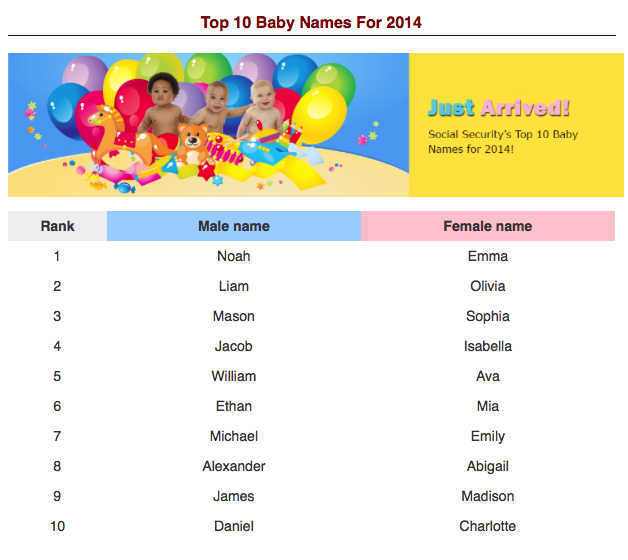
Today I was looking at some lists of the most popular names for girls in the past few years, and was quite shocked at how old-fashioned some of them sound. Isabella and Sophie, both wildly popular right now (and both which have reached and probably passed their peak of popularity), sounded old about 10-15 years ago but no longer do. The same thing happened with names like Emily and Grace in previous years.
Supposedly there’s a 100-year rule,which means names become popular again for a new generation of babies after about 80-100 years (around the same time the generation that was given those names has nearly died off). So there are names now in the Top 100 like Cora, Evelyn, Vivian, Lillian, Esther, and Lucy. I also read that Betty (not Elizabeth, which has always been popular and never becomes dated) is just beginning to come back and experienced a huge uptick in 2014. So is Jane (I really like this name because of how simple and feminine it is). These names haven’t been popular long enough to stop sounding like old-lady names yet but soon they won’t anymore. Boys’ names tend to change less frequently so I’m not focusing on those here, but this can be seen to some extent in the boys’ lists too. Following the 100 year rule, I’d guess that names like Helen, Joyce, and Dorothy will begin to get popular again very soon, if they’re not already, since few people under the age of 70 or 80 have these names (plus, all three have a great legacy and are attractive names in their own right).
If you’re naming a baby girl and don’t want to risk them being one of 5 other girls in their class with the same name (which is what happened to me) and want to stay away from trendy or “creative” names (PLEASE go away, Neveah and any names ending in –aiden) , may I suggest a cute mid-century name like Karen, Susan, Deborah, Lisa, Linda or Patricia. It’s too soon for these names to be making a comeback yet, so they will seem somewhat exotic and uncommon when the girls are young, and by the time they reach midlife and these names are due to be popular again (following the 100 year rule), their names will seem very “young” and not date them.
My daughter’s name is fortuitous for her. She was born in 1993 and her name didn’t even enter the Top 1000 until 2003, and has been growing more popular every year since. In fact, when she was born it was so unusual that most people had never heard of it used as a first name before, but now girls (and some boys) much younger than she is have this name (and no, her name is NOT Madison!). It’s analogous to a girl who was born in the late 50s/early 60s having a name like Heather or Jessica, so when she’s older she will seem to have a very “young” name that won’t “date” her (but I don’t think it will ever be as popular as Heather or Jessica, thank goodness). I think it’s a very strong name, and she loves it, which makes me happy. My son’s name is very ’70s even though he was born in 1991, but it was never that common in the United States so it just seems classic.
Five types of gaslighting narcissists.
I haven’t written an original narcissism article in awhile, and I was thinking about gaslighting today, so I thought I’d write a post about it.
Gaslighting is a defense mechanism commonly used by narcissists in order to diminish their victims and make them doubt and question their own reality. The term comes from the 1942 movie “Gaslight,” in which a young wife is abused in this manner by her husband, who almost succeeds in driving her insane by telling her she is imagining the gaslights in their house going on and off, even though he has been secretly playing with the gaslights himself to make her think she’s going insane. Gaslighting is one of the most sinister and crazymaking things a narcissist can do, and over time your self esteem and even your grip on what is real and what isn’t begins to erode. Dealing with a gaslighting narcissist is like looking into an endless hall of mirrors. It’s common for victims of such mindf*ckery to develop PTSD or complex PTSD.
Here are five common types of gaslighters, with examples that show what these darlings do to make us feel like we’re going crazy.
1. The “You’re Insane” gaslighter.
This type of gaslighter, when confronted with the truth about their disgusting and unacceptable behavior, accuses you of insanity, stupidity, or (in the case of women) your terrible PMS (gaslighting with a little misogyny thrown in for good measure).
You: I don’t think you should have told all our friends that you think I’m cheating on you, especially because I’m not.
Gaslighter: You’re imagining things as usual. Have you taken your meds today?
You: I hate it when you use that tone of voice.
Gaslighter: Oh, please, not this again. You must be on your period.
2. The “I never said that” gaslighter:
This type of narcissist is so far into their lies and denial he/she would sell you down that river in Egypt.
You: Why did you tell my mother I can’t keep a job?
Gaslighter: I never said that. This may be followed by a “you’re insane” elaboration to drive home their case that you’re the deluded one.
You: You promised me I could have some money to buy the kids new school clothes.
Gaslighter: No, I never agreed to that. I told you I don’t have the money. What part of “I don’t have the money” did you not understand?
3. The “Everyone’s Against You” gaslighter:
This is an especially mindfucking type of gaslighting, in which the narcissist draws other people into their attack on you, which may in fact not be the case but they can definitely convince you no one is on your side. If actual flying monkeys are being used, then a different tactic, triangulation, has become part of their arsenal of weapons they use against you.
You: Why do you always talk to me like you hate me?
Gaslighter: That’s just your overactive imagination again, but to be honest, I was talking to [names of friends, associates, or family members] the other day, and they all told me they think you’re very difficult to be around [or insane, stupid, etc], so put that in your pipe and smoke it.
This type of abuse can also be very subtle:
You: You are driving me crazy!
Gaslighter: Well, I wasn’t going to tell you this, but [name of friend, family member or associate] and I were talking, and we are all very concerned about you (“I’m/we’re concerned” is narc-ese for “I/we think you’re batshit crazy.”)
This next type of gaslighter is probably the most infamous and well known to most narcissistic abuse survivors:
4. The “You’re Too Sensitive” Gaslighter:
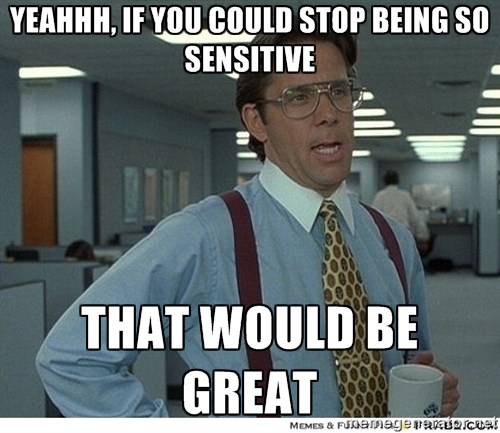
Narcissists love to call out the sensitivity of their victims as if it’s a character defect (and if we were raised by narcissists, we have probably learned to hate and be ashamed of our high sensitivity). It’s true that many abuse victims are highly sensitive, in fact some of us are HSPs. Narcissists are drawn to sensitive people because of their high empathy and tendency to become codependent and thereby good sources of narcissistic supply. At the same time they need us, they also hate and envy those qualities they seem to be so attracted to, and don’t miss an opportunity to take hurtful potshots. Even if they do or say something that would even hurt the feelings of someone as coolheaded as Star Trek’s Mr. Spock, they somehow make it your fault if you’re bothered by it because you’re just too damned sensitive.” It’s really just a variation of the “you’re crazy” tactic.
You: I wish you’d talk to me more respectfully when we’re out in public.
Gaslighter (dramatically rolling eyes): I do talk to you respectfully (lie). Your oversensitivity is really getting tiresome.
5. The “I Was Just Joking” Gaslighter.
Similar to the “You’re Too Sensitive” gaslighter, this one calls your sense of humor (or lack thereof) into question, even when their “joke” is clearly anything but.
Gaslighter: That dress makes you look fat.
You: (looking hurt): It does? But I’ve been trying to lose weight for you.
Gaslighter: Jesus, don’t you have any sense of humor? You can never take a joke.
To rub salt in the wound, they might even toss a little “Everyone’s Against You” into the mix and say something like, “Maybe it’s because you can’t laugh at anything that no one really likes you.”
There’s one more type of gaslighter that’s incredibly dangerous because they manipulate reality itself and then tell you there’s something wrong with you because you noticed. The abusive husband in “Gaslight” illustrates this well, by manipulating things around the house and then telling his wife she’s unbalanced and imagining things. This was a favorite technique of my ex, who often deliberately misplaced things I needed, such as my car keys, then when I wasn’t looking, he’d return them to their rightful place and chided me for being “careless.” He did this for shitz and giggles.
When you’re dealing with a gaslighting narcissist, nothing you do or say is ever right. They always have to have the upper hand and they always have to make you feel about 3 inches tall, because that’s the only way they know how to keep you weak and in your place so they can continue to prey on you for supply. They do this because their own egos are so fragile they need to put you down in order to make themselves feel better. He or she isn’t going to change. Arguing isn’t going to help, it will only make things worse. The best way to handle a gaslighting narcissist is to leave and never look back.