How I became a Cluster B basketcase.

left-out_child

I had some new insights today on the genesis of my disorders. Not actual new memories, but insights on memories I already had that I know now led to my covert narcissism and BPD. I can pinpoint the exact events that turned me into a borderline, and later on, a covert narcissist.

I’ve been a borderline since about age 4 (in a young child incipient personality disorders are known as attachment disorders). A few weeks ago, following my trip down the rabbit hole, I mentioned having remembered that someone told me something when I was 4 years old that was significant in the development of my BPD.

I still don’t remember what was said, or who said it, but somehow I know I began to be sexually abused at that age. By who or in what context, I can’t tell you because I don’t actually remember. I just know I was.

That’s when things began to get weird for me. I have a vague, dreamlike recollection of sitting on the short flight of carpeted stairs of our split-level house in New Jersey, watching my parents (who were probably drunk) dancing in the living room. They were doing the Cha Cha Cha, a dance popular at that time. I remember feeling unreasoning (and probably Oedipal) jealousy at that moment, because my father was ignoring me, even though I was calling to him to dance with me too. I believe that’s when my hatred toward my mother began. Instead of reassuring me or including me in the moment with them, I was simply ignored and impatiently told to go back to bed.

I don’t remember what happened after that, but I began to have terrible nightmares, and sometimes would wake up screaming. Sometimes after I woke, the dreamlike, dissociated state would continue. I remember hearing, ghostlike, the theme from the TV show “The Mickey Mouse Club” playing somewhere–although it was 3 in the morning and in those days, it wasn’t possible for anyone to have recorded the show and play it somewhere later. I got out of my bed to find out where the music was coming from, but the house was completely dark and everyone was asleep. It was very eerie. I also remember one morning, having gotten out of bed for breakfast, seeing tiny colored sparkly objects that looked like glitter, falling everywhere around me. No one else seemed to see them. I asked my parents if they saw the falling glitter and they looked at me like I was crazy. There was something else that happened around that time that was equally strange, but I can’t recall now what it was. It’s not far from my conscious awareness though. I think I’ll remember soon. I might remember what was said to me and who said it too–because I know it was important.

I started doing things like banging my head against the wall in the family room, because it felt good to me for some reason. My mother would tell me to stop but I’d keep doing it, because I couldn’t stop. It seemed to relieve some kind of congestion inside my head. I don’t know–I tried it recently just to see if it still felt good, and it didn’t at all. It hurt! I also began to develop strange ticks and habits like pulling my hair and sucking on it. My mother started keeping my fine hair short because “I was ruining my hair” by doing that.

I began to get a taste of rejection in kindergarten. I always felt somehow different from the other children, but couldn’t figure out why. Not different in a good way, but in a defective one. I’d already internalized the conflicting golden child/scapegoat messages given to me by my parents, who expected me to serve both roles because I was their only child. No wonder I longed for a younger sibling! This alternating, unpredictable and crazymaking golden child/scapegoat treatment exacerbated my BPD (which I think already existed) and set the stage for covert narcissism–unworthiness and inferiority (beaten into me by being their scapegoat) that overlaid grandiosity and a sense of being better or more “special” than other kids because my parents sometimes told me I was when they weren’t punishing me. I didn’t know who I was. When people told me to “just be yourself,” I had no idea what they meant. Who was I? I couldn’t live up to their lofty idea of the perfect little girl they wanted me to be or thought I was; but it also made no sense when they wouldn’t allow me to try new things or make decisions on my own, always saying things like, “you can’t do that,” or “you know you don’t want that.”

Their punishments were severe and I became a fearful child, and feared rejection wherever I was. How could anyone like a child that was so bad, but at the same time, was supposed to be this perfect princess but could never live up to being one? I was so confused and felt so apart from others. I remember when I wasn’t crying (I wrote a article about what a huge crybaby I was), I was nervously asking the other kids at school if they liked me. Was that my true self or a newly minted false self asking them that? I’m not sure, but I think it was a last ditch attempt of my true self to get reassurance, love and acceptance, because I sure didn’t get it at home.

I was an unpopular, oversensitive child and everyone always told me how sensitive I was too. I remember being mortified and embarrassed by this but had no idea what to do about it. my mother used it against me too, calling me out for my “hypersensitivity” in front of other people, or making excuses for her hurtful comments by blaming me for “always taking things the wrong way.”

I started to try to hide my emotions but wasn’t very good at it, and the other kids could always see right through that transparent mask I tried to wear. I was intelligent, and my grades were okay, but my teachers always told my parents that I was an underachiever and a daydreamer and of course “too sensitive.” They also wrote on my report cards things like, “Lauren is intellectually brilliant and very creative, but she is an underachiever. She could be doing so much better if she applied herself. She also has problems socializing appropriately with the other children.”

And I did. I never fit in anywhere. I got bullied throughout my elementary and most of my high school years. It didn’t help any that we moved three times within my first 8 years of school, requiring me to start two new schools in the middle of the year (actually, the second school was due to my having been bullied so badly my parents were forced to have me change schools). I used to be chased home by bullies everyday and was never invited to parties or after school activities that weren’t teacher- or parent-planned.

I did manage to always have one or two close girlfriends so I’d sometimes get a respite when a sleepover was scheduled. But for some reason, my mother wouldn’t allow me to go on sleepovers very much. She didn’t like the idea of me doing things on my own without her. It got so bad that around the age of 11 or 12, I got very upset one night because she had failed to come in to the bathroom to wash my hair while I sat in the tub. I felt like I couldn’t handle something like washing my hair on my own, and more than that, I felt…rejected and forgotten! I remember going downstairs crying and asking my mother to tell me she still loved me, just because she had failed to come in to wash my hair. I don’t think I got that reassurance. At the time I still went out of my way to make friends. But I was too friendly and clingy too, so although at the time my debilitating shyness hadn’t set in and I made new friends fairly easily, I didn’t keep them for long. I was already demanding too much from them, I guess.

My parents divorced when I was 14, and I moved to New York with my mother. I already blamed her for their divorce, and already had pegged her as a narcissist, although I didn’t have a word for it then. I remember telling her how “empty” and “shallow” she was. This would make her rage. But under my anger was terror. She scared me on some deep gut level and she seemed to hate me. Even as an adult, I’d always revert back to being a child in her presence. She was drinking heavily, and I began to drink too. She didn’t try to stop me. She had a string of lovers that came and went, and to get to the kitchen or bathroom, I’d have to walk through the living room where she and some boyfriend were sleeping. One of her lovers used to love to make fun of me with her. I remember sitting at the dinner table with the two of them laughing at my worries, speech, the way I looked, and anything else they could pick on. I remember running away from the table in tears more times than I can count. I was left alone in the house often, which I actually liked because it meant I didn’t have to deal with her or her nasty boyfriend, and I’d cook my own dinner, usually a TV dinner or frozen pizza. Inside, I secretly worried that this woman who seemed to always want me by her side when I was younger (and be her mini-me) didn’t seem to want me around at all anymore. I wondered what I had done wrong to make her stop loving me. Now I know she never had.
I was a depressed, sullen, underachieving teenager who lived in a fantasy world inside my head because I was learning to hate people.

At age 15, I was rejected by a group of girls that I described in “Crybaby.” That was devastating to me, and I spent several days literally sick in bed after that. I don’t remember if I cried. I think I might have already stopped being able to cry easily, but I felt like I wanted to die. I remember making a promise to myself I would never again reach out to anyone in friendship and that I’d have to hide my emotions from that day on.
I think this was the beginning of my narcissism–my false self was born. Up until then, I’d displayed borderline attitudes and behaviors (as they would appear in a child), but after this event I became increasingly aloof and tried to pretend I didn’t care what anyone thought of me.

I began to act up more at home too, and outwardly rebel. My mother and I got into huge drunken screaming matches that would end with her either passed out on the floor drunk, or with us both throwing things at each other. One night, unable to control my rage, I grabbed a kitchen knife out of the drawer in the kitchen and went after her with it. She was drunk. I held it in front of her to scare her but did nothing, then dropped it and told her I was sorry when I realized what I’d done.

That was the night she kicked me out. I was 17. I went to live with my father for a time before entering a girls’ residential facility for a year that treated adolescents with emotional or behavioral problems.

But even though I can’t say I blame her for kicking me out since I probably scared her to death with the knife incident, being kicked out by my own mother was traumatic. I took this as proof she never loved me, because threatening her with the knife had been a desperate cry for help, to be validated. Even though I can understand why she didn’t want me around anymore, the hurt from her total rejection of me (she didn’t speak to me for another three months after that night) stayed with me and ate away at me for years. I believe this incident–being literally tossed out of the house by my own mother before I reached 18–was what solidified my narcissism and when my false self became a permanent fixture.

I became colder and more aloof. I stopped being able to access my true feelings, except for rage and fear. I could no longer meet people easily. To get too close to anyone meant I’d be rejected, or made fun of. Occasionally I’d explode into a BPD rage, but mostly I kept my emotions inside–so far inside I couldn’t even feel them much anymore. The only exceptions were the times I fell in love. My crushes were intense, insane, overpowering; they were a force of nature. My emotions would be all over the place, and I’d be completely obsessed with some boy I imagined would make me happy for the rest of my life. I couldn’t seem to live without a boy who could reflect me and act as a mirror. I was attractive and seemed to find dates easily, and I had a way of getting boys to fall in love with me (I had the slightly pitiful yet charming waif act down to a science). I think I’d become very manipulative in these relationships. Eventually these relationships would end, and I’d be miserable until the next one came along. When I wasn’t dating, I had intense unrequited crushes and lived in my fantasies of happily ever after. I think I might have been showing histrionic PD traits too, although my narcissism is actually the cerebral type. I was never that interested in sex for some reason.

Without a relationship to validate me and prove that I existed, I felt empty inside. Without a relationship, I was nothing. I had no real interests and any type of hobby I did pick up, I’d eventually drop. I couldn’t stick with anything, and began abusing alcohol and later, drugs. These were the only other things that seemed to temporarily fill the vast black hole I felt inside. I still had no idea who I was or what I was here for.

This was longer than I intended, but it’s pretty clear now when my BPD and narcissism began. My BPD began at age 4 due to some type of sexual abuse and something that was said to me. As for my cNPD, it didn’t happen overnight. It gradually developed in me between the ages of 14 and 17. What solidified it were two things–being rejected by a group of girls who had seemed to like me; and the final boot by my mother. My BPD always lay beneath the narcissism, ready to erupt at the worst possible times.


“Some days I just want to crawl into a hole and make myself very small.”

This article embarrasses me now, but I think it’s a great example of how narcissistic I can be sometimes, even online. I just thought I ought to call myself out about this whiney, self-pitying, falsely-humble, yet grandiose post that’s like wearing a neon sign flashing the words “I can’t take criticism! Waaaaahhh!” This is covert narcissism and BPD in a nutshell. Narcissistic injury. We’re always so butthurt over everything.

It’s interesting. At the time I wrote it, someone called me on this post being very narcissistic, and that upset and angered me (of course!) I actually couldn’t see anything wrong with this self-indulgent post and thought the person was being a bully. They were, but that doesn’t mean the article wasn’t narcissistic.

Seeing myself this way is like having glasses after years of being almost blind.
But I’m being careful not to beat myself up either. The past can’t be undone, but you can make your own future.

luckyotter's avatarLucky Otters Haven

internet_fame

DISCLAIMER:
I feel like a disclaimer is needed, though the above photo should be enough of a disclaimer, because it says it all. Someone made a sarcastic remark about how I think I’m a celebrity because of this post, so I let their comment make me set this post to private, because I don’t have a thick skin and am too chicken to come out with a snappy or snarky comeback. I always think other people can get away with doing that, but I won’t be allowed to. It’s because of my past. I was never allowed to speak my mind or have a voice. Now I’ve internalized that and don’t allow myself a voice sometimes. I’m getting better but I’m not out of the woods yet.

In no way do I put myself in the same category as celebrities (who are just people who get wrinkles, have morning breath…

View original post 1,301 more words

How does avoidant PD differ from covert (vulnerable) narcissism?

avoidant_pd_bagoverhead

Covert (vulnerable or fragile) narcissism (cNPD) can, on the surface, look an awful lot like Avoidant Personality Disorder (AvPD–not to be confuse with AsPD!), which I have been diagnosed with, along with BPD.

But appearances are only skin deep.

I found an article on Psychforums (in the Avoidant PD forum) that describes the differences very well. Because covert/vulnerable narcissism is not an officially recognized diagnosis, and is not included in the DSM (yet), covert narcissists are frequently (if not almost always) diagnosed BPD comorbid with AvPD, as I am. Aspergers can also be easily confused with cNPD, and has been by many. But this article focuses on Avoidant PD, not Aspergers.

“Vulnerable narcissism could be misdiagnosed with at least two other distinct DSM personality disorders: Avoidant Personality Disorder (AVPD) and Borderline Personality Disorder (BPD). In the diagnosis of AVPD, there are several criteria that may overlap with vulnerable narcissism. First, avoidant individuals are observed as appearing shy and being fearful of developing close relationships with others. Second, individuals with AVPD may meet criteria for experiencing fears of feeling humiliated, rejected, or embarrassed within individual relationships. Finally, Millon (1996) proposes that the use of fantasy in individuals with AVPD is a major element in the presentation and perpetuation of this disorder. This is striking in the fact that the use of fantasy has long been denoted as primary to the realm of narcissistic pathology.The vulnerable narcissist will likely exhibit significant interpersonal anxiety, avoidance of relationships, and use of fantasy, but this is guided by a core of entitled expectations. That is, vulnerable narcissists may avoid relationships in order to protect themselves from the disappointment and shame over unmet expectations of others, in contrast to fears of social rejection or making a negative social impact typical of AVPD.

Another false positive diagnosis that may occur as a result of misinterpreting vulnerable narcissismis in the diagnosis of BPD. Masterson (1993) forwarded this issue in an elaborate discussion about the potential for misdiagnosis of the closet narcissistic personalitywith BPD. Misdiagnosis can occur because of a clinician’s attention to the overt presentation of the emotional lability in the individual to the exclusion of an understanding of the cognitive and socio-emotional experience that guides the lability. As with social avoidance, the emotional lability of the vulnerable narcissist is influenced by his or her covert entitlement and difficulties managing disappointment and self-esteem threat. In contrast, the emotionally lability of the individual with BPD is a byproduct of unrealistic anaclitic needs (e.g., the need for a strong caretaker to manage his or her fears of being independent).

avoidant personality

Both the AVPD and the vulnerable narcissistic character will likely report difficulties with feeling self-conscious in interpersonal situations, along with the tendency to avoid situations in which they expect to be ridiculed. The difference between AVPD and vulnerable narcissistic characters lies in their expectations for themselves and others. Individuals with AVPD have needs to be liked and accepted by others, but fear they will fail to be acceptable to others. In contrast, vulnerable narcissistic characters need others to respond favorably to them and to admire them regardless of their behaviors, beliefs, skills, or social status, but fear that others will fail to provide them with narcissistic supplies. For vulnerable narcissistic characters, it is not mere concern about being liked or not. Rather, the vulnerable narcissist’s fear is that he or she will not be admired. Furthermore, vulnerable narcissistic individuals experience significant injury and anger in response to perceived slights. Their avoidance of relationships is based upon their fear of not being able to tolerate the disappointment of their unrealistic expectations.

The assessment of entitled expectations and exploitative motivations are important variables that would guide how an individual approaches and experiences relationships, including a therapeutic relationship. Not acknowledging narcissistic entitlement when it is present could lead to important misinterpretations of clients’ experiences that either reinforce their sense of entitlement or lead to unrecognized self-esteem threat in the therapeutic relationship (Gabbard, 1998).”

From “Interpersonal analysis of grandiose and vulnerable narcissism” Dickinson, Kelly A; Pincus, Aaron L

What It FEELS Like to Live This Way

Incredible description of covert narcissism. This is exactly what it feels like to be one.
I can’t even express how glad I am that now I know. Things have already shifted and my whole perspective is changing. I’m so glad I “came out” about it too. Doing so was TERRIFYING!

healingnarc's avatarFrom Narcissism to Nirvana

There is a wonderful NPD research paper available at: http://ps.psychiatryonline.org/data/Journals/AJP/3874/08aj1473.PDF

It is my personal opinion that this is the most scientifically accurate description of NPD and its subtypes.

My NPD falls under the ‘fragile’ category.

According to their Q-factor analysis, the following traits are typical of the fragile narcissist experience. In order to add the actual viewpoint of a fragile narc, I am including the ranked list of traits and how they manifest in my life.

Please note that it is difficult for me to separate my current sense of awareness from my history. I may use past and present text in some places, but my general intent here is to describe what my life has felt like for the past 35 years.

Maybe it can be useful to help self identify if you think this is what you have!  Just be sure to confirm with a trained and licensed…

View original post 3,326 more words

False self vs. true self.

wolf

UPDATE: I wrote this post during a four-month period of time when I thought I had covert narcissism.   I don’t (BPD + Avoidant PD in the same person can look a LOT like C-NPD and even confuses some professionals), but I think this still applies because Borderlines do indeed have a “false self” (and to some extent, everyone does) which is just less developed than someone who has NPD.  

Like the wolf graphic above shows, all human beings have a good self and a bad self. But in a narcissist, the good (true) self is dissociated and split off from the bad (false) one, where in normal people all these feelings are integrated into One Self.

I’m beginning to see the woman I can become. The woman I would have been had I not been so abused and allowed myself to fall under the thrall of a malignant narcissist/ASPD man for 27 years.
That woman is taking shape in my mind and all I need to do is find a way to reconcile this new vision with my reality.
She’s someone I like very much–the adult version of the sensitive little girl that brought me so much shame and humiliation because no one mirrored her positively.

My True Self…

Enjoying the sun

Enjoying the sun

–Is in touch with her feelings but doesn’t fly into BPD rages or seethe with envy, bitterness and resentment. She’s in control but can feel appropriate emotions at appropriate times, and isn’t ashamed to show them.

–Is naturally introverted (INFJ) but not shy. People don’t intimidate her but as an inward-looking person, she often prefers solitude to pursue activities and interests she loves. (I’m already halfway there).

–Is creative–she uses her ability to write to purge her past and her emotions (I’m already doing this) and sometimes just for fun (my other blog has a lot of silly or humorous posts). She also loves photography, art, music and wants to learn to play the guitar to accompany herself singing. She’s not a talented singer, but sings for the joy of it. Music feeds her soul.

–Is quietly confident and not afraid to let someone know when her boundaries or rights are being violated.

–Is able to make and keep close friends, not just acquaintances she keeps at arm’s length.

–Is an HSP with possible empathic abilities. (I’m not there yet).

–Is authentic and nurturing, and truly wants to help others discover who they are (I actually do want this now, but I’m mainly doing it for myself. If I help others along the way though, it makes me feel good).

–She feels attractive and even sexy, but appreciates the beauty in others and in the world around her too. She feels beautiful by knowingly and mindfully being a part of beauty (and almost everything has a certain beauty).

–Is able to parlay her love for writing into a career as a published author. No feelings of, “but I’d fail at it.” She isn’t afraid to take smart risks to turn her desire to express her insights and emotions into her life’s work.

My False Self…

false_self

–Is selfish and demanding, always complaining about how badly she’s treated or disrespected.

–Always thinks everything’s about her. If someone looks at her the wrong way, she lets that ruin her entire day and thinks everyone hates her. If she walks into a room and everyone smiles, she focuses and ruminates about the one person who is scowling.

–Overreacts to slights and occasionally flies into rages (this may be more due to BPD; my DBT skills have mostly got this under control though the rage is still present).

–Is envious; can’t be genuinely happy for someone else’s good fortune (except for my kids).

–Sometimes secretly gets a thrill on hearing someone else’s bad news (I’m really ashamed of this and it’s really hard to admit this). I don’t feel that way all the time though. I don’t try to cause pain to others. I hate being the perpetrator and have a lot of guilt and shame when I know I’ve caused someone pain. I’m a passive sadist, I guess. Isn’t schadenfreude the term for this? I’ve read that everyone experiences it, but I think I have it more than most people.

–Feels secretly superior under a self-loathing exterior. Of course I loathed myself to the core (not so much now), but to correct the cognitive dissonance between what I was and what I wanted to be, I’d denigrate others and put my own actions on a pedestal. For example, when I thought I had Aspergers, I felt “superior” for not being a neurotypical and used to feel contempt for people who had a lot of friends or an active social life, or the ability to feel comfortable in a group setting. I actually envied their ability to connect with and not fear the judgment of others , but I convinced myself I was somehow “better” because I didn’t have to engage in stupid small talk and my mind was probably superior to their anyway.

–No matter what the situation, I always think about how it’s going to affect *me* first.

–Fearful of getting involved in a romantic relationship, yet at the same time I long for one. (This is probably more due to my BPD).

I’m happy to say a lot of these FS behaviors are diminishing, just through the self-discovery I’ve achieved through blogging for the past year. A couple of my FS traits have nearly disappeared. I seem nice now, and I am nice (I don’t think I present my false self on this blog), but I wasn’t always so.

I just noticed I wrote most of this list in the third person–isn’t that something narcissists are known to do? :/

What does covert narcissism feel like?

itsmytime

This was a comment in another post but I wanted it to be a blog post because I think it’s a good nutshell explanation of what covert NPD actually FEELS like, filtered through self-awareness:

I feel like…”everyone’s better than me and has more and I deserve to die because I’m a worthless POS”…but underneath THAT is this “how DARE they have more, I’m more SPECIAL and that’s why I don’t feel like bothering with you and people are stupid for rewarding you for not being all that,” (but this defensiveness stems from my fear of them getting too close and seeing nothing but a black void under that).

And under all THAT–inside the VOID I can’t let anyone see–is the true self I’m seeing more and more of, as she shows herself more. She’s creative and sensitive and cares about people–a LOT. That void isn’t empty at all, but I have to go in there and face the darkness…

Does that make sense?
We have TWO masks, not just one.

So it can’t be Aspergers. Aspies don’t have all that RAGE..and self hatred…and fake hidden grandiosity and bitterness…

I still have a long way to go but I’m feeling pretty good about it all. I hope that’s not being grandiose. I’m actually happier than I’ve ever been right now because I lost something really toxic during that bizarre journey of a week ago…I still get emotional (in a good way) thinking about it…

Processing my trip down the rabbit hole.

journaling

I’m so glad I talked about it. Everyone has been great. There have been no negative comments and hardly any unfollows, which surprised me. I’ve had a few comments like these though:

“You can’t be a narc, you’re too self aware and have too much remorse,”
“You’re a good person, so that can’t be true.”
“It’s just a bad case of ‘fleas'”
“It’s probably really just complex PTSD mixed with BPD”
“It’s probably NVS (narcissistic victim syndrome).”

Denial is understandable; I denied it too. For months. And it could be that all those things are true too. Narcissism is, after all, a result of being a victim. Narcissists are the most damaged of all victims, so damaged they became what was destroying them. And until (and if) I can get an official NPD diagnosis (which I probably wouldn’t get anyway, because I don’t fit the classic DSM criteria for NPD), there’s a possibility that I don’t have NPD at all, covert or not. Narcissists low on the spectrum aren’t necessarily bad people who have lost their humanity, but they are broken people and some want help. BPD symptoms and Avoidant PD symptoms mixed together can also look a lot like covert narcissism, but a few things didn’t fit–like the hidden resentment, envy and grandiosity I thought everyone felt.

In addition, because of the intensity of the emotions and events that led to my discovery and the surreal and almost supernatural coincidences that began to play out immediately after, as well as an enormous feeling of relief and a completely shifted vantage point where I could now see myself as others saw me, I can only believe my disorder is real and not a figment of a deluded imagination.

I feel like the copious tears I was able to shed just prior to and during my epiphany both cleansed me of some of the toxic, angry emotions I was always carrying around (suddenly I feel something closer to actual empathy!) and helped carry me to the next step of this journey, which is healing.

I know the next phase will be even more difficult. I doubt I can do it alone. I started a new blog intended to act as a therapy tool for this second big phase of my journey (and is also intended to help others in similar positions find their way), much as this blog has been a therapy tool for the first.

Because there’s no way I can afford the type of therapist I’d need, I’ve decided to search for a university clinical psychology program that uses BPD/NPD patients as “guinea pigs” to people training to be therapists, especially in reparenting/psychoanalytic (not just behavioral like CBT) techniques.

darknessintolight2

During my crisis last week I thought the shock of finding out the truth would kill me. But it didn’t and now I think it’s the most pivotal moment in my life. It also proved to me that God not only exists but loves me very much, because this revelation came after weeks of prayer that I thought were falling on deaf ears. I was almost ready to give up my faith because nothing was happening.
I was even losing interest in writing.
And then it happened, when I didn’t expect it. It hurt more than I can describe in words. But so does bearing a child–something wondrous comes after all the pain. God doesn’t always make things easy.

I’m not sure what’s going to happen down the line, but that’s not for me to know yet.
The idea to start a new blog happened after the dust settled so I think that was part of his plan for me.
If I’m right and God has taken the reins of my journey, I have faith he’ll direct me to the right therapist.
I’m both scared to death and excited as hell to meet my real self and for us to become reacquainted.

I think the true self comes out through art and creativity. For some narcissists, the “art” they produce isn’t real art but trash. But if they’re at all able to suspend their false self while creating (and I think some do), their art can be honest and beautiful because it’s coming from a place of truth.
Writing is when my true self is at its strongest. So I’m taking things from there.

I’m not sure which direction this blog is going to take. I’m not sure how to reconcile writing about narcissistic abuse without seeming like a fraud, even though that’s probably stupid because it’s not as if I wasn’t a victim of abuse. I was for my entire life until a year ago. Getting away from my narcs brought me the clarity I needed to get to this point. I don’t even want to think of what I might become if I had never escaped.

If anyone’s afraid I might abandon this blog, I promise I won’t. Just like I wouldn’t abandon a first child after having a second. However, for the time being I may focus a bit more on the new one, because of my need to write about things that would fit better over there right now, as well as mundane things like setting it up, putting some “meat” on it, and getting it established.

I’m not sorry this happened at all. I’m grateful. I feel so much better now, almost happy!

Down the rabbit hole.

rabbit_hole

This blog has existed for nearly a year and I’ve come to care about all of you who read it. I hope some of you have found it helpful in navigating your world after narcissistic abuse. But more than anything, this blog has been a journey of self discovery since I left my malignant narcissist ex. It’s been a wonderful tool, but part of the process of self discovery is learning things about yourself you didn’t want to know. That’s why I’m writing this article.

It’s the hardest article I’ve ever had to write.

For several days I’ve mulled over how I was going to talk about it. I know it’s not going to go over too well for some. I fully expect some of you to leave and if that’s what you decide to do, I can’t say I blame you and it’s okay. I understand. For what I’m about to say will probably shock some of you as much as it shocked me.

But to say nothing would be to misrepresent myself so rather than take down this blog (which would be akin to giving away a pet you love), I’m going to stick to my original vow to be honest, no matter how much it hurts and regardless of the consequences. It’s the only right thing to do; to continue blogging about narcissism without writing this post would make a fraud out of me.

A little background.

Here’s a quick background for those of you who may be new to this blog. A year ago I started journaling on WordPress as self therapy because my life was shattered after 27 years of abuse at the hands of a malignant narcissist after having been raised by one (and possibly two). In 1996 I was hospitalized with major depression and anxiety and diagnosed with BPD while in the hospital. I took the DBT classes but at the time didn’t take it very seriously and didn’t use the tools as well as I should have. I kept the workbook though, and last year after I got out of my abusive relationship with my ex, I started to use the tools again and they do help but it’s no cure.

Several things have led to the breakthrough I’m about to describe–writing a LOT about my feelings and recovery from narcissistic abuse, reading as much about narcissism, BPD and PTSD as I could get my hands on, trying my best to always be honest no matter how painful or embarrassing (but not always succeeding), and finding God and prayer. It’s been an incredible roller coaster ride.

I’d been praying daily for the ability to regain the easy access to my emotions I had as a child, only tempered with the wisdom and restraint of an adult. I kept reading, writing, and trying to elicit emotion through music, movie-watching, and self-reparenting. This required making myself as vulnerable as possible. I even took myself to see “Inside Out,” which loosened something inside me but not quite enough. It was like one of those almost-sneezes that never quite comes out and leaves you wanting to punch a wall in frustration. Nothing much happened after that. I was growing impatient.

Emerging awareness of a horrifying truth.

This week has been very difficult for me emotionally. It started with an unnamed, free-floating but intense anxiety and panic, to the point I could barely function. A few days ago I plummeted into a black depression that seemed different somehow in quality from my prior zombie-like apathetic depressions when I was living with my ex. This depression felt more alive and more proactive in some way. I’m pretty sure I had an idea all along of what was about to happen but it hadn’t quite bubbled into conscious awareness yet. Its rising through the murky swamp of my unconscious caused me to panic and then a kind of grief took over but I still couldn’t name what its source was.

A week ago, I fell into a panicky, anxious, almost dissociated state and this was followed by a “wet” depression (that included tears instead of my usual catatonic apathy). I didn’t even know what I was crying about. I lost my motivation to write (in retrospect, I think this as a form of self protection when I needed it). I was snappish and irritable on the job but would come home and set aside alone time so I could just let everything out without fear of embarrassment or shame. I knew instinctively something important was about to make itself known and that scared me, but I felt a kind of excitement too.

During this time, I had trouble sleeping and when I did sleep my dreams were upsetting and I had this overwhelming sense of aloneness and separateness. I rarely have nightmares but woke up shaking and close to tears twice.

A few months ago I began to worry I might have NPD. I could tell because of an expressed grandiosity that had always remained hidden in the past (except in my BPD rages which I learned to control) due to my blog being somewhat successful and attaining the attention of a few important people in the field of narcissism. A few people suggested I was narcissistic (not on this blog but elsewhere) and I took this to be bullying (and some of it may have been). So what did I do? DENY IT LIKE HELL! It wasn’t lying–I still didn’t believe I really was one, but I was beginning to question and think it wasn’t impossible and comments like those told me something I did NOT want to hear. Because inside, I already knew.

I think that’s why recently I’ve been writing a lot about covert narcissism. I didn’t make the connection though until the other night.

My “Aspergers”

You might have noticed I took “Aspergers” out of my blog’s graphic and my profile.
There’s a reason why. For as long as I can remember I’ve been painfully shy, socially awkward, and always seem to be a target or victim no matter where I am. I obsess intensely over my hobbies and interests and have trouble making eye contact, which is another symptom.

I don’t function well in work situations because of my low self esteem, kick-me demeanor, and lack of confidence. I’m always passed over for promotions, raises and other perks that others seem to get with ease. Underlying all this self-hatred and always feeling unworthy, is this sense of grandiosity. I’ve always had a seething, hidden resentment toward others who seem to be doing better or have more (which is almost everyone). It’s mellowed with age but hasn’t gone away. I know I shouldn’t feel that way but it just comes over me and I always feel this…bitter resentment and envy. But I don’t have any desire to ruin anyone’s life or take away what people have. I don’t have ill will and don’t want to hurt anyone, but just I feel so envious and defective, and then I feel guilty and beat myself up over having these evil thoughts.

I’m an underachiever and have been my entire life, in spite of a high IQ and a college education. Things seem to come so easily to everyone else and I’m constantly comparing myself to others, and always coming up short. I can’t seem to help comparing myself to everyone all the time, even though I know rationally that these sort of comparisons are poison to my soul and aren’t going to make me feel any better.

I never was able to stand up for myself and resented how disrespected I got by everyone. I felt like, how dare they treat me that way–they’re just a bunch of dumb neurotypicals and I’m too good for them anyway. But at the same time I longed to be included and treated like everyone else.

Lately I’ve been reading a lot about covert narcissism and have posted a few articles. Covert narcissists are almost always painfully shy and sometimes awkward. Their social ineptitude is also a kind of social cluelessness, VERY similar to Aspergers–only rather than having a developmental/cognitive source, a covert narcissist’s social cluelessness and obtuseness is due to the great effort of trying to keep the mask of sociability up so as to not risk being “exposed” as the empty shells we feel ourselves to be, and that is exhausting. This is taken as a lack of empathy but actually it’s obtuseness–like it is for Aspies. After speaking to a lot of covert narcissists over at Psychforums over the past few days and reading their experiences, I think the caring is actually there (not for malignants though), but they can’t SEE that they should care because their defense mechanisms keep them from seeing it.

And there you have it. I’m a covert narcissist.
Some of this could be explained by my Avoidant PD of course, especially the social awkwardness and avoidance of others, but cNPD explains it too. I had no idea. I’m not sure if I have comorbid Avoidant PD or not, but I sure as hell don’t have Aspergers.

These are all symptoms of covert narcissism. Although cNPD is not yet recognized by the DSM, I think it will be in future editions. There is a lot of talk on the web about it, a lot of scholarly articles. While our outer behavior can resemble Aspergers, and had both me and even a psychiatrist I was seeing fooled, the reasons underlying the Aspie-like behavior is nothing other than narcissism. When I found this out the other day, I was blown away but spooked out of my mind. The shock of the truth can take your breath away.

Problems with empathy.

All my life I’ve difficulty making lasting friendships because I lack the ability to really be able to empathize with anyone. Oh, I can empathize in a kind of distracted, disconnected way–like if I hear about an abused child or animal I feel bad and sometimes even tear up. I can empathize with fictional characters in books or films. I hate hearing about injustice and abuse. But no matter how hard I try, it’s almost impossible for me to be able to really share the feelings of a real life, flesh and blood person. I don’t want to see anyone suffer, but it’s just all seems so foreign and I have trouble relating. If someone tells m a problem, I can sort of empathize, but it’s a cold, intellectual sort of empathy and I feel like I’m acting, so as soon as they leave, I move on with my life and it’s as if they never told me. I used to wonder why most people didn’t like me that much but now I realize how self-involved I really was. Everything was always about me. I isolate myself because it’s hard to keep up the appearance of truly caring when there’s nothing inside except a yawning black hole and fear of being discovered.

I also was almost as abusive (emotionally) to my ex as he was to me, but again, at the time I couldn’t see the part I played in all this. I was very self-involved and manipulative in our marriage and although it probably would have ended anyway (a good thing), I sure didn’t help by being the way I was. I thought of myself as codependent until my sudden epiphany a few nights ago. Yes, I was a victim, but covert narcissists, when paired up with grandiose/classic narcissists, are almost always the victims. But I was far from an angel myself.

Mental blindness.
I always thought my BPD explained any “narcissism” I showed.

But all my life I’ve been accused of being narcissistic in various settings, and I never could understand why, because it seemed like I was always giving, giving and giving some more. I never made waves, never stood up for myself (except in sudden rages that used to scare people but I got that under control more or less using DBT tools).

I never set out to hurt anyone or play manipulative games. At least not consciously. But it seemed that I was always hurting people. Then I’d genuinely surprised when I was called out on it. I’d feel terribly guilty and filled with shame and apologize profusely (and mean it). I slowly began to see the passive aggressive things I was doing that I *thought* were just passive or things anyone would do. One hand never knew what the other one was doing. I came to not trust myself, and this added to my social awkwardness and shyness, because I couldn’t hurt anyone if I remained silent and disconnected.

I only become overt/grandiose when I’m getting a lot of supply (it makes me cringe with shame to use that word about myself). I’ve become more grandiose recently. Not aggressive. It makes me cringe to read some of my older articles that make me sound so arrogant and conceited. Even before I knew what I know now, I was trying to curb those kind of articles. I didn’t want to come off like a conceited asshole. IRL, though, nothing changed. I was still my same painfully shy, awkward self.

I control my borderline symptoms with DBT tools and that helps with some of the cNPD ones too (in clinical settings, DBT skills which were developed for BPD, also work for some people with NPD).
But my problem is, I don’t feel the things I want to feel — and I’m so cut off from everyone and avoid people because I don’t want them to see the void inside. My deep emotions simply are not accessable to me under normal circumstances.

Down the rabbit hole.

Nearly 11 months from the day I started this blog, I had a mind-bending breakthrough. It happened about a week after my inexplicable anxiety followed by depression began. One night I could’t fall asleep and finally gave up trying. At about 3 AM I talked to 2 close Facebook friends for awhile. They’d been a bit worried about me because my mood had been so erratic.

I logged off Facebook at around 4 AM.

And then…I read this article:
http://www.researchgate.net/publication/275665641_Narcissistic_Personality_Disorder_Diagnostic_and_Clinical_Challenges

It fit me like a glove. I saw myself described in one of those vignettes and…and went down the rabbit hole…
I could not deny it anymore. I was a fucking narc.

I’ve probably already read about 50-100 articles about covert narcissism (cNPD) so I don’t know why this particular one had the effect it did. Maybe I was finally ready. While reading, I recognized myself. It was a deep and horrifying knowledge that hit me like a tsunami. It was like that lightbulb moment. And getting punched in the gut HARD at the same time. I almost threw up. I cried like a child for over an hour. For a few terrifying minutes I felt like I couldn’t catch my breath. I felt hot and cold flashes and started to shake.

head_exploding

No. No, it couldn’t be. I could not have NPD. I frantically tried to fight the truth. It just seems absurd and you’re sitting there with your tongue hanging out when the connection is made. “Huh? wut? But I’m a victim of narcisisstic abuse! I’m an ACON! I’m a nice person! I have low self esteem! How on the name of God can I be a narcissist?

And then….at least for me…you freak out.
I could not deny the truth anymore.

The shock of realization broke through my emotional zombitude. I’ve been on the verge of tears now ever since my epiphany. There may be an element of grief involved. I feel like one of my layers of defense fell off.

It’s funny because this was hardly the first time I’d read anything about covert NPD. I never connected it with my own problem. BPD was bad enough.

Sudden clarity.

Everything suddenly made sense and I felt like I was seeing my situation and all my relationships—hell, over 50 years of my life–with eyes that had been closed since I was very young. I remembered, vaguely, that someone told me something when I was four years old. I couldn’t remember what was said or who said it but I did know whatever it was had been the catalyst when all my problems started that would not abate for over 50 years. One day when I’m ready I’ll remember what actually was said and who said it. I cried harder than I’ve cried since I was about 12. Realizing I am a covert narcissist is something that although its discovery is incredibly upsetting, it’s also something I needed to have in my conscious awareness before I could really start to do the hard work necessary for real healing.

I have faith God works on all of us if we reach out with a sincere heart and ask for help. Now that I know I’m a covert narcissist, the next step is to figure out what to do with this information. Right now I still feel shell shocked. I have to be gentle with myself while I work through and try to understand everything that happened. I’m working on finding a therapist to help me sort it out because I think it’s too big for me to handle all by myself anymore (I can’t afford on though and finding one who works for free or on a sliding scale with NPDrs is going to be a huge challenge to say the least). All I can do right now is keep on praying and writing every day and working on myself and being as mindful as I can until I find someone appropriate. I know the work ahead of me is going to be harder now than it has been and that’s okay. It may take a long time and that’s okay too. I feel like I graduated from something. This might have been the best moment of my life because now it means I can work toward ridding myself of it. I’m both excited and scared to death. I know I can do this thing. But for the love of all that is holy, WHY DID IT TAKE SO LONG?

Coming to the realization that you have NPD is an enormous step, but they sure aren’t lying when they tell you how painful it is, and you’re just sitting there shocked and crying, with the emptiness that’s inside you just yawning open like a black hole. It’s incredibly scary but I’m not backing away. I don’t want this disorder. I want to be able to feel real emotions and real empathy and have satisfying relationships and be a normal, happy human being instead of this terrified, angry, envious, and constantly scared person who feels like they deserve nothing but at the same time resents everyone for having what I don’t. It’s a hell of a way to live and I’m over it.

My take on the genesis of covert narcissism.

An interesting thought started to play around in my mind–covert narcissists have TWO false selves: the outer meek, deferent, “nice” one that everyone sees, that cloaks the grandiose, entitled false self just under that (you know, the one that seethes with resentment and envy because you feel “entitled” to be regarded better or have more, and why should THEY get what I need? )

My little theory about this is that a covert narcissist is born when a narcissistic parent is especially abusive–or the child is especially sensitive. My MN mother scared the daylights out of me–I mean I actually saw those *black eyes* on her. She hated my “spooky” moods when i was about 4-6 and used to punish me for them. The “spooky” moods I had were when I’d go inside my head where she couldn’t reach me, especially when she was punishing me. That’s why she hated them, because she couldn’t penetrate these trances. I don’t know when I became a narcissist, but I’ve been this way as long as I can remember. My guess is it happened around the same time I had the weird “spooky” moods, probably around age 4. I don’t remember actually making a conscious “choice” to become one.

I think the covert form develops when a child is afraid that being too grandiose or aggressive will result in punishment. The child learns it’s not safe to challenge the parent in any way or be “better” than them, so although already a narcissist, they add the additional mask of being an obedient, deferent person. They grow up unable to stand up for themselves or express their opinions because of fear of punishment but inside they are anything but what they present to the world and hate being corrected or told what to do. It doesn’t go away either and leads to a life of misery and loneliness. The good thing though, is that covert narcissists are more easily cured because their disorder is so ego-dystonic and they’re so unhappy that they’re more likely than overt/grandiose narcs to get help.

I think it can also develop when a child is both a scapegoat and a golden child, which is common in only children. I would bet there’s a correlation there between only children and covert narcissism. I wonder if any studies have been done.

Narcissism is an effect of prolonged abuse from early childhood. (So is BPD). I’ve sometimes wondered if BPD/NPD may be a form of complex PTSD so deeply ingrained that it’s very difficult and sometimes not possible to dislodge. BPD symptoms in particular seem almost identical to complex PTSD but the DSM doesn’t recognize complex PTSD (C-PTSD) because it’s due to prolonged trauma rather than a single traumatic event, like a car accident or a war.
I agree all those effects are due to abuse, and are part of covert NPD/borderline PD (I have both).

For awhile I thought I had NVS (narcissism victim syndrome), which can show many of the same traits as narcissism. Basically it’s the “fleas” a narc leaves on you. In my case, the fleas were so many and lasted for so long that my case of fleas turned into full blown narcissism. I didn’t know this until a few days ago. I could still have NVS too; most narcissists probably do. After all, their disorder is caused by abuse. NVS is another diagnosis that is not recognized and is still largely an Internet meme.

The other side of the mirror.

twilight-zone

Since my epiphany, things are weird. I’ve been a bit dissociated and things seem a little unreal to me right now, almost dreamlike. It’s as if with one layer of defenses gone (denial), my body seems lighter somehow. I’m not feeling grounded at all. I’m also almost constantly on the verge of tears. Just a lot of emotion filtering through, neither good or bad. I think this is a good thing.

I’ve been posting on a forum about NPD and a lot of narcs post there. I’ve found several of them to be welcoming and supportive. These people don’t seem very narcissistic at all. They’re like me; they want to change. I can relate to some of their stories too. I know I have to be careful though. I’ve had a few surreal moments where I wondered if somehow, I’d shifted to “the dark side” and evil was taking over and was starting in the insidious manner of having open and honest conversations about narcissism with other narcissists.

I always wondered why it was that, whenever I wrote an article about why narcissists became that way, or the ways they suffer, that I’d always get so emotional. I know these articles enraged some ACONs. Why was it so important for me to “understand” narcs? Why couldn’t I just accept they were these evil, inhuman demons who had no capacity to change? There was one article in particular, “Letter from a Narcissist’s True Self,” that made me so emotional I was in tears while writing it (even though the fictional narcissist is far more malignant than I am).
Why?
Why did I feel a kind of warm empathy for a few narcs who wrote to me telling me they hated the way they were and hated themselves?
Why did I feel somehow personally insulted when narcissists were demonized (even though I still agreed much of the time)?
Why did I get into a blog war with people who hated the fact I suggested that maybe narcissists get too much hate and not enough understanding. That they were victims too?
Why did I care at all about…these toxic people?
Now I know why. I was trying to understand myself.

Other strange things have happened too. Bizarre coincidences and “signs” that all of this discovery had meaning and that my assessment of myself was correct. Describing these things would take too long and this article’s already long enough, so I’ll spare you the metaphysical woo-woo for now. Suffice to say that almost everything I thought I thought was true was a lie, and everything I thought was a lie was the truth. It’s disorienting. I’m on the other side of the mirror, looking inside.

Where to go from here?

Immediately following my epiphany, I realized I needed to make a decision about this blog, for to continue it as it was and say nothing about my realization would make me a fraud and a liar and that flies in the face of the honesty I made a commitment to a year ago. So I had three choices.
–Take this blog down. (That was out of the question–it would be the equivalent of having a beloved pet put to sleep).
–Shift its focus to say, a general purpose blog? (Eh. That idea didn’t excite me).
–Bite the bullet and “come out” about my narcissism and take my chances?
Yes I would lose readers if I did that (and of course the “supply” is nice), but what would be the right thing to do?

I decided to go with being honest. I think I made the right decision, as difficult as writing this post is.
Whatever I shift the focus of this blog to (and it may not change that much), it has to be coming from a sincere place fueled by honesty and candidness. I’ve already had practice having haters, and I’m prepared for that again (well, sort of). I’m prepared to lose readers. It’s okay.

I’ll continue this blog for those of you who want to stay, because I love doing this so much. But I can’t be the new Sam Vaknin, nor would I want to be. There’s only room for one of him and there’s plenty of blogs out there for victims of narcissistic abuse written by non-narcs. So although I’ll continue to write about narcissism and the effects it has on its victims, I’ll be shifting this blog’s focus, though I’m not sure what direction that will take.
I’ve also decided to start a second blog, which is intended to be a supportive environment for people like me–self aware narcissists/BPDs who need to talk about it and want to heal.

I have a lot of anger toward the narcissists who infected me with their disorder. You can’t spend an entire lifetime at the mercy of malignant narcs and not develop at least a bad case of fleas yourself. I never asked for this and I reject it. I do have a conscience (a well developed one actually) and now finally awareness, so those things are in my favor. I’m not malignant, thank God. At least I hope not. But I’m on the spectrum whether I want to be or not. I want to get off.

I think my life will be changing for the better now. I don’t have to be a narcissist if I don’t want to be. That’s what I’m working toward now. I know I can do this thing. Wish me luck.

And now I’m going to hit “Publish.” My heart’s in my mouth right now.
I hope my friends here can understand.

ETA: I started the new blog: https://luckyotter.wordpress.com/

When the “fleas” of narcissism go too far.

flea

Narcissists infect people, just like a disease. They have the uncanny ability of turning people into one of them, if you’re around them long enough. That’s why, whenever it’s possible, No Contact is always the best course of action. You cannot change a narcissist or reform them. What will happen instead is you will start to take on narcissistic behaviors yourself.

Narcissists are body-snatchers and will snatch yours and before you know it, you can become one of them. It may be the only personality disorder that’s contagious. Hanging around one too long is very dangerous to your self esteem, your identity, and even your soul. It’s more dangerous than making your escape, even if you don’t have a dollar to your name.

If you were raised by them, you may have a serious problem. Many (though not all) children of narcissists become narcissists or borderlines themselves. Because narcissistic parents can’t form proper bonds with their children and either use them as supply or scapegoats, children of narcissists more likely than not develop severe attachment disorders in childhood, and attachment disorders can easily become NPD, either covert or overt, somatic or cerebral. If the child is a little luckier, she or he can develop BPD, PTSD and many other disorders that make adult life difficult.

flea_cartoon

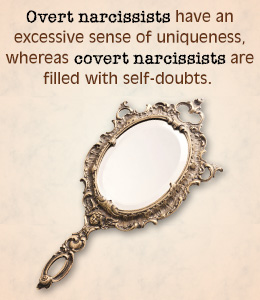
Overt/classic/grandiose narcissism (the type that best fits the criteria in the current DSM) develops most often in golden children who were held on a pedestal and could do no wrong, or were terribly spoiled, or it can develop in child who served as the parent’s flying monkey. It can also develop in a scapegoat who wants to prove their narcissistic parents wrong. Overt narcissists are usually extroverts who are good at playing the role of a confident, aggressive leader and many of them become financially and professionally successful. They are good at maintaining their mask for as long as they need to.

Covert/vulnerable narcissism usually develops in a scapegoated child who cloaks their grandiosity in an outer cloak of deference and humility, usually as a way to avoid punishment for acting too arrogant or aggressive while growing up. It can also develop in a child who is sometimes a scapegoat and sometimes a golden child. In a way, they are worse off than an overt narcissist, because they have a double layer of masks (false selves): the grandiose mask that hides the undeveloped, atrophied true self within, and a meek, shy and deferent outer mask that cloaks their grandiosity and sense of entitlement. That’s why a covert narcissist can be easily pushed around or bullied by others, but underneath their seemingly nice, quiet image there is seething envy and anger that isn’t expressed unless they are pushed to the limit and explode in rage. Their rage and envy is also likely to come out in passive-aggressive ways. Yet a covert narcissist is easier to cure because (a) they are far more likely to want help; and (b) their lives are miserable and their brand of narcissism isn’t adaptive in today’s world.

BPD is more common in women and some female covert narcissists may actually be diagnosed with BPD, because the disorders can seem so much alike and women aren’t diagnosed with NPD as often as men are. BPD probably develops most often when there is ambiguous attachment to the mother during early childhood and the child is inconsistently rewarded and punished. They learn early that people and life are unpredictable and no one can be trusted. They fear abandonment because they were never able to tell if their parent would love them or push them away. BPD also is correlated with early sexual abuse.

Fleas of narcissism are deadly because with prolonged exposure, they can cause permanent infestation. If it’s at all possible, cut off any narcissist in your life or avoid them as much as possible. Watch for red flags so you can escape before it’s too late because escaping once they “have” you is far more difficult and can be dangerous.

If you were raised by narcissists, no matter how damaged you are, if you didn’t become a narcissist yourself, consider yourself extremely lucky. There is hope for you to eventually be able to live a normal, happy life. If you’re a non-malignant narcissist, there may still be hope but the road to becoming a normal and happy person is going to be longer and harder.

Comparing covert narcissism and BPD

covert_narcissism2

I read an excellent article (thank to Natasha!) last night about covert narcissism, which is not currently recognized by the DSM, although it’s been considered as a provisional diagnosis.

Covert (vulnerable) narcissists are essentially low-functioning narcissists who present a shy, avoidant, humble, or caring image but they also constantly struggle with feelings of inferiority, emptiness, and self hatred. Like overt narcissists, they are hypersensitive to criticism but don’t hide it as well. They can become quite parasitic, relying on the support of others, either financially, emotionally or otherwise–but never giving back, even if they try to make a show of how “giving” they are. From what I’ve read in this article, it seems that the symptoms of covert narcissism, a subtype of NPD, are remarkably similar to those of BPD, with a few glaring differences:

— The covert narcissist suffers from more pathological envy than a person with BPD. The envy stems from a hidden sense of entitlement or superiority to others that belies their false humility and actual low self esteem. BPD is not characterized by a sense of entitlement. In a way they are wearing a double mask or have two false selves: the grandiose false self (that cloaks the emptiness they really feel) which is cloaked by false humility and shame. A covert narcissist may constantly be apologizing, but they don’t really mean it.

— A covert narcissist is more likely than a borderline to seek out friends who they perceive as “beneath” them so they can feel superior in comparison. This also stands out from an overt narcissist, who will seek out anyone who can provide them with supply (and likes to be associated with those they look up to). Covert narcissists avoid people they perceive as superior or having more than they do, which is most people.

— The covert narcissist has Avoidant (or introverted) features not associated with the DSM-recognized symptoms of BPD (although it’s possible for a borderline to be introverted and socially phobic, or for Avoidant PD and BPD to be comorbid with each other, as they are for me). Covert narcissists are more socially awkward than borderlines and can seem very similar on the surface to someone with Aspergers or Social Phobia. But behind the avoidant or socially awkward traits is a fear of being discovered and a hidden feeling of superiority to other people, unlike someone with Aspergers who simply finds relating to people exhausting or uncomfortable or a person with Social Phobia, who finds relating to others terrifying.

— They have no empathy. Any “empathy” they show is false, intended to get supply by bolstering their image as a “nice” person. Borderlines usually have at least a rudimentary ability to experience empathy.

— Like a classic narcissist, a covert narcissist lives in fear of their own emptiness being exposed, while someone with BPD lives in fear of being abandoned.

— Borderlines are more likely to be suicidal or self-harm than a covert narcissist, who may do self destructive things or threaten suicide for attention (supply) but will rarely make a serious attempt.

— Borderlines are more impulsive.

http://www.researchgate.net/publication/275665641_Narcissistic_Personality_Disorder_Diagnostic_and_Clinical_Challenges

This is also a very good article comparing covert NPD with overt (classic, grandiose) NPD: http://narcissisticbehavior.net/revealing-the-two-faces-of-narcissism-overt-and-covert-narcissism/

Some people believe covert narcissists are actually more malignant than classic narcissists, because their agenda is so hidden (covert) and they can seem like such nice, humble people. Although they are harder to detect, I think they really want people to see them as “nice” even though their motives are entirely selfish. I think the reason some narcissists become covert is because early in childhood they learned that acting grandiose or entitled was too dangerous (they were likely to be punished for it) so they cloaked their grandiosity behind false humility and shame. This is why they often feel victimized by everyone but at the same time feel entitled to be treated as if they are special and separate themselves from others, who they see as morally inferior (but actually feel inferior to–yes, it’s very confusing!) At the same time, a covert narcissist is more likely to seek therapy than a classic narcissist because their lives are so unsatisfying and limited–and for the same reason also more likely to be cured if they commit themselves to getting better. In this way they don’t differ too much from people with BPD.

A person with NPD can also switch back and forth between the covert and overt subtypes. When things are going well and supply is abundant, a covert narcissist may become grandiose and aggressive, and a normally grandiose narcissist can become much more covert when their supply is running low or has been removed.