A new study found that people with BPD may have lowered or limited empathy, and that it may be biochemical. I sometimes think I’m a bit empathy challenged, though not in a general sense. For example, I feel just awful when I see or read about someone’s suffering (especially if it’s an animal or a child) but it’s hard to me to empathize on an interpersonal, emotional level with another person (which could be due to my introversion and social awkwardness, and also my complex PTSD). I do have cognitive empathy (KNOWING how another feels), even if its sometimes hard for me to feel WITH someone else. This is something I want to change and am working on in therapy.
I’ve known other Borderlines who seem to almost have too much empathy, and are very profoundly affected by the moods of those around them. The problem for BPDs, whether they have too much or too little empathy, is that we get so caught up in our own problems we can seem to be oblivious to what others are feeling. Usually when we’re called out on our selfishness though, we feel pretty badly about it and try to make up for it.
I think a lot more research needs to be done on this matter before any blanket judgments are made. Unlike people with NPD or Antisocial Personality Disorder, I don’t think lack of empathy is a defining characteristic for Borderlines.
I’ve posted before about my SAD (seasonal affective disorder). I also explained that for me, a sufferer of the Fall/Winter type (the most common type), I’m extremely sensitive to changes in daylight.
The Winter Solstice falls around December 21 or 22 every year. That’s the shortest day of the year, but also the last day the days are going to get any shorter. The next day, the sunlight-hours increase every day by increments of about a minute a day, as they march toward the Summer Solstice which falls from June 20 – June 22 every year.
I always noticed a darkening of my overall mood and loss of energy very shortly after the first day of summer, since the days are already becoming shorter even as they grow hotter. My body perceives these changes as early as mid-July!
There’s probably an evolutionary reason for this. Our distant ancestors were nocturnal, tree climbing, shrew like animals who may have needed to hibernate during colder weather to conserve energy and calories, while food was scarce. Many mammals today have a need to hibernate, and this tendency may have been retained in human genes to some extent, causing many of us to feel tired and depressed when they days begin to shorten. How nice if hibernation were an option for some of us humans!
Getting back to the topic at hand, my mood is already starting to improve, even though the first day of winter was only about 3 weeks ago (that long already???)
That’s early even for me. My body and spirits don’t usually start reacting to these increases until the end of January at the earliest.
But maybe my improving mood is due to more than just the lengthening days. Since I’ve been in therapy, I’ve been feeling a little bit happier and less anxious overall. For example, I have a serious car issue, but I’m actually not freaking out the way I would have a year or two ago. I’ve also noticed people are responding to me in a more positive way (or maybe nothing has really changed but I’m just perceiving they are perceiving me less negatively than before).
My creativity is increasing, and my motivation to write, and–I dearly hope I don’t sound narcissistic saying this–I think my writing lately has improved immensely and I’m beginning to find my humorous voice too and seeing how funny things can be I never would have found the humor in before.
I still have a long road ahead (my therapist thinks it’s going to take a while) and maybe this is just the honeymoon stage of therapy before the work starts getting really emotionally draining, but it’s a taste of what might be to come and I’ll enjoy this as long as it lasts.
I recently saw this little gem on another website.
If you feel upset, worried, and guilty that you don’t care about others enough, then you don’t lack empathy. That right there shows you you have a conscience. Also guilt is a sign of empathy. If there’s guilt, there’s empathy. There can be no guilt without empathy. No empathy, no guilt because they are part of each other.
I’d like to take issue with this paragraph. The author is stating that feeling guilty or having a conscience means you have empathy. I beg to differ.
Empathy is the ability to feel an emotion with another, to be able to “put yourself in another person’s shoes.” It has nothing to do, really, with having a sense of right and wrong, which is what both guilt and conscience are based on. It’s entirely possible to be a self-righteous, stiff-necked prick and not have an ounce of caring for the way others feel. Think of that teacher you hated. Chances are, that teacher had a very strong conscience and a clear idea of what was right and wrong (and held themselves to the same tough standards they expected you to meet), but thought nothing of making you feel like a wad of old gum on her sensible orthopedic shoes when you violated their lofty standards. It’s also possible to feel guilty over things that aren’t even your fault but be completely oblivious to the feelings of others. Think of the worst covert narcissist you know. Chances are, that person is constantly saying “I’m sorry” and flagellating themselves until they draw blood, but their over the top guilt stems from a need to prove they’re really a good person, not because they really care that they just put your feelings through a cheese-shredder. They aren’t going to feel your pain with you–they just want to redeem themselves and have you forgive them.
Empathy and conscience do often go together though–they’re like the peanut butter and chocolate of the world of emotions–and I don’t think it’s possible to be a high empathy person and at the same time have no conscience or the inability to feel guilt or shame. But to assume that a strong conscience or the ability to feel guilt automatically indicates high empathy just makes an ass of u and me. All having a strong conscience or sense of guilt means is you’re not a sociopath.
Many experts, including Sam Vaknin, think spoiling a child or pouring on excess praise (placing them on a pedestal) is actually a form of child abuse, because it does not mirror the child as who they really are, but as who the parents wish them to be or believe them to be. Children not mirrored appropriately, whether excessively criticized or excessively praised, grow up unable to form a viable true self and are vulnerable to developing disorders of the self, especially NPD.
The following article explains in further detail why excessively praising a child can actually hurt their self esteem, rather than help it develop normally. It also describes the two types of praise–one that builds self esteem because it takes a child’s effort into account (“you worked hard to win that contest” or “you showed a lot of dedication in getting those A’s”) and one that fosters narcissism because it implies inherent superiority over others (“you’re the prettiest girl in school” or “you’re the smartest kid ever”).
When a kid does something amazing, you want to tell her so. You might tell her that she’s very smart. You might tell her that she’s a very special kid. Or you might say that she must have worked really hard.
On the surface, they all sound like the same compliments. But according to Brad Bushman, a communications and psychology professor at Ohio State University, the first two increase the child’s chances of becoming a narcissist. Only the last one raises the child’s self-esteem and keeps her ego in check.
Bushman and a group of collaborators surveyed parents to see how they show warmth and value their child’s accomplishments. They then compared those findings to the children’s levels of self-esteem and narcissism. The results were published Monday in the Proceedings of the National Academy of Sciences.
Of course, self-esteem and narcissism are two very different things. The difference has to do with how you value yourself compared to other people. “Self-esteem basically means you’re a person of worth equal with other people,” Bushman tells Shots. “Narcissism means you think you’re better than other people.”
And not in a good way.
“Narcissism is a somewhat toxic personality trait,” Jean Twenge, author of The Narcissism Epidemic and psychology professor at San Diego State University, tells Shots. Narcissists tend to overestimate their abilities, take too many risks and mess up their relationships, she says. Some people see narcissists hurting the people and society around them, but they hurt themselves, too. “In the long term it tends to lead to failure,” Twenge says.
While narcissists tend to have high self-esteem [my note–this is not true], not all people with high self-esteem are narcissists. Bushman needed to separate the two. So he asked children ages 7 to 12 years old how they felt about statements like “Some kids like the kind of person they are,” or “Kids like me deserve something extra.” The first statement measures self-esteem; the second, narcissism.
Bushman made sure to focus on children between 7 and 12 years old, so that by the time the study finished all of them would be older than 8. “You can’t measure narcissism in children before age 8, because every child is a narcissist,” he says. If you ask younger kids in a classroom if they are good at math or good at baseball, Bushman says all the kids will raise their hands.
Then he surveyed the children’s parents, asking them to respond to statements to determine whether they overvalued their children. For example, “I would not be surprised to learn that my child has extraordinary talents and abilities,” or “Without my child, his/her class would be much less fun.” And he asked how they expressed warmth toward their child by measuring how strongly they agreed with statements like “I let my child know I love him/her.”
When he analyzed the results from the surveys, Bushman found that the more narcissistic children had parents who consistently overvalued their accomplishments. He ran additional tests to make sure that the parents weren’t narcissists, too — after all, it’s possible that the children could be mirroring narcissistic behavior. But statistically, the children of narcissists aren’t more likely to be narcissists themselves.
The research team continued to survey the same group of 565 children and their parents for a year and a half. They watched the children develop, and they could link each child’s tendency toward self-esteem or narcissism back to what the parents had told them six months earlier.
“We’re not just measuring their narcissism at time one; we’re using these measures to predict the behavior a year and a half later,” says Bushman. “Parental warmth doesn’t predict it. Parental narcissism alone doesn’t predict it. But parental overvaluation alone does predict it.”
Bushman is particularly worried about narcissism because both he and other researchers have linked it to aggressive and violent behavior. He thinks it’s partly because narcissists are less likely to feel empathy toward others.
“Empathy involves putting yourselves in other people’s shoes, but narcissists have a very difficult time putting themselves in other people’s shoes,” Bushman says. Plus, he says that narcissists respond poorly when they don’t get special treatment. “Whenever people have this sense of superiority, then they lash out at others in an aggressive way.”
Of course, someone who appears more narcissistic at age 10 isn’t necessarily going to grow up to be a narcissistic adult, let alone aggressive. And the results of this study hinge on a handful of short surveys — no extensive personality testing here.
“There are definitely going to be things that influence the personality after that stage,” says Twenge. “Those [narcissistic] tendencies may start to show up around then, but will continue to be influenced by parenting and environment throughout adolescence.”
But this study has Bushman thinking about the way he praises his own children. “It’s a lot better to say ‘You worked really hard’ than ‘You must be really smart,’ ” he says, “because if you tell the kid that they’re smart and then if they fail they think ‘Oh I’m stupid.’ ” If the praise relates to effort, a child who fails will work harder next time.
Bushman is also trying to cultivate self-esteem in his children, because people with high self-esteem tend to have lower levels of anxiety and depression over time. Based on Bushman’s research, parents can raise their children’s self-esteem just by expressing more warmth.
Both researchers agree that voicing the connection you feel to your children really helps. “If you want to look for a substitute for ‘You’re special,’ just say ‘I love you,’ ” says Twenge. “It’s what you mean, and it’s a much better message.”
Have a child age 8 to 12? Find your own “Parental Overvaluation” score here.
Covert (vulnerable or fragile) narcissism (cNPD) can, on the surface, look an awful lot like Avoidant Personality Disorder (AvPD–not to be confuse with AsPD!), which I have been diagnosed with, along with BPD.
But appearances are only skin deep.
I found an article on Psychforums (in the Avoidant PD forum) that describes the differences very well. Because covert/vulnerable narcissism is not an officially recognized diagnosis, and is not included in the DSM (yet), covert narcissists are frequently (if not almost always) diagnosed BPD comorbid with AvPD, as I am. Aspergers can also be easily confused with cNPD, and has been by many. But this article focuses on Avoidant PD, not Aspergers.
“Vulnerable narcissism could be misdiagnosed with at least two other distinct DSM personality disorders: Avoidant Personality Disorder (AVPD) and Borderline Personality Disorder (BPD). In the diagnosis of AVPD, there are several criteria that may overlap with vulnerable narcissism. First, avoidant individuals are observed as appearing shy and being fearful of developing close relationships with others. Second, individuals with AVPD may meet criteria for experiencing fears of feeling humiliated, rejected, or embarrassed within individual relationships. Finally, Millon (1996) proposes that the use of fantasy in individuals with AVPD is a major element in the presentation and perpetuation of this disorder. This is striking in the fact that the use of fantasy has long been denoted as primary to the realm of narcissistic pathology.The vulnerable narcissist will likely exhibit significant interpersonal anxiety, avoidance of relationships, and use of fantasy, but this is guided by a core of entitled expectations. That is, vulnerable narcissists may avoid relationships in order to protect themselves from the disappointment and shame over unmet expectations of others, in contrast to fears of social rejection or making a negative social impact typical of AVPD.
Another false positive diagnosis that may occur as a result of misinterpreting vulnerable narcissismis in the diagnosis of BPD. Masterson (1993) forwarded this issue in an elaborate discussion about the potential for misdiagnosis of the closet narcissistic personalitywith BPD. Misdiagnosis can occur because of a clinician’s attention to the overt presentation of the emotional lability in the individual to the exclusion of an understanding of the cognitive and socio-emotional experience that guides the lability. As with social avoidance, the emotional lability of the vulnerable narcissist is influenced by his or her covert entitlement and difficulties managing disappointment and self-esteem threat. In contrast, the emotionally lability of the individual with BPD is a byproduct of unrealistic anaclitic needs (e.g., the need for a strong caretaker to manage his or her fears of being independent).
Both the AVPD and the vulnerable narcissistic character will likely report difficulties with feeling self-conscious in interpersonal situations, along with the tendency to avoid situations in which they expect to be ridiculed. The difference between AVPD and vulnerable narcissistic characters lies in their expectations for themselves and others. Individuals with AVPD have needs to be liked and accepted by others, but fear they will fail to be acceptable to others. In contrast, vulnerable narcissistic characters need others to respond favorably to them and to admire them regardless of their behaviors, beliefs, skills, or social status, but fear that others will fail to provide them with narcissistic supplies. For vulnerable narcissistic characters, it is not mere concern about being liked or not. Rather, the vulnerable narcissist’s fear is that he or she will not be admired. Furthermore, vulnerable narcissistic individuals experience significant injury and anger in response to perceived slights. Their avoidance of relationships is based upon their fear of not being able to tolerate the disappointment of their unrealistic expectations.
The assessment of entitled expectations and exploitative motivations are important variables that would guide how an individual approaches and experiences relationships, including a therapeutic relationship. Not acknowledging narcissistic entitlement when it is present could lead to important misinterpretations of clients’ experiences that either reinforce their sense of entitlement or lead to unrecognized self-esteem threat in the therapeutic relationship (Gabbard, 1998).”
From “Interpersonal analysis of grandiose and vulnerable narcissism” Dickinson, Kelly A; Pincus, Aaron L
Informative video about the Cluster B disorders that discusses what they have in common and what causes someone to develop them. BPD has been unfairly stigmatized because of its similarity in some ways to the other disorders in this cluster, but few people recognize that borderlines don’t lack empathy or a conscience the way people with NPD and ASPD do, even though they can be difficult to deal with and even abusive when they are triggered.
Last weekend I went to see the Pixar animated movie, “Inside Out,” and reviewed it in this article. In researching the article about positive thinking I just posted before this one, I saw an interesting New York Times article describing the science behind the five emotions in the movie, especially the important role that Sadness played in 11 year old Riley’s mind. The article states that our emotions, when working together in harmony, fuel rational thinking, rather than interfering with it. I think I agree. Rational thinking isn’t the absence of emotion. It’s when one or more of the emotions is sleeping on the job or overpowering the others that we become irrational.
FIVE years ago, the writer and director Pete Docter of Pixar reached out to us to talk over an idea for a film, one that would portray how emotions work inside a person’s head and at the same time shape a person’s outer life with other people. He wanted to do this all in the mind of an 11-year-old girl as she navigated a few difficult days in her life.
As scientists who have studied emotion for decades, we were delighted to be asked. We ended up serving as scientific consultants for the movie, “Inside Out,” which was recently released.
Our conversations with Mr. Docter and his team were generally about the science related to questions at the heart of the film: How do emotions govern the stream of consciousness? How do emotions color our memories of the past? What is the emotional life of an 11-year-old girl like? (Studies find that the experience of positive emotions begins to drop precipitously in frequency and intensity at that age.)
“Inside Out” is about how five emotions — personified as the characters Anger, Disgust, Fear, Sadness and Joy — grapple for control of the mind of an 11-year-old girl named Riley during the tumult of a move from Minnesota to San Francisco. (One of us suggested that the film include the full array of emotions now studied in science, but Mr. Docter rejected this idea for the simple reason that the story could handle only five or six characters.)
Riley’s personality is principally defined by Joy, and this is fitting with what we know scientifically. Studies find that our identities are defined by specific emotions, which shape how we perceive the world, how we express ourselves and the responses we evoke in others.
But the real star of the film is Sadness, for “Inside Out” is a film about loss and what people gain when guided by feelings of sadness. Riley loses friends and her home in her move from Minnesota. Even more poignantly, she has entered the preteen years, which entails a loss of childhood.
We do have some quibbles with the portrayal of sadness in “Inside Out.” Sadness is seen as a drag, a sluggish character that Joy literally has to drag around through Riley’s mind. In fact, studies find that sadness is associated with elevated physiological arousal, activating the body to respond to loss. And in the film, Sadness is frumpy and off-putting. More often in real life, one person’s sadness pulls other people in to comfort and help.
Those quibbles aside, however, the movie’s portrayal of sadness successfully dramatizes two central insights from the science of emotion.
First, emotions organize — rather than disrupt — rational thinking. Traditionally, in the history of Western thought, the prevailing view has been that emotions are enemies of rationality and disruptive of cooperative social relations.
But the truth is that emotions guide our perceptions of the world, our memories of the past and even our moral judgments of right and wrong, most typically in ways that enable effective responses to the current situation. For example, studies find that when we are angry we are acutely attuned to what is unfair, which helps animate actions that remedy injustice.
We see this in “Inside Out.” Sadness gradually takes control of Riley’s thought processes about the changes she is going through. This is most evident when Sadness adds blue hues to the images of Riley’s memories of her life in Minnesota. Scientific studies find that our current emotions shape what we remember of the past. This is a vital function of Sadness in the film: It guides Riley to recognize the changes she is going through and what she has lost, which sets the stage for her to develop new facets of her identity.
Second, emotions organize — rather than disrupt — our social lives. Studies have found, for example, that emotions structure (not just color) such disparate social interactions as attachment between parents and children, sibling conflicts, flirtations between young courters and negotiations between rivals.
Other studies find that it is anger (more so than a sense of political identity) that moves social collectives to protest and remedy injustice. Research that one of us has conducted has found that expressions of embarrassment trigger others to forgive when we’ve acted in ways that momentarily violate social norms.
This insight, too, is dramatized in the movie. You might be inclined to think of sadness as a state defined by inaction and passivity — the absence of any purposeful action. But in “Inside Out,” as in real life, sadness prompts people to unite in response to loss. We see this first in an angry outburst at the dinner table that causes Riley to storm upstairs to lie alone in a dark room, leaving her dad to wonder what to do.
And toward the end of the film, it is Sadness that leads Riley to reunite with her parents, involving forms of touch and emotional sounds called “vocal bursts” — which one of us has studied in the lab — that convey the profound delights of reunion.
“Inside Out” offers a new approach to sadness. Its central insight: Embrace sadness, let it unfold, engage patiently with a preteen’s emotional struggles. Sadness will clarify what has been lost (childhood) and move the family toward what is to be gained: the foundations of new identities, for children and parents alike.
Yesterday I decided to take myself to the movies for a change, and chose to see “Inside Out,” the Disney Pixar animated summer fantasy blockbuster.
Seeing “Inside Out” was a serendipitous choice, because I just happened to have enough money to afford a ticket (which is a rarity for me), and also because, although I didn’t know it right away, this movie has a beautiful message about the way Sadness and Joy, though seemingly polar opposites, when working together make human connection and unconditional love possible. Just as the light can’t exist without darkness, or good without evil, joy cannot exist without sadness. When working in sync with each other, these two emotions create a beautiful life affirming thing called Empathy, and that’s what connects us to each other and keeps the human race from becoming extinct.
Official Trailer
Sneak Preview–Teaser Clips
Riley Andersen is a young girl of 11 who becomes severely depressed after her parents’ decision to move from Minnesota to San Francisco. The movie begins at the moment of Riley’s birth in Minnesota, shown from Riley’s point of view. Her first Emotions (depicted as loveable anthropomorphized characters) are Joy (feeling secure in her parent’s love) and Sadness (when she needs something or feels ignored or in pain). As Riley grows into early toddlerhood, sometimes her needs and desires are thwarted and Anger takes over and she throws a tantrum. Around the same time she is also capable of feeling Fear or Disgust (both necessary for her survival), and it’s at those times those characters become dominant in Riley’s growing mind.
When the five Emotions work together in harmony, not overstepping each other’s boundaries and only doing the jobs assigned to them, this teamwork manifests in Riley as a well-adjusted little girl able to feel all her emotions at the appropriate times.
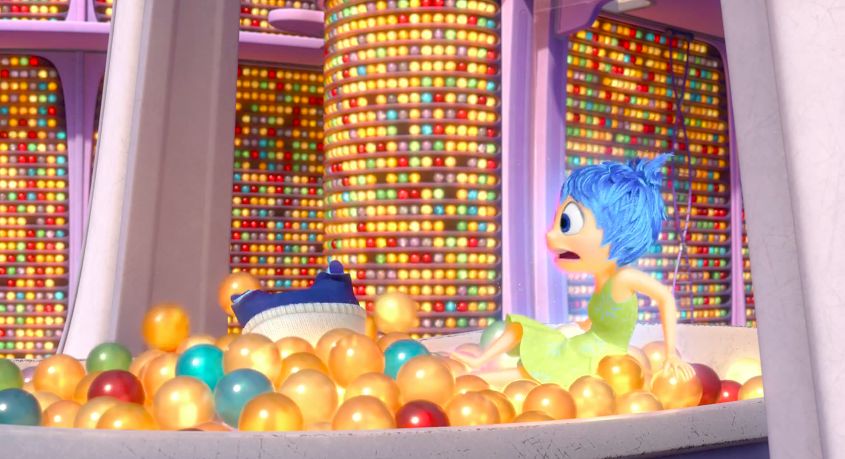
The five Emotions work in Headquarters, which is the conscious part of Riley’s young mind. Joy is responsible for making sure Riley’s short term memories are sent to Long Term Memory deep in Riley’s subconscious. Her memories are depicted as glowing colored orbs containing a ghostly image of the actual memory. The color of the orbs represent the dominant Emotion Riley felt at the time of the event. Transporting Short Term memories into Long Term Memory happens during Dream Production as Riley sleeps, and sometimes the other Emotions are needed to help Joy do her job getting the memories there (and sometimes discarding certain irrelevant or painful ones.) Occasionally the other Emotions (as well as Riley’s imaginary childhood friend, Bing Bong, who is a jokester) like to play little jokes–and certain irrelevant memories like an annoying gum commercial jingle are sent to Long Term Memory along with the important memories, which causes Riley to occasionally hear the gum jingle in her head at random times years later.
At the center of Headquarters is the vault which contains Riley’s Core Memories–important but happy long term memories that are responsible for Riley’s happy go lucky personality. The orbs that represent these are colored gold (Joy’s color) and for Riley’s continued mental health, these core memories must not be contaminated by the other Emotions, which is why they are kept locked in a vault. Each of the Core Memories has a long glowing tube that leads to one of Riley’s Five Islands of Personality: Family, Goofiness, Hockey (which she loves to play), Friendship, and Honesty. Maintaining these islands is necessary for Riley’s continued normal psychological development.
The crisis in Riley’s mind is set off when her family moves from her beloved Minnesota to San Francisco. Moving away is always a traumatic event for even the most loved child. Feeling isolated from her old friends and lonely in a place she doesn’t know, Riley’s Emotions begin to make mistakes and not work in sync. Joy and the other Emotions have never been sure of Sadness’s purpose because she just seems to be a Debbie Downer who is always in the way and always making mistakes. It’s Joy’s job to keep Riley’s happiness intact, but one day shortly after the traumatic move, Sadness goes around touching Riley’s happy memories, turning them blue (sad). Joy frantically tries to undo the damage but the memories already touched cannot be repaired. Desperate, Joy tries to isolate Sadness to prevent her from doing any more damage.
On Riley’s first day at her new school, Sadness takes over and Riley begins to cry in class, which creates a new but painful core memory. Joy frantically tries to keep this new core memory from reaching the central vault, but in her struggle with Sadness, who seems to keep contaminating more memories, she accidentally knocks out some of Riley’s untouched happy core memories, which fall off into the abyss. These memories are almost impossible to retrieve once lost to Riley’s Unconscious. Worse yet, both Joy and Sadness are sucked through the Long Term Memory Tube themselves, and are both lost deep in Riley’s vast and labyrinthine Unconscious.
During Joy and Sadness’s absence, Anger, Fear and Disgust attempt to run Headquarters in their place and make a holy mess of things. They attempt to provide “joy” but of course it’s faked now, rather than genuine. Sadness too is absent, so Riley can no longer longer cry or even feel grief over her loss. Anger, Fear and Disgust manifest in Riley’s new insolent and angry attitude toward her parents and loss of interest in the things she used to love. With the core memories now missing or contaminated, one by one the Five Islands of Personality crumble and fall into the abyss of the Memory Dump, a place deep in Riley’s mind where old memories are forgotten. The first Island to crumble into oblivion is Goofiness (Riley’s sense of humor), followed by Hockey (which she quits), and then Friendship (she no longer has any desire to make new friends).
Joy and Sadness find themselves adrift after falling through the Long Term Memory tube deep into Riley’s unconscious mind.
Desperate, Anger decides to insert in Riley’s mind the idea to run back to Minnesota. He plugs this into the Control Console, in the belief this can produce new happy memories. This requires Riley to steal money from her mother’s purse in order to fund her trip back to Minnesota, and then she lies about the theft. As a result, the second to last Island left, Honesty, falls away in ruins into the Memory Dump.
Back in the abyss of Riley’s deep Unconscious, Joy and Sadness run into Bing Bong, Riley’s long forgotten childhood imaginary friend. Bing Bong wants to reconnect with Riley, so he tells Joy and Sadness they can all get back to Headquarters by riding the Train of Thought. After a series of failed attempts, they eventually catch the train, but it becomes derailed when the last personality island, Family, falls into the Dump.
At this point, giving any more away would be spoiling the plot, but gradually Joy and Sadness, who have always been at odds with each other, realize that in order for Riley to return to her normal happy state of mind, they must work together as a team and Sadness has the biggest job of all. Riley must be able to experience–and receive–empathy and love (which comprise both joy and sadness) to heal from her near-catatonic depression.
As a blogger about narcissism and personality disorders, I see Riley at this point in grave danger of suicide or developing a personality disorder, even NPD or BPD. Her trauma-induced depression has caused her to become apathetic and unable to feel anything at all. What happens next is so magical and touched me so deeply I sat there in the darkened theater with tears running unchecked down my face and my nose running. I wasn’t alone–I heard sniffles and nose blowing all over the theater, and there’s a safety and sense of connection with total strangers that comes from that, and that’s why going to see a good movie never gets old. There’s something wonderfully liberating about being able to cry in a public place yet unseen by others and unjudged for it because everyone else is crying too. I think that’s why “heartstring tugging” movies are so popular. But the emotions elicited in “Inside Out” feel real–there’s no sappiness or fake sentimentality in this film that make you feel manipulated by the producers.
The five Islands of Personality.
But for all its poignancy, “Inside Out” has plenty of humor too, and all the jokes are clever and well timed. At times during the movie I was both laughing and crying at the same time. The Five Emotions are all funny characters with their own unique charm. Even Anger is loveable and hilarious in his own irascible way, and the Tinker-Bell like Joy, who could have been incredibly annoying for all her upbeat perkiness, has a depth you don’t expect and over time you realize she is the only Emotion who can feel all the other Emotions. I pictured Joy and Sadness as really being the same person–the two sides of Riley’s True Self–and when they were lost in Riley’s memory dump, Riley’s behavior became quite narcissistic. It wasn’t lost on me that both Joy’s hair color and her “aura” are colored blue–Sadness’ color.
Pete Doctor, the film’s director and screenwriter, was inspired to develop “Inside Out” while trying to come to terms with his own daughter’s psychological changes and mood swings as she approached adolescence. To give the complex psychological concepts presented credibility, well-known developmental psychologists were consulted during pre-production. It’s obvious that a deep knowledge of the way the human mind works fueled both the story and the landscape of Riley’s mind. Kids will adore “Inside Out” because of its lovable characters, fantastic animation, humor, its engaging story about a regular girl, and impressive special effects. In the theater I saw it in, there were plenty of children there, and all of them were rapt in the story.
But adults will love it just as much because of the movie’s deep message of Empathy being born from pain and loss, and the necessity of “negative” emotions to exist in a healthy person’s psyche, working in tandem with “positive” ones. Understanding the movie at this level requires an ability to think in an abstract way about the mechanisms behind personality development and psychological disorders. “Inside Out” is a rare movie that celebrates the human ability to feel, and to love, cry, connect, and laugh. It tells kids that all their emotions are okay, and experiencing them is normal and just part of growing up.
Parents, if you have children ages 4 to early teens, please take them to see “Inside Out.” Both you and they will leave the theater feeling great, and the ideas presented in the story can open up honest discussion about emotions between parents and their children. I’d even go so far as to suggest teachers show this movie to their students, and engage them in discussion afterwards.
I find it encouraging and heartening that such an honest and touching movie with a positive message about genuine emotions and empathy has become the hit of the summer, instead of the usual mindless dreck that passes for summer blockbusters.
“Inside Out” is rated PG. I would not recommend it for children age 3 and younger, due to several quite scary moments that could give a young child nightmares.
Riley with her concerned parents at the dinner table.
“Inside Out” is a 2015 American 3D computer-animated comedy-drama film produced by Pixar Animation Studios and released by Walt Disney Pictures. Directed and co-written by Pete Docter, the film is set in the mind of a young girl, Riley Andersen (Kaitlyn Dias), where five personified emotions—Joy (Amy Poehler), Anger (Lewis Black), Disgust (Mindy Kaling), Fear (Bill Hader), and Sadness (Phyllis Smith)—try to lead her through life as she moves with her parents (Diane Lane and Kyle MacLachlan) to a new city. The film was co-directed and co-written by Ronnie del Carmen and produced by Jonas Rivera, with music composed by Michael Giacchino.
Docter first began developing Inside Out in 2009 after noticing changes in his daughter’s personality as she grew older. The film’s producers consulted numerous psychologists, including Dacher Keltner[6] from the University of California, Berkeley, who helped revise the story emphasizing the neuropsychological findings that human emotions are mirrored in interpersonal relationships and can be significantly moderated by them.
After premiering at the 68th Cannes Film Festival in May, Inside Out was released on June 19, 2015. It received universal critical acclaim, with many film critics praising the voice performances (particularly for Poehler, Smith, and Richard Kind), its concept and poignant subject matter. The film grossed $90.4 million in its first weekend—the highest opening for an original title, besting Avatar ’s previous record.
Much like earworms are snippets of a song that refuses to vacate your auditory processing center, mindworms are remnants of thoughts that stubbornly replay through your brain. It’s not only annoying; it’s maladaptive. The stuttering brain becomes stuck on a particular thought and is unable to move on to the next or be receptive to new ideas.
Mindworms are tenacious little buggers. They like to hide when you focus on them too intently only to start their slithering once you allow yourself to relax. They may go quiet for hours or even days at a time, prompting a false sense of security, before making themselves heard once again.
Although not fatal, mindworms are parasites that remove some of our lifeforce. If allowed to wander for too long, they hold their host back from optimal health and wellness.
There are no quick fixes for the removal of mindworms. The development of…
I first heard about Sam Vaknin’s book “Malignant Self-Love” about 15 years ago–when I made a cursory online search about NPD after I realized my own mother was one. At that time, Vaknin was pretty much the only voice on the Internet about narcissistic abuse. Vaknin, a self-confessed narcissistic psychopath , had written a “bible of narcissism” and it became obvious, from scanning the selected pages he provided in PDF format on his website (which has never been upgraded to a more current look and format–he uses the ancient blogging site, Tripod), that this guy was obsessed with his own disorder to the point of unhealthy navel-gazing and what’s more, he and seemed to hate people like himself. What was this, some kind of pathology performance art?
His book and his own story that inspired the book intrigued me, but at the time, I was still trapped (or thought I was trapped) in my abusive marriage and my kids were still very young, so I filed this information away in the back of my brain, and quickly moved onto other things, such as trying to keep my doomed marriage together. In fact, I didn’t think about his book again until late last year, after I left my narcissist.
When I started my blog in September 2014, Vaknin still had a huge presence online (though he no longer had a monopoly on narcissism). He was often quoted on ACON blogs and even in more serious articles in publications like Psychology Today. The difference was, by now, he was no longer alone. There were other voices joining his–Kim Saeed, Michelle Mallon, and Kathy Krajco (who is with us no more) just to name a few, and of course psychologists and other authors like Dr. George K. Simon, Robert Hare, and Marsha Stout. And too many ACON (Adult Children of Narcissists) bloggers to count. By this time, Narcissism was a Very Hot Topic, at least on the Intenet. Sam Vaknin probably began that trend, in spite of his being so vilified by so many of the narcissism bloggers he paved the way for.
A self-professed malignant narcissist writing self help books for victims of abuse may seem like the ultimate irony–but when you look a little deeper, it makes a lot of sense. Who better than a narcissist to know what makes a narcissist tick? Every other expert who writes books about narcissism has to make educated — or not so educated — guesses.
If you’re not a narcissist, it’s almost impossible to imagine what such a disorder can feel like to its bearer, just as the pain of cancer can never be convincingly described by one who has never suffered from cancer. If a book were to be written about what it’s like to have cancer, the writer should be a cancer survivor–or one about to succumb. My point here being that Sam Vaknin, whether you like him or not, whether you think he’s doing ACONs a service or hurting them, whether he’s got the proper credentials or not (and personally I don’t care about the whole credential brouhaha because not once in the book does he say he’s a mental health professional and in fact it’s full of disclaimers), is definitely qualified to write about narcissism. His primary qualification–the only qualification that really matters–is that he is speaking from personal experience.
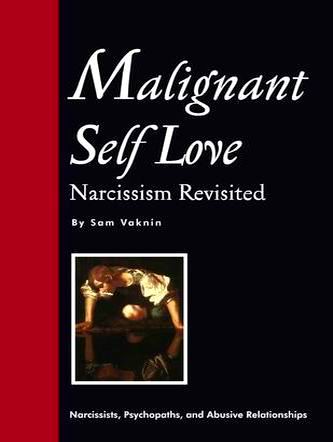
So I pulled out my debit card and ordered the huge black-and-red tome with its Caravaggio “Narcissus” illustration on the cover (which, for me, was a draw in itself, because I love the painting). It set me back about $40 on Amazon (you can get a copy signed by the author for about $54.95) I thought the price was a bit high, until I held the book in my hands. It was as big as the Bible! Maybe even bigger. I flipped through its onion-skin thin Bible-like pages and saw how tiny the print was.
Oh, man, I thought. I don’t think I can read this. But I was determined to. I wanted to understand what it felt like to be a narcissist, what it felt like to be inside Sam’s head. And so I began to read.
Malignant Self-Love is not a book you can read in one sitting–or even ten. Maybe not even twenty. Normally, I’m a very fast reader. Until I started blogging (and no longer had time to read much), I could consume about 3 good-sized books a week. People looked at me like I had three eyes and a horn growing out of my head when I’d tell them I finished a 300 page novel in 2 days. But Vaknin’s book is different. It’s not only got a LOT of information–almost more information about narcissism than you’d ever need or want to know–but it’s a dark and depressing read too, and I found that while reading it, I felt my mind being sucked into Vaknin’s bottomless black vortex of pain. He’s pessimistic, negative, and hates his own disorder. He also seems to hate himself for having NPD, and demonizes narcissists in general, referring to them as non-humans and machines. He demonizes himself in the process, and warns his readers to stay far away from people like himself. You would think from all this encouraging advice to the sort of people who would have been his prey, that he cares about the victims. I’m not so sure, since he himself is quoted as saying he never intended to help anyone by writing Malignant Self-Love, that his primary motive was narcissistic supply and attaining a guru-like status for himself.
Sam Vaknin, the psychopathic, emotionless predator.
Yet in spite of his heart never having been in its creation, Malignant Self-Love is an outstanding piece of writing, and English isn’t even Vaknin’s native language. He weaves words together into a beautiful piece of literature the way a holy man weaves tiny colored threads together to create a Persian rug–with an intricacy and detail that is rare in modern writing.
Indeed, Vaknin’s writing at times can seem as if it’s from a bygone century. His phrasing is old-fashioned and his writing is highly descriptive, hearkening back to 19th century authors. At times it reads almost like poetry. And it’s very emotional writing. You come away from the pages (which feels somewhat like coming up for air after having been underwater too long), with the strong sense that whenever Vaknin refers to the “Narcissist,” he is really speaking about himself in the third person. There is passion and pain in these pages, but more than anything else, there is rage. White hot rage. Sam Vaknin is…intense. And so is his book.
Although some mental health professionals and other who study NPD have criticized Vaknin for appearing to take several related personality disorders–Antisocial, NPD (the less malignant type described in the DSM-V), Borderline Personality Disorder, and even autism–and churn them together into a mutation of the psychiatric definition of NPD into a devastating form of psychopathic malignant narcissism. Some mental health experts have even said Vaknin’s book has been damaging to the field of diagnostic psychology because it blurs the lines between several distinct personality disorders.
But since when is the field of diagnostic psychology a real science anyway? At best, it’s a social science; at worst, an art form–so in my mind, Vaknin’s theories about NPD make as much–or more–sense than some of the experts.’
Vaknin was also not the first narcissism writer to ever do this. While M. Scott Peck’s 1983 book “People of the Lie” is written from a completely different perspective from Vaknin’s–one with religious overtones written by psychiatrist who is also a born-again Christian–Peck’s book too seems to mix traits of NPD and ASPD. And while Peck didn’t call the hybrid disorder “malignant narcissism” (he calls it “evil”) because that term wasn’t in wide use in 1983, people could relate–because we almost all know someone like that. Vaknin’s book also describes people that victims of narcissistic abuse recognize–a dangerous kind of narcissist who has nothing but ill will toward others, but it was born from having been abused themselves, as Vaknin was abused.
Vaknin’s readers are mostly women, who are in a relationship with a narcissist or thinking about leaving one. Sam Vaknin does not disappoint. Victimized, emotionally damaged women see Vaknin as a kind of online therapist (especially those who frequent his discussion groups and forums), and the “transference” of strong feelings of a patient to their therapist is an important development in the psychotherapeutic relationship. If they’re using the Internet as their therapist, Vaknin can easily become the object of these feelings of transference. He becomes a kind of mirror reflecting back to them all the admirable qualities they have imbued him with–-which may or may not be accurate-–but it’s what they want or need to see in him. The problem is, unlike with a therapist in a controlled psychotherapeutic setting, women experiencing transference toward a online cult hero like Vaknin have no idea what to do with these feelings or how to use them to learn more about themselves. But on the plus side, he does tell them how to disengage and tell them WHY they should disengage and what makes their narcissist tick, and of course he’s right. Many of these women (and men too) claim Vaknin’s book saved their lives and helped them get started along the road to self-discovery and freedom from abuse.
I think this picture shows a sad side Sam Vaknin rarely shows in public. That’s why I think it might have been a candid photo that caught him with his mask temporarily down. Of course he could be acting for the camera too.
If you don’t like ponderous, pessimistic tomes or books that don’t require the reader to think, then Vaknin’s bible of narcissism may not be for you. But if you like a book you can savor and digest over weeks or months, the way you would savor a fine wine by taking small sips and not chugga-lugging it down like a cheap bottle of Gallo, then I recommend his book if you’re in an abusive relationship with a narcissist, trying to go No Contact, or just interested in narcissism. His writing is so good it’s worth reading even as just a work of literature, even if you disagree with his assessment of NPD as a blight on humanity and the precious little hope he conveys that sufferers of NPD can ever get well (which is one of the few problems I have with his book).
It took me nearly three months to finish Malignant Self-Love, but only because I could only swallow a little of his brand of darkness at a time without making myself sick. However, when I finally read the last page, I came away feeling like I had an insight into my narcissists that no one else could have made possible. It was as if Mr. Vaknin provided a sort of mirror to my narcissists and made them talk to me– openly and honestly–about why they did the awful, hurtful things they did. In giving my narcs a voice, albeit a depressing, raging one–I felt as if Vaknin’s book had somehow stripped away some of their power over me. And that’s always a good thing.









 Lucky Otters Haven