
Guest Post #11: Life with Complex PTSD

Alexis Rose has a blog about Complex PTSD (C-PTSD) called A Tribe Untangled.  Her C-PTSD was brought about by a family tragedy (a terrible accident that befell her young daughter, something every loving parent fears with every fiber of their being) and it opened up a Pandora’s box of long repressed years of abuse and torture. Alexis Rose also has written a book, Untangled: A Story of Resilience, Courage and Triumph.
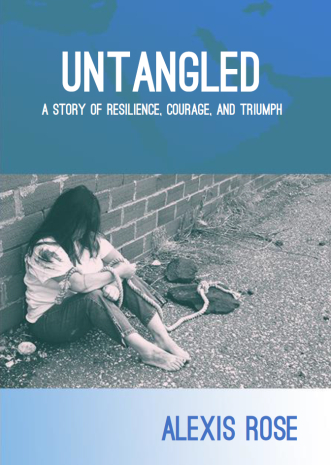
coverimage

From her Book information page:

Recalling her life, the author takes us on a journey of unimaginable abuse with continued explicit threats that eventually led to her being sent overseas on an impossible mission.  She repressed the memories of her past until a family tragedy forced her to face what her life had been. A history of abuse, torture, and threats to maintain her silence or be killed could no longer be denied.

This is the story of facing the truth and risking the consequences of breaking the silence. The author learns to accept the effects of the trauma that echo through her daily life as PTSD.

Through years of self-exploration, she learns to live her life fearlessly, with eyes wide open. Ultimately this book is about resilience; hope for victims who have suffered trauma and for the people who support them.

Alexis is an experienced speaker on the topics of living with courage and resilience in the face of Post-traumatic Stress Disorder. She has also presented multiple interactive workshops titled, Using One’s Innate Creativity (writing and drawing) as a Tool for Healing and Personal Growth.

For more information about Untangled, A Story of Resilience, Courage, and Triumph, to request a book signing, or to ask Alexis to speak to your group or lead a workshop, email alexis@atribeuntangled.com.

Alexis has been kind enough to write a guest post for this blog, which when I read it brought me to tears because I could relate so much to so much of what she wrote.   She is one strong woman.  Here is her wonderful post.  Please follow her blog: https://atribeuntangled.com/

Life with Complex PTSD

strong_quote

I was diagnosed with complex post-traumatic stress disorder about eight years ago, after a family tragedy. My daughter was hit by a van at 30 miles an hour as she was crossing the street on her way to school.

The year following Aria’s accident I was busy with tending to her health, taking her to appointments, trying to work full time, and keep our house hold running as normal as possible. And at the same time, I kept having these experiences that were making me feel crazy. I had worked so hard to keep my life, my family and their world so protected that the instant Aria got hit, my controlled snow globe world came crashing down. In fact when my son and I were talking the day of the accident, he looked at me and innocently said, “things will never be the same again.”  Extremely prophetic words, that at the time myself nor my family had any idea what they would come to mean.

I was becoming anxious. I started losing time, I was called into meetings at work because my performance was terribly erratic. I was physically sick all the time, and kept having these bizarre memories leaving me feeling crazy.  I knew something was seriously wrong with me so I made a call to a psychologist who agreed to see me the next day.

When I started working with my first therapist, I was so anxious to tell her everything all at once so I could just feel better and get back to work. I didn’t understand that I was having flashbacks, or that I was living in a constant state of crisis. I was writing her letters from a dissociated state which made no sense to me when she would read them aloud. I would lock myself in my room for hours for fear that I was going to hurt myself and I didn’t want to be around my family.

My first therapist diagnosed me correctly but neglected to start my therapeutic process by teaching me any kind of safety or distress tolerance tools.  I was out of control, thinking I was losing my mind, feeling like I had failed my family, and spiraling down a very slippery slope. She did the best she could but was way over her head and within nine months of seeing her, I knew intuitively that I had to find another therapist. I have been working with my current therapist for seven years.

When I first started seeing my therapist I was dissociated most of the time. I was in crisis, I was anxious, confused, and convinced I was going crazy. After a couple of sessions, it became apparent to him that we had to get some safety plans in place. Once that was in place we could begin the process of working on and processing my trauma.

I (sort-of) started to come to terms with the idea that my erupting memories were in fact true. I was so overwhelmed by my memories and what we would process during session that I would remember, forget, remember, forget; until I started to turn a corner and forget how to forget. That’s when I found I could really start taking the baby-steps towards health.

Not only was my therapy about processing the memories, I also had to start accepting that there were some pretty intense effects of the trauma and that influenced how I saw and reacted to the world.  I knew I had some pretty deep-rooted trust issues. I also had large, thick, almost impenetrable walls holding back any feeling or emotions that I was willing to let the world see. I also began to understand that because of my trauma I had a pretty significant attachment issues, which for me, has been one of the hardest things to learn and accept. For some reason the attachment issue fed into my very low self-esteem and it’s something I still work on.

I also had to face down how my trauma effected my relationships with my family, friends, parenting style and career. In the midst of dealing and coping with the trauma, there were a lot of AHA moments, when I saw how my behavior and ways of coping with life, had been a direct result of my trauma and not because I was a bad person.

Eight years later and one of the biggest reasons I write is because my PTSD symptoms still have a pretty good choke-hold on me. As with many mental illnesses PTSD can be invisible on the outside. I had always been the master of wearing many masks, and deflecting any conversation away from me, all with a supportive smile for everyone else. But when I couldn’t hide my illness any longer my friends began to ask me, what does it feel like inside. I couldn’t really explain it, so I wrote a poem and shared it with my friends and family. I found that by writing I found a way to share with others and begin to understand what PTSD means for me, and find a way to cope with my fear that I would be plagued by the symptoms forever.

My symptoms include (not limited too) flashbacks, concentration issues, becoming overwhelmed and my brain shutting down, not being able to make choices, anxiety/depression, and sensitive to the triggers that start the whole shebang of symptoms. We use the term, triggers, triggers everywhere. The wind can blow a certain way, or fireworks, or a car back-firing, even the moon can bring on flashbacks.

Unfortunately, my symptoms have left me with the inability to work. I went from having a wonderful career with the fringe benefits that provided me with some comfort for the future and the ability to provide for my family. I’m only able to work about 2 hours a day…on a good day.

It seems as if my symptoms (depending on the time of year) can start a chain reaction, so I needed to learn to work within my deficits. This isn’t easy or comfortable for me and because I’m still pretty new at learning how to work within my symptoms, I can find myself becoming frustrated and angry at my PTSD! Actually most days, if I’m going to be honest I am VERY angry at my PTSD. But then I settle down and think about what I want for my life and try to rest and reset.

The inability to concentrate can be over-whelming for me. I know what I want to do, what I want my brain to do but I simply am unable to do it. Making choice at the grocery store, or a restaurant can be so uncomfortable that I will just simply lose my interest in eating and shut down. Sometimes as night approaches it feels overwhelming because I know that its highly likely that sometime during the night I will have nightmares. Even practicing good sleep hygiene listening to podcasts, all the tricks can’t stop the nightmares sometimes and it gets overwhelming. And sometimes I’m overwhelmed because I’m a survivor of trauma and have PTSD and that’s just the way it is, even though I wish it was different.

Writing gave me the courage I needed to address the pain I was feeling. I would write even when I thought I had nothing to write about. At first, I strictly used it for bilateral stimulation. I would write and send what I wrote off to my therapist. I started to find that I was able to write down what I couldn’t say aloud.  It provided distance from having to use my voice at first, but then I found it actually gave me a voice.

What I hope to convey as I move forward: Try to remember to notice those perfect moments. Celebrate each step on the path towards health, know that it is a long and never linear process, and that it really is just one foot in front of the other, you need to do a lot of resting, a lot of just sitting and metabolizing.  And even though healing can feel like be a lonely process, through a blogging community and other support systems, we realize that we are not alone.

I’ve been hurt, I’ve been threatened, I’ve been abandoned, but I wasn’t going to let the effects of what happened to me keep me from trying to have the life I wanted. I never lose sight of my goals. They are to live with my past, live in the truth, and recognize and relish in the feelings of internal contentment. Some days those goals seem as far away as the furthest star, and other days I can see them just through the clutter, almost there. I still need a lot of therapy to manage my symptoms, and I may need a lot of assistance for the day-to day grind, but I’m motivated to keep moving forward, spurred on by the hope for a better life. A life where I am living, not just surviving.

http://atribeuntangled.com

Making your inner judge work for you.

heal_meme
Credit: Me (click to enlarge image)

I’ve recently met my Inner Critic, who from now on I’m going to call my Judge, because it’s funnier and seeing the Critic as cartoon-like helps me be able to make him seem  (I think of the Critic as male for some reason) less intimidating and scary.

I mentioned that the Judge, while keeping me trapped on a very thin tightrope, making me afraid of a lot of things, really is trying to protect me. Unfortunately the Judge’s overbearing manner can be abrasive and downright abusive, attempting to keep me trapped in old shaming thinking patterns (which apparently it thinks are best because it’s a big clueless dummy).

You need your Inner Judge, because it keeps you moral and doing the right thing. It also gangs up on you when you’ve let others step on your boundaries or abuse you (“how could you be so stupid to let that person take advantage of you AGAIN?”) The problem is, the voice isn’t very nice and feeds into your already low self-esteem. It makes you feel like a bad person–or a pathetic loser. As a result, you can be afraid to take any action.

For me, although I’ve used all the Four F’s, my primary defense has been and still is Dissociation.  Pete Walker talks about the Four F’s of C-PTSD–Fight (narcissism), Flight (obsessive-compulsiveness and workaholism to escape), Freeze (dissociation; withdrawal from humanity, self-isolation), and Fawn (being codependent).

The trick is to make your Inner Judge work FOR you instead of against you. My therapist had me try to think of “him” as being afraid rather than mean and judgmental. By having compassion for your Judge, you can actually change the way the Judge talks to us.

Changing the Judge’s script.

My Judge used to (and often still does) tell me things like:

1. You are worthless. You never accomplished anything of any value.
2. Who would listen to you? You think you’re some kind of expert? What sort of credentials do you have?
3. You’re over the hill and it’s too late for you. You will die poor, miserable and alone.
4. All your friends and everyone in your age group are making more money than you, own their own homes, can go on vacations, have real careers, etc. What’s wrong with you?
5. All your friends are still married or re-married, but you don’t have anyone and will never find anyone else. You’re too old to find anyone now.
6. You’re so weak and such a pushover.
7. You are too crazy to have a good life. You have too many mental issues.
8. You made bad choices, that’s why your life is like it is.
9. You’re embarrassing to be around and are socially awkward so it’s best if you keep your mouth shut.
10. Your accomplishments aren’t real, they don’t really count, so bragging about them makes you look like a narcissist.

And finally…
11. What is wrong with you?

These are lies, the same lies my abusers used against me as long as I can remember. These lies became internalized and now that I’m NC with my abusers, my Inner Judge still does their dirty flying monkey work. But unlike my abusers, my Judge can be trained to change the unhelpful, judgmental statements to things that can be more helpful, like:

1. You are worthwhile. You have accomplished as much as you have been able to, and that’s enough for right now.
2. Many people enjoy your blog and tell you how much it’s helped them. You have friends who love talking to you and like your insight about things. Just because you don’t have a piece of paper deeming you as an “expert” doesn’t mean you don’t know what you’re talking about.  You have the expertise of life experience, which is more valuable than any degree.
3. You’re never over the hill. Age is just a number. We evolve with age and get wiser. Getting old isn’t bad, but society likes to tell you it is.  even if you remain “alone,” you can still have friends, happiness, and a full life.
4. You might feel envious, but many people are doing worse than you. You have many blessings, and you also shouldn’t compare yourself to others. You should only compare your accomplishments to previous accomplishments, not those of others. We are all different and have different reasons for being here.
5. Being alone doesn’t have to be lonely. What’s so bad about being single? You could still find someone anyway. In the meantime, cultivate your skills, talents, self esteem and friendships. Those count for just as much if not more than “being part of a twosome.”
6. You’re strong and are getting good at setting boundaries that work but are also permeable enough to let others in sometimes.
7. You are not crazy. You have PTSD, which isn’t a mental illness, but a normal reaction to a series of abnormal events. And you’re getting better every day.
8. Yes, you made some bad choices, but who doesn’t? You also made those bad choices because you didn’t have a choice but to make them (you were programmed to always make the choice that kept you from taking any real risks or chances–which usually meant not making a choice at all–and this is what kept you from growing emotionally). This was NOT YOUR FAULT.
9. You are smart and a lot of people like you. You have a right to express what you feel.
10. You should be proud of your accomplishments. Talking about them sometimes isn’t bragging, it’s showing healthy self esteem.
11. What happened to you to make you believe such outrageous lies?   There was something wrong with the people who told you these lies.

The “Four F’s” of C-PTSD

child-abuse1

I just began reading “Complex PTSD: From Surviving to Thriving” by Pete Walker. I can already tell I won’t be able to put it down (I will write a book review when I’m finished, which shouldn’t take long). I’m also going to bring this book to my next therapy session because I want my therapist to see it.

Walker, who is a therapist and also a survivor of narcissistic abuse and sufferer of C-PTSD, is an engaging writer and definitely knows his subject matter. In one of the first chapters, he discusses the “Four F’s”–which are four different “styles” of coping that people with C-PTSD develop to cope with their abusive caregivers and avoid the abandonment depression. Whatever style one adopts may be based on several factors–natural temperament, the role in the family the child was given (scapegoat, golden child, “lost” or ignored child), birth order, and other factors.

complex_ptsd2
Available on Amazon

The Four F’s are:

1. Fight (the narcissistic defense): often “golden children,” such children learn to project shame onto others; may go on to develop NPD
2. Flight (the obsessive-compulsive/anxiety defense): these children will grow up to become highly anxious, obsessive-compulsive, and avoidant.
3. Freeze (the dissociative defense): these children “protect” themselves by dissociating from others, themselves, and their environment.
4. Fawn (the codependent defense): the child learns to avoid harm by people-pleasing or siding with their abusers.

Walker speculates that if C-PTSD were recognized in the psychiatric literature, the DSM could probably be reduced to the size of a pamphlet, for many people diagnosed with other disorders actually have C-PTSD, which encompasses symptoms of many other disorders and have common roots.

What you may have been misdiagnosed with (or diagnosed yourself with) if you have C-PTSD (these are the most common):

Personality Disorders:
Borderline Personality Disorder
Narcissistic Personality Disorder

Dissociative disorders

Anxiety Disorders:
Generalized Anxiety Disorder
Panic Disorder
Social Anxiety
Obsessive-Compulsive Disorder

Mood Disorders:
Depression
Bipolar Disorder

Developmental Disorders:
Autism Spectrum Disorders
ADHD
ADD

Codependency

Addictive Disorders

While any or all of these diagnoses can be co-morbid with C-PTSD, they miss the mark or don’t tell the whole story. Personality disorders such as BPD can develop from severe, unrelieved C-PTSD and they do share many similarities, but personality disorder labels are stigmatizing and not very helpful for someone who has suffered prolonged childhood trauma and abuse. Labels like “panic disorder” or “depression” aren’t helpful because they only address one or two symptoms of C-PTSD and therefore can’t even begin to address the roots of the depression or anxiety. You can treat anxiety or depression with drugs or short term therapy, but you can’t cure the person of the C-PTSD that’s causing their chronic anxiety or depression. The same goes for labels such as alcoholism or codependency. These are merely symptoms. People with C-PTSD are also sometimes erroneously diagnosed with developmental disorders such as ADHD or autism, which not only don’t address the trauma that led to the ADHD- or Aspergers-like behaviors, but also have completely different causes.

Empathy begins at home.

happy_childhood

I know that for a very long time I’ve had issues empathizing with others on a one to one basis (with a few rare exceptions like my children). It’s not that I like seeing others in pain or want to hurt them (I don’t, at all), more that I have had so much trouble connecting to my emotions, especially tender or vulnerable feelings, that this avoidance extends to everyone else. I’ve always felt empathy when it’s “safe” though–therefore I can cry for a character in a movie or novel, or even a TV commercial. I can get quite upset reading a news story about someone who’s been abused, especially if it’s an animal or a child.

But when it comes to real life people, I just can’t allow myself to get that close. I hold everyone at arm’s length. It’s too dangerous to let them in, because they might stir up emotions I haven’t wanted to feel. Of course this means emotional (as opposed to cognitive) empathy goes out the window too. You can’t feel an emotion for someone else if you can’t even access it for yourself.

It’s a common belief that all people who lack empathy are narcissists or psychopaths (or have some kind of schizoid disorder or psychosis, or autism). But a lack of empathy is also a common symptom in people with complex PTSD. Shutting off emotions–including empathy–is a defense mechanism that protects you from further harm. The problem is, this protection also “protects” you from feeling much joy or being able to really love anyone else.

Recently I’ve been feeling a kind of tender regard for my child-self/true self. Right now she’s not integrated and feels far away sometimes, but I can feel her sadness and pain. I can also feel that she’s a good person, a gentle sensitive spirit with so much love to give. I feel a tender protectiveness now where before I felt only shame and wanted to hide her away, just as she had been hidden away by the narcissists who “raised” her. So how was I any different from them, by keeping her hidden, projecting badness and shame onto her, refusing to see her strengths? Sometimes I just want to hold her like my own child. It’s not self-pity; it’s closer to empathy and even love.

Is this where empathy begins? Does it begin with loving yourself–your true self? If you hate your real self, you cannot learn to expand empathy onto others, since you can’t even empathize with yourself. If all you feel is shame, that is going to be projected onto others. That would apply to narcissists and the personality-disordered as well as people suffering from C-PTSD.   The problem for the disordered is it may be too late for some of them.  They are so thoroughly shielded by a false self they cannot even access their real selves or only with a great deal of difficulty that could take years.  There are much stronger defenses to break through.  They may be so shut off they can’t even see the lie they are living and think it’s everyone else–not them–with the problem.

The root of attachment and trauma disorders is is rejection of the self internalized from the people who were supposed to love you and mirror you; to heal, you must be able to develop empathy for your true self. That’s what my therapist has been helping me do.

Where did BPD stigma come from?

stigma_truth

In recent years, BPD has earned a very disagreeable stigma, so disagreeable that people who have a BPD diagnosis are refused treatment, being told they cannot get better or feared by professionals who might treat them. NPD too, hasn’t always been as demonized as it is right now. NPD and BPD have become almost interchangeable in the narc-abuse community. I don’t recall it being that way in 1996 when I got my BPD diagnosis, and I don’t remember ever being told I was hopeless or unredeemable or evil or anything like that. I was treated pretty much like any other psychiatric patient, and was given therapy and put on antidepressants. I was obliged to take a DBT class, which at the time I blew off. (DBT is like CBT but exclusive to Borderlines–and it does work. The fact it worked for me makes me think maybe I *did* have BPD but no longer do!)

BPD was always classified as a Cluster B disorder, ever since its introduction into the DSM in 1980 (it was recognized, however, for much longer than that, and popularized as a disorder in the 1960s because of the research of Otto Kernberg, a German psychologist who studied “the narcissistic and borderline personalities,” and other “disorders of the self.”).* All “Cluster B” means really is the person has a weak, fragmented or nonexistent sense of self. Not being able to access a “true self” means they become either cut off from or cannot regulate their emotions. One of the results of this is a lack of empathy (but BPDs are the most empathetic of all the B’s, and some have normal levels of empathy). In NPD, a strong false self takes the place of the true one, which is a very dissociative symptom. In BPD, there’s not a strong false self like with NPD, but there is a weak and unstable one, and the person isn’t ALWAYS showing that false self. Some BPDs act quite a bit like over-emotional or unstable narcissists (or narcissists in the midst of a breakdown due to loss of supply). Others act like covert narcissists or just act neurotic and insecure but are otherwise nice people. Some feel their emotions too much, including empathy. A few are antisocial. I’m not sure why BPD (and maybe NPD) isn’t classified as a dissociative disorder, because essentially the person is cut off from their “self” in some form or another and that is what dissociation means. I’m not sure what the mechanics are in ASPD (antisocial personality disorder) but they are very different from either Borderlines or narcissists because they aren’t dependent on others to boost their weak egos. They are psychopathic and just do what they want.

bpd_stigma_quote

So the Cluster B’s, including BPD, were already around, but until the mid-1990s, no one thought of them as anything but mental illnesses or for ASPD, a kind of “adult conduct disorder.” They were psychiatric labels and nothing more. The narc abuse community started in 1995 or so, and Sam Vaknin was pretty much the first one online who wrote about it. Of course, he has NPD but even so, he first called attention to the “evil”-ness of NPD/narcissism (actually it was M. Scott Peck but at the time he wrote “People of the Lie” in 1983, the term “malignant narcissism” wasn’t in vogue yet and there was no connection of “evil people” to people with NPD. There was also no Internet to spread Peck’s concepts like wildfire the way they could have been in 1995 and later. But over time, M. Scott Peck’s book has become one of the most popular in the narc-abuse community) After Vaknin established his online narcissistic abuse community and wrote his popular book “Malignant Self-Love,” more narc-abuse sites got established (many or most of them started by victims, who were understandably angry at the narcissists who had abused them). Soon “narcs are evil” became a sort of meme, and by association, so did all the Cluster B disorders earn a “evil” reputation.

There are benefits to this, of course. Victims are being more heard than ever before. People are paying attention and avoiding narcissistic abusers. But some people who carry a Cluster B label are being hurt too, especially Borderlines (or people–usually women–who were erroneously diagnosed with it). Some experts want to get rid of BPD and just re-label BPD as Complex PTSD (probably not a bad idea). There are MANY similarities. The vast majority of BPDs are not anything like malignant narcissists and are not sociopathic at all. Most just act extremely insecure, needy, and maybe “high maintenance.” They can be manipulative or act out to avoid rejection. They may collude with people with NPD, however. But it’s possible to find these same types of behaviors in many people with Complex PTSD. Are they actually the same thing?

Another reason for the BPD stigma could be the tendency for narcissists and borderlines to form partnerships or be attracted to each other. In such a pairing, the Borderline is almost always the abused or codependent partner. In several “couple killings,” one of the criminal partners, usually the female, has had a BPD diagnosis. But they may have been so brainwashed by their abusers they were coerced into colluding with them against others (a form of Stockholm Syndrome).

Finally, a number of high profile criminals and serial killers have labels of NPD or BPD. But they almost always also have a comorbid ASPD diagnosis. Media icons like Joan Crawford who were known to scapegoat their children also had a BPD diagnosis. In Crawford’s case, she was also diagnosed with HPD (Histrionic Personality Disorder). It wouldn’t surprise me at all if she had NPD (malignant) or ASPD as well, as her behavior was very sociopathic behind closed doors.

Why am I “defending” people with BPD if I don’t have it?  Several reasons:

  1.  I was diagnosed with it and carried that diagnosis for two decades.   I have personally experienced being rejected by therapists once they saw my “red letter” on paper.
  2. Just because my current therapist thinks I don’t have it doesn’t mean I don’t.  Or maybe I did have it and no longer do.  If I no longer have it, that means BPDs are not “hopeless.”
  3. Maybe BPD isn’t a valid diagnosis.
  4. Many people I have cared about who were slapped with “BPD” have been hurt by it.

These are just my rambling thoughts about this matter; I’d be interested in hearing your opinions.

* Timeline of BPD

Narcissistic Victim Syndrome (NVS): What the heck is that?

nvs

This is a very informative article about a type of complex PTSD suffered by victims of narcissistic abuse called Narcissistic Victim Syndrom, or NVS. Neither NVS or C-PTSD are currently recognized by the DSM, but are under consideration for future editions. Although this article is written for therapists, I think it belongs here and can be well understood by people who live with or whose lives have been seriously affected by narcissists. The author stresses that to be able to effectively work with patients with NVS, it’s necessary to be well-knowledged about NPD and narcissism(which abusers are most likely to have).

Narcissistic Victim Syndrome: What the heck is that?

Diagnosis: Complex PTSD

your brain on CPTSD

My therapist finally spilled the beans (at my insistence) and thinks PTSD or complex PTSD is the closest fit for what I actually have.   BPD may have fit once, but he doesn’t think it does any longer, if it ever did.   He said a lot of those “borderline” symptoms may really have been PTSD.   He also doesn’t think I fit the criteria for any other personality disorder.    Also I would not be responding to therapy as well (or as quickly) if I had an actual personality disorder.

This is wonderful.   Complex PTSD is a non-stigmatizing label that acknowledges that damage was done to YOU,  and you are just reacting normally to the abnormal.   Personality disorders imply that the problem is in the person and BPD is one of the most stigmatizing labels of all.

I’ve grown quite attached to my BPD label though, and I’m not quite ready to give it up yet. So I’ll still keep BPD under “Read About My Crazy” since I actually was diagnosed with it twice.  Maybe it was an erroneous diagnosis or maybe not,  but being a “borderline” has become so much a part of my identity I’m going to keep it for now.  I’m just overjoyed that my therapist does NOT think I have it and also that he’s aware of narcissistic abuse and the ways it can really f**k with your mind.

He says it’s fairly common for people with PTSD/C-PTSD to try to self-diagnose and it’s normal to be confused, as I have been very much so.

Guest Post #8 : Abusers break you–and then HATE you for being broken.

My dear friend and active participant on this site, Linda Lee, has written a wonderful and OMG SO TRUE post, which describes a lifetime of abuse, including incarceration in a state mental hospital, and being faced with unethical doctors and caregivers, including one who raped her. She was sent back home to a rejecting family–who had put her there in the first place! Linda Lee has Complex PTSD, a form of PTSD that’s often the result of chronic abuse during childhood, rather than an isolated traumatic incident later on in life. After describing the insane house of mirrors she had been thrusted into that seemed to have no way out, Linda lifts the reader out of the darkness with an uplifting message about Easter and the resurrection.

Linda Lee also has a blog about her Complex PTSD caused by prolonged, severe trauma called Surviving Trauma (formerly Heal My Complex PTSD).   (I got a little confused here because Linda recently changed her blog but the old one is still there too.  Her new blog is called A Blog About Healing From PTSD. )

I know the following story sounds so crazy, it’s hard to believe. But it is all true, so help me God… unless I really AM nuts, and the mental health professionals who have told me otherwise over the years were all wrong!

ABUSERS BREAK YOU — AND THEN HATE YOU FOR BEING BROKEN
By Linda Lee, Surviving Trauma and A Blog about Healing From PTSD

going_crazy_bookcover
The cover for Linda Lee’s future book, which she designed herself!

If you take a young puppy away from his canine family before he is weaned, yell at him, kick him, shake him, beat him, half-starve him, and leave him on a chain outdoors, exposed to every kind of weather without shelter, that poor little puppy is going to grow up to be a deeply disturbed dog – if he lives to grow up.

If you treat human children like that pitiful dog, they are going to have behavioral and emotional problems, too.

I grew up with parents who were normal and nice some of the time, and behaved like insane, demonically possessed monsters part of the time. I never knew from one day to the next whether my mother was going to be like June Cleaver in the TV show “Leave it to Beaver,” or Joan Crawford in the movie “Mommy Dearest.”

As for my dad, a fundamentalist minister whose episodes of violence led to his diagnosis of multiple personality disorder (now known as Dissociative Identity Disorder), some people believed that he actually was possessed by demons.

When I was fourteen years old, I began to have some emotional problems. Big surprise, right? I told my mother about the difficulty I was having, hoping she could help me. But, although my problems were mild compared to both of my parents’ history of extreme mental problems, my mother said “You are crazy just like your father!” Then she contacted my dad (my parents were divorced by then), and he agreed with her that I needed to be put in a state mental institution – against the advice of my doctor!

Of course, my dad said that I was “crazy like your mother.” He also told me he was GLAD I had psychiatric problems, because now I would understand what he had gone through.

But I did not understand. Almost fifty years later, I still don’t. Unlike both of my parents, my behavior was not out of control. On the contrary, although I wasn’t perfect, I was obedient, subservient, and eager to please. I had never been the least bit violent. I had never threatened or tried to harm anyone.

My dad, on the other hand, came so close to murdering my mom when I was twelve years old that for several terrifying moments I had thought she was dead. That’s when my father was arrested, then put in the psychiatric ward of a general hospital after the police took him to the emergency room because his insulin-dependent diabetes was out of control.

As for my mother, a few weeks after my dad tried to kill her, she did something even worse – she tried to gas us all to death while my four younger brothers and sisters and I were sleeping in our beds. Yet she never put herself under any kind of psychiatric care. With no other responsible adult living in the house at the time, there was no one to force her to get help. So now, because she has never been to a mental health professional and labeled with a psychiatric diagnosis, my mother thinks she is “just fine.”

When my dad’s medical insurance ran out and he was discharged from the psych ward, my mother dropped her charge of attempted murder so he could go back to work and provide financial support. Then my dad married the head nurse of the psychiatric ward whom he had met while he was a patient there (how unethical is that?), and my mother started dating a newly divorced man who had previously worked with my dad. She soon became pregnant (accidentally on purpose?), and quickly married the unborn baby’s father.

So now my parents were living happily ever after with their brand new loves while I, their eldest daughter, became the family scapegoat and “the crazy one.” And together my parents decided that I needed to be locked up in a state insane asylum, because: “she might become violent some day.”

Projection much?

About a year after my parents put me in the institution a new psychiatrist, Dr. Fenster, was hired to replace the rapist shrink who had been caught and fired the third time he drugged me unconscious and raped me. Lucky Otter posted this story for me almost a year ago. Here is the link: https://luckyottershaven.com/2015/04/12/have-you-ever-been-hurt-by-a-psychiatrist-guest-post-by-alaina-holt-adams/. (I wrote that post under the pen name Alaina Adams. I have since changed my pen name to Linda Lee, because it’s more like the real me.)

I had originally met the newly hired doctor when I was first put in the asylum and he was there, finishing his psychiatric residency. He had told me then that there was nothing mentally wrong with me, in his opinion, and he was confident that the psychiatrist in charge of my ward would soon have me released.

When Dr. Fenster took over my case more than a year later, he was shocked and dismayed to see that I was still there. Within the first five minutes of his first day on the job, the good doctor made me a promise: “I am going to get you out of here as soon as possible. You never should have been put here in the first place!”

But his promise turned out to be much easier said than done. Eight months later, Dr. Fenster called me into his office one last time before sending me out into the world. “I am very sorry that it has taken me so long to get you out of here,” he said. “The amount of legal red tape involved to release a patient from a state hospital is unbelievable, especially when it comes to a minor child. Because you are only sixteen, you are legally a ward of the state and you cannot be released on your own recognizance until you are twenty-one, five years from now! Until then, you can only be released into the care of a responsible adult. I have spoken with every adult in your family several times, at length – with your grandparents on both sides, and your mother and father. I hate to tell you this, but every last one of them is far sicker than you ever were! Frankly, it’s no surprise to me that you had emotional problems. Coming from a hateful, self-centered crew like that, I don’t understand how you can be as sane as you are! Even your maternal grandparents are unbelievably hard-hearted and selfish! At first, I thought they would be the best hope for you to have a decent chance at life. With your grandfather’s current position as the associate warden of Leavenworth Federal Prison, they could so easily provide you with a stable home and every advantage.”

He shook his head sadly. “I hate to tell you this, Linda, but no one in your family wants you. Every single one of them came right out and told me they don’t want a ‘mental patient’ living in their home. It didn’t make any difference when I told them that you are not mentally ill and you never should have been put here in the first place. In fact, when I mentioned that, your mother said that just by virtue of the fact that you have been kept here in this place for so long, you have probably been changed by the experience and now you may be dangerous! So… when I kept hitting a brick wall with everyone in your family, I gave up and tried to find a foster home willing to take you in. But they have to be informed about your time in this institution, and I could not find any foster parents willing to take the chance. I even tried to talk my wife into the two of us fostering you, but… it was a no-go.”

Dr. Fenster stared down at his hands, which were lying palms-up on his desk in an attitude of defeat. “Your mother is coming to take you out of here today,” he said. “although she is the last person I want to send you home with. Why she chose to have so many kids when she doesn’t have a maternal bone in her body is beyond my understanding. But she is coming to get you because – frankly – I found out something about her and I have used it to blackmail her. But even then, she would not agree to take you unless I wrote your discharge paper in such a way that it says you are being sent home on an ‘indefinite leave.’ I’m sorry this isn’t a full discharge. What it means is that your mother can bring you back here at any time, for any reason, or for no reason at all. So my advice to you is to get as far away from everyone in your family as soon as you can – and don’t ever go back!”

A nurse handed me a paper bag full of my threadbare clothes, then escorted me from the doctor’s office down to the lobby. My mother and her mother were waiting there, both with very grim faces. After a tense, silent two-hour car ride to my mother’s house, I discovered that I no longer had a bedroom or a bed – I was told to sleep on the living room sofa. In fact, everything that I had ever owned, my beloved books, the papers I had written, my clothes, my costume jewelry, and the childhood toys I had cherished and saved, were all gone. Taken to the dump, I was told, right after I was put in the mental institution.

My “WELCOME HOME” was nonexistent. Not one person said “I’m glad you’re back, I’ve missed you.” My much younger sisters and brothers had always looked up to me, loved me, and depended on me, especially during our mother’s deep depression after the violent end of our parents’ marriage. Along with my new stepfather, my four little siblings had begged our mother not to send me to the institution two years earlier. Even my grandparents may have questioned why she would send her adolescent daughter to the most notorious insane asylum in the region, when my behavior, to all outward appearances, was completely normal. So then my mother had told horrible projecting lies about me, to justify what she had done. Lies which the majority of my family apparently believe to this day.

Three days after my return “home,” while I was being ultra careful not to be a bother to anyone in any way, my mother waited until my stepfather was at work and my school age siblings were all in school, and then she told me that I needed to leave – to run away – because she could not afford to feed a big grown girl like me.

“I can barely afford to feed the five little ones,” she said. “Your father doesn’t pay nearly enough child support, and it wouldn’t be fair to expect your stepfather to feed you. And after where you have been, I am afraid you might be a bad influence on the younger children. I had you when I was only eighteen, too young to know what I was doing. So I made all my mistakes on you. Unfortunately, it’s too late for you. But I think that throwing one child away, in order to save the other five, is the right thing to do, don’t you? And don’t worry, I promise I won’t call the police and report you as a runaway!” She said this, about not calling the police, with a big smile on her face, as though she had just handed me the keys to a brand new car.

“You know, I married your father when I was sixteen. Sixteen is old enough to be on your own. And, like I’ve been telling you ever since you reached puberty – no house is big enough for two women!”

This happened in the middle of a cold December and there were several inches of snow on the ground. The tiny town where my mother and stepfather had moved to while I was in the institution was miles away from a city, where there might be some kind of shelter or help. Without a penny to my name, with my few clothes bunched up in a pillowcase, because the paper bag I had brought my clothes home from the hospital in, had torn – and I remember feeling guilty for taking one of my mother’s pillow cases, that’s what a “terrible” daughter I was! – I walked out the door into the frozen December morning. I had not eaten any breakfast that day, because no one had offered me anything and I was trying so hard not to be a bother….

Whew. Right now, as I am writing about that terrible time in my life, I feel so ANGRY!

My husband today, a combat veteran from the war in Vietnam, has talked about the pain of coming back from the hell of war and getting rejection, instead of a Welcome Home. I’ve told him I understand how that feels. A few years ago, there was a big push to finally welcome our Vietnam War Veterans home. I’m so glad they got that. They deserve it. But… deep down inside, I feel like I am still waiting for my Welcome Home.

I did not follow Dr. Fenster’s advice to have nothing to do with anyone in my family of origin, until I was in my fifties. Why? Because I loved my family. I wanted to have a family! Although I stopped living in the same state forty years ago, I kept reaching out to them, time and time again, over the years – by driving very long distances to visit them, by phone calls, by letters, and finally, when social media became available, I reached out to them through Facebook.

With the exception of my aunt (my mother’s younger sister) and my oldest niece, every time that I have ever reached out in any way to anyone in my family of origin, I have been hurt and abused all over again. The bullying I took on Facebook was so bad, I ended my account. Even today, every time I see that ubiquitous blue logo, I shudder inside.

WHY does my family of origin despise me so much? Because they apparently believe my mother’s lies about why she “had no choice” but to commit me to an insane asylum almost half a century ago. And anything that I have to say on the subject is suspect because, you know, I must have been really crazy in order to be locked up.

They BREAK you, and then they HATE you for being broken.

Every trauma story is unique. Some people have told me that my trauma story is so extreme, it makes them feel ashamed of having any kind of emotional problems when their trauma is “less” by comparison. But I absolutely do not want anyone who reads this to feel that way! Please!! Pain is pain, trauma is trauma, and – in my experience – THE WORST PAIN OF ALL IS THE PAIN OF BEING REJECTED BY THE PEOPLE WHO ARE SUPPOSED TO LOVE YOU. Not the terrifying episodes of violence, not the rapes, not even being labeled “crazy” and locked up for almost two years in a lunatic asylum, hurts as bad as this!!

If you, like me, have ever been scapegoated, lied about, shunned, and rejected for being so “bad” as to have any kind of emotional or mental problems, then I believe your wounds go just as deep as mine.

Thank you for reading this. Please feel free to share your own story in the comments. And thank you, Lucky Otter, for giving people like me the opportunity to share our mental health struggles with your readers. God bless.

In truth and love, Linda Lee

PS: Today is Easter, the day we Christians celebrate our risen Lord. I believe HE is the reason why I finally got free of the insane asylum, during an era when 97% of the people committed there were never released. (This is what one of the psychiatrists told me right after I got there, when I asked him how soon I could go home.) I was one of the lucky few who got a second chance at life. I think the reason may be because I had given my heart to Christ when I was a little girl. “Weeping may endure for a night, but joy comes in the morning.” Amen!

Another brick in the wall…nuked!

crumbling-wall

How do I even begin? What happened tonight in my therapy session was a little thing, objectively speaking, really a very little thing. But to me it was a huge, HUGE deal, maybe even a breakthrough of some sort.

I refuse to write a separate post about this, but when I got home from work, my mother called. She had gotten my phone number through my son and I took the call because it was coming from a New York phone and my mother lives in Illinois so I had no idea who it was. Normally I don’t take phone calls if I can’t tell who’s calling but for some reason I took it this time. When I heard her voice, it was like being transported back to being a five year old again. All my mindfulness skills and everything I know about narcissism and No Contact went flying out the window.  I won’t go into detail because nothing of any consequence was said. She told me she just wanted to hear my voice and proceeded to ask a bunch of personal questions. I felt like she was checking up on me for her own benefit, which is probably the case. I put on my fake-nice act and answered her questions as politely as I could, telling her nothing too personal, and finally made an excuse about having a sore throat (which is actually true because I’m still sick) and had to get off the phone.

I brought up the phone call in therapy. I asked my therapist (rhetorically) why I can’t just tell her to bug off. Rationally I know nothing would happen if I did that. I know she’s read my blog so surely she knows how I feel about her. Sure, she might get mad, but really why should I care? What could she do to me? Nothing! He suggested (correctly) that I was programmed from an early age to always respond to her in a certain manner, and that programming is hard to break, and that’s what’s making it so hard for me. I started laughing about the idea of myself being a computer that could be programmed. I looked at him and told him to debug me. He laughed at that, but really it wasn’t funny. I felt a little hysterical.

I’m always a little more emotionally labile when I’m ill, and so this illness he gave me last week acted as a kind of emotional lubricant–or maybe I was just ready and what I’m about to describe was going to happen anyway.

I said I was tired of talking about my mother and I wanted to talk about my transference feelings instead. It’s what I’d been planning to talk about but my mother, even in my therapy sessions, always has a way of drawing all the attention to herself and I wasn’t going to let that happen tonight.   Recently we have been meeting twice a week instead of once a week, but I won’t be able to afford to do that for too much longer, or at least for the next few weeks. I explained hard it is for me to only be able to meet him once a week because of my strong feelings of attachment. He wanted me to elaborate on this and describe how it felt. I had to think about that for awhile. The closest I could come was that it’s a little bit like limerence but without the sexual and obsessive aspects and has a more infantile quality. (There’s also a kind of mindfulness to it that’s impossible to explain but that keeps it from getting out of control.) It’s the way I imagine a baby feels about their primary caregiver. That I’m this little baby and he’s the only person who ever mirrored me or accepted me unconditionally for me. Because of that I feel extra vulnerable with him, too close to my raw core and fearing rejection while at the same time being able to let my guard down in a way I normally can’t. When I was asked to elaborate on the vulnerable feelings I had to think about it for a long time.

Finally I began to explain (in what I felt was a very childlike manner) and to my surprise I started to cry. I’ve come close to crying a couple of times recently, but this time my eyes actually filled up and a couple of tears spilled over (which I wiped away quickly). Sure, I didn’t sob and there weren’t many tears and it all ended quickly, but it happened. For just a minute, I shed real tears in front of another human being! Even more astounding to me than that, I felt no shame doing so. In fact, I was very proud of myself and even while I cried, I knew exactly what was happening and felt really, really good about it. So my tears turned to laughter and he laughed along with me. It was a real, bona fide emotional connection. How can that be? I don’t have those! I don’t connect with people! This was surreal.

“How did you do that?” I asked, sort of gobsmacked.
“I did nothing,” he said. “You did that yourself.” He was smiling.
“Then I guess you’re just the facilitator!”
“Well, I do have a degree!” he said jokingly.
We laughed again. Then the tears almost started again.
“You’re getting emotional,” he observed. “What’s going on?”
“I DON’T KNOW!” I wailed like a three year old. And I didn’t. I didn’t know why I was so emotional, but I felt happy that I was. “I just feel fragile, that’s all.” My lower lip was trembling like a toddler’s.
“I want you to know I think you’re very strong.” His eyes were shining.

So, another brick in that f*cking wall crumbled tonight.
I put my shoes back on (lately I’ve been taking them off and putting my feet on the couch–it seems to help somehow).
As I was leaving, he said our session moved him. I wanted to hug him so much right then but of course I didn’t.

My verbal processing problems and not getting jokes. .

jokes

Today a co-worker told me why people tend to not respect me and why they talk down to me.  I already knew the reasons why, but hearing it from another person, even when it’s not said in a mean or patronizing way, still stung a lot.  She said when people talk to me, I seem to not understand what they are saying,  and I don’t process verbal directions as well as most people.  Unfortunately, what she said is absolutely true.  Even though I know I’m well above average intelligence, I’ve always been sensitive about this and afraid people will think I’m stupid because of this problem I have processing verbal communication.

This is typical of someone with Aspergers or autism, and I also suffer from the social awkwardness of an Aspie.  Both result from failing to process verbal communication in a normal (some would say “neurotypical”) way.   Although I was never diagnosed with Aspergers, for many years I was sure I had it, because I certainly act and think in Aspie-like ways.   I’ve had this problem since childhood.   There’s never been any proof I don’t have Aspergers though, so who knows–I could be on the autism spectrum.  But I actually think my problem is due to complex PTSD mixed with Avoidant Personality Disorder.    I’m usually slightly dissociated or “off in space” somewhere when people are telling me things.  I also am highly uncomfortable in groups of other people (or people I don’t know well) and the ensuing self-consciousness makes me clam up and do and say awkward things.  I can’t really focus on what others are saying because I’m so obsessed with not looking stupid or weird.    I get so nervous that I might not understand what the other person is telling me, that my brain stops working and makes the problem even worse.    The fact I also have very poor hearing (I only have 20% hearing in my left ear) exacerbates this problem.

I have a similar problem when people are telling me jokes.    I’m so afraid I “won’t get it” that instead of listening to the joke, I’m worrying that I might not get it and the person telling the joke will think I’m stupid.  So what happens?   Ding ding ding!  I don’t get the joke!    That’s why I prefer jokes that don’t require any “getting.”  Goofy or silly humor, or “random” humor is much more my speed.

My malignant narcissist ex used to exploit my discomfort with joke-telling for his own sadistic entertainment.  He did this by deliberately telling long, involved jokes when others were present, and then pointedly look at me, asking, “Did you GET it?”   If I didn’t (which was often the case when I was put in this nerve-wracking situation), I could do one of two things:  (a) I could lie and say I did get it, but this didn’t work because he’d then ask me to explain the joke; or (b) admit I didn’t get it.   Either way, he was turning my insecurities against me in order to make me appear stupid in front of others.  He’d rub salt in the wound by telling me I had no sense of humor because I was unable to get his jokes, even though this actually isn’t true at all and I think I have a very well developed sense of humor (just not a traditional one) and many people find me funny. What that sociopath did was an especially subversive and vicious form of gaslighting that exploited my differently-wired brain and my self-consciousness.   I still find situations where people are telling jokes very triggering.