Cold spring.


haveagreatsummer

I don’t know about other areas, but with the exception of a few warm, almost hot days, April and May have been exceptionally chilly, making jackets and sweaters necessary, even during the day.   Today was more like mid-November than mid-late May–overcast, rainy and only about 60.   It’s windy too, making it seem even colder.  Earlier this month, there was actually snow in some higher elevations (and this ain’t exactly the Rockies).   Two nights ago we were down in the low 40’s.   I’m actually running the heat right now.  It’s so fall-like I half-expect the leaves to start changing colors. It’s also been very dry–so dry there have been fires in some places, which is unusual in the spring.   My area is finally getting some rain, but it’s still not exactly warm.

The year 1816 is remembered as the “year without a summer.”  Temperatures in the northern hemisphere were much lower than average all that summer. The bizarre weather was a “volcanic winter” caused by the eruption of Mount Tambora in the Dutch East Indies.   While I haven’t heard about any volcanic eruptions and there’s no reason to think this summer won’t be as hot as always, right now I’m tempted to pull out the fall decorations.

I’m planning to spend Memorial Day at the lake, so I sure hope it warms up a little.

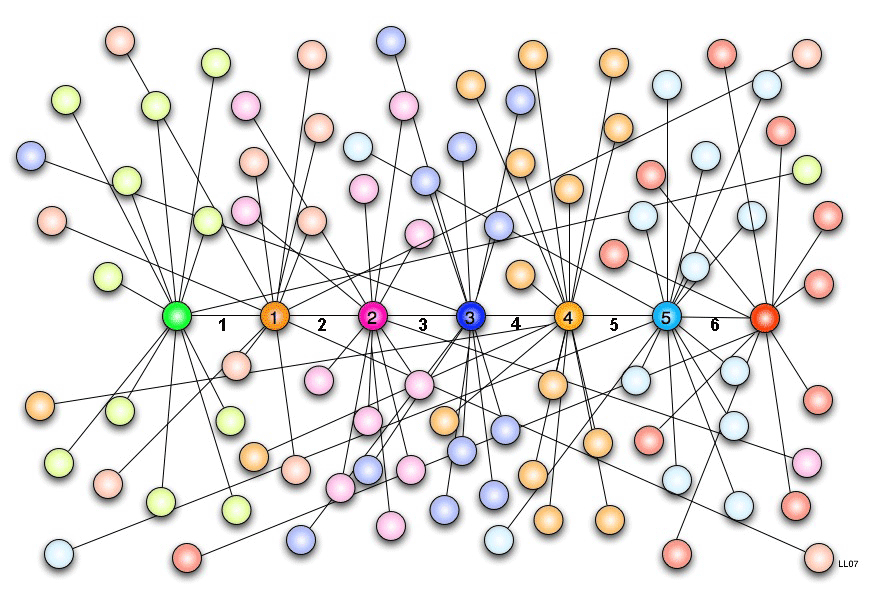
Six degrees of separation.

Six_degrees_of_separation_01 kevin_bacon

The theory of six degrees of separation–that every person on earth is separated from every other person on earth by no more than six people–is interesting to me.  It’s also extremely creepy.  But it could also be sort of comforting.   I suppose the same claim could be made for anything on earth, not just humans.  We are all connected?  Maybe.  It’s just one of those odd things I always think about.

Things to ponder:

How does the Internet play into 6DOS?  Would there be fewer “separations” between us all now that most people are online?   Were there more than six degrees of separation back in the days before electronic communication of any kind was possible? Or less, because there were fewer people?  Or does only IRL contact count?

I remember the game based on this theory called “The Six Degrees of Kevin Bacon,” in which actors–any actors, be they in TV, film, or the stage–are linked to Kevin Bacon with the theory that no more than six individuals are between Bacon and anyone else.

Oh, and I came across the concept of 6DOS by reading about rickrolling.  Is any topic on the Internet only separated from any other by six degrees or less too?

ETA: A commenter just informed me that the number has been reduced to four and it’s probably because of Facebook.  I always suspected that Facebook was evil.  This proves it. Pretty soon there will be only one (or would it be zero?) degrees of separation between every person on earth, or at least those with Internet.   Oh, joy.  We can all hold hands and sing Kumbayah together.

Also see When My Worlds Collide.

Down The Rabbit Hole blog.

I know some of you have been wondering why you cannot access my other blog, Down The Rabbit Hole.  It’s still there, but due to some trolling, I was forced to set it to private for the time being.  I hope to make it public again soon but am not quite at that point yet.  Right now it’s accessible by invitation only.    You can request an invitation by clicking on this link.

https://downtherabbitholeblog.org/

Please keep in mind I cannot grant a request if I do not know who you are.    Hopefully this matter will be resolved soon and the blog will be public again.  You are free to contact me in private also (via my email) if I did not grant your request.

Thank you in advance for your understanding and patience.

Paranoid Personality Disorder (PPD)

PPD, though more common than NPD,  is often ignored or overlooked and I think can be (and often is) mistaken for Narcissistic Personality Disorder (NPD).   The symptoms are remarkably similar and resemble the way a narcissist acts when in defense or attack mode. These are not very nice people. Someone with PPD acts like narcissist who is perpetually suffering narcissistic injury (must be fun!).   They are combative, controlling, envious/jealous, unforgiving, and quick to project blame onto others.  Also like narcissists, they are unlikely to think they have a problem so they rarely try to get help.

I wonder if PPD should actually be classified as a Cluster B personality disorder, since it involves a weak sense of self, hypersensitivity to real or imagined slights, and resultant abusiveness toward others and lack of insight/inability to accept blame.  Other then a tendency to avoid social interaction, PPD doesn’t seem that much like the “odd/eccentric” (Cluster A) disorder it is currently classified as (it’s in the same subcategory with Schizoid and Schizotypal Personality Disorders, neither of which bear much resemblance to PPD).

I’ve known people who I thought were narcissists and who were definitely abusive, but their behavior actually more closely resembles PPD than NPD.

One thing that’s unique about people with PPD is that they are more likely than others to have a parent with schizophrenia.

PPD2

Source:

http://www.mentalhealth.com/home/dx/paranoidpersonality.html


But I like my widgets!

keep-calm-and-be-tacky

Almost every article that lists do’s and don’ts for bloggers says that having too many widgets and plug-ins in your sidebar is a big no-no.    They say they make your blog look cluttered and unprofessional, and even worse, they slow down load time, so that potential followers grow impatient with waiting for all your digital doo-dads to load, and go elsewhere.

It’s said that if you have too much “flair” in your sidebar, it makes your blog look amateurish.   It screams “newbie.”   New bloggers love widgets.   They’re eye-catching, colorful, and they’re a novelty that hasn’t had time to wear off.  Sometimes they also give a blogger bragging rights (such as those blog awards that only new or new-ish bloggers accept) or information that may be of interest to the blogger but probably not to anyone else (those little maps that you can click on for a real-time traffic report).

I’m guilty of having a lot of widgets.   I might even have too many widgets (oh, the horror!)  I like widgets.  They’re fun and I like the way they look, dammit. But I certainly don’t want to be seen as a “newbie” or someone who has tacky taste.  Or the blogging equivalent of some attention-hog on the road whose car bumper is obscured by bumper stickers.  I also hate the possibility of people growing impatient with the slow load time and going somewhere else in exasperation.  So last night I decided to say adios to some of my beloved widgets.

But I couldn’t do it.   Well, not much anyway.   I got rid of “community” and the friend faces under the Facebook Like box.  Also the captions under the awards because they were redundant.  And that’s all.   I simply couldn’t bear to part with anything else, no matter how useless or annoying they may be to my readers.   I love my widgets!   So they are going to stay (for now).  Suck it up, readers!  I probably won’t add any new ones though.

Have a day!

Image

haveaday

How They Abuse — Invalidation


Here’s a man’s perspective on emotional abuse which elaborates even further on the sneaky tactics abusers often use to get others to see THEM–not the actual abused–as the victim. There’s even an acronym for this I was not aware of: DARVO (Deflect–Attack–Reverse Victim and Offender)

Object of Contempt's avatarRoll Away My Shame

In various articles and blogs I’ve read about abuse by invalidation. This has been a huge part of my experience, and is ongoing in a big way because I’m unable to leave my abuser at this time. Invalidation is a tactic that hurts the victim by way of frequently rejecting the victim, disallowing even the basic acceptance that people rely on for normal functioning. It involves questioning or denying the truth of their pain, experience, perception, memory, et cetera.

To be clear, I am not talking about having a difference of opinion, or even a heated disagreement. I’m talking about abuse, which entails a pattern of behavior that is injurious.

Invalidation is one of the most insidious ways to abuse a person. It causes a tremendous amount of strain and damage in the victim. I suspect this is largely because it can go on for so long without being detected…

View original post 1,057 more words

A thank you to all my international readers.

worldmap_wp

One thing that still excites me is seeing how much reach this blog has had.  Two years ago, my thoughts were read by no one.   They didn’t even leave the confines of my own brain.  That sure has changed!  Pictured above is a map showing my visitors since January 1, 2016. It still shocks me (in a very good way) that people in almost every country have visited my little corner of the Internet. So I want to take this opportunity to thank all of you for taking the time to visit and read this blog. It’s very much appreciated.

Narcissistic abuse: who is the real victim?

adult-workplace-bullying

Narcissistic abusers are great at charming people they want to impress, or those people they want to get on their side. When they have targeted an individual for abuse, they will stop at nothing to turn their friends, colleagues, even their families against them–and it’s not at all uncommon for them to claim that THEY are the ones being abused.   The process of using malicious gossip and lies to turn people against the victim is called triangulation and is well known in the narcissistic abuse community. Most of us who have been targeted by narcissistic abusers know all too well about triangulation and its close cousin, gaslighting. Both will be used in conjunction with each other to turn the victim’s potential allies against them, effectively isolating them and ripping away any support systems they could use later.

Those who have been turned against the victim by the narcissist are called flying monkeys. They may or may not be narcissists themselves, but they are duped and misled by the narcissist’s convincing lies and charm into believing the narcissist is the real victim and that the victim is the abuser. You can’t really blame them for siding with the abuser, since the abuser can be so convincing and often has a glibness that the real victim lacks. Complicating the situation further is the likelihood that the real victim indeed acts “crazier” or more irrationally than the abuser, usually because they have been driven half-mad by the abuse, which can be so easily hidden, even from those who are witnesses to it.

The good news is, there is a way the real victim can be discerned in an abuse situation, even if the narcissist complains loudly about how THEY are being abused. This isn’t something I thought of myself; it’s been described already by other writers and bloggers. Still, I think it’s something that isn’t given a lot of attention, so I want to describe in detail how this works because it may be the only way you can extract the truth in the evil mental clusterf*ck set up by a narcissistic abuser.

Isolating the victim.

In any abuse situation, there is almost always more than just two people involved. At the core are the victim and the abuser, of course, but chances are good the abuser has convinced other people–including friends and family members of the victim–that the victim is the real abuser, and recruited others as flying monkeys that collectively condemn and mob the victim. The abuser may have even convinced a mental health professional or pastor (or anyone else who works closely with a family) that the real victim is the real abuser, effectively turning everyone against the victim, so only the narcissist appears to have allies and the victim has no one.

This happened to me, when I was still married to my sociopathic MN ex. My ex was always more socially adept than me. He was always better at making friends and giving a good first impression than I was. He was very glib and could spread the lies on as thick and convincingly as a trial lawyer. In fact, I used to joke that he should have been a lawyer (no offense to any lawyers who may be reading this!)

verbal_abuse

It wasn’t a joke anymore when he decided I was an easy target for abuse. We had several friends–mostly other couples–who suddenly seemed to want nothing to do with me, but still talked to him and seemed to like him. When I questioned my ex about why all our friends had cooled toward me, he said things like, “So-and-so doesn’t like you; I really don’t know why!” or “The Joneses told me they think you act kind of crazy and they don’t feel comfortable around you.”  I was even told our friends were “afraid of me.”  Even our children–who were middle schoolers at the time–had turned chilly toward me, as had several other family members. (It turned out later he was telling the kids I didn’t love them and wished they’d go away–of course, this was an utter lie). Meanwhile he had convinced our friends I was insane. If I questioned him about his treatment or if I seemed to be getting at the truth, suddenly I was called paranoid or too sensitive or even crazy. Or I’d get a non-answer like, “No wonder no one likes you. You’re so selfish. Everything is always about YOU.” He was projecting his own narcissism onto me, but I didn’t know it back then. I began to think there must be something very wrong with me that everyone else could see but I couldn’t.

The real abuser may act more sane.

It didn’t help any that my behavior around this time did in fact appear more insane than his did. I always seemed to be the one to act out or lose my cool, while he always appeared completely rational, cool and collected. Of course our kids were more likely to take his side–they looked at their dad and saw a calm, rational person who wasn’t raising his voice and who was telling them their mom was both insane and didn’t love them. They looked at me and saw a frazzled, half-mad, emotionally unstable woman who was always yelling, crying or locking herself in her room–and on two occasions had to be hospitalized. Why wouldn’t they believe him? What they–and everyone else–didn’t know was that his crazymaking behavior was driving me insane and I was already suffering PTSD due to the mental and emotional abuse. He always treated me well whenever anyone else was present, so no one would suspect what he was actually doing. If I tried to call him out on his abuse, I was gaslighted: “stop making things up,” or “that just proves how insane and self centered you are.” Everyone we knew believed him and I found myself all alone, with no one I could trust or confide in. He was able to use confirmation bias to his advantage–thereafter, anything I did became “proof” of my “craziness” or “unfitness” or “selfishness” and the more abused I was, the “crazier” I got.

At one point we began to see a marriage counselor at my insistence. My behavior in counseling was more volatile than his, and my ex also began to see the counselor in private. He was able to convince this therapist that I was the problem in the marriage and the less fit parent. Here was one more person who could have been a potential ally, but due to her ignorance of narcissistic abuse (and his attorney-like glibness and charm), became another flying monkey he could use in his smear campaign against me.

isolation
Click chart to enlarge.

I have read and heard about many similar situations described by numerous narc-abuse survivors, whether the narcissist was a parent who turned all their siblings and other relatives against them, or a spouse who turned all their mutual friends against them. It happens in the work world too, and online, and in schools, and anywhere where bullying can take place. In any bullying or abuse situation, there is one ringleader (or main narcissist) who has successfully used triangulation, gaslighting and projection to turn others against the abused person. The real abuse victim, who may lack the charm and glibness and manipulativeness of the abuser, has usually been isolated by the narcissist from anyone who could have been of support.

Identifying the real victim.

It doesn’t matter if the real victim seems “crazier” or more emotionally unstable or even more “abusive” than the abuser; they have become that way due to the abuse.   They may have a history of previous victimization which rendered them vulnerable to becoming an abuser’s prey and they may have pre-existing PTSD.   The real clue here is which person seems to have no one on their side? Which one has no friends or allies?  Who seems to be fighting a losing battle?  Who seems to have more “mental problems?” That person is almost always going to be the actual victim, no matter how much “evidence” the alleged “victim” claims to have.

If you are currently being victimized by an abuser, this knowledge may be the only way to be able to tell that you are actually the abuse victim and not the perpetrator, since chances are, your abuser has convinced everyone (including you!) that you are the one at fault. Hold onto this knowledge and remind yourself of it as you begin to disengage. Hopefully, knowing that you are NOT at fault and the narcissist is just a convincing liar will give you the motivation you need to get away. Or, if you are a bystander witnessing abuse, you may be able to help the real victim by keeping in mind that the one who seems to have no one on their side is the one you should be helping. Don’t let the narcissist’s convincing lies sway you over to their side.

Monday Melody: Smells Like Teen Spirit (Nirvana)

monday_melody

I was going to post a different (more recent) song for this week, but my DS, who will be 25 this year, just reminded me that this iconic song is as old as he is. It still sounds as great as it did in 1991. Sorry about this being a day late.