I can’t relate to narcissists who love their disorder.

android

I read this post at Psychforums written by a person who sees their narcissism as a huge advantage.

I spent all my life trying to figure out why I felt so different from other people. A few months ago I was researching in detail narcissism for my master thesis on The Picture of Dorian Gray when I suddenly realized that I fit perfectly with all the criteria to be assessed as a high functioning, cerebral, covert narcissist. I immediately felt amazing about it. Not even for one second I believed that there is something wrong in me, but I soon realized that the rest of the world doesn’t seem to agree with my view.

The idea that my malignant tendencies have a reason to exist empowers them, and all the studies I have read on this topic instead of making me feel like I have a mental illness that should be cured provided me with the tools I need to expand my narcissism and use it in my favor. I guess this sounds like I really am sick, but bear with me: why would I, as a narcissist who feeds upon the desire of being special and unique, have a problem with being diagnosed as such? It makes me different from others for real. I am not going to stand in line with all those narcissists who fear themselves, who punish the way they are. Becoming self-aware opens infinite doors to the great potential I have.

I always deeply enjoyed manipulation, now I know why, but I also know that I have the power to bring this skill on a higher level and the more I master this “science” the less people will realize what I am doing to them. I don’t have a problem letting people know that I am a narcissist, but they never believe it – they still see me as a caring, loving, trustworthy girl who would go out of her way to help, too nice and interesting to be classified as “evil”. This discovery has given a great boost to my self-esteem which used to be pretty low. But it was low because I didn’t embrace and accept who I am. Knowledge is power. I am more functional now than before, I test my potential daily to see how far it can go, how much more I can get from it. Why would people ever want to heal from this?!

They say that a lack of empathy is a terrible thing. I don’t even know what empathy is, so why would I be concerned about owning it? They say I will never be happy with the way I am, but, let’s state the truth, people are never satisfied and fully happy anyway; they live for unhappiness because hope is far more enjoyable and stimulating. They say I cannot have fulfilling and real relationships, but that’s not true: given the right partner I can make him feel like he is the most special person in the world. Of course, all of this is done primarily to make myself feel like I have total control over them, but it can still provide them with some good things for themselves. It’s twisted, but I find unconditional love far more twisted. Self-awareness helps me regulating my depression since now I understand that it’s triggered by a lack of NS, so I just need to adjust that to feel back on track.

And when a NS is not readily available I feed my ego by trying to achieve success and praise in my work or studies. The more difficult and stressful it is, the larger my ego grows when I get there. Have you ever felt a proper ego boost? When it feels like there is something extremely warm in your chest which is expanding throughout your body? I live for that feeling.

I always wanted to become a teacher, but I was scared that I wasn’t good enough for that. Right now it has become clear that this is the only thing that I can do successfully. What’s better than a group of people who you can manipulate on a daily basis without being perceived badly? And here by manipulation I don’t mean in a bad way: you can convince them that they can be and do whatever they want in life. And they will repay you by making you feel omnipotent.

That’s a fair deal to me. Last but not least, being a narcissist made me finally forgive my mother for all the years of psychological and physical torture I had to endure. She made me the person that I am today, for better and for worse. I let go of all the grudge and hate and established a far better relationship with her.

I am human, but if my being a narcissist means that I am an evil human being, I can totally accept that and carry on. I would rather be good and be a hero for others, but I always found villains much more charming and true to themselves.

android2

This is an example of ego-syntonic narcissism and is common in high spectrum grandiose (classic, not covert) narcissists whether they’re self aware or not. It seems psychopathic to me. While on an intellectual level I can understand the logic behind it, and yes, I’ll even concede that it is possible to be devoid of empathy or a conscience and still choose to be prosocial (people with NPD and even ASPD can tell the difference between right and wrong, but usually won’t choose to do the right thing, only what suits them), I simply cannot relate to this way of thinking. It seems very machine-like to me, almost a parrot-like existence.

Sure, without a conscience you don’t suffer from guilt and shame the way most people do, but living this way just seems so cold and sterile to me. I spent years unable to feel much of anything, and am recently beginning to discover my softer emotions and wouldn’t have it any other way. Even sadness adds depth to the experience of being alive. How can a person like this be able to experience higher emotions like love, empathy or real joy? A machine can’t experience joy, sadness or love, all they can do is fake it. To me, this seems like a sterile, joyless way to live, an imitation of being a human, and I want no part of it. How can you really enjoy life when everything and everyone becomes nothing but narcissistic supply? I’m sorry, but I’m a person, not a parrot.

That being said, high functioning/high spectrum narcissists do seem to like their narcissistic traits, because they tend to be beneficial in the selfish and narcissistic society we currently live in. The enormous popularity of Ayn Rand and her philosophy of selfishness as a virtue attests to this. But such a world, run by people who feel nothing and get high off their own perceived power and superiority, is deeply frightening to me.

When does a narcissist cross the point of no return?

no_going_back

This question came up on the forums I’ve been active on. I think this question has fascinating implications but may never be answered with any degree of certainty.

Where the point of no return (the point at which a narc cannot be healed) exists on the narcissistic spectrum isn’t a question we will probably ever know. However, I have a couple of theories that ping ponged around inside my head.

1. Level of sadism/paranoia. (these traits were suggested by another forum member)
I think the ratio of ASPD traits to NPD traits would come into play–and most ASPDs are at least somewhat sadistic. I don’t know what the percentage of ASPD traits would have to be (and maybe it would vary in individuals anyway) but obviously a narcissist with a lot of ASPD is going to be more sadistic, and therefore more malignant/psychopathic, and that’s the point where no self awareness is possible–when a narc becomes malignant or psychopathic. Paranoia would come into play too, as I think paranoia rises with sadism. The more malignant the narcissist, the more paranoid (and sadistic) they will be.
For more, please see my article about The Dark Triad.

2. Soul-murder/cognitive dissonance.
My second theory about the point of no return is going to sound a little strange. I don’t believe the world is just the physical world we see. I’m not especially religious and don’t interpret biblical events literally but I am Christian (Catholic) and believe with no doubt that evil exists. Whether there’s an actual entity called Satan is not something I can answer. But I think there are evil entities, or energies, and I think M. Scott Peck’s book “People of the Lie” explains all this brilliantly (and was the first book to explain malignant narcissism even though it wasn’t called that in 1983). It was also the book that helped me identify my mother and my ex as MNs.

Anyway, I think it’s possible for a person (a victim of abuse) to be infected with the evil of another person. If it goes on long enough, the victims’ “narcissism fleas” (N traits picked up from their narcissists) can become cancerous and turn into full blown narcissism. If the victim was especially abused or sensitive (or was both scapegoat and golden child) they may be more covert but are still N.
I think choice also has to do with it. If one sides with their abusers all the time, or colludes with them in antisocial acts, I think something in the person’s soul can turn dark.

npd_spectrum

Once this darkness sets in, a person who was low-mid spectrum moves higher on the spectrum into malignant narcissism and can’t go back to being the way they were. That’s the point of no return. This has happened in wartime, with soldiers forced to do things that go against their morals like killing innocents, or accidentally killing a fellow soldier in combat — when these veterans return they suffer severe PTSD but for some, who were forced to commit deeds that went against their conscience and morals, they crossed a line into evil.

I think the mechanics of what happens is that when one makes a choice or is forced to do something that goes against their morals, there’s so much cognitive dissonance that a split in the mind occurs, where the person, feeling so guilty over their deed that it’s unbearable, takes the side of evil, to correct the dissonance.

I think all PD’s may actually be complex PTSD (c-PTSD) that is more deeply embedded in the personality.

As far as narcisissts lower on the spectrum (low-through mid spectrum)–and I absolutely believe it’s a spectrum disorder like autism–a non-malignant/non ASPD narcissist isn’t evil and hasn’t crossed the point of no return. It won’t be easy to get that “skeleton transplant” (and will be extremely painful!) but it can be done.

I hope my BPD wall of words made sense (someone told me that all BPD’s write posts that are as long as books with a lot of run on sentences, LOL!)

NPD vs. malignant narcissism vs. psychopathy.

I know a lot of readers are probably confused about the differences between NPD (narcissistic personality disorder), malignant narcissism and psychopathy. I think this article about malignant narcissism from the website The Narcissistic Life describes the differences in a very clear way much better than I could. They are all at different points on the same spectrum, according to most experts.

Malignant Narcissism: http://thenarcissisticlife.com/malignant-narcissism/

Movies about narcissism and psychopathy (new header topic)

clapperboard

I have so many reviews and commentaries about movies that portray narcissism and other Cluster B disorders such as BPD that I realized it needed to be a topic in the header.
I am not including documentaries in this list, just theatrical films.

Narcissism and Psychopathy

“Risky Business” (1983)

“Ordinary People” (1980)

“Ferris Bueller’s Day Off” (1986)

“We Need to Talk About Kevin” (2011)

Article from another source about movies that portray NPD.
A Streetcar Named Desire
Black Swan
Lucy in the “Peanuts” comic strips (I know it’s not a movie, relax)
Gaslight
Mommie Dearest
Schindler’s List

Borderline Personality Disorder

“Welcome to Me” (2015)

“Mary Jane Harper Cried Last Night” (1977 TV movie)

Other

“Inside Out” (2015) — not really about narcissism, but about emotions and how they work.

“Risky Business”–another 1980s hit that glorified psychopaths and narcissists.

risky_business_poster

A while back, I wrote an article about the 1980s teen hit movie “Ferris Bueller’s Day Off” and how its title character–the hero of the movie–was actually a raging (but extremely charming) psychopath who scored high on Hare’s Psychopathy Checklist.

I realized that most of the movie hits marketed to teens in the 1980s also idealize narcissism and psychopathy/sociopathy. One of the must successful movies of that era was a movie starring a then-unknown young actor named Tom Cruise (who I highly suspect of being an extremely malignant narcissist and probably a psychopath himself). I had a huge crush on him; many of my friends did too. But what was it about Joel Goodson (Cruise) that made him so attractive, that set the stage that turned Tom Cruise into a megastar and cultural icon whose fame (or infamy?) is still growing to this day?

I think one of the reasons these films were so popular was because the implications that sociopathy was A-okay came at the perfect time–when material values like wealth and power were beginning to be idealized over the humility and idealistic values of earlier generations. The fact that the movie starred people just entering young adulthood (and was marketed to a teen audience) made sure the next generation of adults would get the not-so-subtle message that psychopathy and narcissism are necessary to be happy and succeed in life.

underwear_scene
The now iconic “dancing in underwear” scene.

The protagonist, Joel Goodson, was a studious, vulnerable, somewhat nervous kid, not much unlike Cameron in “Ferris Bueller’s Day Off.” He studied hard, made good grades, and obeyed his parents. He was naive and unassuming and just a little nerdy. But he was nice and seemed fairly popular in the low key kind of way enjoyed by smart, good kids who don’t make waves, especially when they’re as adorably handsome as Cruise was.

But Goodson was being tainted by his charming but sociopathic friend, an unattractive but uber-cool, edgy kid named Miles (Curtis Armstrong). Miles was the Ferris Bueller to Cruise’s Cameron, and his main goal was to “reform” him of his prosocial ways. His main advice (and the most important as it turned out) was his mantra “Sometimes you just have to say what the f*ck” (in this sense meaning not giving a damn and doing what you want).

Goodson’s parents go on vacation, leaving him in charge of their stately suburban Chicago home (why are these movies always taking place in upper middle class Chicago suburbs?) Miles encourages Joel to loosen up and have fun and not worry about consequences. He raids the Goodson’s parents’ liquor cabinet, gets Joel to smoke pot, and cons him to take part in antisocial escapades. He also invites prostitutes and other unwholesome types of people to Joel’s home while his parents are away.

lana
Rebecca DeMornay as Lana.

One of the prostitutes is a gorgeous blonde named Lana (Rebecca DeMornay) who seems to care about Joel in a maternal, nurturing way. Despite her questionable profession, she seems to be the best thing that could happen to Joel. She’s the empathetic mother Joel never had, whose own mother seems almost as cold as the mother in “Ordinary People.” Lana listens to him. He confides in her. She’s using him–but he’s too naive to know it yet.

Joel’s falling helplessly in love, but Lana has her own agenda. She invites (without asking Joel’s permission) some of her other prostitute friends over to Joel’s house, including Vicki, who is Lana’s best friend. They all go out to party along with Miles and a few of Joel’s other friends and get so stoned that they forget the put Joel’s new Porsche in the right gear when parking and it rolls down the hill into a lake. The car is filled with water and must be pumped out. Joel panics–he can’t afford the repairs but his parents will kill him if they find out. What to do?

Lana comes to the rescue. She talks Joel into having a party, in which all her friends will be there and take money for sex with all Joel’s friends and he can earn enough from the proceeds to get his car repaired before his parents come home. Plans are made for it to happen.

risky_business2
Miles advising Joel.

Meanwhile, Lana’s pimp Guido (Joe Pantoliano) is causing more problems for Joel. He’s stalking her for money she owes him and Joel is caught in the fray. Lana doesn’t seem too worried about it though. As a narcissist herself, she doesn’t worry about much of anything. Joel falls more deeply under Lana’s thrall. But she has other plans. Guido keeps stalking Joel and Lana, demanding his money.

Party day arrives, and is more successful (and makes more money) than Joel could have dreamed. The only low point was when an officer from Princeton’s School of Business Administration decided to show up randomly at the door at the party’s high point, with everyone drinking and having sex in every room and bills exchanging fists. The interview ends and the officer appears to leave.

Joel’s in an awkward position, but tries to enjoy the rest of the party. Meanwhile, the Princeton officer has never left. He’s in one of the rooms having sex with one of Lana’s friends.

joel_goodson
The “new and improved” Joel Goodson.

After the party, Lana and Joel make love on an empty Chicago “El” train. Moody music plays and their lovemaking is tender and romantic–for the moment it seems like this hardened prostitute could be falling for Joel as much as he’s fallen for her.

When Joel returns home, he finds his parents’ home has been cleaned out, including his mother’s rare and expensive Steuben glass egg. His parents are due home in hours. Panicking, he calls Lana but gets Guido, who informs him the only way he can get the furniture and the egg back is by buying them back. Joel gets his friends together and they all go to Guido’s house where Joel’s parents’ possessions are being held hostage in the back of a van. They manage to get everything back and have it in its proper place just as Joel’s parents return home, to find their house looking as if it’s never been touched–except for one thing: a small crack in the Steuben egg.

In spite of that, Joel’s father tells him he’s proud of him for being so responsible and being accepted into Princeton– it turns out the officer who wound up bedding a whore was impressed with Joel’s enterprising nature and thought Princeton “could use someone like Joel.” He and Lana remain friends, but Joel’s changed. His attitude is a lot more cocky and confident than before. His reticence but also his conscience seem to be gone.

Official Trailer.

What is “the dark triad”?

the_dark_triad_by_shad0w_w0lf
“The Dark Triad” by ShadOw-wOlf on Deviantart

I’ve heard this term before, so I decided to look it up. According to Wikipedia:

The Dark Triad is a group of three personality traits: narcissism, Machiavellianism and psychopathy. Use of the term “dark” implies that these traits have malevolent qualities:

Narcissism is characterized by grandiosity, pride, egotism, and a lack of empathy.
Machiavellianism is characterized by manipulation and exploitation of others; a cynical disregard for morality, and a focus on self-interest and deception.
Psychopathy is characterized by enduring antisocial behavior, impulsivity, selfishness, callousness, and remorselessness.

People high in Dark Triad traits are correlated with those who show an increased tendency toward racism, aggression, and bullying. Studies have shown that Internet trolls are high in Dark Triad traits, which include sadism, antisocial behavior, psychopathy, and Machiavellianism.

Dark Triad traits also are correlated with an accelerated mating strategy. Again, from Wikipedia:

[…]studies have suggested that on average, those who exhibit the dark triad of personality traits have an accelerated mating strategy, reporting more sex partners, more favorable attitudes towards casual sex, lowered standards in their short-term mates, a tendency to steal or poach mates from others, more risk-taking in the form of substance abuse, a tendency to prefer immediate but smaller amounts of money over delayed but larger amounts of money, limited self-control and greater incidence of ADHD symptoms, and a pragmatic and game-playing love style. These traits have been identified as part of a fast life strategy that appears to be enacted by an exploitative, opportunistic, and protean approach to life in general and at work.

A variation on The Dark Triad is the Vulnerable Dark Triad, comprised of three related (but more vulnerable) traits: vulnerable (covert) narcissism, Factor 2 Psychopathy (a high score in the second–aggressive as opposed to manipulative–set of traits in the Hare Psychopathy Checklist), and borderline personality disorder (BPD).

Extrapolating from this information, it would seem that a typical Dark Triad person would be a high-functioning malignant narcissist with sadistic traits and very cunning and manipulative, while a VDT (Vulnerable Dark Triad) person would be a hypersensitive, paranoid borderline with poor impulse control and prone to frequent rages.

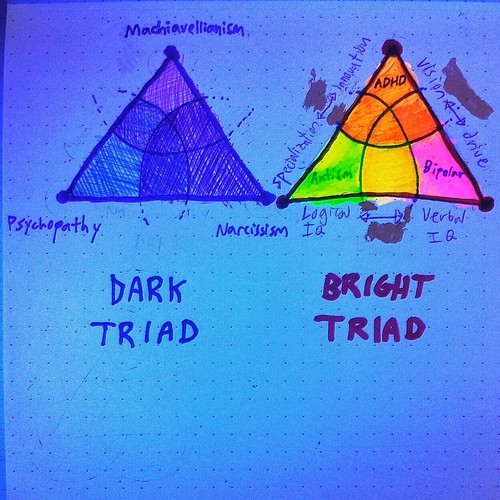
On a lighter note (pun intended), here is Ruji’s “Bright Triad”: ADHD + Autism + Bipolar.

bright_triad_don_depresso

It’s a nice antidote for the unsettling creepiness of the Dark Triad. (Click to enlarge graphic).

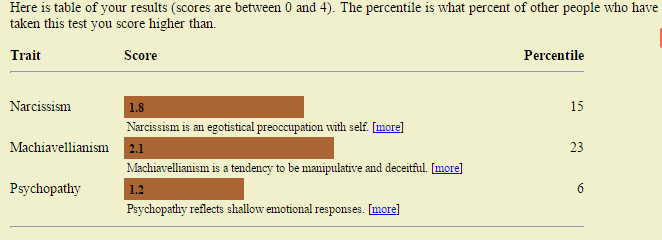
Here’s a test that will show you how high you score in Dark Triad traits:
http://personality-testing.info/tests/SD3.php

My results:
dark_triad_test

Free associating about narcissism.

narcstare

In reading and writing so much about narcissism, sometimes it seems like more questions are raised than are answered. Here are some of the random questions and thoughts I’ve had that I can’t really explain. Some of these random thoughts may seem crazy, but they are still questions and I’m still looking for answers.

Why is it that so many of us narcissistic abuse survivors don’t realize what happened to us or even have a name for it until so late in life? Most of the people I’ve met who have realized they were raised by narcissistic parents, married to narcissistic spouses or have gone No Contact are in their 40s, 50s and older. It seems so unfair to discover this at such a late age and realize how many years have been wasted or lost.

Related to this, I wonder why there seem to be so few male victims? Is it because men are more likely to have NPD and thus be the perpetrators, or is it because in our culture, men are more reluctant to express their feelings and write about them on public blogs or message boards?

Why is it the more I read about narcissism the more narcissistic traits I see in myself and the more I want to be rid of them? Sometimes it’s like looking into a mirror. Overall though, I’ve learned even more about myself than I have about the narcissists in my life, and I think that’s a good thing, even if I’m too hard on myself and am seeing narcissism that isn’t really there.

Why is it that one of the warmest, emotionally open, and seemingly most compassionate people I’ve met in the narcissistic abuse community is a woman who believes herself to be a psychopathic (malignant) narcissist? Is her warmth and openness faked and I’m a fool for falling for it, or is her “narcissism” a delusion? I’ve looked for red flags and I simply haven’t seen any, but it’s easy to misrepresent yourself online. I have pretty good sixth sense and I don’t get any “evil” vibes or feelings of discomfort from socializing with this person, and I normally do when dealing with even the “nicest” narcs IRL.

What exactly is borderline personality disorder? Is it a form of complex PTSD not recognized by the psychiatric and medical community, is it a dissociative disorder, or is it a form of narcissism where the person never constructed a viable False Self? Should it even be in the Cluster B category of disorders or is it something else altogether?

narcissist_continuum

For that matter, is NPD a form of complex PTSD so deeply ingrained in the personality so early in life it’s almost impossible to eradicate? After all, almost all narcissists were abused and that’s why they became narcissists. Should “personality disorder” labels just be scrapped completely the way BPD Transformation suggests?

Is malignant narcissism what happens when an HSP (highly sensitive person) “goes bad”? I wrote about that in this article, but I still wonder.

Can a psychopath (or a narcissist) ever do good things intentionally (and not just for supply)? I wrote about this too, and understandably, the ire of a few ACONs was raised from that particular article. I agree it seems like a stupid question because a psychopath or narcissist has no empathy. But they still have “cold empathy” which means they can know exactly how you feel but only in a cold, intellectual way. Are there any narcs or psychopaths who simply choose not to do wrong? I haven’t ever met any, but I still think it’s something worth asking. On the other hand, wouldn’t “not doing wrong” negate their “psychopathy,” even if they lack that quality called empathy? Maybe some of them just want to be seen as good, and it’s really just a way to get supply.
Here’s a fascinating interview with Dr. James Fallon, a diagnosed psychopath who chooses prosocial behaviors over antisocial ones (although his attitude in the interview does seems quite narcissistic). I think he comes off much like a cult leader so I’m very skeptical.

I’ve seen the “black eyes” many people talk about in malignant narcissists, especially when they rage. It’s very scary to see and it’s very real. Does this indicate a spiritual deficit in which part or all of their soul is corrupted (or even missing) or is there some medical reason for this? I do remember reading something describing this phenomenon in medical terms; unfortunately I’ve lost the link to that article. Personally I think there is a spiritual element involved and a malignant narcissist has chosen evil over good, even if there is a medical or scientific reason for the strangeness of their eyes. Most abuse survivors have seen this and find it as terrifying as I do.

Why would anyone in their right mind choose to be a narcissist, even if done unconsciously as a young child? Why would anyone want to shut themselves off from the ability to feel love, empathy and joy, even if the payoff means they can protect themselves from being hurt anymore? It makes no sense because most narcissists are still incredibly sensitive (about themselves) and are constantly fending off or reacting to insults. It seems like a horrible way to live.

Are all narcissists “evil”? Or is that a blanket judgment? I’m kind of torn on this. I think the higher you go on the spectrum (and I do believe narcissism is a spectrum disorder), the more evil the narcissist will be. I’ve met some low spectrum narcs who are merely full of themselves and difficult to deal with, but I wouldn’t call them evil. Maybe those people don’t really qualify as narcissists though. I think the point at which a person becomes “evil” coincides with their willingness to change. The higher you go on the spectrum, the less likely it is the narcissist will ever become self aware or willing enough to get better. There are some high spectrum narcissists who are aware of their disorder, but don’t think of it as a disorder and are unwilling to change, so self-awareness by itself is meaningless. Willingness must also be present.

Do narcissists ever have moments of being non-narcissistic or even feeling empathy? I’ve known many narcissists who care nothing about the feelings of those around them, but cry like babies when they watch a sad or touching movie, listen to music, or when their pet dies or becomes ill. Have they simply shoved all their original empathy into one or two “safe” outlets, such as the ability to feel the emotions of a fictional character who doesn’t actually exist?

Why are some of the most religious people I know also the most narcissistic? Is their faith real?

How can you really tell if a victim of abuse may actually be the real narcissist and the “narcissist” the real victim? I know this can and does happen.

These are just a few of the things I wonder about. I’m sure I’ll think of others.

Disturbing documentary about narcissists and psychopaths

I never saw this film (Narcissism: The Psychology of Demons) before. While I dislike the all-too-common merging together of the characteristics of psychopathy/sociopathy/ASPD with those of NPD (non-malignant narcissists are not without feelings, even if they are very self-centered), this is still a very interesting, scary and disturbing video describing the emotional vampires in our lives and that dominate our society.

Several people are interviewed about narcissism in the video. Zain Arcane (the smarmy Slash-looking dude in the hat and sunglasses), a vocal coach who makes videos about narcissism, gives me VERY stong narc vibes. I have read elsewhere he does in fact have NPD and is probably a psychopath. During the few minutes he takes off his sunglasses, his eyes look unfocused and lifeless and he doesn’t seem mentally all there. Maybe he’s on drugs, but there’s every reason to believe he’s a wolf in sheep’s clothing and thinks of himself as a god, based on what I read.

The creepiest part of this film is the interview with the little 5 year old girl from “Toddlers and Tiaras” and her mother (this starts at 33:32). The mother is obviously a narcissist, and has turned her daughter into her little mini-me by forcing her into beauty pageants. The little girl is already showing the odd emotional disconnection, complete self-absorption and the dead, flat eyes of the malignant narcissist/sociopath–and her self absorption is so great she doesn’t even seem to hear the interviewer and her mother talk. If this girl doesn’t get intervention very soon (and she probably will not), she is going to become an extremely dangerous, Jezebel-like woman when she gets older and utterly destroyed when her looks begin to decline. It may already be too late for her, because something about her already seems thoroughly corrupted, even evil. It’s hard for me to look at her face without wanting to recoil and get away fast.

New books for psychopathic business leaders!

business_books

Found in the same copy of MAD I wrote about a couple weeks ago … obviously this is supposed to be a joke but 3 of the titles recognize the psychopathy the business world reeks with!
Sorry about the crappy quality of the photo — my phone camera sucks.

The 3 titles are: “Blame Shifting for Success,” “Awaken the Cold and Heartless Capitalist Within,” and “The 7 Habits of Highly Dishonest People.”

No, these books are not actually for sale but they could be, because they’re not too far off from actual books about how to become a filthy rich narcissistic master of the universe.

The Psychopathy of Ayn Rand

Ayn_Rand1
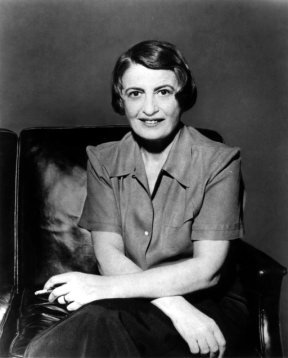
Ayn Rand1” by Phyllis Cerf (April 13, 1916– November 25, 2006), permission obtained from her son Christopher Cerf[…]Richard E. RalstonPublishing ManagerThe Ayn Rand Institute”. Licensed under Fair use via Wikipedia.

I am not, nor have I ever been, a fan of Ayn Rand, the author and philosopher who The Tea Party seems to worship with the same reverence they worship Jesus Christ (which is highly ironic, because Rand was an atheist and her values diametrically opposed to Christianity). Certain conservative pundits in recent years have twisted Rand’s ugly philosophy of selfishness (“objectivism”) into their “Christian” right-wing political agenda, and Bill O’Reilly even went so far to say that Jesus would not want to help the poor and homeless because it’s their own fault they don’t have enough to eat. These right wing pundits and politicians never stop to consider that it was the poor and homeless who were Jesus’ disciples and friends, not the rich and powerful. Rand believed that empathy and altruism were the greatest evils to beset mankind, and her childhood hero was a serial killer. She said “she liked the way his mind worked.”

I was going to write an article today about Rand’s obvious psychopathy, but someone has already done it for me. Everything I’d want to say is already here, so I am just going to reblog their excellent article, which uses the items on Hare’s psychopathy checklist to pulverize Ayn Rand because she fit every one of them (these are highlighted in bold).

THE PSYCHOPATHY OF AYN RAND
From Prophet 451’s Journal [link not available]
(stolen from Democractic Underground)
http://www.cwporter.com/psychorand2.htm

randkikestar1
Czar of all the “Rationalists”

You’ve probably heard of Ayn Rand. Most people have these days. She was the author of such inexplicably widely-read “novels” (really, barely-disguised political diatribes) as “The Fountainhead” and “Atlas Shrugged”. Her books are currently enjoying something of a boom among those who misguidedly believe they would be in the self-righteous community of “Atlases” at Galt’s Gulch. The novels themselves are of only passing interest, being long, melodramatic and mediocrely written. Rather, it is the “philosophy” at the core of the novels which bears attention.

Hear ye, hear ye, I come to bury Rand, not to praise her. While numerous conservative thinkers (and, oddly, Neil Peart) have lauded Rand as a philosopher, few academic institutions include Rand or Objectivism as a philosophical discipline. Conservatives, such as Chris Sciabarra, tend to believe that the academic left decries Rand due to her anti-communist, pro-capitalist slant. Like much of the witterings of conservatives who presume to know what the left thinks, that presumes firstly, more power than the academic left has had in decades; secondly, assumes that the left was universally pro-communist and anti-capitalist, something which has never been true and thirdly, that Rand was saying anything worth studying. She wasn’t. Rand’s “philosophy” was the same defence of endless greed which mankind has been engaged in for eternity, the same attempt to place a moral cover on pure selfishness that has long been pursued by any number of exploiters down the centuries. Nietzche was, and is, pilloried for saying “God is dead”, Rand is lauded for effectively saying “the self is God”. There is nothing new here, save perhaps for the self-delusion that allows so many professed “Christians” to adhere to a philosophy that glorifies greed and athieism. There is also a cult-like deification of Rand by her followers and “swarming” of those who dare criticise her which reminds one very strongly of Scientology (and Glenn Beck followers but that’s another matter).

There is another name for those who hold that the only proper moral consideration is the happiness of the self; for those who view empathy and compassion as weakness; who view selfishness as the only virtue: Psychopaths.

Contrary to popular belief, the psychopath is not automatically violent. Rather, the psychopath is defined by a near-complete lack of empathy. Robert Hare (who created the widely used “Hare Psychopathy Checklist”) describes psychopaths as “intraspecies predators” who use a combination of charisma, manipulation, intimidation, sexuality and violence to satisfy their own desires. The more human qualities of conscience, empathy, remorse or guilt are either completely absent or extremely limited. It must be repeated that the psychopath is not necessarily violent. Indeed, many are not because their lives have never placed them in a position where violence was the only means to satisfy their desires. Many businessmen (and therefore, many politicians) profile as psychopaths because they exhibit the core characteristics or some section thereof. Ayn Rand should also be considered a psychopath.

Hare’s checklist lists certain personality factors as indicative of psychopathy. The average person will perhaps exhibit one or, at most, two. The psychopath will exhibit all but one or two.

In no particular order, these items are: Glibness/superficial charm.

After her writings became popular, Rand collected around herself a group of cultists who virtually worshipped her. However, Shallow affection, the psychopath’s charm is only ever superficial. As one comes to know and understand the psychopath more fully, the charm which initially attracted one to them is revealed as only skin-deep. In this, Rand was entirely textbook. She was described by most who knew her best as a bitter, friendless child who grew into an equally bitter and acidic woman.

Grandiose sense of self-worth would certainly fit Rand. A woman who names her beliefs “Objectivism” out of a belief that any reasoning person who observes the objective truths of the world would necessarily come to full agreement with her would probably qualify. The fact that her little cult were required to memorise her works and discounted as “imbecilic” and “anti-life” if they asked questions simply seals the deal. Her sincere belief was that thinking freely would automatically lead to total agreement with her views.

The ruthless policing of her cult would also qualify her under the Cunning/manipulative qualifier.

Pathological lying is one that Rand is probably innocent of. So far as we know, there is no reason to believe she was a pathological liar.

Lack of remorse or guilt and Callous/lack of empathy could be described as “Ayn Rand syndrome”. These two qualifiers are really the core of her books, philosophy and worldview. In one of her books (“The Fountainhead”), her “hero”, Howard Roark, blows up a housing project he designed when a minor alteration is made and then orders the jury to acquit him (the fact that, as an architect, Roark was presumably contracted for his work and therefore, it wasn’t “his” anymore piddles all over the supposed respect for property too). [I will add here that there is a scene in “The Fountainhead” in which Roark rapes a leading female character, and Rand defends his crime because it gets him what he wants–Lucky Otter].

In “Atlas Shrugged,” her ode to the super-rich which imagines them going on strike against progressive taxation, Rand describes the rest of the world (without whom, let us not forget, the super-rich would be unable to make anything) in such niceties as “savages”, “refuse” and “imitations of living beings”.

When one of the strikers engineers a train crash (because they don’t just strike but commit acts of terrorism too), Rand makes it clear that she believes the murdered victims deserved their fate because they supported progressive taxation. A stewing hymn of Nietzchean will-to-power, misanthropy, failure to understand economics, feudalism and sexual politics verging on the obscene, “Atlas Shrugged” is full of this stuff. Her heroes spend their time both insisting that they are the heroic producers (and without labour, what are they producing exactly?) and bemoaning that others do not worship them as such. In her spare time, Rand was an admirer of serial killer William Hickman (I’ll spare you the details of his crimes save to say that they were brutal even by serial killer standards), describing him as “a brilliant, unusual, exceptional boy”; “other people do not exist for him and he does not see why they should” was her evaluation of his crimes and Rand considered this worthy of praise.

Finally, on the personality factor, there is Failure to accept responsibility for one’s actions. Since our record of Rand’s life isn’t fully detailed, it’s difficult to say how much she satisfied this one. Certainly, when her lover Nathaniel Branden found another partner, she blamed him rather than herself or her increasingly poisonous views. We shouldn’t sympathise with Rand as injured party too much here, she was herself married to someone entirely different and cruel enough to carry on the affair without regard to discretion. Indeed, if the only duty of the superman is to please himself, Branden was acting according to Rand’s ideals and she should have applauded him. She once said the USA should be a “democracy of superiors only” with “superior” being defined as “rich”. One scarcely needs to point out that such a system wouldn’t be democracy at all but oligarchy and interestingly elitist for all her followers’ claim to despise elitism.

One doesn’t need to work very hard to diagnose Rand. Her life and writings paint a vivid picture of psychopathy so clear and obvious that it is only surprising so many miss it. She was a phenomenally damaged woman for whom one can feel an element of pity (an emotion that disgusted her) even while aware of how terrifically dangerous she and her philosophy was and are.

Rand herself died alone except for a hired nurse. Her deranged views had driven away anyone who might have been close to her. Like L. Ron Hubbard, however, her lunatic ideas have spawned a cult that would turn all of us into happy little psychopaths; a cult that includes many of the world’s foremost economists, politicians and rabble-rousers (Beck again, although “intellectual terrorist” might be more appropriate). Like George Orwell, Rand imagined a dystopian world characterised by the powerful’s exploitation of the powerless. Unlike Orwell, Rand wanted to live there.

…..

I suppose I should add here that Rand was also a hypocrite. Decrying government support systems and safety nets as “coddling the incompetent and undeserving,” she unflinchingly collected both Medicare and Social Security when she contracted lung cancer late in her life. I suppose she thought she was a “deserving” exception to her own ugly philosophy of selfish callousness?