Rich people see the world differently.

richpeople_nymag

I’ve long noticed that middle, working class and lower middle class families seem to care more about each other and show more empathy and generosity to each other than upper middle class and wealthy families, who often seem cold and unsupportive, even to their own. Many upper middle class families, including my own, seem to take the “sink or swim” attitude even to their own children. They refuse to offer either emotional or financial support when you fall on hard times. Their attitude is, each man or woman is an island and no one is responsible for you but yourself. They don’t seem to believe in lending a helping hand when one of their members falls down or is having difficulty. In fact, too many seem likely to kick that person when they’re down and blame the victim for their troubles. “Well, if she had only done this or that,” or “she never listened and this is what she gets,” or “well, she always made such poor choices.” If you’re not doing well, they seem embarrassed or ashamed of you and may even exclude or shun you.

In middle to lower-class families, there just seems to be more empathy and understanding and emotional support shown to other family members who are having difficulties. They seem more likely to listen without judging or shaming, and will even try to help financially when they can, even though they might not be able to afford to.

Of course, this isn’t an ironclad rule. There are many well to do families who are very emotionally supportive and empathic to one another, and may also give generously to charity. There are also many dysfunctional lower class families who treat other family members horribly. But the class differences in empathy is a pattern I’ve noticed, especially as someone who came from one of these cold as ice upper middle class families. I think narcissism runs rampant in the upper middle class even more than the truly wealthy, who are more secure in their status. In my own family (we were far from rich, but I suppose we were solidly upper middle class), I might as well have been an orphan, for all the “love and support” I got from them over the years. Now I’m a source of shame for most of them. Oh well, too bad. I feel like I’m a better person than they are because I don’t judge people based on their physical appearance, financial status, or job title.  I look at what’s inside, or at least I try to.

I thought it was just me, but apparently there is empirical evidence that supports the idea that rich people are less empathic and care more about themselves while the less wealthy feel more like “we’re all in this together.”   This article from NYMag.com  explains the research behind this finding.

Rich People Literally See The World Differently

By Drake Baer, for NYmag.com

http://nymag.com/scienceofus/2017/02/how-rich-people-see-the-world-differently.html

The way you view the world depends on the culture you come from — in a granular, second-by-second sense. If you present a Westerner and an East Asian with the same visual scene, for instance, the former is more likely to focus on individual objects, and the latter will likely take in more of the scene as a whole. East Asians are more holistic in their thinking, the research indicates; Westerners are more analytic.

The same thing is happening with people who are from the same country, but belong to different social classes. With America’s top one percent of earners earning 81 times the average of the bottom 50 percent, the research shows how the wealthy and the working classes really do live in different cultures, and thus see the world in different ways.

One of the most powerful examples come from Michael Varnum, a neuroscientist at Arizona State University. In a 2015 paper on empathy, he and his colleagues recruited 58 participants for a brain-imaging study: First, the participants filled out a self-report on their social class (level of parents’ education, family income, and the like) before sitting down for an EEG session. In the brain-imaging task, participants were shown neutral and pained faces while they were told to look for something else (the faces were a “distractor,” in the psych argot, so hopefully the participants wouldn’t know they were being tested for empathy).

*****

Read the rest of this article here.


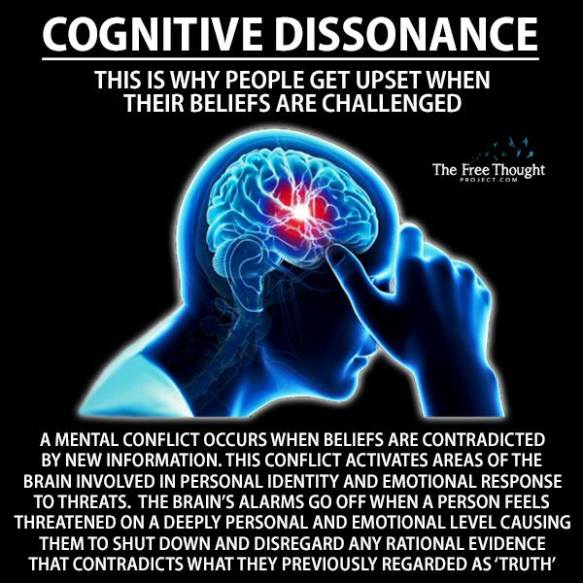
Why people get upset when you challenge their beliefs.

Image

cognitive_dissonance

Why Scientology auditing is not at all like traditional psychotherapy (Part 1)

scientology_auditing

This is an actual question an auditor asks you during the introductory (“communications”) course that is really an early indoctrination procedure.

This is my second post about Scientology.  It will be in two parts.

My first post about Scientology was about my own experience (thankfully, short lived) in the cult, but this one will focus less on my own personal experience and more on how Scientology (and the related Dianetics) “auditing” works and why it isn’t at all like (and is far inferior to) traditional psychotherapy (that is, when you have a good, empathetic therapist).

But before I get into the differences, I feel it’s necessary to give you some background about Dianetics and Scientology auditing and the religion that arose from it.

Mainstream mental health: an imperfect science.
emotional_baggage

Psychotherapy isn’t perfect, and of course, there are many bad therapists.   Even when you have a therapist who you are comfortable with and who knows what they’re doing, it can take years to be “cured.”    It isn’t an exact science, or really, much of a science at all (it’s more of an art form) so there aren’t any easy answers or sure-fire “formulas.”   Human beings are complicated, and a modality that may work well on one person may actually do nothing for another, or even make them worse.   And of course, there are many terrible therapists, who are either completely incompetent, are only in it for the money,  lack enough empathy to be effective, are unconsciously attempting to work out their own issues (which is what attracted them to the profession in the first place), and even (if they are sociopathic or narcissistic, and many are) exploit or emotionally abuse their clients.

People can also become “addicted” to their therapists. They can become overly dependent on them and never leave therapy because they feel like they can’t cope on their own.   And it’s true, some therapists do become unhealthily attached to their clients, and discourage them from ever leaving.   A good therapist who doesn’t have unresolved attachment issues will discourage a client from becoming overly dependent on them (while still projecting warmth and empathy), with the end goal being for the client to be able to leave and  function better and feel happier, using new sets of emotional tools to do so.

But psychotherapists (both psychiatrists, who are medical doctors who can prescribe drugs, and psychologists and  clinical social workers, who cannot) are bound by the law. In a best case scenario, they must abide by the law and a certain code of ethics, or be barred from practicing their professions or even face civil or criminal charges.

All these disadvantages aside, traditional psychotherapy is a positive and life-changing experience for most people who undergo it and stick with it, and it has existed for over a century.  There are many different modalities suited for different psychological disorders or problems.   There are both short term and long-term methods.   Some, like CBT or DBT, aren’t cures but are really training methods that teach a person mindfulness skills so they can function better and are less symptomatic.  Others, like Freudian or Jungian psychoanalysis, schema therapy, attachment therapy, psychodrama, EFT, hypnotherapy, and other “talk therapy” methods are long-term modalities that actually attempt to get to the root of the client’s problems or release trauma.  Many therapists mix several different modalities, and some include mindfulness tools like meditation, visualization, and relaxation techniques into their sessions.  Talk therapy can take many months or even years to have results.   In a best case scenario, the client will be cured of whatever is ailing them.  Even if they aren’t cured, a lot of the charge that was feeding their disorder is removed. Some disorders, especially those that have a physical component or are due to faulty neurological “wiring” respond better to drugs than to talk therapy, and continued management by a psychiatrist may be necessary, even though improvement in symptoms is almost immediate.

Scientology’s beginnings. 
dianetics

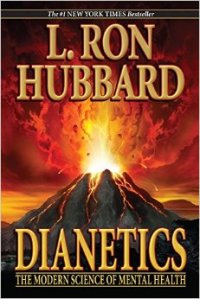
The book that started it all.

Scientology has always been very hostile to both psychiatry and psychology.  L. Ron Hubbard, a second rate science fiction author, had always been fascinated with the human mind and how it worked.  He published his bestselling  book about his discoveries, “Dianetics: The Modern Science of Mental Health” in 1950.  Dianetics is a bastardization of traditional psychoanalysis, but really isn’t much like it at all.   Hubbard was a sociopathic narcissist who had no degree in psychology and in fact lied about many of his accomplishments.

Dianetics uses elements of Freudian psychoanalysis, but is based on the belief that almost all people have “engrams” (unless they are “natural clears,” which are very rare).  Engrams are cellular imprints of moments of trauma that always contain some sort of physical pain and the “unconsciousness” that accompanies a painful or traumatic event.    The part of the mind that contains the “engrams” is called the reactive mind, and the goal of Dianetics “auditing” is to remove all the engrams through “reliving” the memories associated with them, so the person eventually attains a state called “Clear,” which means they have no reactive mind anymore and can act in rational and healthy ways not based on unconscious painful memories or trauma.

psychiatrykills

A Scientology anti-psychiatry demonstration.

In the early years of Dianetics, Hubbard attempted to get it recognized as a valid form of psychotherapy, but his book and methods were rejected by the mental health community. Hubbard, being a malignant narcissist who was devastated by this massive narcissistic injury, turned against the entire mental health field.  He vilified it and preached  to his followers that psychiatry and psychology were the worst evils to befall mankind and that Dianetics was the only valid way to become a happy and functioning person.


A new religion is born.

scientology_church

Hubbard began to market his book through the same pulp science fiction magazines  that published his stories, and his Dianetics book proved popular.  Many people claimed to be helped through Dianetics auditing, but this wasn’t enough for Hubbard.    He was quoted as saying, “the quickest way to become rich is to start your own religion,” and so he did.   Not only could he become the messiah of his own church based on his “miracle cure,” he also no longer had to pay taxes.    He trained many new auditors and started the Church of Scientology in December, 1953.    He added the levels of O.T. (Operating Thetan) states that go beyond the state of Clear.  An OT supposedly had complete control over matter, energy, space, and time, and at the highest level, could perform Herculean actions without even needing a body to do it.

To his religion Hubbard added a “space opera” cosmology, which sounds suspiciously like a plot in one of his stories.   The level of OT III is the level at which the “top secret” cosmology is finally revealed (of course, now due to the Internet, anyone can find out about it for free).   Supposedly, an evil galactic ruler called Xenu, who lived 75 million years ago, thought his planets were overpopulated and had most of the population frozen and dumped into volcanoes in Hawaii (which didn’t exist 75 million years ago), and programmed their spirits (thetans) with the “R6” implant, which is the reason why traditional religion and mental illness (and all other evils of mankind) came into being.    These disembodied spirits were then released and attached themselves to living people as “body thetans” (BT’s).  BT’s are analogous to possession by minor demons.   A person at the OT levels spends much time “auditing out” the BT’s to achieve more perfect spiritual enlightenment.  Scientology’s insane doctrine was illustrated in a famous episode of South Park in 2005.      It’s so unbelievable that the show had to show disclaimers at the bottom of the screen that said, “This is what Scientologists actually believe.”

xenu

From “Trapped in the Closet,” South Park episode.

Hubbard believed if this “top secret” material were revealed to someone at a lower level of “processing,” that they would die of pneumonia or go insane.  His real fear was probably that people might laugh his church out of existence.  Of course, most Scientologists (at least before the Internet) don’t even know about this secret doctrine because so few of them have achieved the state of OT III.   Many (who haven’t been completely brainwashed into believing anything they are told) leave when they find out.   Others are offended that figures like Jesus or the Buddha are considered “implants” who never even existed, especially since when they first joined Scientology, they were promised that their own religion was not incompatible with Scientology.  At OT III, they find out they must renounce their former religious beliefs, if they still had any.  It’s the ultimate bait and switch, something Scientology is well known for.

“You don’t get rich writing science fiction.  If you want to get rich, you start a religion.” — L. Ron Hubbard

Scientology also co-opted the Christian cross (although the eight pointed version Scientology uses is actually based on the Rosicrucian cross) and sometimes requires its clergy (professional auditors and high ranking church officials) to wear clerical collars in public to seem more authentic.

During the late 1950s through the 1970s, when people were becoming interested in alternative therapies and “new age” religions, the Church of Scientology exploded in popularity, until the late 1970s when the IRS and the FBI descended on Hubbard and his church due to tax fraud and other shady and unethical activities conducted at Scientology’s headquarters and at its paramilitary offshoot, The Sea Org.  While Scientology remains popular, especially among celebrities and the very wealthy, the costs of Scientology training and Dianetics auditing are far too expensive for the average person to afford, so the only people who can move up the “Bridge” and attain the rarified Clear or O.T. (Operating Thetan) states, are the very wealthy or those unfortunates who “work off” the expense as residents of the Sea Org (and rarely achieve those states anyway).

Dianetics and Scientology auditing vs. traditional psychotherapy. 

Moving away from the religious aspects of Scientology and back to its original purpose as a form of “therapy” (and most people who undertake Dianetics or Scientology auditing are only using it as a form of therapy anyway, having no idea of what they’re really getting into), please read Part 2:

Why Scientology auditing is not at all like traditional psychotherapy (part 2).

The Still Face Experiment (with an observation about Caylee Anthony).

I was reminded of the Still Face video again today and think it’s so important because it shows how vital attachment is to develop a healthy sense of self. Watch how quickly this child in the experiment notices the mother’s lack of mirroring and how hard she tries to make an emotional connection.

***THESE VIDEOS MAY BE TRIGGERING***

Caylee Anthony and Casey Anthony

I was watching some Caylee Anthony videos that were filmed by her mother Casey before she murdered her daughter.   The lack of interaction with Caylee in these videos is very creepy and disturbing.  Casey apparently didn’t physically abuse her daughter (at least not anything that could be readily seen), but was starving her emotionally.  She would sit and film her daughter but not interact with her at all.  You can see Caylee reacting in ways very similar to the baby in the Still Face video experiment,except that Caylee almost never cried, which make you wonder if she had already partly given up.

In this video, you can see how frustrated and confused Caylee is.

https://www.youtube.com/watch?v=sCYd9hKh4Dw


luckyotter's avatarLucky Otters Haven

Here is a dramatic video that shows how powerful the lack of mirroring is on an infant. It’s amazing how quickly the baby in this video notices the mother’s lack of affect and responds negatively to it. This is at the root of attachment disorders in children and most personality disorders, especially Cluster B. Without appropriate mirroring a child can’t develop empathy because it has never been modeled for them.

https://www.youtube.com/watch?v=apzXGEbZht0

View original post

The elimination of NPD from the DSM would be a disaster

narcissus

Apparently, the removal of Narcissistic Personality Disorder (DSM-V code 301.81; ICD-10 code F60.81) from the Diagnostic and Statistical Manual of Mental Disorders is still being considered.   Sam Vaknin talks about it in this video.

I think its removal would be disastrous. It already scares me that narcissism seems to be increasingly regarded as an advantage in today’s winner-take-all society and that we even have a potential US President who is a poster boy for malignant NPD. Trump has even been given the NPD label by many mental health professionals. Yet he still remains popular and is a serious contender for our next President.

But narcissism (not the healthy, but the pathological type) is definitely not a positive thing. Narcissists are actually miserable people even if they become successful (and many of them do not). These are people without a real sense of self, who have constructed a false one to compensate and must feed off others like vampires to keep their false self intact. They do others a lot of damage, even if they think they don’t have a problem. Under the facade, these are people who have a vast well of emptiness inside and if the false self is removed through loss of narcissistic supply, will become deeply depressed, possibly psychotic, and even suicidal. NPD is a serious mental illness, but I think people tend to forget that, because on the surface, people with this disorder can seem so functional. SEEM is the operating word here.

Many self-help books, especially those that tell you how to be successful, encourage you to develop narcissistic traits. I think these books are dangerous, not only because they encourage people to become narcissists, but also because they have caused a shift in thinking about NPD to the point that many no longer consider it a mental illness and in fact think of it as something to strive for. We need to stop pretending narcissism isn’t a problem. More attention needs to be paid not only to the damage narcissists cause others, but also to the internal world of the NPD, which is a painful and bleak one. NPD is a serious mental illness, not a “personality type.” Its removal from the DSM would cause untold damage to the world.

We also need more mental health specialists who are actually trained to treat people with NPD. I think part of the reason why it’s under consideration for removal is because most therapists don’t want to treat people with NPD. If you have the diagnosis, you are shown the door. They don’t want to deal with you and assume you are incurable. Hence, there are more narcissists walking around doing damage to themselves and others than ever before. I don’t think the non-malignant type of narcissist is as incurable as people think; it’s just because it isn’t an easy disorder to treat and therapists don’t want to be bothered working with people who have it. Old-school psychiatrists and psychologists such as Kohut, Kernberg, Masterson, and Lowen treated people with NPD successfully in their practices, but we seem to have forgotten that and just assume it’s incurable and worse, that it’s not even a mental illness but a personality type. This needs to change!

#22 – Proof That Borderlines Are Motivated for Psychotherapy and Can Fully Recover

BPDTransformation used to be one of my commenters but has not posted anything in his blog in over a year, or made any more comments here.   Edward (his real name) wrote fascinating, intelligent, and extremely well researched articles about BPD, which he was diagnosed with. At some point he came to believe BPD was a bogus diagnosis, a catchall for an array of symptoms that weren’t easily classified or understood. (Some people believe BPD and C-PTSD are the same disorder, which does make sense to me).

Edward, who became BPD-free, writes here about how motivated many borderlines are to recover, and how effective psychotherapy can be in healing this disorder. This flies in the face of the common belief that because BPD is in the Cluster B group of personality disorders, that it’s just something you have to resign to yourself to having forever.

The article, like all of Edward’s articles, is a bit on the scholarly side, but is still a very good read and helps reduce the stigma against people with BPD.

bpdtransformation's avatarBPD Transformation

This post will answer critics who say: “Borderlines are not motivated to attend therapy. Borderline patients don’t stay in treatment. At best, therapy can manage but not cure BPD.”

These statements are absolutely false. Yet these myths continue to appear online, often being communicated to people recently diagnosed. As the studies below demonstrate, most people diagnosed with BPD do want help, most will stay in good treatment, and most do recover to different degrees.

Earlier posts have elaborated my dim view of the (non) validity of the BPD diagnosis. Since it cites studies using the BPD construct, this post might be viewed as hypocritical. That may be a valid criticism! Nevertheless, these studies provide evidence that people with “borderline symptoms”, however defined, can be motivated and recover both with and without therapy

Study 1:  88 Borderline Patients Treated Twice a Week for Three Years

Highlights: Led by Josephine Giesen at…

View original post 3,215 more words

Regression.

This is what’s going on with me now.    Comments are disabled here; please leave comments under the original post.

How to reparent yourself.

This short post went viral on my other blog, although I really have no idea why because not a whole lot of thought went into it and I wrote it on the fly, but it seemed to resonate, so I’m reblogging it here too. (Chair Girl is the name I give to my inner child in therapy).

The Male Borderline Waif

This is a good article about an overlooked subject–the male borderline. BPD is usually associated (and diagnosed) in women; men are more often diagnosed with NPD. But they aren’t the same disorder, and this article explains what a man with the introverted/fragile sort of BPD can be like. (The more aggressive types of male Borderlines are often mistaken as having Antisocial Personality Disorder due to their impulsivity and acting-out behavior, which sometimes gets them in trouble with the law). There’s a lot of gender bias in the diagnosis of mental illness and BPD is one of the most stigmatized and misunderstood of all the disorders.

MJ's avatarOut of the Mire

I’ve written a lot on borderline personality disorder (BPD) on this blog largely because my mother has the disorder.  It is not something I wish to vilify, and I don’t want to verbally mistreat people who have been diagnosed with it either.  Of all the personality disorders, BPD is the most stigmatized.  Many therapists refuse to treat it or see clients who carry the diagnosis altogether.  That is a hard road to walk when one has the disorder, and it’s also a very difficult situation if you love someone with it.  Where do you turn? What resources are available to you when there are so little available to your loved one with BPD?

Another inherent problem is that of diagnosis.  Many people struggling with BPD are never diagnosed and, therefore, never treated due to 1) treatment resistance 2) refusal to seek help.  The other factor? Gender bias within the clinical…

View original post 1,665 more words

Test of the 3 R’s (acquired situational narcissism vs. NPD)

narcrealityshows

I just read an interesting article by Sam Vaknin (author of Malignant Self-Love) describing a condition that afflicts some celebrities and other high-profile people or people who achieved overnight success, called Acquired Situational Narcissism (ASN). It can also occur in codependents of a narcissist (what the ACON community calls “fleas”). ASN can mimic NPD, but tends to diminish over time or if the person’s fortunes change. But a more important difference is that a person with ASN isn’t lacking what he calls “The Three R’s.” These are:

1. Remorse
2. Remediation
3. Restoration

Narcissism is used as a coping strategy but doesn’t necessarily become a life sentence. I’ve done enough editorializing, so here is the article.

The Test of Three R’s
By Sam Vaknin
http://www.selfgrowth.com/articles/the-test-of-three-rs

Acquired Situational Narcissism can be induced in adulthood by celebrity, wealth, and fame. But, it may also occur in a variety of other situations. Codependents, aiming to fend off gnawing abandonment anxiety, can resort to and evolve narcissistic and even psychopathic behaviours and traits in order to cater the whims of their “loved” ones; in anomic societies and depraved cultural or religious settings, people with a conformist bend tend to adopt antisocial modes of conduct and personal style so as to “fit in” and belong.

How can we tell whether one’s narcissism is of the ephemeral, derivative variety – or an integral, immutable, and inalienable feature of his or her personality? By applying the test of “Three Rs”: Remorse, Remediation, and Restoration.

To qualify, remorse has to be expressed repeatedly and must be heartfelt. It should entail a modicum of sacrifice, embarrassment, and inconvenience. Regretting one’s misdeeds in public is more convincing than sending a private missive or whispering “sorry” anonymously. Remediation requires making amends and offering reparations, which are commensurate with the offending acts and bear some symbolic relation to them. Thus, financial abuse can be absolved only with the aid of a monetary compensation that corresponds to the damage done and suffered. Finally, restoration involves affording one’s victims the opportunity for closure, if not forgiveness, so that they can move on with their lives.

True narcissists and psychopaths fail the Three Rs test at every turn: their remorse is feigned and ostentatious; they provide little or no recompense; and they never put themselves at the victim’s disposal to allow her to achieve that she needs most: closure.

Read the rest of Sam’s article here.

Related to this, on February 22, writer/producer Nancy Fulton will be interviewing Sam Vaknin about the portrayal of narcissists in media and entertainment. More info can be found here.