On narcissists who want to be cured.

narcissists_cant_change
We shouldn’t just dismiss them as hopeless until we know more.

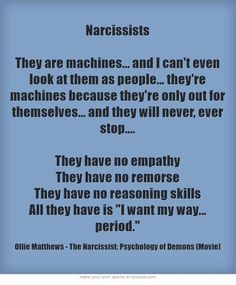
The above quote is a common sentiment among survivors of narcissistic abuse, and healthy when we are trying to go No Contact with a narcissist who has tried to ruin us, or cope with a narcissist we can’t practically disconnect from. To give a narc any benefit of the doubt during these times is what has kept us trapped in a sick and destructive relationship. Many of us are also empaths and that’s the very quality that has kept us trapped in the hellish merry-go-round of the cycle of abuse. When we’re leaving our narc (or trying to cope with one), it’s healthiest for us to give them no benefit of the doubt at all. It serves us best to think of them as inhuman machines, devils, or monsters with no ability at all to love or to feel real emotions.

But is it fair or realistic to think of them this way? I don’t think it is, because narcissists aren’t machines, demons or monsters. They are human beings with a terrible mental disorder that causes them to attack and manipulate others for their own gain. I’ve come to a point in my healing where my narcs are safely out of my life, and I can finally afford to think of them as fellow humans and even have a degree of empathy for them. It’s nice to not hate, but am I deluded?

Do narcissists really suffer?

Obviously, I read a lot of blogs and forums about NPD and narcissistic abuse. There seem to be very few websites for people suffering from NPD, which you would expect, since narcissists are more likely to cause suffering in others than suffer themselves.
NPD

It has been argued that narcissists do suffer, but they suffer alone. They don’t want you to know. They aren’t likely to seek help for their disorder unless they’ve lost a major source of narcissistic supply, and the defensive structure they have built for themselves is seen by the narcissist as the flimsy house of cards it really is. I believe this is all true, but some narcissists are so out of touch with reality and their true self that they project their misery and emptiness onto others and keep lying even to themselves.

But occasionally, even on victims’ boards and blogs (the following is from a Christian-oriented blog with a strong focus on victims of narcissistic abuse whose pastor owner is unusually compassionate toward people with NPD), I see a post like this:

Wow! Reading this is very sobering. I an not a victim of this, but the oppressor! I admit that I have been this way. I am saved but I am discovering that my while life I have really been a selfish narcissist. My question is this- is hope for an unempathetic narcissist like me? I am honestly sick and tired of my selfish ways and the way I’ve hurt others and have lacked any empathy or emotional feelings for others. I trust that Christ can help me out of this, but does anyone have some advice or testimony for a narcissist who WANTS to change? I always see alot of literature for the victims of narcissistic abuse and I give my utmost respect to the victims, but what about us perpetrators who want to give this up? Any feedback put advice will help.

The narcissist, who calls himself “Michael,” followed up his post with this:

It bothers me a lot that i lack love and empathy for others. I can’t feel life the way I want to. I think my narcissism problems are largely fear-based, over rejections that happened to me at a young age. Also, I admit I’m just addicted to pleasing my self and I don’t know how to truly love someone else. It is no fun being a narcissist, it is miserable. It really bites when it seems everyone else around you knows how to love and feel deep empathy and passion, while you’re feeling “stuck in an emotional bubble”.

Posts like these ones by Michael give me hope that somewhere inside their blighted souls, narcissists still possess a seed of goodness and with enough water and sunlight, that seed can grow into something beautiful, healthy and good.

I remember several months ago a self-proclaimed narcissist came to this blog and wrote a seemingly heartfelt post that he or she wanted to change. It floored (and moved) me enough to write an entire article about it.

Malignant optimism.
I still can’t get over my childlike excitement whenever it appears a narcissist wants to get well. I’m just like a 4 year old with an ice cream cone. Sam Vaknin calls this malignant optimism. Is he being overly pessimistic about the possibility of a cure, or is he right?

I don’t know the answer to that.

malignant_optimism
Malignant optimism.

As a Christian (and a codependent), I tend to want to give people the benefit of the doubt. After all, we’re all God’s children. He made us in His own image. I always try to look for the good even when all I can see is the bad. I do believe in evil, however, and that there are truly evil people in this world. I like to think they’re not that common though. So when a narcissist says they want to change, how can I sit there and pass judgment and assume they’re just lying? To do that would make a narcissist of me. Maybe there are moments of clarity or windows that occasionally open in their dirty souls to let in the light. How can I say they’re not telling the truth? Maybe they are. They are still human beings with souls, after all.

Maybe they aren’t really narcissists.

Then there’s the possibility that a narcissist who goes on a blog or forum and writes a post about wanting to be cured, isn’t actually a narcissist at all. Very few narcissists have the insight or desire to change. Maybe “narcissists” who write posts like this really suffer from some other disorder that causes them to hurt others and lack empathy, like Borderline Personality Disorder or even certain anxiety disorders like OCD (whose sufferers may also seem to lack empathy) or psychotic disorders like schizophrenia (although the pleas for help I have seen by narcissists certainly don’t sound like they’re written by schizophrenics).

“Michael” (the above quoted poster who claims to be a narcissist), wrote about how the Holy Spirit was trying to change him but he kept fighting against it. He doesn’t sound much like a narcissist at all in this followup, but there’s no way to tell for certain without an official diagnosis. Maybe he has another disorder besides narcissism. It’s an interesting post though, because he speaks about the bullying and abuse he endured that may have caused him to develop NPD. If he does have NPD, he seems to have both insight and the desire, and that’s a good omen.

Wow thank you for that insight. I will also add i have a great deal of apathy in my life. It’s like i don’t care about others, God, life, or even my own well-being at times. But having Christ in my heart, it’s like the Holy Spirit wants it but my flesh does not.

I never handled shame or rejection well as a kid. At a young age, I was bullied in school until the end of my middle school years. I wanted acceptance from my peers- from women I wanted attention, from men I wanted respect. I didn’t receive either, so I put on a facade of myself to fit in so I would be “accepted”. My whole life I’ve been emotionally numb, and I hate it how it’s like I don’t even cry when i should, like when a loved one passes away, or when someone shows a deep display of love, just as Jesus did. Even in my Christian life, I feel like the Gospel hasn’t really penetrated me on that deep heart level yet because I cannot really love or feel love. I guess only God is the answer to this, because i sure can’t do this in my own strength.

abused

The cost-benefit analysis of healing.

If it’s possible for a narcissist to be cured of their disorder (not merely treated), it’s not going to be an easy or a short process for them or their therapists. (I’ll explore this more in a later post, but I’ve already written about it in other posts about NPD healing regimes such as Attitudinal Healing and Reparenting). It’s a topic that’s fascinating to me, and I also have a vested interest in it because it gives me hope for the narcissists in my own life that I have cared about and even loved. This could include my beloved daughter, who may have a mild form of NPD (but is more likely Borderline–the jury’s still out on that).

smashingmirror

Obviously, some narcissists would be more curable (or at least more treatable) than others. They must have both the insight into their disorder and the desire to change. They must be willing to undergo enormous psychic pain and terror as they confront their true self and shed their false self. Desire without insight isn’t possible, but insight without desire is. If narcissism has been beneficial to its sufferer, they may not want to be rid of their disorder, even though they still may be in immense psychic pain. Whether they are willing to be cured requires a cost-benefit analysis of whether undergoing intense and painful emotional catharsis is worth giving up whatever benefits narcissism has afforded them. For the vast majority, it probably isn’t. Even if they willingly enter therapy, once the painful process of healing is underway, they are likely to run away in terror and put their masks back on.

I have to be realistic too, and not dismiss the tragic possibility that a narcissist can want to change, but have no hope at all of it actually happening. All I can do is pray that God will step in and help them find their way to the light. I pray for them every day, as well as the more numerous people they have victimized.
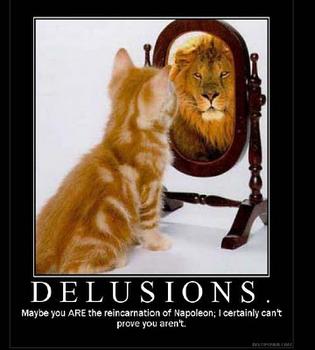
The grandiose, deluded narcissist.

deluded

The website Sociopath World, a blog by and for sociopaths (and psychopaths), is full of intriguing articles and blog posts about sociopathy and related disorders, such as Narcissism.

Naturally, I clicked on the section on Narcissism and among many entries about remorseless criminals, sadistic murderers, and narcissistic psychopaths, I found this hilarious but sad little gem about Mary Roach, a long forgotten American Idol auditionee, a young woman who shows every trait of narcissism you can imagine and is pitifully deluded about her singing ability. If there was ever a poster child for NPD, Mary was it.

The 9 Psychiatrically Recognized Traits of NPD:

–Has a grandiose sense of self-importance (e.g., exaggerates achievements and talents, expects to be recognized as superior without commensurate achievements)
–Is preoccupied with fantasies of unlimited success, power, brilliance, beauty, or ideal love
–Believes that he or she is “special” and unique and can only be understood by, or should associate with, other special or high-status people (or institutions)
–Requires excessive admiration
–Has a very strong sense of entitlement, e.g., unreasonable expectations of especially favorable treatment or automatic compliance with his or her expectations
–Is exploitative of others, e.g., takes advantage of others to achieve his or her own ends
–Lacks empathy, e.g., is unwilling to recognize or identify with the feelings and needs of others
–Is often envious of others or believes that others are envious of him or her
–Regularly shows arrogant, haughty behaviors or attitudes

It’s only necessary to have five of these traits to be diagnosed with Narcissistic Personality Disorder; Mary appears to have more than five, if not all of them.

I decided to post about poor forgotten Mary Roach rather than another depressing article about a murderer, cult leader, or abusive parent, in part because the subject matter is lighter and even funny in its sad way, but to show just how deluded and out of touch with reality “normal” everyday non-criminal narcissists can be.

Given that reality shows are swarming with narcissists, Mary wasn’t that unusual on a show like this, but even in an environment where narcissistic traits are probably beneficial if not actually necessary, Mary’s particular brand of narcissism stands out for its complete disconnect from any semblance of reality.

I’m also posting the original write up from Sociopath World because it’s so spot on. (Some of the dialogue in the video is most likely scripted, but I have no doubt Mary is very high on the narcissist spectrum).

Famous narcissist? Mary Roach
A friend sent me this. Obviously it’s hilarious, but it’s also a really good example of what if feels like watching a narcissist at work (to all of your narcissist readers that this blog apparently attracts?). There’s something so blatantly ridiculous about the way they act and how disconnected they are from reality.

Mary is absolutely immune to criticism and when confronted with the truth about her singing, she immediately assumes that her critic has a personal issue with her that is driving the criticism as opposed to merely stating the obvious truth. One of the more obvious narcissist qualities is that when the judges start playing with her, she doesn’t fight it or immediately defend herself but plays along. She wants it to seem like she is in on any joke that they might be having and even if the joke is at her expense she would rather have the attention (even negative) than cede the spotlight. When they give her the goodbye, she keeps the conversation going, although it means rehashing their worst criticism of her. She also feels compelled to turn the tables and judge them for their appearances, as being smaller, thinner, prettier, and “hot.” She doesn’t need to criticize them necessarily — it is enough that they seem interested in her assessment of them. Of course they did not ask her for her opinions on them, but she manages to misunderstand a direct question and act as if she has some unique vision that warrants sharing.

It’s so funny to watch this because I know someone who acts exactly this way, even down to the little awkward mannerisms, especially the shrug at 4:50. The world is just not ready enough to appreciate their talents, but ain’t no thing. These people can’t be kept down for long by haters.

Sociopath vs. psychopath: is there a difference?

psychopathy

I’ve been using the terms psychopath and sociopath interchangeably on this blog, even though I’m aware there are differences between the two. I was curious enough to Google what the difference is, and came across an article in Psychology Today that explains how they are alike–and how they differ.

How to Tell a Sociopath from a Psychopath
By Dr. Scott Bonn

Many forensic psychologists, psychiatrists and criminologists use the terms sociopathy and psychopathy interchangeably. Leading experts disagree on whether there are meaningful differences between the two conditions. I contend that there are clear and significant distinctions between them.

The fifth edition of the Diagnostic and Statistical Manual of Mental Disorders (DSM-5), released by the American Psychiatric Association in 2013, lists both sociopathy and psychopathy under the heading of Antisocial Personality Disorders (ASPD). These disorders share many common behavioral traits which lead to the confusion between them. Key traits that sociopaths and psychopaths share include:

A disregard for laws and social mores
A disregard for the rights of others
A failure to feel remorse or guilt
A tendency to display violent behavior
In addition to their commonalities, sociopaths and psychopaths also have their own unique behavioral characteristics, as well.

Sociopaths tend to be nervous and easily agitated. They are volatile and prone to emotional outbursts, including fits of rage. They are likely to be uneducated and live on the fringes of society, unable to hold down a steady job or stay in one place for very long. It is difficult but not impossible for sociopaths to form attachments with others. Many sociopaths are able to form an attachment to a particular individual or group, although they have no regard for society in general or its rules. In the eyes of others, sociopaths will appear to be very disturbed. Any crimes committed by a sociopath, including murder, will tend to be haphazard, disorganized and spontaneous rather than planned.

Psychopaths, on the other hand, are unable to form emotional attachments or feel real empathy with others, although they often have disarming or even charming personalities. Psychopaths are very manipulative and can easily gain people’s trust. They learn to mimic emotions, despite their inability to actually feel them, and will appear normal to unsuspecting people. Psychopaths are often well educated and hold steady jobs. Some are so good at manipulation and mimicry that they have families and other long-term relationships without those around them ever suspecting their true nature.

When committing crimes, psychopaths carefully plan out every detail in advance and often have contingency plans in place. Unlike their sociopathic counterparts, psychopathic criminals are cool, calm, and meticulous. Their crimes, whether violent or non-violent, will be highly organized and generally offer few clues for authorities to pursue. Intelligent psychopaths make excellent white-collar criminals and “con artists” due to their calm and charismatic natures.

The cause of psychopathy is different than the cause of sociopathy (1). It is believed that psychopathy is the result of “nature” (genetics) while sociopathy is the result of “nurture” (environment). Psychopathy is related to a physiological defect that results in the underdevelopment of the part of the brain responsible for impulse control and emotions. Sociopathy, on the other hand, is more likely the product of childhood trauma and physical/emotional abuse. Because sociopathy appears to be learned rather than innate, sociopaths are capable of empathy in certain limited circumstances but not in others, and with a few individuals but not others.

Psychopathy is the most dangerous of all antisocial personality disorders because of the way psychopaths dissociate emotionally from their actions, regardless of how terible they may be. Many prolific and notorious serial killers, including the late Ted Bundy and John Wayne Gacy, and Dennis Rader (“Bind, Torture, Kill” or BTK) are unremorseful psychopaths. Psychopathic killers view their innocent victims as inhuman objects to be tormented and violated for their amusement.

Contrary to popular mythology, most serial killers are not mentally ill or “evil” geniuses. See my related article: http://www.psychologytoday.com/blog/wicked-deeds/201406/serial-killer-myth-1-theyre-mentally-ill-or-evil-geniuses

tedbundy ed_gein
Although both were deadly serial killers, Ted Bundy was a psychopath who gave a good impression and knew how not to get caught; Ed Gein was most likely a sociopath who acted more impulsively, was more disorganized and didn’t give a very good first impression. Though both men’s crimes were equally heinous, Bundy’s eyes seem “colder” than Gein’s.

Although the traits of a psychopath more closely resemble those of a person with Narcissistic Personality Disorder (NPD) than those of the more impulsive, disorganized sociopath, both are actually described here as variations of ASPD, not NPD. Once again, if ASPD is really “NPD on crack” then it follows that NPD and ASPD are both on the same spectrum, with ASPD (and psychopathy/sociopathy) at the top of the spectrum. If this is in fact the case, people with NPD, even malignant narcissists, may border on psychopathy, but would not actually qualify as true psychopaths.

Here’s a little graph I devised to illustrate where all the Cluster B disorders may fall on a spectrum. These are just my guesses and are not based on psychological research, just my instinct and gut feelings.

psychopathy_graph
Click image to enlarge.

Are you being “gaslighted”?

I found an interesting article on A Healthy Place about the emotional abuse practice of gaslighting. I never knew the various types of gaslighting actually had names!

Here’s everything you need to know about this sinister manipulation tactic used by narcissistic abusers, and how to tell if you’re a victim.

Gaslight-2

Gaslighting Definition, Techniques and Being Gaslighted
Written by Natasha Tracy

Gaslighting is a form of emotional abuse where the abuser manipulates situations repeatedly to trick the victim into distrusting his or her own memory and perceptions. Gaslighting is an insidious form of abuse. It makes victims question the very instincts that they have counted on their whole lives, making them unsure of anything. Gaslighting makes it very likely that victims will believe whatever their abusers tell them regardless as to their own experience of the situation. Gaslighting often precedes other types of emotional and physical abuse because the victim of gaslighting is more likely to remain in other abusive situations as well.

The term “gaslighting” comes from the 1938 British play “Gas Light” wherein a husband attempts to drive his wife crazy using a variety of tricks causing her to question her own perceptions and sanity. Gas Light was made into a movie both in 1940 and 1944.

gaslighting2

Gaslighting Techniques and Examples
Gaslighting is emotional abuse that aims to make victims doubt their own perceptions and memories. Find out if you are being gaslighted in your relationship.There are numerous gaslighting techniques which can make gaslighting more difficult to identify. Gaslighting techniques are used to hide truths that the abuser doesn’t want the victim to realize. Gaslighting abuse can be perpetrated by either women or men.

“Withholding” is one gaslighting technique where the abuser feigns a lack of understanding, refuses to listen and declines sharing his emotions. Gaslighting examples of this would be:

“I’m not listening to that crap again tonight.”
“You’re just trying to confuse me.”

Another gaslighting technique is “countering,” where an abuser will vehemently call into question a victim’s memory in spite of the victim having remembered things correctly.

“Think about when you didn’t remember things correctly last time.”
“You thought that last time and you were wrong.”
These techniques throw the victim off the intended subject matter and make them question their own motivations and perceptions rather than the issue at hand.

It is then that the abuser will start to question the experiences, thoughts and opinions more globally through statements said in anger like:

“You see everything in the most negative way.”
“Well you obviously never believed in me then.”
“You have an overactive imagination.”

“Blocking” and “diverting” are gaslighting techniques whereby the abuser again changes the conversation from the subject matter to questioning the victim’s thoughts and controlling the conversation. Gaslighting examples of this include:

“I’m not going through that again.”
“Where did you get a crazy idea like that?”
“Quit bitching.”
“You’re hurting me on purpose.”

“Trivializing” is another way of gaslighting. It involves making the victim believe his or her thoughts or needs aren’t important, such as:

“You’re going to let something like that come between us?”

Abusive “forgetting” and “denial” can also be forms of gaslighting. In this technique, the abuser pretends to forget things that have really occurred; the abuser may also deny things like promises that have been made that are important to the victim. An abuser might say,

“What are you talking about?”
“I don’t have to take this.”
“You’re making that up.”

Some gaslighters will then mock the victim for their “wrongdoings” and “misperceptions.”

Gaslighting Psychology
The gaslighting techniques are used in conjunction to try to make the victim doubt their own thoughts, memories and actions. Soon the victim is scared to bring up any topic at all for fear they are “wrong” about it or don’t remember the situation correctly.

The worst gaslighters will even create situations that allow for the usage of gaslighting techniques. An example of this is taking the victim’s keys from the place where they are always left, making the victim think she has misplaced them. Then “helping” the victim with her “bad memory” find the keys.

gaslighting

Are You a Victim of Gaslighting Emotional Abuse?
According to author and psychoanalyst Robin Stern, Ph.D., the signs of being a victim of gaslighting emotional abuse include:

You are constantly second-guessing yourself.
You ask yourself, “Am I too sensitive?” a dozen times a day.
You often feel confused and even crazy at work.
You’re always apologizing to your mother, father, boyfriend,, boss.
You can’t understand why, with so many apparently good things in your life, you aren’t happier.
You frequently make excuses for your partner’s behavior to friends and family.
You find yourself withholding information from friends and family so you don’t have to explain or make excuses.
You know something is terribly wrong, but you can never quite express what it is, even to yourself.
You start lying to avoid the put downs and reality twists.
You have trouble making simple decisions.
You have the sense that you used to be a very different person – more confident, more fun-loving, more relaxed.
You feel hopeless and joyless.
You feel as though you can’t do anything right.
You wonder if you are a “good enough” girlfriend/ wife/employee/ friend; daughter.

Is antisocial personality disorder really NPD on crack?

I have to admit I’ve been confused by the distinctions between the Cluster B personality disorders, especially those of NPD and ASPD. There seems to be little distinction in most literature between NPD and ASPD (antisocial personality disorder) with most experts saying the difference is just a matter of degree, with ASPD (psychopathy or sociopathy) being higher on the spectrum than NPD.

Let’s turn to the Bible of mental disorders for some clarification. These are from the DSM IV-TR, but have apparently been updated, because these descriptions are all labeled obsolete. But for our purposes, I’ll stick with these criteria.

Diagnostic criteria for 301.81 Narcissistic Personality Disorder

Handsome narcissistic young man looking in a mirror

A pervasive pattern of grandiosity (in fantasy or behavior), need for admiration, and lack of empathy, beginning by early adulthood and present in a variety of contexts, as indicated by five (or more) of the following:

(1) has a grandiose sense of self-importance (e.g., exaggerates achievements and talents, expects to be recognized as superior without commensurate achievements)

(2) is preoccupied with fantasies of unlimited success, power, brilliance, beauty, or ideal love

(3) believes that he or she is “special” and unique and can only be understood by, or should associate with, other special or high-status people (or institutions)

(4) requires excessive admiration

(5) has a sense of entitlement, i.e., unreasonable expectations of especially favorable treatment or automatic compliance with his or her expectations

(6) is interpersonally exploitative, i.e., takes advantage of others to achieve his or her own ends

(7) lacks empathy: is unwilling to recognize or identify with the feelings and needs of others

(8) is often envious of others or believes that others are envious of him or her

(9) shows arrogant, haughty behaviors or attitudes

Diagnostic criteria for 301.7 Antisocial Personality Disorder

antisocial_personality

A. There is a pervasive pattern of disregard for and violation of the rights of others occurring since age 15 years, as indicated by three (or more) of the following:

(1) failure to conform to social norms with respect to lawful behaviors as indicated by repeatedly performing acts that are grounds for arrest
(2) deceitfulness, as indicated by repeated lying, use of aliases, or conning others for personal profit or pleasure
(3) impulsivity or failure to plan ahead
(4) irritability and aggressiveness, as indicated by repeated physical fights or assaults
(5) reckless disregard for safety of self or others
(6) consistent irresponsibility, as indicated by repeated failure to sustain consistent work behavior or honor financial obligations
(7) lack of remorse, as indicated by being indifferent to or rationalizing having hurt, mistreated, or stolen from another

B. The individual is at least age 18 years.

C. There is evidence of Conduct Disorder with onset before age 15 years.

D. The occurrence of antisocial behavior is not exclusively during the course ofSchizophrenia or a Manic Episode.

Just for comparison’s sake, let’s include the (obsolete) criteria for the other two Cluster B disorders: BPD (Borderline Personality Disorder) and HPD (Histrionic Personality Disorder):

Diagnostic criteria for 301.83 Borderline Personality Disorder

borderline

A pervasive pattern of instability of interpersonal relationships, self-image, and affects, and marked impulsivity beginning by early adulthood and present in a variety of contexts, as indicated by five (or more) of the following:

(1) frantic efforts to avoid real or imagined abandonment.
Note: Do not include suicidal or self-mutilating behavior covered in Criterion 5.

(2) a pattern of unstable and intense interpersonal relationships characterized by alternating between extremes of idealization and devaluation

(3) identity disturbance: markedly and persistently unstable self-image or sense of self

(4) impulsivity in at least two areas that are potentially self-damaging (e.g., spending, sex, Substance Abuse, reckless driving, binge eating).
Note: Do not include suicidal or self-mutilating behavior covered in Criterion 5.

(5) recurrent suicidal behavior, gestures, or threats, or self-mutilating behavior

(6) affective instability due to a marked reactivity of mood (e.g., intense episodic dysphoria, irritability, or anxiety usually lasting a few hours and only rarely more than a few days)

(7) chronic feelings of emptiness

(8) inappropriate, intense anger or difficulty controlling anger (e.g., frequent displays of temper, constant anger, recurrent physical fights)

(9) transient, stress-related paranoid ideation or severe dissociative symptoms

Diagnostic criteria for 301.50 Histrionic Personality Disorder

histrionic_personality

A pervasive pattern of excessive emotionality and attention seeking, beginning by early adulthood and present in a variety of contexts, as indicated by five (or more) of the following:

(1) is uncomfortable in situations in which he or she is not the center of attention

(2) interaction with others is often characterized by inappropriate sexually seductive or provocative behavior

(3) displays rapidly shifting and shallow expression of emotions

(4) consistently uses physical appearance to draw attention to self

(5) has a style of speech that is excessively impressionistic and lacking in detail

(6) shows self-dramatization, theatricality, and exaggerated expression of emotion

(7) is suggestible, i.e., easily influenced by others or circumstances

(8) considers relationships to be more intimate than they actually are

It does seem that ASPD is more linked to criminality than NPD, most likely due to poor impulse control, which isn’t a problem in people with NPD. People with ASPD are more willing to break the law and are more likely to be in prison. They are less likely to be concerned with image or consequences of their actions (most people with NPD want to maintain their sqeaky clean image which means staying out of prison). Antisocials also seem more prone to violent behavior.

The DSM criteria for ASPD seem to describe psychopathy/sociopathy. Most narcissists are probably not psychopaths, but are on the same spectrum. Does this mean that ASPD and NPD should really be considered the same disorder, with ASPD higher on the psychopathy spectrum?

BPD is more clearly distinguishable from ASPD and NPD because a person suffering from this disorder does have a conscience and can feel empathy and remorse, but like someone with ASPD they have problems with impulse control. Also, their motives for doing what they do are different: they fear abandonment, while people with ASPD and NPD fear their true self being exposed.

HPD seems very similar to the somatic form of narcissism and includes many narcissistic traits. However, it seems that someone with HPD would be more prone to drama, neediness and tantrum throwing (although these traits aren’t unknown in narcissists). Like BPD, the motives for the sufferer’s behavior seem based on insecurity and fear of abandonment rather than the need to maintain a false front.

NPD and ASPD are more common in males than females, and HPD and BPD are more common in females than males. Does gender determine what disorder a child is more likely to develop later in life? Are BPD and HPD really the “female” forms of the other two disorders?

ASPD almost seems like an exaggeration of typically male traits–aggressiveness, lack of emotion (except rage), and risk taking; whilst HPD seems like an exaggeration of typically female traits — excessive emotionality, preoccupation with beauty/sexiness, and excessive neediness. BPD and NPD are somewhere in between these two and can include elements of both: ASPD –> NPD –> BPD –> HPD

The fact that the American Psychiatric Association keeps changing their criteria just makes things even more confusing.

Will I ever stop blogging about narcissism?

end_of_the_road

So far, I’ve been blogging about narcissism for 5 months, and I haven’t run out of things to say about it. I’m still writing and reading as much as I can about it, because doing so helps me to deal with my past and the MNs who tried to destroy me. I feel like this topic still has many more nooks and crannies for me to explore before I say enough’s enough.

But there will probably come a time when I either feel ready to move on in my life and focus on other things besides a devastating mental disorder, or simply can’t think of anything new to say about it. At that point I will need to make a decision: do I keep this blog going and move the focus from narcissism onto something else, or do I rehash old ideas I haven’t brought up in a while because of the continuing need for our voices to be heard and for our presence to be felt on the web?

Fivehundredpoundpeep wrote a post talking about the disappearance of blogs by ACONs. Many of the most well known blogs by ACONs went inactive years ago. She says that, according to Mother Jones, blogs in general are losing popularity due to social media (especially Facebook) taking over everything. I certainly hope she is wrong about that! Social media mainly sucks, in my humble opinion. I won’t get into my rant about THAT right now. My anti-Facebook listicle came close enough.

Peep speculates that after a while, survivors of narcissistic abuse simply run out of steam or new ideas, and also that as they get stronger, they may not have a need to blog about narcissism anymore. One of the most well-known and beloved narc bloggers, Anna Valerious of Narcissists Suck, hadn’t posted anything since 2012, but reappeared and wrote a post on December 30th explaining that she abandoned her blog because it was time to start focusing on the positive instead of spending so much time exploring such a negative, dark thing as NPD. She had also run out of things to say about it.

That’s why I post about other topics as well as narcissism. I have many followers who aren’t ACONs and don’t care that much about narcissism–they are following this blog for other reasons. My posts are somewhat eclectic; I’m estimating only about 75%-80% of them are related to narcissism. That’s still a lot, but leaves my options open if I decide at some point to shift my focus to another topic.

If I blogged 100% about narcissism, my followers wouldn’t like it if I suddenly decided to start blogging about music or backyard chickening or antique salt and pepper shakers. But because I already post about just about anything that concerns me or interests me, I could switch focus without too much of an upheaval, especially if this becomes a general purpose blog (that has no focus other than being a running commentary on whatever topic is on my mind at the moment).

But for now, my focus is still on narcissism (and to a lesser extent, being Aspie). I feel like it’s a necessary service. We need a voice, and other victims need to know they are not alone, that there is a whole community of us out there on the web, boldly and bravely speaking out and gaining courage and self esteem as we do so.

So while things may eventually change, I think it will still be quite a while before I abandon narcissism as this blog’s primary focus.

Grandiose and “vulnerable” narcissists: how do they differ?

beggar_king
Both the beggar and the king could be narcissists with a different M.O.

An interesting article in Psychology Today explains the difference between grandiose (invulnerable) narcissists, and “vulnerable” narcissists. Either can be somatic or cerebral, and either can also be malignant or non-malignant.

The two kinds of narcissists can seem very different on the surface:

Grandiose narcissists can seem emotionally cold, convinced of their achievements or success, and rarely if ever talk about their fears or their problems. They can be very quick to judge others though. On the surface they seem strong and tough. You won’t see them show emotions other than rage or pride, and if they are ever sad or fearful, you will never see that side of them. Like all narcissists, they are never happy,but they can “act” happy if they need to. And like all narcissists, they are incapable of love but may be able to put on a show of “falling in love” to obtain a new source of narcissistic supply.

Grandiose narcissists are the CEOs, politicians, narcissistic celebrities and others who have achieved a high level of success. Those who haven’t achieved success will stop at nothing to rise to the top, even if it means destroying their competition in the process. They are ruthless predators. Our current society glorifies the traits of the grandiose narcissist and doesn’t seem to bemoan what they don’t have: the ability to show emotion and feel love or empathy. Grandiose narcissists don’t care what others think of them.

Vulnerable narcissists, rather than brag about their achievements and never showing their feelings, are given to bouts of self pity, and use emotions (like crying, whining, demanding, or sulking) to manipulate others into giving them what they want. They are less likely to be materially successful, and may be dependent on others for their survival. In fact, they may seem to take a kind of perverse pride in their failures and hard luck. Vulnerable narcissists are the emotional and financial vampires who will suck your funds dry and constantly demand attention and comfort for their many problems. They are high-maintenance “drama queens.” They seem to have no self esteem. They will wear down their sources of supply with their constant demands and mind games. Both types of narcissists will shamelessly manipulate others to have their way.

…narcissists feel emotions like vulnerability, sadness, empathy and compassion in a shallow way, if at all, and cover them up with rage, blame, manipulation and disdain for others. This coping mechanism has a heavy price: they don’t feel secure enough to relax and really feel happiness and joy, although they may have fleeting moments of those emotions.

Vulnerable narcissists tend to swing back and forth between acting superior and feeling hurt; may become self-destructive when their vulnerabilities are pointed out; they may accuse their spouse or significant other of having affairs and being unfaithful, and may resort to spying on their partner or constantly asking for reassurance. They also have a pattern of looking for the “perfect mate” and then demand constant reassurance they are loved and valued.

Grandiose narcissists have much in common with people with Antisocial Personality Disorder; while vulnerable narcissists have more in common with people who have Borderline Personality Disorder. Both of these disorders, along with NPD and Histrionic Personality Disorder, comprise the Cluster B (dramatic) personality disorders in the Diagnostic and Statistical Manual of Mental Disorders (DSM). It can be very difficult to distinguish those who have NPD from those suffering from one of the other two disorders.

Grandiose narcissists were more likely to have been spoiled as children and treated like a little king or queen by their families; vulnerable narcissists are much more likely to have been abused or neglected as children.

But both types are still narcissists, so they still have many things in common under the surface, especially their sense of entitlement, lack of empathy and inability to feel joy.

According to the Psychology Today article, the main difference between vulnerable narcissists and and invulnerable narcissists is in the way they feel:

With their fragile self-esteem, vulnerable narcissists experience helplessness, anxiety, and depression when people don’t treat them as they desire.

They feel shamed and humiliated by negative feedback or when others challenge their superior self-image. They also experience anxiousness, bitterness, dissatisfaction, and disempowerment.

They suffer from many BPD-like emotions, like feelings of emptiness and inadequacy. Others find them sensitive and emotional; preoccupied with fears of rejection and abandonment. They are touchy, quick to be offended, and easily provoked.

A vulnerable narcissist may seem “nice” at first, but their constant demands will wear you out and they will never ask you how your day was or how you feel. They don’t care. Vulnerable narcissists may seem sensitive but they are only sensitive about themselves and how others feel about them; they are oblivious (or just don’t care) if you are suffering or have been hurt or need to talk. They are unable to give love in return for the love they demand. They cannot feel joy or ever appreciate anything. They are vampires who will keep taking until you have nothing left to give–or leave.

Earlier I said both types of narcissists can be somatic or cerebral. My guess is that women, who are more likely to be somatic narcissists, are also more likely to be the “vulnerable” type of narcissist. Acting needy and helpless are traits that are still found more socially acceptable in females than in males. That being said, I’ve known several males of the vulnerable type and some of them are cerebrals. My ex-husband is a great example of a “vulnerable” cerebral narcissist.

I also think it’s possible to be both types at once, swinging back and forth between acting invulnerable/grandiose and vulnerable/helpless. Their dramatic mood swings would probably make this hybrid type of narcissist easily misdiagnosed as suffering from the manic-depressive form of Bipolar Disorder.

A narcissist can also be vulnerable in one area of their life and grandiose in another. The high achieving company president who never seems ruffled and terrifies his underlings may go home to his wife and demand attention and sympathy from her, and sulk or whine if he doesn’t get it. The snobbish, perfectly groomed and physically fit trophy wife may fall apart and act helpless and needy if forced to look for a job.

Poetry by Sam Vaknin #2

dark_night_soul
I can’t get enough of Sam’s poetry. It takes me to a dark and desolate place, but it also draws me in. I can’t read too much of it at a time. When it comes to Vaknin, tiny nibbles are better for you than large gulps.

Cutting to Existence

In the Concentration Camp called Home

Prowling

When You Wake the Morning

Selfdream

A Hundred Children

Snowflake Haiku

Getting Old

There’s more of his poetry here: http://samvak.tripod.com/contents.html

Movies that portray NPD

I found this on Out of the Fog, an excellent resource that covers every personality disorder recognized by the DSM and several other mental disorders as well.

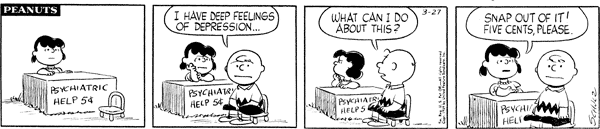
It never occurred to me Lucy from Peanuts is a narcissist but now that I think of it, she displays every trait of NPD, and Charlie Brown is her biggest victim.

Movies Portraying Narcissistic Personality Disorder Traits

A Streetcar Named Desire – A Streetcar Named Desire is a is a 1947 play written by Tennessee Williams, later adapted for film, which tells the story of a woman who displays histrionic and borderline traits, who goes to live with her codependent sister and her narcissistic husband.

Streetcar_original

Black Swan – Black Swan is a 2010 psychological thriller about a ballet dancer, played by Natalie Portman, who discovers a dark side to herself as she struggles to please her overbearing narcissitic mother, played by Barbara Hershey.

black_swan

Charlie Brown – Charlie Brown is the lead character in Charles M. Schulz’s classic “Peanuts” cartoons who is generally portrayed as feeling insecure and seeking acceptance. Charlie Brown’s character contrasts with the somewhat narcissistic character of Lucy and their relationship is sometimes used to illustrate the relationship between personality-disordered and non-personality-disordered people.

lucy_peanuts
Click to enlarge.

lucy_football
Click to enlarge.

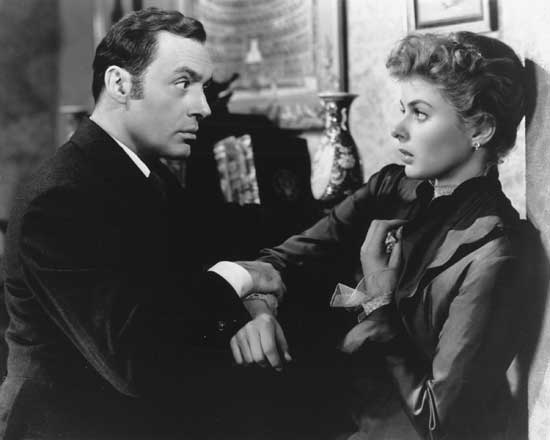
Gaslight – Gaslight is a 1944 MGM suspense thriller set in 19th Century London in which the villain, Gregory Anton (Charles Boyer), in an attempt to cover up his crimes, actively tries to convince his new wife, Paula (Ingrid Bergman) that she is losing her mind. Gaslight gave it’s name to the practice known as Gaslighting.

Gaslight-2

Mommie Dearest – Mommie Dearest is a 1981 biography of Hollywood Actress Joan Crawford, played by Faye Dunaway, who, according to the account in the movie, exhibited Obsessive Compulsive, Borderline and Narcissistic Traits.

mommie_dearest

Schindler’s List – Schindler’s List is a 1993 drama which chronicles the suffering of Jews in Nazi-occupied Poland during World War II and Oskar Schindler, a German businessman who rescued over a thousand of them by employing them in his factories. The movie includes a striking portrayal of Amon Göth, a narcissistic SS officer and camp director, played by Ralph Fiennes.

schindlers_list

These are just a few examples. There are many others. One that comes immediately to mind is the movie Ordinary People portrays a malignant narcissist in Mary Tyler Moore’s chillingly cold mother, Beth Jarrett. Her son Conrad suffers from severe PTSD and his mother’s coldness and thinly veiled hatred just serves to make things even worse for him.

ordinary_people

What I have learned.

bullet

I had some computer problems tonight (am still having them–this computer is running very slow), so that’s why I haven’t posted anything. I am finally getting to do that.

Some of us may think a narcissist can change. Some of us may think that deep down, they can’t possibly be such bad people. We make excuses for them: they’re rough around the edges, need someone to care about them, they’re really a big softy under that hard exterior, they’re defensive and nasty to us because they’ve been hurt too often.

Not everyone who is rough acting or cranky is a narcissist. There are people who throw up defense mechanisms or act grumpy or snap at you for no reason, but you’ll be able to tell they aren’t narcissists because they won’t be trying to gaslight you, triangulate against you, tell you lies, project their own character flaws onto you, blame you for things that you didn’t do, or act sadistic to try to hurt you. They will have a conscience; they can feel empathy; they can apologize when they’ve been wrong and mean it. They may be depressed or anxious which causes them to act out. They may have something on their mind or be angry with someone. It could even be cultural–kids who had to grow up in rough neighborhoods may act a bit hard-edged even as adults, but that doesn’t make them narcissists or bad people.

A good way to tell if someone who is lashing out at you is not a narcissist is to wait until they are calmed down, and then calmly ask them why they attacked you. If they apologize or talk about their feelings with you, most likely they aren’t a narcissist (but be careful, because a narcissist who thinks they might be losing their supply could be love-bombing you).

If they ignore you, change the subject, or most tellingly, tell you you’re the one with the problem and they’ve done nothing wrong, most likely you’re dealing with a narcissist. Once you know that, expect nothing from them, because you will always be disappointed.

If you know someone is a narcissist, never give them the benefit of the doubt.
They aren’t nice people.
They aren’t going to change.
You cannot help them.
You cannot reason with them.
You cannot get them to “see your side” of things.
They cannot be pleased.
They don’t care about your feelings, only their own.
You are wasting your time on them.

Being nice to them or pandering to them not only won’t work; it will make them treat you worse. They may respect you if you play their own games right back or stand up to them, but they are never going to like you, because they don’t like anyone, least of all themselves.

I like to think the best about people. I’m a natural born sucker. I always give people the benefit of the doubt.
Until today, I thought there was hope for some of them. But I learned a hard lesson.
There is hope for none of them.
They may not want to be narcissists, but they are, and nothing they or you or anyone can do will ever make them change. The only thing that makes sense is to stay the hell away from them or avoid them as much as possible.

They are poison. They live in a hell they created for themselves and they will take you with them if you give them half a chance.
Don’t.