Empathy in an NPD person: is this possible?

Recently I met a woman who seems to be a narcissist, but who insists she is an empath. She is quite grandiose about her high empathy too, always pointing out how sensitive she is to the moods of others. From my own observations, this woman does actually seem to know how other people are feeling and is upset if the feelings are negative, even if they aren’t directly related to her. At the same time she is very full of herself, arrogant, exaggerates her achievements, and entitled-acting. She’s also someone I wouldn’t want to get very close to because she seems like a manipulator and game-player. Yet the other day when someone talked about their grief over a dying relative, she cried with them. She didn’t appear to be attempting to gain something for herself, though I could be wrong. I wondered about this–is she just a very good actor, or was her behavior sincere? Or is she not really a narcissist at all?

The DSM-V cites that a person must have 5 out of 9 criteria to qualify for the NPD diagnosis. Lack of empathy is one of the most well-known and common of these criteria, but nowhere does it say this trait MUST be present. So the way I understand it, a person can still have five of the 9 criteria but not lack of empathy. But other than this person I described above (who may be faking empathy or not really be a narcissist) I’ve never met a narcissist who has much if any empathy, at least not for other people, although they are usually extremely sensitive when it comes to themselves.

If anyone has experience with this or can shed some light on this question, or has known a high-empathy narc, please speak up.

Storyteller.

storytellers

My therapist told me I’m a good storyteller.
This was one of the most validating things anyone ever told me. He likes my stories. I keep him entertained. I make him laugh and keep him on the edge of his seat.
Yay me!

Maybe I really could write that novel and keep millions entertained and become rich and famous after all. Why not? Its never too late. Hell, Grandma Moses didn’t become a famous painter until her 90s. There’s nothing wrong with being a late bloomer.

I always thought of myself as a pretty boring person and an even worse storyteller, because I didn’t think I had any stories worth telling. But I’m finding out that’s not the case.
We all have a story to tell. We’re all actors on this stage called life.

But feeling complimented isn’t really the reason I’m over the moon about what he said. It doesn’t matter if I have the capacity to entertain anyone. I don’t really care if I can make people laugh or keep them quaking in suspense or move them to tears. That’s not my reason for being here.

It means a lot because I feel like he cares. I keep him entertained because he cares about me or at least does a pretty good job pretending he does (but I don’t think it’s pretending). He’s very good at what he does, but more importantly, after four sessions, I feel like we have established trust and a good working relationship. He’s one of the few people who ever showed me any real empathy. I feel like I could tell him almost anything.
Except one thing.

I realized this week I’ve developed strong transference feelings. That’s supposed to happen in psychodynamic therapy. It’s like limerence but without the sexual aspect. I just want to be cared for and protected by him, as if he’s the nurturing and caring surrogate parent I should have had. These feelings can be intense. They replicate ancient attachments from early childhood. You’re supposed to work through them. Right now I just feel incredibly excited to be seeing him again tomorrow.

I know this euphoria won’t last. It might even become painful. I’m prepared for that. I’m idealizing someone I don’t even know. All he is is a mirror, in which I can see whatever I want–or see aspects of myself I can’t own yet. I went through this when I was 22 and wound up walking out on my therapist because I couldn’t handle the intensity of my feelings anymore. But I’m older and more mature now, and know a lot more about how this stuff works than I did back then. Therapy isn’t easy. It’s work, hard work, and I’m prepared to roll up my sleeves and get busy instead of slacking off and expecting to just suddenly not have any problems anymore.

He doesn’t know yet. I don’t know if I’m ready to tell him. He may figure it out even if I don’t say anything. Maybe I can tell it like a story.

It isn’t all about me.

paranoia

What I’m learning is that everything isn’t always about me.

I used to always assume people were obsessing in a negative way about me and would interpret, say, a neutral expression or a lukewarm greeting as “that person must be upset with me/hate me/is mad at me/disapproves of me” etc. Sometimes I have to make a conscious effort not to let my mind go in this direction if someone acts in a way other than thrilled to see me. Sometimes they’re just having a bad day, are angry at someone else, or angry in general, or are generally just an asshole to everyone. Sometimes it’s nothing at all other than my choosing to perceive a neutral expression or body language as something negative. It takes a lot of practice to get out of that habit of paranoia and hypervigilance and I always have to remind myself to stop taking every little thing personally and think outside myself instead. I think this is a prerequisite to being able to empathize–being mindful that someone else might have a problem that has nothing to do with me.

I finally got my new diagnosis (sort of).

I know the labels don’t really matter, but I’ve been wanting to know for months. I also wanted to know if I’m really a covert narcissist. I got my diagnosis on Friday.

Trust..

trust

Before I talk about that, I just want to say that I know I picked he right therapist and it’s because of the way he showed me his empathy and got me to trust him.

Modeling empathy.

empathy3
We originally had our appointment for Thursday but he forgot.  It turned out it was a mixup in his calendar due to the confusion over Thanksgiving week.  The first thing he did when I showed up and he realized his mistake was to apologize.  He  said he would make it up to me. I felt a niggling of rejection  (how did he forget??? How could he possibly make it up? I had important thing to tell him!)

I worried that maybe he didn’t really like me and was trying to get rid of me.

He must have known this because I think he saw the look on my face (that I was trying to hide with laughter and “no problem” reassurances) but he knew that was an act, I think.

“Why don’t you swing by tomorrow?” he said. This guy saw how I felt, and empathically addressed the situation and in so doing, removed my worries that he might be trying to get rid of me. I told him that I was glad he remedied things so quickly because, I admitted, if he hadn’t done that I would have continued to feel rejected.

His quick remedy showed he had a lot of empathy and was concerned how I felt. That made me trust him. I also realized he was modeling empathy for me, something I never got from my parents and very few other people growing up.

The Diagnosis.

psych_cartoon

He knows I have a BPD, PTSD and AvPD diagnosis, but from the very first session I told him I think I’m also a covert narcissist. I explained what that was in case he didn’t know (since it’s not recognized officially). This session, which was my third, I finally worked up the courage to ask what he’d diagnosed me with.

“Well, I don’t really believe in the medical model,” he said. “Also, the Axes have been removed from the DSM-V.” This was news to me.
He was staring at me. “What?” I said.
“Do you want me to give you a diagnosis?”
I stared back and looked away, licking my lips nervously and giggled a little.
“What’s going on?”
“Uhmmm, nothing.”
“Why is it important to you to have a diagnosis?”
“It isn’t, really…” But it was, and I didn’t know why or how to explain it. “I’m just curious, I guess.”
“I won’t give you a diagnosis but you do appear to have symptoms of PTSD and some borderline traits….”
His sentence hung in the air.
“and…?” I asked, waiting.
“Well, you wanted to know, so I’ll tell you. I don’t think you have NPD, but you do have narcissistic traits and are probably on the spectrum.” That’s about where I thought I was. I was relieved I didn’t have NPD.

But it was like I went down the rabbit hole all over again, feeling dissociated and lightheaded but only for a minute. This time I had my emotional water wings on and floated back into reality. I was so overcome with relief that my eyes watered.

I think it was the relief of having some kind of closure.  I’ve been so confused for so long.  Well, I guess I’m sort of in limbo between narcdom and non-narcdom, which doesn’t clear things up a whole lot more than they were before, but somehow now the confusion makes more sense.

Beauty and The Beast: a metaphor for NPD.

beauty_beast

A few days ago, I was thinking about the wonderful 1991 Disney animated movie, “Beauty and The Beast.” I was always moved by the Transformation scene at the end when the evil spell on the Beast and his castle is finally lifted after he nearly dies and Belle finally declares her love for him. In my opinion, it’s one of the best moments in animated movie history. That scene has haunted me for a long, long time and the other day, I felt inspired to watch it again, and was as–or even more moved by it–than the first time I saw it. And this time I knew why–the entire story of the Beast in this movie is a metaphor for a man suffering from NPD–who healed from it.

As the movie opens, we are shown a series of stained-glass images telling the story of how the Beast became that way. He wasn’t always a Beast. His real name was Adam and he had been a handsome young prince, but extremely arrogant, entitled, and lacking in empathy (sound familiar?). One cold and snowy night, a beggar woman came to the castle begging for a place to sleep for the night to escape from the bitter cold. In exchange she offered him a single rose. Adam sneered at the rose and refused her a warm bed and coldly sent her on her way, but not before the beggar woman suddenly transformed into a beautiful enchantress, who in her righteous anger at the callous young prince’s heartless actions, put a spell on him, turning him into the physical manifestation of the Beast he had become inside, and at the same time transforming the trappings of his former grandiosity and entitlement (a well-appointed and beautiful castle and loyal servants) into a dark and frightening prison and common household objects. The rose she had left him–which I believe represents Adam’s True Self (and he had sneered at it because it represented the vulnerability he had rejected)–would continue to bloom for a decade. If Adam failed to learn to love another (and earn her love) in that decade, the woman had warned him the rose would die and he would be forever doomed to his fate (unable to heal from his narcissism, he would become malignant). Adam’s only window to the outside world was the magic mirror the woman had left him, but all Adam can see in it is his own hideous reflection.

The Making of a Beast:
https://www.youtube.com/watch?v=__x8CYAVMbk

No longer receiving any narcissistic supply, Adam falls into depression, despair, and self hatred. He attacks his own image in a painting and refuses to look at himself in the mirror anymore. He is consumed by anger and self-pity until the day a beautiful young woman (Belle) comes by the castle to rescue her father, who The Beast has imprisoned for trespassing.

Belle is the opposite of The Beast in every way. Not only is she physically beautiful, but she is poor, the daughter of the town eccentric who is a laughing stock and considered crazy, even though he is actually a brilliant inventor. Belle is kind and loving and has a high level of empathy. The first thing she does is offer to take her father’s place in the castle’s dungeon if The Beast will only free him.

The Beast takes her up on her offer on the condition she stay there in the castle with him forever. Belle reluctantly agrees, even though she is at the mercy of The Beast’s terrible temper and frequent narcissistic rages. Her father is freed, and Belle dutifully obeys whatever the Beast tells her to do, but because she is an empath, she can see through his frightening facade to the broken young man he really is.   Early during her stay, she is wandering around the Castle and comes across the enchanted rose under its glass dome.  The Beast catches her and quickly covers the rose (evidence of his vulnerability) and rages, bellowing “Do you realize what you could have DONE?? Get out!” But as the months pass, the Beast begins to look forward to their time together, and slowly learns some manners and social graces. Belle works on humanizing Adam and finds she is slowly falling in love with him, and as he begins to accept her love (mirroring), he reluctantly begins to reveal his true self to her.

Meanwhile, Belle is being pursued by a very arrogant and probably malignantly narcissistic young man from her town named Gaston. Belle can’t stand Gaston, and refuses his proposal of marriage in which she would be nothing but an object and slave to him. Consumed by rage over her rejection of him, one night Gaston and his buddies plan an attack on the The castle to kidnap Belle. In the ensuing battle, The Beast is falls to the ground from a high elevation and is left for dead. A grieving Belle finally proclaims her love for the Beast, just as the last rose petal falls.

The spell is broken and The Beast is transformed back into Adam, the handsome Prince he used to be–only with a difference–he is no longer entitled or arrogant and he is now capable of being able to love, thanks to Belle’s empathic kindness. The castle (which I think represents the quality of Adam’s life) is also transformed to its former glory and the household objects turn back into loyal servants (who can now be his friends too).   Note that a narcissist regards other people as mere objects and not human.

The Transformation:

When I talked to some friends about writing an article about this movie being a metaphor for healing from NPD, it was mentioned to me the dangers of making such a comparison. First of all, this is a fairy tale and in real life, things don’t normally work out this way. A woman who falls in love with a narcissistic man is far more likely to be abused and exploited than loved in return–and she almost certainly isn’t going to be able to “fix” the narcissist. Just as problematic is the idea that in order for a narcissistic man to change, he must earn the love of a woman. It was pointed out that this could be construed as sexist.

But because this is a fairy tale, the underlying moral is of course more compelling (and entertaining) if there’s a romance involved. I think of this romance as a metaphor for the relationship between a self-aware and willing narcissistic patient and his or her therapist. Belle’s looks don’t actually matter–her beauty is a metaphor for her pure soul and empathetic nature. She is giving the Beast the reparenting he probably never got from his own family. The Beast’s ugliness is a metaphor for his narcissistic personality, but in this case, it’s not so deeply ingrained in him for it to have become malignant–which is why the enchanted rose is still alive until the spell is broken. The rose represents The Beast’s true self, which is integrated back into the Beast’s psyche during the Transformation.

The Still Face Experiment.

Here is a dramatic video that shows how powerful the lack of mirroring is on an infant. It’s amazing how quickly the baby in this video notices the mother’s lack of affect and responds negatively to it. This is at the root of attachment disorders in children and most personality disorders, especially Cluster B. Without appropriate mirroring a child can’t develop empathy because it has never been modeled for them.

HSPs and codependency.

einstein_quote

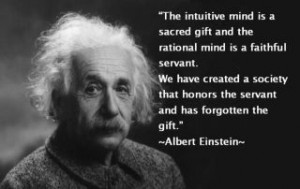
There’s a lot of discussion on the web about codependency as well as empathy, especially in the narcissistic abuse community. While it’s true people who are codependent to a narcissist also tend to be high in empathy and very sensitive, there seems to be a lot of confusion–people who aren’t too familiar with either term tend to believe empathic people are also always codependent. While codependent people are almost always highly sensitive (which is the quality that attracts their abuser to them and keeps them trapped in a toxic relationship because they believe they can “fix” their narcissist), the reverse is not always the case.

A healthy HSP (highly sensitive person) is simply an emotionally healthy person. They are confident and secure enough with themselves that they can resist the “charms” of an abuser. If a healthy person with high empathy does find themselves being drawn into an abusive relationship with a narcissist, they have the courage and presence of mind to pull themselves out of it and even go No Contact before they fall under the thrall of the abuser and before any damage is done. In fact, having high empathy makes it more likely a person will be able to “see” the red flags before anyone else, giving them a chance to escape and/or avoid the person.

A healthy HSP does not waste time trying to “fix” a narcissist. They know the chance of that happening is about the same as the likelihood they will sprout wings and fly to the moon. If a narcissist is going to change (I’m not one of those people who believes it’s not possible), it must be the desire of the narcissist and they have to work very hard at it, but no one else can “save” them except themselves, and it’s going to be a long, hard road if they decide that’s what they want. A healthy HSP will not allow themselves to fall into a love-bombing trap or be “hoovered” by a narc. Once they realize what they are dealing with, they will cut off any further communication. They know they can’t be nice about it, but must be firm. They may care, but they know they are not going to be the ones doing the fixing, and will be able to move on to a healthier relationship with someone they can actually grow with and who will be able to return their love.

codependency_love

Our society today is also quick to judge those who have high levels of empathy and want to give back to others as being “enablers.” This happens even in the public realm, with the massive cuts in spending to programs that help the most vulnerable people of society and the blanket dismissal by the Powers That Be of those who want to help as “suckers” who are “enabling” the most vulnerable people. I don’t wish to get on a political soapbox but there’s something very wrong with any society that only values how “powerful” you are or how much money you earn. There’s something sick about a society that dismisses its most vulnerable members as “lazy and stupid” or “deserving” of their sad lot. Empathy is a virtue that has become increasingly dismissed as a weakness, but is actually the one thing–maybe the only thing–that could rescue modern society from completely self-destructing. Empathy isn’t a weakness at all–it’s a strength. If you’re a HSP you have this quality and should be proud of it and use it, not hide it away like a shameful thing. The narcissists who run things in the world would like us all to think it’s a shameful thing, but that’s just another lie they tell. It’s needed now more than ever. So, you are not an “enabler” if you want to help others; just be careful who you are helping!

Unfortunately, HSPs have often been abused themselves or have other disorders such as complex PTSD, and they often find themselves targeted by narcissists for abuse. Narcissists are usually attracted to people with high empathy because they know they can get the “understanding” and love they crave and will proceed to feed on the HSP’s emotions much like a vampire feeds on blood. They know it’s hard for such a person to say “no” because they can’t stand to hurt anyone’s feelings, so an HSP person is more likely to stick around and tolerate abuse than someone who is less sensitive.

If you are such a person; if you are very sensitive, cut your losses now! Staying around a narcissist who is actively abusing you is just not worth it, and there’s also a very real danger of being drawn so far into the narcissist’s web of deception and abuse that you could develop Stockholm Syndrome and begin to identify with your abuser. Once this happens, you could even find yourself taking on traits of narcissism yourself and colluding with your abuser. It’s an insidious process but it can and does happen; and it happened to me. Be careful. Your soul is a precious thing and you should not give it freely to anyone until you know that person can be trusted with it. That doesn’t mean you have to become hypervigilant and start seeing demons around every corner, but if your intuition is throwing up a lot of red flags about a particular individual, don’t dismiss them. They could save your life.

Empathy and conscience are not the same thing.

Empathy-definition

I recently saw this little gem on another website.

If you feel upset, worried, and guilty that you don’t care about others enough, then you don’t lack empathy. That right there shows you you have a conscience. Also guilt is a sign of empathy. If there’s guilt, there’s empathy. There can be no guilt without empathy. No empathy, no guilt because they are part of each other.

I’d like to take issue with this paragraph. The author is stating that feeling guilty or having a conscience means you have empathy. I beg to differ.

Empathy is the ability to feel an emotion with another, to be able to “put yourself in another person’s shoes.” It has nothing to do, really, with having a sense of right and wrong, which is what both guilt and conscience are based on. It’s entirely possible to be a self-righteous, stiff-necked prick and not have an ounce of caring for the way others feel. Think of that teacher you hated. Chances are, that teacher had a very strong conscience and a clear idea of what was right and wrong (and held themselves to the same tough standards they expected you to meet), but thought nothing of making you feel like a wad of old gum on her sensible orthopedic shoes when you violated their lofty standards. It’s also possible to feel guilty over things that aren’t even your fault but be completely oblivious to the feelings of others. Think of the worst covert narcissist you know. Chances are, that person is constantly saying “I’m sorry” and flagellating themselves until they draw blood, but their over the top guilt stems from a need to prove they’re really a good person, not because they really care that they just put your feelings through a cheese-shredder. They aren’t going to feel your pain with you–they just want to redeem themselves and have you forgive them.

Empathy and conscience do often go together though–they’re like the peanut butter and chocolate of the world of emotions–and I don’t think it’s possible to be a high empathy person and at the same time have no conscience or the inability to feel guilt or shame. But to assume that a strong conscience or the ability to feel guilt automatically indicates high empathy just makes an ass of u and me. All having a strong conscience or sense of guilt means is you’re not a sociopath.

“Why I Am Teaching My Son That Tears Take Courage”

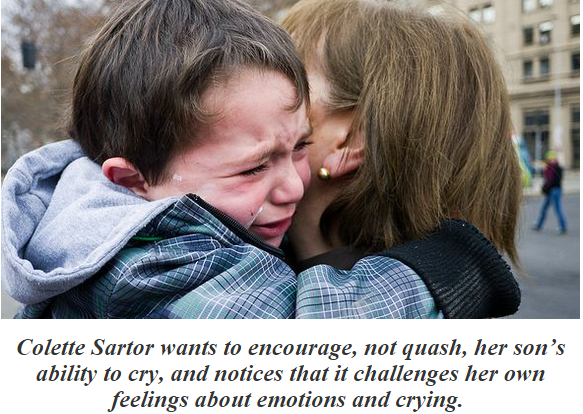
Here’s a wonderful article from The Good Men Project about a mother who is encouraging her young son to express his emotions instead of stuffing them. If only more parents encouraged this sort of thing, we’d live in a world with more empathy and less narcissism.

Why I Am Teaching My Son That Tears Take Courage
By Colette Sartor, for The Good Men Project

sartor_article

My son didn’t cry on his first day of preschool; he cried on his thirtieth. The school was a tiny, progressive place that took a surprisingly stern approach to drop offs: Say goodbye and leave. No looking back or lingering. This was fine by me. I hate to cry in public, and I knew I might, which would scare my three year old and make him cry.

So, that first day, I watched him cautiously pile blocks for a few minutes, then I told him I’d pick him up later, kissed him, and left for work. He barely glanced up. He was absorbed in the newness of everything: new kids, new toys, new sights and sounds and smells.

Every day that month, I repeated the routine. I’d briefly watch him play, kiss his cheek, and leave. Every day, I breathed easier. “He loves his new school,” I told people. How well adjusted he is! How happy! Yay him! Yay me! I thought. Then, on the thirtieth day, he raced to me with outstretched arms. “Mommy, stay!” he sobbed. I gathered him up, buried my face in the talc of his hair. “I’ll be back, honey, don’t worry,” I whispered before his teacher gestured to hand him over. He cried and reached for me, struggling to extricate himself from the teacher’s grasp. “Just go,” she mouthed over his head. I nodded and walked out, my own tears streaming as he sobbed behind me.

♦◊♦
When I was growing up, our family motto was, “If you want to play with the big dogs, don’t piss like a puppy.” Which meant no crying.
♦◊♦

My son cries easily. He gets it from me. I cry over life insurance commercials, sappy movies, real and imagined slights. I usually hide my tears, even from him. When I was growing up, our family motto was, “If you want to play with the big dogs, don’t piss like a puppy.” Girls were puppies by default. They showed the world when they hurt. They cried. To play with the big dogs, girls had to be tough. Which meant no crying. So I learned not to cry. At least, not in public. Still, I try not to discourage my son from crying. I love his sensitivity. I love that he cries when a friend is hurting, that he cries when he feels he’s being treated unjustly, that he cries at all.

See more at: http://goodmenproject.com/featured-content/why-i-am-teaching-my-son-that-tears-take-courage-jnky/#sthash.FTqEhBGI.dpuf

I can’t relate to narcissists who love their disorder.

android

I read this post at Psychforums written by a person who sees their narcissism as a huge advantage.

I spent all my life trying to figure out why I felt so different from other people. A few months ago I was researching in detail narcissism for my master thesis on The Picture of Dorian Gray when I suddenly realized that I fit perfectly with all the criteria to be assessed as a high functioning, cerebral, covert narcissist. I immediately felt amazing about it. Not even for one second I believed that there is something wrong in me, but I soon realized that the rest of the world doesn’t seem to agree with my view.

The idea that my malignant tendencies have a reason to exist empowers them, and all the studies I have read on this topic instead of making me feel like I have a mental illness that should be cured provided me with the tools I need to expand my narcissism and use it in my favor. I guess this sounds like I really am sick, but bear with me: why would I, as a narcissist who feeds upon the desire of being special and unique, have a problem with being diagnosed as such? It makes me different from others for real. I am not going to stand in line with all those narcissists who fear themselves, who punish the way they are. Becoming self-aware opens infinite doors to the great potential I have.

I always deeply enjoyed manipulation, now I know why, but I also know that I have the power to bring this skill on a higher level and the more I master this “science” the less people will realize what I am doing to them. I don’t have a problem letting people know that I am a narcissist, but they never believe it – they still see me as a caring, loving, trustworthy girl who would go out of her way to help, too nice and interesting to be classified as “evil”. This discovery has given a great boost to my self-esteem which used to be pretty low. But it was low because I didn’t embrace and accept who I am. Knowledge is power. I am more functional now than before, I test my potential daily to see how far it can go, how much more I can get from it. Why would people ever want to heal from this?!

They say that a lack of empathy is a terrible thing. I don’t even know what empathy is, so why would I be concerned about owning it? They say I will never be happy with the way I am, but, let’s state the truth, people are never satisfied and fully happy anyway; they live for unhappiness because hope is far more enjoyable and stimulating. They say I cannot have fulfilling and real relationships, but that’s not true: given the right partner I can make him feel like he is the most special person in the world. Of course, all of this is done primarily to make myself feel like I have total control over them, but it can still provide them with some good things for themselves. It’s twisted, but I find unconditional love far more twisted. Self-awareness helps me regulating my depression since now I understand that it’s triggered by a lack of NS, so I just need to adjust that to feel back on track.

And when a NS is not readily available I feed my ego by trying to achieve success and praise in my work or studies. The more difficult and stressful it is, the larger my ego grows when I get there. Have you ever felt a proper ego boost? When it feels like there is something extremely warm in your chest which is expanding throughout your body? I live for that feeling.

I always wanted to become a teacher, but I was scared that I wasn’t good enough for that. Right now it has become clear that this is the only thing that I can do successfully. What’s better than a group of people who you can manipulate on a daily basis without being perceived badly? And here by manipulation I don’t mean in a bad way: you can convince them that they can be and do whatever they want in life. And they will repay you by making you feel omnipotent.

That’s a fair deal to me. Last but not least, being a narcissist made me finally forgive my mother for all the years of psychological and physical torture I had to endure. She made me the person that I am today, for better and for worse. I let go of all the grudge and hate and established a far better relationship with her.

I am human, but if my being a narcissist means that I am an evil human being, I can totally accept that and carry on. I would rather be good and be a hero for others, but I always found villains much more charming and true to themselves.

android2

This is an example of ego-syntonic narcissism and is common in high spectrum grandiose (classic, not covert) narcissists whether they’re self aware or not. It seems psychopathic to me. While on an intellectual level I can understand the logic behind it, and yes, I’ll even concede that it is possible to be devoid of empathy or a conscience and still choose to be prosocial (people with NPD and even ASPD can tell the difference between right and wrong, but usually won’t choose to do the right thing, only what suits them), I simply cannot relate to this way of thinking. It seems very machine-like to me, almost a parrot-like existence.

Sure, without a conscience you don’t suffer from guilt and shame the way most people do, but living this way just seems so cold and sterile to me. I spent years unable to feel much of anything, and am recently beginning to discover my softer emotions and wouldn’t have it any other way. Even sadness adds depth to the experience of being alive. How can a person like this be able to experience higher emotions like love, empathy or real joy? A machine can’t experience joy, sadness or love, all they can do is fake it. To me, this seems like a sterile, joyless way to live, an imitation of being a human, and I want no part of it. How can you really enjoy life when everything and everyone becomes nothing but narcissistic supply? I’m sorry, but I’m a person, not a parrot.

That being said, high functioning/high spectrum narcissists do seem to like their narcissistic traits, because they tend to be beneficial in the selfish and narcissistic society we currently live in. The enormous popularity of Ayn Rand and her philosophy of selfishness as a virtue attests to this. But such a world, run by people who feel nothing and get high off their own perceived power and superiority, is deeply frightening to me.