Sam Vaknin on why narcissists and abuse victims hate the holidays

These are pretty interesting–both narcissists and their victims have problems with holidays like Christmas and birthdays. Narcissists ruin the holidays for everyone because of their envy, including themselves. Victims associate holidays with bad experiences because of their abusers.

Narcissists and holidays:

Abuse victims and holidays:

Thanks again, Sam. Would you like green eggs and ham?

samiam

The spike in my stats has not let up. My views today were almost as high as yesterday’s.

thankssam

I was informed by a commenter I’ve never seen before that Sam has been pimping my blog again (one article in particular) all over social media again (mostly Facebook–said article has been shared 84 or more times).

Honestly, I didn’t think Sam had anything to do with the rising stats this time, because it was another article I thought was getting all the views (one that probably wouldn’t be of interest to him). I thought wrong. Well, that other article was getting a lot of views too.
I checked Sam’s Twitter timeline (I don’t do Facebook), and sure enough, this “informer” was correct.

I don’t care if Sam’s a narcissist, a malignant narcissist, a wannabe, or pink and purple polka-dotted with ball bearings in his brain–I’m loving what he’s doing for this blog. I’m sure he’s got his own selfish motives for doing this because he’s a narc, but I don’t care. Sometimes the end is more important than the means.

The funny thing is, this article he seems to like so much is not all that complimentary.

Would Sam like some green eggs and ham?

greeneggsandham

We were the lucky ones.

narcissusrevoy
“Narcissus and Echo” by David Revoy

Those of us who are ACONs and didn’t become narcs ourselves really are the lucky ones.

Narcissism, as I’ve written so many times, is a family disorder and is passed on through generations, both through the genes (as a predisposition, not as a “bad seed,” which I don’t believe in) and through early childhood abuse and neglect.

I’ve read so many of Sam Vaknin’s writings from his personal journal now. He is an ACON just like us but was never able to escape from developing the disorder himself, in spite of his insight and high intellectual ability. The abuse he suffered at his mother’s hands was horrific. With loving parents he may not have developed NPD.

I am also pretty sure my MN mother was sexually abused. I wrote about her childhood in this post. She never actually said she was, but she’s never talked much about her past. Most of what I know I pieced together from bits of information others told me. But even though sexual abuse was never mentioned, I strongly suspect she was and it would explain a LOT.

My MN ex was abused by his mother too. I haven’t written a lot about it, but someday soon I will. His mother was a malignant narcissist who mas a master manipulator and gaslighter, and physically abusive too.

I thought, “that could have been me.” It could have been any of us.

There are narcissists much worse than Sam, who have no insight and no desire to help others avoid people like themselves. Sam and his wife have chosen not to have children because of the devastating effects NPD could have on them–either as its victims or inheritors of the disorder. The fact he doesn’t want to burden a potential child with that proves to me he must have some semblance of a conscience, even if he thinks he doesn’t. That doesn’t mean he doesn’t have NPD but he probably isn’t that malignant compared to some truly evil people out there. I wouldn’t call him a benign narcissist either though–his behavior in “I Psychopath” was pretty intolerable, for the most part, even if he made me laugh sometimes. Sometimes I feel sorry for his wife, who seems like a meek, codependent type and scored very high in empathy on the tests she had to take in that film. I hope he treats her well. But because he’s a narcissist, he probably doesn’t, even if he tries to.

I have complained endlessly about my disorders and the effects of narcissistic abuse on me at the hands of my family and my ex (as well as previous boyfriends before him–I’ve ALWAYS been attracted to narcissistic men, which is why I won’t enter into another romantic relationship ever again). But you know what? For all my social awkwardness, PTSD, BPD, avoidant personality, low self esteem, debilitating anxiety and hypervigilance, and intermittent major depressions, I wouldn’t trade any of that in exchange for Narcissistic Personality Disorder. I could have EASILY become a narc. So could any of you reading this who suffered similar abuse, because you may have the gene for it or it runs in your bloodline, like it does in my FOO.

Maybe we suffer more than someone with NPD (although someone like Sam definitely suffers in his own way), but we have hope. We can get better. We can heal ourselves either through traditional therapy or writing about it. We can separate ourselves from the malignants and the psychopaths who hurt us (narcs can never escape from themselves and make no mistake–they are dangerous to themselves). Our healing may take a long time, it may not be easy, but we can get well. We can become whole, happy people. Because we have the willingness.

Narcissists do not. Their true self is so damaged and atrophied it can’t be accessed and the masks have no desire to get better, because the are just masks. The more malignant the narcissist, the less hope there is for them. The are the cursed ones. They are trapped in their sickness. The really unfair thing is, in most cases this was something done to them. That doesn’t excuse the way they act, but they never had a choice.

We were the lucky ones. We have hope because we never lost our true selves. Think about that the next time you feel like you’re worthless because of the mindgames your narc plays with you.

Narcissism is a family disease

abused


Children of narcissistic parents are always deeply damaged people. Because it’s a genetically inherited disorder (at least to some degree) but also because narcissism is a defense mechanism to protect and isolate oneself from abuse, many victims of narcissistic abuse become narcissists themselves. Those who do not become narcissists suffer from all manner of mental disorders, especially PTSD, avoidant personality disorder, schizoid and schizotypal personality disorder, depression and bipolar disorder, the whole gamut of anxiety and dissociative neuroses, and even psychoses like schizophrenia. And it’s entirely possible to be a narcissist and ALSO suffer from those other disorders. Being a child of a narcissist is the ultimate mind-fuck. There is no way to escape its effects, unless you are removed from the disordered FOO at an early age and adopted and raised by loving parents. Even then, the child will be scarred (“Child of Rage” Beth Thomas is a good example of a child who was severely abused and adopted by a loving family at age one and a half, but still needed years of therapy to overcome the damage that was done to her.)

I see signs of this happening in my daughter due to her MN father’s psychological mind games and mental abuse, but I don’t think it’s deeply entrenched in her because she also suffers from guilt and remorse and does have empathy or at least seems to, so I may be wrong. I hope I am. I still see signs of the sweet child she was, and her currently relationship seems to be bringing that out in her more and more often; she told me sincerely she wants to change her behavior and stop doing things that sabotage herself and hurt others.

Sam was an abused child, the oldest son of a malignantly narcissistic, thoroughly evil mother. He is an ACON, like we are. This is an interview he gave to a writer for Psychology Today, in which he describes what his childhood is like. It’s an excerpt from this journal entry from his website.

Interview granted to Elizabeth Svoboda of Psychology Today

Q. Could you briefly describe your relationship with your parents growing up? What were some of the high and low points?

A. My mother was by far the dominant presence in my life. She treated me as an extension of herself. Through me she sought to settle “open scores” with an indifferent world who failed to appreciate her gifts and to provide her with the opportunities that she so richly deserved. My role was to realise her unfulfilled dreams, wishes, and fantasies. I thus became a child prodigy.

But this was a vicious circle. The more successful I was, the more insidious envy I inspired in her and the more she attempted to subvert me and my accomplishments. Moreover, she resented my newfound personal autonomy. Smothering and doting turned into undisguised contempt and hatred and these fast deteriorated into life-threatening physical and psychological abuse.

Apart from savage beatings, she hit me where it hurt most: tore my poems, shredded my library books, invaded my privacy, humiliated me in front of peers and neighbours. Instead of being her prized possession, I now came to represent the much despised “establishment”. To avoid this disorienting predicament, I made myself into a juvenile delinquent, a gang member, a truant, a rebel with one cause: to regain my mother’s attention. But to no avail.

I hate the words “physical abuse”. It is such a clinical term. My mother used to burrow her fingernails into the soft, inner part of my arm, the “back” of my elbow and drag them, well inside the flesh and veins and everything. You can’t imagine the blood and the pain. She hit me with belts and buckles and sticks and heels and shoes and sandals and thrust my skull into sharp angles until it cracked. When I was four she threw a massive metal vase at me. It missed me and shattered a wall sized cupboard. To very small pieces. She did this for 14 years. Every day. Since the age of four.

She tore my books and threw them out the window of our fourth floor apartment. She shredded everything I wrote, consistently, relentlessly.

She cursed and humiliated me 10-15 times an hour, every hour, every day, every month, for 14 years. She called me “my little Eichmann” after a well known Nazi mass murderer. She convinced me that I am ugly (I am not. I am considered very good looking and attractive. Other women tell me so and I don’t believe them). She invented my personality disorder, meticulously, systematically. She tortured all my brothers as well. She hated it when I cracked jokes. She made my father do all these things to me as well. This is not clinical, this is my life. Or, rather, was. I inherited her ferocious cruelty, her lack of empathy, some of her obsessions and compulsions and her feet. Why I am mentioning the latter – in some other post.

I never felt anger. I felt fear, most of the time. A dull, pervasive, permanent sensation, like an aching tooth. And I tried to get away. I looked for other parents to adopt me. I toured the country looking for a foster home, only to come back humiliated with my dusty backpack. I volunteered to join the army a year before my time. At 17 I felt free. It is a sad “tribute” to my childhood that the happiest period in my life was in jail. The peaceful, most serene, clearest period. It has all been downhill since my release.

But, above all, I felt shame and pity. I was ashamed of my parents: primitive freaks, lost, frightened, incompetent. I could smell their inadequacy. It wasn’t like this at the beginning. I was proud of my father, a construction worker turned site manager, a self-made man who self-destructed later in his life. But this pride eroded, metamorphosed into a malignant form of awe of a depressive tyrant. Much later I understood how socially inept he was, disliked by authority figures, a morbid hypochondriac with narcissistic disdain for others. Father-hate became self-hate the more I realized how much like my father I am despite all my pretensions and grandiose illusions: schizoid-asocial, hated by authority figures, depressive, self-destructive, a defeatist.

But above all I kept asking myself:

WHY?

Why did they do it? Why for so long? Why so thoroughly?

I said to myself that I must have frightened them. A firstborn, a “genius” (IQ-wise), a freak of nature, frustrating, overly-independent, unchildlike Martian. The natural repulsion they must have felt having given birth to an alien, to a monstrosity.

Or that my birth fouled their plans somehow. My mother was just becoming a stage actress in her fertile, narcissistic, imagination (actually, she worked as a lowly salesperson in a tiny shoe shop). My father was saving money for one of an endless string of houses he built, sold and rebuilt. I was in the way. My birth was probably an accident. Not much later, my mother aborted my could-have-been-brother. The certificate describes how difficult the economic situation is with the one born child (that’s me).

Or that I deserve to be punished that way because I was naturally agitating, disruptive, bad, corrupt, vile, mean, cunning and what else.

Or that they were both mentally ill (and they were) and what was to be expected of them anyhow.

And the other question:

WAS IT REALLY ABUSE?

Isn’t “abuse” our invention, a figment of our febrile imagination when we embark upon an effort to explain that which cannot be explained (our life)?

Isn’t this a “false memory”, a “narrative”, a “fable”, a “construct”, a “tale”?

Everyone in our neighbourhood hit their children. So what? And our parents’ parents hit their children as well and most of them (our parents) came out normal. My father’s father used to wake him up and dispatch him through hostile Arab neighbourhoods in the dangerous city they lived in to buy for him his daily ration of alcohol. My mother’s mother went to bed one night and refused to get out of it until she died, 20 odd years later. I could see these behaviours replicated and handed down the generations.

So, WHERE was the abuse? The culture I grew in condoned frequent beatings.

It was a sign of stern, right, upbringing. What was different with US?

I think it was the hate in my mother’s eyes.

You can read about the daily reality in our home:
Nothing is Happening at Home
http://gorgelink.org/vaknin/wronghome-en.html

Q. Once you became an adult, how did your relationship with your parents change? What are some of the unique difficulties of being an adult child of narcissistic parents? Feel free to give examples or describe specific situations you found yourself in.

A. Adult children of narcissists adopt one of two solutions: entanglement or detachment. I chose the latter. I haven’t seen my parents since 1996 (Actually, since I left the army in 1982). I avoid the encounter because it is bound to stir up a nest of emotional hornets which I am not sure I could cope with effectively. I also refuse to subject myself to repeated abuse, however subtle, surreptitious, and ambient. Absenteeism is my way of neutralizing my parents’ weapons.

But the vast majority of grown up offspring of narcissists find themselves enmeshed in unhealthy permutations of their childhood, caught in an exhausting dance macabre, developing special semiotic vocabularies to decipher the convoluted exchanges that pass for communication in their families. They compulsively revisit unresolved conflicts and re-enact painful scenes in the forlorn hope that, this time around, the resolution would be favorable and benign.

Such entanglement only serves to exacerbate the corrosive give-and-take that constitutes the child-parent relationship in the narcissist’s family. Such recurrent friction, unwelcome but irresistible, deepens and entrenches the grudges and enmity that both parties accumulate in sort of a bookkeeping of hurt and counter-hurt.

Q. What effects do you think your parents’ personality problems had on you–as a child and as an adult?

A. I owe my multiple personality disorders – narcissistic, borderline, masochistic – and my depression to their unhealthy upbringing and to the nightmarish atmosphere that they have instilled in our home. I owe them every single self-destructive and self-defeating act I have since committed (quite a few). I inherited from them and via their flawed version of socialization my paranoid delusions, my antisocial behavior, my misanthropy, my a-sexuality.

I am fully accountable for my conduct. My parents cannot be held responsible for my choices at the age of 46. But that I react the way I do, that I am the sad vessel that I am, is their doing, no doubt.

Q. When we become adults, what are our responsibilities to parents who have personality problems? Do you think we’re obligated to put up with them as a kind of payback for everything they gave us when we were young, or are we justified in cutting them off if the situation gets too intractable?

A. Our first and foremost obligation is to ourselves and to our welfare – as well as to our loved ones. People with personality disorders are disruptive in the extreme. They pose a clear and present danger both to themselves and to others. They are an emotional liability and a time bomb. They are a riddle we, their progeny, can never hope to resolve and they constitute living proof that not only were we not loved as children but are unloveable as adults.

Why would one saddle oneself with such debilitating constraints on one’s ability to feel, to experience, to dare, and to soar to one’s fullest potential? Narcissistic parents are an albatross around their children’s necks because they are incapable of truly, fully, and unconditionally loving.

Q. Now that your parents are no longer part of your life, have you compensated by putting together your own “adopted family,” so to speak, of people you care about and that care about you? If so, could you talk a little bit about what effect doing this has had on your well-being?

A. In my late teens and early twenties I was still making the mistake of looking for a surrogate family. Soon enough, I have discovered that I cannot but import into these new relationships all the pathologies that characterized my family of origin. Ever since then I am careful not to get involved with family structures. I haven’t even created my own family. I am married (for the second time) but am repulsed by the idea of having to parent children. In general, I am trying to avoid relationships with an emotional component.

further reading: The Narcissist is Looking for a Family
http://samvak.tripod.com/narcissistnofamily.html

Q. How can we try to manage difficult parents’ behavior, if at all—or at least, minimize its impact on us? Q. What advice would you give others who find themselves in a similar situation with their parents? What were some of the strategies that worked for you?

A. At the risk of sounding repetitive: disengage to the best of your ability. Make it a point to limit your encounters with these sad reminders of your childhood to the bare minimum. Delegate obligations to third parties, to professionals, to other members of the family. Hire nurses, accountants, and lawyers if you can afford it. Place them in a senior home. Move to another state. The more distance you put between yourself and your personality disordered abuser-parents and their radioactive influence, the better you are bound to feel: liberated, decisive, empowered, calmer, in control, clear about yourself and your goals.

These points are crucial:

Do not allow your parents to manage your life any longer

Do not allow them to interfere with your new family: your wife and children

Do not allow them to turn you into a servant, instantaneously and obsequiously at their beck and call

Do not become their source of funding

Do not become their exclusive or most important source of narcissistic supply (attention, adulation, admiration)

Do not show them that they can hurt you or that you are afraid of them or that they have any kind of power over you

Be ostentatiously autonomous and independent-minded in their presence

Do not succumb to emotional blackmail or emotional incest

Punish them by disengaging every time they transgress. Condition them not to misbehave, not to abuse you.

Identify the most common strategies of fostering unhealthy (trauma) bonding and the most prevalent control mechanisms:

Guilt-driven (“I sacrificed my life for you…”)

Codependent (“I need you, I cannot cope without you…”)

Goal-driven (“We have a common goal which we can and must achieve”)

Shared psychosis or emotional incest (“You and I are united against the whole world, or at least against your monstrous, no-good father …”, “You are my one and only true love and passion”)

Explicit (“If you do not adhere to my principles, beliefs, ideology, religion, values, if you do not obey my instructions – I will punish you”).
The day Sam Vaknin knew he was a narcissist

Vector illustration of a man lock up in prison

I’m going to go ahead and confess part of the big secret that I alluded to in an earlier post. I’m writing a book about Sam. I can’t say too much else about it right now because the book’s focus hasn’t completely gelled in my mind yet. Right now I intend for it to be a biography, focusing on NPD from the inside–that is, what the disorder FEELS like. Sam is a controversial figure, and has enemies within the narcissistic abuse community and even more so among professionals who specialize in NPD (mainly because in their minds he lacks the proper qualifications), but there are also a great many people he has helped–even if helping wasn’t his intention, which it most likely wasn’t if he really is the malignant narcissist he says he is.

I took on this project because I need to come to my own conclusions without being influenced by others, either positive or negative. I do feel like Sam’s been more maligned that he deserves over the brouhaha over his “paper mill” degree, among other things. He’s an interesting character, and to my way of thinking, deserves to have a book written about him. I realize it will probably be a small market, but that’s okay–his story needs to be told. I also realize this will most likely be a feast of narcissistic supply for Sam, but I can live with that. Of course, I’m not going to sugar coat anything–but narcissists even consider negative attention to be satisfactory supply. In fact, some even prefer it. I think my book will be balanced, and there are good reasons to defend him from his haters but there are many things I don’t know about him yet either. If he’s really that malignant, I could wind up hating him myself when I’m done with this project. Or maybe not. Whatever happens, I know it will be very educational and mind-expanding and I feel that one way or another, writing this book will change me in some profound (and good) ways.

So anyway…Sam gave me the go ahead for this project after I emailed him wanting to do it. I’m trying to figure out how to go about getting an interview with him (I would have to go to Macedonia), but for the time being, I emailed a woman who did interview him who has some tapes and who may be able to share those with me. I’m waiting for a reply. Sam also sent me a long list of links to his writings, most which I have never seen before but which are publicly available here. These are his personal journals, poetry and short stories. I have a lot of reading to do!

Sam’s disordered mind fascinates me because he has two qualities in spades that both fly in the face of the typical narcissist (and he insists he is a malignant narcissist; of that I still have my doubts but that’s another thing I need to find out on my own): he is completely and brutally honest, and he has incredible insight into his disorder.

I’ve rambled on long enough about why I want to write this book. In reading Sam’s journal entries, I came across this one that left me gutted, breathless and nearly crying. It’s hard to wrap my mind around how a narcissist–a machine-like being with the inability to feel–can write about themselves with so much raw and searing emotion. There’s something else going on there. He’s a wicked good writer, but I believe with the certainty that the sun will rise tomorrow that there’s not one shred of fiction in this journal entry. I can smell bullshit from a mile away by now, and there’s no bullshit here. For the record, Sam’s poetry is just as gut-wrenching as his prose.

It’s about the day he became aware he was a narcissist. Until that day he had no insight into his disorder; he gained all his insight after the incidents leading up to that day. In some ways, the way he describes it, NPD seems much like a dissociative disorder, like MPD (multiple personality disorder). I have written before about how taking away a narcissist’s supply would send them into a “narcissistic crisis” of severe depression, forcing them to confront their own emptiness, which in turn results in emotional catharsis; this is exactly how it happened here for Sam.

Unfortunately, he got to that point, but was either unable or unwilling to seek further treatment to attempt to rewire his brain to have empathy or a conscience. A cure may not be possible. Maybe you can’t retrain the adult brain to have a conscience the way it was done for a child like Beth Thomas; I just don’t know. That’s one more thing I need to find out more about. I sure have my work cut out for me.

How I “Became” a Narcissist

prisonman2

I remember the day I died. Almost did. We were in a tour of Jerusalem. Our guide was the Deputy Chief Warden. We wore our Sunday best suits – stained dark blue, abrasive jeans shirts tucked in tattered trousers. I could think of nothing but Nomi. She left me two months after my incarceration. She said that my brain did not excite her as it used to. We were sitting on what passed as a grassy knoll in prison and she was marble cold and firm. This is why, during the trip to Jerusalem, I planned to grab the Warden’s gun and kill myself.

Death has an asphyxiating, all-pervasive presence and I could hardly breathe. It passed and I knew that I had to find out real quick what was wrong with me – or else.

How I obtained access to psychology books and to Internet from the inside of one of Israel’s more notorious jails, is a story unto itself. In this film noire, this search of my dark self, I had very little to go on, no clues and no Della Street by my side. I had to let go – yet I never did and did not know how.

I forced myself to remember, threatened by the immanent presence of the Grim Reaper. I fluctuated between shattering flashbacks and despair. I wrote cathartic short fiction. I published it. I remember holding myself, white knuckles clasping an aluminum sink, about to throw up as I am flooded with images of violence between my parents, images that I repressed to oblivion. I cried a lot, uncontrollably, convulsively, gazing through tearful veils at the monochrome screen.

The exact moment I found a description of the Narcissistic Personality Disorder is etched in my mind. I felt engulfed in word-amber, encapsulated and frozen. It was suddenly very quiet and very still. I met myself. I saw the enemy and it was I.

The article was long winded and full of references to scholars I never heard of before: Kernberg, Kohut, Klein. It was a foreign language that resounded, like a forgotten childhood memory. It was I to the last repellent details, described in uncanny accuracy: grandiose fantasies of brilliance and perfection, sense of entitlement without commensurate achievements, rage, exploitation of others, lack of empathy.

I had to learn more. I knew I had the answer. All I had to do was find the right questions.

That day was miraculous. Many strange and wonderful things happened. I saw people – I SAW them. And I had a glimmer of understanding regarding my self – this disturbed, sad, neglected, insecure and ludicrous things that passed for me.

It was the first important realization – there were two of us. I was not alone inside my body.

dualman

One was an extrovert, facile, gregarious, attention-consuming, adulation-dependent, charming, ruthless and manic-depressive being. The other was schizoid, shy, dependent, phobic, suspicious, pessimistic, dysphoric and helpless creature – a kid, really.

I began to observe these two alternating. The first (whom I called Ninko Leumas – an anagram of the Hebrew spelling of my name) would invariably appear to interact with people. It didn’t feel like putting a mask on or like I had another personality. It was just like I am MORE me. It was a caricature of the TRUE me, of Shmuel.

Shmuel hated people. He felt inferior, physically repulsive and socially incompetent. Ninko also hated people. He held them in contempt. THEY were inferior to his superior qualities and skills. He needed their admiration but he resented this fact and he accepted their offerings condescendingly.

As I pieced my fragmented and immature self together I began to see that Shmuel and Ninko were flip sides of the SAME coin. Ninko seemed to be trying to compensate Shmuel, to protect him, to isolate him from hurt and to exact revenge whenever he failed. At this stage I was not sure who was manipulating who and I did not have the most rudimentary acquaintance with this vastly rich continent I discovered inside me.

But that was only the beginning.

Sam Vaknin’s birthday poem to his wife (Lidija).

samlidija
Sam and Lidija in the documentary, “I Psychopath.”

Found a link to this on Twitter. I have little to add–I know next to nothing about poetry, so I’ll just let his words speak for themselves.

One thing that does stand out to me, is that Sam’s words show a man who suffers greatly from his disorder and at least a part of him wants desperately to be free from it. Lidija is his comfort and strength and he yearns to break free of the prison of narcissism to be able to return the love she gives to him. Such passionate words from a man who insists he has no ability to feel love.

I really hope he is a good husband to his wife, who seems very sweet and empathetic from what I saw of her in “I, Psychopath.”

http://samvak.tripod.com/herbirthday.html

Her Birthday
I. Apology …

My Wife:

Sometimes I watch you from behind:

your shoulders, avian, aflutter.

Your ruby hands;

the feet that carry you to me

and then away.

I know I wrong You.

Your eyes black pools; your skin eruptions of what is

and could have been.

I vow to make you happy, but

my Hunchbacked Self

just tolls the bells

and guards you from afar.

II. … And Thanks

In the wasteland that is Me

You flower.

Your eyes black petals strewn

across the tumbling masonry.

Your stem resists my winds.

Your roots, deep in my soil,

toil in murk to feed both you and me,

to nurture Us.

And every day a spring,

and every morn a sunshine:

you’re in my garden,

you blossom day and night.

Your sculpted daint feels

in my hands like oneness.

III. In Toronto

So much is left unsaid between us.

Your crests of silence

fallen on my shores of pain.

IV. Dedication (9th Edition of “Malignant Self-love”)

My Wife:

You are in every carefully measured space,

In every broken word

That we had mended with

The healing hyphens of our together-

-ness.

This book, the memory of us,

A record of survival

Against all odds.

Malignant Self- gives way to love, two points, we are:

Revisited.

V. Happy 2014 (dedication on the book “Macedonian Woodcarving”)

Carved in the wood of our togetherness, entwined,

the chiseled hurt of us:

sprawled in your arms, my wounds

and your iconic smile,

Madonna of leaves and angels.

Only one unicorn we are,

sheltered behind the royal doors

to our love. And you?

My own Iconostasis.

The mystery: solved

mystery

I came home today to find another huge increase in my view count, but couldn’t immediately figure out why. The last time this happened was when Sam Vaknin visited my blog and linked one of my earlier articles about him all over social media (Twitter and Facebook). There were no new comments from him today, so I thought maybe there was some other reason for the abnormally high view count (like maybe being Freshly Pressed! Yeah, right.)

I checked my stats and did see there were 3 views from Macedonia, which is where Sam lives. So it had to be him–after all, how many people from Macedonia are visiting my blog? I checked “referrers” and saw some ridiculously high number of Facebook shares. Still, when I clicked on the Facebook link, it only took me to my own FB page. I had to find out where all those views were coming from!

Finally, I went to Twitter and looked at Sam’s profile–and sure enough, he’d linked to this article today, just as he promised a few days ago in his last comment. Because of this, I also have 12 new followers. Narcissist or not, the man does keep his promises. Thanks, Sam!

I’m sorry I keep bringing this up, but this is driving me crazy!

I just read a comment on this post, which really got me questioning things again.

owl says:
December 1, 2014 at 7:25 am (Edit)
I watched one of his videos tonight and learned that if the narcissist doesn’t involve himself with the public in some ways, it will lead to a much bigger psychosis; it will increase his psychopathy, he will become even worse. So my thought is that he is using his own desire to talk about himself as a way to involve himself in the world, a way to force himself to interact with people, thus setting up a stopgap and preventing a further slide into psychosis. He has already admitted that he has very few sadistic tendencies and in that way he has lucked out bc it could be worse.

I haven’t seen the video Owl has, but I have read the first 100 or so pages of Mr. Vaknin’s book, and must say I’m amazed by this man’s insight into NPD as well as his insight into its victims! After seeing how many pages of testimonials/qualifications are included in the book when I received it the other day, I decided once and for all he was a narcissist (and wrote a post saying so). But now I’m once again not so sure. I just can’t figure it out. He is such an enigma. I don’t know why it even matters but the mystery is driving me nuts.

Owl brings up the fact that Vaknin believes engaging with the public is a way to lessen psychopathic tendencies, and does so to avoid becoming psychopathic or more psychopathic. Which means there must be goodness in him, and possibly even empathy? I still can’t wrap my mind around his motives for writing a self help book for the victims of narcissists–does he have ulterior, dishonest motives, like greed, glory, fame, or just because he wants to show what an expert he is–or maybe it’s possible that he really does want to help survivors heal–which can only indicate the man has empathy! And if he has empathy, then how can he be a narcissist? Unless he’s a very low spectrum one.

Good Lord, I’m just so confused. I wish I could decide if he is or isn’t. I’ll tell you this much though: if Mr. Vaknin IS a narcissist, he must be getting so much narcissistic supply if he’s still reading everything I’ve written about him–and how many comments there have been about him–that I should probably stop this before his head explodes!

I’m a little embarrassed I’m obsessing so much about this thing which really doesn’t matter in the grand scheme of things, but as someone with Aspergers, we tend to do that!

Could “reparenting” actually cure a narcissist?

depression

Almost all professionals who deal with narcissists and psychopaths insist they cannot be cured, but say that Cognitive-Behavioral therapy can help “train” them to act in more prosocial ways. Of course, this isn’t going to work unless there’s something to be gained for the narcissist in doing so. Most won’t even enter therapy. Cognitive-behavioral therapy isn’t a cure though and does nothing to address the underlying problem or access the “true self” which even the narcissist has obscured from their consciousness with their elaborate series of masks.

I was thinking about a much more intense form of therapy, that would be costly and difficult, and takes into account several different methods of treatment, that may actually be able to cure narcissism. This therapy would take place in several stages:

Stage One: The Narcissistic Crisis/Narcissistic Injury
I was skimming through Vaknin’s book and toward the end he has a chapter about curing a narcissist. He believes these incorrigible people can actually be cured (which of course begs the question, why isn’t he cured? Or is he?) However, in order to be open to being cured they must have undergone a “narcissistic crisis” or “narcissistic injury”–that is, his or her sources of narcissistic supply must have been removed (such as after a divorce or the death of their primary source of narcissistic supply, loss of a career, financial ruin, incarceration, what have you).

In a state like this, without anything to prop them up or continually affirm their “greatness,” a narcissist will usually sink into a deep depression, and will do ANYTHING to make themselves feel better, even voluntarily entering therapy.

The tricky part would be identifying the depressed patient as a narcissist, but there should be enough signs in the way they talk about the glory of their “former life” and they will still lack remorse and empathy and blame others for their sorry condition rather than themselves. So identifying a severely depressed narcissist shouldn’t be too difficult for a trained professional.

The therapist cannot, under any circumstances, give the narcissist any sources of narcissistic supply or affirm them in any way, or give them any sympathy, at least not at first. In other words, they cannot mirror them. That will just make the narcissist feel good enough that their masks will go back up and they may think they’re “cured” and leave.

Stage Two: “Cold Therapy:” Deny the narcissist any narcissistic supply!
In order to force the narcissist to face what’s inside, it’s important the therapist does not affirm or mirror the narcissist. Instead, the therapist should stay nearly silent at first and make sure the narcissist is forced to confront his own emptiness. This will be extremely painful to them. They may leave, but if the narcissist is desperate enough he will probably stay. However, he will likely become angry at the therapist (transference) and rage. Still, the therapist must not show any reaction. When even their rage fails to elicit a response, the narcissist has no choice but to regress to the infant he really is.

Stage Three: Catharsis/”Remothering”
This would be a breakthrough point, and the point at which some real therapy could possibly be done. Becoming an infant will turn the narcissist into a blubbering, sobbing, needy, vulnerable mess. And this is where I can begin to see why in “People of the Lie,” M. Scott Peck, in his chapter about “Charlene” (a narcissist who entered therapy voluntarily because of her inability to maintain a relationship), wanted her to become vulnerable and baby-like so he could become her surrogate “mother” and give her the maternal nurturing she never had as a child. This might have worked too, had Charlene been ripped of all her sources of narcissistic supply and been undergoing a narcissistic crisis. Dr. Peck’s mistake was affirming her too much in the beginning of therapy and engaging her fantasies. By the time he realized his mistake, it was too late.

At the time I read Dr. Peck’s thoughts about how he should have “mothered” Charlene and held her in his arms (in a nonsexual way), I thought it sounded very odd and even unethical. But knowing more about narcissism than I did when I read that book, and more about why they’re the way they are, I can understand why Dr. Peck’s wish to “mother” Charlene may have worked. But not only did Peck start out all wrong, Charlene was not depressed enough to be open to such a technique.

So a vulnerable narcissist stripped of all their elaborate defense mechanisms, reduced to a dependent infant, is going to be going through an emotional catharsis as the true self (which was arrested in infancy and is still an infant) begins to emerge. They are going to be in unbearable terror and pain. A good (and very strong) therapist can offer maternal support through holding the patient during catharsis, stroking them in a nonsexual manner, but still must not tell them anything they want to hear, such as how they’re not a bad person, how they don’t deserve their pain, and the like. The therapist must remain quiet and let the patient go through the catharsis and only offer support by their mere presence.

smashingmirror

Stage Four: Retraining and Internalizing the Conscience
I’ve elaborated a lot on what Vaknin says about curing a narcissist in this post, and I’m going to elaborate even further. Because the narcissist, while rendered virtually harmless at this point in therapy, still doesn’t have a conscience. They would still go right back to their old ways if they stop therapy now or their circumstances suddenly improve. Psychologically, they are infants and an infant has no conscience: they must be taught by their parents and caregivers the difference between right and wrong.

So after a few sessions of this cathartic crisis (however long it lasts–by its nature it will eventually exhaust itself), I would propose something like the sort of treatment that was given to 6 year old Beth Thomas in the documentary “Child of Rage,” who at first wanted to kill her parents and brother and who tortured animals, but was cured of incipient psychopathy early enough that she was still able to develop a conscience and become an adult with normal levels of empathy and no desire to hurt anyone.

The narcissistic patient, if at all possible, should be in a setting, such as a hospital or residential treatment setting, where they are closely monitored and supervised by trained professionals. Any good behavior is to be rewarded, any bad behavior punished. Any privileges at all would have to be earned. Just like a small child, reward and punishment will train their brain to develop a conscience. This is basically the same thing as the cognitive-behavioral therapy currently used on narcissists, but it cannot cure a narcissist who hasn’t first been broken down by a narcissistic crisis and catharsis, because all their masks are still on. A narcissist who has been through the process of crisis and catharsis has lost their masks, and therefore cognitive-behavioral retraining would become internalized rather than just a “positive” mask they can wear to make them more bearable to others.

Disclaimer:
I am in no way a professional (though I did major in psychology in college). I’m certainly not qualified to propose new methods of treatment, but this process I’ve described isn’t one I made up: it’s basically a combination of Vaknin’s proposed method of breaking down all the narcissist’s defenses so they become infantile (with a little M. Scott Peck thrown in), followed up with cognitive-behavioral techniques for retraining the patient’s conscience in a highly supervised setting.

It would be a difficult and expensive therapy at the very least, but I really think it could work. Of course, it also requires the narcissist to voluntarily enter therapy, which means they would have to have suffered a grave loss that threw them into deep depression in the first place (the narcissistic injury or crisis).

I’d be interested to hear your thoughts.

Oh hell yeah, Sam Vaknin is a narc!

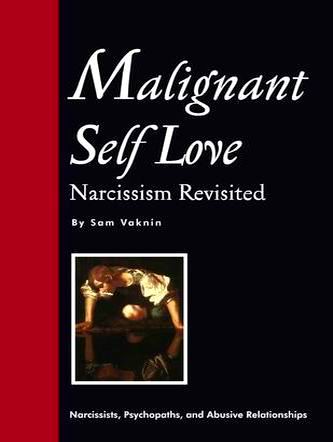
malignantselflove

I got the three books I ordered from Amazon in the mail yesterday and started to read Sam’s book first because I really need to know about narcissism from the perspective of a narcissist. I said it before and I’ll say it again–it’s huge (but I like huge books).

So far (I finished the first chapter) I can tell he’s a very good writer (in a verbose, almost old fashioned way) and I think it’s going to be a fascinating read. He also gives credit where credit is due, and cites experts in the field and the DSM-IV-TR as sources.

But something stood out to me right away that screamed narcissist. At the back of the book, there are SIX PAGES of Vaknin’s accomplishments and qualifications (“Curriculum Vitae” he calls it–he is very pedantic too). SIX PAGES. I kid you not.

Not only that, there are four pages of testimonials. That’s right, FOUR PAGES. Who includes four pages of testimonials and six pages listing their qualifications? A narcissist, that’s who!

I have no problem reading a book about narcissism by a narcissist. The way I see it, it’s coming directly from the source, not from some detached expert with 8-10 years of higher education who doesn’t know what the disorder feels like. Sam KNOWS what it feels like, and it sounds like hell. Narcs are not happy people, I can assure you of that. They may SEEM happy, but they are not. They live their lives in sheer terror of their masks being stripped off.

That doesn’t mean we should feel sorry for them though. Miserable or not, they aren’t nice people, and don’t deserve our pity.

Here is an excerpt of what Paul Shirley, MSW, has to say about Sam’s book in the Prologue:

Sam’s writing on the subject pulsated with heat, it ran red with blood, it crackled with flames of passion, it cried out in agony. Sam KNEW narcissism like the fish knows the water and the eagle knows the air, because he had lived it. He described its small insignificant currents, he knew what it does when the weather changes, he knew exactly what happened to little frogs, snakes and crickets whenever they fall into the stream. Most psychologists only KNOW about narcissism. Sam UNDERSTANDS it.

After I finish his book, I’ll write up an in depth review. So far, a good read though.
You can also order his book here.