Today I cried.

bottleoftears

[My lame attempt at freeverse poetry, for whatever it’s worth.]

Softer, more buoyant than ocean water
Welcome as a warm spell in January
and sudden as a summer squall
hot floods of tears from some unknown cistern rise up and
caress my face like
the loving touch of the mother I longed for and never had and
my fears and doubts fade and dissolve

Relaxing, not scared and
Melting into this dark warm and unfamiliar place
I sleep but never forget.

Ascending to the surface through an ocean of dissolving dreams
I cry out to the stars: Where are you? Who are you? How did you know?
I wait and wait and wait and I
hear nothing but the endless silence of the stars and
the crashing of the waves on the faraway shore and
the beating of my heart and

I wait

moonset

Then the answer comes: I’ve always been here.
Look inside and then look up.
Loving arms reach down and lift me up and
hold me like my mother should have and then I hear these words:

“You have passed this test.
Now, armed with the twin swords of truth and light
the dangers you faced can no longer harm you.
You are strong, you are safe and
God anoints you
with every tear that falls.”

I still won’t blog about my secret, but…

emptybook

I did tell one person, a very good friend of mine–another blogger in the psychopathic/narcissistic abuse community, the exact nature of my secret. My confession was satisfactory enough to ease the itch I had to blog about it. She advised me not to, for basically the same reasons I had for not doing so.

We Aspies sometimes don’t say things even when we should. We know how awkward we seem to others and feel like it’s better to stay silent than sound like idiots, especially in the real, flesh and blood world of face to face communication.

Other times we say too much, especially on the Internet, a place where Aspies and INFJs and INTJs like myself abound (I’m either one of those depending which Myers-Briggs test I take), because we feel more comfortable socializing behind the anonymity of a computer and like the fact we can edit what we say before we say it. But there are times we Aspies still can get carried away with our candor and our filter goes on a Caribbean vacation. We just don’t know when to STFU. And we can find ourselves in a world of trouble because of that failure to censor our real feelings.

Back in 2008 and 2009, I was an active member of a certain entertainment related forum. At first I was a respected and popular member and then my virtual mouth developed a bad case of diarrhea. I had developed a crush on a person on the forum and was way too honest about it. Inevitably, a group of bullies and trolls on the forum smelled blood. They decided to use me for target practice, and soon even regular members started to join in. I was openly mocked and even started having problems with the forum administrator. I was nearly banned but wound up leaving of my own accord because posting there was no longer fun. My username became a pejorative, and to my horror, when I Googled my username, I discovered I was being quoted and mocked on two different but related sites, and their members were having a field day making fun of everything I said. I was mortified. It was as bad as being the school pariah all the bullies went after. It didn’t matter that I was essentially still an anonymous person on the Internet and no one knew my real name–I hadn’t felt that shamed or embarrassed since my days as the school dartboard.

The secret I have is actually not what it appeared to be at first. Now I understand the real reasons for it, and to my relief they are normal, healthy ones. It was really a springboard to something else. Strange things happen when you begin to journal publicly about something so personal as narcissistic abuse. One important side effect of blogging was I developed a closer relationship with God, who I rely on now to guide me in all my decisions, including what I blog about. I have prayed about this thing, this secret–and God is providing me with answers–including one I never expected.

An idea is beginning to form in my mind, an huge idea that could totally change my life and maybe the lives of others as well if I play things smart. Or it could lead to nothing other than an interesting venture into unknown territory. Doing this thing requires self-discipline, hard work, passion, and dedication. I’ve never stuck with anything before. I’d become intensely interested in something, and then drop it when it became too hard or frustrating, or when my interest in it burned itself out. That’s one of the reasons I’m still floundering through life like a teenager even though I’m over 50.

That’s all changing. I’ve stuck with blogging now for three months and show no signs of stopping. I’m passionate about blogging. It’s my new drug of choice. Because it’s become so much more than just a way to journal publicly about my experiences with narcissism. Watching my blog do so well and watching it grow and knowing it’s helping others besides just me is raising my self esteem so I no longer hear my N mother’s accusation of “loser” or “you can’t succeed” bouncing like a poisoned ping pong ball inside my brain anytime I tried something new. My entire viewpoint on life is different. I feel like I can do things, accomplish something important, and even help others while I make myself happy. Hey, I might not even have to remain poor and underemployed the rest of my life, something I had actually become resigned to. For years I’ve taken it for granted that I would die in great pain, alone and destitute, and no one would care.

There’s a certain topic related to narcissism I desperately want to write a book about. After I wrote my “Secrets” post, after a few days this book idea began to form. I tossed the idea around in my head for a few days and am waiting for some further information before I start, but even if I don’t get the information I’ve requested, I still want to write the book. It will make it harder but I can still do it. I feel like it’s something I must do, but not only that, I’m convinced it’s also what God wants me to do. I have no idea what his reasons would be for my writing this book, but then again, God doesn’t usually explain his reasons. It isn’t until later on that we find ourselves surprised to be in places we never dreamed we’d be in our wildest fantasies.

I have a good feeling about this. Not an unrealistic, grandiose fantasy that never sees the light of day because you either don’t have a real passion for it or have no practical plan to carry it out–this time it’s a real plan that I know I can fairly easily turn into reality. I think I can stick with it this time too, because it’s where God has been trying to lead me my entire life–but I couldn’t hear him because of all the noise inside my head.

The last time I wrote a book–a novel–I made the mistake of letting my MN mother read it. She hated it, so it went in a box in the back of my closet and I didn’t write another thing (except forum posts) until I started this blog. Recently I pulled the manuscript out of its box and read parts of it. It really was cringe-worthy, but in 2003 I was coming from a very unhealthy mental space and besides, fiction writing isn’t really my thing, so.

I know this post doesn’t make much sense, because I’m trying to write about something obliquely and it’s hard to be clear when you’re being oblique.

But the important thing is I have decided to use the writing ability God gave me and use it to write a book about something I’m deeply interested in. I still have self doubt, a lot of it, but I won’t let anyone or anything let me give this up.

PS: my laptop was acting weird while I wrote this, and I just realized I typed the whole thing in airplane mode. 😀

What Sam Vaknin thinks about Jesus.

He replied to my last article about what he says about Jesus Christ–twice.   Once again he had to clarify a few things by providing links. One of the links provided talks about religion being a perfect way that narcissists can make themselves feel superior to nonbeliever (even though they must “submit” to a higher entity than themselves). They hold their nose and submit to a God or messiah because of the narcissistic thrill of self righteously being able to claim their piety makes them better than everyone else. I’ve seen this sort of thing going on in 12 step programs like AA too. In fact, my mother uses the AA program exactly like a religion and loves to use its slogans and dogma (and yes, it does have a dogma) to prove how righteous and sinless she is compared to non-teetolalers and everyone else, especially me.

I agree with what Vaknin writes in his post. I’ve seen way too many fundamentalist or evangelical Christians use their religion to intimidate (“you are going to hell”), make themselves feel special (“I know I’m going to heaven”), make threats (“unless you do X…you will go to hell”), not take responsibility for their actions (“God told me to do this” or “the devil made me do it”), and show a lack of empathy (“It’s God’s will”) and not acknowledge your concerns or questions (“It’s right here in the Bible or other holy text). This is especially prevalent in religious leaders, but is quite common in other people too.

god

Let me add that not all Christians are like this, and narcissistic behavior definitely applies to followers and leaders of other belief systems too, even atheism! (Self righteous, intolerant atheists are commoner than you would think).

Here is what he writes:

For the Love of God

“1 But know this, that in the last days perilous times will come: 2 For men will be lovers of themselves, lovers of money, boasters, proud, blasphemers, disobedient to parents, unthankful, unholy, 3 unloving, unforgiving, slanderers, without self-control, brutal, despisers of good, 4 traitors, headstrong, haughty, lovers of pleasure rather than lovers of God, 5 having a form of godliness but denying its power. And from such people turn away! 6 For of this sort are those who creep into households and make captives of gullible women loaded down with sins, led away by various lusts, 7 always learning and never able to come to the knowledge of the truth. 8 Now as Jan’nes and Jam’bres resisted Moses, so do these also resist the truth: men of corrupt minds, disapproved concerning the faith; 9 but they will progress no further, for their folly will be manifest to all, as theirs also was.”

(The Second Epistle of Paul the Apostle to Timothy 3:1-9)

God is everything the narcissist ever wants to be: omnipotent, omniscient, omnipresent, admired, much discussed, and awe inspiring. God is the narcissist’s wet dream, his ultimate grandiose fantasy. But God comes handy in other ways as well.

The narcissist alternately idealizes and devalues figures of authority.

In the idealization phase, he strives to emulate them, he admires them, imitate them (often ludicrously), and defends them. They cannot go wrong, or be wrong. The narcissist regards them as bigger than life, infallible, perfect, whole, and brilliant. But as the narcissist’s unrealistic and inflated expectations are inevitably frustrated, he begins to devalue his former idols.

Now they are “human” (to the narcissist, a derogatory term). They are small, fragile, error-prone, pusillanimous, mean, dumb, and mediocre. The narcissist goes through the same cycle in his relationship with God, the quintessential authority figure.

But often, even when disillusionment and iconoclastic despair have set in – the narcissist continues to pretend to love God and follow Him. The narcissist maintains this deception because his continued proximity to God confers on him authority. Priests, leaders of the congregation, preachers, evangelists, cultists, politicians, intellectuals – all derive authority from their allegedly privileged relationship with God.

Religious authority allows the narcissist to indulge his sadistic urges and to exercise his misogynism freely and openly. Such a narcissist is likely to taunt and torment his followers, hector and chastise them, humiliate and berate them, abuse them spiritually, or even sexually. The narcissist whose source of authority is religious is looking for obedient and unquestioning slaves upon whom to exercise his capricious and wicked mastery. The narcissist transforms even the most innocuous and pure religious sentiments into a cultish ritual and a virulent hierarchy. He preys on the gullible. His flock become his hostages.

Religious authority also secures the narcissist’s Narcissistic Supply. His coreligionists, members of his congregation, his parish, his constituency, his audience – are transformed into loyal and stable Sources of Narcissistic Supply. They obey his commands, heed his admonitions, follow his creed, admire his personality, applaud his personal traits, satisfy his needs (sometimes even his carnal desires), revere and idolize him.

Moreover, being a part of a “bigger thing” is very gratifying narcissistically. Being a particle of God, being immersed in His grandeur, experiencing His power and blessings first hand, communing with him – are all Sources of unending Narcissistic Supply. The narcissist becomes God by observing His commandments, following His instructions, loving Him, obeying Him, succumbing to Him, merging with Him, communicating with Him – or even by defying him (the bigger the narcissist’s enemy – the more grandiosely important the narcissist feels).

Like everything else in the narcissist’s life, he mutates God into a kind of inverted narcissist. God becomes his dominant Source of Supply. He forms a personal relationship with this overwhelming and overpowering entity – in order to overwhelm and overpower others. He becomes God vicariously, by the proxy of his relationship with Him. He idealizes God, then devalues Him, then abuses Him. This is the classic narcissistic pattern and even God himself cannot escape it.


Sam Vaknin thinks Jesus was a narcissist.

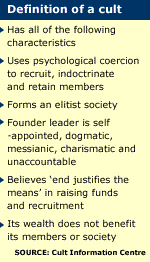
cultdefinition
A true cult’s agenda and operation is definitely psychopathic. (click to enlarge).

Sam Vaknin has a lot to say about religion and cults and how they relate to psychopathy.
On his website, he addresses the problems of religious cults and describes the way they are almost always run by malignant narcissists who use their usual bag of psychopathic tricks to brainwash people into converting and once converted, keeping them in thrall to the cult. The article is here.

Vaknin’s description of cults sounds exactly the way a cult such as Scientology is run (I dabbled in it back in the late 1970s for about 2 years but was fortunate enough to be able to escape before I was completely taken in). I have no doubt Scientology’s founder, L. Ron Hubbard, a hack science fiction writer, was a malignant narcissist (his official bio is full of lies and “accomplishments” that are complete fabrications). Scientology doctrine uses every trick in the psychopath’s book of coercion: brainwashing techniques disguised as “auditing” or “training routines (TR’s), threats to members who threaten to leave the cult (“fair game”), attempts to separate members from their non-Scientologist families and friends, exhorbitant and extortionist prices to move up the “bridge,”
insane doctrine passed off as “truth,” and definitely lots of paranoia and secrecy.

Lronhubbard
L. Ron Hubbard, malignant narcissist

Scientology is the enemy of any legitimate psychotherapy–psychology and psychiatry are held to be the utmost evil, members are required to use underhanded means to attack and even attempt to destroy the careers of professionals in those fields (I have a personal story about this I’ll describe at a later time), and of course Scientology has had numerous problems with the IRS and other government agencies. Anyone who criticizes Scientology is labeled a “Suppressive Person” and is either excommunicated from Scientology or punished by a form of shunning. Members who are influenced by someone who is against Scientology are labeled “Potential Trouble Sources” (PTS) and ordered to cut the “SP” out of their lives, even if it’s a spouse or another close family member.

There’s an excellent and fascinating website about the insane mindgames this “religion” plays and includes case histories of people whose lives were totally ruined by this dangerous and psychopathic cult. The “secrets” of the upper OT (operating thetan) levels used to be unobtainable to anyone who had not “gone clear” and had the money to pay for further “processing” to the OT levels, but those jealously guarded secrets are now available to anyone who has Internet access and is curious enough to Google them. Well, naturally I was curious and the “secrets” are indeed pretty crazy, obviously the ravings of L. Ron Hubbard’s disordered and paranoid mind.

It used to be said that the secrets could not be revealed to members at lower levels because such knowledge would shock them to the point of actually killing them. I remember reading about one ex-Scientologist who suggested that the real reason the upper level secrets were so carefully guarded was not to “protect” anyone from the shock of the “truth” but rather, because the things revealed at the upper levels were so insane that only someone who had spent thousands of dollars and been thoroughly brainwashed could possibly take them seriously (in fact, there are cases of those who did reach those levels and when the secrets were finally revealed to them, they left the Church because they felt their entire journey had been a colossal waste of time and money). Anyone who hadn’t made such a huge mental and financial investment and read about the OT revelations online would die alright: they would die of laughter. And yes, they are that crazy. I read the “revelations” of the OT levels with my jaw glued to the table in disbelief that any sane person would believe such a load of crap.

Vaknin should have used the example of Scientology, a perfect example of a “religion” with a psychopathic agenda and a malignant narcissist “god.” There are many other examples he could have used too–the Branch Davidians, Heaven’s Gate, the Unificiation Church (Sun Myung Moon’s cult), a few “New Age” cults, and many others.

But no, instead Vaknin attacks Christianity. He actually says Jesus Christ was a narcissist. I don’t know what Vaknin’s religious beliefs are, or even if he has any, and I certainly have my own issues with organized religion and fundamentalist Christianity in particular (the God of the Old Testament does come off as quite psychopathic at times), but I think Vaknin is missing the mark by describing Jesus Christ this way (or Christianity in general as a cult). He uses Bible quotes to “prove” that Jesus was a narcissist. Rather than try to paraphrase what he says, I’ll just post it here:

Jesus Christ, narcissist
http://samvak.tripod.com/journal79.html

Note:
Though most of the quotes in this essay are from the Gospel of Saint Matthew, I was careful to compare them with the texts of the other three canonical gospels. Where the gospels disagree, I avoided using the quote altogether.

Illegitimate and adopted children, especially of humble origins, often develop narcissistic defenses to fend off persistent feelings of inadequacy and inferiority. Admittedly, it is highly unlikely that Jesus was an illegitimate child. Adulteresses in ancient Judea were stoned to death. But, equally, there is little doubt that the circumstances of Jesus’s birth were shrouded in mystery. His mother, Mary, got herself pregnant but not by having sexual intercourse with her lawfully-wedded husband, Joseph.

Early on, Jesus developed magical thinking, compensatory grandiose delusions, and fantasies of omnipotence and omniscience. A firstborn, he was much pampered by his doting mother. He was a prodigy, a Wunderkind: highly intelligent and inquisitive and more comfortable in the company of adults than with his peers.

When he was a mere 12 years old:

“(T)hey found him in the temple, sitting in the midst of the doctors, both hearing them, and asking them questions.” (Luke 2:46)

Even at this tender age, he showed a marked lack of empathy and a full-fledged case of pathological grandiosity:

“His mother said unto him, Son, why hast thou thus dealt with us? behold, thy father and I have sought thee sorrowing. And he said unto them, How is it that ye sought me? wist ye not that I must be about my Father’s business?” (“My Father” being God – SV). (Luke 2:48-49)

Gurus at the center of emergent cults are inevitably narcissistic, if not outright narcissists. The self-imputation of superiority, epiphanic knowledge, and infallibility and the assumption that others need and crave the guru’s message are at the heart of an elaborate construct which often borders on the psychotic:

“… (T)he people were astonished at his doctrine: For he taught them as one having authority, and not as the scribes.” (Matthew 7:28-29)

Referring to his 12 disciples, Jesus made clear that: “The disciple is not above his master, nor the servant above his lord.” (Matthew 10:24)

“He that loveth father or mother more than me is not worthy of me: and he that loveth son or daughter more than me is not worthy of me. And he that taketh not his cross, and followeth after me, is not worthy of me. He that findeth his life shall lose it: and he that loseth his life for my sake shall find it.” (Matthew 10:37-39)

Here is how Jesus, the lowly, unmarried, and itinerant son of a carpenter – an abysmal failure by the standards of his society – viewed himself:

“When the Son of man shall come in his glory, and all the holy angels with him, then shall he sit upon the throne of his glory: And before him shall be gathered all nations: and he shall separate them one from another, as a shepherd divideth his sheep from the goats … And these shall go away into everlasting punishment: but the righteous into life eternal.” (Matthew 25:31-32 and 25:46)

“Thinkest thou that I cannot now pray to my Father, and he shall presently give me more than twelve legions of angels?” (Matthew 26:53)

Contrary to his much-cultivated image, Jesus, like the vast majority of cult leaders, lacked empathy and was a heartless and irresponsible manipulator whose magical thinking ruined the lives of many. He instructed his followers to commit acts that must have had harshly adverse impacts on their hitherto nearest and dearest. Jesus monopolized the lives of his disciples to the exclusion of all else and all others:

“For I am come to set a man at variance against his father, and the daughter against her mother, and the daughter in law against her mother in law. And a man’s foes shall be they of his own household.” (Matthew 10:35-36)

“Then one said unto him, Behold, thy mother and thy brethren stand without, desiring to speak with thee. But he answered and said unto him that told him, Who is my mother? and who are my brethren? And he stretched forth his hand toward his disciples, and said, Behold my mother and my brethren!” (Matthew 12:47-48)

“And Jesus, walking by the sea of Galilee, saw two brethren, Simon called Peter, and Andrew his brother, casting a net into the sea: for they were fishers. And he saith unto them, Follow me, and I will make you fishers of men. And they straightway left their nets, and followed him. And going on from thence, he saw other two brethren, James the son of Zebedee, and John his brother, in a ship with Zebedee their father, mending their nets; and he called them. And they immediately left the ship and their father, and followed him.” (Matthew 4:18-22)
Consider the disastrous effects their actions had had on their fathers and their families, now left to starve. To Jesus, evidently, these were irrelevant considerations.

Jesus healed only those who visibly, volubly, clearly, publicly and repeatedly worshipped him. In other words, he extended his gift only to his sources of narcissistic supply. There are numerous instances in the four canonical gospels where Jesus actually bargains with the afflicted and demands – sometimes in anger – their unconditional adoration. He is happiest when acknowledged and affirmed as Christ, the Son of Man (son of God). Those who do not recognize his splendid grandeur, unbounded might, and implied divinity are “dogs” and “swine” (Matthew 7:6)

His much-touted love of the poor was not a match for his malignant self-love. When his disciples upbraided a woman for anointing Jesus with expensive ointment because the money could have been better used to help the poor, the great humanist, Jesus, had this to say:

“Why trouble ye the woman? for she hath wrought a good work upon me. For ye have the poor always with you; but me ye have not always.” (Matthew 26:10-11)

The principles espoused by Jesus were malleable and easily bent. He professed to minister only to the Hebrews (Sons of Israel) and steadfastly refused to heal the Gentiles whom he called “dogs”. When a woman of Canaan beseeched him to cast the devil out of her daughter (“Have mercy on me!”), he retorted, shockingly:

“I am not sent but unto the lost sheep of the house of Israel … It is not meet to take the children’s bread, and to cast it to dogs.” (Matthew 15:24-26)

But he soon forgot and retracted this lofty “principle” when she adulated him:

“Then Jesus answered and said unto her, O woman, great is thy faith: be it unto thee even as thou wilt. And her daughter was made whole from that very hour.” (Matthew 15:28)

Similarly, he cured the servant of a Roman centurion after his master catered to Jesus’s by-now rampant megalomania:

“When Jesus heard it, he marvelled, and said to them that followed, Verily I say unto you, I have not found so great faith, no, not in Israel. And Jesus said unto the centurion, Go thy way; and as thou hast believed, so be it done unto thee. And his servant was healed in the selfsame hour.” (Matthew 8:10 and 8:13)

Jesus’s initial false modesty soon gave way to bragging and outlandish, often confabulatory claims.

Whenever he affected a miracle – such as restoring eyesight to the blind, cleansing lepers, reviving the crippled, and raising the ostensibly dead – Jesus beseeched them to keep mum about the events. One of many examples:

“And their eyes were opened; and Jesus straitly charged them, saying, See that no man know it.” (Matthew 9:30)

But Jesus was not averse to blatant self-promotion when his false modesty failed to elicit narcissistic supply:

“Go and shew John again those things which ye do hear and see: The blind receive their sight, and the lame walk, the lepers are cleansed, and the deaf hear, the dead are raised up, and the poor have the gospel preached to them.” (Matthew 11:2)

“I say unto you, That in this place is one greater than the temple … For the Son of man is Lord even of the sabbath day … behold, a greater than (the prophet) Jonas is here … behold, a greater than (King) Solomon is here.” (Matthew 12)

As a true narcissist, Jesus reprimanded others for his own brand of behavior. This psychological defense mechanism is called “projection”.

This is how he described the Pharisees, the scribes, and the Sadducees (and, inadvertently, himself and his own conduct):

“(T)hey say, and do not. For they bind heavy burdens and grievous to be borne, and lay them on men’s shoulders; but they themselves will not move them with one of their fingers. But all their works they do for to be seen of men: they make broad their phylacteries, and enlarge the borders of their garments, And love the uppermost rooms at feasts, and the chief seats in the synagogues, And greetings in the markets, and to be called of men, Rabbi, Rabbi.” (Matthew 23:1-6)
Narcissists are disruptive, counter-dependent, combative, and resent authority (rebellious and contumacious). They feel that they are above the law, or, rather, that they are a law unto themselves. They hold themselves to be immune to the consequences of their actions:

“Think not that I am come to send peace on earth: I came not to send peace, but a sword.” (Matthew 10:34)

“And Jesus went into the temple of God, and cast out all them that sold and bought in the temple, and overthrew the tables of the moneychangers, and the seats of them that sold doves, And said unto them, It is written, My house shall be called the house of prayer; but ye have made it a den of thieves.” (Matthew 21:12-13)

Narcissists are ill-disposed towards disagreement and criticism. They react to the slightest hint of either with narcissistic rage and fury that knows no bounds and no mercy:

“And thou, Capernaum, which art exalted unto heaven, shalt be brought down to hell: for if the mighty works, which have been done in thee, had been done in Sodom, it would have remained until this day. But I say unto you, That it shall be more tolerable for the land of Sodom in the day of judgment, than for thee.” (Matthew 11:23-24)

“He that is not with me is against me” (Matthew 12:30)

“For I say unto you, Ye shall not see me henceforth, till ye shall say, Blessed is he that cometh in the name of the Lord.” (Matthew 23:39)

Narcissists react particularly badly when their concocted personal myth, their False Self, is directly and effectively challenged and they are consequently discredited and humiliated in public:

“And when he was come into his own country, he taught them in their synagogue, insomuch that they were astonished, and said, Whence hath this man this wisdom, and these mighty works? Is not this the carpenter’s son? is not his mother called Mary? and his brethren, James, and Joses, and Simon, and Judas? And his sisters, are they not all with us? Whence then hath this man all these things? And they were offended in him. But Jesus said unto them, A prophet is not without honour, save in his own country, and in his own house. And he did not many mighty works there because of their unbelief.” (Matthew 13:54-58)

Ultimately, the narcissist pays the price for years of ill-treating others and sucking their energies dry with constant demands for attention, adulation, and affirmation. People get tired of the overbearing and overweening presence of the narcissist in their lives, of his disruptive and destabilizing influence, and of the pernicious effects he has on their nearest, dearest, and communities. Invariably, they seek to banish him and extricate themselves from his cult. The authorities usually are forced to intervene and lock the narcissist up or, worse, crucify him.

Even his closest followers, supporters, and disciples give up on the narcissist:

“Then all the disciples forsook him, and fled.” (Matthew 26:56)

“Then did they spit in his face, and buffeted him; and others smote him with the palms of their hands, Saying, Prophesy unto us, thou Christ, Who is he that smote thee?” (Matthew 26:67-68)

“Peter remembered the word of Jesus, which said unto him, Before the cock crow, thou shalt deny me thrice.” (Peter, indeed, denying knowing Jesus thrice – SV) (Matthew 26:75)

And the fickle “multitude” (the common folk), who were supposed to be the mainstay of Jesus’s power and popularity, betrayed him gleefully and with a clear sense of relief and good riddance:

“Whether of the twain will ye that I release unto you? They said, Barabbas … They all say unto him, Let him be crucified … they cried out the more, saying, Let him be crucified … Then answered all the people, and said, His blood be on us, and on our children … And they that passed by reviled him, wagging their heads, And saying, Thou that destroyest the temple, and buildest it in three days, save thyself. If thou be the Son of God, come down from the cross. Likewise also the chief priests mocking him, with the scribes and elders, said, He saved others; himself he cannot save. The thieves also, which were crucified with him, cast the same in his teeth.” (Matthew 27)

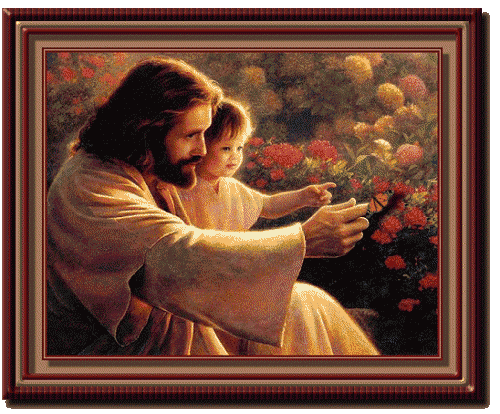
Jesus_with_a_child
Jesus doesn’t look like a narcissist to me.

Vaknin is using the words and deeds described in the Gospels to spin Jesus into a malignant narcissist. I don’t buy it. I have been attending RCIA classes (the classes one takes to become Catholic), and am still on the fence as to whether Jesus was actually the Son of God or just a very good man and prophet, but have lately been leaning more toward him being divine.

If Jesus was actually who he said he was–the Son of God–then he was being truthful and not narcissistic or grandiose in any manner. Jesus was compassionate and empathetic toward the unfortunate and the poor and healed the sick and disabled, and while he does appear to have had a temper, it was a righteous anger toward those who refused to believe who He was. He didn’t reject or disrespect his mother either. He had a great love for Mary as his earthly mother, but if Jesus was the son of God, then God’s desires would naturally have to come first.

In Vaknin’s defense, if he doesn’t believe Jesus was divine (and many people don’t), then I suppose it could be argued Jesus acted in narcissistic and grandiose ways (it could actually more easily be argued he was a paranoid schizophrenic–insisting he was God Himself when he really wasn’t), but I still wouldn’t call him a narcissist. Vaknin is probably not a Christian due to his nationality (he’s from Israel and his mother was Turkish) so it’s understandable that he wouldn’t believe Jesus was the Son of God, but to make such a sweeping accusation against a religious entity whose words have changed the lives of many millions of people for the better is pretty narcissistic on Vaknin’s part (which of course is no surprise).

Some of the more extreme evangelistic and fundamentalist Christian churches (especially those that believe in such unpleasant and elitist doctrines as predestination–a Calvinistic belief that certain “chosen” people have been predestined for heaven even before they were born, making the concept of “free will” and works null and void) are not too far removed from cults and they commonly have psychopathic leaders and use cult-like brainwashing tactics. There are also unfortunately many religious leaders of mainstream churches who are very narcissistic and even psychopathic, but this doesn’t mean Christianity itself is a cult of narcissism or that Jesus was a narcissist.

I still defend most of Vaknin’s writings from his critics, given that as a narcissist who is honest about himself, he is more than qualified to call himself an expert on the disorder and write as much as he wants to about it. Whether intentional or not, he has helped a great number of sufferers and victims of psychopathy. But in this particular discussion about cults, using Christianity as an example of a cult and Jesus as a malignant narcissist not only misses the mark, but to many people would be considered blasphemous. In spite of my own misgivings about Christian doctrine, I just couldn’t let this pass.

We All Need a “Mother”

This article is right in keeping with my own attendance at RCIA (the classes one takes to become Catholic) and what I am learning. As the child of a malignant narcissist mother, Mary is about as unlike my mother as it’s possible to be. I need a ever merciful Mary in my life! I’m also finding that, rather than the dogmatic, intolerant, bloated religion Catholicism has a reputation of being, that’s it’s actually one of the most loving and tolerant of all Christian religions–and probably the most authentic (being the oldest and apostolic church Jesus actually founded).

I’m also taken with this writer’s affinity for Buddhism, which I’ve dabbled in myself. Buddhism, rather than being a religion, is more of a philosophy. You can believe in one God or not. I don’t think reincarnation and karma are reconcilable with Catholicism (or any other form of Christianity), but these beliefs have a lot going for them and there are a lot of good arguments in their favor. I’m reblogging this article because it puts a lot of the thoughts I’ve been having into words much better than I can.

The Tree

CLF - Olmstead Parks

Until August 1999, I had a vague concept of God and if anyone had asked, would have told them I was agnostic, leaning toward atheist. I was very far away from God in those days–embroiled in a deteriorating marriage to a narcissistic psychopath, drinking and smoking pot in an attempt to “put up” with him, all while I was raising two young children. I also was an unfaithful wife (as was my husband) and handily made excuses about my infidelity based on his abusive treatment of me and the fact he was unfaithful too. I never darkened any church’s doorway, and thought prayer was useless and silly. God was an abstract and mostly irrelevant concept to me–of no further consequence to my personal life than an Ebola case in Africa. My theory back then was that if there was a God, then maybe he created the universe, but then he left it pretty much alone after that, and was probably too busy creating new universes to give a damn what happened in ours. After all, if God was so concerned about our little human corner of the universe, why did He allow so many bad things to happen?

My ex was drinking heavily back then, and frequently became violent. During one of these fights, he blackened my eye and I had other bruises too, so I called the police. Given that he had no marks on him, but I was in pretty bad shape, he was arrested and went to jail for 90 days. During the time he was in jail, we had a stick-shift pickup truck, which I had never learned to drive. Since it was our only vehicle back then, and I had a six and seven year old that I needed to transport to dental and doctor appointments, as well as getting them home from their after school program, I had no choice but to teach myself how to drive the stick.

At first it was hard knowing what gears to shift into and when. It was very difficult to get used to how totally different a feel driving a stick-shift was over the ease of an automatic, which you didn’t have to “think” about so much. Some people told me they liked stick-shifts better because they felt they had more control over the vehicle, but it never felt that way to me. Still, over time, I got better, and soon was able to drive the thing adequately. Or so I thought. Obviously I still had a lot to learn about what gear to use when.

At the time, we lived in a house that sat at the top of a steep hill, and I’d usually take the long way around, following a gravel easement that looped around the back of the house, and continued down into our driveway, where I’d park so the truck was facing toward the road, so the gas could run into the tank.

On this muggy August day in 1999, after I picked the kids up after their after-school program, we stopped at McDonalds, and the kids were excited about their new Happy Meal toys and were contentedly playing with them in the back seat. Molly, just six and small for her age, still used a booster seat. Ethan, seven going on eight, no longer used a booster or car seat, and wore the seatbelt, which was still pretty loose on him.

When I stopped at the bottom of the part of the hill that merged into the driveway, I put the gear in what I thought was the correct setting for a parked car (neutral). Nothing had ever happened before, and no one had told me this was wrong, so I thought nothing of it this time. I got out of the truck and went around to the back to let the kids out.

Suddenly the truck began to roll. Downhill. The hill was steep and bumpy since it was unpaved. I watched helplessly, as if in a dream, as the truck bumped and rolled its way downhill, picking up speed as it went. I saw my son’s little face in the window of the backseat, frozen in a scream of terror. I heard my daughter cry, “Mama!” Suddenly I was moving, and racing after the truck which had picked up speed as it headed for the road. I threw myself on the ground and tried to grab onto one of the tires, as if that would make it stop. The truck continued to roll, and I was dragged along with it, bloodying my knees and ripping my clothes in the process, but I didn’t even know I was bleeding until later. All I could see was my kids and I had to save them.

The truck barreled into the road, and straight across it was a tree. A very large oak tree with a thick trunk. The truck was headed directly for that tree. At this point I had lost my grip and was screaming and crying, blood from my knees soaking what was left of my jeans. My hands were bleeding too. I watched in horror as the truck got closer to the tree. A few neighbors had come out and were watching the drama unfold, but I was hardly aware of them. Everything was moving in slow motion; I felt like I was trapped in some kind of nightmare. Desperately, I prayed: “God, if you exist, please do something!” I didn’t believe anyone heard my prayer.

The road and the tree were on flat ground, and the truck seemed to slow a little, and then the most incredible thing happened. The truck swerved to the right, and went around the tree, before continuing its journey across the neighbor’s property, which ended in a fairly deep ditch.

The ditch wasn’t visible from where I stood, and neither was the truck when it dove into it. My neighbors from the house across the street ran down into the ditch to see if the kids were alright. My heart was slamming inside my chest like a hammer. I still feared the worst.

A few minutes later, my neighbor appeared–Molly and Ethan each holding one of his hands. Molly was crying; Ethan looked solemn and pale as a ghost. Both children were fine, save a scratch on Ethan’s head (it turned out he had already taken off his seatbelt before all this happened!) They were scared, but fine. Mama, not so much! EMS workers had come and taken us all to the hospital by ambulance. It was me who suffered the worst injuries–deep cuts on both knees and severely chafed hands.

The emotional injuries were much worse, and would last for years. For months, I had flashbacks to that moment of sheer terror, when the truck started to roll and I could hear my kids screaming. Over time, the flashbacks stopped, but I’ve had a phobia ever since about ever parking on a hill–or even having to drive up one.

But overriding the negative aftereffects, is a conviction that at that moment when the truck had veered to the right and safely went around the tree instead of crashing into it, I had seen the hand of God at work, through one or more of his angels. Whoever or whatever it was made sure my kids stayed safe. No longer could I believe God just doesn’t care. I realized that it was the very moment when I called out to him through my skepticism, that he stepped in.

Sometimes we just have to ask and God will show himself, even if we don’t believe.

Which religion is the One True Religion?

onetruereligion

I came across a fascinating post over at Godless Cranium’s blog. Although I’m not an atheist, I always find his posts thought-provoking and he raises a lot of great questions. This one really got me thinking.

Until recently I’ve been agnostic, and I still have a lot of agnostic views. I don’t expect those to all change any time soon. But this week I decided to become Catholic. I know, I know, a lot of you are thinking, WTF? Why would you choose such an ancient, archaic, bloated religion that has a violent past full of hypocrisy, bloodshed and immoral practices such as people being bilked out of their hard earned money to get someone out of Purgatory? I have my reasons. If you’re interested in why I chose this faith over others, you can read the two posts I wrote a few days ago.

That being said, do I think the Catholic church is the “right” religion? Not really. It may be all wrong for someone else, but for a number of reasons, I think it will work for me. Catholics actually believe all Christians are going to heaven, and some non-Christians who do good works are going there too. I like that. But they still have their doctrine that holds that it’s much, much better to be a Christian, even a non-Catholic one, so a non-Christian’s chances of getting to heaven still aren’t very good.

Muslims believe they are the only ones going to heaven. Allah will save a faithful Muslim but everyone else, including all Christians, will go to their version of hell. What if they are right? I mean, they could be, right? They are as convinced as any Christian that their Allah is the One True God and believing anything else is heresy.

Closer to home, many fundamentalist Protestant denominations think only members of their particular denomination will go to heaven. There are about 30,000 Protestant denominations. Which one is right? Then of course there are the offshoots of Christianity that don’t really fit into traditional Christianity–Jehovah’s Witnesses, Seventh Day Adventists and Mormons come to mind. Without exception, they all believe their faith is the one true religion and only their Bible is the correct one.

There are the non-Abrahamic religions too–Buddhism, Hinduism, Taoism and other eastern religions, as well as Wicca and various forms of paganism and shamanism, not to mention Scientology and Santeria. Even though they don’t worship the western God and don’t use any version of the Bible, their adherents all think they’re right. Who is to say they aren’t?

Who is right? Is anyone right? Maybe the atheists are right and there is no God or afterlife at all.

onetruereligion2

None of us will know for certain what will happen until we die. If we are just annihilated at death we will never be surprised there is no God waiting for us at the pearly gates because there will be no consciousness to draw such a conclusion. Perhaps reincarnation is what will happen. I can imagine many evangelical Christians being gobsmacked when they realize the Buddhists were right all along. Who’s to say? There are some very good arguments in favor of reincarnation. There are even some Christians who don’t think the idea of reincarnation can’t be reconciled with Christianity.

My head is swimming.

Maybe what happens is whatever we believe will happen. If you’re a good Christian and believe you will go to heaven, then better start shining that halo. If you’re a miserable person who thinks you deserve fiery torture, then to hell you go. If you worship Allah and believe you have pleased that God, then expect Arabic to be spoken in heaven. If you’re a Jew you will find the promised land. If you’re a Buddhist get ready for Nirvana (but be ready for a few more thousand earthly lives first). If you’re a Scientologist, L.Ron Hubbard instead of Jesus will meet you at the gates. If you’re an atheist you may be surprised you aren’t annihilated after all, but what to do then? It might be nice to be free of an earthly body, but you’ll have to decide on some sort of afterlife for yourself. Maybe if you don’t believe in anything you’ll spend eternity floating around aimlessly here on earth. Maybe ghosts are really confused atheists who have passed on.

Is it possible everyone is right and there is no one true religion? Because if only one of them was right, wouldn’t there be a way for God to show us slow-witted humans which one was the One True Religion, while identifying the rest as false? Answering “The Bible answers this” doesn’t cut it, because so many groups of Christians can’t seem to agree. Even those that use the same Bible can’t agree on how to interpret many of the passages. Then of course there are different translations of the Bible and not all are exactly the same. Some even include extra books (Catholics and Mormoms) that are considered heretic by other Christians. And of course, the Muslims can counter any Christian argument by smugly stating, “It’s all here in the Q’uran.”

It’s enough to make my head explode.

So apparently God accepted my deal… (Part Two of Two)

stainedglass

As far as Catholic mysticism goes, I never had a problem with it and don’t now. In fact, I always liked the idea of Mary and the saints, not for any theological reason, but simply because sometimes the saints and Mary are just easier for the average person to relate to. According to Catholic theology, in no way does Mary or the saints replace Jesus and God. They are venerated and honored, not worshipped. They act as intercessors and do not answer prayers themselves, but pray on behalf of the person who is addressing them and those prayers are offered to God. Of course, belief in Mary and the saints is not a requirement for Catholics, but is encouraged. Mary is particularly venerated because, as the woman chosen by God to give birth to the human incarnation of Himself (Jesus), she is held in high esteem by God and deserves such honor. I happen to agree with this. I always thought Mary was sort of cool, actually. As far as her physical assumption into Heaven, I have some problems with that, but it’s a minor point and I’m willing to let it go. Again, this doctrine is not a requirement to be a Catholic.

Although unscientific, I really like the idea of transubstantiation (the literal transformation of the bread and wine into the body and blood of Jesus Christ during Communion). Suspending scientific disbelief at the climax of the Catholic mass, Communion (which is considered a sacrament, not merely a symbolic ritual) becomes something very special and mysterious and seems an appropriate way to end such a solemn event as the Mass. I also like the “Peace be with you” ritual, where just before communion, parishioners turn to one another and offer this sentiment. If only this sentiment were more often followed in daily life! Throughout my life, I always felt a sense of great peace during this and the Communion rituals, something I never felt at any Protestant service.

In the Catholic faith, while we are saved by grace and Christ’s sacrifice for us on the cross, grace ALONE is not enough. Protestantism in part arose from Martin Luther’s idea that grace alone was enough to satisfy God, and works were not important. But works are very important. While works won’t give you salvation, they are important as a means to practice and use the grace Jesus gave us when he died on the cross. In evangelical Protestantism, you can be a murderer or a selfish, immoral person in life but will still get to heaven if you accept Jesus as your personal savior. There’s something wrong with that picture and it just seems very lazy to me. They get to have their cake and eat it too: say a few words in the “sinner’s prayer,” but not be required to show anything for it (although according to most evangelicals, accepting Jesus will change your heart so you won’t want to do bad things–of course this doesn’t always seem to play out in reality!).

I also found out that Catholics do NOT condemn other Christians (or even non-Christians who do good works in life) to eternal torment. (This is a sea change from what I understood the Vatican taught when I was in grammar school.) It seems the Vatican has changed their stance on this issue, and they now accept that ALL Christians who accept Jesus as their divine Savior will go to Heaven, regardless of denomination. (It’s okay to be Protestant!) Denomination is regarded as personal preference. It’s tragic how much bloodshed and misery has resulted between groups of Christians who couldn’t agree on the extraneous details of their religion, Catholics in the past having been one of the biggest perpretators (which the Church readily admits). Even if you’re not a Christian but are a good and moral person, you will not necessarily go to hell (although the greatest glories of Heaven may be barred to you). Hell itself is something Catholics can’t seem to agree on, and while some interpret it as a literal lake of fire, others do not (hell being merely a spiritual state of separation from God). However, there does seem to be a consensus that if you are a terrible person who spends most of your life deliberately hurting others, you will probably go to hell. And of course, there is also Purgatory, which is kind of a way station on the way to Heaven, for those who have been saved, but whose works don’t measure up. Purgatory has been one of the biggest bones of contention between Catholics and Protestants, but it makes sense to me, and it’s purpose has been misunderstood by many as one of temporary punishment rather than spiritual cleansing. According to fundamentalist Protestants, you are going to heaven or hell, with nothing in between. I just could never get on board with that because people aren’t all good or all bad. There are many shades of gray in between. In a nutshell, all that’s required to get to heaven is a belief that Jesus was born, lived and died on the cross to save us from our sins–something that evangelical Protestants also believe. All the other stuff (belief in the Bible as a literal document rather than allegory, evolution [divinely inspired] vs. creationism, veneration of Mary and the saints, participation in the sacraments, etc.) is basically window dressing that helps Catholics in their faith and their journey with God.

mary

Getting back to my own journey these past few days, the thing that happened that made me realize that maybe God had seen my post and was taking me up on my challenge to Him, was that suddenly I understood the concept of the Trinity in a personal way. In the past, I never could wrap my mind around how God could be three persons in one, no matter how hard I tried or how many Bible verses born-agains tried to make me read. Out of the blue, it all made perfect sense. There is God the Father (the one who created the universe), God the Son (God presented himself in human form because that was the only way we could truly understand each other and because only God in human form could deliver us from sin) and the Holy Spirit (which is basically what you feel when a hymn, sermon or religious work of art makes you teary eyed or overcome with awe–I also think the holy spirit can get through via ANY transformative experience, be it a work of art or piece of music, nature, encounter, etc.). I know I’m not explaining my revelation very well, but I could see how this concept does not negate science or logic. It was also very comforting. After reading the personal stories of conversion on WhyImCatholic.com and explanation of Catholic theology on Catholic.com, I realized that perhaps I could be “saved” after all–as a Roman Catholic.

Why Catholic? After all, there are a few mainstream Protestant faiths that don’t preach about hell and Satan, and are more “liberal” than Catholicism and may be in keeping with a progressive worldview like mine, but honestly I always found those churches to be kind of wishy-washy, as if they were cherry-picking what they liked from traditional Christianity and chucking the rest. Their theology seems like a sort of copout, a man-made compromise that has nothing to do with God. I don’t get that feeling about the Catholic church, even though they have updated many of their traditional doctrines for modern times.

It also holds a great deal of weight for me that the Catholic church was the first organized Christian religion, and all other Christian faiths emerged or split off from that. In spite of their bloody history and many transgressions, I felt Catholicism as it stands today could be something I could accept with both my mind and heart. That being said, I do need to point out that I don’t agree with all Catholic doctrine and there are several problems I have with the Catholic church:

–Their highly heirarchical structure. While I realize this is due to tradition and is perhaps the only way to organize and administer such a huge worldwide religion, I need to find out if talking to God directly is really not a possibility, and a priest must always be a mediator between myself and the Divine.

–Their stance on abortion and contraception. While neither affects me directly (I’m no longer of childbearing age) and as I already said, their rationale does make a type of sense, it’s hard for a liberal, politically progressive woman to accept such strictures on women’s reproductive rights.

–I need to find out more about their stance on homosexuality. While the current Pope (who is pretty cool) does not condemn homosexuality and thinks too much emphasis has been put on the entire issue by evangelical Christians, it’s my understanding it’s still not acceptable according to the tenets of the Church. As a mother of a gay son, this is important for me to find out.

–Celibacy of the clergy. While on a theoretical level this actually makes a type of sense (clergy who are not married or don’t have the option to be involved in a sexual relationship are less likely to be distracted by those things and can turn their energies into a closer relationship to God), on a practical level it doesn’t seem to work: witness the recent publicization of sexual abuse cases perpetrated by Catholic clergy–it may be unrealistic to expect a human being, regardless of how pious they are, to completely divorce himself from his sexual urges and the Church’s refusal to acknowledge these physical needs may result in inappropriate sexual behavior to “whatever or whoever” is available.

–Women in the priesthood. A no brainer. Women should be allowed in the priesthood, period.

There are other problems as well, but these are the ones that bother me the most. All that being said, overall I feel that I may have finally found a spiritual “home” that works best for me–one that’s been staring me in the face my entire life but I always dismissed for one reason or another. There are a lot of negative stereotypes about Roman Catholicism and some of them are deserved, but to my surprise I realized that most are not. There are a lot of misconceptions. The Catholic church may be one of the most misunderstood religions, but it says something that it’s been around so long and continues to have so many adherents all over the world. I’ll have to dig a little deeper and make sure this is really something I’m willing and ready to embrace. Tomorrow I plan to attend Mass and talk to a priest about upcoming RCIA classes.

worldisabook

I’m completely blown away by everything that’s happened since I made that deal with God, and feel like he really is trying to get through to me. I haven’t accepted Christ yet, but I think maybe I could. One thing I have no doubt about is that God really does work in strange and mysterious ways. I’m on the quest of my life.

So apparently God accepted my deal…(Part One of Two)

outofthedarkness

For the past couple of days, I haven’t posted anything, mostly because something has happened I’ve been burning to write about, but am reluctant to because I’m afraid of what my atheist and agnostic followers will think (my feelings get hurt easily LOL). I know that’s silly, but if I don’t write about this I feel like I might explode. And I want to keep this blog active. I dearly hope my atheist and agnostic followers can keep an open mind and realize that this is something personal that has happened to ME, and in no way affects anyone else or my views about other faiths including agnosticism and atheism. I have a deep respect for all belief systems (including the right not to have one at all) and atheists and agnostics do make a lot of rational sense and I can understand why they feel the way they do about God and religion. Hell, I more or less felt that way myself until just a couple of days ago, and I don’t see myself as a person who would ever shut my mind off from their all too often very valid viewpoints.

But still. I have to blog about this, so here goes.

When I wrote my post, “I made a little deal with God,” I really didn’t expect anything to come out of it, other than a lively discussion about God and religion, which is what happened and I am grateful to all those who participated, no matter whether they’re Christians, pagans, atheists, or anything else. So after I wrote that post, I put it in the back of my mind and moved on to other things. After a couple of days, I concluded that because nothing dramatic had happened and there was no Saul-to-Paul-like “miracle” or sudden, earth-shattering change of heart, that perhaps the atheists were right and there was no God at all, that He was just a comforting construct invented by humans to deal with the stresses and injustices in our lives. Perhaps Napoleon was onto something when he said, “religion is what keeps the poor from murdering the rich.”

But in spite of all that, I’ve always been a spiritual seeker and was never satisfied with the atheistic idea that we are just a random bunch of cells that happened to glom together and gradually shape-shift into our current form. I’ve always believed there was something more, much more, but never found a religion I was happy with. Apparently God saw my post and decided to take me up on my challenge. Because two days ago while browsing the web, I came across a Catholic website, called WhyImCatholic, which is basically a bunch of testimonials from people who converted to Catholicism from other faiths, ranging from born-again (Protestant) Christianity to hardcore atheism. I have no idea how I found this website or what I was looking for, but the subject matter was interesting so I started reading some of the testimonials. Why would anyone become a Catholic, of all things? So I started to read and I couldn’t stop reading. I found that, unlike the many born-again Christians who had tried and tried without avail to explain their faith to me, these stories ACTUALLY MADE SENSE! Imagine that.

More about that later, but let me give you a little background on my relationship with Catholicism. While I’m not Catholic myself, I was raised in northern New Jersey, where Catholics were as common as toadstools after a rainstorm. Almost all my neighbors were Catholic (with a sprinkling of Jews and atheists) and I was sent to Catholic schools (the one thing I’m really grateful to my parents for, due to the superior education Catholic schools usually provide) for most of my childhood. As a child, I remember envying my Catholic friends, because of all the cool stuff and rituals their Church had–such as rosary beads, incense, a new name they got at their confirmation, and statues and painting of Mary and the saints. The Methodist church my family sometimes went to (we were really an agnostic family, and while I was sent to Sunday school and was baptized by my paternal grandfather, who was a Methodist minister, my parents were never churchgoers) didn’t have any of those awesome tangibles and there was no “mystery” to Methodism (or any other Protestant church I ever attended) like there was at the Catholic masses I had the privilege to attend with my friends or at school. As I got older, and learned more about what Catholics actually believed, I found I didn’t agree with their doctrine and also had a number of problems with their stance on abortion, homosexuality, women in the clergy, the celibacy of the priesthood, etc. But despite my issues with their beliefs, and even with my ambivalence about God and Jesus, my attraction to the Catholic mass did not wane. From time to time throughout my adulthood, I’ve attended Catholic services, just because I like the ritual and the formality of the liturgy, the chanting and the hymns. There’s a lot to be said on an aesthetic level about Catholicism, but I never really embraced what they believed and in fact now realize I had closed my mind off to a lot and had developed a lot of preconceived notions (some which are simply not true).

In 2003 I attended a 5-day retreat sponsored by a local Catholic church that also happened to be extremely progressive on many issues. It was an amazing experience (and a lot of fun), and I was surprised that one of its leaders, a Cherokee Indian named Owl, was not even a Catholic. He taught us about Cherokee symbology and mysticism and we spent one golden August afternoon making stone carvings of a “totem animal” we had chosen to represent ourselves. This was Catholicism? It was all so New Age, even Pagan. Of course this was all balanced by a morning Mass, Bible readings and very personal and deep group discussions about spirituality and God. There were other non-Catholics attending the retreat, including another agnostic, two Protestants and a Jew. There was nothing about that retreat to offend the sensibilities of an agnostic like myself, and so I decided to take their RCIA classes (the classes you are required to take to become a Catholic). But in my current spiritual state and embroiled in an impending divorce, I quickly lost interest once the discussions in the classes became too Biblical and religious. I explained to Father Bill (the priest running the classes) that I’d learned a lot but I didn’t think I was ready. He was very understanding and told me he understood and to take my time finding my path. And so I moved on, chalking up this experience to one more thing I’d undertaken but eventually abandoned (my track record for sticking with anything to the end is embarrassing). Other than attending one Midnight Mass about 5 years ago, I never thought about Catholicism again until a few days ago.

So anyway. I was reading the above-mentioned website, and was riveted by the stories of people, many much like myself–intelligent, thoughtful, educated, forward-thinking people who were ambivalent or even opposed to the idea of religion and submission to God and Jesus–who had decided through various means that the Catholic Church was right for them. I found a link on that site to another website that explained Catholic theology in exhausting detail and is set up in encyclopedic form, so that you can type in anything you want to know about in the search bar, and get all the information you need about the Catholic stance on that topic. Sometimes there was just too much to read! But what surprised and shocked me more than anything is all the misunderstandings and preconceived notions I had about the Catholic church. It came as quite a shock to find I agreed with most of their views, or at least wasn’t particularly offended by them when I didn’t agree. For example, while abortion and artificial contraception is still unacceptable, unlike fundamentalists, who preach about sin and what the Bible says/doesn’t say on these issues, the Catholic stance on these things actually made rational sense! Imagine that. I won’t get into their stance on those things here, as it’s not my desire to convert anyone, but suffice to say that there is nothing about their reasoning that offends my rational mind. I’m not saying I agree with them on these things (I don’t), but simply that their stance does not offend me. Nor does it judge opposing viewpoints in the harsh way that fundamentalist Christianity does. Granted, there are a few Catholics who are also very harsh and judgmental (and a few in politics), but they are almost always evangelical Catholics, who are not really any different from other evangelical Christians. There are extremes in any religion. It also holds a great deal of weight for me that Catholics are opposed to killing in general (in spite of their bloody past, which they have publicly apologized for), and while against abortion (for sound reasons to my way of thinking), they are also against the death penalty.

Some of the explanations the site offered seemed to be a perfect reconcilation between spirituality and science. They spoke to ME. For example, their stance on evolution is one that I’ve held myself for a very long time: that evolution is most likely a fact, proved by science (as well as the 3.5 billion year timeframe for the age of the earth), but was divinely inspired by a higher intelligence we call God. Now, they don’t actually take an official stance on this, and there are some Catholics who do buy the Creation story in the Bible, but Catholic theology doesn’t dispute evolution and it is acceptable to believe in it, as long as God is given credit for being behind it all. As for Adam and Eve, you have the choice to think of them as a literal couple in the Bible, or a figurative story about early civilized humans falling from grace. They acknowledge that while humans have probably been around for several million years, and evolved from ape-like ancestors, that shortly after we became sentient, and developed the capacity for self-awareness and the idea there was something greater overseeing things (which happened about 10,000 years ago), we fell from grace (which I won’t get into here as that’s not my aim in this article and it would take too long). Adam and Eve represent tribes of ancient peoples in the near East, not actual persons. I won’t get into all the theology behind that now, but that’s the gist of it, and it actually made sense to my skeptical, science-loving brain. Taken this way, it was possible to read the Bible as truth but realize at the same time that the details in the stories were allegorical, not a literal account of historical events. I always wondered how so many of the world’s greatest scientists could also be devout Catholics, and this explained how that could be possible. The Church’s support of science and encouragement of scientific thought is cetainly impressive: a very high emphasis is put on education and this is shown by how many Catholic-run colleges and universities there are today.

This article is getting too long and unwieldy to contain in one post, so Part Two will be posted later today. I have to run a few errands first.

Next up: Catholic mysticism, the concepts of grace vs. works, the Trinity, Jesus as Savior, and more.

Note to my atheist and agnostic readers: I certainly you continue to read and follow my blog! I value your contributions, and am in no way attempting to convert anyone, just relating what has happened to me in the past few days. I hope you keep reading!

I made a little deal with God today

rainbow

In my post from a few days ago about my problems with Christianity, I discussed how lately, I’ve been thinking a lot about God and religion and how it all fits into my worldview.

I have a sort of dilemma though. I believe in God, and I want to be on his/her/its good side when I die, just in case there really is a hell, which I don’t think there is. But there’s still that niggling little voice in the back of my mind just the same: what if hell is real? What if the born again Christians are right and I am going there, no matter how moral a life I try to lead, because I have not accepted Jesus as my personal savior? I can’t accept their dogma (my brain and heart just can’t get on board with it). I have serious issues with biblical literalism and the divinity of Jesus, but…what if hell is real? I don’t want to go there!

Now, I’ve heard of Pascal’s wager, which basically means going ahead and getting “saved,” even if you have doubts, just in case they’re right. The logic goes like this: if they’re wrong, nothing’s lost but if they’re right then you’re safe from eternal torment. But my problem with Pascal’s wager is that I simply don’t believe in evangelical Christian doctrine. If my brain and heart don’t buy what they’re selling, then taking Pascal’s wager means I’d be living a lie, something I think is much worse (and probably more offensive to God) than being honest about my true feelings about evangelical Christianity. If God really is omnicient and knows what’s in my heart and mind, then he’d know I was being dishonest. It makes me wonder how many born-again Christians actually really believe the doctrine they’ve embraced–and how many of them converted only because they were afraid of what might happen if they didn’t. That alone is a huge problem for me. Religious fear tactics just seem so…wrong.

So I made a little deal with God. Not to challenge or test God or anything, but to help me out of this conundrum. Since I actually believe in God, this part wasn’t too hard. I told God I didn’t believe what fundamentalist Christians were selling, and that “praying for faith” in the past hadn’t worked. I told him that if in order to escape the fiery pit I had to embrace dogma I simply didn’t believe, then could he please give me some sort of concrete sign that would show me this was actually the truth. If I could believe it was real, maybe then I could accept it. I reminded him that conversions like this were performed all the time in the Bible–heathen Saul’s miraculous vision and subsequent conversion to Paul, for example–so if things like that happened so often back then, why couldn’t it happen today? I reminded him that sending me yet another person trying to save my soul or coming across some Bible tract in a laundromat or gas station would not work. It hasn’t worked before and it wouldn’t work now. I would need something more dramatic, much more dramatic than that. I would need an actual miracle, something like, oh, maybe Jesus himself talking to me (hey, some Christians say that’s happened to them). I told God that I was open to it, if it was his will for that to happen, but if nothing happened, I wouldn’t have any other choice than to go on assuming Jesus was just a man, heaven and hell are probably mythical places, and the Bible is nothing more than a collection of ancient fairy tales.

So far nothing’s happened. Maybe tomorrow.