
Will Gutenberg kill WordPress as a writer’s platform?

gutenbergdonotwant

Almost every WordPress.com blogger has no doubt seen that irritating little blue blurb that keeps appearing at the bottom of the editing screen:  “A new editor is coming to level up your layout,” followed by a “learn more” offer that you can click on if you really want to learn more.   Over in the editor sidebar (where you find your status, post settings, categories and tags, sharing info, etc.) at the bottom is another distracting box offering you to try out the “new editor.”

Not many people like change, especially older folks like me.   Those of us who write for a living or just for fun who just want a nice big easy space to write in (like we have with the Classic Editor) don’t want to have to worry about “blocks” and dragging and dropping them around to “build a page.”  We just want to write, dammit.

Because essentially, what Gutenberg is, is not an editing platform intended for writers, but a page builder geared more for web designers or people more into building a page than writing text.   I know this because, even though I haven’t tried Gutenberg yet myself (and hope I never will have to),  I have watched many tutorials on Youtube about how it works, and have done  a lot of reading and research on it, including the user reviews over at WordPress.org., where users have already been forced to adopt it — unless they install a “Classic Editor” or “Disable Gutenberg” plugin so they can continue to write their posts the old way.   And, not surprisingly, the “classic editor” plugin is, at the moment, the most popular WordPress.org plugin ever, with over a million downloads already.   That’s a pretty clear message for the WP staff, but they appear to not care.  Like Trump, they’re just going to plow ahead and do things the way they want, and to hell with the people forced to adapt to this unwanted change.

People hate Gutenberg, at least people who want to just write, and that’s most WordPress users.    Since most WordPress users, both at WP.com and WP.org, are writers and bloggers first, and were attracted to WordPress in the first place due to its user friendliness and intuitive writing platform (meaning you can easily figure it out on your own without a user manual or tutorials) that worked almost exactly like the popular Microsoft Word, which almost everyone already knew.  People happily chose WordPress when they were promised, “if you know how to use Word, you will be able to use WordPress.”  And it was true.   The classic WordPress editor is almost ridiculously easy to use and that’s one of the reasons WordPress is still the most popular content management system (CMS) around.

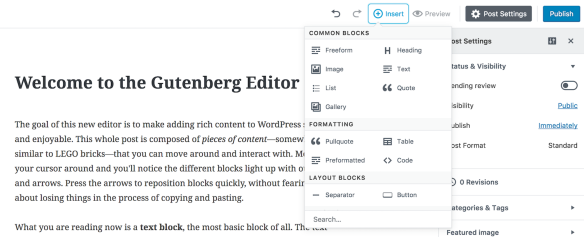
Gutenberg does not give you a nice clean WYSIWYG screen that can be easily toggled to an HTML screen (if you prefer entering your own code or have custom design), with all your editing choices neatly and clearly contained in an easy to read toolbar at the top and your other options in a sidebar well away from your text.     Instead, Gutenberg uses a system of “blocks,” in which every feature of your post must have its own block, even down to individual paragraphs and titles.   That means you cannot see your entire page all at once, and the blocks are too small to see much of your writing at a time.   Few writers can write well if they cannot see their entire post at once, because much of writing involves being able to see the whole thing in its entirety and then cut and paste and move things around, including pictures and captions.  The classic editor allows us to do that easily with one or two clicks, by highlighting text or graphics and then moving it or deleting it or whatever.    The classic editor is intuitive, meaning that you can learn it on your own without any special instructions.

In contrast, Gutenberg wastes your time by forcing you to work within a “block” and while these can also be moved around the page and edited, it takes more clicks and is much more complicated to do so, and involves things like hidden menus, cryptic symbols, and odd toolbars at the top of each block, and hidden icons that only appear if you hover over them within the block.   Some of these icons and toolbars actually block the block itself, so you can’t even see what you have written in the block.  If you are a writer who needs to be able to see the entire post to know how you want to edit it, forget it.   There’s no way to see your entire post in editing format.  To do that, you have to create a draft or preview (and then go back in the editor and edit the blocks, somehow remembering what you saw in the draft or preview, or keeping it in a separate tab).   Also, each time you hit < enter > it creates a new block which you then must delete.  There have been many other complaints about this system that I’m not even including in this post.   You can read the complaints for yourself in the link I have provided below.

Most of the comments I read said Gutenberg is much slower and clunkier than Classic editor, and has turned something that’s a joy (writing a post) into a dreaded and time consuming chore.   It’s complicated and nonintuitive, so it’s difficult to figure it out on your own.
samplegutenberg

Huh?


WordPress is trying (again) to fix something that isn’t broken.    I understand the system is still in its “beta” version and therefore has bugs which will probably get fixed later.  I also understand the company wants to remain tech savvy and up to date, and evidently, “block” editors like Gutenberg are the wave of the future.   In its desperation to be “relevant,” WordPress wants to throw away something that works so they can be more like Weebly or Wix (platforms which use block editors like Gutenberg).  But since most WP clients are writers, bloggers, or just regular folks trying to share their art, photography, or conduct business through their website, not web designers and page builders,  WordPress is really jumping the shark by forcing its users to adapt to such a drastic change that will require them to climb a very steep learning curve and take time away from actually writing or conducting their business.   I feel ultimately, WordPress users are going to go elsewhere that fits their needs better.

It feels like they are force feeding this change on us.  In fact, it feels almost like a form of internet fascism, with the staff at the WordPress.org review page showing little to no empathy for its users’ complaints and concerns, even blaming them for “resisting” having to learn something new, or belittling them for not liking change.    They are told to suck it up because that’s how it’s going to be, whether they like it or not.   Then they are “reassured” with a formulaic sentence telling them to install the classic plugin (when it’s actually Gutenberg, which is still full of bugs because it’s still in beta format, that should be the optional plugin) if they hate Gutenberg so much.   In the comments that don’t specify exactly what the person hates about Gutenberg, the staffer asks the user what the issue is.  Okay, fair enough.   But in the many other comments that DO specify, often in great detail, what the issues are, the staffers NEVER address the issues, only the user’s attitude and the only “help” given is to tell them to install the classic plugin.

Even if you don’t mind being condescended to and gaslighted by the WP.org staff, the plugin solution is only a temporary one.

Because the ultimate plan is to completely do away with the Classic Editor by 2022.   In three years, like it or not, we will all be forced to use Gutenberg.   There won’t be another option — except using a platform besides WordPress.  (Already, there is something called Classic Press in the works, created by WP defectors, for people who can’t or won’t use Gutenberg — I may be looking into that myself.)   I’ve seen enough of how Gutenberg works and read enough about it to know I will never have a good relationship with it.   If it doesn’t work for most users at WP.org (who tend to be a bit more technically savvy than WP.com users, since their websites and blogs are self hosted), then it’s going to be an absolute nightmare for us WP.com users.   Frankly, the whole idea of it terrifies me.

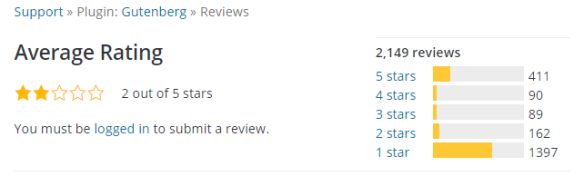
Here is a screenshot of the rankings of Gutenberg by WP.org users (and keep in mind that many of the five star reviews are actually bad reviews that were accidentally given five stars. I know because I’ve read many of these reviews):
gutenbergreview

In spite of the obvious bad reviews of this product,  one WP staff member (I will have to paraphrase since I can no longer find the post), in their usual condescending way, scolded one user who pointed out how many one star reviews there were.  The staff member actually said the review system was invalid and shouldn’t be believed.  Even more unbelievably, the staff member said that most people who loved Gutenberg (obviously, almost everyone) just weren’t writing reviews or ranking the product because happy people don’t write reviews or give stars.  WHAT?

WordPress.org appears to be gaslighting and shifting blame to its own users, and straight up making shit up to make themselves look superior and their own review system look invalid!    That’s crazy!  It makes me wonder if the people running WordPress.org are on the narcissism/Cluster B spectrum (someone else actually mentioned this to me).   I can’t say if they are or not, but blaming the users of a product for disliking a change because it doesn’t work for them and is making their writing experience unpleasant seems profoundly undemocratic and callous.   It seems that WordPress somehow knows it will benefit from forcing this change on people, even if most of those people wind up taking their websites somewhere else.   You gotta wonder who is paying them off.

So far, these changes haven’t been forced on WordPress.com users.  Yet.   But it’s coming.  We are reminded of it every time we open our editing screen.  When it finally is,  I intend to switch to the Classic Editor and keep using it as long as it’s still an option.  As for 2022, I’m not going to worry about that yet.   A lot can happen in three years.

Gutenberg has been compared by many to New Coke, another example of “fixing something that isn’t broken.”  Hopefully WordPress realizes their mistake decides to keep Gutenberg as an optional plugin (for people who actually like playing around with confusing blocks, like page builders and web developers), and Classic Editor as its default, rather than the other way around.    Gutenberg is NOT FOR WRITERS.

Why Twitter has made me a better writer.

280chartweets

Twitter has made me a better writer.

I’ve always been a good writer (my teachers always told me so).  To me it’s not work, it’s pleasure.  I write largely for the fun of it.   English composition was always my best subject in high school, and creative writing comes to me naturally.  Always has.    So it’s no surprise that I wound up with a career in medical editing and (technical) writing for several years until I started a family.   It wasn’t exactly creative writing, but it was still writing, and therefore enjoyable to me.

Off and on throughout my life, I’ve dabbled in creative writing: fictional stories, fanciful memoirs, imaginative prose, all kinds of descriptive writing, poetry, and even a novel I refuse to show anyone and today sits in a rotting cardboard box in the back of a closet.   And today, of course, I blog.

In college I really enjoyed my creative writing class and made high grades, but my professor had one big problem with my writing:  my tendency to use “purple prose.”

Purple prose is overwrought writing.  My sentences used to be overly long, way too descriptive, and filled with a lot of unnecessary adjectives and adverbs, and flowery, overwrought descriptions.

If I could have written the perfectly serviceable sentence, “A black cat jumped over the fence,” I’d write something like this instead:

A lithe feline creature as dark as a starless midnight, so dark its fur absorbed every color that might have surrounded it, virtually shape-shifted its grace-infused body into a spread eagle form and effortlessly soared over the wooden obstacle that no other creature could have breached without seriously injuring itself.

What the hell was that all about?   A cat jumping over a fence or some supernatural shapeshifting thing?  It’s hard to tell for sure.

I think my point is clear.   Publishers and editors hate purple prose, but it is fun to write.  It’s just that no one else wants to read it.  Why use 100 words to make the same point that can be made in 10?   Purple prose is also often emotionally overwrought and a bit nausea inducing.   You can write the simple sentence, “her face crumpled and she began to weep silently” but a purple prose writer might write something more like:

Rivers of clear, salty tears poured from her Caribbean colored eyes (made even more deep turquoise when they were puddled with tears), and as they made their journey, they traced the fine lines of age just beginning to etch themselves into her cheeks, then divided into smaller rivers, and finally into streams, creeks, and small brooks before they finally dripped off the precipice of her chiseled, bony chin and splashed onto the bodice of her magenta velvet dress, and sat there, like clear glass beads, rather than being absorbed by the fabric.

Ugh.  The simple sentence somehow has more emotional impact and doesn’t make you gag.

There’s nothing wrong with simple writing that doesn’t use a lot of big descriptive words and gets right to the point.   Good writing has more to do with the way you string sentences, paragraphs, and ideas together, not how long and descriptive you can make a sentence.

If you enjoy writing long, flowery, descriptive passages, that’s great, but your writing probably won’t get read.   That kind of writing went out of style about 100 years ago.  That’s why novels written in the 18th and 19th centuries are so wordy and descriptive.  Classic novels can go on for ten pages about the physical attributes of a single room or even a piece of furniture.   Back then, people weren’t always rushed and they actually enjoyed reading extremely descriptive writing.   Today it’s all about the action and the dialogue.   Today (unfortunately or not), a novel that starts off describing a single object or a person’s face over several pages would go into the slush pile.

snoopy-writing

Twitter cured me of my tendency to write purple prose.   Many people think of Twitter as shallow because how meaningful can you make a tweet that can only contain 280 characters?  (It used to be worse:  until a year or so ago, you were limited to 140!).   And to some extent, that’s true.   On Twitter, there’s a lot of cotton candy in prose form: shallow “ideas” or strings of words with no nutritive value for your soul or your mind.  But there are also brilliant tweets that contain more meaning and depth than an entire book.  Think of some of the most famous and profound quotes you have ever heard.  They tend to be quite short, don’t they?  Sometimes just a few words.   But they are remembered, and used for decades or even centuries after they were first uttered.  Twitter is a virtual quote factory, if you can bushwack your way through all the fibrous, sugary fluff that obscures the meaty, nutritious stuff.

And if you really, truly need to make your point in more than 280 characters, you can always  thread a series of tweets together.   It’s very easy to learn how to do this (though Twitter addict Donald Trump, not too surprisingly, appears to not have mastered this skill).  Each tweet stands on its own, but is connected to the other tweets in your thread, making an entire article.   Being limited to 280 characters for each tweet within a thread makes it virtually impossible to write run on paragraphs which can make your writing boring and hard to comprehend.  Many tweet threaders number their tweets so there’s no question about what order you’re supposed to read them in.

Writing good tweets that have actual meaning (or are uproariously funny) is an art form and a discipline.   If you write good tweets, they tend to get retweeted by others a lot.   People recognize a good tweet when they read one.   They are relatable, meaningful, and either very true, very funny, or very profound.  They never use lots descriptive words because they can’t.   Forced brevity tends to enhance the message you are trying to get across.   It’s all about the meat and bones of an idea, with all the fat trimmed off.

So, because of Twitter, I have learned to write my ideas or observations without the fat and gristle that could obscure my message.  This has improved my writing in general, and now whenever I read over a post I just wrote, any purple or overly descrptive prose sticks out like blobs of gristle hanging off a pork roast and immediately get sliced off.  At first it was hard to do, but over time it gets a lot easier.

If you’re a writer, don’t knock Twitter.   Expressing an idea using a very limited number of words works wonders for your writing, especially if you are like me and tend to be too wordy or descriptive.

*****

Further reading:

Is Your Prose Too Purple?  (includes a test to find out if your prose needs to go on a diet

Snowbound blogging.

snowbound

We’re expecting a big snowstorm here in western North Carolina starting in about 24 hours.   They’re saying we might get up to two feet!  (I’ll believe it when I see it).

Since I’ll be pretty much housebound, as long as I have power, my plan is to write some new blog posts and catch up on some reading.    I’ve been getting lazy about doing both, but if I’m snowbound, I have no excuses to not write!

I’m not a winter person, but I’m still looking forward to sipping hot cocoa and spending several days in intimate contact with the written word, cocooned by a world of white.  If we get the two feet of snow, I doubt I’ll be going to work on Monday.

11 ways blogging has changed my life.

Originally posted on August 16, 2016


 keyboard

Next month will be Lucky Otter’s Haven‘s 2 year anniversary! It’s hard to believe I’ve been blogging that long. I started blogging only 6 months after going No Contact with my ex. It has become a real addiction, but much more than that–it was a game changer for me. My life is not the same as it was two years ago. Here are ten (plus one) ways blogging has changed my life.

1. I’ve become a much better writer. I’m rather embarrassed by how badly written some of my early posts were. I think I’ve honed my writing skills and use a lot less “purple prose” and unnecessary adjectives than than I used to–that has always been a huge weakness of mine when it comes to writing.

2. I’ve become more self confident and less shy. Writing about your thoughts and feelings teaches you a lot about yourself. You become more introspective and in so doing, realize a lot of good things about yourself, and that gives you confidence. You also get validation from others, and that boosts your self esteem. You also find out that most people aren’t going to judge you for things you thought were shameful or embarrassing. It takes a while to work up the courage to write about such personal things, but once you do, you realize that your words may have helped or inspired someone else and they will appreciate you for your honesty. This has translated into my real life to some degree–while I’m still shy and awkward in social situations, I seem to be a bit more outgoing and less awkward now.

3. I’ve made some wonderful friends. Although I haven’t met any of my blogging friends, I feel like we’re a family, and for a few of you, I feel as if I’ve known you all my life. Before blogging, I felt so alone and isolated, but in the blogosphere, I’ve found so many people who have stories similar to my own, have gone through similar kinds of trauma, and we’ve grown to care abut and support each other. We’re like the surrogate family we never had!

4. I’ve become more creative. Writing almost every day forces me to consult my “muse” and the more ideas I think of to write about, it seems the more ideas just come to me, and some of them are pretty wild! I go ahead and write about those crazy ideas too, and sometimes those prove to be my best posts.

Hello world. This is my very first blog. I’m not sure what the hell I’m doing yet or how the heck this thing (WordPress) works. I’m learning so please be patient with me.

–The first sentence of my first blog post, Lucky Otter’s Haven, 9/10/14


5. I’m a better person than I was. Writing about your deepest thoughts and feelings, and exploring painful memories helps purge a lot of the pain that was keeping me from moving forward into real healing. Writing is powerful therapy and I find that today I’m less depressed, less angry, less fearful, have more moments of joy and serenity, and have even become more outgoing. I’ve also developed a lot more empathy, which was almost unavailable to me when I began blogging.

6. A blog is a great record of how you’ve changed over time. It’s always fascinating (and a little horrifying!) to go back and read over old posts and see how much you’ve changed. It gives you perspective and clarity. I can tell by the tone of my early posts that I’m not the same–my early posts were a lot more bitter, angry, whiny, and cynical, and a LOT less spiritual (I was agnostic when I started blogging). I realize a lot of that attitude was because I was only recently out of an abusive relationship and was still in shell shock, but blogging has definitely helped me overcome that.

7. My computer skills are better. Setting up and designing my blogs has given me more confidence in my computer skills. I can do a lot of things on a computer I didn’t used to be able to and thought would be difficult but are really not.

8. Blogging has given me a focus and a goal. All my life, I never had a real goal and never really knew what I wanted to do with my life. Narcissism and narcissistic abuse has always been my primary topic on my blogs, but lately my fascination with this subject is expanding into my wanting to help others heal, whether from abuse or from narcissism itself. I haven’t decided yet whether I will write a book or become a life coach or therapist. Maybe both!

9. My faith in God has grown. God gave me writing ability for a reason, and as I grew as a writer and shared my thoughts and feelings on an increasingly intimate level, I found myself actually listening to what God was trying to tell me, and realizing how much he really does care. I found other bloggers like myself whose faith was also strengthened through the gift of the written word.

10. It’s fun. Blogging is so addictive, and I’ve never had a hobby I’ve been more passionate about. In fact, I never really had any serious hobbies until I started to blog. I always look forward to coming home from work, opening my laptop, and starting to write, or reply to comments, or read other blogs (when I have time). I get so immersed in blogging sometimes I actually forget to eat!

11. I make a little bit of money from blogging. I can’t quit my day job, but I make about $50 a month from ads that run on this blog. It ain’t much, but it pays for my gas for a couple of weeks or a nice dinner out once a month! It’s always a great feeling to get paid to do what you love doing the most–even if you can’t live on it. But I’d blog even if I had to pay to do it. That’s how much I love doing this.

Three years ago today: 20 Truths About Blogging.

Still as true today as they were three years ago!

 Originally posted on May 21, 2015

number_20

In my 8 months of blogging I’ve learned a few things. Here are 20 of them.

1. Nothing is too personal to write publicly about. There will always be someone who will be grateful you shared it. As for the rest, they don’t care as much as you think they do. That soul-baring post is probably only embarrassing to you.

2. If you have a post you’re afraid to make public, make it public anyway (see #1). It’s okay to run naked in public sometimes. You’ll feel freed.

naked

3. You are going to have haters. It’s unavoidable. If you can’t handle people hating you or your blog, you have no business blogging.

4. If your blog starts getting popular, your haters will be more numerous and more vocal. It’s okay to have haters. Love your haters. They’re obviously obsessed enough with you to visit your blog and that increases your views.

5. Some people you thought were your friends or supporters are not. Be careful who you trust.

6. If you write about a serious or dark topic, break it up with a little fluff sometimes. Or write about something else. But don’t lose your focus.

piece_of_fluff

7. Trolls are easily controlled. Just don’t approve their comments or send them to Spam/Trash.

8. Be agreeable. Don’t attack commenters who disagree with you. Most people are reasonable and disagreements can lead to some interesting debates where both of you may learn something.

9. If you decide to run ads, you’re not selling out. If you’re serious about blogging or writing, it’s a good idea if you have enough traffic.

10. You do not need to pay for SEO. All you need is patience. If you post often enough and your blog starts getting enough hits (USE THE SHARE BUTTONS–or at least have them available under your posts so others can do your dirty work for you), those hits will eventually lead to more hits, and this keeps feeding on itself. Eventually you’ll find some of your posts appearing at the top of the search engines, and once that happens, the sky’s the limit.

waste_of_money

11. You can’t “make” a post go viral. There is absolutely no way to tell what article of yours may go viral or when. It could be one you never expected to, or it could happen months after you first posted it. When it happens, it’s a complete surprise and a completely amazing feeling.

12. Don’t write something just because you think it’s popular if it isn’t something of interest to you. Don’t try to be cool–people can always tell if you’re trying too hard. You’re either cool or you’re not, but you don’t have to be cool to have a great blog. (I’m definitely not cool).

13. You are going to lose followers. It’s inevitable. As long as you are gaining more followers than you’re losing, then there’s no problem. The people who are unfollowing you are probably not people you want to have sticking around anyway.

unfollowers

14. You will change in ways you never expected. Blogging is an adventure.

15. Don’t beat yourself up if you miss a day and don’t post. We all have those days we need to take a break or just can’t think of a good idea. If it really bothers you, reblog someone else’s article or post a funny picture or inspirational saying. People always love those.

16. When all else fails, post a picture of a cat or a cat meme. Cats on the Internet are like sex in the movies. They attract viewers. Kittens are even better. Everyone loves kittens, even people who hate cats.

kitten

17. Use pictures and graphics, especially in long posts (but don’t use so many your post looks like the cover of a supermarket tabloid). No one wants to read a wall of text, even if you’re the best writer ever. But they want a clean look too, so be careful how many graphics you use, especially if you are running ads too. No one likes a cluttered, messy looking blog that makes their eyes hurt or gives them flashbacks to the MySpace era.

18. You don’t have to be a great writer. You just have to be original and willing to take a few risks.

19. Always be honest even if your opinion might be controversial or unpopular. Controversial posts may get you more haters, but they’ll also make your views soar.

haters_bitches

20. Haters can make good fodder for new posts. Sometimes those posts will be your most interesting. But be careful about calling out specific people by name; you could get in trouble for that.
 

How to retain your blog’s traffic when you aren’t writing new content.

traffic.jpg

If you’ve been around a while, you probably noticed I post a lot less frequently.  During my first two or three years as a blogger, I posted at least one new post a day, and sometimes several a day.   Now it’s closer to one new article a week.

Over time, you may find that as the novelty of blogging begins to wear off, writing new content may become more of a chore.  That doesn’t mean you no longer like blogging or that you’re burning out,  just that, as with most things in life, the initial excitement eventually tapers off.   While writing new content may still be as enjoyable as ever,  it’s just a lot harder to get motivated.

Don’t abandon your blog!

I try to write at least one original post a week, but I don’t like my blog to just sit around being idle during all those days in between.   People who are in the habit of checking my blog for new posts every day are bound to be disappointed, and it is hard to keep your traffic moving at a healthy pace when you aren’t posting as frequently as you’d like, and  relying on on your older, popular, or once-viral posts to do the work for you.

Share, share, share! 

As an established blogger, several of my older articles have gone viral and have high Google rankings (this happens naturally over time if you’re a dedicated blogger and share your posts a lot — you do not need SEO, just patience and dedication!).   I do rely on these older posts to bring in new traffic, since they are regularly seen on Google when people type in certain phrases or keywords.   Every so often I’ll also share those older articles (as well as other ones I wish to get more views) to my social media to keep their Google rankings high.

Since I have a newly large-ish Twitter following due to my online political activity,  I like to share my older articles a lot on Twitter and this way, they get even more views and shares — by a brand new audience who had no idea my blog even existed!   My posts about narcissism and narcissistic abuse dovetail nicely with my newer posts about Trump’s psychology because there is a lot of overlap between narcissism, sociopathy, and psychopathy and the rise of Trumpism in America right now.   Learning about narcissism prepared me for what I write about now, and my new Twitter audience is interested in all of these topics since they are so interrelated.

But I digress.  There are other ways you can keep your blog active and keep the traffic coming besides sharing your older posts on social media.  You can also

— reblog someone else’s post.   Don’t do this too often if you aren’t adding original content — you are not a clearinghouse for other people’s blogs.

— post memes, cartoons and photos (don’t do this too often though, because eventually people will be able to pick up on the fact you’re just too lazy to write anything original and they’ll go elsewhere.

— reblog your own posts.   There are bloggers who insist this is a no-no because it annoys people.    While I can understand it becoming annoying if you reblog an article only a few weeks or a month after you first posted it (that makes you look desperate),  I see nothing wrong with reblogging a post that is several months to several years old.   You can turn it into an “anniversary” and add a phrase to the reblog’s title such as “This Day Last Year” or “Blast from 2015” to disguise the fact you just want this particular article to get more views that it did the first time around.    It’s also a good idea to add an original intro to your reblogged post, which gives the reader some perspective into how the feelings expressed in your old article have changed for you over time — or even how you changed since then.

Ways to reblog your own or other people’s stuff.  

On WordPress, there are two ways to reblog an article, whether it’s your own or someone else’s.   The first way is to simply hit the reblog button at the end of the article.  This is the easiest method, and it allows you to write an original intro, but does not allow you to change the content of the actual post.   This benefits both of you by making potential plagiarism impossible.   However, you will need to add categories and tags.   I try to use the original blogger’s own categories and tags.

When you use the reblog button, the entire article will not appear on your blog, but the first few paragraphs will, as a sort of “teaser.”  A link is then provided to the original post where readers can read the whole thing if they want to.

The other way to reblog an article is to simply copy and paste it into a new blog post.   This is a good method if you’re reblogging your own post, because you can edit or change the article, or add different graphics or other content, so that it’s less recognizable to others as a “recycled” post.   You can also update the article if that is necessary.   When I reblog my own material using this method, I like to add an “originally published on…” date at the top of the reblog (without actually linking to the original post).

I don’t recommend using this method if you’re reblogging someone else’s material, unless they are not using WordPress.com and you do not have the reblog button option.  Make sure to give the author credit and be sure to link to their post.   This is extremely important, but it’s surprisingly easy to forget to do!  If you want to add your own graphics, photos, or edit the post in any way, be sure to check with the original author first.

Annnnd…it’s confession time.

One reason I occasionally like to use the reblog button for my own posts instead of the copy/paste method (I use this method if there have been no changes or updates to the original post) is that it helps my traffic!  Because I run ads (no, I do not choose my own ads), it means more impressions which means more money.  I don’t make very much but I’d be lying if I didn’t admit this is a factor.   With a reblogged post, you have to click on a link that takes you to another page on my blog.   The more clicks, the more money I make!  I try not to overdo it though, and I’d say most of my self-reblogs are actually done the copy and paste way.

So, to sum up, my traffic isn’t quite what it used to be, but it’s remained pretty steady and hasn’t really declined, as long as I continue to:

— post something original at least once a week

— share relevant older posts — both viral and not — on social media

— reblog or recycle my old stuff

— reblog other people’s stuff


16 kinds of bloggers: which one are you?

Originally posted on September 25, 2015

different_bloggers

There are as many types of bloggers as there are blogs. Here I’m going to describe the 16 different types of bloggers I’ve encountered. Which one are you?

1. The Self-Therapist.
I began my blogging experience as a member of this category. Having just left a long, abusive relationship, I felt the need to document my journey to recovery after abuse by writing about it. My intuition told me that making my therapeutic journal public for all eyes would ultimately be more beneficial for me than just putting it on WordPad or something. My intuition proved correct and I’ve been able to help others too, just by going public.

After awhile, as I no longer felt much of a need to blog about my mental health and relationships with my abusers, I moved more in the direction of The General Purpose Blogger (#13) and now I’m strongly leaning into Pundit (#5) territory. Self-therapy blogs (pejoratively referred to sometimes as “crazy” blogs) have become increasingly common in recent years, probably because of the sagging economy that makes it difficult for many people to be able to access or afford good psychotherapy. Blogging definitely *is* effective therapy, though!

2. The Journalist.
Somewhat related to #1, The Journalist writes about their daily experiences, observations, thoughts, opinions, activities, etc. for the whole world to see. The intention isn’t necessarily self-therapeutic, just a way to express to the world their subjective state or feelings at the time. If well written, these blogs can be brilliant and entertaining slices of life many people can relate to, sometimes rivaling New Yorker essays. But if the writer isn’t careful (or is a terrible writer), such posts could come off as narcissistic or just mind-numbingly boring.

3. The Show-Off.
This may be the most common sort of blog, and they are a dime a dozen. Basically an extension of a Facebook or social media page, Show Offs post blog entries documenting family picnics, children’s school events, Breanne and Jacob’s soccer trophies, the progression of the blogger’s pregnancy, home projects, the Family Trip to Disney World, “what I cooked for dinner for the kids last night using only leftovers,” and other bland minutiae of family life. These would be the infamous “Mommy blogs” that have become so vilified of late. Show Off blogs aren’t just limited to moms though–here you would also find teenagers and young adults posting pictures of their friends making silly faces, documenting their social activities, posting videos of drunken parties, and of course, lots and lots of selfies. Show Off blogs could also include pet lovers posting pictures of Fido sporting his new rubber boots or Fifi in her brand new tutu. In all cases, these sort of blogs are essentially extensions of their social media page. Sometimes these sort of blogs even include a Music Player (always the blogger’s current favorite song) that cannot be turned off when viewing the blog.

dog_dress

4. The Vindicator.
Not that common, but there are a few blogs that exist solely to “get back” at a person or group of persons they feel offended them personally. Blog entries are basically endless rants against the offending person or group. Occasionally, the person or group attacked will attack back, and blog wars can arise. These kind of blogs tend to be short lived, until the blogger’s rage burns out, or the offending party (now the offended) threatens civil action.

5. The Pundit.
Many blogs are basically political soapboxes for people to spew their political beliefs. There are also bloggers on larger news sites such as Huffington Post, who have been given their own license to do the same thing. Since Trump’s election, many small-time bloggers like me have found themselves becoming armchair political analysts. Such are the times we live in.

6. The Preacher.
Related to The Politician (above), The Preacher’s mission is to convert everyone to their belief system, whatever it may be. These blowhards may quote from the Bible or other religious text excessively to back their views. If you don’t do exactly as they say, you are going to burn in Hell. Disagreement in comments is usually not tolerated, and comments are sometimes not even allowed.

To be fair, however, there are a number of more liberal Christian/religious blogs that are not like this at all, and are open to other points of view and encourage people to ask questions. But I don’t personally consider them “preacher” blogs, even though technically they are.

preaching-fire

7. The Expert.
Usually a professional in their field, such a blogger may be a paid guest blogger for a large website. Such experts could be doctors, psychologists, nurses, teachers, finance and business executives, or experts in any other field.

8. The Practical Muse.
These are the “how-to” bloggers, who focus on their hobbies or interests like cooking, gardening, home decor, beauty and fashion, child-rearing, car maintenance, blogging, etc. Sometimes the focus is more specific: bonsai gardening, dessert cookery, antique car maintenance, fashion for wannabe hip hop stars, raising a child with autism, blogging for fame and fortune, etc.

9. The Creative Writer.
These blogs can be either great or terrible. These are the blogs where you’ll find the angsty adolescent poetry, word-salad like prose, bad (or sometimes great) fiction, fan fiction, etc. This category sometimes bleeds over into #1 (The Self Therapist) or #2 (The Journalist).

10. The Hater.
Blogs like these exist to celebrate hatred toward a person (usually a celebrity or other public figure) or group of people. These blogs can be entertaining (if you agree with the prevailing sentiment) or infuriating (if you do not). Unless you are in a agreement, it’s probably best not to comment on these blogs, because you will be mobbed and acquire a new lower orifice in the process. Hater blogs tend to last only as long as the blogger’s passionate ire lasts, so they tend to burn themselves out (or are sometimes forced to be taken down by offended parties).

bieber_hate

11. The Motivational Blogger.
All sweetness and light and positive thinking, 24/7, 365 days a year. Such bloggers focus on inspirational memes, verses, quotes, and sometimes original essays, meant to make you feel inspired or motivated. Unfortunately blogs like these can sometimes have the unintended effect of making you feel like a horrible person or a failure because you’re not that upbeat, happy and successful all the time. Or they can simply be annoying.

12. The Artist.
A showcase for an artist’s creations, showing their paintings, sculpture, photography, jewelry, etc. Sometimes these can also be “Merchant” blogs, if the artwork is for sale.

13. The General Purpose Blogger.
Opinionated Man’s A Good Blog Is Hard to Find (formerly HarsH ReaLiTy) is such a blog. A General Purpose blogger writes about everything. Nothing is off limits. General Purpose blogs tend to become popular due to the fact they attract a large audience who have varying interests. The only problem with blogs of this type is the blogger can be seeming to spread themselves too thin, and the blog seems to lack a focus or sense of cohesiveness and can overwhelm readers with too much information.

This blog seems to be veering in the General Purpose (and Pundit) direction too, because I’ve been running out of new things to say about narcissism. But this has always been sort of a general purpose blog anyway, because from the very beginning only about 80% of my articles have been about narcissism or mental health. I’ve always written about other things too. It’s just that lately, “other things” is a larger chunk of the pie.

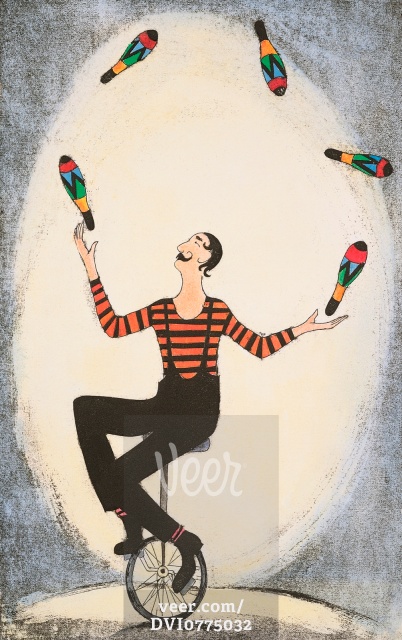
juggler

14. The Popularity Seeker.
These bloggers just want to get as many views and hits as they can. They want to present an image–a sort of online “false self,” if you will. They are trying to be cool and only write about things they think are cool or “cutting edge,” even if those things don’t really interest them. You can always tell a blog that’s trying too hard to be popular, because it will usually bore you to tears. You can just tell the blogger doesn’t really give a shit about what they’re posting, they just want as much traffic as they can get and want to present an image of something they probably aren’t in real life. Bloggers like these are usually narcissists or people with low self esteem using blogging to try to feel better about themselves.

15. The Merchant/Entrepreneur.
A blogger whose posts are essentially cleverly concealed advertisements for items or services they’re selling. Artist blogs (#12) often (but not always) bleed over into this category.

16. The Fan.
Like #10, fan blogs focus on a celebrity or other public figure, a sports team, a TV show, a musician, or the like. The only difference is the blogger is a fan instead of a hater. Haters of the blogger’s object of adoration need not comment. If you do, you will probably be banned.

10 things that make your blog suck.

Just thought it was time to throw this up here again. If you blog, don’t do these things.

luckyotter's avatarLucky Otters Haven

Grumpy-Cat

I think I’ve been in this blogging business long enough to tell when I see a bad blog. So I decided to round up the ten most annoying things I’ve seen bloggers do that make me hit the backspace key and never visit their blog again. If you blog, I hope you don’t do any of these things.

1. The blogger allows comments, but attacks anyone who disagrees with them. I’m not talking about abusive or trollish comments (which should be trashed or sent to spam anyway), but there are some bloggers YOU ARE NOT ALLOWED TO DISAGREE WITH. You can’t have a civilized debate because even questioning their opinions sends them into the online equivalent of a two year old’s temper tantrum. If you are so certain of your rightness that you must attack those who even suggest a differing viewpoint, why allow comments at all?

2. The majority…

View original post 749 more words

My problem with pens.

Originally posted on April 17, 2017

broken_pens

I have a house full of old, nonworking pens.  It’s not because I want them.   Keeping up with pens and throwing away old ones is one thing I never seem to bother keeping up with.    Whenever I need a pen, I can never, EVER find a working one.  I have dozens of old markers that no longer have any ink in them, tens of cheap ballpoints I got for free somewhere with no ink in them and non-working clickers; I even have dried up pen refills with no actual pen to cover them.  I have Sharpies with their nubs worn down to nothing.  They all sit forlornly in old coffee mugs around the house.

People can’t understand why I can’t find a working pen when I need one.  They look around at the mugs of pens in every room and on every available surface, and they also know I have drawers full of pens (as well as old phone chargers, paper clips, rubber bands, broken push pins, paid bills from 2003, business cards for businesses I’ll never use or have never heard of, a broken lighter with Y2K joke on it [no joke], and all the other detritus most of us wind up gathering somehow without any effort at all).   I almost always wind up having to borrow their pen — if they’re carrying one — and I can see them just shaking their heads in bemused amazement.

I have the same problem with pencils.  I have at least a hundred pencils — all with broken points or sharpened down to an inch or so (and still sporting broken points) — and not one sharpener.   So the pencils I own are utterly useless.   Maybe I should install a sharpener on the wall, like the one we kept on the basement stairs while I was growing up (I’ll never know why it was installed on the wall of the dark basement stairs, as if it was something to be embarrassed about).

pencilstub

At least with the Internet, I rarely need a pen.  But sometimes I do.  There’s still the occasional form I need to fill out, or the birthday card I need to sign (I hate e-cards).  Sometimes I have to leave post-it notes to myself on the bathroom mirror that say things like:  BUY A PACK OF PENS TODAY!  Hah.  I never learn.   I never go out and buy a pack of pens for these moments.  The one time recently that I did buy a pack, I somehow lost all those pens.  But the old, dried up, broken ones stuck around like unwelcome guests.

And they MULTIPLY.  You know that portal that’s hidden in the back of your washer that sucks your socks into an alternate universe?    Well, I think there’s another portal — a reverse wormhole — from that same universe that spews broken old pens into ours.  Maybe it somehow transforms our socks into pens.  You never know.

Why don’t I just throw away all those broken and nonworking pens and pencils?  Honestly, I don’t know why.    It’s not sentimentality,  and it’s not because “maybe one day I will use them in a multi-media project where I can glue them to a board with all the other useless junk in my drawers and call it art.”  ” No, I think the reason I don’t weed out all the old pens and pencils is pure laziness.   The idea of going through all those mugs and drawers full of broken writing implements and testing them isn’t something I want to spend my day doing.

So the pens stay, and I continue to search in vain for a working pen when I need one.

Anyone want some of my old broken pens?

20 ways to lose followers.

I just saw this under “related posts” under my last post and thought it was good enough to deserve a reblog.

luckyotter's avatarLucky Otters Haven

Tired woman are sleeping and holding cup. Laptop is situated on the table.

As a blogger, I admit I’m guilty of doing some of these things myself.  So I’m writing this  post as a reminder to myself to stop doing these things, and hope other bloggers can take away something from this list too.

1. Don’t allow comments.

Some blogs, especially those dealing with mental illness or abuse, don’t allow comments because negative comments can be very triggering to people struggling with these things, and you are going to get negative comments.   It can’t be avoided.  But as a general rule, it’s good to allow comments because it makes your blog more interactive.  Real conversations get started that way and build a feeling of community, which can make your followers stick around and your blog more engaging.

2. Be a comment nazi. 

Some bloggers don’t want anyone to disagree with them and will not approve or delete comments that question the blogger’s…

View original post 1,516 more words