Trump and his impressionistic speech: HPD or NPD?

make_america_great

I’m engaged in an interesting conversation in a Facebook group about Cluster B disorders. Someone raised an interesting point about Trump possibly having HPD instead of, or in addition to, NPD.   His “impressionistic speech,” which is a symptom of HPD, is a clue, but based on his inability to accept blame or criticism (and not just projecting it onto others), that seems a lot more NPD.

I’ll just let the actual conversation speak for itself because it raises some interesting points.  (There were more replies, but I’m leaving out the ones not relevant to the topic raised, which is Trump).

Someone in the group posted this question (who I will call Participant A) :

Random thought: Donald Trump initially appears NPD. But that fucking hair… the orange tan, and the impressionistic speech…makes me wonder if he’s not HPD, or at least comorbid. The one HPD I’ve known was basically a narc in a series of crazy outfits. And she sounded JUST like him with her wild lack of details, inappropriate sex talk and constant attention seeking behavior. Thoughts?  

Participant B:

I think a person with HPD might respond to all of the criticism a little differently than he does. He seems to hold tight to his grandiosity, a person with HPD would be more wounded and emotional. He ignores the fact that nobody wants to join his inauguration and even lies and pretends It’s sold out, inauguration dresses are sold out, etc. That looks like NPD to me.

Participant A:

The HPD I know did this exact thing though. I worked for her and while planning a conference she made me send out an email to supporters saying we had this amazing star studded line up (we had no one) and the tickets would soon be sold out (we had like 10 people signed up so far). As an NPD I personally would be too nervous to publicly fail, so I would opt to undersell the event, in case no one showed up, to save myself embarassment. If people show up, bonus points, because I look humble. She just threw wild shit out there with seemingly no concept of reality. Constantly contradicted herself too.

Participant B:

People with HPD are supposed to be more uncomfortable with criticism and more uncomfortable not being the center of attention. I think people with NPD have mental blocks up that sometimes don’t allow them to see when they’re disliked or unpopular. Maybe on a subconscious level they get it. I think a person with NPD might be better able to answer this though

Me:

I think it’s easier to have ASPD than NPD — NPDs and BPDs care very much what you think (even if they never admit it) while psychopaths and ASPDs generally don’t give a shit.

Participant B:

People with HPD are more easily influenced, they typically blame failure on others. He doesn’t even admit to any failure existing.  Superficial emotional displays or a little more agreement with the majority might be more HPD too…

Me:

That’s a good point. He could also be a somatic narc — with extremely tacky taste! Cluster B disorders often appear together, so it’s entirely possible he could be both NPD and HPD too. But no way is he *just* HPD — like Participant B said, he doesn’t admit to failure — ever.

Me (replying to Participant A):

I’ve heard that HPDs have “impressionistic speech” but I never understood exactly what that means. Can you give an example of Trump using this kind of speech? I’m not doubting you, but I’m just not sure what it is. Sort of a vagueness? Because he talks and talks and never actually says anything. Or it’s like word salad and makes no sense. Is that what you mean?

Participant A:

Earlier today, “It’s going to be Huge! We’re going to turn things around”. Ok, Donald, how are we going to do that? ” We will make America great again!” Lol. Literally just now: “My cabinet is so smart. We have the highest IQ of any cabinet ever assembled.” Oh ok, based on what fucking data? No explanation.

Definition and example of impressionistic speech: “A term used to describe a person’s speech when it consistently lacks in detail and emphasizes emotions. For example, if you asked someone what they thought of something, and they said that the thing was “just wonderful, fabulous”.”

Does he not consistently fit the bill, or what?

Me:

Ah, I see. My NPD mother (who I always suspected was HPD too) talked that way. “Everything was fabulous!” “Oh, I feel marvelous!” A lot of hyperbole, but no substance. At all. Yes, Trump does talk exactly like that and never can back up his grandiose claims. And people think he’s pissing gold.

HPD doesn’t seem to be that common for some reason. Or it gets diagnosed as BPD or NPD.


Envy is the emotion at the core of narcissism.

Of I never heard of envy being the core emotion that fuels narcissism, but it makes a lot of sense. I just discovered this psychologist’s Youtube channel. His videos are excellent.

He believes envy is a primitive form of hatred.  Envy is, of course, a defense against toxic shame.

The childhood origins of narcissism.

This is a very informative video explaining how narcissism develops during childhood.

Do narcissists ever cry? (article from The Narcissistic Life)

I believe I wrote an article a while back with the same title (my conclusion — yes, they do)  but this article is better and I like the way it doesn’t stigmatize narcissistic tears or the reasons why they cry as always insincere (it’s not always crocodile tears meant to get supply).   Sometimes they just cry because they hurt.

My  own article about this, written when I was still  enraged at my own narcissists, took a much more negative and cynical view of the reasons why narcissists may cry.

Do Narcissists Ever Cry?

By Alexander Burgemeester, for The Narcissistic Life.

cry-1

Whilst narcissism is often characterised by bombast and a seemingly unwavering self-belief, there are times when even a narcissist may cry. Do Narcissists cry? It seems impossible but it is true. So how can someone who is so tied up with their own success, self-image and the presentation of themselves in their everyday lives suffer the kind of emotion or tearful outburst that is more characteristic of us other mere mortals?

Read the rest of this post here.

5 Howling Wildernesses

This post has haunted me for months and I was thinking about it again today. Enter the inside of a malignant narcissist’s mind — a vast and bleak howling wilderness — if you dare. This is one of my favorite posts by HG Tudor, who is a brilliant and poetic writer.

HG Tudor's avatarHG Tudor - Knowing The Narcissist - The World's No.1 Resource About Narcissism

Five reasons it cannot work

1. Nothing about the golden period is real

It feels like every day is summer doesn’t it? Warm and wonderful. No rain clouds anywhere, just a cornflower blue sky. Not a cloud to be had. Everything is fantastic. We do everything together. We match on every conceivable level. I like what you like. We laugh at the same things. We enjoy the same books and films. I know what you are about to say. We like to cook together, try new wines and explore interesting places. Whether it is forest or foam, city or village we both enjoy going to these places and do so together. We are soulmates. I do not want anyone but you. You have finally met the person that you have wanted all of your life. You still cannot believe how lucky you are to have found someone like me, someone…

View original post 1,082 more words

Why empaths and narcissists seem to need each other.

narcissist-and-empath
Credit: Let Me Reach with Kim Saeed

The concept of narcissism and HSP (highly sensitive person) or empathic traits coexisting in the same person is a matter that has very little research behind it, but I definitely think there is a strong case to be made for it. Hear me out before you hit the backspace key. I actually think it’s at the core of why empaths and narcissists are so uncannily drawn to each other.

In my article A Match Made in Hell: Narcissists and HSPs, I wrote about the tendency for narcissists and HSPs to form trauma-bonds with each other–that’s really just a fancy way of saying these two seemingly opposite types of people are often attracted to each other and form codependent relationships.

The trauma bond.

The narcissist is both attracted to and envious of the empath’s vulnerability and high empathy. They are attracted to it for a very simple reason:  they need it badly. As children, narcissists failed to be mirrored or loved unconditionally by their parents, and are love-starved, even though they’d rather die than ever admit it.   The empath, in turn, is able to love the narcissist without condition, to the point of allowing themselves to be sucked dry.

Narcissists also envy the empath’s ability to love unconditionally because on some level, usually unconsciously but sometimes consciously, they know they jettisoned their own ability to love and feel empathy a long time ago in order to survive.  Most were highly sensitive children but shamed for it.  Many were bullied.   So they learned to bury their emotions behind an invulnerable facade because continuing to be so vulnerable hurt too much. Empathy may be a gift, and I think most narcissists were born with that gift, but were never shown how to use it and were punished for having it.  It became a curse instead of a blessing, so they sent the gift into exile and shored up a false self to make sure it never saw the light of day again.

Knowing they jettisoned their ability to access their own vulnerability, combined with a continued starvation for unconditional love and acceptance, is what draws narcissists to empaths. They abuse the empath, either consciously or unconsciously, because they hate the fact they need their love so badly, and the empath’s sensitivity also unconsciously reminds them of their own sensitivity that caused them so much pain. It’s a constant reminder of the shame they felt as children for being so sensitive, but they also can’t live without it. So they punish the empath for reminding them of their own “weakness” and making them feel so needy.

The narcissist, in their neediness and simultaneous resentment of being so needy, feeds off the empath like a vampire. If they are malignant, they don’t care that they’re destroying the very person who gives them a reason to live. They may even get some satisfaction in knowing they are punishing them. If the narcissist is not malignant, they may feel some guilt over what they do to  the person who gives them so much love, but be unable to stop doing it. Or more often, they aren’t even aware they are doing it. They just seem like a bottomless well that can’t get enough and keeps on demanding more.

Of course such a relationship is extremely unhealthy, even deadly, for the empath, who will eventually either leave the narcissist or be completely sucked dry or in the worst cases even destroyed. But the empath does gets something important out of the relationship too. They truly believe that through their unconditional love, they are saving the narcissist from him or herself.

Common roots.

Empaths and narcissists often both come from abusive or dysfunctional families. Both started life as highly sensitive children. But at some point they diverged. While the empath embraced their own vulnerability and learned how to use their gift to help others and find joy and authentic connection with others, the narcissist rejected it because it seemed more like a curse and made them feel too much pain. If they were never shown any empathy or were shamed for being too sensitive, it’s understandable why they might have rejected their own empathy and covered it over with a facade of toughness.

Why are empaths drawn to narcissists?

Empaths, like narcissists, often have narcissistic parents, and are unconsciously drawn to those who remind them of their parents or perhaps a sibling or other close family member.  They are naturally drawn to those who seem to need healing, and in embarking on a relationship with a narcissist, they are unconsciously attempting to heal their parent or other family member. This is why empaths so often become codependent to narcissists.

Empaths are able to see through the facade the narcissist presents to the world, to their hidden true self. They can see the hurt, abandoned child that lives inside every narcissist. They truly believe they can “fix” them and transform them into authentic, feeling humans capable of returning what they have been given. Of course, this belief is almost guaranteed to end in disappointment (if the empath is lucky), and possibly much worse. For a narcissist to change and stop the pattern of abuse, the desire to do so must come from inside of them. They must be willing to drop their mask of invulnerability and do the hard work of reclaiming the vulnerability they were born with and gave up a long time ago. The empath can’t make a narcissist want to change. Just because they can see through to the sensitive true self doesn’t mean they will be able to draw him or her out. They can die trying, but it probably won’t work. The unwilling, un-self-aware (or malignant) narcissist is likely to punish them for trying.

Failed empaths?

There may even be a genetic connection between narcissism and those who become empaths. I’ll go out on a limb and even speculate that they might even be the same thing–the narcissist being a “failed empath.  It’s ironic but I definitely think there’s a connection.

But how can that be? Narcissists are incapable of empathy, have problems feeling and expressing deep emotions, and are incapable of loving anyone but themselves. Isn’t that the opposite of being an empath?

Well, yes and no. The explanation is complicated, so I hope you stay with me here.

As I’ve explained before, I think most narcissists began life as highly sensitive people who at an early age suffered trauma due to abuse. This caused them to shut off their too-vulnerable true (authentic) selves from the world and in its place construct an elaborate defense mechanism–the false self–initially meant to protect the vulnerable true self from further harm, which has no defenses at all. Even empaths who are not narcissists have some protective psychological armor, so they did not need to construct a false self to take the place of the true one. Healthy empaths are truly authentic people who feel deeply and are emotionally honest with themselves and others. Narcissists were born with no emotional defenses at all; the false self replaces the true one and appears invulnerable. But this is only an illusion. When you face a narcissist, you will never know who that person really is because all they will show you is the protective mask they have created. They are so terrified of being hurt again that they will attack with vicious ferocity if they think you pose any threat to its flimsy underpinnings. It must be a terrifying way to live.

The high sensitivity of a narcissist is retained in the way they react to personal insults or slights. They overreact when they feel like they are being attacked, ignored, or they perceive their source of narcissistic supply may be in danger. They are paranoid, touchy, and often lack a sense of humor about themselves. They may try to appear as if they don’t care, but if you know narcissism, it’s usually not too hard to see the emotional fragility behind their defenses and acts of false bravado. When it comes to other people, they can seem incredibly insensitive.

Narcissists who aren’t high on the spectrum and become self aware may be able to reclaim emotional empathy toward others, because empathy is a skill that can be learned.  A forum member on the NPD board I read (who has NPD) described something that happened with her husband that warmed my heart.  She said he had hurt her feelings, and she caught herself about to attack him.  She felt her defenses go up, but instead of acting out, she decided to NOT act out and just allow herself to feel the hurt.  Instead of attacking him as she normally would have, she cried.   He put his arms around her and she allowed herself to be held and comforted, to feel vulnerable and cared for.   She said at first she felt awkward and uncomfortable, but the next time it happened, she felt less uncomfortable.  Now allowing herself to be loved is becoming second nature and she says she is starting to feel some tenderness toward him too, and even moments of a new feeling that she thinks is real love, a warm feeling not based on getting supply from him or bolstering her ego.   So I think empathy takes practice.  If you were born with it, you don’t lose it, but it may be hard to access and takes a conscious effort to learn to reclaim and use.

But before a narcissist can really get better and feel empathy toward others, they first need to develop self-compassion (this is NOT the same as self-pity, but is actually empathy for the rejected child-self). They must also be courageous enough to stay in treatment and confront and release the traumatic feelings that lie hidden beneath the mask.

This usually only happens when the narcissist hits rock bottom and suffers a massive loss of supply, sending them into a depression.  At that point they may enter therapy or realize the problems they have are because of themselves.   The problem with this is once things begin to improve or they begin to feel better again, they are likely to leave therapy because the work to get to their authentic self is too painful.    It takes an enormous amount of motivation, courage and positive thinking for a narcissist to stay in therapy long enough to begin to access their true self and embrace their own vulnerability.  It can be done, but it’s not easy.

For malignant narcissists though, things are very different.  Stay with me here because things are about to get complicated.

The connection between malignant narcissism and high sensitivity.
warm_cold_empathy
Warm and cold empathy.

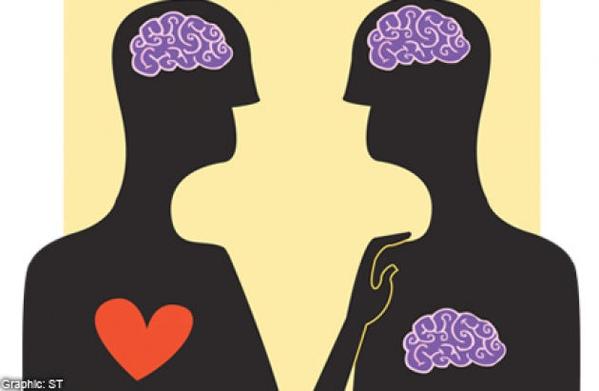
In my research about NPD, there has been a lot of discussion about a concept called “cold” empathy.   Most of us associate narcissism with a lack of empathy, but this isn’t exactly the case. Most narcissists–especially malignant ones–do have empathy, but it’s not emotional or affective empathy; it’s cognitive or “cold” empathy. What this means is that a narcissist KNOWS what you are feeling, and may use what they know you are feeling against you. Cold empathy is “felt” on the cognitive (thinking) level, but not as an emotion, and that is why the narcissist can feel no compunctions about turning your feelings against you in order to punish or hurt you.

An extreme example of this would be the sadistic, psychopathic rapist. The rapist “smells” your fear and uses that against you to become even more sadistic. It *is* empathy, but it’s “cold”–the rapist understands exactly what you are feeling and your fear makes him feel powerful, so he increases the level of torment. He feeds off your fear like a vulture feeds on carrion. You don’t need to tell him you’re afraid; he KNOWS. He just doesn’t care and even derives pleasure from it.

Cold empathy is the twisted mirror image of warm empathy, which non-pathological people are capable of feeling on an emotional, not just a cognitive level. HSPs and empaths have an excess of warm empathy.  Here’s where things get complicated. If a narcissist is also a failed empath, their high sensitivity could morph into a quality that seems almost supernatural and is utterly chilling–a cold, sadistic form of “empathy” where they seem to be able to see into your mind. A non-sensitive person would not be able to detect your emotions without you telling them how you feel, and therefore not have that creepy, unsettling way of “seeing into your soul” that the malignant narcissist does. So, the higher the sensitivity a narcissist has (and the more the “warm” empathy has been shut out or turned “cold”), the more malignant they will be.
narcautism_spectrum
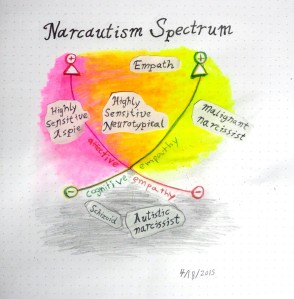
Malignant narcissism is high on the HSP spectrum.
Credit: http://dondepresso.rujic.net/post/116940034025/manic-chart-narcautism-spectrum

This idea was actually illustrated in the humorous-but-true graph (shown above), where initially I wondered why malignant narcissism was showing so high in empathic/HSP traits. But actually it makes perfect sense. An empath who adopts narcissism as a way to cope and whose warm empathy all turns cold will become malignant. A less sensitive person (or a highly sensitive person who still retains some warm empathy) may still become a narcissist, but they won’t become malignant. Of course, at their core, all narcissists are highly sensitive. They just don’t want you to know.

In summary, then, empaths and HSPs can be the most kind and caring people you can ever hope to meet–or the most dangerous. A narcissistic empath is definitely someone you’d want to avoid.

They are two sides of the same coin. The tragedy is that a malignant narcissist can destroy a previously healthy empath, but it doesn’t work the other way around: a non-narcissistic empath can’t change a malignant narcissist into a good person.

*****

Further reading:

Narcissists and Empaths: The Ego Dynamic
Guest Post: Recovering from NPD: My Journey to Self-Awareness

A very insightful and courageous post written by a woman who once identified only as a narcissistic abuse survivor with a case of “fleas” who later discovered she had NPD herself.  She started a blog and is working hard to change and find real happiness.

When is narcissism a good thing?

preening

Originally published on November 23, 2014

Narcissism has become a dirty word. But the kind of narcissism that’s such a hot topic all over the media and the Internet right now is the the type we call malignant narcissism–or at the very least, NPD. Narcissism isn’t a bad thing itself, but like most good things, it becomes bad when it becomes extreme or there is too much of it.

Why do we always hear about “malignant” narcissists, but never “benign” ones? Do they exist? This was a topic that was brought up in the comments section of one of my posts a few days ago.

Of course they do. Not everyone with narcissism is malignant. Narcissism, like autism, runs on a spectrum from practically non-existent to mild to moderate to severe. Most of us have some degree of narcissism, especially those of us with blogs! Studies have shown that people who post lots of photos on Facebook or Twitter or are very active on social media, who take a lot of selfies, or keep online journals or blogs where they talk about themselves are narcissistic, or at the very least, vain. Well, vanity is one aspect of narcissism.

Benign narcissists are lower on the spectrum than malignant narcissists. Some in the middle of the spectrum or close to the middle may be self-centered, can act like jerks, talk about themselves a lot, and may be overly concerned with their appearance, likeability, athletic prowess, or some other quality. Think of the popular kids you knew in high school, the cheerleaders and the overconfident jocks on the football team. (Of course, some of the “mean girls” and boys are probably malignant narcissists). Even farther below the annoying jerks on the spectrum, a benign narcissist is just a normal person with high self esteem.

meangirls

Benign narcissists don’t normally use or manipulate others to get what they want, they have a conscience, and they can feel remorse, guilt or empathy. They can feel genuine love or care for someone else. They can be moved by beauty or truth. They can be happy for you. They can weep tears that aren’t of the crocodile variety. They may be annoying at times and seem full of themselves, but they are not generally dangerous to others. A malignant thing, whether it’s a tumor or a narcissist, is a threat. Something benign will generally not hurt or kill you.

Benign narcissists do not have NPD. Not all people with NPD are malignant narcissists, but they are still above the midpoint on the spectrum and can be manipulative and make other people suffer. They are more malignant than benign narcissists, who populate the entire lower half of the spectrum. In fact, most bloggers probably “suffer” from benign narcissism, at the very least.

Benign narcissism has evolutionary advantages. A woman wanting to look beautiful and who preens in the mirror or takes time choosing an attractive outfit is more likely to attract a mate than one who is slovenly and doesn’t take care of her appearance. A man who works out at the gym and takes pride in his appearance is likewise more likely to attract a beautiful woman than a flabby man who sits in a La-Z-Boy all day munching on hot wings and drinking beer. On the evolutionary level, attractiveness and beauty signify fertility and good health. Even if we don’t want children, we are unconsciously more attracted to people who appear fertile and healthy–which means a good looking person. Wanting to feel good about ourselves is healthy–and narcissistic. So reasonable levels of narcissism are healthy and have advantages in propagating the human species. A person without narcissism at all is a person who thinks they’re worthless and deserve nothing. That can be just as “malignant” as a dangerous narcissist, the difference being that person is more likely to hurt themselves instead of others–and are likely to suffer instead of making those around them suffer. Benign narcissism is good. It’s only when it overtakes other qualities necessary for survival that it becomes malignant and dangerous.

There’s even an increasingly popular theory stating that malignant narcissism (psychopathy) is an evolutionary strategy that was adaptive before we became sentient and civilized. Malignant narcissists and psychopaths normally fear commitment but have high sexual desire and like to have many sexual partners. They may be “serial monogamists” (keeping one lover at a time, but will callously leave one lover for the next) or they may be promiscuous, having several lovers at the same time.

manwithlovers

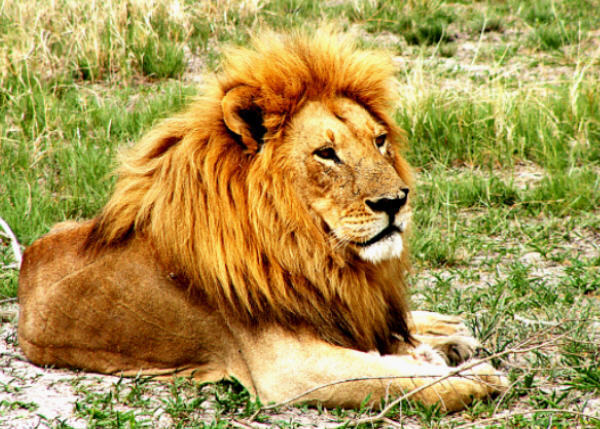
For a man, being promiscuous or bedding many women can result in having many children (even if having children is not consciously desired). There are many male mammals that use this strategy–they don’t stay with the female or care for the young. They will mate with the female, impregnate her, and move on to the next. This strategy results in more offspring, which helps propagate the species. Of course, many of the young will die, but overall, the strategy works. Think of male lions: they are terrible fathers and “husbands.” Male lions are lazy and spend most of their days sleeping and lounging around while the female does all the hunting, caring for the cubs, and defending the pride. Male lions insist on being the first to eat a kill, even though the female was the one who did all the work and brought the kill back to the pride. A hungry male lion will aggressively cuff an upstart cub or a female who dares to eat before him (the male lions in the movie “The Lion King” are anthropomorphized and are atypical of real lions). Male lions are also known for killing unrelated cubs of a female he wants to mate with. This is to ensure she can only devote herself to his cubs, once she gives birth to a new litter. This isn’t far off from the psychopathic stepfathers we hear about in the news who abuse or even kill babies and young children that don’t belong to them.

malelion

It’s harder to see how this strategy would work for females, but think of reptiles or fish–or spiders. Non-mammalian females (except for birds, which are very nearly mammals) do not have the capacity to feel love for their young, and evolution has ensured they give birth to many young at a time to ensure that some survive. It’s to their advantage to drop their load of young and abandon them, moving on to finding another mate. In the case of the spider, the female will even eat the male after she mates with him. That’s pretty psychopathic, but the strategy works if you’re a spider.

spider

A person with psychopathy seems to lack the higher, mammalian part of the limbic system of the brain that enables them to feel love or provide care for their young after they are born. They are acting on the reptilian (or in the case of males, the lower mammalian) brain instead, which all of us still possess. The problem is that as humans have become civilized, these reptilian, callous strategies that many animals use to propagate themselves have become maladaptive to civilization. That’s why we’ve developed laws that keep psychopathic behaviors that were once advantageous under control.

But a little narcissism is adaptive, because it helps us attract and keep a mate.

The Truth In The Lie Of Narcissistic Love

This brilliant post ponders on the question all of us who have ever been in a narcissistic relationship (or had narcissistic parents) have asked: can a narcissist feel love? This deeply personal post says yes, they can. But they have no idea how to express their love in appropriate ways because everything, especially loving someone, hurts too much. So they hurt the one they love instead so they don’t have to feel all that pain.

You can’t reason with them or plead with them to stop doing what they do, though. Attacking you isn’t something they can control — it’s an automatic reaction, almost like a reflex. Whether or not a narcissist is capable of FEELING love, they don’t know how to EXPRESS it in a loving way, so you’re better off not wasting your own love trying to make a relationship with one work. If you must love a narcissist, do it from a safe distance.

NPD: weird traits.

dog_food

Here is a list of some traits of NPD (with detailed explanations), some of which I’ve never heard of, but make sense/or I have noticed (the tendency to not have opinions of their own is included here).  Some are truly strange but accurate:

Odd sense of time/no sense of the passage of time.

Unusual/bizarre eating habits

Strange work habits

Bad gift givers; stingy

Lacks a sense of humor/doesn’t get jokes (but are often meanly sarcastic)

Naive and easily taken advantage of (!) — actually makes sense because they are oblivious to what is going on around them

Complain all the time; negative and pessimistic

Passive, lack initiative

No opinions of their own

Can’t follow conversations

May look much younger than they are

Self-sabotaging impulsivity

Occasional moods of giddy euphoria (not to be confused with real happiness — which is alien to narcissists)

http://www.halcyon.com/jmashmun/npd/traits.html#time