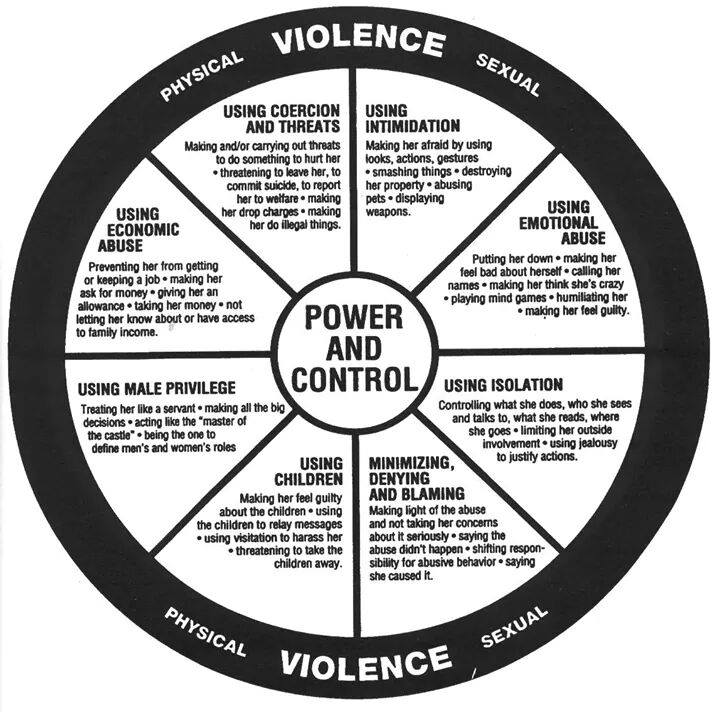
Not all abusive relationships involve physical abuse. Emotional and mental abuse can be every bit as damaging, and sometimes more so. (Click image to make larger).
A new friend of mine (a survivor of several abusive relationships with narcs) and I were talking on Facebook. Rather than try to paraphrase, I’ll quote her directly–and then give my own opinions.
Friend:
“I realized he [her malignant narcissist ex-boyfriend who she’s still in minimal contact with but who is still trying to gaslight her and get her attention by stalking her on Facebook] did everything on that wheel except for the Economic abuse. He started to subtle test the boundaries…and realized I wasn’t game. Although I believe he probably still believes I’ll contact him again. It’s amazing, [Lauren.]
The more time your away, they stronger you feel. Your self-esteem comes back slowly. I get those frightened moments when I think my new boyfriend will just Abandoned me out of nowhere. I understand why the Psychopathic free support group did not recommend a relationship right away. They know you suffer from PTSD from the aftermath of this abuse. It’s difficult. I find myself having dark flashbacks. I also believe you have to be careful and choosy about your women friends and surround yourself with only kind people. We are fragile and vulnerable after this abuse.
My reply (My original reply was short–I embellished it when I wrote this post. I hope my friend sees it).
These are all great points. It makes sense to stay out of relationships if you’ve just escaped from an abusive one because of the PTSD you probably have or even worse problems such as major depression–you need time to find yourself and work on yourself. You need time to be selfish and not have to answer to anyone because you’ve been giving, giving and giving some more with nothing to show for it in return.
We’re mentally and emotionally exhausted and need time to recover, just as if we’re recovering from any illness. We need to not have to be responsible for someone else’s welfare or self esteem or happiness for a while before taking the plunge into a new relationship. We need to take care of ourselves and find out who we are–whether that means going to therapy, writing a journal, turning that journal into a public spectacle like a blog or video diary, taking up martial arts, yoga, or finding God. We need time to heal.
Jumping into any new relationship–even with a non-narc–when you’re this vulnerable is almost guaranteed to fail and retard you in your self growth, and if you’ve been attracted to another narcissistic abuser (which is common in codependent, PTSD and Borderline women), you may wind up much worse when all is said and done.
We’re like addicts. Narcs need their narcissistic supply; we codependents need our narcs. Let’s face it: Narcissistic suitors (male or female)–at first–make us feel alive, vital and fulfill our wildest romantic and sexual fantasies (when they are trying to trap you as their prey). In a weakened state like PTSD or depression, your judgment is not going to be great and you re going to be VERY suggestible. Most likely, you’ll also become unconsciously attracted to a romantic partner who reminds you of the narc you just left (or who left you). He made sure you can’t forget him easily, even if he was terribly cruel at the end.
Anime drawing (artist unknown).
Also, we tend to be attracted to the same type of person anyway. So if you’re usually or always attracted to narcissists, then most likely your taste is not going to change.
Getting involved too early after the end of a relationship with a narcissist is dangerous. Even with a non-narcissist, old patterns will still come up and you will be hypervigilant and suspicious of your new partner, causing them confusion and eventual discord. If you’re falling for a non-narc, that’s a good sign, but if you just left an abusive relationship, please wait. Envision a giant red STOP sign. Be friends instead. Now’s not the time to get involved beyond that level. If you met someone who truly cares for you, they won’t mind waiting a while and being friends with you.
If you’re already falling hard for someone, I know it’s going to be really hard to resist the pull of a new romance. It’s a powerful force, built into normally-wired people’s genes.
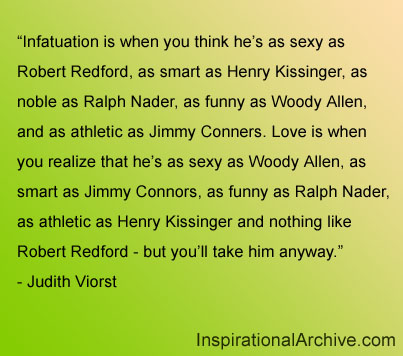
But remember, even though it feels like the most exciting, heady, intoxicating rush you ever felt, that feeling won’t last: what you feel is infatuation, a crush–actually caused by changes in the brain that act like a euphoric drug. That’s really what it boils down to.
Infatuation so soon after an abusive relationship is really just a form of transference onto a phantom “therapist” [the person you are infatuated with] when you are at your most vulnerable. You’re looking for someone to rescue you. There is no Prince Charming. A love relationship cannot rescue you from yourself, your memories, or your PTSD. By its nature, it can’t. You are the only one who can make you well, with the help of therapists, counselors or another other trusted person who is not involved sexually or romantically with you.
So be patient, wait until you heal yourself and feel more confident. Then if you fall in love, dive in and enjoy it–and with any luck it might turn into the real thing.
I was just reading about infatuation on Wikipedia (everyone should know why by now) and found this:
In transference
In psychoanalysis, a sign that the method is taking hold is ‘the initial infatuation to be observed at the beginning of treatment’,[16] the beginning of transference. The patient, in Freud’s words, ‘develops a special interest in the person of the doctor…never tires in his home of praising the doctor and of extolling ever new qualities in him’.[17] What occurs, ‘it is usually maintained…is a sort of false love, a shadow of love’, replicating in its course the infatuations of ‘what is called true love’.[18]
Freudian theory holds that when a person enters psychoanalysis, they will develop strong feelings toward the therapist, usually in the form of a powerful crush, but it can take other forms too. It happened to me with one of my therapists many years ago. I had to quit because it became so intense. He kept telling me it was normal and to work through it (he was a Freudian psychoanalyst) but I just couldn’t deal with it anymore.
I think what happened to me these past few weeks was really a form of transference, even though the person in question is someone I never met. I looked up to him as an authority on mental health and found (well, still find) his writings therapeutic and powerfully written. This man is also a person who I’ve been told has this spell-like effect on many women (and probably some men too) who have been victims of narcissistic abuse and look to him as an authority. But he is also a narcissist and he proved to me today he’s exactly what he says he is. My idealization of him came crashing down to reality. I had hoped he was “different.” He wasn’t.
I don’t think transference is really beneficial to the therapist-patient relationship. I think it’s a distraction that keeps the patient from focusing on themselves. I noticed during the time I’ve had this ridiculous infatuation I haven’t been focusing on ME as much as I should be. I think developing a “pleasant diversion” (at least pleasant until your fantasies are shattered by hard, cold reality) in one’s mind by forming an obsession over another person might be a way to not have to focus on painful emotions that might be coming up.
Infatuation has also been called “limerence” in Dorothy Tennov’s excellent 1979 book, “Love and Limerence,” which I highly recommend (and have provided the link if anyone wants to order a copy). Tennov gives the best description of the experience I’ve ever read. I don’t know why that word hasn’t really caught on because it’s a good one. In later chapters, she also writes about the phenomenon of transference in psychotherapy.
Infatuation is not love. Many people confuse the two, and it can feel like “love” to those entering a new relationship and finding themselves obsessed with the other person. It can lead to real love over time. But infatuation is shortlived unless it’s continually fed and has little to do with genuine love. You can be infatuated over someone you don’t even know–such as a celebrity, and how can that be love?
Infatuation involves increased levels of dopamine in the brain similar to a cocaine or opioid high, which is why it feels so good and why it must be “fed” to be kept alive. When it can’t be fed anymore, the infatuated person, like a person withdrawing from drugs, may “crash” or experience depression. I wonder if people with addictive personalities are more likely to develop this condition.
Real love isn’t drug addiction or a “condition.” It involves commitment, genuine caring about the other person, willingness to compromise and sometimes sacrifice, and mutual understanding. Genuine love must include true friendship and mutual give and take. It also requires an ability to empathize with another person you care about. Real love may or may not include infatuation. They are two different things, although one can lead to the other. A mother’s love for her child certainly doesn’t involve infatuation, but it’s love in one of its highest forms.
Infatuation includes none of these things, only an unrealistic idealization and obsession with another person. The idealized image the infatuated person has of their object of obsession may or may not be accurate at all. Most likely it isn’t. That’s why crushes tend to be shortlived. Tennov calls limerence/infatuation “cognitive obsession,” and that pretty much sums up what it is. Sure, it can be a lot of fun (like a drug high), and an interesting diversion if not taken to extremes, but it’s not “love.”
I’ve always wondered too why crushes are so embarrassing for people to talk about, since they’re so common and normal. I hesitated a LOT about discussing this on a public blog, especially knowing the person in question is most likely going to see all this, but you know what? I don’t care, because I’m not going to lie about anything in this blog. It’s my therapy, and I made a commitment to never lie about anything, so there you go.
I have always been attracted to narcissistic men. And them to me. I spent 28 years (7 of those AFTER we divorced) living with a malignant narcissist substance abuser and raising children with him. Before Michael, I had three serious boyfriends, and only one was not a narcissist (but was severely bipolar).
When I was in my twenties, all I wanted to do was marry and have babies–this wasn’t considered cool or forward thinking at the time (the 1980s). I wasn’t really focused on having a career like most young women my age.
I think my oddly timed longing for normal family life was because more than anything in the world, I longed to be part of a family that would not be like the one I came from, a close, functional family whose members truly loved and cared for one another. I had grand fantasies of Perfect Family Life–3-4 perfect, normal kids; a perfect, normal husband with no serious mental disorders or drug or alcohol issues; and a beautiful home with plenty of old school charm in a safe neighborhood. My Perfect Mate would be an honest, loyal husband and father who loved animals and long walks and would care deeply about all of us. Of course there would be pets too, probably a large friendly dog like a Golden Retriever. I wanted the damned Brady Bunch.
I know, you’re probably ready to vomit all over your keyboard. Chill. I’m stopping right here. I cringe when I think about how naive and clueless I was.
Does anyone remember this commercial from about 2007-09? If you’re a nausea-prone ACON you may want to take some Pepto first.
Well, this was the family I wanted to make, back in the 1980s.
30 odd years later: I hate that damned commercial with its perky, perfect, cute-but-not-beautiful soccer mom–a woman who undoubtedly had loving parents who raised her with consistency and lots of hugs and support, a woman who has extended family members like cousins or aunts or an uncle she is close to, and also has lots of friends. She also has an advanced degree in something like sociology or art history. She was popular at school, not Mean Girl/cheerleader-popular, but the next tier down from that–she was one of the honor roll kids where the girls all played volleyball or were in the Drama Club, and the guys all looked like Ferris Bueller and were Theater Nerds. But these second-tier, almost-popular kids were actually nice to everyone (unlike the top tier of popular kids who really weren’t so much popular as they were feared and respected–because they consisted largely of narcs and their sycophants) and you wanted to hate them but you couldn’t because they were always so darned nice.
Instead of pursuing her career in art history or writing a book about The Sociology of Art History, this perky redhaired 30-something has chosen to stay home with her growing brood of ginger kids, each one more red haired than the last. Her infuriating announcements of big moves (to MEMPHIS!), promotions at work, home enlargements, weeks-long family vacations, learning how to speak French, and especially…ESPECIALLY!..the group shot at the end showing the whole family focusing on Perky Soccer Mom bouncing the the new baby on her hip at the end–not just any baby, but a gorgeous fat healthy good natured baby girl with an adorable grin who probably sports fire engine red hair under that white cap–made me want to throw a brick at my TV screen.
I know this is just a commercial and those people are actors, but…I ACTUALLY KNOW FAMILIES LIKE THIS. Of course I don’t know what goes on behind closed doors (and everyone has their dark secrets), but because the members of these families always seem happy and relaxed and everyone seems to love everyone else, with not a molecule of narcissism anywhere to be seen, the skeletons in their closets don’t come out to haunt them all that much. They are probably covered with dust from disuse.
I’m assuming here that the reason this thoroughly obnoxious commercial was so popular (it ran for almost 3 years), is not because it depicts the idealized family everyone strives to create, but rather, because many people can actually relate to this smugly contented woman and her tall, dark and handsome husband, their perfect dog, their big colonial house, and their large brood of gingers.
I longed for this family because having this family would vindicate my dysfunctional and narcissistic family of origin. It was the family that would bring me Justice.
I never got that family, because I fell in love with a malignant narcissist, who in every imaginable way at the beginning, convinced me he was the Perfect Boyfriend, and later the Perfect Fiance. We made two highly intelligent but troubled kids (well, one is a lot less so but lives almost 700 miles away).
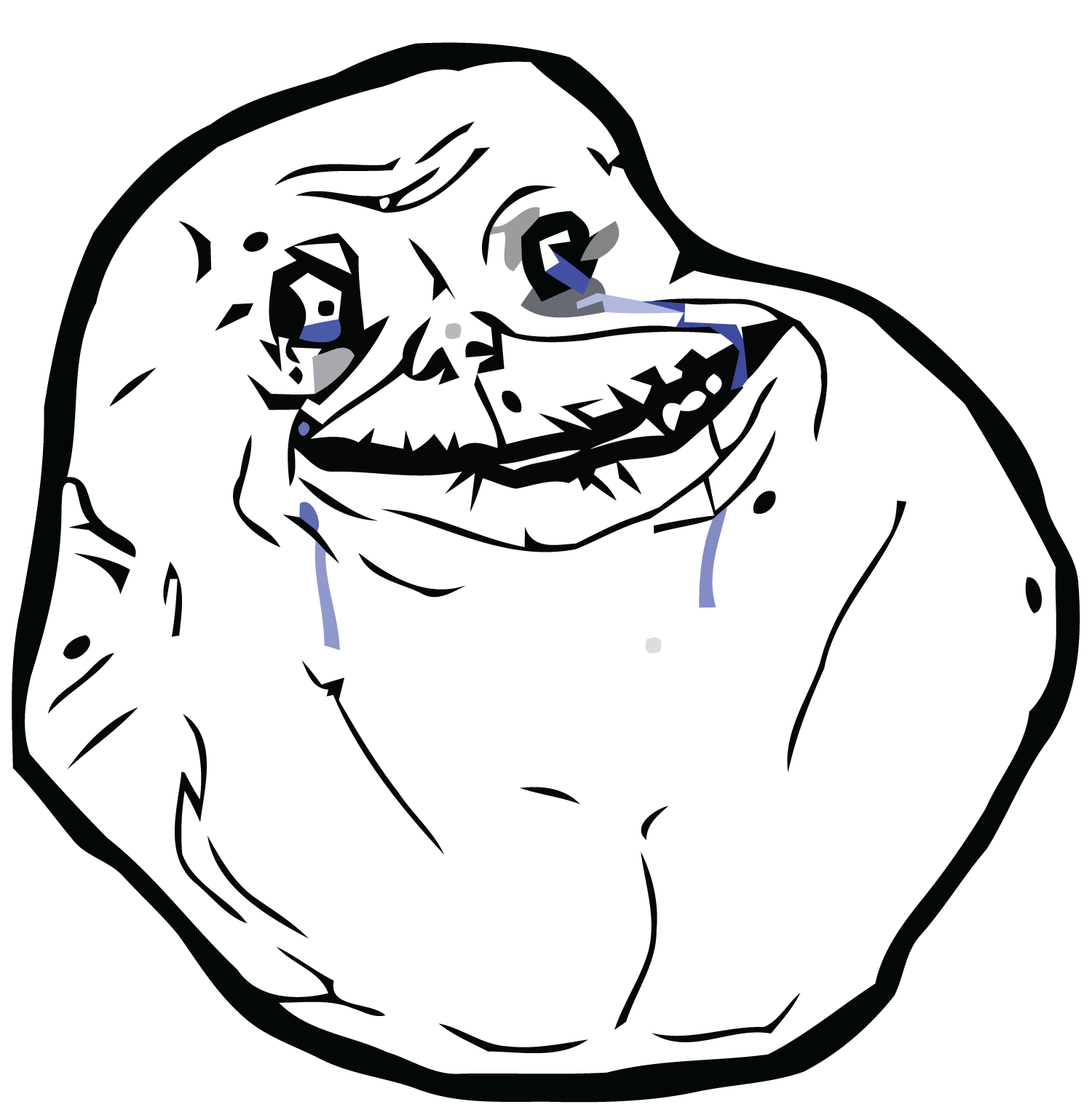
And now I am Forever Alone.
But I’m alright with that. More than alright.
In my past relationships, I never saw any of the red flags. I knew nothing of red flags back then other than the physical kind that signal physical danger. The most useful psychological advice about men and relationships I got in the early-mid 1980s was from articles and fluff quizzes (such as “What Does his Lovemaking Say About his Character?”) in magazines like Cosmopolitan and Glamour.
I was never attracted to “bad boys.” I chose men who had good jobs, prospects and didn’t stink or break the law. But sometimes these “perfect” guys can be anything but perfect, and because they put on such a convincing and impressive mask of normality, you don’t suspect their true motives until it’s too late. I always seemed to gravitate to the devils dressed in white.
I’m not going to recount the downward spiral that led to the dissolution of our marriage, drug addiction, troubled kids, and all the rest because I’ve done that already ad nauseam (if you must know my story of being married to a malignant narc, click on the links under “My Story”).
So I’ve done a 180 from the naive, romantic starry eyed girl I was in the 1980s–the girl who was uncool enough at the time to want a family and babies and a normal life with people who were not psychopathic or addicted to drugs or alcohol (today that would make me Taylor Swift–how times have changed). I no longer want a relationship. I relish my solitude.
I still get crushes, and plenty of them (I have one now), and just as in my teens and twenties, they still tend to be intense. My crushes are pleasurable to me but they are mine alone to enjoy, not something to be shared with the object of my infatuation. I know, I’m weird. I have an excuse to be weird and avoidant though, because I’m Aspie with Avoidant Personality Disorder. I enjoy my dreams and fantasies far more than my reality, and why ruin a good fantasy by trying to make it real?
That’s why I think my mind makes sure my crushes are never on people I know personally or have to see all the time, and instead chooses men who are inaccessible for one reason or another. Famous people are the safest of all, because I do not ever not have to meet them and either (a) face rejection; or (b) worse: not be rejected but gradually find out they are really just another sick malignantly narcissistic tool who will fly me to the moon and feed me fresh blackberries dipped in cognac, and then ever so insidiously proceed to turn my life into one resembling incarceration in a Turkish prison before I know what even hit me.
I’ve been there, done that. I am no longer of childbearing age, and though I look far younger and fitter than my 55 years, I realize I’m not going to look this good too much longer. At my age, there’s a feeling that you just don’t have what it takes to attract a man anymore, even when it’s not true. Because I look better now than I have since my mid-late 30s. Sure, maybe a woman of a certain age can’t attract the 20-somethings anymore, but what middle aged woman in her right mind really wants a 20-something for anything but a quick fling, anyway? In my case my wariness and self consciousness is due to the low self esteem that’s lived with me my entire life like some parasitic twin I’ve grown so used to I sometimes forget it’s there. Hating yourself is a tough habit to break.
But the real problem isn’t my fear of losing my sexual desirability (which is already well on its way over the other side of the mountain), it’s the simple fact that I don’t trust men (or anyone) enough to become intimate with one. As an Aspie, I have trouble reading social cues, which means I often miss the important red flags and warning signs of a narcissist who is love bombing me and wooing me into his black den of misery. And more than that–I want to believe them. I want to give them the benefit of the doubt. I never learned from my past mistakes.
So no longer is “love” my passion in life or my goal. I figure I will die single and alone, but very possibly, happy. Hopefully by the time I die, I will have written a book or two that helped others, gave others joy, and brings me a nice income so I can buy my own small, quaint, quirky home near my son in Florida, somewhere near the beach.
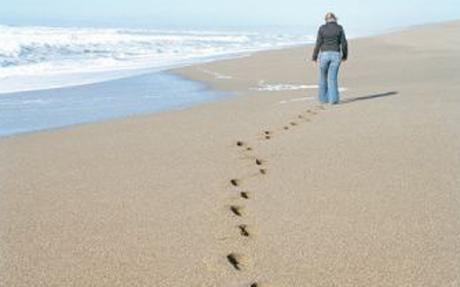
Twenty or thirty years from now: I see myself–an old spinster (I love the strength that word conveys–we need to bring it back!) wearing a long brightly patterned madras-cotton dress or jeans and a slouchy, comfy sweater in cooler weather, walking barefoot along the Gulf Coast at sunset, feeling wet sand squeeze between my pale toes, waves lapping at my feet, the salt air breeze making me smile and my eyes water. I’m tossing small pebbles into the golden waves, a large dog with a cool name like Hector skipping along by my side, occasionally running ahead of me when he sees a seagull land on the darkening sand. I’ll be thinking about my grown son and daughter, and their families and satisfying lives, and my only worry would be the two-month deadline my publisher has given to finish writing a groundbreaking new book about something that matters. I’ll be Forever Alone. And like it.
All this being said, if an attractive, genuinely nice man comes along when I’m not looking, and maybe I’m feeling more strong and confident, I might venture into the ocean again, or at least get my feet wet. So sure, it could happen, but right now I’m just trying to get to know myself.





 Lucky Otters Haven
