Trump and his impressionistic speech: HPD or NPD?

make_america_great

I’m engaged in an interesting conversation in a Facebook group about Cluster B disorders. Someone raised an interesting point about Trump possibly having HPD instead of, or in addition to, NPD.   His “impressionistic speech,” which is a symptom of HPD, is a clue, but based on his inability to accept blame or criticism (and not just projecting it onto others), that seems a lot more NPD.

I’ll just let the actual conversation speak for itself because it raises some interesting points.  (There were more replies, but I’m leaving out the ones not relevant to the topic raised, which is Trump).

Someone in the group posted this question (who I will call Participant A) :

Random thought: Donald Trump initially appears NPD. But that fucking hair… the orange tan, and the impressionistic speech…makes me wonder if he’s not HPD, or at least comorbid. The one HPD I’ve known was basically a narc in a series of crazy outfits. And she sounded JUST like him with her wild lack of details, inappropriate sex talk and constant attention seeking behavior. Thoughts?  

Participant B:

I think a person with HPD might respond to all of the criticism a little differently than he does. He seems to hold tight to his grandiosity, a person with HPD would be more wounded and emotional. He ignores the fact that nobody wants to join his inauguration and even lies and pretends It’s sold out, inauguration dresses are sold out, etc. That looks like NPD to me.

Participant A:

The HPD I know did this exact thing though. I worked for her and while planning a conference she made me send out an email to supporters saying we had this amazing star studded line up (we had no one) and the tickets would soon be sold out (we had like 10 people signed up so far). As an NPD I personally would be too nervous to publicly fail, so I would opt to undersell the event, in case no one showed up, to save myself embarassment. If people show up, bonus points, because I look humble. She just threw wild shit out there with seemingly no concept of reality. Constantly contradicted herself too.

Participant B:

People with HPD are supposed to be more uncomfortable with criticism and more uncomfortable not being the center of attention. I think people with NPD have mental blocks up that sometimes don’t allow them to see when they’re disliked or unpopular. Maybe on a subconscious level they get it. I think a person with NPD might be better able to answer this though

Me:

I think it’s easier to have ASPD than NPD — NPDs and BPDs care very much what you think (even if they never admit it) while psychopaths and ASPDs generally don’t give a shit.

Participant B:

People with HPD are more easily influenced, they typically blame failure on others. He doesn’t even admit to any failure existing.  Superficial emotional displays or a little more agreement with the majority might be more HPD too…

Me:

That’s a good point. He could also be a somatic narc — with extremely tacky taste! Cluster B disorders often appear together, so it’s entirely possible he could be both NPD and HPD too. But no way is he *just* HPD — like Participant B said, he doesn’t admit to failure — ever.

Me (replying to Participant A):

I’ve heard that HPDs have “impressionistic speech” but I never understood exactly what that means. Can you give an example of Trump using this kind of speech? I’m not doubting you, but I’m just not sure what it is. Sort of a vagueness? Because he talks and talks and never actually says anything. Or it’s like word salad and makes no sense. Is that what you mean?

Participant A:

Earlier today, “It’s going to be Huge! We’re going to turn things around”. Ok, Donald, how are we going to do that? ” We will make America great again!” Lol. Literally just now: “My cabinet is so smart. We have the highest IQ of any cabinet ever assembled.” Oh ok, based on what fucking data? No explanation.

Definition and example of impressionistic speech: “A term used to describe a person’s speech when it consistently lacks in detail and emphasizes emotions. For example, if you asked someone what they thought of something, and they said that the thing was “just wonderful, fabulous”.”

Does he not consistently fit the bill, or what?

Me:

Ah, I see. My NPD mother (who I always suspected was HPD too) talked that way. “Everything was fabulous!” “Oh, I feel marvelous!” A lot of hyperbole, but no substance. At all. Yes, Trump does talk exactly like that and never can back up his grandiose claims. And people think he’s pissing gold.

HPD doesn’t seem to be that common for some reason. Or it gets diagnosed as BPD or NPD.


I finally signed up for Obamacare, was pleasantly surprised, but now Trump and his band of goons wants to repeal it.

obamacare

WARNING: RANT AHEAD.

Last year I didn’t sign up for Obamacare because I didn’t think I qualified based on my income being so low, and North Carolina is one of the states that hasn’t expanded Medicaid to low income people.  But that’s only part of the reason I didn’t sign up in 2016.  I also just felt triggered, irritated, and emotionally overwhelmed by the whole process, and frankly, I’m also morally opposed to the fact we as a nation do not have single payer healthcare like every other freaking industrialized country.  So I guess there was also an element of rebellion in my refusal to sign up, which is stupid, because what would have happened if I got sick or in an accident?   I was lucky I did not.   I already knew a year ago I’d have to pay the $695 fine when I do the 2016 tax returns, but I assumed it would cost me a whole lot more to get Obamacare, if I even qualified at all.   After all, it seemed like everyone was whining about how expensive Obamacare is, but it’s mostly people who hate Obama (I’m not one of them –but I’m starting to really appreciate him now, knowing the Ooompa Loompa is taking over in 3 days.)

So anyway, back to my health insurance saga.  I make a little more money now than I did a year ago, due to being promoted to a semi-supervisory position a few months ago (and being up to my ears in work).  I just wanted the whole health insurance thing to go away and acted like it would if I just did nothing at all.  I  just didn’t want to deal with it, but in the back of my mind, I knew that the penalty for 2017 would be close to $2,000 if I didn’t sign up.  I also knew I was living on borrowed time, because inevitably the day will come when I will need medical care and not just a first aid kit or an aspirin. But I kept procrastinating because I just didn’t want to deal with the unpleasantness.

Today I got a letter in the mail reminding me to sign up by January 31 if I didn’t want to pay that ridiculous fine for 2017.   Personally,  I think it’s outrageous that people are being fined for not opting to line the health insurance companies’ coffers, especially if their states haven’t expanded Medicaid to low income people, but what are you going to do? You have to do something, even if it makes you feel like throwing up in your mouth.    Why does America think “the market” is so damn wonderful anyway?   I think corporations are just as, if not more corrupt than the “big bad government.”   Their ONLY reason for existing is for profit. In my opinion, healthcare is a right, not a privilege, and every American should have access to it and not have to pay some insurance company.    But no one complains about corporate America, they only complain about “the government.”

So anyway, back to the letter I got.   After reading it, I said to myself, what the hell, might as well sign up right now and get it over with, since I have to do it anyway.  Why put off the inevitable?  There were a lot of questions to answer but it turned out I am eligible for Obamacare and get most of it paid for!  My premiums will be only $29 a month!.  Maybe I had it all wrong and could have done the same last year and avoided the $695 fine.  I also feel better knowing I have health insurance now, even if it’s not the greatest plan in the world.   Now I can stop worrying about what I will do should I become sick or have to go in the hospital.  Not having insurance at my age is playing with fire, and I’ve been all too aware of that, and tried to ignore it.    Now I can cross that off my list of worries.   For now.

Because here is what really sucks.   Now that I’ve finally signed up, Trump and his band of goons are talking about repealing Obamacare.   Now that I finally have it, I’m afraid I’m going to lose it.   If I do lose it, will people still be required to pay fines for not having health insurance?  I know there’s no way I could ever afford the premiums without the generous tax credit Obamacare gives me.  The idea of fining low income people for not having the money for the full price of health care (especially now that most companies no longer offer health insurance to their low-wage slaves) makes me feel sick to my stomach.   It would be appallingly unfair if that actually happened,  but I wouldn’t put something like that past this godawful, compassionless, immoral administration.

I’m worried about something else too.  Paul Ryan, who is a “Christian” (Catholic) Ayn Rand devotee (how is it even possible to be both?) wants to privatize social security.  Oh, no, we can’t have that!  It helps people!  It has to go away because “it’s an entitlement.”

EARTH TO PAUL RYAN:  IT’S NOT A FREAKING ENTITLEMENT!   I paid into it since 1976!    I’m really worried that as I enter my later years, which isn’t that many years from now, that all the money I’ve paid into social security for FORTY-ONE YEARS will be for nothing, and older folks like me who don’t have savings, investments, and 401Ks (because we never made enough money to have those things) who had counted on social security to be there for us when we finally were too old or weak or sick to work anymore,  will just have to just keep on working until we drop dead, or become a burden on our grown children, who will be forced to support us.

There’s also talk about privatizing Medicare.    If either of these programs the previous three generations enjoyed and that (until recently) seemed immune from being tampered with by Stupid Party, get the plug pulled on them (which “privatizing” essentially means), there’s going to be a whole lot of really angry and frightened people.  WHAT IS THIS?    LOGAN’S RUN?  Or even…SOYLENT GREEN!  (That 1973 movie about a dystopian future sounds a LOT like what’s starting to happen here, and the year it takes place in? 2022! Only 5 more years!)

Why not just off everyone too old to work.  Riiight, let’s just let the old and the sick DIE OFF.  They don’t contribute anything anyway!  They’re not PRODUCTIVE! Who cares if they SUFFER?

I think if Obamacare is repealed or especially if Medicaid and social security are privatized, there will be civil war.   Hell, maybe a civil war or a mass uprising is what needs to happen so people stop being sheep and keep voting for people who don’t represent their best interests.    The squinty eyed fat man with NPD and his pack of sociopathic stooges really have me scared.   I’m  getting reeeeally close to hating this country and wishing I could just leave.  America, the nation that promised so much and  that everyone used to want to live in, is turning into a third world country.   What’s happening here is the way third world countries are run.  Why’s Trump so worried about our borders?   Who will want to come here?

Am I the only one who feels like that?

Anyway, I have health insurance.  Finally.  For now.

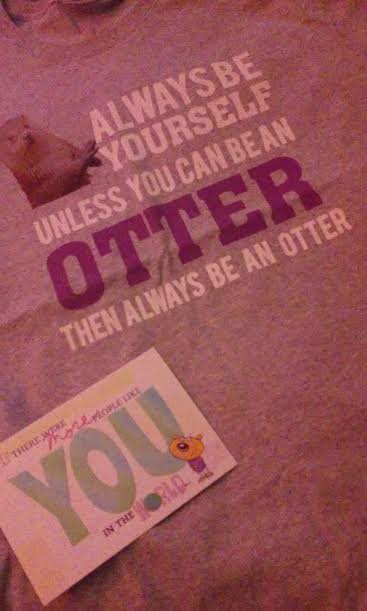
My son just sent me this T-shirt!

My wonderful son finally sent me the Christmas gift he’d promised — and I’m wearing it right now!   I love it!

ott_tee

The card that came with it is hard to read, but it says:

If there were more people like you in the world…

—there’d be more smiles like mine! (inside)

He also wrote this little note and my heart leapt with joy:

Mom,

I am very proud of all you are doing.  The world needs more people like you that have experienced pain, hardship, and loss so that they don’t have to suffer what you did and still come out with a heart as strong and bold.   Love, your son, ___


Monday Melody: If I Had a Million Dollars (Bare Naked Ladies)

I heard this this morning and I just can’t help smiling every time I hear it.  So cute and witty, even if it’s just stoner rock.

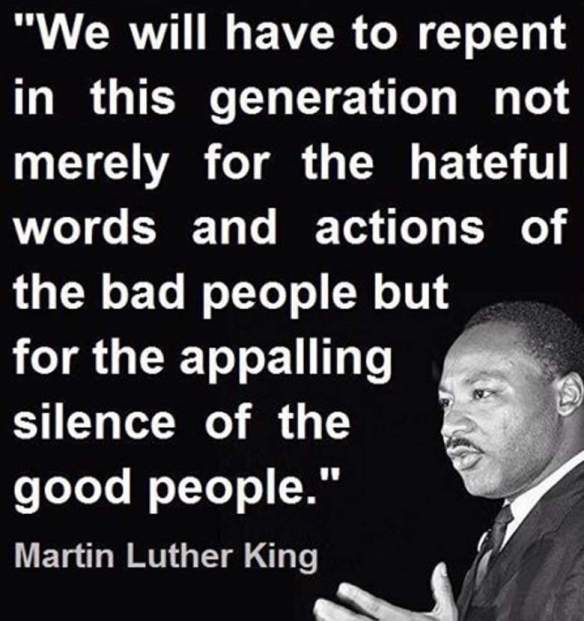
We desperately need a hero like MLK today.

martin_luther_king

These words are just as relevant today as they were 50 years ago — maybe even more so!


Email and me.

email-delay

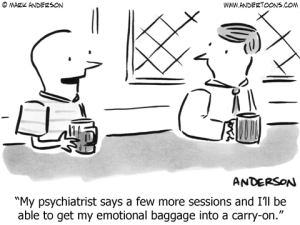
This isn’t really my philosophy, but I just liked the cartoon.

I have a terrible problem.   I am absolutely awful when it come to responding to emails.  I procrastinate forever.  So far this week, THREE people thought I was ignoring them or wasn’t interested in what they had to say, because they had sent several emails and I hadn’t responded.  (I finally did today and feel a lot better).

It’s true that I do get a lot of email, and can’t answer every one of them in a timely fashion.  It’s also true I get a lot of spam email and opening my in box and picking out the spam from the legit stuff can be a chore.   Maybe that’s part of the reason why I procrastinate.

Also, I was locked out of my email for three days last week and finally had to set a new password to get in.  Remembering passwords is something I will always be bad at, and for that reason I learned the hard way to never erase my entire history because that means I have to log into everything again and I always forget my passwords.  Even though I try to use the same password for every account I have (not recommended!), somehow there is still at least one account I can’t for the life of me remember the password for.  In fact, that’s how I got locked out of my email.  I erased my history and forgot my password!  😳

But I digress.  I suck at answering emails.  It’s not because I don’t like you, or have any beef with you, or because I’m not interested in what you have to say.   I’m just really bad with this particular method of communicating (phones are another — I can’t stand them) and I really have no idea why.  It’s not that much work to answer an email — it just seems so clunky and inefficient somehow.

Now, if you follow me on Twitter, I’ll probably talk to you so much you will get sick of me! I’m a Twitterholic.  I’ve had people actually unfollow me on Twitter because I talk too much there!  I know not everyone loves social media (and frankly, I hate most of it, especially Facebook), but I loooooovvve Twitter, so if you follow me there, I won’t be ignoring you.  If you want to talk privately, you can DM me.

Or just comment here — I try to reply to all my comments, or at least Like them so you know I read them, even if I have nothing new to add.   I also share all my posts to Twitter (they get auto-posted), so if you follow me there, you will never miss a new post.  My Twitter feed is in the sidebar, and you can just follow me from there too, if you already have an account.

Spring in January?

januarytemps

I adore spring (it’s my favorite season), but the temperatures all along the East Coast have been unseasonably warm for at least a week (like , 60 – 70 degrees every day) — and there is no sign that it’s going to get colder any time soon — even though the forecasters are promising winter isn’t done with us yet.  Apparently, it’s warmer in New York than it is in Florida — at least according to this map.  Now, that’s weird.

What concerns me is that the trees here are looking a little “pregnant” — that is, they’re starting to get that sort of full look, with a muted reddish tint, that trees always get in the late winter just before they start to bloom.   Usually that doesn’t happen until March in this region, or sometimes as early as late February.  But mid-January?  That’s not normal.

The grass is also starting to look like it needs a mow.

I also saw a bee buzzing around.  And the birds were singing as if it was May.

I think I recall in 2007, the same thing happened.   Shortly after Christmas it got warm and stayed warm for two weeks — and the rose bushes outside started to bloom.  So did some of the early-blooming shrubs.  But it got cold again, and by the time real spring rolled around, the shrubs decided once was enough: they weren’t going to put on their flamboyant show of color again.   So they just went from bare to green.

If it stays warm, then, well, maybe global warming is true after all (and now we have a President who thinks it’s a myth started by the Chinese) and we can start to plant palm trees here on the East Coast.   Hey, I hear they plant them on the Jersey Shore now!  They’d probably have an even better chance here in the South.

But if it gets cold again, which most likely it will, then I’m afraid we’ll be in for another barren, bloomless spring, like we had in 2007.

Spring, you know I love you, but please be patient!   It’s too early.

Why Scientology auditing is not at all like traditional psychotherapy (part 2).

cartman_emeter

Credit: “Trapped in the Closet,” South Park episode about Scientology.


In Part One, I wrote about how Scientology and the related Dianetics (a “therapy” technique started by science fiction writer L.Ron Hubbard) came into being, and why Scientology is so opposed to psychotherapy or psychiatry and regards Dianetics as a much better “technology” (they actually call it that) to become mentally healthy and happy.

But having had experience with both Dianetic/Scientology auditing (during my two year stint with Scientology back in the late ’70s) and psychotherapy, I’m of the opinion that psychotherapy is much better, in spite of Scientology’s claims to the contrary.


The cost of Scientology auditing. 

The first problem (and the most publicized one) with Scientology auditing is the expense.   Psychotherapy can also be expensive, but if you have mental health coverage, you may only have to pay a small copay.   Even if you have no coverage,  many therapists are willing to work with you on a sliding scale.  This is up to the  individual therapist, and some are strict about their fees, but others, like mine, only charge what the client can afford.   For me, that’s $40 a session — or about $160 a month.  That’s not a lot more than my utility bills during the winter months.

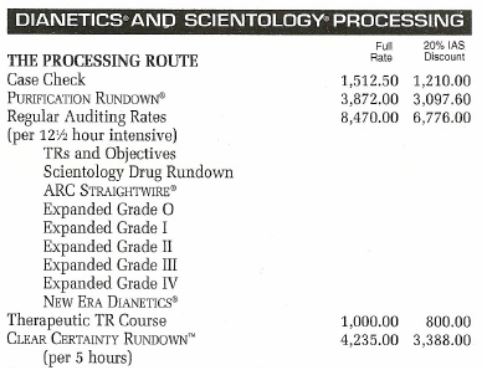
Scientology/Dianetic auditing prices, on the other hand, are not set by individual practitioners, but by the Church of Scientology itself.   Most of the proceeds do not go to the auditors (who actually make practically nothing), but directly to the Church.  The prices for auditing are extremely high.  The chart below shows that it costs approximately $8,000 for 12 1/2 hours of auditing (I don’t know how old these prices are, but they may be even higher now).  In comparison, if an average session with a therapist costs $150 (a fairly high going rate), 12 1/2 hours of therapy would come to only about  $1,875.    If you want to pay slightly less (but not by a whole lot and in the end, it might prove even more expensive) there is the “training” route up the Bridge.  Scientology training requires you to sign up for and prepay for a series of courses, in which you and a “twin” (sort of like the buddy system) take turns auditing yourselves to the next level instead of by a trained auditor.  In order to get as many people on the training route as they can (and make new auditors who they don’t have to pay), the first course offered (the HAS, or “communications course”) costs less than $20 at today’s prices.    In fact, pricing for the HAS course (Hubbard Apprentice Scientologist) has hardly changed at all since I took it in 1978.    For that price, you think you are getting quite a bit for your money.  You are trained in “Training Routines” (TR’s) which are fun and seem to help you improve your ability to confront other people and communicate with them, but are actually early indoctrination (brainwashing) procedures.

Very quickly though, the prices for both training and auditing become exorbitant.  You will be subjected to a very hard sell by a recruiter, and shamed or even threatened if you refuse (or simply can’t afford to) take the next level to “spiritual enlightenment.”  You will be told to take out loans you can never afford to pay back or to manipulate or lie to family members or friends to get the money.  Or you can “work off” the expense by becoming a slave to Scientology and devoting all your spare time to it.

In addition to the extremely high prices, there are books, checklists, and tapes you are required to purchase–and none of them are cheap.

Here is a partial list of prices (this is only for one part of the Bridge and does not include books and course materials):
scientologyprice

Time theft.

In addition to money, you are also required to sacrifice a significant chunk of your time if you are serious about moving up the Bridge, whether you’ve taken the training or auditing route.   Courses can run 4 – 5 hours a night, 5 or 6 days a week, or even more than that, and straight up auditing can eat up even more of your time, since an auditor is not allowed to end a session until a “preclear” (person getting auditing who is not yet Clear) has a “cognition” (realization).    If a preclear is “enturbulated” (triggered), an auditor cannot end a session, even if it means a session must run all night, or for hours at a stretch.  No breaks are allowed for either the auditor or the preclear, not even to eat or sleep.

Also, if you don’t achieve the expected End Phenomena (EP) in the amount of time set for that particular auditing procedure, you will be required to hand over even more money for additional hours of auditing to achieve that particular EP.   For example, the first step up the bridge on the auditing route is an auditing procedure called “Life Repair,” which is supposed to bring a preclear to the EP within 12 1/2 hours.    But because people aren’t machines, some people may take more time to get to the EP, and will be required to pay for additional hours of auditing to achieve the EP, at non-discounted prices.

Such a time allotment makes it impossible for people to work at another job or have a life outside Scientology,  and this is, of course, intentional.  With most of your time and all your money now devoted to the Church of Scientology, they effectively own you, which makes indoctrinating you and reprogramming your mind all that much easier.

One-size-fits-all. 

scientology_auditing

It doesn’t seem coincidental that Scientology auditing is called “processing” and the auditing procedures are called “tech.”   People are treated as if they’re machines.  A one-size-fits-all method is employed, with the auditor basically using a script of set commands or questions invented by Scientology’s founder, L. Ron Hubbard, rather than a free give and take exchange of experiences and memories that is used in traditional psychotherapy.  No variations or changes to the script are allowed.  If an auditor makes any changes to the “tech” at all or tries to adapt it to the individual, they are considered to be “squirrelling,” which is one of the worst “sins” a Scientologist can commit.

The EP is also a set “cognition” that cannot vary.  In the early stages of “processing,” the EP is usually something related to needing more auditing or training to achieve enlightenment.  For example, in Life Repair, the expected EP is “preclear realizes that Scientology works.”  While the preclear may claim to feel somewhat better, their life is far from repaired — and may be about to get a whole lot worse!   In ARC Straightwire auditing, the expected EP is “realizes they will not get any worse.”  (When will they get any better? That requires more auditing, of course!)  But the auditor isn’t allowed to give the preclear any hints of what the cognition needs to be.     Obviously, failing to get to that cognition will require many additional hours of auditing, which allows Scientology to completely exploit you financially, with few actual results being achieved.  It’s a mindfuck of epic proportions.

e_meter

The preclear is connected to an E-meter (a lie detector type of device that measures galvanic skin response) at the end of each session, and cannot be “passed” until they get a “floating needle.”  If they do not get a floating needle, the auditor and preclear must immediately resume the session until a floating needle is achieved.  This can be frustrating and exhausting for both.   In my last post about my own experience, I described becoming so run down from lack of sleep and hunger that I started crying while auditing a fellow student, and got sent to Ethics and shunned until I fulfilled their Conditions by performing certain actions to get me back in good graces with the church (showing “case” [negative emotions] on post is strictly forbidden).

In traditional psychotherapy, there isn’t a set “cognition” or EP that a patient must achieve.  The end result of therapy is a general improvement in the ability to cope with life and feel better about yourself, not a particular set of words that must be said.  You also can’t pass or fail, because results vary according to the person and the techniques used by the therapist are tailored for that particular individual.   Therapists aren’t reading from a script, as they are in auditing.    There also isn’t a certain amount of time that is set in advance to achieve a particular result, which can cause both preclear and auditor an enormous amount of undue stress.

Lack of qualification requirements.  

In Scientology, if you have the money and time, you can become a “professional auditor” in just a few months of training.   While there are definitely many bad therapists who are not at all suited to be working with patients, they are required to have at least a master’s degree and have spent many hours practicing in simulated sessions before being given the green light to set up practice and work with actual clients.   In Scientology, no degree is required, just a certificate that you passed an auditing class.  An auditor doesn’t even have to be an adult.  In many Scientology families, even children as young as 10 or 11 can audit others after they have passed an auditing course.

Empathy as a liability.

no-empathy2

Empathy is not required; in fact, in Scientology, empathy (Sympathy on the Tone Scale) is considered “low toned” and is associated with someone who is ruled by their reactive mind.   Auditing and training removes any trace of empathy or concern for others. Any show of empathy or sympathy for a preclear can result in a dreaded trip to “Ethics,” so even if an auditor feels empathy for their preclear, they are not allowed to let anyone know and must not let the E-meter detect it.    People with narcissistic or sociopathic personalities tend to stick with Scientology and be the ones to rise the farthest in the organization, and for those who have progressed up the Bridge to the Clear and OT levels, there is a shocking lack of empathy and a forced “happiness” accompanied by the infamous blank Scientology stare.

Besides empathy, showing real emotions other than happiness or contentment (except while being audited) is considered “aberrated” or “showing case” or “bank” (reactive mind) and you can be punished for it in various ways, including shunning and even excommunication.   If a false self is present to begin with (as it is in narcissistic people), its further development is bolstered and rewarded.   People who possess empathy and express authentic emotions are either brainwashed or shamed out of them, or they eventually leave the organization.

In psychotherapy, empathy is usually a desired (though not required) characteristic of a therapist.  All good therapists have it.  Therapists who possess empathy for their clients are usually the most successful and their patients are the most likely to get well.  The goal of therapy is usually to help a patient own and be able to better express their real emotions, not deny them or cut themselves off from feeling them.

Auditing is disguised brainwashing. 

mind_control

The above quote by L. Ron Hubbard  pretty much says it all.  In Scientology (and all sociopathic groups and organizations), language is often used this way, to manipulate people into believing something bad is really something good, or to convince them to engage in activities they would otherwise never engage in.

The methods used in auditing — set commands, endless repetition, rote questions, no allowance made for free exchange of ideas or real conversation, and a requirement to “pass” each session — are really methods of mind control.   There’s a beginning form of auditing called TR’s (training routines) that is introduced in the Communications course.  TR1 involves sitting for hours staring at a fellow student, and not being passed until you can sit there and show no reaction at all.  A later TR, called “bullbaiting” ups the ante so that you don’t react even if insults are thrown at you or your fellow student tries to make you laugh or lose your blank stare.  Later TR’s involve repetitive actions like walking across the room, touching things, and doing the same mindless actions over and over.  This sets up a preclear for feelings of dissociation, which aren’t recognized by Scientology as being dissociation.

The processes conducted in auditing are really a form of hypnotic suggestion, and are intended to send the preclear into a “reverie” which is really a euphemism for the hypnotic state (Hubbard was extremely opposed to hypnosis, even though hypnosis is exactly what Dianetics processing does).   It’s not uncommon for a preclear to panic or fall asleep during an auditing session. Unfortunately, auditors (especially student auditors taking the course route) are often pathetically untrained and lack any skills to handle an emergency situation or deal with a preclear who keeps falling asleep.

There’s a phenomenon called “exteriorization,” which is Scientology’s term for being out of your body, a much-desired result.   In contrast, the mental health field recognizes feeling exterior from your body as a form of dissociation (specifically, depersonalization) and it’s definitely not something you want to work toward.     I remember once, after hours of TR1, feeling very dissociated and I became pretty freaked out.   I started to experience a panic attack, but fearing judgment for “showing case” in class and being connected to the E-meter made me try to hide my panic, which I can assure you wasn’t easy.  I had to keep staring at the other person and somehow talk myself down while showing no reaction.

Some people, however, enjoy the feeling of exteriorization.  They say it makes them feel high or euphoric.   That wasn’t the case with me, but many people who enjoy that feeling are encouraged to keep working toward attaining the upper levels (OT levels) where you are “exterior” to your body most or all of the time.    Being constantly dissociated is the normal and desired state of someone who has achieved a high level in Scientology auditing, and is also common in ritual abuse and mind control.   No wonder so many upper level Scientologists act so strange!

The Purification Rundown.

There’s a required step early on the way to Clear called the Purification Rundown, which is probably the most dangerous of all the Scientology processes (it’s also used in Scientology’s drug rehab program, Narconon).   While on the Rundown, you are required to take massive doses of vitamins, including Niacin (which is toxic in high doses), and spend 5 hours a day in a sauna, sweating out impurities caused by drugs (both legal and illegal) you have taken during your life (Scientology is extremely anti-drug and that’s one of their major criticisms of psychiatry).   Hubbard believed that all drugs are stored in the fat cells, even drugs such as LSD which have been proven by medical science to be water soluble.

People undergoing the Purification Rundown literally become run down and many wind up very ill.  Several have died of kidney or heart failure .  The Purification Rundown was invented by Hubbard, who was not a doctor and had no medical training.   His ideas about massive doses of niacin and other vitamins was based on his half baked theories about radiation sickness and the idea that vitamins, especially niacin, could cure it.

Of course, if you become ill, it’s because of your engrams being retriggered as a result of the process,  not because of the process itself.   Due to the high doses of vitamins and depletion of vital minerals and dehydration resulting from the constant sweating, many people attain a euphoric and dissociated state of mind that leaves them vulnerable to further mind control.

Conclusion.

In Scientology, you are required to act a certain way, think a certain way (or those “missed withholds” will be found out by the E-meter), and give so much of your time, energy, and money to the organization that you pretty much have no life left.   Without a regular job anymore (because you’re spending all your time working for free for “course credits” or even living on-base at a place like Sea Org), no remaining family or friends (who you may have been required to “disconnect” with if they opposed Scientology or your involvement in it),  no money, and no outside interests (because outside interests might interfere with your progression up the Bridge),  they effectively own you.  You think you’re giving yourself willingly to the organization for your own enlightenment (and that’s what they promise you when you sign up), but nothing could be further from the truth.  The process of indoctrination and spiritual destruction is so insidious you may not notice what has happened until it’s too late — if you ever do at all.  If you want to feel better about yourself and your life, see a regular therapist or pray for guidance — stay far away from this bogus form of “therapy” that can be so seductive at first.

*****

Further reading:  

My Love Affair With Scientology

Why Scientology auditing is not at all like traditional psychotherapy (Part 1)

scientology_auditing

This is an actual question an auditor asks you during the introductory (“communications”) course that is really an early indoctrination procedure.

This is my second post about Scientology.  It will be in two parts.

My first post about Scientology was about my own experience (thankfully, short lived) in the cult, but this one will focus less on my own personal experience and more on how Scientology (and the related Dianetics) “auditing” works and why it isn’t at all like (and is far inferior to) traditional psychotherapy (that is, when you have a good, empathetic therapist).

But before I get into the differences, I feel it’s necessary to give you some background about Dianetics and Scientology auditing and the religion that arose from it.

Mainstream mental health: an imperfect science.

emotional_baggage

Psychotherapy isn’t perfect, and of course, there are many bad therapists.   Even when you have a therapist who you are comfortable with and who knows what they’re doing, it can take years to be “cured.”    It isn’t an exact science, or really, much of a science at all (it’s more of an art form) so there aren’t any easy answers or sure-fire “formulas.”   Human beings are complicated, and a modality that may work well on one person may actually do nothing for another, or even make them worse.   And of course, there are many terrible therapists, who are either completely incompetent, are only in it for the money,  lack enough empathy to be effective, are unconsciously attempting to work out their own issues (which is what attracted them to the profession in the first place), and even (if they are sociopathic or narcissistic, and many are) exploit or emotionally abuse their clients.

People can also become “addicted” to their therapists. They can become overly dependent on them and never leave therapy because they feel like they can’t cope on their own.   And it’s true, some therapists do become unhealthily attached to their clients, and discourage them from ever leaving.   A good therapist who doesn’t have unresolved attachment issues will discourage a client from becoming overly dependent on them (while still projecting warmth and empathy), with the end goal being for the client to be able to leave and  function better and feel happier, using new sets of emotional tools to do so.

But psychotherapists (both psychiatrists, who are medical doctors who can prescribe drugs, and psychologists and  clinical social workers, who cannot) are bound by the law. In a best case scenario, they must abide by the law and a certain code of ethics, or be barred from practicing their professions or even face civil or criminal charges.

All these disadvantages aside, traditional psychotherapy is a positive and life-changing experience for most people who undergo it and stick with it, and it has existed for over a century.  There are many different modalities suited for different psychological disorders or problems.   There are both short term and long-term methods.   Some, like CBT or DBT, aren’t cures but are really training methods that teach a person mindfulness skills so they can function better and are less symptomatic.  Others, like Freudian or Jungian psychoanalysis, schema therapy, attachment therapy, psychodrama, EFT, hypnotherapy, and other “talk therapy” methods are long-term modalities that actually attempt to get to the root of the client’s problems or release trauma.  Many therapists mix several different modalities, and some include mindfulness tools like meditation, visualization, and relaxation techniques into their sessions.  Talk therapy can take many months or even years to have results.   In a best case scenario, the client will be cured of whatever is ailing them.  Even if they aren’t cured, a lot of the charge that was feeding their disorder is removed. Some disorders, especially those that have a physical component or are due to faulty neurological “wiring” respond better to drugs than to talk therapy, and continued management by a psychiatrist may be necessary, even though improvement in symptoms is almost immediate.

Scientology’s beginnings. 

dianetics

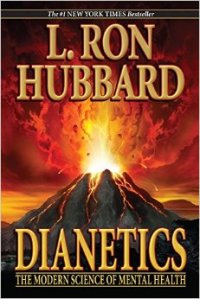
The book that started it all.

Scientology has always been very hostile to both psychiatry and psychology.  L. Ron Hubbard, a second rate science fiction author, had always been fascinated with the human mind and how it worked.  He published his bestselling  book about his discoveries, “Dianetics: The Modern Science of Mental Health” in 1950.  Dianetics is a bastardization of traditional psychoanalysis, but really isn’t much like it at all.   Hubbard was a sociopathic narcissist who had no degree in psychology and in fact lied about many of his accomplishments.

Dianetics uses elements of Freudian psychoanalysis, but is based on the belief that almost all people have “engrams” (unless they are “natural clears,” which are very rare).  Engrams are cellular imprints of moments of trauma that always contain some sort of physical pain and the “unconsciousness” that accompanies a painful or traumatic event.    The part of the mind that contains the “engrams” is called the reactive mind, and the goal of Dianetics “auditing” is to remove all the engrams through “reliving” the memories associated with them, so the person eventually attains a state called “Clear,” which means they have no reactive mind anymore and can act in rational and healthy ways not based on unconscious painful memories or trauma.

psychiatrykills

A Scientology anti-psychiatry demonstration.

In the early years of Dianetics, Hubbard attempted to get it recognized as a valid form of psychotherapy, but his book and methods were rejected by the mental health community. Hubbard, being a malignant narcissist who was devastated by this massive narcissistic injury, turned against the entire mental health field.  He vilified it and preached  to his followers that psychiatry and psychology were the worst evils to befall mankind and that Dianetics was the only valid way to become a happy and functioning person.


A new religion is born.

scientology_church

Hubbard began to market his book through the same pulp science fiction magazines  that published his stories, and his Dianetics book proved popular.  Many people claimed to be helped through Dianetics auditing, but this wasn’t enough for Hubbard.    He was quoted as saying, “the quickest way to become rich is to start your own religion,” and so he did.   Not only could he become the messiah of his own church based on his “miracle cure,” he also no longer had to pay taxes.    He trained many new auditors and started the Church of Scientology in December, 1953.    He added the levels of O.T. (Operating Thetan) states that go beyond the state of Clear.  An OT supposedly had complete control over matter, energy, space, and time, and at the highest level, could perform Herculean actions without even needing a body to do it.

To his religion Hubbard added a “space opera” cosmology, which sounds suspiciously like a plot in one of his stories.   The level of OT III is the level at which the “top secret” cosmology is finally revealed (of course, now due to the Internet, anyone can find out about it for free).   Supposedly, an evil galactic ruler called Xenu, who lived 75 million years ago, thought his planets were overpopulated and had most of the population frozen and dumped into volcanoes in Hawaii (which didn’t exist 75 million years ago), and programmed their spirits (thetans) with the “R6” implant, which is the reason why traditional religion and mental illness (and all other evils of mankind) came into being.    These disembodied spirits were then released and attached themselves to living people as “body thetans” (BT’s).  BT’s are analogous to possession by minor demons.   A person at the OT levels spends much time “auditing out” the BT’s to achieve more perfect spiritual enlightenment.  Scientology’s insane doctrine was illustrated in a famous episode of South Park in 2005.      It’s so unbelievable that the show had to show disclaimers at the bottom of the screen that said, “This is what Scientologists actually believe.”

xenu

From “Trapped in the Closet,” South Park episode.

Hubbard believed if this “top secret” material were revealed to someone at a lower level of “processing,” that they would die of pneumonia or go insane.  His real fear was probably that people might laugh his church out of existence.  Of course, most Scientologists (at least before the Internet) don’t even know about this secret doctrine because so few of them have achieved the state of OT III.   Many (who haven’t been completely brainwashed into believing anything they are told) leave when they find out.   Others are offended that figures like Jesus or the Buddha are considered “implants” who never even existed, especially since when they first joined Scientology, they were promised that their own religion was not incompatible with Scientology.  At OT III, they find out they must renounce their former religious beliefs, if they still had any.  It’s the ultimate bait and switch, something Scientology is well known for.

“You don’t get rich writing science fiction.  If you want to get rich, you start a religion.” — L. Ron Hubbard

Scientology also co-opted the Christian cross (although the eight pointed version Scientology uses is actually based on the Rosicrucian cross) and sometimes requires its clergy (professional auditors and high ranking church officials) to wear clerical collars in public to seem more authentic.

During the late 1950s through the 1970s, when people were becoming interested in alternative therapies and “new age” religions, the Church of Scientology exploded in popularity, until the late 1970s when the IRS and the FBI descended on Hubbard and his church due to tax fraud and other shady and unethical activities conducted at Scientology’s headquarters and at its paramilitary offshoot, The Sea Org.  While Scientology remains popular, especially among celebrities and the very wealthy, the costs of Scientology training and Dianetics auditing are far too expensive for the average person to afford, so the only people who can move up the “Bridge” and attain the rarified Clear or O.T. (Operating Thetan) states, are the very wealthy or those unfortunates who “work off” the expense as residents of the Sea Org (and rarely achieve those states anyway).

Dianetics and Scientology auditing vs. traditional psychotherapy. 

Moving away from the religious aspects of Scientology and back to its original purpose as a form of “therapy” (and most people who undertake Dianetics or Scientology auditing are only using it as a form of therapy anyway, having no idea of what they’re really getting into), please read Part 2:

Why Scientology auditing is not at all like traditional psychotherapy (part 2).

Kneeling down…

Cyranny writes so beautifully about those inexplicable “bad days” all of us have, whether we want to admit we have them or not. They just sort of come out of nowhere sometimes!
Please follow Cyranny’s Cove for more of her wonderful writing and poetry.
Comments are disabled here; please comment on the original post.

Cyranny's avatarCyranny's Cove

Depression

Today was not a good day.

It happens. It is just life… We all have bad days, right? Right. Only, depression leftovers make my bad days B.A.D.

It often doesn’t really show. I just won’t think about eating, and spend all day concentrating on not letting show what goes on in my brain. Doesn’t sound too bad? Of course not.

I am aware I am not the only one having those post-depression random bad days. But not many people know about them. My parents don’t, my friends don’t…. Heck, Chéri doesn’t know about them. Not because I want to lie to them, but because of two simple things:

1- I don’t want them to worry everytime I frown.

2- It is so dang difficult to explain.

I don’t know why “bad days” happen. I don’t know if they are triggered by specific factors. (if so, I can’t wait to find…

View original post 512 more words