I’m holding my nose…

Boy with Clothespin On Nose

I did the unthinkable.

I started linking my blog posts with my Facebook account.

I did something even more heinous than that.

I started talking to people on Facebook, and there’s a vast community of narcissistic abuse survivors. The beauty of that is I can talk to these survivors in real time. There’s a whole different and wonderful dynamic to communicating in real time that can enrich your entire blogging experience.

I had all but given up on Facebook because it’s just too connected to my IRL life. My family all want to “friend” me so they can check up on me (my account is set to private except for those I’ve friended). My MN ex is there, and that makes me nervous even though he can’t see the details of my account. People I used to work with and go to school with are all there. The whole freaking world is there. It was scary and still is.

But I changed my mind for two reasons:

1. I no longer care who sees my blog. I still use my fake name on this blog and LinkedIn, but I’m known by my real name on Facebook. It doesn’t matter, since my family already found this blog over a month ago and the world hasn’t come to an end.

It kind of makes me giggle when I think about what they must be thinking if they’re actually reading what I’m saying about them (if they’re even interested enough to read my posts, which they might not be). Even though no one’s real name has ever been used in any of my posts, they will recognize themselves. Maybe that’s what they need though. To see themselves through my eyes, and read all about how they are perceived BY me, instead of them always telling me how they perceive me. Karma is a bitch.

2. It increases this blog’s visibility and reach to a part of the narcissistic abuse community that spends most of its time on Facebook. Like it or not, that’s where most people online can be found. Since doing this, my reach has increased quite a bit. OM would be proud. 🙂

But the third reason is one I never expected or intended. I’m making friends with some amazing people I never would have met had I not made the decision to give Facebook one more shot.

I don’t think I sold out. Do you?

A vast wasteland.

Wasteland-03-Digital-Illustration-by-Atelier-Olschinsky
Wasteland 03 by Atelier Olschinsky

I remember when forums were a thing. So much has changed in the past 5-10 years, with the proliferation of social media and the enormous popularity of Big Brother Facebook, which started its unholy takeover of the Internet in 2008. Twitter is getting almost as bad.

Forums still exist, but most of them are dead or dying. The last one I posted on was about a year ago. It was a political/history related forum that had been in existence since 1997. I started posting there in 1999, and was on-again, off-again for the next 13 years. That forum (as far as I know) is still in existence, but when its only moderator left and was never replaced, the site was overtaken by trolls who proceeded to destroy the site by running off its regular members. Last time I was there, it was a shell of what it once was. There were about 3 intelligent people still posting there. I had to leave; it had become mind numbingly boring and too sad to stick around.

Another forum I used to be active on has about a tenth of the activity it once did. All you can hear is the crickets there now.

I see this sort of thing happening all over the web. The Internet is littered with dead and dying forums. They’re a thing of the past, really a relic of the last century, when the Internet was still new and social media was still just someone’s bright idea. They remained popular during the first decade of this century, but seemed to start their decline in about 2007-8, when Facebook made its debut. As content management systems became easier for the average person to use, blogging gained popularity too. Blogs are probably as numerous (if not more numerous) than forums were 8-10 years ago.

I always liked forums because of the way they were organized by topic, but they did have their problems. Blogging is more appealing and much more creative and rewarding for a writer than posting on forums is. You don’t have to worry about going against the status quo because you have an “unpopular opinion.” You don’t have to censor your language (although I try to use decorum). You don’t really have to worry about bullies ganging up on you or trolls invading or hacking into your site. Moderators weren’t always your friend either; sometimes they even sided with the bullies.

The Internet is a mess with the debris of dead forums, but there’s also a wealth of information on them if you look. It’s fascinating to read a decade-old thread about a topic that interests you, and you might find out some things you never would have known otherwise. Reading old forums is like reading the memoir of someone who has passed on. You can learn so much. It’s incredible how fast history moves on the web.

10 reasons why Facebook drives me insane.

dislike_facebook

I don’t like Facebook. Here’s the reasons why.

1. EVERYONE is on there. I mean EVERYONE. And they WILL find you.

2. It’s the new Big Brother. Potential employers and actual employers use FB to check up on you. You can be fired or rejected for a job for “liking” the wrong thing or posting the wrong photo or meme. Make no mistake. You are being watched.

3. The layout is confusing, cluttered and not attractive.

4. Way too many notifications about dumb things you don’t care about and invitations to “like” commercial products and suggestions of who to “friend.” Okay, well all social media has that. Still, it’s more annoying on Facebook.

5. Too many people posting selfies and photos of themselves with all their friends partying and having fun all the time. Or photos of their renovated house or their Caribbean vacation or their ugly new baby. It’s a narcissist’s wet dream.

6. This breeds envy in people who see those photos. You always wind up comparing yourself to others and you always seem to come up short.

7. Too many games and “gifts” from games you don’t play appearing on your wall. Although I’ll confess in around 2007-8 when Facebook was new and seemed cool, I got addicted to Cafe World and Farmville. Those games were fun, I won’t lie.

8. Overrated.

9. Too many people from my RL trying to get me to “friend” them.

10. You can’t choose your own theme or change the look of your profile much. Even Twitter allows more creativity than Facebook. Not that I think we should go back to the days of MySpace with its jarring profiles of neon green on shocking pink backgrounds with their glittering Blingies, flashing signs, badly sized photos that took a year to load, and other digital doodads that slowed your system down to a crawl and sometimes made it crash.

Mainly, I like to keep my online life separate from my personal life, and Facebook doesn’t make that easy because EVERY PERSON IN THE FREAKING WORLD IS ON THERE and THEY WILL FIND YOU. Yep, all 7 billion human beings on this planet. They’re all there. Waiting. Watching.

I’ll check my Facebook sometimes but I hesitate to post anything there. I never, EVER share this blog on my own profile. I wouldn’t dare. And once I’ve checked whatever I’m looking for, I sign out ASAP. Facebook is scary.

Maybe that’s what Hell is. After you die, you go into the Matrix and find yourself trapped in Facebook for all eternity.

I think my family knows.

scaredwoman

Oh, dear.

I don’t have definite proof I was “found out,” but I saw that both my parents have LinkedIn profiles, and reading her profile, she is quite knowledgable about social media.

Of the two viewers I had tonight, one chose to be “anonymous.” I bet one of them is a family member, possibly my mother or father, who may have seen one of my articles I shared there tonight. Since I’m using my real name there and my profile contains my blog’s name and IRL, I think I was probably found out, if they didn’t know about it already (which they might have).

Oh well. It wasn’t going to be a secret forever, and maybe it’s all for the best.

ETA: I just changed my name on my profile to Lauren Bennett (I always liked the name Lauren, and Bennett is a family name). It might be too late now, but it could throw them off.

The drudgery of blogging

ohmygodineedhelp

As writers, we get excited about getting a new idea out there on our blogs. I know I do!

After I’ve spent an hour or two laboring lovingly over a new article, then editing it about 30 times to make it as readable as possible, then finding and adding the perfect photos and illustrations, and finally adding tags and categories (which, to me, is the most boring part of writing a blog post), I get a huge rush when I finally get to hit “Publish” and see my hard work in its final form, the way the world will see it.

I take pride in my posts (well, most of them), especially when they seem to get popular. A few have. It’s fun getting comments, lots of likes, and watching your stats go up. It’s cool as hell to see how many countries my lowly little blog post has touched.

But blogging has its dull side too, the side that seems more like work than play. If, like me, you have decided you want your blog to grow and get lots more views, and be replicated and reposted many times on other social media for maximum exposure, then that requires linking every post you want to be seen to various social media.

I don’t really like social media, even though I have accounts on Twitter, StumbleUpon, Facebook, and now LinkedIn. But like it or not, it’s necessary to use it if you want your blog to be seen.

I refuse to post anything to Facebook (except for my silliest fluff posts) because my FOO and other people from my past I prefer to avoid have all found me there–and I do NOT want them to read my blog. I should probably just delete that account and start another one under a fake name, but I don’t like Facebook anyway because it’s become like fucking Big Brother so I probably won’t bother doing that.

Instead, I rely on you guys to share my posts (if you want to) using the Facebook button that’s under each post. That makes things easy for me! The buttons are there for you to use!

All my blog posts are automatically linked on Twitter, which doesn’t scare me like Facebook does because the only relative I know of who posts there is my son and I can trust him with my life. He never reads my blog anyway, but a friend of his does.

StumbleUpon is something I stumbled upon while here at WordPress, and it’s a cool way to share posts and it does seem to bring me more viewers. I don’t use that service for anything but sharing my posts. When I look at my stats, SU has brought me more viewers so I have no complaints.

I just joined LinkedIn today and spent the last two hours sharing every blog post I’ve written (with the exception of a few that I don’t think were that good or were just announcements or something) on that site. That’s the part of blogging that’s drudgery. I would much rather be writing a new post than sitting here pressing buttons for two hours, but that’s part of what it takes to get visibility.

I hate it when I see my stats going down. Today they weren’t very good at all, and I thought to myself I should be doing this when my stats are up and write a new post right now with a super-grabby title to get everyone’s attention.

There was one advantage to this boring task: I got to see old articles that I’d forgotten I’d written. I’m up to well over 200 blog posts now so it’s impossible to remember all of them. I think my writing has improved since the beginning.

It’s not like I had any great blog ideas tonight anyway.

I’m on LinkedIn now

linkedin

I never thought about joining LinkedIn because I didn’t feel like I was enough of a “professional” to have a profile there, because I haven’t had a paid position in any professional field since the 1990s. I used to be a book review writer for Publishers Weekly and editor/writer for two medical journals, but that was a long time ago. I wrote book reviews and also did some proofreading/freelance editing for several years after I moved to North Carolina. (I’m not writing a resume here, mmmkay?)

Due to narcissistic abuse at the hands of those closest to me, I lost all my self esteem and all my motivation due to severe PTSD. Being an Aspie too certainly doesn’t help.
I also spent most of the 1990s and early 2000s as a stay at home wife and mother.

I had the confidence today to go ahead and set myself up on LinkedIn and found several people I know there who read this blog. It’s another way to get this blog out there to an even wider audience. Unfortunately I did have to use my real name there, but I can live with that.
The main reason I’m doing this right now though is so I can link my articles to that as well as Twitter and StumbleUpon. (I only rarely connect my articles to Facebook as too many people from my past know me there, including my FOO).

If any of you have a LinkedIn account or want to make one, please follow me there:

View my profile on LinkedIn

You can also follow me on Twitter.

This blog is growing. Yours can too.

statsdec2014
Click graph to see more detail.

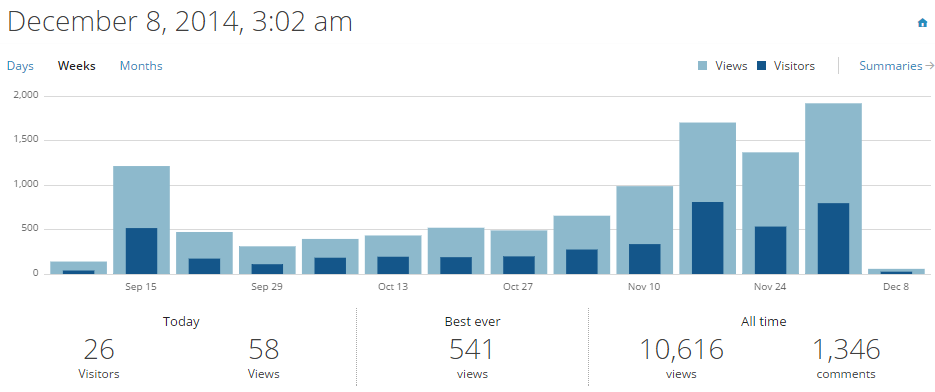
Now that I can finally crop parts of a screenshot, I can visually show my readers how this blog has done since I started it on September 10th. Its growth has been pretty steady and seems to be increasing fairly quickly, given this blog has only existed for 3 months.

The only anomaly in the graph is the huge spike in views during my second week–the week of September 15th. That was when OM from Harsh Reality reblogged my rant about being frustrated because no one was seeing my blog (I had 12 followers at that point and almost no likes or comments–I was a whiney and impatient noobie!)

Due to OM’s act of generosity, I got 354 views that day, which remained my Best Ever day until a couple of weeks ago, when I wrote my post about whether Sam Vaknin (self professed narcissist and writer of books about narcissism) was a narcissist or not. That article itself would probably not have been all that popular–except Sam himself saw it and commented, then he did the unbelievable; he linked it all over various social media–and that brought me a ton more viewers and about 15 new followers. That was the day I beat my previous Best Day Ever, with 541 views!

While things have died down just a bit from that HUGE spike, overall it appears this blog’s visibility on the web is still growing. I was tickled to death to find several of my articles (the more popular ones mainly) now showing up on the first 3 pages of Google, instead of way back on page 68 or something. They’re starting to show up on other search engines too.

Things new bloggers can do to increase visibility and views.

Blogging (1)

–Read OM’s blog.
I try to take all OM’s advice to new bloggers, and he does know what he’s talking about. I highly recommend his blog, which offers all kinds of advice to beginners and veterans alike. He follows new blogs all the time. He even occasionally offers bloggers the opportunity to “pimp” their blog on his site. Take advantage of it! Here is his blog. Do what he says–it does work.

–The title is everything.
I find it helpful to keep my titles “grabby.” Make them stand out. Make them a little controversial (“Don’t judge me because I’m poor”), a little confessional (“People think I’m stupid” or “I’m Frustrated”), or even pose a challenge to the reader (“My Son is Furry–Have a problem with that?”) Don’t try to make them too “nice”–then they will just be boring.

Keep your titles as short as possible. Never, ever write a title that sounds like a Ph.D thesis, such as: “Preternaturally narcissistic and sociopathic actions within the social media milieu: a paradigm of the interglobal loss of interpersonal altruism.” WUT?
Never, EVER use the word “paradigm” in a title. If you do that, I will personally come to your house and pour water all over your keyboard. That’s a promise. The same goes for “milieu.” Don’t use that word. Ever. No one even knows how to spell it anyway.

paradigm

–Keep your subject matter on topic as much as you can.
It’s alright to veer off topic to tell an anecdote or provide an example–in fact that can make your post seem more personal. But try not to veer off the topic the title promises too much. It’s hard to do sometimes, but if you do, always somehow bring the article back to your original topic, and it will look like you intended for it to veer off topic a little to make a point.

–Break up your text!
Readers don’t like walls of text. While a photo or picture isn’t required for a very short post, it can make it stand out more and look more appealing. If your post is very long, break it up. Use photos or pictures or quotes at appropriate intervals that illustrate the point of your story or article. It’s easy to Google images you want to use–just type the subject matter into the browser and click on Images, and you will find the perfect image to illustrate your article. That’s the way I do it. Your own photos or pictures are fine to use too.

Beyond that, break up your paragraphs into smaller, easier to chew pieces. Readers are not cavemen gnawing an entire flank of beef at once. They are civilized humans who like their steak cut into small pieces that can be picked up and savored one at a time. The same advice goes for paragraphs. Keep them bite size and they will be much more readable and taste better too.

–Use the share buttons!
Even if you hate social media (like I do), make sure each blog post contains all the social media share buttons available, which can be found in the dashboard. Even if YOU don’t want to link your post to them, OTHER people will use them. If they’re not there under your post, people probably won’t bother sharing your post. Share buttons are a lazy way of getting your post seen by many people, only you’re letting your readers do the work for you. Nothing wrong with that.

–Link to other blogs.
Linking to other blogs within your post creates a pingback: the writer of that blog will see that you quoted them, and will come and check out your blog. It’s more than likely that blogger will start following you back. Creating a blogroll (in Widgets) will help your blog too. It shows you read other blogs as well as your own, and the other bloggers will appreciate your support.

–Reply to the comments you get!
If you ignore your comments, people will lose interest in your blog. People don’t want to feel ignored. If you fail to answer your comments, it’s insulting to the reader who wrote the comment or asked the question, and it will seem like you don’t care. If you don’t want comments on your blog, you can always disable them, but I never understood why anyone would do that. All popular blogs are interactive blogs, where people can comment and lively conversations and debates can get started. It’s helpful to comment on other people’s blogs as well.

–Write frequently.
You should challenge yourself and try to write a post a day. If you can think of nothing to write about (I have those days), post a funny or attractive photo or a quote you like. If you don’t post frequently, people will stop visiting your blog. Sometimes I write 3-5 posts a day. You don’t have to write that many, but one post a day will keep your blog from stagnating like unmoving pond water.

–A few other things to remember.
If you’re a new blogger, don’t panic if things go slowly at first. Don’t get discouraged, frustrated or give up because at first it will seem like no one is reading your blog. It takes time. Becoming visible and getting lots of views and follows takes some people longer than others. The only reason mine seems to be growing faster than some new blogs is because of fortuitous visits by a person in the field I focus on (narcissism and psychopathy) who is somewhat well known and helped get my blog out there. I also write about a topic that happens to be “hot” right now. I don’t think the growth of this blog is because it’s “better” than any other–in fact I think there are many blogs that are much better written and more professional looking than mine.

Are Millennials really the most narcissistic generation ever?

millennialwithitall
Hipster Millennial with all his high tech stuff.

“The National Institutes of Health found that for people in their 20s, Narcissistic Personality Disorder is three times as high than the generation that’s 65 or older…”

–TIME Magazine

Millennials have been loaded with negative stereotypes: lazy, entitled, or what seems to be the media favorite, narcissistic. A recent Time magazine article managed to fit all three adjectives into one title in the cover-story, “The Me Me Me Generation: Millennials are lazy, entitled narcissists who still live with their parents.” Ouch.

— Rachel Gall, So-Called Millennial.com

The burning question of whether the much-debated Millennial Generation (people born between about 1981 and 2004,according to William Strauss and Neil Howe’s generational theory, which is based on historical cycles, and uses a set of dates I prefer to the more popular dates used in mass media that refer to anyone born from 1976 to 1991 or so as “Generation Y”) are entitled, narcissistic spoiled brats continues to be a popular and controversial topic.

Like every youth generation ever since the Baby Boomers started thumbing their noses at The Establishment’s stultifying conformity back in the ’60s with their pot, patchouli, and peace signs, when the media first discovered the coming of age Millennials about a decade ago, its initial reaction was one of disdain and dismissal–it was immediately assumed that all Millennials were spoiled, indulged narcissists who cared about no one but themselves, their iPhones and iPods, and having the best looking and coolest MySpace or Facebook profile.

“[you are] so self-obsessed. Tweeting your Vines, hashtagging your Spotifys, and Snapchatting your YOLOS.” Our social media feeds are being filled with our favorite subjects: Me, Me, and Me……“Us Baby Boomers are very upset, because self-absorption is kinda our thing.”

–comedian Stephen Colbert

But recently, writers and bloggers all over the web and in the news are beginning to question the validity of the narcissistic Millennial stereotype. Two fairly recent articles–from opposite sides of the political spectrum, no less: Are Millennials Deluded Narcissists (Forbes Magazine) and The Persistent Myth of the Narcissistic Millennial (The Atlantic Monthly), both defend Millennials and offered reasons why they may not be all that narcissistic, or at least why any narcissism they do have should be blamed on other things like the narcissistic, materialistic, and individualistic society they grew up in, a society that keeps up with the Joneses (or the Kardashians) and thinks greed is good. There are many other articles and news pieces that have been making the same arguments. New York Magazine posted this insightful article, completely disputing the idea that Millennials are no-good narcissistic Red Bull-guzzling basement dwellers taking advantage of their parents’ generosity.

Even when they still have the N label pinned to them, at least the accusers are placing the blame on things like the economy, lack of decent jobs, the extortionist prices of higher education and decent health care, and the astronomical amounts of money Millennial college grads owe for student loans that were supposed to make it possible for them to earn the kind of money to be able to pay back the loan and become productive middle class citizens. But instead, being in debt to Sally Mae in a stagnating economic environment burdened this disappointed and angry generation of unemployed and underemployed young people–20-somethings with college or even graduate degrees–with having to take low-paying McJobs or put up with the cold and factory-like environment of call centers (but which pay far less and offer fewer benefits than factory work, whose workers at least had the unions on their side). Then, to add insult to injury, those McJobs pay such dismally low wages there’s little or no hope of ever being able to pay back the loans they hoped would give them a foot in the door to a successful life, or even allow them to move out of their childhood home.

Most Millennials, unless they are very lucky, very talented and manage to procure the right connections and contacts, find at some point they will probably default on their student loans, which in turn earn them the accusation from conservative foghorns like Fox News, that they are entitled takers and moochers, feeding shamelessly off the government teat and living, Morlock-like, in the damp dark caverns of mom and dad’s basement, growing fat and pasty as they play with their collection of high tech gadgets that enable them to become an Internet star if the video or meme they just made goes viral.

In fact, going viral on the interwebs may be the most sure way a Millennial can ever become successful in our current sick and unstable economy and general diminishing quality of life for all but the very rich. Millennials are being forced to sink or swim in a society that has become increasingly compassionless and narcissism-glorifying. So they’re finding their own well of hope and opportunity, and that well seems to spring from social media, Youtube and reality TV.

Don’t knock it. Going viral by sheer luck and the fortuitous timing of a Youtube video is basically what happened to Justin Beiber; crime victim and folk hero Antoine Dodson, whose impassioned and unintentially hilarious rant on a local news station was transformed into a huge iTunes hit and made him an overnight star; and many other Millennial pop stars. Probably the biggest success story of all is that of Mark Zuckerburg, the multibillionaire twentysomething founder and CEO of Facebook, which he started in his spare time as an ingenious way to chat online to his college buddies from his dorm room at Harvard.

antoinedodson marczuckerberg
Millennials Dodson and Zuckerburg both became successful through viral spread via social media on the Internet.

If you have a halfway decent voice, you can win a record deal or at least a little temporary fame by auditioning for reality/game shows like The Voice, America Has Talent, or American Idol. Hey, you could be the next Kelly Clarkson or Carrie Underwood! If you can cook (and can tolerate the constant narcissistic rants of the cooking shows’ mean hosts such as Gordon Ramsey from Hell’s Kitchen and Master Chef), well you can win your own restaurant and become rich.

What if you have no talents at all? No problem. You can still get on a reality show, even if you’re a teen mom who never graduated from high school, or a bitchy girl who likes to get into catfights with other bitchy girls. You can get rich just by acting like a jerk on TV, or doing nothing at all. And let’s be honest here: that sure beats working in Wal-Mart’s underwear department and not being able to pay your rent because your student loan debt exceeds what you earn in your dead end job. Who wouldn’t do it? Reality shows may be dumb and glorify stupidity and bad behavior, but we can blame their popularity on the uncertainty of the hope of gainful employment obtained in more traditional, socially acceptable ways.

So what generation wins the title of Most Narcissistic Generation Ever?

Personally, I would give that dubious honor to the Boomers (born from 1943-1960 according to Strauss and Howe; the popular media range is 1946-1964), the pig-in-a-python generation that pretty much turned the conformist, narrow minded, and yet community oriented and moderately altruistic Pax Americana of the post-war years into the self-worshipping, narcissistic, greedy, materialistic, hedonistic, glory mongering morass of misery and despair it has become since Reagan’s trickle down economics became sanctioned as a way to piss (trickle down) on the poor; since Rush Limbaugh’s ugly epithets toward everyone who wasn’t white, conservative, Christian, heterosexual and male became widely accepted as sound advice; since G.W. Bush gave us permission to “Go shopping!” after the 9/11 disaster and its shortlived mood of national solidarity after the attacks.

Millennials didn’t create or want this narcissistic, selfish society. They were born and raised during a time of economic uncertainty, philandering presidents whose actions became widely discussed, 24/7 coverage of heroes-turned-villains (O.J. Simpson), and a general atmosphere of increasing political discord and animosity toward those who weren’t like yourself. Millennials were often raised by single parents who were struggling to make ends meet in our crumbling society, or passed back and forth between divorced parents. Millennials are reacting the only way they can react to a society that denigrates them, gives them no opportunities, ships potential jobs overseas, makes it impossible to earn enough money to move out of their parents’ homes, and generally places them in a no-win situation.

overreacting

Where Boomers could protest Vietnam and attend a huge 4 day rock festival held on a farm, and win publicity (if not glorification) in the media over their countercultural activities, Millennials’ “Occupy” movement of late 2011–a movement that wasn’t anti-establishment or countercultural but just an expression of their desire to be treated fairly and be given more opportunities–was quickly silenced by the media. A year later, you barely heard of it anymore. We are still hearing about the Vietnam and civil rights protests of the 1960s and the womens’ and gay rights movements of the 1970s. Don’t get me wrong–those were all good causes and I agree with them–but why are Millennials being silenced for nothing more radical than wanting a decent job and a measure of respect?

underpaid Protestors sit in the street and demonst
All they want is a chance.

Although born at the butt-end of the Boom generation (and thereby almost X), I don’t consider myself a Boomer and find myself balking at my inclusion within it; nor do I truly identify with Gen-Xers. I actually consider myself a member of Generation Jones (a subgeneration that straddles both Boom and X and contains characteristics of both Boomers and Xers and includes a few of their own). Anyway, I highly recommend reading Strauss and Howe’s books, 1991’s Generations and its 1997 followup, The Fourth Turning, both which describe the way history runs in cycles of four “seasons” that produce four corresponding archetypal generational types that repeat themselves at approximately 80 year intervals, and how the interplay of the generational “constellation” and the turning (national mood) at hand impacts history and society.

But I have digressed from my original point. Boomers as the most narcissistic generation ever is not an unpopular notion. Politics, big religion and entertainment is glutted with narcissistic, bombastic Boomers who bloviate over their greatness, judge the rest of us harshly, shove religion down our throats, and show their hypocrisy by demanding obedience, family values, and morality when they themselves showed their disdain for the very same things when they were younger.

Boomers started the “Me Decade” of the 1970s–an unbridled era of vanity, designer drugs, designer jeans, pleasure seeking and hedonism; before that, during their younger, more idealistic phase, Boomers naively promised they could change the world through music, eastern forms of meditation, and psychedelic drugs. During the 1980s, they morphed into the selfish, greedy Yuppies, and by the 1990s, they had taken over the political landscape, becoming ever more bombastic, judgmental and just plain uncivil and nasty to anyone who disagreed with them.

hippiesyuppies
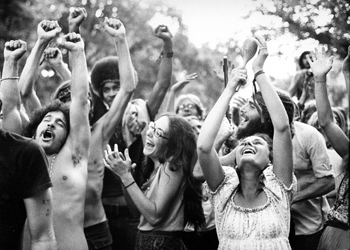
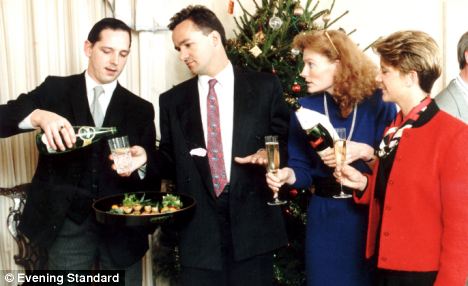
1960s era idealistic hippies and their 1980s incarnation as materialistic Yuppies.

Staying young and fit forever became the collective goal of the Boomer generation once they became disillusioned with their youthful idealism following Woodstock and Watergate. Perhaps due to their huge numbers and a firey passion and culture of cool that first enchanted and then took over the American imagination as early as the late 1960s, they grew up into adults who thought they were immortal, invincible, forever young and vital. They started the health and organic food craze of the late 1970s and 1980s and has continued to this day. They told us how we should all eat, look, exercise, worship, raise our children, and live our lives. And if you didn’t follow their rules and became sick or poor, well that was your own fault for lacking self discipline and strength of will. Even into their 60s and early 70s, Boomers are getting facelifts and liposuction, in a sad attempt to resurrect the appearance they had 30 or more years ago, Of course they’re just getting old like everyone else, but they refuse to confront it.

What about Generation X?
Poor Generation X (born 1961-1981, according to Strauss and Howe) is like the ignored middle child–or even the scapegoated child in a narcissistic or dysfunctional family. Having children was unpopular when they were being born, with more and more women shunning motherhood in favor of moving up the corporate ladder. Telling someone you were pregnant was usually met with side-eye by the cool people, and if you had the gall to admit you wanted to have more than two children, people looked at you like you were an unenlightened throwback to the 1950s. Getting on the “Pill” was what every young woman wanted to do.

Movies made about children during the 1960s and 1970s depicted kids as evil, demonic, bratty or badly behaved. Child psychologists recommended letting kids do whatever they wanted, which basically meant neglecting them. During the child-hating 1970s, “Latchkey” kids became the norm rather than the exception. Even “throwaway” kids, kicked out of their homes by parents who cared more about themselves than about their children, weren’t especially uncommon, especially in urban areas.

Not surprisingly, Generation X grew up with collective low self esteem, and while their humor can be dry, cynical, and full of snark, it is almost always self-deprecating. They have grown into adults in their late 30’s to early 50’s who tend to embrace traditional values, take on DIY projects, are politically and morally conservative, and believe in practical solutions rather than unproved theories. They don’t trust those who talk the talk but don’t walk the walk. They’re overprotective of their children and highly critical of the Boomers before them.

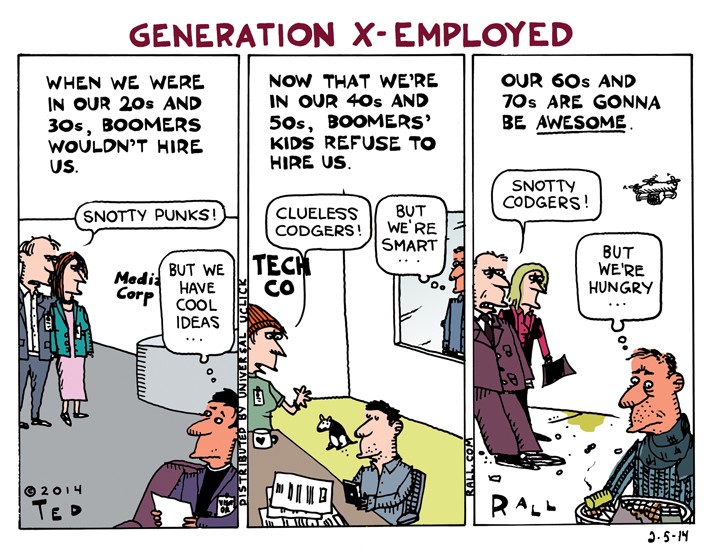
Middle aged Gen-Xers appear to accept the aging process fairly well, pretty much resigned to the inevitable. Hey, it’s better than the alternative. They’re not lining up at plastic surgeon’s offices for facelifts and body sculpting. While there are definitely narcissistic Gen-Xers (and I could list a lot), their generation as a whole seems the opposite of narcissistic–perhaps they’re avoidant or suffering collective PTSD. They are having problems in the workplace too–squeezed between older Boomers who refuse to retire, and Millennials wanting to take their places at the lower level jobs many Gen-Xers haven’t been able to move up from because of Boomers who refuse to pass on the torch.

genxemployed

Millennials are not a generation of narcissists; they are the victims of the narcissistic society they are trying to fit into without too much success. Their behavior shows frustrated young people who are just trying to find their footing and their place in the world, but no one seems to want to help give them a hand up, just blame them for failing to navigate the obstacles they never put there and never asked for.

Disclaimer: I’m well aware that every generation has its good and bad individuals, and there are certainly narcissistic Millennials and Gen-Xers, as well as unselfish and truly good Boomers. I’m generalizing about the generations as a whole, not their individual members.

The mystery: solved

mystery

I came home today to find another huge increase in my view count, but couldn’t immediately figure out why. The last time this happened was when Sam Vaknin visited my blog and linked one of my earlier articles about him all over social media (Twitter and Facebook). There were no new comments from him today, so I thought maybe there was some other reason for the abnormally high view count (like maybe being Freshly Pressed! Yeah, right.)

I checked my stats and did see there were 3 views from Macedonia, which is where Sam lives. So it had to be him–after all, how many people from Macedonia are visiting my blog? I checked “referrers” and saw some ridiculously high number of Facebook shares. Still, when I clicked on the Facebook link, it only took me to my own FB page. I had to find out where all those views were coming from!

Finally, I went to Twitter and looked at Sam’s profile–and sure enough, he’d linked to this article today, just as he promised a few days ago in his last comment. Because of this, I also have 12 new followers. Narcissist or not, the man does keep his promises. Thanks, Sam!

Narcissism on the Internet: what Vaknin has to say

Narcissistic? Me?

Oh, hell. I’m going to milk this thing for all it’s worth at the moment. I admit it, I want this upward momentum to keep going for a little bit longer.

Let me start by confessing I’m just a wee bit star-struck because a somewhat famous person who writes about narcissism gave me validation and in doing so helped my blog become more visible, even though he’s a narcissist and we victims are all too aware what no-good gaslighting, manipulating, triangulating mind-fuckers narcissists are. I must remember that he IS a narc and is NOT my friend. I must not allow a few crumbs of flattery to somehow suck me into becoming some kind of online narcissistic supply to this man. I gotta keep it real.

But no worries: in a day or so (if not my next post), I’ll return to my regular scheduled programming and write a fluff post about something like kittens or a rant about fracking or toenail fungus.

In my second blog article about Sam Vaknin, he commented (when asked) that he did, in fact, Google himself (hey, don’t we all?) and that’s how he finds out which bloggers are writing about him. He provided an explanation as to why he looks himself up on Google and linked to his website. I decided to repost his journal entry because there’s a whole Pandora’s box of truth here, and whether we like it or not, there’s a little or even a lot of Narcissist in all of us who blog and find ourselves giddy with excitement when our blogs get views, likes, comments, or suddenly take off like 4th of July firecrackers.

WARNING: In typical Vaknin fashion, this post is extremely long winded. That said, it’s definitely worth your time to read the whole thing. There’s some great insights here that still apply today even though it appears to have been written some years ago.

Cyber (Internet) Narcissists and Psychopaths

To the narcissist, the Internet is an alluring and irresistible combination of playground and hunting grounds, the gathering place of numerous potential Sources of Narcissistic Supply, a world where false identities are the norm and mind games the bon ton. And it is beyond the reach of the law, the pale of social norms, the strictures of civilized conduct.

Indeed, many of the innovators who gave us the Internet and social networks can easily be described as narcissistic. Technology did not invent or even foster narcissism – rather, it was driven by it: an increasingly narcissistic populace demanded empowerment, self-expression, self-gratification, and self-aggrandisement via gadgets and software applications that catered to its pathology.

The somatic finds cyber-sex and cyber-relationships aplenty. The cerebral claims false accomplishments, fake skills, erudition and talents. Both, if minimally communicative, end up at the instantly gratifying epicenter of a cult of fans, followers, stalkers, erotomaniacs, denigrators, and plain nuts. The constant attention and attendant quasi-celebrity feed and sustain their grandiose fantasies and inflated self-image.

The Internet is an extension of the real-life Narcissistic Pathological Space but without its risks, injuries, and disappointments. It allows the narcissist to enact and act out his grandiose fantasies of omnipotence and omnipotence, brilliance and perfection, self-righteousness and superiority with impunity.
Many moderators and owners of discussion groups and support forums, for instance, are tyrannical narcissistic bullies with little or no impulse control and the tendency to form cult-like settings where the wayward are sadistically penalized and publicly humiliated by peers for speaking out of turn and in contravention of the “party line.”

In the virtual universe of the Web, the narcissist vanishes and reappears with ease, often adopting a myriad aliases and nicknames. He (or she) can thus fend off criticism, abuse, disagreement, and disapproval effectively and in real time – and, simultaneously, preserve the precarious balance of his infantile personality. Narcissists are, therefore, prone to Internet addiction.

The positive characteristics of the Net are largely lost on the narcissist. He is not keen on expanding his horizons, fostering true relationships, or getting in real contact with other people. The narcissist is forever the provincial because he filters everything through the narrow lens of his addiction. He measures others – and idealizes or devalues them – according to one criterion only: how useful they might be as Sources of Narcissistic Supply.

The Internet is an egalitarian medium where people are judged by the consistency and quality of their contributions rather than by the content or bombast of their claims. But the narcissist is driven to distracting discomfiture by a lack of clear and commonly accepted hierarchy (with himself at the pinnacle). He fervently and aggressively tries to impose the “natural order” – either by monopolizing the interaction or, if that fails, by becoming a major disruptive influence.

But the Internet may also be the closest many narcissists get to psychodynamic therapy. Because it is still largely text-based, the Web is populated by disembodied entities. By interacting with these intermittent, unpredictable, ultimately unknowable, ephemeral, and ethereal voices – the narcissist is compelled to project unto them his own experiences, fears, hopes, and prejudices.

Transference (and counter-transference) are quite common on the Net and the narcissist’s defence mechanisms – notably projection and Projective Identification – are frequently aroused. The therapeutic process is set in motion by the – unbridled, uncensored, and brutally honest – reactions to the narcissist’s repertory of antics, pretensions, delusions, and fantasies.

The narcissist – ever the intimidating bully – is not accustomed to such resistance. Initially, it may heighten and sharpen his paranoia and lead him to compensate by extending and deepening his grandiosity. Some narcissists withdraw altogether, reverting to the schizoid posture. Others become openly antisocial and seek to subvert, sabotage, and destroy the online sources of their frustration. A few retreat and confine themselves to the company of adoring sycophants and unquestioning groupies.

But a long exposure to the culture of the Net – irreverent, skeptical, and populist – usually exerts a beneficial effect even on the staunchest and most rigid narcissist. Far less convinced of his own superiority and infallibility, the online narcissist mellows and begins – hesitantly – to listen to others and to collaborate with them.

Ultimately, most narcissists – those who are not schizoid and shun social contact – tire of the virtual reality that is cyberspace. The typical narcissist needs “tangible” narcissistic supply. He craves attention from real, live, people, flesh and blood. He strives to see in their eyes their admiration and adulation, the awe and fear that he inspires, the approval and affirmation that he elicits.

There is no substitute to human contact, even for the narcissist. Many narcissists try to carry online relationships they nurtured into their logical extension and conclusion offline. Other burst upon the cyber scene intermittently, vanishing for long months, only to dive back in and reappear, reinvigorated. Reality beckons and few narcissists resist its siren call.

Narcissists, Social Media, and Porn

Social media, such as Tumblr.com, have become the playground of narcissists, psychopaths, and sadists who post extreme and, at times, illegal porn and revel in the reactions to it, thus garnering vicarious narcissistic supply. Via such postings, they express their rabid misogyny by objectifying women and subjecting them to humiliating subjugation and to aggression bordering on outright violence.

Yahoo and Tumblr’s protestations to the contrary notwithstanding, some of the content is illegal and can land even an accidental viewer in hot waters. Relatively innocuous search terms such as “family”, “wife”, “sister”, or “daddy” often yield sleazy and actionable photo and video results, displayed automatically on the user’s screen and saved to his or her browser cache without any warning or consent. Tumblr is not alone in this. Twitter and Facebook, although to a lesser degree, also host porn on a massive scale.

Porn addiction ties well with the narcissist’s fantasy sex life. Social media enable and legitimize a host of sexual fetishes and paraphilias, including pedophilia. Via these platforms, the narcissist finds an eager audience and a sense of empowerment and immunity, aided and abetted by his anonymity.

Interview granted to Misty Harris of CanWest on February 23, 2005

Q. How might technology be enabling narcissism, particularly for the Internet generation?

A. To believe that the Internet is an unprecedented phenomenon with unique social implications is, in itself, narcissistic. The Internet is only the latest in a long series of networking-related technological developments. By definition, technology is narcissistic. It seeks to render us omnipotent, omniscient, and omnipresent – in other words, Godlike.

The Internet allows us to replicate ourselves and our words (through vanity desktop publishing, blogs, and posting online content on Web sites), to playact our favorite roles, to communicate instantly with thousands (narrowcasting), to influence others, and, in general, to realize some of our narcissistic dreams and tendencies.

Q. Why is it a bad thing to have a high opinion of yourself?

A. It is not a bad thing if it is supported by commensurate achievements. If the gap between fantasy and reality is too big, a dysfunction that we call “pathological narcissism” sets in.

Q. What does it say about our culture that we encourage narcissistic characteristics in people? (example: Paris Hilton – we made her a star for loving herself)

A. Celebrity culture is not a new thing. It is not a culture-dependent phenomenon. Celebrities fulfil two emotional functions for their fans: they provide a mythical narrative (a story that the fan can follow and identify with) and they function as blank screens onto which the fans project their dreams, hopes, fears, plans, values, and desires (wish fulfilment).

Western culture emphasizes ambition, competitiveness, materialism, and individualism. These admittedly are narcissistic traits and give the narcissist in our society an opening advantage.

But narcissism exists in a different form in collectivist societies as well. As Theodore Millon and Roger Davis state in their seminal tome, “Personality Disorders in Modern Life”:

“In an individualistic culture, the narcissist is ‘God’s gift to the world’. In a collectivist society, the narcissist is ‘God’s gift to the collective'”.

Twitter: Narcissism or Age-old Communication?

It has become fashionable to castigate Twitter – the microblogging service – as an expression of rampant narcissism. Yet, narcissists are verbose and they do not take kindly to limitations imposed on them by third parties. They feel entitled to special treatment and are rebellious. They are enamored with their own voice. Thus, rather than gratify the average narcissist and provide him or her with narcissistic supply (attention, adulation, affirmation), Twitter is actually liable to cause narcissistic injury.

From the dawn of civilization, when writing was the province of the few and esoteric, people have been memorizing information and communicating it using truncated, mnemonic bursts. Sizable swathes of the Bible resemble Twitter-like prose. Poetry, especially blank verse one, is Twitterish. To this very day, newspaper headlines seek to convey information in digestible, resounding bits and bites. By comparison, the novel – an avalanche of text – is a newfangled phenomenon.

Twitter is telegraphic, but this need not impinge on the language skills of its users. On the contrary, coerced into its Procrustean dialog box, many interlocutors become inventive and creativity reigns as bloggers go atwitter.

Indeed, Twitter is the digital reincarnation of the telegraph, the telegram, the telex, the text message (SMS, as we Europeans call it), and other forms of business-like, data-rich, direct communication. Like them, it forces its recipients to use their own imagination and creativity to decipher the code and flesh it out with rich and vivid details. It is unlikely to vanish, though it may well be supplanted by even more pecuniary modes of online discourse.

Interview granted to Agencia Efe, Spain, April 2008

1. Does the Internet make a special amplification of narcissism or is just the reflection of reality? How, despite of the fact that many people is disturbed by the anonymous characters that you can adopt in the Internet, the exhibitionism is, maybe, more usual. I mean, in terms of narcissism? Can a person be addicted to the web because is own narcissism?

A. The narcissist likes to appear to be mysterious. It enhances his self-perceived sense of omnipotence, it renders him “unique” and “interesting”. The right moniker (Internet alias or handle) imbues the narcissist with a sense of immunity and superiority and permits him to commit the most daring or heinous acts.

2. What kind of lacks or necessities there are behind this behaviour? What are we expecting when we search our name on Google? Can we construct our image with the pieces of us in the internet?

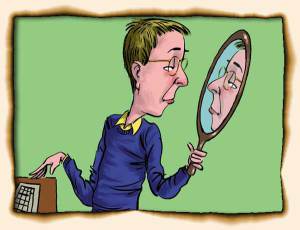
A. The Internet is the hi-tech equivalent of a giant mirror. Like the mythical Narcissus, it allows us to fall in love with our reflection every day anew. We gaze into the depths of the Internet to reassure ourselves of our continuity and very existence. It is our modern photo album; a repository of snippets of our lives; and our external memory.

In psychoanalytic terms, the Internet replaces some of our ego functions: it regulates our sense of self-worth; puts us in touch with reality and with others; and structures our interactions (via its much vaunted peer-pressure of the Netiquette and the existence of editors and moderators).

We crave attention and feedback: proof positive that we matter, that someone cares about us, that we are not mere atoms in a disjointed and anomic Universe. In this sense, the Internet substitutes for God and many social functions by reassuring us that we fit into a World that, though amorphous and protean, is sustaining, predictable, constant, and nurturing. The Internet replaces our parents as a source of nourishment, support, caring, discipline, and omniscience.

3. In the case of the blogs, what’s the point in common in the idea of doing a private diary and be available for everybody?

A. I am not sure what you mean. Blogs are anything but private. They are explicitly meant for public consumption, thrive on public attention, and encourage interaction with the public (through the comments area). One can set one’s blog or online journal to “private”, though, as the hi-tech equivalent of a personal diary.

4. Internet, with their blogs, Facebook, Myspace or YouTube, has create the possibility of make yourself famous without promotion, just with the progressive diffusion of your material. Examples like the singers Mika and Lilly Allen or many bloggers, can it make a new way of realizing the “American dream” for the users of the Internet?

A. Being famous encompasses a few important functions: it endows us with power, provides us with a constant Source of Narcissistic Supply (admiration, adoration, approval, awe), and fulfils important Ego functions.

The Internet caters to our narcissistic traits and propensities and allows us to become “celebrities-by-replication”. The image that the blogger or artist projects is hurled back at him, reflected by those exposed to his instant celebrity or fame. By generating multiple copies of himself and his work, he feels alive, his very existence is affirmed and he acquires a sensation of clear boundaries (where he ends and the world begins).

There is a set of narcissistic behaviours typical to the pursuit of celebrity. There is almost nothing that the Net celebrity refrains from doing, almost no borders that he hesitates to cross to achieve renown. To him (or, increasingly, her), there is no such thing as “bad publicity”: what matters is to be in the public eye at any price.

Because narcissistic individuals equally enjoy all types of attention and like as much to be feared as to be loved, for instance – they don’t mind if what is published about them is wrong (“as long as they spell my name correctly”). The celebrity blogger or artist experiences bad emotional stretches only when he lacks attention, or publicity.

It is then that some bloggers, artists, and Webmasters plot, contrive, plan, conspire, think, analyse, synthesise and do whatever it takes to regain the lost exposure in the public eye. The more they fail to secure the attention of the target group (preferably, the entire Internet community), the more daring, eccentric and outlandish they become. A firm decision to become known is transformed into resolute action and then to a panicky pattern of attention seeking behaviours.

It is important to understand that the blogger/artist/Webmaster are not really interested in publicity per se. They appear to be interested in becoming a celebrity, but, in reality, they are concerned with the REACTIONS to their newly-acquired fame: people watch them, notice them, talk about them, debate their actions – therefore they exist.

5. There are many new applications to feed human narcissism on the net: Googlefight, Egosurf.org, the blogs themselves… Could be used narcissism as a business?

A. Every good business is founded on the mass psychology of its clientele. In a narcissistic civilization, business is bound to adapt and become increasingly more narcissistic. The Internet started off as an information exchange. The surge of (mainly American) users transformed it in profound ways. User-generated “content” is a thin veneer beneath which lurks the seething and pathological narcissism of the masses. Narcissism is our main business organizing principle outside the Internet as well: cosmetics, fashion, health, publishing, show business, the media, and the financial industries all rest on firm narcissistic foundations. The management class itself is highly narcissistic!

6. Can be satisfied the true and pathologic narcissism just with the feed-back on the Internet or it needs, finally, to put in “real” his power of attraction.

A. What’s not real about the Internet? This dichotomy between virtual and real is false. The Internet is as real as it gets and, for many of its users, it is the only reality and the only frame of reference. It is “reality” as we used to know it that is gradually vanishing and being replaced by “virtual” substitutes: print media are dying and giving way to blogs and online news aggregators; iTunes and Napster and BitTorrent and eMule are ruining the very physical music CD; there is more published on the Internet than is available in many brick and mortar libraries, and so on.

7. Could presence or non-presence in Internet create a new kind of social class?

A. Like every other social phenomenon, the Internet gave rise to a stratified society with hackers, crackers, nerds, geeks, Wikipedians, bloggers, etc. occupying various niches. Not using the Internet – a kind of Internet Luddism – may yet become a badge of honor. Internet addicts may become either outcasts or the new elite. Who knows? Everything digital is still in its formative years and still in flux.

8. How dangerous is narcissism, inside or outside the web?

A. Very dangerous. Just read the list of diagnostic criteria for the Narcissistic Personality Disorder (NPD): the narcissist lacks empathy, is arrogant, exploits people, is envious, has a strong and unjustified sense of entitlement, and is obsessive and delusional. Many narcissists are also psychopaths. Pathological narcissism is often diagnosed with other mental health disorders (a phenomenon called “co-morbidity”). Narcissists are over-represented among criminals, gamblers, and people with reckless and inconsiderate behaviors.

Interview granted to About.com about Online Dating

1. In your opinion, why does the Internet seem to be an easy forum to fall in love?

A. Frequently, in online dating, the partners are treated as “blank screens” onto which the online dater projects her dreams, wishes, and unfulfilled needs and yearnings. The Internet allows the two sides to maintain an emotionally riskless intercourse by fully controlling the interaction with their interlocutors or correspondents. While thoroughly gratified, they are less likely to get hurt and feel less vulnerable because they invest – emotionally and otherwise – far less than in a full-fledged, “real” life liaison. Of course, they are usually disappointed when they try to flesh out their online fantasy by moving the relationship offline, “down to earth” and into “brick-and-mortar” venues.

2. Despite an online relationship being made up of text messages and pictures, why does it seem people more easily get into Internet relationships than they do in real life?

A. “Internet relationship” is an oxymoron. A relationship entails the existence of a physical dimension, time spent together, friction and conflict, the satisfaction of all the senses, and experiences shared. IM, chat, webcams, and the like can seemingly bring people closer and create the illusion of intimacy, but actually it is a narcissistic sham, an echo chamber, a simulacrum. People “fall in love” with their own reflections and with idealized partners, not with the real items. Their counterparty is merely a peg on which they hang their desire for closeness, a sounding board. It is like watching a film: one can be moved to tears by what is happening on the screen, but very few confuse the flickering lights with reality itself.

3. What dangers are there in falling in love online?

A. Online “love” is not love at all and, therefore, it is less prone to heartbreak and disappointment. The parties fully control their side of the interaction and limit it at will. The information exchanged is doctored and there is no way of verifying it (for instance, by paying attention to body language and social cues). Online “love” is more akin to infatuation, comprised of equal measures fantasy and narcissism. The parties fall in love with the idea of falling in love: the actual online partner is rather incidental. The extant technology dictates the solipsistic and self-centered nature of these exchanges.
Online dating is inherently unsafe as it affords no way to ascertain the identity of your interlocutor or correspondent. When you date online, you are missing out on critical information such as your potential partner’s body language; the pattern of his social interactions; his behavior in unexpected settings and circumstances; his non-scripted reactions; even his smell and how he truly looks, dresses, and conducts himself in public and in private. The dangers, like in real life, is when one comes across a predator: a psychopath, a stalker, or a bully. Click on this link to learn how to avoid these people: How to Recognize a Narcissist or Psychopath Before It is Too Late?

4. What tips can you share with readers who have fallen in love online and have been burnt by the rejection of a breakup online who might do it again?

A. The Internet is merely a sophisticated, multimedia communication channel, a glorified videophone. “Distance relationships” don’t work. Real, lasting, emotionally-rewarding relationships that lead to happiness and personal growth require propinquity, familiarity, intimacy, and sacrifices. Don’t make the Internet your exclusive dating venue and don’t use it to shield you from life itself . Deploy it merely to find information and reach out and, on the first opportunity, log off and go out there to confront multidimensional reality with all its complexity and ambiguities. Do not use the Internet to fend off potential hurt: there is no growth without pain and no progress without experience.

5. Despite some problems, do you think the Internet should be sworn off as a means of finding love?
A. Online dating is a great tool for people who, for various reasons, have limited access to other dating options or venues where you can date “real” people face-to-face, instead of mere avatars.