What If Conservatives Actually Followed The Teachings of Jesus?

There’s not much more I can add here that hasn’t already been said by this blogger. Most conservatives in America are following a god of greed and narcissistic values instead of the charitable and compassionate teachings of Jesus Christ, who himself would be one of the “47%” if he were walking on the earth today. He would be told to “go get a job” and accused of “socialism.” FWIW, why is capitalism better than socialism anyway? Unbridled capitalism has caused untold misery and is on the brink of turning America into a Third World nation. Socialism isn’t communism. America was more socialist until the 1980s when Reagan’s “trickle down economics” caught on like wildfire and has gotten completely out of control with its celebration of narcissism, greed, hatred and intolerance toward those who are not white, fundamentalist Christian, conservative, straight and male.

Apologies to any conservatives who are reading this–these are just my opinions. I know there are many good conservatives who believe the lies they are being told by our leaders, sometimes in the name of Christianity.

I’m proud to be the “L” word.

Poverty in America is getting worse

BESTPIX  Homelessness Reaches All-Time Record In New York City

This article describes the way America’s attitude of narcissism is destroying it and insidiously transforming it into a Third World country. Like an apple rotting rotting from the inside, America is a shell of what it once was. We live in a nation where narcissistic values are glorified and even thought of as virtues (“Greed is Good”) and those of empathy and compassion are “weaknesses.” People who are poor “deserve” to to be poor because of their “bad choices.”

It’s not lost on me how often victims of narcissistic abuse become poor as adults due to their dismally low self esteem and having been sent into life without the tools for success others are given by their families while still young. They are programmed to fail.

Narcissism doesn’t just destroy individuals and families, it destroys entire nations.

http://www.globalresearch.ca/christmas-in-america-growing-poverty-unemployment-and-homelessness-in-the-worlds-richest-country/5421511

I can’t repost the article, but you can click on the link.

Are Millennials really the most narcissistic generation ever?

millennialwithitall
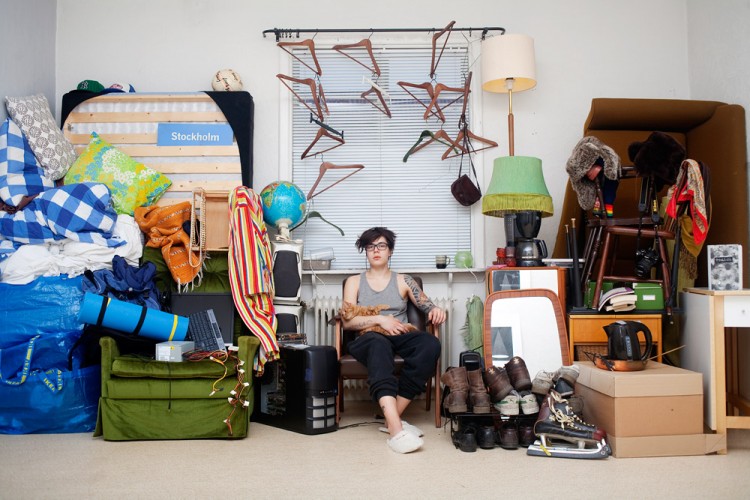
Hipster Millennial with all his high tech stuff.

“The National Institutes of Health found that for people in their 20s, Narcissistic Personality Disorder is three times as high than the generation that’s 65 or older…”

–TIME Magazine

Millennials have been loaded with negative stereotypes: lazy, entitled, or what seems to be the media favorite, narcissistic. A recent Time magazine article managed to fit all three adjectives into one title in the cover-story, “The Me Me Me Generation: Millennials are lazy, entitled narcissists who still live with their parents.” Ouch.

— Rachel Gall, So-Called Millennial.com

The burning question of whether the much-debated Millennial Generation (people born between about 1981 and 2004,according to William Strauss and Neil Howe’s generational theory, which is based on historical cycles, and uses a set of dates I prefer to the more popular dates used in mass media that refer to anyone born from 1976 to 1991 or so as “Generation Y”) are entitled, narcissistic spoiled brats continues to be a popular and controversial topic.

Like every youth generation ever since the Baby Boomers started thumbing their noses at The Establishment’s stultifying conformity back in the ’60s with their pot, patchouli, and peace signs, when the media first discovered the coming of age Millennials about a decade ago, its initial reaction was one of disdain and dismissal–it was immediately assumed that all Millennials were spoiled, indulged narcissists who cared about no one but themselves, their iPhones and iPods, and having the best looking and coolest MySpace or Facebook profile.

“[you are] so self-obsessed. Tweeting your Vines, hashtagging your Spotifys, and Snapchatting your YOLOS.” Our social media feeds are being filled with our favorite subjects: Me, Me, and Me……“Us Baby Boomers are very upset, because self-absorption is kinda our thing.”

–comedian Stephen Colbert

But recently, writers and bloggers all over the web and in the news are beginning to question the validity of the narcissistic Millennial stereotype. Two fairly recent articles–from opposite sides of the political spectrum, no less: Are Millennials Deluded Narcissists (Forbes Magazine) and The Persistent Myth of the Narcissistic Millennial (The Atlantic Monthly), both defend Millennials and offered reasons why they may not be all that narcissistic, or at least why any narcissism they do have should be blamed on other things like the narcissistic, materialistic, and individualistic society they grew up in, a society that keeps up with the Joneses (or the Kardashians) and thinks greed is good. There are many other articles and news pieces that have been making the same arguments. New York Magazine posted this insightful article, completely disputing the idea that Millennials are no-good narcissistic Red Bull-guzzling basement dwellers taking advantage of their parents’ generosity.

Even when they still have the N label pinned to them, at least the accusers are placing the blame on things like the economy, lack of decent jobs, the extortionist prices of higher education and decent health care, and the astronomical amounts of money Millennial college grads owe for student loans that were supposed to make it possible for them to earn the kind of money to be able to pay back the loan and become productive middle class citizens. But instead, being in debt to Sally Mae in a stagnating economic environment burdened this disappointed and angry generation of unemployed and underemployed young people–20-somethings with college or even graduate degrees–with having to take low-paying McJobs or put up with the cold and factory-like environment of call centers (but which pay far less and offer fewer benefits than factory work, whose workers at least had the unions on their side). Then, to add insult to injury, those McJobs pay such dismally low wages there’s little or no hope of ever being able to pay back the loans they hoped would give them a foot in the door to a successful life, or even allow them to move out of their childhood home.

Most Millennials, unless they are very lucky, very talented and manage to procure the right connections and contacts, find at some point they will probably default on their student loans, which in turn earn them the accusation from conservative foghorns like Fox News, that they are entitled takers and moochers, feeding shamelessly off the government teat and living, Morlock-like, in the damp dark caverns of mom and dad’s basement, growing fat and pasty as they play with their collection of high tech gadgets that enable them to become an Internet star if the video or meme they just made goes viral.

In fact, going viral on the interwebs may be the most sure way a Millennial can ever become successful in our current sick and unstable economy and general diminishing quality of life for all but the very rich. Millennials are being forced to sink or swim in a society that has become increasingly compassionless and narcissism-glorifying. So they’re finding their own well of hope and opportunity, and that well seems to spring from social media, Youtube and reality TV.

Don’t knock it. Going viral by sheer luck and the fortuitous timing of a Youtube video is basically what happened to Justin Beiber; crime victim and folk hero Antoine Dodson, whose impassioned and unintentially hilarious rant on a local news station was transformed into a huge iTunes hit and made him an overnight star; and many other Millennial pop stars. Probably the biggest success story of all is that of Mark Zuckerburg, the multibillionaire twentysomething founder and CEO of Facebook, which he started in his spare time as an ingenious way to chat online to his college buddies from his dorm room at Harvard.

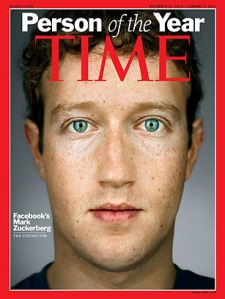
antoinedodson marczuckerberg
Millennials Dodson and Zuckerburg both became successful through viral spread via social media on the Internet.

If you have a halfway decent voice, you can win a record deal or at least a little temporary fame by auditioning for reality/game shows like The Voice, America Has Talent, or American Idol. Hey, you could be the next Kelly Clarkson or Carrie Underwood! If you can cook (and can tolerate the constant narcissistic rants of the cooking shows’ mean hosts such as Gordon Ramsey from Hell’s Kitchen and Master Chef), well you can win your own restaurant and become rich.

What if you have no talents at all? No problem. You can still get on a reality show, even if you’re a teen mom who never graduated from high school, or a bitchy girl who likes to get into catfights with other bitchy girls. You can get rich just by acting like a jerk on TV, or doing nothing at all. And let’s be honest here: that sure beats working in Wal-Mart’s underwear department and not being able to pay your rent because your student loan debt exceeds what you earn in your dead end job. Who wouldn’t do it? Reality shows may be dumb and glorify stupidity and bad behavior, but we can blame their popularity on the uncertainty of the hope of gainful employment obtained in more traditional, socially acceptable ways.

So what generation wins the title of Most Narcissistic Generation Ever?

Personally, I would give that dubious honor to the Boomers (born from 1943-1960 according to Strauss and Howe; the popular media range is 1946-1964), the pig-in-a-python generation that pretty much turned the conformist, narrow minded, and yet community oriented and moderately altruistic Pax Americana of the post-war years into the self-worshipping, narcissistic, greedy, materialistic, hedonistic, glory mongering morass of misery and despair it has become since Reagan’s trickle down economics became sanctioned as a way to piss (trickle down) on the poor; since Rush Limbaugh’s ugly epithets toward everyone who wasn’t white, conservative, Christian, heterosexual and male became widely accepted as sound advice; since G.W. Bush gave us permission to “Go shopping!” after the 9/11 disaster and its shortlived mood of national solidarity after the attacks.

Millennials didn’t create or want this narcissistic, selfish society. They were born and raised during a time of economic uncertainty, philandering presidents whose actions became widely discussed, 24/7 coverage of heroes-turned-villains (O.J. Simpson), and a general atmosphere of increasing political discord and animosity toward those who weren’t like yourself. Millennials were often raised by single parents who were struggling to make ends meet in our crumbling society, or passed back and forth between divorced parents. Millennials are reacting the only way they can react to a society that denigrates them, gives them no opportunities, ships potential jobs overseas, makes it impossible to earn enough money to move out of their parents’ homes, and generally places them in a no-win situation.

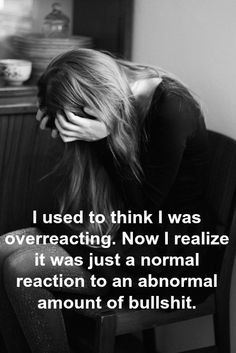
overreacting

Where Boomers could protest Vietnam and attend a huge 4 day rock festival held on a farm, and win publicity (if not glorification) in the media over their countercultural activities, Millennials’ “Occupy” movement of late 2011–a movement that wasn’t anti-establishment or countercultural but just an expression of their desire to be treated fairly and be given more opportunities–was quickly silenced by the media. A year later, you barely heard of it anymore. We are still hearing about the Vietnam and civil rights protests of the 1960s and the womens’ and gay rights movements of the 1970s. Don’t get me wrong–those were all good causes and I agree with them–but why are Millennials being silenced for nothing more radical than wanting a decent job and a measure of respect?

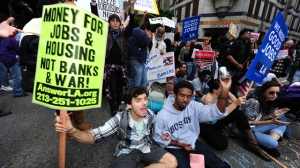
underpaid Protestors sit in the street and demonst
All they want is a chance.

Although born at the butt-end of the Boom generation (and thereby almost X), I don’t consider myself a Boomer and find myself balking at my inclusion within it; nor do I truly identify with Gen-Xers. I actually consider myself a member of Generation Jones (a subgeneration that straddles both Boom and X and contains characteristics of both Boomers and Xers and includes a few of their own). Anyway, I highly recommend reading Strauss and Howe’s books, 1991’s Generations and its 1997 followup, The Fourth Turning, both which describe the way history runs in cycles of four “seasons” that produce four corresponding archetypal generational types that repeat themselves at approximately 80 year intervals, and how the interplay of the generational “constellation” and the turning (national mood) at hand impacts history and society.

But I have digressed from my original point. Boomers as the most narcissistic generation ever is not an unpopular notion. Politics, big religion and entertainment is glutted with narcissistic, bombastic Boomers who bloviate over their greatness, judge the rest of us harshly, shove religion down our throats, and show their hypocrisy by demanding obedience, family values, and morality when they themselves showed their disdain for the very same things when they were younger.

Boomers started the “Me Decade” of the 1970s–an unbridled era of vanity, designer drugs, designer jeans, pleasure seeking and hedonism; before that, during their younger, more idealistic phase, Boomers naively promised they could change the world through music, eastern forms of meditation, and psychedelic drugs. During the 1980s, they morphed into the selfish, greedy Yuppies, and by the 1990s, they had taken over the political landscape, becoming ever more bombastic, judgmental and just plain uncivil and nasty to anyone who disagreed with them.
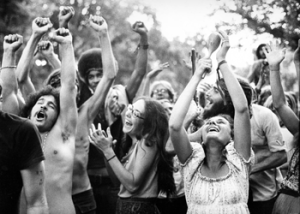
hippiesyuppies
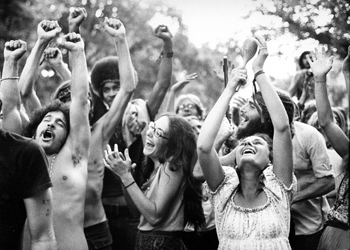
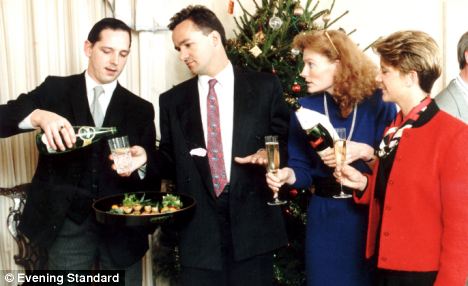
1960s era idealistic hippies and their 1980s incarnation as materialistic Yuppies.

Staying young and fit forever became the collective goal of the Boomer generation once they became disillusioned with their youthful idealism following Woodstock and Watergate. Perhaps due to their huge numbers and a firey passion and culture of cool that first enchanted and then took over the American imagination as early as the late 1960s, they grew up into adults who thought they were immortal, invincible, forever young and vital. They started the health and organic food craze of the late 1970s and 1980s and has continued to this day. They told us how we should all eat, look, exercise, worship, raise our children, and live our lives. And if you didn’t follow their rules and became sick or poor, well that was your own fault for lacking self discipline and strength of will. Even into their 60s and early 70s, Boomers are getting facelifts and liposuction, in a sad attempt to resurrect the appearance they had 30 or more years ago, Of course they’re just getting old like everyone else, but they refuse to confront it.

What about Generation X?
Poor Generation X (born 1961-1981, according to Strauss and Howe) is like the ignored middle child–or even the scapegoated child in a narcissistic or dysfunctional family. Having children was unpopular when they were being born, with more and more women shunning motherhood in favor of moving up the corporate ladder. Telling someone you were pregnant was usually met with side-eye by the cool people, and if you had the gall to admit you wanted to have more than two children, people looked at you like you were an unenlightened throwback to the 1950s. Getting on the “Pill” was what every young woman wanted to do.

Movies made about children during the 1960s and 1970s depicted kids as evil, demonic, bratty or badly behaved. Child psychologists recommended letting kids do whatever they wanted, which basically meant neglecting them. During the child-hating 1970s, “Latchkey” kids became the norm rather than the exception. Even “throwaway” kids, kicked out of their homes by parents who cared more about themselves than about their children, weren’t especially uncommon, especially in urban areas.

Not surprisingly, Generation X grew up with collective low self esteem, and while their humor can be dry, cynical, and full of snark, it is almost always self-deprecating. They have grown into adults in their late 30’s to early 50’s who tend to embrace traditional values, take on DIY projects, are politically and morally conservative, and believe in practical solutions rather than unproved theories. They don’t trust those who talk the talk but don’t walk the walk. They’re overprotective of their children and highly critical of the Boomers before them.

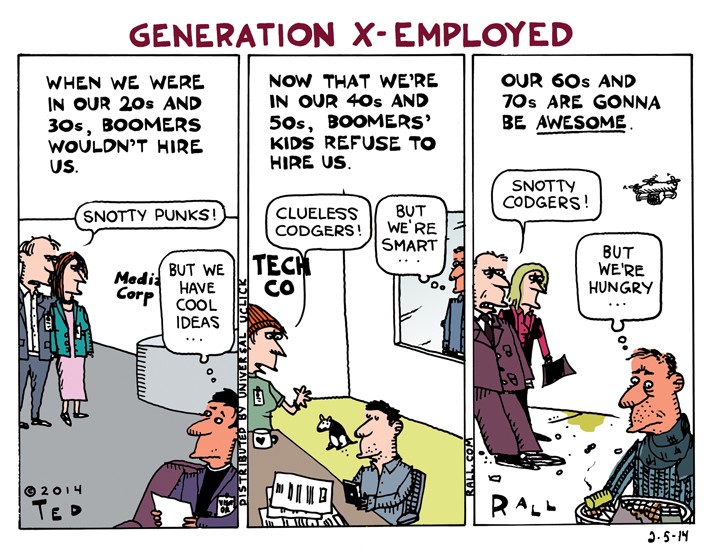
Middle aged Gen-Xers appear to accept the aging process fairly well, pretty much resigned to the inevitable. Hey, it’s better than the alternative. They’re not lining up at plastic surgeon’s offices for facelifts and body sculpting. While there are definitely narcissistic Gen-Xers (and I could list a lot), their generation as a whole seems the opposite of narcissistic–perhaps they’re avoidant or suffering collective PTSD. They are having problems in the workplace too–squeezed between older Boomers who refuse to retire, and Millennials wanting to take their places at the lower level jobs many Gen-Xers haven’t been able to move up from because of Boomers who refuse to pass on the torch.

genxemployed

Millennials are not a generation of narcissists; they are the victims of the narcissistic society they are trying to fit into without too much success. Their behavior shows frustrated young people who are just trying to find their footing and their place in the world, but no one seems to want to help give them a hand up, just blame them for failing to navigate the obstacles they never put there and never asked for.

Disclaimer: I’m well aware that every generation has its good and bad individuals, and there are certainly narcissistic Millennials and Gen-Xers, as well as unselfish and truly good Boomers. I’m generalizing about the generations as a whole, not their individual members.
It’s all about image: the skewed values of narcissistic families

monopolyguy

Last night I read a blog post by another survivor of narcissistic parents , and was astounded by how similar her parents’ values were to mine.

She writes that her father criticized her for being too idealistic. Now that would normally be a compliment, but because her family valued nothing but money, class and image, it was meant to be an insult. My father (who I don’t think is a narcissist, but has always been a huge narcissist apologist and enabler), said exactly the same thing to me.

We live in a narcissistic and materialistic society, that increasingly values traits that are narcissistic and exalt the individual over the community. In fact, studies have shown that a high percentage of CEOs, top executives, Wall Street tycoons, and others of the “One Percent” have narcissistic personality disorder. It’s a disorder that is very adaptive in modern society and whose traits are rewarded with money and material goods. Especially since the 1980s, with its “Greed is Good” ethos, we reward those who act in their own self interest over those who act in the interests of the community and want to help the less fortunate. There’s even a meme that’s become especially popular with narcissistic Baby Boomers: “I’m spending my children’s inheritance,” as though this is something to be proud of.

inheritance

My family bought right into this ethos. Image was everything to my parents, especially my mother. My parents looked down on our blue-collar neighbors and relatives, and my mother in particular constantly made jokes at their expense and talked about how much better we were because we had nicer things and my father had a better (meaning white collar) job in the city. Appearance mattered, and our clothes had to come from the best department stores, never Sears. We had to live in the most exclusive neighborhoods. To not have a college degree was considered a mortal sin, and even then, it was far better to be successful in the cold-hearted business world than to be a successful teacher, social worker or a nurse. Such things were regarded as jobs for those who couldn’t do anything else, and of course they required a level of idealism that my parents just couldn’t relate to. When my parents split up when I was 14, my extremely image-conscious mother took up public relations as a career, which is all about image. She had so many face-lifts that today her face looks like a mask.

Whenever my parents, my mother in particular, complimented someone else, it was always on their visible, tangible qualities–things like their appearance, home decor, financial status, and taste in clothes. Table manners were of utmost importance, but being a good person was not. I can’t remember a time when my mother ever complimented anyone for qualities such as sweetness, generosity, friendliness and altruism. I do remember her putting down others for having these qualities, calling them “insipid” or accusing them of having no backbone.

My values never matched those of my immediate family, and when I became poor as an adult (because I was never given the tools and self esteem that would have led me to make better choices) I was shunned and rejected by them. I don’t think it’s any accident that when narcissistic parents choose a scapegoat, they usually choose the most sensitive child–the one most likely to be empathetic and have idealistic values. To a narcissist, idealism and empathy are weaknesses. They truly believe that the poor deserve to be poor, and they make no exception for their own child. The child with traits that cause them to become a scapegoat (and who all too often are also bullied at school) would probably become successful if they were raised in a loving, nurturing home, but in a narcissistic home, having these traits is a curse because that child is led to believe they are worthless and this leads to cowardly, “safe” choices that are more likely to lead to poverty. They are constantly told they will fail, that nothing they do is good enough, and then are usually “tossed out to the wolves” at a young age, with no family financial or emotional support to help them get a foothold in the larger world. I have read so many blogs by the scapegoated children of narcissistic families, who were forced to make their own way in the world with no family support, even if their parents could have afforded to help them, and even when other children in the family (who were not scapegoated) did receive support when they entered adulthood.

superiority

What is so ironic about all this is we scapegoats are rejected and hated for the very traits that were instilled in us as children! Scapegoated children are not encouraged to think independently or have ideas of their own. In fact, having a mind of one’s own is reason for punishment and abuse. We were trained to be deferent and obedient–and very much afraid. Deference, obedience and fear are not traits that lead to success in modern life. I think this training is deliberate, in that an evil narcissistic parent needs and wants someone they can use as the family trashcan–someone who can take and absorb all the family pathology and carry its burden. This child is then blamed for everything that goes wrong both within the family and in their own lives. When a scapegoated child becomes an adult, their low self esteem and fear almost inevitably leads to a life of material and financial lack, and this gives the narcissist parents an excuse for rejecting that child and refusing to help–for “violating” their materialistic, self-centered values. I think another reason narcissistic parents train HSP (highly sensitive) children to be scapegoats is because they know an HSP child must be silenced: this is a child who sees through their lies and can use the light of truth to blow the whistle on them. If they are encouraged to think and act independently, they might “out” the narcissistic parent and that is a prospect that terrifies them.

Of course, the best revenge for a scapegoated child is to become successful in spite of their upbringing–and of course there are those who have. Even then, narcissistic parents will find reasons to put that child’s accomplishments down as somehow not “good enough.” The few times in my adult life where I had some legitimate tangible success, I was never praised for it, but given some sort of left-handed compliment or told why it didn’t really count. I was also always compared with my more financially successful older half-siblings, who of course never had been designated the family scapegoat.

Narcissistic parents also don’t care if you have a mental disability. I’m a self-diagnosed Aspie (this was later confirmed by a psychiatrist) and suffer from intermittent major depression, but when I tried to tell my parents these were the reasons why I had so much trouble making the social connections necessary to become financially successful, these diagnoses were dismissed. I was told I was “making excuses.” Both my parents are convinced my poverty is my own fault because of the stupid choices I made. While I don’t deny having made dumb choices, these choices were based on the way I had been raised–to be afraid of taking any risks or challenging myself.

The only way to break the narcissist/scapegoat family dynamic (and it is probably the most toxic parent-child combination imaginable) is by cutting off contact with the abusive parent, because as long as you keep trying to please them, they will continue to attempt to break you down and make you feel insignificant. Nothing will ever please them, even if you dare to become more successful than they are. And if you somehow manage to do this without sacrificing your idealistic and empathetic values, that’s the biggest threat to them of all.

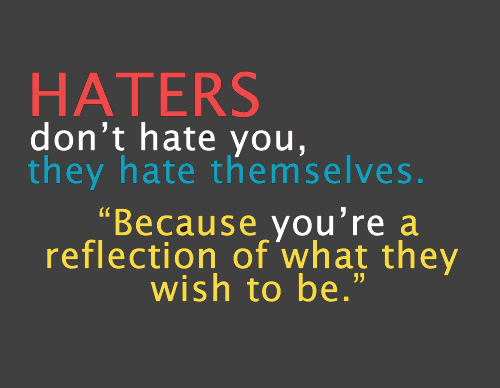
Make no mistake: your narcissistic parent doesn’t love you and never will, but it isn’t your fault. They hate you because they envy those qualities you have–empathy and humanity–that elude them. Be a good parent to yourself. Love yourself. You deserve it.

haters

We Need a 12-Step Program for the Self Absorbed

I came across this article in the Reader and was really impressed by it. It’s also a nice counterpoint to my article from a few days ago, Narcissists who use 12-Step Programs to further Their Agenda.
Enjoy!

insanitybytes22's avatarSee, there's this thing called biology...

speak

Desperately. We’ve become a nation-cult of narcissists, so enamored by our own selves it’s a wonder we don’t just spontaneously combust. It’s so bad people are actually taking selfies of our very own selves. People are  consumed by our own health issues, our various disorders, our own particular brokenness, our social concerns. Even in our social concerns it’s become all about us, our martyrdom, we’re the only one who cares, look at me, I’m so socially conscious and aware! Filthy rags, indeed.

Even faith frequently becomes something we like to lord over others, evidence of our own vast moral superiority. Not all of course, but our TV’s are constantly selling prosperity, beauty, and power, for three easy payments of 19.95. Become a Christian, you’ll get free stuff! CS Lewis was right when he said that kind of happiness was to be found in a bottle of port, not in Christianity.

So, in the 12…

View original post 356 more words

How “positive thinking” nazis jettison responsibility

upwardbattle

We live in an unempathic, selfish, narcissistic society. It’s social Darwinism at its finest, an Ayn Rand wet dream–a society that values selfishness over altruism, greed over empathy, money and material goods over timeless human virtues, fake smiles and phony platitudes over honest emotion.

Nowhere is this sickness more prevalent than it is in America today. One of the most irritating symptoms of how shallow a nation we’ve become is the plethora of corny “positive thinking” platitudes, cliches, and memes.

Don’t get me wrong. There’s absolutely nothing wrong with some healthy positive thinking, and attempting to see the glass as half full rather than half empty–as long as the positivity is tempered by realism. If you spend your entire life thinking how awful your life is and don’t even try to look for the silver linings, chances are you’re not going to see much improvement in your life. Daily affirmations are a good idea, as long as we don’t delude ourselves into thinking problems don’t exist and therefore don’t need to be addressed.

But as human beings, we all need a shoulder to cry on sometimes, someone we can tell our troubles to without fear of being judged or our concerns dismissed or criticized. There are times when we all need a little empathy and someone who understands what we are going through. Being told in our darkest moments that we need to “smile and the world smiles with you,” “lighten up,” or “this is a learning experience” is the last thing we need or want to hear. Corny “positive thinking” platitudes can sound like an invalidation or dismissal of what’s close to our hearts and in some cases even make us feel shame in addition to the pain we’re already experiencing.

Both my parents and my stepmother are on the phony positive thinking brigade. A long time ago, I used to actually try to talk to my parents about my fears and heartbreaks, but never felt supported by them. All I wanted was a hug and some encouraging, genuine words, maybe something like “I understand why you’d be so upset” or “You have every right to be angry.” Sometimes even an attentive silence would have done, since really listening to someone doesn’t always require words and sometimes just being heard without judgment is all that’s needed.

discontent

Instead I’d get simplistic “think positive” cliches and slogans, if not straight up invalidation and criticism of my feelings. My narcissistic mother was notorious for emailing me these corny platitudes that were as phony and devoid of true emotion as a smiley face bumper sticker on a hearse. Receiving her brand of “encouragement” made my blood boil. I spent a long time trying to figure out why it bothered me so much when she (or my stepmother or father) did this, and I finally figured out why. It was a dismissal, not only of my feelings, but a method of jettisoning any responsibility or having to take any time away from themselves to provide genuine help or comfort. It was, in effect, the same thing as tossing a lollipop to a crying child instead of trying to find out why the child is so upset. “Alright kid, here’s a lollipop, now leave me alone and stop crying.” By sending me pictures of kittens with happy slogans under them or a rainbow with an “inspirational” sentiment, they were avoiding taking any responsibility or showing any empathy, while still being able to say, “Well, what’s your problem? I acknowledged your pain–I sent you that “Don’t Worry, Be Happy” video.”

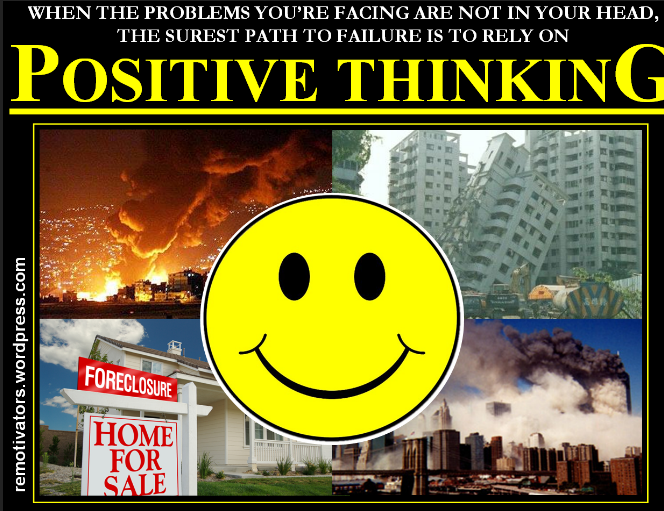
Positive thinking nazis are pervasive, they’re fake as hell, they’re complacent, and they’re everywhere. Every day we’re bombarded with Internet memes (Facebook is notorious for them), slogans, bumper stickers, and politicians (usually Republican) telling us to “just be happy and everything else will take care of itself.” It’s enough to drive me insane. How do you “just be happy?” I’m sorry, but I’m not a machine with a “happy” button. I can’t switch my emotions on and off because you’re uncomfortable with my negative moods.

There’s also a huge disconnect from reality. Poverty, homelessness, mental illness, and addiction actually do exist and they’re everywhere, in every town, every city, every neighborhood. Positive thinking nazis choose to not see these realities and even blame those suffering from poverty, homelessness, addiction, and mental illness for “their own condition” by not being “positive” enough. If only it were that simple. But it’s not simple at all because for those who can’t even procure basic food, medical care, and shelter, or who have a chemical imbalance in their brain that causes severe depression or addiction, thinking happy thoughts is just about impossible.

positive2

There needs to be a balance between the deluded positive thinking tyranny and providing authentic support. The first does not replace the second and in fact can exacerbate the situation by making the person needing help feel guilty and ashamed for feeling the way they do.

We need to stop being a nation concerned only with ourselves and stop dismissing the very real concerns of our friends, family and neighbors. Saying “smile!” to an upset person doesn’t cut it. We are all in this together, and authentic care and support are in very short supply and are needed now more than ever. We will never heal as a nation if we continue to equate slapping happy face stickers on everything with actually going out of our way to do good for others.

Don’t judge me because I’m poor.

impoverished
The topic that’s on my mind right now is potentially volatile and can open a huge, rotten, festering can of political worms, so that’s why I’ve been hesitant to write this. But heck, it’s on my mind, and I promised myself and my readers I would hide NOTHING, and I NEED to rant about it because it hits so close to home, so here goes.

Recently, there’s been an increasing number of conservatives (the loudest and most extreme are in the Republican Party) who have abandoned all pretense of caring about those who have less than they do–in fact, they are openly (even proudly) hostile toward the poor, blame-shifting the lousy economy, lack of jobs, and basically all of America’s problems onto the most vulnerable people in our society. American society in particular has become narcissistic, worshiping and rewarding those who have the most money and the most toys, while punishing those who have nothing more than ever before, rubbing salt into their wounds. Their contempt used to be limited to the poor who didn’t work (and those who were milking the system and might have deserved their wrath), but lately it’s extended even to the working poor–men and women who hold up to 2 or 3 jobs and work full-time (and many supporting young children), but due to the low wages they earn that haven’t kept up with an economy rife with inflation and where good jobs are scarce, still can’t lift themselves out of poverty. Empathy is seen as a liability rather than a virtue, and those who have empathy for others are seen as weak. Ayn Rand’s “Atlas Shrugged” has become the bible of the greedy and self-centered, and no one bats an eyelash, even though Rand herself was a narcissist whose role model was a serial killer.
The verdict is, if you don’t have money, you don’t deserve to live. There are no extenuating circumstances. If you’re poor, it’s your own fault.

Hatred of the poor isn’t anything new (and has been going on throughout human history, but enjoys spurts of popularity from time to time), but lately there hasn’t even been any effort to mask the hatred–it’s in your face constantly. Just watch FOX News, which I don’t. There’s no civility any more, and even less empathy.

It’s really a form of prejudice, no different really than a person of color ostracized and shamed because of the color of their skin. As a person who is currently under severe financial stress and trying to survive on an income barely above minimum wage (and having no outside help or assistance) as well as being a Highly Sensitive Person, I feel these insults keenly and feel diminished and enraged every time I read another article or watch another news show where some self-righteous cretin blathers on about how “the poor choose to be poor,” or that we are lazy, entitled, “welfare queens” with no morals and even less intelligence–and worse yet, dare to hide their ugly and mean-spirited self-righteousness under a cloak of piousness: many (not all) of these small-minded people call themselves Christians. I actually remember hearing some politician (I can’t remember who) who said Jesus wouldn’t give handouts to the poor, and cutting Food Stamps would be the most Christian thing one could do. What I’d like to know is, what God does he worship and what Bible is he reading? How dare he presume to put words like that into Jesus’ mouth, when Jesus himself was all about acceptance and love of the downtrodden and oppressed of his society.

The reason why this open hostility toward the poor is such a huge trigger for me is because that attitude assumes something about me that isn’t true. People who embrace the “you chose to be poor” mindset haven’t walked in my shoes, and they don’t know me or what led to my circumstances. They are presuming something about me based on an ugly stereotype. How is saying all poor people are lazy, stupid and entitled any different from saying all blacks are criminals, or all Jews are dishonest and greedy, or all Italians are dirty and don’t bathe? Now I’m not saying I didn’t make some bad choices because I have. I’m not saying I bear no responsibility for my own circumstances, because I do. I’m not saying it’s my government’s responsibility to lift me into the middle class, because it is not.

But you don’t know me. You have no idea who I am or why I am poor. You can’t, since you probably either never were poor, or if you had to “pull yourself up by your bootstraps,” you probably didn’t really–you probably had a grandpa, a mom and dad, or a long-lost uncle who helped you through college and graduate school, or helped you get the job you have today, or a loving mother who gave you a place to stay when you were down on your luck. Don’t tell me this does not apply to you. Hillary Clinton said “it takes a village” to raise a child, and she was right: it’s a fact that kids who were not given the opportunities–either in the form of college tuition or some other type of tangible or even just emotional support, are far less likely to become successful.

As an only child of narcissist parents (mostly my mother, but my father was an enabler and N-apologist), I had no financial, physical, or emotional support once I reached the age of 18. I had to pay for my own college education with student loans, while working full time. When I hit rough spots later in life, I never had the option to return home while I got back on my feet. On top of this I was suffering from depression, PTSD, autism, and avoidant personality disorder–and every one of these disorders causes people to become withdrawn, isolated and introverted. I think it’s a legacy a lot of us children of narcissists have been saddled with–there does seem to be some sort of correlation between narcissistic parents and autism (as well as the obvious PTSD and avoidant personality). Back in the 1960s and 1970s, it was believed autism was caused by “refrigerator mothers” but this theory was later rejected–however I do think there is something to it and should be studied further. Autistic adults (and non-autistics who have nevertheless turned inward due to their abuse) have a real handicap in today’s fast paced, competitive society where aggression, brashness and great social skills are a huge plus. Those of us who are intelligent but who don’t do well in a social setting are likely to become lost in the world because we lack the ability to connect and make friends with successful people who could help us. If an autistic adult (or just a painfully shy adult) doesn’t have family support and also lacks a specialized degree or talent (that may or may not be “discovered”), it’s not likely they’ll get very far in life, regardless of their native intelligence. It has nothing to do with how hard they work: I’ve worked my butt off most of my life, at times holding 2-3 jobs AND attending college, so I don’t think my poverty is due to my being “lazy and entitled.” I do not get any “welfare” or even food stamps. Everything I have, I pay from my own pocket, so shut the hell up.

So that’s why I hate it when people make assumptions about why I’m poor, and tell me what I’m doing wrong when they know diddly squat about what makes me tick or what motivates me. I don’t think poverty is a lifestyle “choice”–no one in their right mind would choose a life of struggle, want and heartache. For most of us, it was foisted upon us. And the more you have to worry about basic things like food and shelter, the less energy and time you have to “improve yourself.” But I don’t expect outside assistance or a “government handout” and haven’t asked for any. I try to take the steps necessary to pull myself out of the mire, but I REALLY resent being blamed for my situation when I lacked the advantages most other kids had, then had to somehow find my place in an unempathic, narcissistic, materialistic society where people who are introverted or highly sensitive or who live inside their heads are considered weak, stupid and incompetent because we don’t “schmooze” well with others.