Can narcissists feel empathy for fictional characters?

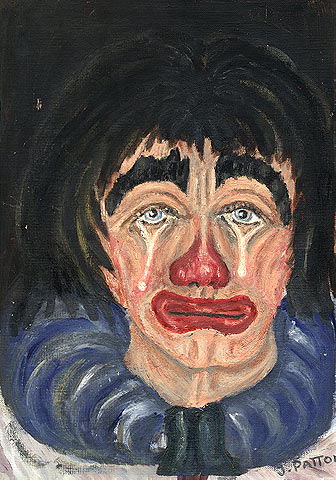
clown1

There is a question I have wondered about for a long time that was brought up on another post.

Narcissists are exquisitely sensitive. They are very easily hurt. But their hypersensitivity is limited to themselves (this is called narcissistic injury). Any insult, no matter how minor, will send them flying into a narcissistic rage or cause the “needy” type to break down like the babies they are.

But as we all know, when it comes to others, they have no empathy. They cannot feel your pain, share your sadness, or rejoice with you. On this level, they are incredibly insensitive.

But there’s something I wonder about. Because narcissists are “fictional people” themselves (what you see is not their true self but a mask), can they feel empathy for fictional people, such as characters in a sad or touching movie? Can they cry when reading a sad book or when they hear a sad song?

I’m leaning toward yes, because my MN mother never could feel pain for anyone but herself (and never expressed even her own narcissistic injury in any manner other than rage), yet I remember she could cry a river of tears when we went to a sad movie or watched a touching love story on TV. Hell, she could even turn on the eye-faucets when a maudlin commercial came on. My N ex used to get all weepy when he watched sad movies too.

For a narcissist, it’s “safe” for them to feel empathy for fictional characters on a movie screen or in a book, because those are not real people. There’s an interesting article written on the blog Let Me Reach by Kim Saeed about this subject, in which the author concludes that narcissists definitely do cry at movies, and it has to do with cognitive dissonance. Read Kim’s article for a more in-depth look at how this works for narcissists, because she explains it much better than I do.
More on empathy: this baby knows best

This incredible video went viral a little over a year ago. In it, a mother sings to her baby girl (yes, it is a little girl) and the child responds emotionally to her mother’s voice and cries in a very adult way and also smiles through her tears, showing pleasure in her mother’s lovely voice in spite of the sad emotions she is also picking up from mom. It’s fascinating to watch her because who would think a child this young could be moved to tears the way an adult can? This little baby is most likely an empath–and probably an HSP too.

http://www.youtube.com/watch?v=nIsCs9_-LP8

We don’t have to worry this little girl will grow up to be a psychopath, do we?

I think the video went viral not only because cute things about babies and animals always seem to go viral, but because people are starved for empathy and this little baby is a breath of fresh air and a ray of hope (sorry about the double cliche!) in a narcissistic and hostile society where it seems too many people have become hard, cold and shut off from the feelings of others, and where empathy is all too often seen as a liability rather than a potential strength and tool for healing.

The Hug Seen Round the World — The Antidote to Evil

This beautiful photo and story following a terrible tragedy shows us that empathy is still alive and well. I have to admit this photo brought tears to my eyes. If only we saw more of this sort of thing.

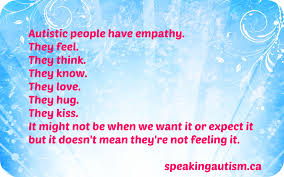
People with autism do not lack empathy!

autism

Autism and narcissism have a few things in common: First, they are both spectrum disorders. With autism, the spectrum runs from mild (Aspergers, colloquially known as “geek syndrome”) to full blown autism so severe the patient seems retarded and cannot even perform the most basic self-care or live without full time supervision. With narcissism, the spectrum runs from “benign” narcissism (people who are self-centered and vain but not completely lacking empathy or a conscience and don’t deliberately want to hurt anyone) to full blown malignant narcissism/psychopathy (which are basically one and the same).

Second, they are both at least partially (in the case of autism, probably totally) due to a miswiring or malfunction in the brain. One can be born without the ability to love or feel empathy (though abusive parenting does seem to exacerbate an inborn tendency), and almost all persons with autism were born with it (although there does appear to be a suspicious correlation between Aspies and narcissistic mothers, which probably exacerbates the Aspergers symptoms).

In one important way, autism and narcissism are mirror-images of each other. Narcissists cannot feel empathy for others, but can fake empathy quite well if they wish to. They can be very good actors. People with Aspergers (or mild autism) have the opposite problem. They can feel the emotions of others around them (very keenly in fact) but due to their inability to read social cues and difficulty acting “appropriately” in social situations, they can seem unempathic because they can’t express their emotions well.

Due to their difficulty showing empathy (people with Aspergers can seem aloof, cold or just awkward) it’s become popular to believe that people with Aspergers or autism, just like narcissists, do not have empathy. M. Scott Peck’s book “People of the Lie” is one of the best books I’ve ever read about malignant narcissism (it wasn’t called that when the book was first written in the early ’80s), but there was one thing that really bothered me: Dr. Peck used the term “autism” a number of times to describe the psychopath’s inability to feel empathy.

Nothing could be further from the truth. Here is an excellent article that makes mincemeat of this popular notion. If anything, people with mild autism/Aspergers empathize too much. I would even go out on a limb and say most of them are also Highly Sensitive People (HSPs). HSPs worry excessively about the impression they are making on others and whether or not they’ll be liked–and that sort of anxiousness itself can be socially disabling, even if no autism is present.

I’m sorry I keep bringing this up, but this is driving me crazy!

I just read a comment on this post, which really got me questioning things again.

owl says:
December 1, 2014 at 7:25 am (Edit)
I watched one of his videos tonight and learned that if the narcissist doesn’t involve himself with the public in some ways, it will lead to a much bigger psychosis; it will increase his psychopathy, he will become even worse. So my thought is that he is using his own desire to talk about himself as a way to involve himself in the world, a way to force himself to interact with people, thus setting up a stopgap and preventing a further slide into psychosis. He has already admitted that he has very few sadistic tendencies and in that way he has lucked out bc it could be worse.

I haven’t seen the video Owl has, but I have read the first 100 or so pages of Mr. Vaknin’s book, and must say I’m amazed by this man’s insight into NPD as well as his insight into its victims! After seeing how many pages of testimonials/qualifications are included in the book when I received it the other day, I decided once and for all he was a narcissist (and wrote a post saying so). But now I’m once again not so sure. I just can’t figure it out. He is such an enigma. I don’t know why it even matters but the mystery is driving me nuts.

Owl brings up the fact that Vaknin believes engaging with the public is a way to lessen psychopathic tendencies, and does so to avoid becoming psychopathic or more psychopathic. Which means there must be goodness in him, and possibly even empathy? I still can’t wrap my mind around his motives for writing a self help book for the victims of narcissists–does he have ulterior, dishonest motives, like greed, glory, fame, or just because he wants to show what an expert he is–or maybe it’s possible that he really does want to help survivors heal–which can only indicate the man has empathy! And if he has empathy, then how can he be a narcissist? Unless he’s a very low spectrum one.

Good Lord, I’m just so confused. I wish I could decide if he is or isn’t. I’ll tell you this much though: if Mr. Vaknin IS a narcissist, he must be getting so much narcissistic supply if he’s still reading everything I’ve written about him–and how many comments there have been about him–that I should probably stop this before his head explodes!

I’m a little embarrassed I’m obsessing so much about this thing which really doesn’t matter in the grand scheme of things, but as someone with Aspergers, we tend to do that!