
Ever just want to trash common sense and do something insane?

comfort_zone

I live in western North Carolina, which is a beautiful part of the country.   People actually envy me for where I live.   They’re right, too.  The scenery here is gorgeous.   The mountains are impressive.   The main hub (Asheville) is very cool too, very progressive for a small city in the South, with a surprising amount of arts and culture.     Go downtown and there are buskers on every street corner and a thriving artists’s community and people walking around dressed in tie dies and dreads.   There’s even a bumper sticker that’s popular: “Keep Asheville Weird.” I can understand why people find this area so vibrant and want to move here.

But I want out.    I’ve been living here for 23 years.  I loved it at first (or thought I did), but I’m over it.   I’ve been over it for awhile now.    I try to look at the positives; I try to look at it the way people who don’t live here and want to look at it.    Once in a while I can shift my mindset to more of an outsider one and actually appreciate it.    But it never lasts.

This is not a state that is friendly to anyone who isn’t rich, white, straight, and Republican (even though the town I live in is the opposite).   I can’t get health insurance (North Carolina did not accept the Medicaid expansion for people who are too poor to qualify for Obamacare because our governor has declared war on the poor–and he’s likely to get re-elected this November) and while we do have a “health department,” it sucks.  I won’t get into why here (I could write a whole post about THAT), but trust me, it does.    Someone in my age bracket should never be without decent health care.      The job market in this area is also terrible, even for college graduates.    Everything is unaffordable.  Rents and mortgages rival those of New York City.   That’s because everyone from New York City is moving here.    It’s lost its sleepy southern charm.

I can’t deal with falls and winters anymore.   I’m over “seasons.”  I’ve lived with seasons my entire life and don’t need to see any more snow or fall foliage.    Watching spring unfold is no longer worth enduring the five or six miserable months that precede it.   True, winters aren’t as intense here as farther north but it’s still too cold for me.    I want to move to Florida.   I guess that means I’m officially “old.”

A lot of people hate Florida and I suppose I can understand why.  Heat, bugs, crime, hurricanes, tornadoes, and never-ending summer.    But the advantages for me are that I’d never be far from the beach.  Having grown up in New Jersey and New York, I crave the coast.  It’s in my blood.   I was never more than an hour’s drive from any beach.  During the summers, I spent almost every weekend at the Jersey Shore, or any number of beaches on Long Island.   The mountains, as beautiful as they are, don’t speak to my soul the way the ocean does.   I feel closed in.   The sky here isn’t big enough because so much of it is obscured by trees and hills.     To get to the beach, you have to drive at least five hours (Myrtle Beach or Charleston, SC is the closest to me), which requires a lot of advance planning and money.    You can’t just get up and say, “Oh, I think I’ll hang out on the beach today” and still be home for dinner.

I could live near my son, and he could help me find decent work (the job market in his area is very good, or at least it beats the one here).  The rents are also dirt cheap.  My son isn’t exactly rich; in fact he barely makes more than I do.   But he’s able to afford an apartment in a beautifully landscaped gated complex with a pool, hot tub, gym, a tennis court(!), and only five minutes from the beach.   Here, to have digs like that you have to be pretty well off.  Although Florida also hasn’t expanded Medicaid to those who don’t qualify for Obamacare, I’m a lot more likely to get a job that pays well enough that I’d qualify for health insurance.

There’s only one problem though: money.   I live paycheck to paycheck.  My rent is almost half of what I earn, which leaves very little left for anything else.   It’s difficult if not impossible to save anything.  Moving costs money, especially moving to another state.

I know you take yourself anywhere you go.    Some people have told me that moving wouldn’t solve all my problems.  I’m aware of that.   I know all about “doing a geographic” and that a new locale won’t suddenly make my life perfect or stress-free.    I won’t suddenly be cured of my PTSD or BPD or AVPD or whatever it is I actually have (though it will probably vastly improve my SAD symptoms).    I won’t be any closer to God either, since He’s everywhere.

But I really feel like I’m being called there.  I’m more than ready for a change of scenery, to be near the water again.   But to do that, I would need to take a huge risk, and I’m a risk-averse person.    Since I can’t save anything, I’d have to live in my car for a month or two.   My son doesn’t have room to put me up in his place, and I wouldn’t expect him to.    I’m pretty sure I could find a decent job in a matter of a couple of weeks, if not sooner, and my son’s in a position that he could even find me a position in his company (he’s actually offered to do this).  I could also find out if the company I work for could transfer me to the Tampa area.

I’d have to sell or give away almost everything I own, which isn’t that much.   That’s okay.  I don’t need all that stuff.  I might even be able to make enough to afford the rent and deposit somewhere for a month or so until I’m employed.   Maybe.  But even if I don’t, I could keep what I need in the car and park somewhere safe and convenient.   Although I don’t expect him to do this, my son might let me keep some of my things in his large closet.

I know this sounds batshit insane, especially for someone in their 50s.   But it’s either that or stay in a place that’s too expensive and getting more so, a place that eats all my income and doesn’t make me happy. I have too many bad memories associated with this place, there’s been way too much dysfunction.  I can’t separate those associations from my time here now.    I moved here for dishonest reasons and by even less honest means back in ’93 (that would be a whole other post), and I feel like that’s put a sort of curse on my long stay here.   Call it karma if you want, but I don’t feel like I was ever meant to live here.

There’s a saying that goes, “life begins at the end of your comfort zone.”    Living in my car for a few weeks or a month or two would definitely be living outside my comfort zone.   But it’s my only option, outside of winning Lotto (which I don’t play), to live where I want, in a place not associated with bad memories.   Some risks are smart; others are just stupid.    I’m not sure if taking this risk would be smart or stupid, but if I stay here and never take a risk, how will I ever know?

I’m not saying I’m going to do this. Like I said, I’m not a risk taker.  At all.   But it’s something I’ve been thinking about.  And being too risk-averse has caused me to miss out on so much of life.   I’m sick of always having to be practical and reasonable and live in fear of “what might happen.”  My mother always liked to rail on about all my “bad choices,” and it’s true I’ve made a lot of bad choices–but the truth is, I never had many choices.  I always had to choose the lesser of two or three evils because the opportunity to make better choices was never available to me.    Or the choice was made dishonestly.  The one big risk I ever took was moving here, but like I said, it was a risk based on deception and co-dependency.  I still struggle with regrets over that.   Maybe you just have to wrestle life’s limitations to the ground and force that choice by taking a huge risk that most people think is nuts, but still keep your integrity in doing so.    I don’t think I’d have to end up like Dustin Hoffman’s character at the end of “Midnight Cowboy.”

Ever just want to do something crazy, that everyone tells you is crazy?  Have you ever gone ahead and done it anyway?  Was it the best thing you ever did for yourself, or do you regret being so impulsive?


What is Seasonal Affective Disorder (SAD)?

sad_snow

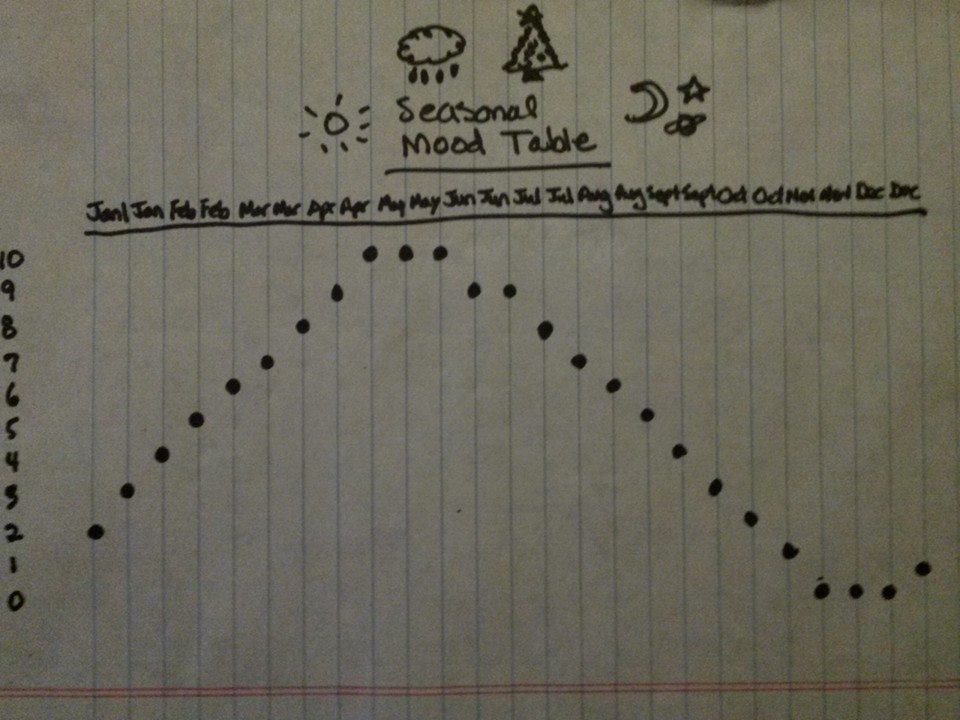
I think it’s worse this year, but there are a few other things going on that are exacerbating my symptoms.   I seem to have a weird form of it, which starts in late July or August, when my body begins to notice the reduction of light, even though summer is at its peak. Even though I detest winter, my mood starts to pick up in late January or February, when my body notices the lengthening days. I’m at my best in April – June and at my worst in November and December. My SAD seems to imitate the sleep/wake patterns of hibernating animals.

seasonal_moods
Graph I made showing my moods throughout the year. This never varies much.

Here’s an overview of what SAD is, from mayoclinic.org.

Seasonal Affective Disorder (SAD)

http://www.mayoclinic.org/diseases-conditions/seasonal-affective-disorder/basics/definition/con-20021047

Seasonal affective disorder (SAD) is a type of depression that’s related to changes in seasons — SAD begins and ends at about the same times every year. If you’re like most people with SAD, your symptoms start in the fall and continue into the winter months, sapping your energy and making you feel moody. Less often, SAD causes depression in the spring or early summer.

Treatment for SAD may include light therapy (phototherapy), psychotherapy and medications.

Don’t brush off that yearly feeling as simply a case of the “winter blues” or a seasonal funk that you have to tough out on your own. Take steps to keep your mood and motivation steady throughout the year.

Symptoms

By Mayo Clinic Staff

In most cases, seasonal affective disorder symptoms appear during late fall or early winter and go away during the sunnier days of spring and summer. However, some people with the opposite pattern have symptoms that begin in spring or summer. In either case, symptoms may start out mild and become more severe as the season progresses.

Major depression

Seasonal affective disorder is a subtype of major depression that comes and goes based on seasons. So symptoms of major depression may be part of SAD, such as:

Feeling depressed most of the day, nearly every day
Feeling hopeless or worthless
Having low energy
Losing interest in activities you once enjoyed
Having problems with sleeping
Experiencing changes in your appetite or weight
Feeling sluggish or agitated
Having difficulty concentrating
Having frequent thoughts of death or suicide

Fall and winter SAD

Symptoms specific to winter-onset SAD, sometimes called winter depression, may include:

Irritability
Tiredness or low energy
Problems getting along with other people
Hypersensitivity to rejection
Heavy, “leaden” feeling in the arms or legs
Oversleeping
Appetite changes, especially a craving for foods high in carbohydrates
Weight gain

Spring and summer SAD

Symptoms specific to summer-onset seasonal affective disorder, sometimes called summer depression, may include:

Depression
Trouble sleeping (insomnia)
Weight loss
Poor appetite
Agitation or anxiety

seasonal-affective-disorder

Seasonal changes in bipolar disorder

In some people with bipolar disorder, spring and summer can bring on symptoms of mania or a less intense form of mania (hypomania), and fall and winter can be a time of depression.

When to see a doctor

It’s normal to have some days when you feel down. But if you feel down for days at a time and you can’t get motivated to do activities you normally enjoy, see your doctor. This is especially important if your sleep patterns and appetite have changed or if you feel hopeless, think about suicide, or turn to alcohol for comfort or relaxation.

Causes

By Mayo Clinic Staff

The specific cause of seasonal affective disorder remains unknown. Some factors that may come into play include:

  • Your biological clock (circadian rhythm). The reduced level of sunlight in fall and winter may cause winter-onset SAD. This decrease in sunlight may disrupt your body’s internal clock and lead to feelings of depression.
  • Serotonin levels. A drop in serotonin, a brain chemical (neurotransmitter) that affects mood, might play a role in SAD. Reduced sunlight can cause a drop in serotonin that may trigger depression.
  • Melatonin levels. The change in season can disrupt the balance of the body’s level of melatonin, which plays a role in sleep patterns and mood

Risk Factors

Factors that may increase your risk of seasonal affective disorder include:

  • Being female. SAD is diagnosed more often in women than in men, but men may have more-severe symptoms.
  • Age. Young people have a higher risk of winter SAD, and winter SAD is less likely to occur in older adults.
  • Family history. People with SAD may be more likely to have blood relatives with SAD or another form of depression.
  • Having clinical depression or bipolar disorder. Symptoms of depression may worsen seasonally if you have one of these conditions.
  • Living far from the equator. SAD appears to be more common among people who live far north or south of the equator. This may be due to decreased sunlight during the winter and longer days during the summer months.

Complications

Take signs and symptoms of seasonal affective disorder seriously. As with other types of depression, SAD can get worse and lead to problems if it’s not treated. These can include:

  • Suicidal thoughts or behavior
  • Social withdrawal
  • School or work problems
  • Substance abuse

Treatment can help prevent complications, especially if SAD is diagnosed and treated before symptoms get bad.

Original article is here.


Mountaintop view.

I was working in a home today that sits on top of a mountain.     This is the view from their porch.   Although fall isn’t my favorite time of year (and I would never want to live on top of a mountain),  I think the tree on the right with the falling leaves make the picture more interesting.

bear_left

Slapped with the truth.

Image

slapped_truth

Falling down a mental black hole.

blackhole

I’ve been dealing with a situation that’s been somewhat traumatizing to me and has gotten me very depressed and experiencing feelings of self-hatred and shame (having SAD doesn’t help).   I became so depressed all I could do was lie in bed and sleep or just mope around and do nothing except wallow in self pity.  I lost all motivation to write anything at all.    I prayed for answers and clarity on this situation, and now that I finally understand the reason this thing triggered me so much, I’m finally starting to feel a little better about it.

I’m sorry, but I’m not prepared to say what the situation is.    I’m not ill nor is anyone close to me sick.  I didn’t lose my job. No one died. Nothing “bad” happened.   It’s purely a thing that has to do with my mental disorders and is probably something that wouldn’t bother a normal person nearly so much but sent me hurtling down a mental black hole.

I have therapy tomorrow where I will be talking about it.  The only person that knows exactly what’s going on with me right now is my therapist.    I hope I come away feeling almost back to normal.

I still don’t know how much I’ll feel like posting, though.

I’m taking a short break.

I probably won’t be posting for the next couple of days.  There are some other things I need to catch up on, including answering some of the emails I’ve been neglecting to answer (if yours is one of them, my apologies and you should be hearing from me).  There’s also a situation I need to gain some perspective on and I can’t do that by staying online.   This doesn’t mean I won’t post (I still might if I have a “lightbulb” moment and just have to write about it) , but I probably won’t for a couple of days.

See you in a few!


Words of comfort for the scapegoat.

Image

psalm2710

6 ways to turn things that annoy you into hilarious blog posts.

microwave_dinner
This ever happen to you? Yep, it’s beyond annoying. I bet you could write something funny about it.

Let’s face it. Annoying things are funny.   If you can look at the humorous side of the things that drive you crazy,  two things happen:  (1)  it no longer seems as annoying; and (2) you can write a great post that makes your readers laugh.   Some of my most popular posts–such as “12 Reasons Why I Don’t Like Autumn“– have been biting jabs at things I don’t like.

Here are 6 ways you can turn something that makes you want to stick white-hot steel pins in your eyes into something that makes your audience (and you) laugh.

1. First, try to find the funny side of whatever it is that annoys you.

Come on, you don’t have to dig that deep.  Almost everything has a funny side to it.  Most things that are merely annoying (as opposed to, say, tragic, where it might be hard to find a light side) are very funny indeed.   Hate morning radio shows? (I do.)  Make fun of them!  Talk about how idiotic they are or the way they never play any music.  Rant on about the way there’s always a dumb-as-a-bag-of-hammers female sidekick who gets paid to do nothing except laugh idiotically at Bubba and Ed’s lame jokes. Lampoon the way all the jokes are about celebrities and sex.  Or celebrities having sex.  Like anyone cares.

2. Don’t be afraid to use sarcasm.

If you’re good at it, that is. You should know if you are.  I’m one of those people that is not.  Snark and sarcasm don’t come naturally to me.   But if you’re good at it, that’s a plus because it can make your funny posts even funnier.     If, like me,  you’re not good at sarcasm and snark, skip it because you’ll seem like you’re trying too hard, and worse, come off as nasty and mean instead of bitingly funny.

3. Exaggerate!

exaggeration

“That Turbo-sized mug of Pumpkin Spice cappuccino she forced on me against my will smelled like cinnamon-and-clove-scented sewer” is a lot funnier than “that large mug of Pumpkin Spice cappuccino she gave me smelled terrible.”   You’re not lying; you’re embellishing the truth with colorful imagery to enhance its humorous effect. (Oh, and almost everyone  I know is fed up with Pumpkin Spice everything).

4Profanity can be useful, but use it sparingly.

I try not to use too many profanities in my blog posts, not because I’m some prudish church-lady afraid of “salty” language, but because most of the time,  it just makes you sound low class, mean, and uneducated. It’s also lazy.  There are usually better ways to  express frustration, anger, surprise, or whatever strong emotion you’re trying to convey.  That being said, sometimes a well placed expletive gets your point across more effectively than anything else, and you don’t have to worry about Those Words making you sound pretentious, as a euphemism might.   You can usually get away with naughty words if you’re writing something humorous–especially if it’s about something you find f***ing annoying.  It’s the surprise factor of seeing a four letter word there that sometimes sets off the guffaws.  Everyone can relate to the F-bomb (and well-placed,  it does act like a kind of bomb!), even if they don’t admit it.   Only use it once or twice though.  If you overload your post with profanities, you’ll probably just turn off most readers instead of making them laugh.

5. Make a numbered list.

Everyone loves lists–or “listicles,” as they have been recently (and annoyingly) called when they refer to lists on blog posts.   The human love of lists is the reason why back in the 1980s, “The Book of Lists” was a huge bestseller, and spawned a jazillion followup books.  It’s the reason why every article about writing engaging blog posts will tell you to “put it in a list.”    If you’re writing about something that annoys you, you can either write a list of all the different things that annoy you, or focus on one thing and list all the reasons why you hate it.

Lists are also a lot easier to write than regular prose, and easier to read too.

6.  Find funny images to illustrate your post.

I love Google Images, and I can almost always find the perfect image for any post I’m writing.   All you do is type in a few words describing what you’re looking for or what your post is about, and click on Images, and voila!  Then it’s just a matter of choosing the one that “speaks” to you the most.    There are some pretty hilarious ones too, for almost any subject you can think of.   Images, memes, cartoons, and funny photographs can make your funny post even funnier, but don’t overwhelm your readers by posting too many.  After all, you want your  own words to stand out, not have their effect diluted with too many funny pictures.  One at the top of your post, and maybe one or two others sparingly placed should be enough.  If you’re good at writing captions, do it, because sometimes those are the funniest things in a post.   If you love funny captions,  check out those on Cracked.com.  Theirs are the greatest.

*****

You can also turn things that elicit other disagreeable emotions in you (as long as they’re not “serious” emotions like sadness or grief) into comedy gold!   Try writing a funny post about things that disgust, bore, or scare you!    Here’s one I wrote called “25 Things That Gross Me Out.

Summer’s not over yet!

As someone who suffers from Seasonal Affective Disorder (SAD), I’m extremely sensitive to the shortening days and increased darkness of fall.    Believe it or not, my disorder actually begins to kick in during high summer–around early August–when the days are growing noticeably shorter, even though the heat and humidity is at its peak.  So it’s really the lessening light, and not cooler weather, that sends me into the yearly doldrums and makes me feel depressed.  I’ve sometimes wondered if SAD might be some kind of evolutionary throwback to a time when we still hibernated.  I know every year I want to go into hibernation and sleep away the fall and winter and  wake up again in early spring.

Another weird thing about my SAD is that it begins to dissipate sometime in late January or early February, when the days are beginning to grow noticeably longer.   Even though February days are still shorter than September days, it’s the increase of light every day that begins to improve  my mood, not the actual amount of light.

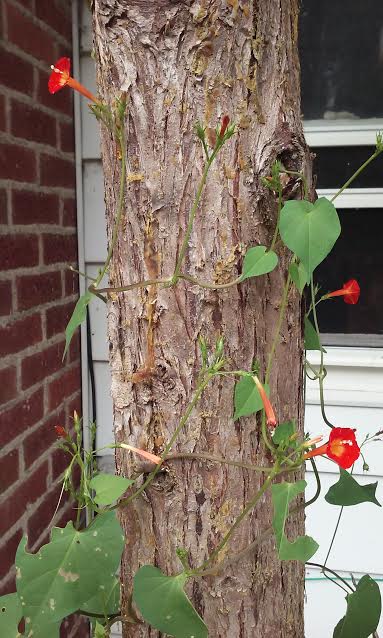
But I couldn’t feel too depressed about fall beginning in just a couple days when I saw this little treat in the front of my house.    I don’t know where this vine with these cute little red flowers came from–it looks like a type of morning glory (Bluebird of Bitterness might know what these are).   Maybe my daughter planted some seeds here, or maybe they’re just growing there all on their own.   However they got here, they made me smile this morning.

little_morningglories

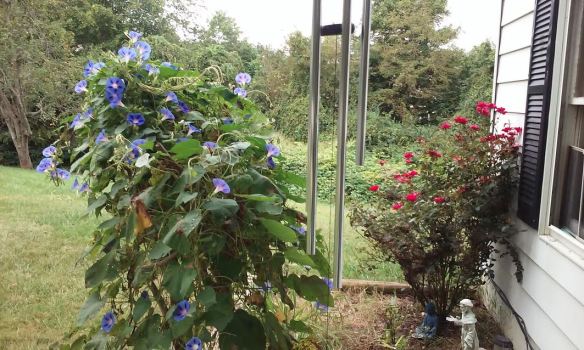
Also, my rose bush and the blue morning glories I planted back in April are turning my small garden into a riot of color (and I even spied a few bumblebees in the trumpet shaped flowers), so it seems like summer isn’t quite ready to go anywhere yet!

flowers

ETA:  I found out the small red-orange morning glories in front of the house are actually a very rare variety called “Orange Noah.”  They bloom in late summer and fall, when most other glories are ready to quit for the year.  But where they came from is still a mystery!

Haters.

Image

jackass_whisperer