Is narcissism caused by nature or nurture?

narc_child
Credit: davidwolfe.com

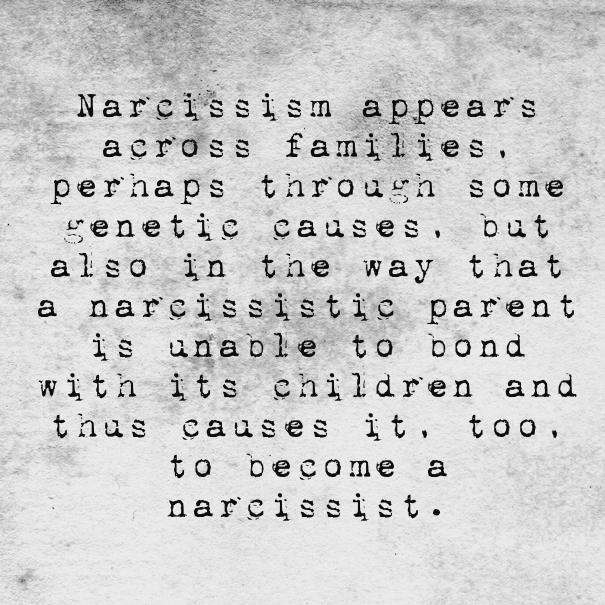
Although the consensus seems to be that narcissism or NPD (clinical narcissism) is a result of abuse or neglect during childhood, there may also be genetic factors involved.   An article from The Narcissistic Life cites several studies and concludes that narcissism results from a combination of nature and nurture, describing it this way:

These factors include biological vulnerability, social interactions with early caregivers, and psychological factors that involve temperament. There are studies that suggest that a gene (or genes) for narcissism can be inherited but that a person also needs the “right” environment for narcissism to be manifested.

What this means is that while a child may be born with a predisposition to becoming a narcissist, they won’t unless environmental factors are also fulfilled.  If the parents do their job well and give the child a secure emotional foundation, they will not develop NPD even if they are predisposed to it.    In this way it works a lot like alcoholism:  alcoholics are probably born predisposed to becoming alcoholic, but if they don’t take their first drink until they are well past adolescence or if the culture they are raised in discourages heavy drinking (or drinking at all), they will not develop alcoholism.

Some babies are born more demanding or needy than others.   These may be “difficult” children who are easily hurt or upset and have trouble learning self-soothing.   Such a temperament doesn’t necessarily indicate the child will become a narcissist, but they are probably more likely to than a calm baby who can soothe themselves, if the parents fail to mirror them properly or don’t attend to their emotional needs.

Most children whose parents were abusive or neglectful do not become narcissists.  They may develop some other problem like C-PTSD or BPD or be prone to depression or anxiety instead.  These are probably children who have a calmer, less sensitive or less demanding temperament than children who grow up to be narcissists.  Personally I think people who develop narcissism were children who were especially sensitive and had no emotional defenses at all so they sent the true self into exile and replaced it with a false one.   No other mental disorder causes a person to completely reject their own vulnerability and authenticity.
geneticNPD

It’s not always abused children who become narcissists.  Some are children who are spoiled by their parents. Spoiling may actually be a form of abuse, because it’s a lie and doesn’t acknowledge the child’s real self.  It still fails to mirror them properly.  The child is constantly told how perfect they are and showered with gifts and praise for being so “perfect.”  As a result, they feel like they must always be perfect which of course is a lie.  They feel entitled to whatever they want because of this belief in how perfect they are, and they never learn how to deal with criticism or setbacks when they get out into the real world.

I also think the nature of the abuse and role in the family plays a big part in whether a child develops narcissism and what type of narcissism they develop.   Golden children, who are essentially spoiled children, are more likely to become narcissists than scapegoats are.   Children who serve as both scapegoats and golden children (common in only children) can also become narcissistic, but I think they’re more likely to become Borderlines.   If a scapegoated child does become a narcissist, it’s more likely they’ll become the covert, fragile type of narcissist than the grandiose, overt type.

Some studies have also shown that narcissists’ brains have less grey matter in the left anterior insula region of the brain, thought by researchers to be involved with both the regulation of emotion and the generation of empathy.   But the jury is out on whether these brain differences are genetic or if the brains of narcissists fail to develop properly due to being raised in a narcissism-inducing (abusive or spoiling) environment.

Further reading:

Does Excess Praise and Spoiling Create Narcissists?


The Toxic Attraction Between an Empath and a Narcissist.

empath_narcissist

I have my own ideas about the complicated dynamics between narcissists and empaths, but I’ll just let this excellent article (written by an empath) speak for itself.  These two apparently opposite types of characters do often seem to be drawn to each other.

The Toxic Attraction Between an Empath and a Narcissist. 
By Alex Miles

We know that “narcissist” has become a bit of a buzzword recently, and some folks are quick to apply it to an ex-lover or family member or friend. While awareness of this concept is healthy, so is remembering that it is, in a mental health context, a serious condition that shouldn’t be applied to someone you’re mad at because they stole your mirror. ~ Eds. 

I am an empath. I discovered I was an empath after I got involved in a very deep and highly destructive relationship with a narcissist.

I am writing this article from the perspective of an empath, however, would love to read the view from the opposite side if there are any narcissists that would like to offer their perception on this.

Through writing about the empath personality type I have connected with many other people who class themselves as an empath and time and again I have heard people tell me how they have also attracted relationships with narcissists. There is a link. So, I decided to explore it further.

This is my theory…

From my own experience and studies on the narcissist personality type, there is always one core trait: A narcissist is wounded.

Something, somewhere along the line, usually stemming from childhood causes a person to feel worthless and unvalued and, due to this, they will constantly and very desperately seek validation.

Here comes the empath, the healer. An empath has the ability to sense and absorb other people’s pain and often takes it on as though it were their own. If an empath is not consciously aware of boundaries and does not understand how to protect themselves, they will very easily and very quickly bond with the narcissist in order to try to fix and repair any damage and attempt to eradicate all their pain.

What the empath fails to realise is that the narcissist is a taker. An energy sucker, a vampire so to speak. They will draw the life and soul out of anyone they come into contact with, given the chance. This is so that they can build up their own reserves and, in doing so, they can use the imbalance to their advantage.

Read the rest of this article here.

The Crying Game – Part One

I found this post both beautiful and heartbreaking. This blog’s author has Narcissistic Personality Disorder and really struggles to feel any kind of genuine emotion…

HG Tudor's avatarHG Tudor - Knowing The Narcissist - The World's No.1 Resource About Narcissism

Tears. One might consider them the ultimate embodiment of emotion. Tears appear when you have experienced some kind of extreme emotion. I know because I have watched on so many occasions as I have sought to understand the circumstances in which somebody cries and why it is that they do so. I understand that when tears appear, whether it is a welling-up in the eyes, the single full teardrop which slides down a cheek or the cascading waterfall which leaves the eyes red-rimmed and blurry, it is as a consequence of you experiencing emotion in a huge dosage. What I had to learn was which emotions were associated with the emission of water from the eyes. The first emotion that presented itself for my understanding as to how it caused tears was pain. I remembered as a child that my younger brother was somewhat accident prone. If there was tree…

View original post 1,138 more words

We don’t need a malignant narcissist in the White House.

Donald Trump is such a narcissist that Barack Obama looks at him and goes, ‘Dude, what’s your problem?’ — Ted Cruz

I’m talking about The Donald, of course. Most politicians have a narcissistic style or narcissistic traits, but we have probably never had a president with fullblown NPD. Author and narcissism expert Sam Vaknin has watched over 600 hours of footage of Trump and pegs him as a malignant narcissist. I believe him. Yikes!

Former Republican presidential candidate Ted Cruz had a few words about Trump too. He was enraged when Trump accused Cruz’s father of being involved in JFK’s assassination, and exploded to the press. Here is the transcript of that, and an accompanying video of Cruz’s entire rant.

http://www.realclearpolitics.com/video/2016/05/03/cruz_explodes_pathological_liar_trump_a_narcissist_at_a_level_i_dont_think_this_country_has_ever_seen.html

NPD “alter” in a DID patient.

dissociative_identity_disorder

I have to admit I know next to nothing about this, but I found this fascinating and wonder if anyone else ever heard of anything like it or knows anything about it. Someone who comments on this blog described a woman they know who has Dissociative Identity Disorder (DID). Like C-PTSD and the personality disorders, DID is caused by abuse during childhood. If you’re not familiar with DID, it’s one of the Dissociative disorders. It used to be known as Multiple Personality Disorder (MPD). DID is when a person has one or more “alters” in addition to their base personality, and switches from one alter to another, usually in response to a trigger. The core self usually has amnesia for the the time spent as an alter (many people with DID present because of frequent “blackouts”–gaps in memory where the person can’t remember anything they did as an alter), but there may be some awareness among the various alters of each other’s existence.  Each alter may have their own name, set of interests, likes and dislikes, etc.  They may even have opinions about the other alters as if they were actual people. Adopting different alters is how the DID person copes with trauma-related stress. DID usually first presents during childhood.  It’s a fascinating disorder in its own right.

Like almost everyone with DID, the woman this commenter described had been horrifically abused. One of her alters had Narcissistic Personality Disorder, maybe more than one. I don’t know how many alters the woman had, and I don’t know whether or not she was NPD at her core (usually the core personality is a rather passive and victimized character, and I would think that adopting NPD as a dominant coping mechanism would negate the “need” to develop DID). I found it fascinating that one of her alters had NPD and she was able to switch it off whenever she left that alter. The human mind is an amazing and mysterious thing.

My “crazy” dream.

wishes

No, not a dream of the sleeping kind, but I have this crazy pipe dream, a strong but probably a little out-there wish.   It isn’t very realistic on several levels, but my life would be complete if I could…help someone heal from NPD.    If I could be a therapist to an NPD patient and help them find their true self within–if it’s still reachable.  To  watch a hardened, manipulative, cold, almost soulless narc reclaim their emotions and vulnerability; to help them be able to love, really love, someone else–not for the supply they can bring, but for themselves.  To help them come to terms with their own  past, to help them discover why narcissism was the only path they believed was available to them.

Going back to school at my age is a daunting and probably not realistic goal, and even if I were to go get an advanced Psychology degree, NPD is one of the most difficult, if not THE most difficult, disorder to heal anyone of.   Even getting one to cooperate with therapy and stay long enough for any progress to be made  is like making a cat love the water.  Even so,  it’s a powerful desire of mine.  I think about it a lot.  Sometimes I even wonder if ultimately this is what God wants me to do.  Yeah, I know.  Crazy.

Other bloggers and some of my readers have taken issue with the fact I care about narcs who want to change themselves.*  I see them as abuse victims too.  I don’t think they are all hopeless.  Narcissism is a spectrum disorder, and those who aren’t very high on the spectrum haven’t completely jettisoned their humanity.

Not everyone agrees.  I have lost followers and gotten hate because I don’t hate narcs.  I hate the things they DO.  Make no mistake, I don’t believe in enabling or having contact with them.   The best way to help a narc (and of course, yourself),  is to withdraw supply, which means making yourself unavailable.

I’ve been called a narc-hugger.  I’ve actually been called evil because of my unconventional views.  I’ve  been mobbed for having these views.   But I don’t care.   I feel strongly about this and I don’t think I’m evil or crazy.  As someone who had BPD and no longer does, I know from personal experience that healing from a Cluster B disorder is not impossible.  It’s  hard, frustrating, scary, excruciating work, and you’re left with residual PTSD that must be worked through (the basis, in my opinion, of all PD’s), but for many, Cluster B doesn’t have to be a life sentence.

If this dream ever came true, if I could help someone heal from NPD, I think it would change me profoundly.   As for the question of why any of us who were narcissistic abuse victims, didn’t turn to narcissism ourselves, all I can say is (much as I dislike this expression because of how condescending it sounds): “There but for the grace of God go I.”  We were the lucky ones.

Here’s an article written today by a friend of mine, a Christian, who is thinking along the same lines as me.   I agree with her post.

Why Hating a Narc Harms Their Victim: https://dreamsofabetterworldblog.wordpress.com/2016/04/17/why-hating-a-narc-harms-their-victim/

* I don’t think a cure is possible for narcissists who have become malignant/sociopathic or for those on the psychopathy spectrum.

Further Reading:

Paper Tigers: Why I Choose Understanding over Rage


Divorcing The Donald: Cutting Ties with The Narcissist.

Allison Patton, family lawyer, wrote an eye opening article for The Huffington Post that goes beyond simply describing Donald Trump as an NPD poster boy, which many have already done.

In family law, individuals with NPD are known a HCPs-high-conflict persons. Here, Ms. Patton describes the way Trump’s blatant narcissism has not only alienated him from the Republican Party, but how he could potentially serve as a public example of a serious disorder that family lawyers, judges, and the courts are surprisingly ignorant about–and often unwittingly reward the narcissistic spouse and punish the real victim, due to the narcissist’s glibness and ability to lie convincingly.

Unfortunately, Trump has succeeded in pulling the wool over the eyes of millions of Americans who continue to support him–even though it’s no secret he has been publicly diagnosed with Narcissistic Personality Disorder. Many of these Americans tell themselves, “well aren’t all politicians narcissists anyway?”
Well, most probably have some narcissistic traits, but most are not full-blown NPD like Donald Trump either.

Divorcing The Donald: Cutting Ties With The Narcissist
By Allison Patton, for The Huffington Post
http://www.huffingtonpost.com/alison-patton/divorcing-the-donald_b_9633460.html

Republican presidential candidate Donald Trump speaks during a campaign rally, Wednesday, April 6, 2016, in Bethpage, N.Y. (AP Photo/Julie Jacobson)

Republican presidential candidate Donald Trump speaks during a campaign rally, Wednesday, April 6, 2016, in Bethpage, N.Y. (AP Photo/Julie Jacobson)

Narcissistic Personality Disorder
A “Cluster B” personality disorder in which a person is excessively preoccupied with personal adequacy, power, prestige and vanity, mentally unable to see the damage they are causing to themselves and often others.

While the Republican Party is desperately trying to cut ties with Donald Trump, the world watches in disbelief. All, that is, but a particular group of women and men with one thing in common: each of them has divorced a narcissist, and some still share child custody with one.

They know the story and could write the script. The successful, gregarious person who swept them off their feet. The promises that followed. Gradually the realization that it was all a façade. There could never be a “we” because narcissists care only about themselves. Then the real nightmare began, the battle to remove this toxic person from their lives. . . . and for those with children, the misery of trying to co-parent with an ex who acts and thinks like The Donald.

As a divorce lawyer, these cases are the most difficult and disturbing. In my family law circle, we refer to someone with a narcissistic personality disorder as “an NPD” (or the more general term “HCP” — which stands for “high conflict person”). The legal battle is always the same: the unaffected spouse tries to explain to the attorneys, judge and appointed psychological expert (if there is one) the narcissist’s behavioral pattern: control, emotional abuse, manipulation, duplicity and the damaging impact on the children. The NPD denies it all and mounts a legal response that consists of blame laying, factual distortions, outright lies and a character assassination of the other spouse.

The experts and the judge are sometimes able to weed through the chaos and confusion, identify the personality disorder at play and make decisions that protect the children and unaffected spouse. Often, however, the legal system gets it wrong. Just as we’ve seen with Donald Trump, the NPD can be very convincing and manipulative. And the court system – like the general public – either gets conned by the NPD or isn’t equipped to manage the level of conflict created by a Donald. Often the court assumes both parties are equally to blame for creating and maintaining a high conflict case, so the innocent parent who is fighting to protect the kids is treated as skeptically as the narcissistic parent.

For decades, there has been little understanding of how to spot and handle personality disorders in family law. As recently as 2011, when I blogged on Huffington Post about high conflict people in divorce court, I received emails from out-of-state divorce professionals indicating the information was new to them and they hadn’t heard the term “high conflict people” used in their family court.

Thanks to Donald Trump and his campaign, the entire world now gets daily lessons on NPD behavior. As disturbed as I am by what the Donald has pulled off, the divorce lawyer in me sees the opportunity here. The Donald is our new high conflict poster child. Those of us who want change in the family law system couldn’t hope for a better example. The common traits and behaviors of this personality disorder are being revealed, in their full horrific glory.

Read the rest of this article here.

Bonus article: Donald Trump’s Amazing Answer to “Do You Cry?”  (Washington Post)
https://www.washingtonpost.com/news/the-fix/wp/2016/01/19/donald-trumps-amazing-answer-on-do-you-cry/
Hilarious.

Narcissistic Victim Syndrome (NVS): What the heck is that?

nvs

This is a very informative article about a type of complex PTSD suffered by victims of narcissistic abuse called Narcissistic Victim Syndrom, or NVS. Neither NVS or C-PTSD are currently recognized by the DSM, but are under consideration for future editions. Although this article is written for therapists, I think it belongs here and can be well understood by people who live with or whose lives have been seriously affected by narcissists. The author stresses that to be able to effectively work with patients with NVS, it’s necessary to be well-knowledged about NPD and narcissism(which abusers are most likely to have).

Narcissistic Victim Syndrome: What the heck is that?

Inside the Mind of the Malignant Narcissist

Narcissist word salad–want oil and vinegar with that?

Comments have been disabled; please comment on the original post.

NPD mother.

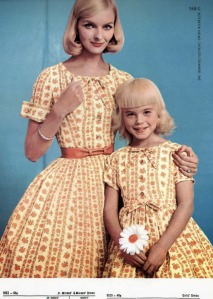
matchingoutfits

I read this post on City-Data.com tonight,  and this sounds so much like my mother it’s not even funny.    Even the time frame seems to be the same.

There is a difference though. My mother wasn’t above taking me to Sears, J.C Penny’s etc. to buy MY clothes, while she always shopped at Lord and Taylor’s for her own. Later, when we moved to New York, she bought her clothing at Bloomingdale’s but mine always came from Alexander’s (closed in 1992).    Not that I minded (I didn’t care), but it’s interesting that I always got the “low rent” stuff.

As for the hairbands mentioned in this post, my mother always bought me elastic ones.     At least they came in different colors.  I doubt she would have bought me a glittery plastic hairband either if I had asked for one, although she probably would have let me wear one and griped about it endlessly.   I remember she went nuts when I bought some pale blue nail polish and little decals to stick on my nails because of how “unnatural” and “tacky” it was, but she didn’t make me take it off.  When I was around 5 or 6, she  was also into those “mother and daughter” matching outfits that were so popular in the mid-196os.  Perfect for creating a mini-me to perfectly mirror the narc mother’s impeccable taste.


glitter_hairband

I was an extension of my mother. And I reflected her beauty and taste.
I grew up in the 1960s and 1970s and attended public schools. But my sisters and I looked as though we were “high society” – but you wouldn’t know it.

While my friend’s parents bought their clothes at Sears, Penny’s or even Macy’s; my mother pronounced those stores as “common” – pretty much her absolute worst word for anything.

She took us to Lord and Taylor, B. Altman, and Bonwit Teller. Frequently, the suburban branches were not deemed “good enough”, so we were made to drive an hour into NYC to buy triplicate Scottish wool kilts or velvet portrait collar dresses for Christmas day.

Same with the dentist! She didn’t like the shape of my lateral incisors, and they were capped in 6th grade!

As with everything though, there was a dark side to all of this.

I really wanted to wear a plastic hair band in the summer. Some were pearly and others were glittery. I thought they were “beautiful”, I was seven and I liked things that sparkled! Everyone in my neighborhood and my day camp had them in many different colors!

She wouldn’t let me get one. Not one. I mean it was a hair band and not a tattoo! It was a fad one Summer forty years ago.

She did relent about hair bands towards the middle of the Summer and bought me a tortoise shell one. It was drab. It was tasteless. It didn’t stand out on my head the way the wonderful glittery ones and lavender pearl ones did.

Worse, for a seven year old, no props from my friends. They thought it was ugly.

I took it into the woods and snapped it in half.

One afternoon she asked what happened to “that thing that you forced me to buy for your hair”.

I told her that I’d lost it. Her reply “thank God”, followed by a snicker that confirmed that she was lacking in any empathy at all.