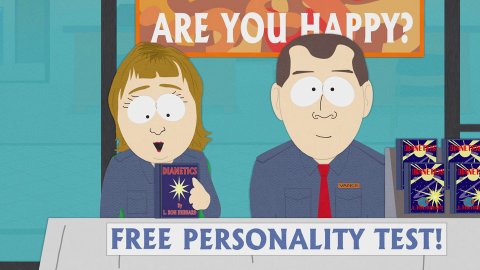
My love affair with Scientology.

south-park-s09e12c01-free-personality-test-16x9
Credit: South Park: What Scientologists Believe – Business Insider

In the late seventies, I flirted with $cientology (the $ sign isn’t accidental). This happened when I came across one of its books (one of the only ones not written by its founder L. Ron Hubbard, who was not only a malignant narcissist of the highest order, but also a very bad writer), an easy to read and humorous “self help” book called “How to Choose your People,” by a writer named Ruth Minshull. The book was discontinued in the early 1980s, most likely because it wasn’t written by Hubbard and was therefore not acceptable “scripture.” Hubbard, a monstrously narcissistic and sociopathic cult leader, couldn’t stand having to share the spotlight with anyone else.

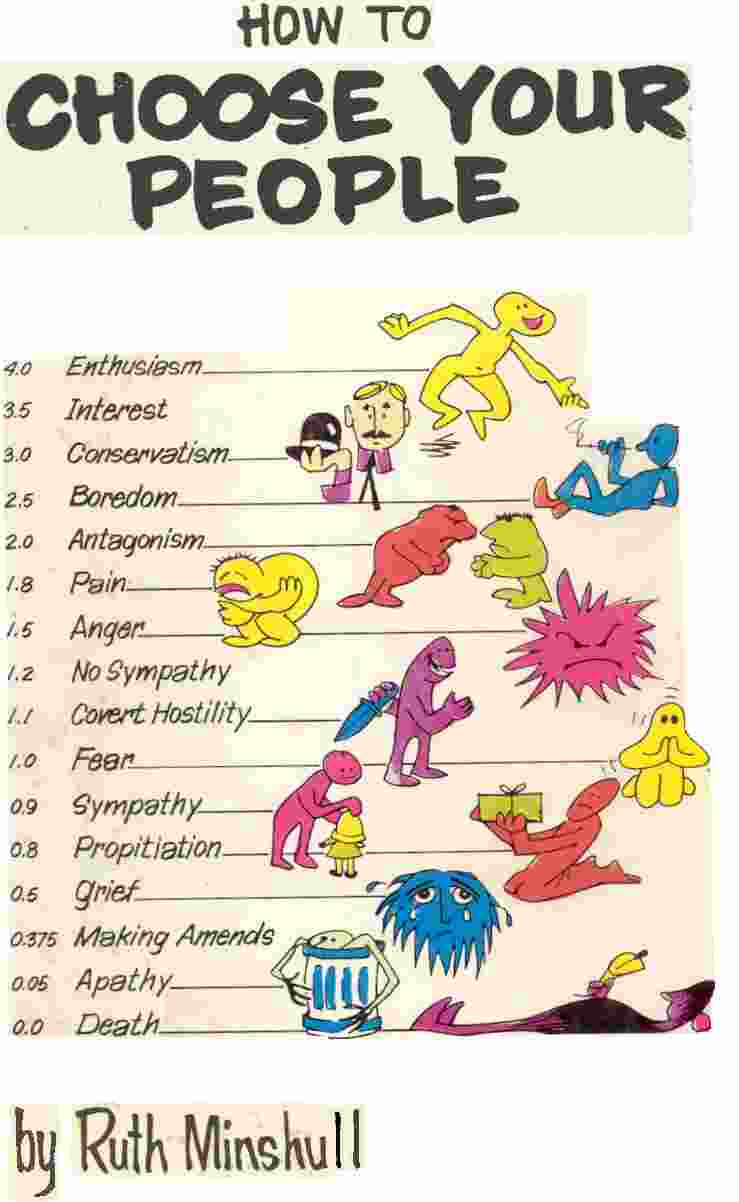
“How to Choose Your People” was entertaining and well written, and I found its idea of something called “The Tone Scale” intriguing and it seemed to make sense. (In fact, I think it’s one of the very few tenets of Scientology that has any validity). I liked the idea that emotions ran on a sort of continuum, with one logically leading to the next. Every human being can be placed somewhere on this “tone scale.” Although most people move around on the scale according to their mood, everyone can be placed at a “home” tone, where they will be most of the time. The “tones” ranged from Apathy (the lowest you could go–this would be where severely depressed and suicidal people are) to Enthusiasm (very happy and contented people). Each tone was assigned an arbitrary number, although no one ever explained what those numbers meant. *

There were two “emotions” around the middle of the scale, called Covert Hostility (1.1) and No Sympathy (1.2, making it slightly “better”). Although not at the bottom of the scale, while I was involved in Scientology (and the related Dianetics, the mental “technology” that is similar in some ways to psychoanalysis and serves as a tool to brainwash its members), Covert Hostility and No Sympathy were considered by most Scientologists to be the two worst places to be on the Tone Scale. No one wanted to be labeled a “1.1.” Because if you were, it meant you were a Suppressive Person–that is, a sociopathic person who could harm the Church and its members. If you were pegged a “1.1” or a “1.2” you could be excommunicated or punished by a cruel form of shunning (which I was subjected to at one point).

The traits of someone with a “tone” of Covert Hostility or No Sympathy are exactly the same of those of the malignant narcissist. Here is a picture of the tone scale as it appeared on the cover of Minshull’s 1976 book. (There is an expanded tone scale too, which has additional levels, but for our purposes this one is sufficient).
minshull1

Click image for larger view.

The love bombing phase. 

So I finished Minshull’s book and was intrigued enough to go to the local Scientology Center (on New York’s upper west side–I was living in Queens, NY at the time) and find out more. They gave me a “personality test,” that was supposed to identify what my issues and weak points were. There were 200 questions on the test, but when I was done, someone sat down with me and went over my results and convinced me I needed Dianetics auditing or classes in Scientology (much cheaper than Dianetics auditing) to overcome these weak points. The recruiter was very convincing and friendly, and assured me I would only be set back $15 to sign up for the HAS course (Hubbard Apprentice Scientologist aka “Communication Course”), which was really training in something called Training Routines (TR’s) which were actually brainwashing techniques, only they don’t tell you that when you sign up.

At first the TR’s were very seductive–they were fun and actually seemed to work. They did seem to help me be able to “confront” people better. The TR’s involved things like sitting in a chair staring at someone as long as you could without reacting, laughing, or looking away. After this, the ante was upped to something called “bullbaiting,” where the person could try to get you to react and “lose your Confront” by insulting you, trying to make you laugh, or calling you names. There were higher levels of TR’s that involved walking across the room, touching things, asking if birds could fly, and reading passages from “Alice in Wonderland.”

All these things were supposed to help you communicate with others better and raise your “tone,” but in actuality, these were all brainwashing techniques that would eventually result in giving you the infamous blank stare that many Scientologists seem to have while under the cult’s thrall.

The ante is upped. 

cartman_emeter

After I “passed” the Communications Course (by getting a “floating needle” on a lie-detector type of device called the E-Meter), I was convinced without too much difficulty to sign up for the next course, the HQS course (Hubbard Qualified Scientologist). That one set me back $250. (The prices are probably much higher today). By this time of course, I’d been sufficiently indoctrinated that $250 for further “processing” and “training” didn’t seem that bad. It didn’t take much to convince me to hand over the money. The prices of the courses (or “auditing,” if you take that route, become higher the further up the “bridge” you go. At higher levels, they run thousands of dollars. Most people don’t have that sort of money, but can “pay off” the expense by allowing themselves to become slaves to the Church — usually by working on site, or at higher levels, by joining the Sea Org, Scientology’s paramilitary organization in Clearwater, Florida. It’s at Sea Org that you hear all the horrible stories of abuse, starvation, imprisonment, the destruction of families, the separation of children from parents, and even the deaths of a few Scientologists who failed to toe the line or became, in Scientology parlance, SPs or “Suppressive Persons,” just because they still had a mind of their own or balked at the abuse meted out on them.

Back to my own story. In order to help pay for the HQS course (because in those days $250 was a lot of money, especially for a 19 year old) it was suggested I work at the Scientology Center (actually a Mission, which does not offer higher level training and auditing) part time, answering phones and opening and distributing mail. The position (called a “post”) paid nothing, but I got “credits” to help pay for the course. Of course, by now I was spending most of my free time at the Center, because right after “work” it was time for the classes, which ran about 4 hours a night (5 days a week).

Students were closely monitored and every class ended with a session on the E-Meter. If you were caught yawning or daydreaming you were told you had a “misunderstood word” and had to go back and re-read Hubbard’s unreadable material to try to find the word you did not understand. You were not allowed to move on until you found the word and “passed” on the E-Meter. I began to realize I wasn’t having much fun anymore, but if you criticized Scientology or its “teaching technology” in any way, you would be sent to Ethics.
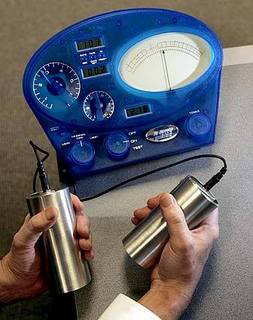
e_meter
Scientology E-Meter

Scientology’s real agenda begins to emerge. 

No one wanted to be sent to Ethics. If you were sent to Ethics, it meant there was a problem and you were considered a “Potential Trouble Source” (PTS) and disciplinary action would be taken. I was sent to Ethics about three or four times, all for very minor transgressions such as minor criticism–or catching a cold (more about that later). The punishments ranged from having to re-read material to find “misunderstood words” (and be “passed” being connected to an E-Meter), to cutting off friends and family members who could be potential “Suppressive Persons” or enemies of Scientology (you would be required to write them a letter telling them you were cutting them off), to shunning, to excommunication.

One time I came to the Center with a bad cold. I was immediately sent to Ethics because according to Scientology’s deluded doctrine, if you became ill, it meant there was a “SP” in your life who was hostile to your involvement in Scientology and by default, you became a PTS (potential trouble source). Sniffling and sneezing, I sat down and held the two metal cans of the E-meter. I was asked a bunch of questions about anyone in my life who was hostile to Scientology. You couldn’t lie, because that would be picked up by the meter. At the time, I was dating a guy who thought Scientology was stupid, and I told them that. I was ordered to “disconnect” from him, or be excommunicated. I had to write the boy (who I was still in love with) a letter telling him I was disconnecting from him because he was hindering my progress up the “bridge.” I cried while writing to him, but it did get mailed and I did disconnect.

Later, I almost had to write a “disconnect” letter to my own father, who I had once dumbly admitted had been making fun of Scientology. I was able to get out of that one by insisting he really wasn’t opposed to my involvement and just liked to make jokes about lots of things. But I did know other people there who were ordered to disconnect from family members, sometimes their entire families. I have heard of some Scientologists even being forced to disconnect from their own children. Looking back, I recognize this as the cult-equivalent of what a narcissist does when they attempt to isolate you from friends and family members. It’s a way to weaken you by cutting you off from your support systems so they more completely own you.

Shunning is another disciplinary measure, and I was once subjected to it (I cried while “auditing” a student, which I’ll describe in more detail later). I was told although I would still be required to fulfill my job duties and attend classes, no one would be allowed to speak to me and I was allowed to speak to no one (unless it was directly related to my job or something I was learning). It was horrible. This torment on for several days, until I was “passed” up a level and allowed to be spoken to again. But before that could happen, I had to go up to every high level member and employee, make amends to them and “re-introduce” myself. I also was required to do some tasks to “make up” for whatever “sin” I’d committed. Some involved things like cleaning bathrooms or washing dishes. But others could get pretty weird. I’ll describe the task I was required to fulfill in order to be re-accepted into the group.

Scientology’s vendetta against mainstream mental health and the part I played in it. 
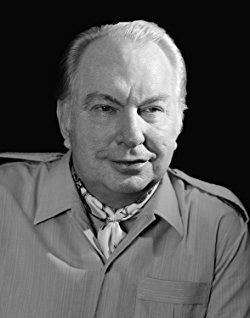
lronhubbard

L. Ron Hubbard: pulp science fiction author turned self-proclaimed messiah.

It’s well-known that Scientology has always been very hostile to mainstream psychology and psychiatry. L. Ron Hubbard thought of psychiatry as the worst evil to befall mankind. My theory about this is based on his malignant narcissism. When he first developed Dianetics (the “auditing technology” that resembles psychoanalysis in some ways) back in the early 1950s, Hubbard had attempted to get it recognized in the psychiatric community as a valid form of psychotherapy. Of course, Hubbard had no psychology degree (and in fact, had lied about much of his background). The psychiatric community refused to promote his ideas or his book, “Dianetics: The Modern Science of Mental Health.” Hubbard, enraged by their rejection of his “brilliant technology,” turned against the psychiatric and psychological communities (and marketed his book, at first, through ads in pulp science fiction magazines, where he was already known as one of their contributors).   Eventually, he decided to turn his ideas into a new religion and named it Scientology.  Now, he could make more money than he ever could as a mere author, and never have to pay a dime in taxes.

That’s the background that will explain the task I was assigned to do to get back in good graces with the Church. I was given a list of names of psychiatrists and psychologists and told to go to the library and look up each one in the phone book and get their phone numbers. Okay, that was easy enough. I headed back to the Center with the phone numbers filled out, hopeful that this would fulfill my duty.

But no, they weren’t done with me yet. I was told to go home with the list of names and phone numbers, and call each of the doctors and ask them what they thought about Scientology! As someone who hates phones and alway felt awkward speaking on them, I felt like I was in some kind of nightmare. I also had to LIE to them and tell them I was a research student doing a study for a university program.

But I did do it. A few of the doctors refused to call me back, or I only got to speak to their secretaries, who couldn’t give me an answer, but most of them I got to actually speak to, and as would be expected, most of the responses were negative toward Scientology. Apparently, my research was sufficient. Finally, I was then allowed to “make amends” to all the higher level staff members and the shunning was lifted.

Ironically (or maybe not so ironically), a year later, I entered college as a Psychology major.

Disillusionment and return to reality.

Toward the end of the HQS course, you are told to recruit other people into Scientology. I had to go outside, no matter what the weather, and try to talk people into coming up to the Center to take its personality test. The more advanced TR’s taught in this class became increasingly bizarre. These sessions could go on for hours, and as part of the training, I was also required to “audit” other students and conduct TR’s on them. If they proved difficult or uncooperative, I was the one who was blamed and was not allowed to stop “running the TR’s” until my student had passed on the E-Meter. If it went on all night, then so it did. You were not allowed breaks to eat or rest, and neither was your student.

This is what led to my “shunning” punishment. What happened was I was so exhausted from lack of sleep and hunger that I burst into tears in the middle of running a session, and was immediately sent to Ethics and that’s how I got shunned. I was stunned by their total lack of empathy. You were never allowed to show any emotions other than fake happiness (“Enthusiasm” on the tone scale); showing any “low toned” emotions like fear, grief, frustration, pain, or anger was “bringing ‘case’ on post” and you would be sent to Ethics or punished for doing it.

I thought about leaving, but didn’t dare–because they threatened you with something called “Fair Game.” No one ever explained exactly what that was, but in Hubbard’s indecipherable scripture, “fair game” appeared to imply the Church reserved the right to stalk you, torment or even kill you if you “blew” (left). I’d also paid so much money into it by this point and spent so much time with them that I was hesitant to toss in the towel.

Shortly before I was to graduate from HQS (which I never did finish), I was sent to talk to a recruiter about my next “step up the bridge.” I was told I should sign up for “Life Repair,” which cost $6K. I told the recruiter I did not have that kind of money. The recruiter turned to the hard sell at that point. He told me to get a bank loan or ask my parents for the money. Neither was possible. There was no way I could pay back the bank, as my other (paying) job was part time and paid only $2.75 an hour (minimum wage at that time), and my parents were not the type to hand over large sums of money, even for something legitimate.

Finally, after two hours of unsuccessfully trying to get me to sign up for this $6,000 auditing package, the recruiter gave up and was quite hostile to me after that. He not only told me that I must not really be interested in moving up the Bridge, but that I was probably a Suppressive Person and an enemy of Scientology because I would not put myself in huge debt to continue to be brainwashed.

It was at this point I left the Church. I just didn’t care anymore. I had gradually come to realize that the “emotional tone” of the organization was somewhere around Covert Hostility and No Sympathy–which was quite interesting since those were the tones that were the most hated and feared and were the realm of the dreaded Suppressive Person. In other words, Scientology was a psychopathic, narcissistic cult, founded by a psychopathic malignant narcissist (1.1 on his own Tone Scale) whose ravings (and fabrications as a “war hero” among other things) are legendary. What they were really doing was projecting their own emotional tone (malignant narcissism) onto those who disagreed with them.

I also realized how I had been gradually seduced into this sociopathic organization through misrepresentation, manipulation, threats and lies. The personality test and the inexpensive and fun HAS course that promised to help me feel happier and more confident was merely the “love bombing” phase before the abuse that would come later and increase over time. I did NOT want to become one of the upper-level Scientologists, with their blank, weird stares, creepy smiles and total lack of empathy. Just look at Tom Cruise today: does he even seem human anymore? Hell, I’d rather be a Suppressive Person any day.

I didn’t get nearly as far up the “Bridge” as many other people, and therefore did not experience some of the trauma and torture inflicted on members who are more deeply enmeshed with this cult. Eventually they WILL take over your entire life. For anyone interested in finding out more about the evil mindgames this cult plays, its psychopathic paranoia about both government agencies like the IRS and its hatred and fear of traditional psychotherapy and psychiatry, and the horrific (and sometimes fatal) punishments inflicted on many of its members and their families, I highly recommend either of these two websites that call out Scientology for what it really is.

The Ex-Scientologist Message Board: http://www.forum.exscn.net
Operation Clambake: The Inner Secrets of Scientology: http://www.xenu.net/

This is also pretty interesting, and what they actually believe is NOT a joke.
South Park: What Scientologists Believe (Business Insider):
http://www.businessinsider.com/south-park-what-scientologists-believe-2015-3

*****

* I just read that the numbers assigned to the emotions on the Tone Scale come from E-meter readings. In fact, Hubbard did not invent the E-meter. It was invented by a Freudian psychoanalyst named Volney Mathison, who used it on his psychotherapy patients.  It was called the Electropsychometry meter.  Hubbard bought the rights to the E-meter, and adapted it for use in Dianetics and Scientology auditing. The readings on the E-meter determine a person’s emotional tone.

Here is a picture of Volney’s E-meter, before it was co-opted by L. Ron Hubbard:

volney_emeter

Guest Post # 10: Narcissistic Abuse in 12-Step Programs

12_step_cult
Artwork by Danny Jock

Ceetee, who wrote this post, writes an interesting blog about the darker side of 12-step programs, called Quicksand: The Darker Side of 12-Step Programs. Be sure to click on the link and pay a visit.

Ceetee writes about a little-known problem in 12-step programs like Alcoholics Anonymous– some members of these programs adopt a cult-like mentality and “take your inventory” for you, even though one of their slogans is “don’t take my inventory.” I have known people, including family members, who treat AA and other 12-step programs like a religion. You must follow their Commandments (the 12 steps) to the letter, and if you disagree with old-timers’ “assessments” of what your problem is, they tell you you are resisting or are on a “dry drunk.” Not all members are like this, but many of them are, and they can be cause psychological trauma to those who are new in these programs. Others have also written about the religious cult-like atmosphere often present in the meeting rooms.

Don’t get me wrong. AA and other 12-step programs have helped a great many people, and are one of the most effective (and cheapest) ways a person can get clean or sober. They have saved many lives. They also have a spiritual aspect, which adds another dimension that goes deeper than just “curing addiction.” They also tell you that once you’re addicted, you’re always addicted and should refrain from using or drinking, one day at a time. This is excellent advice and works for many people. But the dangers of these programs is that many people with addictive disorders who join them are narcissists, and use their “knowledge” or “experience” to make themselves feel superior to others. They think they know you better than you know yourself and don’t hesitate to lord it over you as if you’re nothing. You are told to “shut up and listen” because they are the “old timers” and have a right to tell you what you’re doing wrong. Since 12 step programs are run by the members themselves, there are really no safeguards against narcissistic abuse within these programs. One must proceed with caution.

Another problem with 12-step programs is that for some people, they seem to become another addiction.    I suppose that’s fine as far as if goes (going to meetings beats drinking or drugging), but too often , recovery stops there, and the member never attempts to address the roots of the problems which caused them to abuse alcohol or drugs in the first place.  From what I can tell, disorders such as NPD and BPD seem to run rampant in these programs, and people with these disorders often do become addicted to substances, in their attempt to fill the emptiness they feel inside.  Getting clean or sober is great, but it’s only treating one symptom of a deeper problem, and their disordered, grandiose, gaslighting, entitled behavior remains the same or even becomes worse.

Here, Ceetee writes of her own experience with certain narcissistic individuals in a 12-step program she joined, whose toxic “help” she had to recover from. It almost destroyed her life, but she has quite a story to tell.

NARCISSISTIC ABUSE IN 12-STEP PROGRAMS

zombie-steps-fix

Nearly twenty-two years ago, I made a mistake that destroyed my life and my family. In the middle of an ongoing battle with my mother that I had no idea how to resolve, I took the approach that perhaps total strangers could be objective and would have a solution. It began with pen-pals; I’ll call the first pen-pal “Marie.” Marie offered hope for a better life; but she said what I must do is “work the Twelve Steps.” And without any drug or alcohol problems, that’s how I became involved in 12-Step programs. It didn’t even occur to me until much later that after I was immersed in ‘the programs,’ the actual problem was never addressed again.

Throughout the years, I knew many good people who participated in programs. However, I also met those who took the slogan “If you want what we’ve got–and are willing to go to any lengths to get it” to mean targeting and destroying others. And while there is plenty of information around the web describing all sorts of crimes members commit, this particular subject is rarely addressed: “rewriting your life history” to include false memories of childhood sexual abuse. I feel it is necessary to address it, as I’ve known many individuals who have had similar experiences–no memories of abuse until they were ‘worked on’ by old-timers in the Programs.

I was ‘worked on’ by three different members–each in a different location. Each had something they wanted from me, and this scam was the most destructive tactic they took to achieve it. They tried to cause me to doubt my own mind and memories; but more destructive, took the approach to other people ‘See how crazy she is–she does not even know what happened in her own life!’

I dismissed many “red flags,” because I didn’t understand what they were about. One example was (as the older generation would have called it) being “too familiar”–a total stranger would act like he/she was your dearest best friend, your confidante. Second, total strangers pushing the attitude that they know more about you and about your life than you yourself know. Third, the attitude that they and only they know ‘the truth’–everyone else and everything else is ‘wrong.’

Each began with a different approach. Individual #1 took the approach that he was an expert on everything related to drugs. Individual #2 basically rewrote the English language to suit her agenda–which is a common thing in 12-Step programs. Individual #3 claimed virtually everything about me were signs and symptoms of repressed trauma. None of these individuals were professionals in any capacity. All I could figure was they ‘read a book’ or ‘saw something on the Internet,’ as much was aligned with what memory experts said decades ago: the ability to create false memories, and to plant seeds of doubt, are almost limitless. Between the three of them, they attempted to get me to believe virtually everybody in my childhood had ‘sexually abused’ me. Individual #1–the first I actually met in person–demanded I give him all my family photographs; he tossed them in a wastebasket, set fire to them, and smugly remarked “You’ve gotta mark ’em all as Perpetrators.”

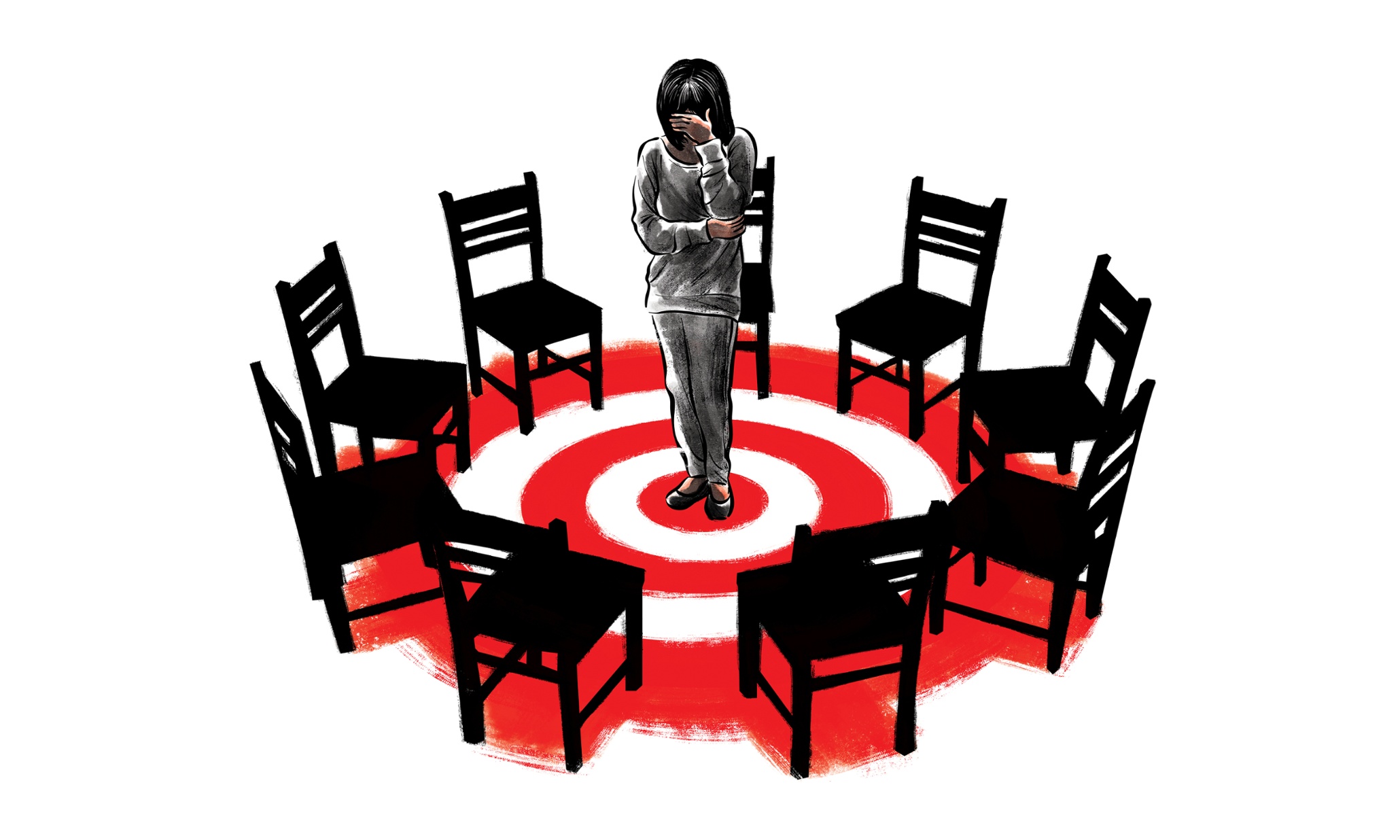
target_cult
Artwork: Chloe Cushman for The Guardian

Another red flag that bears noting: while Marie and most others focused on their programs, the present, and looking toward the future, these three were much different. Their entire focus was on “The Past” and “Abuse.” And yet another red flag: looking for any ‘crack in the armor’ that they could exploit as ‘proof’ that their assessments were correct.

Hopefully it won’t sound too ludicrous taking it all out of context, but some examples:
One, upon learning I’d had a minor medical problem as a small child that required prescription medication, assessed: “Your parents lied to you! They were drugging you so they could Abuse you!”
Noticing I’d run outside to see what the commotion was when police cars arrived at a neighbor’s house: “What is it from Your Past that caused you to Fear the police?” Individual pressed me to search my early childhood to see if I’d known any police officers that may have sexually abused me.

Upon learning I’d never gotten along with my mother, another individual dismissed the fact that it was nothing more than personality conflicts, and claimed I was an incest survivor and had post-traumatic stress disorder because of it. This individual said anything you dislike is sexual abuse, and must be called ‘rape.’

In one instance, I had a minor cold; when this did not require a visit to a doctor, this individual asked, “What is it from Your Past that’s caused you to Fear doctors?” This individual pressed me to think about the doctors I knew in my childhood, and asked if either of my parents were in the profession.

Vertigo attacks from an inner-ear infection; migraines from hypoglycemia; and my habit of watching where I’m going when barefoot so I don’t step on sharp objects were pounced on as proof that I had ‘traumas in the past that I just don’t remember.’ Also, a person does not have personal preferences, likes or dislikes, or objections to anything–they’re all proof of sexual abuse.
Similar to the tactics used when the so-called recovered memory movement was in full swing, I was pressured to consider every thought and dream as a ‘memory,’ any ache or pain to be a ‘body memory,’ etc.

The only incident that actually did occur was blown way out of proportion: when I was four years old, a neighbor of indeterminate adult age exposed himself, and then told me a ‘scare story’ so I wouldn’t tell my parents or brothers what he’d done. The incident was confusing, but it was not ‘traumatic.’ However, one of these members claimed it was a matter of “delayed stress,” that I “only had a cap on it,” and at some point without warning my mind would blow apart. Note I was told this asinine nonsense more than forty years after the incident.

The reason I was vulnerable to this nonsense: I’d never heard of this crap before. For years I knew something was fishy, but didn’t know what to make of it. My first breakthrough came when I met a 12-Step member who was pointing at nearly everyone she’d ever known and accusing them of sexually abusing her. I knew for a fact some of the people she was accusing hadn’t even been in her life when she was growing up.

The second breakthrough: I did some research, and found the ‘drug’ I was told my parents had given me wasn’t even available in the United States when I was a young child. In addition, while the member went by my description of the medication (size, shape, color), the two drugs bore no resemblance to each other.

Fortunately, these breakthroughs occurred before individual #3 intruded into my life against my objections, tried to “convince” me that I was “insane” because of my “past,” and destroyed my reputation and my life because I didn’t fall for it.

This is a widespread problem in 12-Step programs. I’ve known many people who had similar experiences–both male and female in all age groups. And while this is only the tip of the iceberg of what I went through, I’m hoping that exposing this issue can help others avoid these problems. First, if someone you don’t even know gets too familiar, too close, too intrusive, take whatever steps necessary to get that person away from you, your life, your family. Second, if you’re pressured to believe things happened that you don’t remember, keep in mind that this ‘information’ is not coming from within you, yourself, but that it is being placed there by outside sources.

Further Reading:

Narcissists Who Use 12-Step Programs to Further Their Agenda

“Children of God”: demonic cult disguised as Christianity

david_berg
David Berg, founder of the Children of God.

Talk about wolves in sheep’s clothing! David Berg, a malignant narcissist extraordinaire, who believed himself to be the Last Great Prophet of God and called himself “Moses David,” founded the hippie-like Jesus cult, the “Children of God” (a/k/a “The Family”) in 1968, as part of the well-known “Jesus movement” of the late 1960s. The Children of God (from here on, abbreviated CoG) believed in millennarianism, the “last days” and Biblical prophecy. Like almost all Christians, they worshipped Jesus Christ as their lord and personal savior. What’s so bad about that, you say? It’s just garden variety fundamentalist, evangelical Christianity, right?

Well, yes and no. Berg gradually began to incorporate very un-Christian, unbiblical principles into his cult and even re-wrote the Bible as he interpreted it. He believed sex was a God-given tool meant to be used by humans to get closer to Him.

Many religions accept sex as a good and beautiful expression of love within the confines of a marriage or a close and committed relationship, but in this cult, promiscuity and “free love” was okay, because it was a way to commune with the Divine. It was okay for a woman to masturbate and “come” for Jesus. They were encouraged to be “God’s Love Slaves.” Baby Boomers and younger members of the Silent Generation who had already become used to the idea of free love and sex with multiple partners were at first attracted to this “understanding” guru who loved Jesus but encouraged them to indulge in their carnal desires.

But it was their Generation X children who were about to really be exploited.

Illustrations in CoG literature and its Bible were cartoon-like (in the Jack Chick style of cartooning) and sexually explicit. Some involved children and S&M scenarios. Some of the illustrations are shown in this documentary series, so if you’re offended by sexually explicit drawings or pornography, you may want to be aware of this before you watch the videos.

Families were regimented, children were raised separately from their parents and raised by nannies (similar to the way the Hebrew kibbutz is run). Children were raised communally by nannies, while their parents spent their time focusing on their spiritual (sexual) relationships with one another and most of all, with Jesus.

But things got even worse. Eventually children themselves were drawn into the depraved sexual activities of this cult, and were encouraged by Berg to be used sexually by adults, even as young toddlers, to “connect” with one another and in the process become closer to God Himself.

Survivors and especially the adult Gen-X children who grew up in this destructive cult were badly damaged and suffer from PTSD and other serious mental conditions, and in some cases committed or attempted suicide.

Here is the video series–it’s in seven parts, but I have only posted the first installment. From there, you can click on the rest. This is very scary stuff.
The cult still exists today under their new name, “The Family International.”

http://www.youtube.com/watch?v=Ud4Z9xkre6g

Here’s another video that focuses more on Berg and the cult itself, rather than survivors who are trying to cope with the aftermath.

Must-see documentary about NPD

carravagio
Detail from “Narcissus” by Caravaggio (ca 1597-1599)

“Egomania” (an archaic term for NPD) is an extremely well done documentary about NPD with interviews with business executives, cult leaders, criminals and others who have this devastating disorder.

Highlights: David Berg, founder of the biblical sex cult “Children of God” (very scary) and writer of his own bible, eventually encouraged sexual activity with children in the cult; murderer Brian Blackwell, a “nice boy” who had all 9 clinical traits of NPD (very few people have all of them, even among narcissists), a pathological liar and charmer who snapped and murdered his own parents without an ounce of remorse; and Sam Vaknin, who has all 9 traits of NPD but was insightful enough to separate himself from humanity by exiling himself to an eastern European country and lives as a near-hermit with his subservient wife.

Part 1: https://www.youtube.com/watch?v=AGTwgX-TUfM&list=PL8u7CCgBKzq_hqU0zyFBfsG00-ZT3Ct3H
Part 2: https://www.youtube.com/watch?v=pXe9dn_SlE0
Part 3: https://www.youtube.com/watch?v=E3rB2VI4uK8
Part 4: https://www.youtube.com/watch?v=B0vYmKZjQts
Part 5: https://www.youtube.com/watch?v=n52kfOul_hQ

David Berg’s evil cult “Children of God” was so fascinating to me I plan to watch the 7 part series about it on Youtube. I may write about it later and/or post the videos.

The CEO interviewed in the beginning of the documentary was quite frightening to me and I would have pegged him as a very malignant narcissist, and yet he is not clinically NPD because he only possesses three of the traits (most normal people have 2 or 3). Maybe it’s because his few NPD traits seem so extreme.

For easier reference, here are the 9 traits of someone with NPD (per DSM):

1. Has a grandiose sense of self-importance (e.g., exaggerates achievements and talents, expects to be recognized as superior without commensurate achievements)
2. Is preoccupied with fantasies of unlimited success, power, brilliance, beauty, or ideal love
3. Believes that he or she is “special” and unique and can only be understood by, or should associate with, other special or high-status people (or institutions)
4. Requires excessive admiration
5. Has a very strong sense of entitlement, e.g., unreasonable expectations of especially favorable treatment or automatic compliance with his or her expectations
6. Is exploitative of others, e.g., takes advantage of others to achieve his or her own ends
7. Lacks empathy, e.g., is unwilling to recognize or identify with the feelings and needs of others
8. Is often envious of others or believes that others are envious of him or her
9. Regularly shows arrogant, haughty behaviors or attitudes

Kind of off-topic, but why are almost all good documentaries from the UK or Canada and not from America? American “documentaries” are just infotainment and fluff and there seem to be so few good ones.

Scientology: a cult of psychopathy

hubbard

Scientology, like most cults, uses exactly the same brainwashing techniques the narcissist does to recruit and retain its members. Here’s a video I found on the Ex-Scientologist Message Board, where Sam Vaknin talks about the “cult of the narcissist,” and even though it’s not specific to Scientology, it’s spot on in describing the mind games narcissists use to trap their prey (sorry, I was unable to embed the video). The same techniques apply to most cults. Scientology is one of the most dangerous.

In 1978 and 1979, I flirted with Scientology. This happened when I came across one of its books (one of the only ones not written by its founder L. Ron Hubbard, who was not only a malignant narcissist of the highest order, but also a very bad writer), an easy to read and humorous “self help” book called “How to Choose your People,” by a writer named Ruth Minshull. The book was discontinued many years ago, probably because it wasn’t written by Hubbard and therefore not acceptable “scipture.” “How to Choose Your People” was entertaining and well written, and I found its idea of something called “The Tone Scale” intriguing and it seemed to make sense. I liked the idea that emotions ran on a sort of continuum, with one logically leading to the next. Every human being can be placed somewhere on this “tone scale.” Although most people move around on the scale according to their mood, everyone can be placed at a “home” tone, where they will be most of the time. The “tones” ranged from Apathy (the lowest you could go–this would be where severely depressed and suicidal people are) to Enthusiasm (very happy and contented people). Each tone was assigned an arbitrary number, although no one ever explained what those numbers meant.

There were two “emotions” around the middle of the scale, called Covert Hostility (1.1) and No Sympathy (1.2, making it slightly “better”). Although not at the bottom of the scale, while I was involved in Scientology (and the related Dianetics, the mental “technology” that is similar in some ways to psychoanalysis and serves as a tool to brainwash its members), Covert Hostility and No Sympathy were considered by most Scientologists to be the two worst places to be on the Tone Scale. No one wanted to be labeled a “1.1.” Because if you were, it meant you were a Suppressive Person–that is, a psychopathic person who could harm the Church and its members. If you were pegged a “1.1” or a “1.2” you could be excommunicated or punished by a cruel form of shunning (which I was subjected to at one point).

The traits of someone with a “tone” of Covert Hostility or No Sympathy are exactly the same of those of the malignant narcissist. Here is a picture of the tone scale as it appeared on the cover of Minshull’s 1976 book. (There is an expanded tone scale too, which has additional levels, but for our purposes this one is sufficient).

minshull1

Click image for larger view.

So I finished Minshull’s book and was intrigued enough to go to the local Scientology Center (on New York’s upper west side–I was living in Queens, NY at the time) and find out more. They gave me a “personality test,” that was supposed to identify what my issues and weak points were. There were 200 questions on the test, but when I was done, someone sat down with me and went over my results and convinced me I needed Dianetics auditing or classes in Scientology (much cheaper than Dianetics auditing) to overcome these weak points. The recruiter was very convincing and friendly, and assured me I would only be set back $15 to sign up for the HAS course (Hubbard Apprentice Scientologist aka “Communication Course”), which was really training in something called Training Routines (TR’s) which were used as brainwashing techniques.

At first the TR’s were very seductive–they were fun and actually seemed to work. They did help me be able to “confront” people better, or at least seemed to. The TR’s themselves involved things like sitting in a chair staring at someone as long as you could without reacting, laughing, or looking away. After this, the ante was upped to something called “bullbaiting,” where the person could try to get you to react and “lose your Confront” by insulting you, trying to make you laugh, or calling you names. There were higher levels of TR’s that involved walking across the room, touching things, asking if birds could fly, and reading passages from “Alice in Wonderland” of all things.

All these things were supposed to help you communicate with others better and raise your “tone,” but in actuality, these were all brainwashing techniques that would eventually result in giving you the infamous blank stare that many Scientologists seem to have while under the cult’s thrall.

After I “passed” the Communications Course (by getting a “floating needle” on a lie-detector type of device called the E-Meter), I was convinced without too much difficulty to sign up for the next course, the HQS course (Hubbard Qualified Scientologist). That one set me back $250. (The prices are probably much higher today). By this time of course, I’d been sufficiently indoctrinated that $250 for further “processing” and “training” didn’t seem that bad. It didn’t take much to convince me to hand over the money.

In order to help pay for the course (because in those days $250 was a lot of money, especially for a 19 year old) it was suggested I work at the Center part time, answering phones and opening and distributing mail. The position paid nothing, but I got “credits” to help pay for the course. Of course, by now I was spending most of my free time at the Center, because right after “work” it was time for the classes, which ran about 4 hours a night (5 days a week).

Students were closely monitored and every class ended with a session on the E-Meter. If you were caught yawning or daydreaming you were told you had a “misunderstood word” and had to go back and re-read Hubbard’s unreadable material to try to find the word you did not understand. You were not allowed to move on until you found the word and “passed” on the E-Meter. I began to realize I wasn’t having much fun anymore, but if you criticized Scientology or its “teaching technology” in any way, you would be sent to Ethics.

e_meter
Scientology E-Meter

No one wanted to be sent to Ethics. If you were sent to Ethics, it meant there was a problem and you were considered a “Potential Trouble Source” and disciplinary action would be taken. I was sent to Ethics about three times, all for very minor transgressions such as minor criticism. The punishments ranged from having to re-read material (and be “passed” being connected to an E-Meter), to cutting off friends and family members who could be potential “Suppressive Persons” or enemies of Scientology (you would be required to write them a letter telling them you were cutting them off), to shunning, to excommunication.

I was once subjected to shunning. I was told although I would still be required to fulfill my job duties and attend classes, no one would be allowed to speak to me and I was allowed to speak to no one (unless it was directly related to my job or something I was learning). It was horrible. This torment on for several days, until I was “passed” up a level and allowed to be spoken to again. But before that could happen, I had to go up to every high level member and employee, make amends to them and “re-introduce” myself.

Toward the end of the HQS course, you are told to recruit other people into Scientology. I had to go outside, no matter what the weather, and try to talk people into coming up to the Center to take its personality test. The more advanced TR’s taught in this class became increasingly bizarre. These sessions could go on for hours, and as part of the training, I was also required to “audit” other students and conduct TR’s on them. If they proved difficult or uncooperative, I was the one who was blamed and was not allowed to stop “running the TR’s” until my student had passed on the E-Meter. If it went on all night, then so it did. You were not allowed breaks to eat or rest, and neither was your student. I remember once being so exhausted from lack of sleep and hunger that I burst into tears in the middle of running a session, and was immediately sent to Ethics and that’s how I got the “shunning” punishment. I was stunned by their total lack of empathy.

I thought about leaving, but didn’t dare–because they threatened you with something called “Fair Game.” No one ever explained exactly what that was, but in Hubbard’s indecipherable scripture, “fair game” appeared to imply the Church reserved the right to stalk you, torment or even kill you if you “blew” (left). I’d also paid so much money into it by this point and spent so much time with them that I was hesitant to toss in the towel.

Shortly before I was to graduate from HQS (which I never did finish), I was sent to talk to a recruiter about my next “step up the bridge.” I was told I should sign up for “Life Repair,” which cost $6K. I told the recruiter I did not have that kind of money. The recruiter turned to the hard sell at that point. He told me to get a bank loan or ask my parents for the money. Neither was possible. There was no way I could pay back the bank, as my other (paying) job was part time and paid only $2.75 an hour (minimum wage at that time), and my parents were not the type to hand over large sums of money, even for something legitimate.

Finally, after two hours of unsuccessfully trying to get me to sign up for this $6,000 auditing package, the recruiter gave up and was quite hostile to me after that. He not only told me that I must not really be interested in moving up the Bridge, but that I was probably a Suppressive Person and an enemy of Scientology because I would not put myself in huge debt to continue to be brainwashed.

It was at this point I left the Church. I just didn’t care anymore. I had gradually come to realize that the “emotional tone” of the organization was somewhere around Covert Hostility and No Sympathy–which was quite interesting since those were the tones that were the most hated and feared and were the realm of the dreaded Suppressive Person. In other words, Scientology was a psychopathic, narcissistic cult, founded by a psychopathic malignant narcissist (1.1 on his own Tone Scale) whose ravings (and fabrications as a “war hero” among other things) are legendary. What they were really doing was projecting their own emotional tone (malignant narcissism) onto those who disagreed with them.

I also realized how I had been gradually seduced into this psychopathic organization through misrepresentation, manipulation, threats and lies. The personality test and the inexpensive and fun HAS course that promised to help me feel happier and more confident was merely the “love bombing” phase before the abuse that would come later and increase over time. I did NOT want to become one of the upper-level Scientologists, with their blank, weird stares, creepy smiles and total lack of empathy. Just look at Tom Cruise today: does he even seem human anymore? Hell, I’d rather be a Suppressive Person any day than one of them.

I didn’t get nearly as far up the “Bridge” as many other people, and therefore did not experience some of the trauma and torture inflicted on members who are more deeply enmeshed with this psychopathic cult. Eventually they WILL take over your entire life. For anyone interested in finding out more about the evil mindgames this cult plays, its psychopathic paranoia about both government agencies like the IRS and its hatred and fear of traditional psychotherapy and psychiatry, and the horrific (and sometimes fatal) punishments inflicted on many of its members and their families, I highly recommend either of these two websites that call out Scientology for what it really is.

The Ex-Scientologist Message Board: http://www.forum.exscn.net/ (This is where I found the Sam Vaknin video posted at the beginning of this article).
Operation Clambake: The Inner Secrets of Scientology: http://www.xenu.net/

Oh, and this is my 300th post!

Sam Vaknin thinks Jesus was a narcissist.

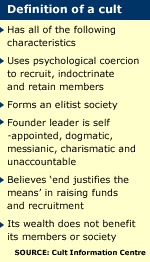
cultdefinition
A true cult’s agenda and operation is definitely psychopathic. (click to enlarge).

Sam Vaknin has a lot to say about religion and cults and how they relate to psychopathy.
On his website, he addresses the problems of religious cults and describes the way they are almost always run by malignant narcissists who use their usual bag of psychopathic tricks to brainwash people into converting and once converted, keeping them in thrall to the cult. The article is here.

Vaknin’s description of cults sounds exactly the way a cult such as Scientology is run (I dabbled in it back in the late 1970s for about 2 years but was fortunate enough to be able to escape before I was completely taken in). I have no doubt Scientology’s founder, L. Ron Hubbard, a hack science fiction writer, was a malignant narcissist (his official bio is full of lies and “accomplishments” that are complete fabrications). Scientology doctrine uses every trick in the psychopath’s book of coercion: brainwashing techniques disguised as “auditing” or “training routines (TR’s), threats to members who threaten to leave the cult (“fair game”), attempts to separate members from their non-Scientologist families and friends, exhorbitant and extortionist prices to move up the “bridge,”
insane doctrine passed off as “truth,” and definitely lots of paranoia and secrecy.

Lronhubbard
L. Ron Hubbard, malignant narcissist

Scientology is the enemy of any legitimate psychotherapy–psychology and psychiatry are held to be the utmost evil, members are required to use underhanded means to attack and even attempt to destroy the careers of professionals in those fields (I have a personal story about this I’ll describe at a later time), and of course Scientology has had numerous problems with the IRS and other government agencies. Anyone who criticizes Scientology is labeled a “Suppressive Person” and is either excommunicated from Scientology or punished by a form of shunning. Members who are influenced by someone who is against Scientology are labeled “Potential Trouble Sources” (PTS) and ordered to cut the “SP” out of their lives, even if it’s a spouse or another close family member.

There’s an excellent and fascinating website about the insane mindgames this “religion” plays and includes case histories of people whose lives were totally ruined by this dangerous and psychopathic cult. The “secrets” of the upper OT (operating thetan) levels used to be unobtainable to anyone who had not “gone clear” and had the money to pay for further “processing” to the OT levels, but those jealously guarded secrets are now available to anyone who has Internet access and is curious enough to Google them. Well, naturally I was curious and the “secrets” are indeed pretty crazy, obviously the ravings of L. Ron Hubbard’s disordered and paranoid mind.

It used to be said that the secrets could not be revealed to members at lower levels because such knowledge would shock them to the point of actually killing them. I remember reading about one ex-Scientologist who suggested that the real reason the upper level secrets were so carefully guarded was not to “protect” anyone from the shock of the “truth” but rather, because the things revealed at the upper levels were so insane that only someone who had spent thousands of dollars and been thoroughly brainwashed could possibly take them seriously (in fact, there are cases of those who did reach those levels and when the secrets were finally revealed to them, they left the Church because they felt their entire journey had been a colossal waste of time and money). Anyone who hadn’t made such a huge mental and financial investment and read about the OT revelations online would die alright: they would die of laughter. And yes, they are that crazy. I read the “revelations” of the OT levels with my jaw glued to the table in disbelief that any sane person would believe such a load of crap.

Vaknin should have used the example of Scientology, a perfect example of a “religion” with a psychopathic agenda and a malignant narcissist “god.” There are many other examples he could have used too–the Branch Davidians, Heaven’s Gate, the Unificiation Church (Sun Myung Moon’s cult), a few “New Age” cults, and many others.

But no, instead Vaknin attacks Christianity. He actually says Jesus Christ was a narcissist. I don’t know what Vaknin’s religious beliefs are, or even if he has any, and I certainly have my own issues with organized religion and fundamentalist Christianity in particular (the God of the Old Testament does come off as quite psychopathic at times), but I think Vaknin is missing the mark by describing Jesus Christ this way (or Christianity in general as a cult). He uses Bible quotes to “prove” that Jesus was a narcissist. Rather than try to paraphrase what he says, I’ll just post it here:

Jesus Christ, narcissist
http://samvak.tripod.com/journal79.html

Note:
Though most of the quotes in this essay are from the Gospel of Saint Matthew, I was careful to compare them with the texts of the other three canonical gospels. Where the gospels disagree, I avoided using the quote altogether.

Illegitimate and adopted children, especially of humble origins, often develop narcissistic defenses to fend off persistent feelings of inadequacy and inferiority. Admittedly, it is highly unlikely that Jesus was an illegitimate child. Adulteresses in ancient Judea were stoned to death. But, equally, there is little doubt that the circumstances of Jesus’s birth were shrouded in mystery. His mother, Mary, got herself pregnant but not by having sexual intercourse with her lawfully-wedded husband, Joseph.

Early on, Jesus developed magical thinking, compensatory grandiose delusions, and fantasies of omnipotence and omniscience. A firstborn, he was much pampered by his doting mother. He was a prodigy, a Wunderkind: highly intelligent and inquisitive and more comfortable in the company of adults than with his peers.

When he was a mere 12 years old:

“(T)hey found him in the temple, sitting in the midst of the doctors, both hearing them, and asking them questions.” (Luke 2:46)

Even at this tender age, he showed a marked lack of empathy and a full-fledged case of pathological grandiosity:

“His mother said unto him, Son, why hast thou thus dealt with us? behold, thy father and I have sought thee sorrowing. And he said unto them, How is it that ye sought me? wist ye not that I must be about my Father’s business?” (“My Father” being God – SV). (Luke 2:48-49)

Gurus at the center of emergent cults are inevitably narcissistic, if not outright narcissists. The self-imputation of superiority, epiphanic knowledge, and infallibility and the assumption that others need and crave the guru’s message are at the heart of an elaborate construct which often borders on the psychotic:

“… (T)he people were astonished at his doctrine: For he taught them as one having authority, and not as the scribes.” (Matthew 7:28-29)

Referring to his 12 disciples, Jesus made clear that: “The disciple is not above his master, nor the servant above his lord.” (Matthew 10:24)

“He that loveth father or mother more than me is not worthy of me: and he that loveth son or daughter more than me is not worthy of me. And he that taketh not his cross, and followeth after me, is not worthy of me. He that findeth his life shall lose it: and he that loseth his life for my sake shall find it.” (Matthew 10:37-39)

Here is how Jesus, the lowly, unmarried, and itinerant son of a carpenter – an abysmal failure by the standards of his society – viewed himself:

“When the Son of man shall come in his glory, and all the holy angels with him, then shall he sit upon the throne of his glory: And before him shall be gathered all nations: and he shall separate them one from another, as a shepherd divideth his sheep from the goats … And these shall go away into everlasting punishment: but the righteous into life eternal.” (Matthew 25:31-32 and 25:46)

“Thinkest thou that I cannot now pray to my Father, and he shall presently give me more than twelve legions of angels?” (Matthew 26:53)

Contrary to his much-cultivated image, Jesus, like the vast majority of cult leaders, lacked empathy and was a heartless and irresponsible manipulator whose magical thinking ruined the lives of many. He instructed his followers to commit acts that must have had harshly adverse impacts on their hitherto nearest and dearest. Jesus monopolized the lives of his disciples to the exclusion of all else and all others:

“For I am come to set a man at variance against his father, and the daughter against her mother, and the daughter in law against her mother in law. And a man’s foes shall be they of his own household.” (Matthew 10:35-36)

“Then one said unto him, Behold, thy mother and thy brethren stand without, desiring to speak with thee. But he answered and said unto him that told him, Who is my mother? and who are my brethren? And he stretched forth his hand toward his disciples, and said, Behold my mother and my brethren!” (Matthew 12:47-48)

“And Jesus, walking by the sea of Galilee, saw two brethren, Simon called Peter, and Andrew his brother, casting a net into the sea: for they were fishers. And he saith unto them, Follow me, and I will make you fishers of men. And they straightway left their nets, and followed him. And going on from thence, he saw other two brethren, James the son of Zebedee, and John his brother, in a ship with Zebedee their father, mending their nets; and he called them. And they immediately left the ship and their father, and followed him.” (Matthew 4:18-22)
Consider the disastrous effects their actions had had on their fathers and their families, now left to starve. To Jesus, evidently, these were irrelevant considerations.

Jesus healed only those who visibly, volubly, clearly, publicly and repeatedly worshipped him. In other words, he extended his gift only to his sources of narcissistic supply. There are numerous instances in the four canonical gospels where Jesus actually bargains with the afflicted and demands – sometimes in anger – their unconditional adoration. He is happiest when acknowledged and affirmed as Christ, the Son of Man (son of God). Those who do not recognize his splendid grandeur, unbounded might, and implied divinity are “dogs” and “swine” (Matthew 7:6)

His much-touted love of the poor was not a match for his malignant self-love. When his disciples upbraided a woman for anointing Jesus with expensive ointment because the money could have been better used to help the poor, the great humanist, Jesus, had this to say:

“Why trouble ye the woman? for she hath wrought a good work upon me. For ye have the poor always with you; but me ye have not always.” (Matthew 26:10-11)

The principles espoused by Jesus were malleable and easily bent. He professed to minister only to the Hebrews (Sons of Israel) and steadfastly refused to heal the Gentiles whom he called “dogs”. When a woman of Canaan beseeched him to cast the devil out of her daughter (“Have mercy on me!”), he retorted, shockingly:

“I am not sent but unto the lost sheep of the house of Israel … It is not meet to take the children’s bread, and to cast it to dogs.” (Matthew 15:24-26)

But he soon forgot and retracted this lofty “principle” when she adulated him:

“Then Jesus answered and said unto her, O woman, great is thy faith: be it unto thee even as thou wilt. And her daughter was made whole from that very hour.” (Matthew 15:28)

Similarly, he cured the servant of a Roman centurion after his master catered to Jesus’s by-now rampant megalomania:

“When Jesus heard it, he marvelled, and said to them that followed, Verily I say unto you, I have not found so great faith, no, not in Israel. And Jesus said unto the centurion, Go thy way; and as thou hast believed, so be it done unto thee. And his servant was healed in the selfsame hour.” (Matthew 8:10 and 8:13)

Jesus’s initial false modesty soon gave way to bragging and outlandish, often confabulatory claims.

Whenever he affected a miracle – such as restoring eyesight to the blind, cleansing lepers, reviving the crippled, and raising the ostensibly dead – Jesus beseeched them to keep mum about the events. One of many examples:

“And their eyes were opened; and Jesus straitly charged them, saying, See that no man know it.” (Matthew 9:30)

But Jesus was not averse to blatant self-promotion when his false modesty failed to elicit narcissistic supply:

“Go and shew John again those things which ye do hear and see: The blind receive their sight, and the lame walk, the lepers are cleansed, and the deaf hear, the dead are raised up, and the poor have the gospel preached to them.” (Matthew 11:2)

“I say unto you, That in this place is one greater than the temple … For the Son of man is Lord even of the sabbath day … behold, a greater than (the prophet) Jonas is here … behold, a greater than (King) Solomon is here.” (Matthew 12)

As a true narcissist, Jesus reprimanded others for his own brand of behavior. This psychological defense mechanism is called “projection”.

This is how he described the Pharisees, the scribes, and the Sadducees (and, inadvertently, himself and his own conduct):

“(T)hey say, and do not. For they bind heavy burdens and grievous to be borne, and lay them on men’s shoulders; but they themselves will not move them with one of their fingers. But all their works they do for to be seen of men: they make broad their phylacteries, and enlarge the borders of their garments, And love the uppermost rooms at feasts, and the chief seats in the synagogues, And greetings in the markets, and to be called of men, Rabbi, Rabbi.” (Matthew 23:1-6)
Narcissists are disruptive, counter-dependent, combative, and resent authority (rebellious and contumacious). They feel that they are above the law, or, rather, that they are a law unto themselves. They hold themselves to be immune to the consequences of their actions:

“Think not that I am come to send peace on earth: I came not to send peace, but a sword.” (Matthew 10:34)

“And Jesus went into the temple of God, and cast out all them that sold and bought in the temple, and overthrew the tables of the moneychangers, and the seats of them that sold doves, And said unto them, It is written, My house shall be called the house of prayer; but ye have made it a den of thieves.” (Matthew 21:12-13)

Narcissists are ill-disposed towards disagreement and criticism. They react to the slightest hint of either with narcissistic rage and fury that knows no bounds and no mercy:

“And thou, Capernaum, which art exalted unto heaven, shalt be brought down to hell: for if the mighty works, which have been done in thee, had been done in Sodom, it would have remained until this day. But I say unto you, That it shall be more tolerable for the land of Sodom in the day of judgment, than for thee.” (Matthew 11:23-24)

“He that is not with me is against me” (Matthew 12:30)

“For I say unto you, Ye shall not see me henceforth, till ye shall say, Blessed is he that cometh in the name of the Lord.” (Matthew 23:39)

Narcissists react particularly badly when their concocted personal myth, their False Self, is directly and effectively challenged and they are consequently discredited and humiliated in public:

“And when he was come into his own country, he taught them in their synagogue, insomuch that they were astonished, and said, Whence hath this man this wisdom, and these mighty works? Is not this the carpenter’s son? is not his mother called Mary? and his brethren, James, and Joses, and Simon, and Judas? And his sisters, are they not all with us? Whence then hath this man all these things? And they were offended in him. But Jesus said unto them, A prophet is not without honour, save in his own country, and in his own house. And he did not many mighty works there because of their unbelief.” (Matthew 13:54-58)

Ultimately, the narcissist pays the price for years of ill-treating others and sucking their energies dry with constant demands for attention, adulation, and affirmation. People get tired of the overbearing and overweening presence of the narcissist in their lives, of his disruptive and destabilizing influence, and of the pernicious effects he has on their nearest, dearest, and communities. Invariably, they seek to banish him and extricate themselves from his cult. The authorities usually are forced to intervene and lock the narcissist up or, worse, crucify him.

Even his closest followers, supporters, and disciples give up on the narcissist:

“Then all the disciples forsook him, and fled.” (Matthew 26:56)

“Then did they spit in his face, and buffeted him; and others smote him with the palms of their hands, Saying, Prophesy unto us, thou Christ, Who is he that smote thee?” (Matthew 26:67-68)

“Peter remembered the word of Jesus, which said unto him, Before the cock crow, thou shalt deny me thrice.” (Peter, indeed, denying knowing Jesus thrice – SV) (Matthew 26:75)

And the fickle “multitude” (the common folk), who were supposed to be the mainstay of Jesus’s power and popularity, betrayed him gleefully and with a clear sense of relief and good riddance:

“Whether of the twain will ye that I release unto you? They said, Barabbas … They all say unto him, Let him be crucified … they cried out the more, saying, Let him be crucified … Then answered all the people, and said, His blood be on us, and on our children … And they that passed by reviled him, wagging their heads, And saying, Thou that destroyest the temple, and buildest it in three days, save thyself. If thou be the Son of God, come down from the cross. Likewise also the chief priests mocking him, with the scribes and elders, said, He saved others; himself he cannot save. The thieves also, which were crucified with him, cast the same in his teeth.” (Matthew 27)

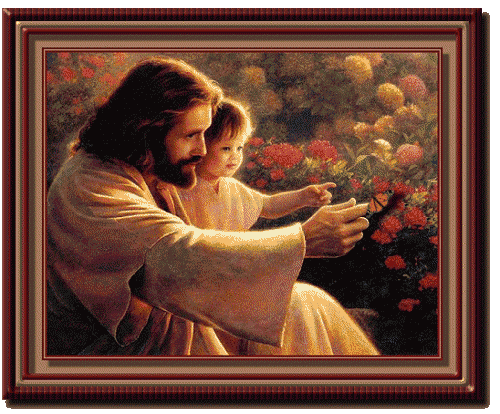
Jesus_with_a_child
Jesus doesn’t look like a narcissist to me.

Vaknin is using the words and deeds described in the Gospels to spin Jesus into a malignant narcissist. I don’t buy it. I have been attending RCIA classes (the classes one takes to become Catholic), and am still on the fence as to whether Jesus was actually the Son of God or just a very good man and prophet, but have lately been leaning more toward him being divine.

If Jesus was actually who he said he was–the Son of God–then he was being truthful and not narcissistic or grandiose in any manner. Jesus was compassionate and empathetic toward the unfortunate and the poor and healed the sick and disabled, and while he does appear to have had a temper, it was a righteous anger toward those who refused to believe who He was. He didn’t reject or disrespect his mother either. He had a great love for Mary as his earthly mother, but if Jesus was the son of God, then God’s desires would naturally have to come first.

In Vaknin’s defense, if he doesn’t believe Jesus was divine (and many people don’t), then I suppose it could be argued Jesus acted in narcissistic and grandiose ways (it could actually more easily be argued he was a paranoid schizophrenic–insisting he was God Himself when he really wasn’t), but I still wouldn’t call him a narcissist. Vaknin is probably not a Christian due to his nationality (he’s from Israel and his mother was Turkish) so it’s understandable that he wouldn’t believe Jesus was the Son of God, but to make such a sweeping accusation against a religious entity whose words have changed the lives of many millions of people for the better is pretty narcissistic on Vaknin’s part (which of course is no surprise).

Some of the more extreme evangelistic and fundamentalist Christian churches (especially those that believe in such unpleasant and elitist doctrines as predestination–a Calvinistic belief that certain “chosen” people have been predestined for heaven even before they were born, making the concept of “free will” and works null and void) are not too far removed from cults and they commonly have psychopathic leaders and use cult-like brainwashing tactics. There are also unfortunately many religious leaders of mainstream churches who are very narcissistic and even psychopathic, but this doesn’t mean Christianity itself is a cult of narcissism or that Jesus was a narcissist.

I still defend most of Vaknin’s writings from his critics, given that as a narcissist who is honest about himself, he is more than qualified to call himself an expert on the disorder and write as much as he wants to about it. Whether intentional or not, he has helped a great number of sufferers and victims of psychopathy. But in this particular discussion about cults, using Christianity as an example of a cult and Jesus as a malignant narcissist not only misses the mark, but to many people would be considered blasphemous. In spite of my own misgivings about Christian doctrine, I just couldn’t let this pass.