The “War on Christmas”? Bah humbug.

waronchristmas

Certain Christians who celebrate Christmas (not all Christians do) have lately been bellyaching via blogs, bumper stickers, and various memes that there is a “war on Christmas” going on. Even some conservative Christian politicians have been bloviating about this alleged “war on Christmas.” Where are the tiny violins?

I find it all a bit mystifying because if anything Christmas is more in your face today than it ever was before. The holiday season used to start the day after Thanksgiving; now it starts the day after Halloween, and even Thanksgiving has been insidiously taken over by a day celebrating the spirit of greed called “Black Friday”–which now has edged into “Black Thursday,” meaning many stores are now open on Thanksgiving so people can stock up on cheap TVs and other appliances to give their holiday shopping a head start.

You can’t get away from Christmas. Everywhere you turn, it’s buy this, buy that; give this, give that; host a big holiday bash or else; and you’re either a Scrooge or a sucky parent/lover/friend/employee if you don’t blindly obey these messages that are blasted into our ears 24/7 for an entire month or more.

If you don’t have the funds to give extravagant gifts or host lavish parties and holiday dinners with all the trimmings or the time or desire to decorate a 10 foot Christmas tree and bedeck your entire house with exterior lights, you are made to feel defective–and Scroogelike. And it’s getting worse and more in your face every year.

So Christmas itself is having no problems. I don’t see any war against it going on.

christmascartoon

I think what the “war on Christmas” actually refers to is cards, banners, signs, and greetings that say “Happy Holidays” or “Seasons Greetings” instead of the more Christian-centric “Merry Christmas.” Those who complain about the war on Christmas are objecting to the political correctness of those attempting to be all-inclusive–because after all, America is a melting-pot nation that includes Jews, Muslims, atheists and people of other faiths besides Christianity. “Seasons Greetings” is convenient and covers at least the Jews who celebrate Hanukkah and African Americans who celebrate Kwanzaa (who probably also celebrate Christmas). In fact, I know a lot of Jews who celebrate both Hanukkah AND Christmas. Christmas has become more of an American holiday than a religious one–and a handy excuse for Big Business to rake in big bucks.

“Seasons Greetings” has been on Christmas cards for as long as I can remember (and I’ve been around quite a while), but it didn’t seem to me that anyone minded that until the past 10-20 years or so. Personally, I think it’s petty and stupid to make such a big deal about it. “Seasons Greetings” or “Happy Holiday” doesn’t exclude Christians, but for some reason certain Christians think that such a greeting is a sign of hostility against them or Christmas itself. I think there are far more important things for them to be worrying about besides the printed message on a holiday oops Christmas card that will probably be tossed in the trash the week after New Years’ anyway.

Here’s a news flash: There is no “War on Christmas.” It’s all in your head.

My journey so far: a timeline of recovery

timeline

Here I am going to show you my timeline in recovery from narcissistic abuse because I’m noticing some fascinating patterns and certain things are becoming much more clear from looking at it.

My Recovery Timeline

2006: Following my divorce, my father sent me a copy of M. Scott Peck’s book “People of the Lie.” While I was still deeply enmeshed with my psychopathic ex, and nowhere near recovery, this was the book that planted the seed for what was to start growing years later. I think this was a sign from God that I needed to make some serious changes but I didn’t recognize it at the time. But I was able, for the first time, to recognize the MNs in my life for what they truly were: evil people. Recognition is the first step in recovery, even if it takes a while to get the ball rolling.

February 2014: 8 years later, I finally had the catalyst I needed and the strength of will to get rid of my narc, who had been leeching off me, using me and manipulating me and our kids for 7 years. (I had allowed him to move back in with me in 2007, a huge mistake). This decision arose from Michael becoming violent toward our daughter. I wasn’t aware before that physical violence wasn’t necessary to obtain a restraining order–I could have obtained one at any time since we were no longer legally married. But maybe I wasn’t strong enough yet and it took an act of violence to inspire me to finally take some real action. I put up with a lot of his other shit, but violence was something I simply would not tolerate, even in my weakened state. Yes, it was scary as hell to do this, but I am so glad I did.

February – July 2014: I had to learn how to live alone again and become independent. There was a part of me that felt I actually needed him, even though he “needed” me far more. I wasn’t just afraid of what he might do if I made him leave, I was also afraid of living alone without him, though I can’t really fathom why since all he did was use and abuse me. This was a difficult and lonely time, but I began to feel a little like a person again.

July – September 2014: I began to educate myself about narcissistic personality disorder and the community of survivors of narcissistic abuse, particularly ACONs. The first blog I started to read was Dr. George K. Simon’s excellent blog, Manipulative People. I posted a few times there and “came out” there as an ACON and abuse survivor, but mostly I just read. I also ordered his excellent books, “In Sheeps Clothing” and “Character Disturbance.” (You can find the links for both his blog and the books in the Info and Support tab in the green header above.) I also found other good blogs written by survivors of narcissism and psychopathy, and among these settled on a few favorites, especially Five Hundred Pound Peep’s blog because she was Aspie like me and had a mother who sounded almost exactly like mine. (Her blog is also listed in Info and Support).

September 2014: Inspired mostly by FHPP’s blog (but others too–see Info and Support for a list of other blogs and resources I think stand out), I decided to start my own. The decision came from out of the blue–it wasn’t something I had to think about. Prior to that, I had always been afraid to start a blog–I thought it would be too hard. But on September 10th it was like I got struck by lightning and without even thinking about it I went to WordPress (after first trying Blogspot and finding it required me to use my real name because it’s connected to Google) and immediately started a blog. In retrospect, I think this action was actually inspired in me by God. I was finally strong enough to start my own course of self therapy (and unbenownst to me, help others in the process of helping myself).

September – November 2014: While my blog wasn’t an immediate hit and started off quite slowly, I had several “mentors” along the way, such as OM from Harsh Reality, who helped me make my blog more visible and got me more followers. At first writing seemed like a chore sometimes and I had to discipline myself to write a post a day (and sometimes I skipped a day or two). Sometimes I wrote two. After a while I found that I couldn’t stop writing (and now I write about 3-5 a day!)

My early posts were almost as likely to be about topics besides narcissism (music, religion, funny rants, photos, etc.). It was good practice, but sometimes I think I was trying to distract myself from the real issue I needed to confront. Posting fluff pieces allowed me to avoid that, but still gave me practice writing and blogging every day.

By November I was addicted and rather than blogging seeming like a chore or work, it was becoming a passion. I was a writing maniac! I couldn’t seem to stop writing, and if you look at “Archives,” every month I have more posts than the last. I realized with great relief and joy that I had never lost my writing ability and this is actually my strongest method of communication. I began to build a small following. I had never known how to use the writing gift God gave me and didn’t think I could ever help anyone using it, especially myself. But all that was being proven wrong again and again.

During the same period of time, I began to explore spirituality and religion. Many of my posts are about my spiritual journey from near-agnosticism and even a slight antagonism toward Christianity, but sometime in October, through a sequence of events (the posts are under “My Story” in the green header), I settled on becoming a Catholic. It’s Christianity (though I know some Christians disagree!) but doesn’t go against my deep love and respect for science and other beliefs I hold dear that I cannot let go of. I have never liked the hellfire and brimstone doctrine of fundamentalist Christianity; but Catholicism isn’t wimpy and wishy washy either, like some liberal Protestant churches. I also love the Eucharist and all the ritual (for aesthetic reasons–I know ritual isn’t important in salvation). While I don’t agree with all Catholic doctrine, much to my surprise I found myself agreeing with most of it. I signed up for RCIA classes (Rite of Christian Initiation) at the local Catholic church and have been attending those and weekly Bible studies regularly. I will be accepted into the Catholic church at their Easter mass. I am very excited!

christianity2

I believe now there was a very good reason for my becoming a Christian and strengthening my belief in Jesus Christ as God and savior when I did. Never before in my life had I been able to understand the concept of the Trinity or the concept of Jesus as a tripartate person of One God, or why he would have sacrificed himself for us on the Cross. Suddenly I found myself understanding these concepts and beginning to internalize them. Yes, I still have doubts and I still have problems with the Bible, and have not had any sudden, earthshattering conversion like Saul/Paul, but from my agnosticism of a couple of months back, I have gradually come to accept Jesus Christ as my Lord and savior, and that prepared me for the next step in my journey, because I was about to enter a very dark and potentially dangerous place for anyone who does not have a strong faith. It could have been my undoing, but is proving to be anything but.

November – December 2014: In mid-November, I watched “I Psychopath” for the second time and became fascinated with its subject, self-proclaimed narcissist Sam Vaknin, whose excellent (if rather scholarly and ponderous) writings about narcissism and narcissistic abuse are exhaustive and highly available to anyone who wants to read them. I wrote an article about my observations about the film, and Sam himself not only commented several times on my post, he shared it on social media so that in a matter of a day or two, I saw a spike in my stats like I’d never seen before. It was unreal.

I wrote a followup a few days later; the same thing happened. I started to read his personal journals and diaries, and found myself deep inside his strange psyche. I wanted to write a biography about him. A narc who was that insightful and (inadvertently) helped so many people was such an oxymoron I had to find out as much as I could about why someone could be like that. But in reading his honest but highly emotional journals and the devastating abuse that led to him developing NPD, I was feeling myself starting to be drawn to a very dark place. I couldn’t explain it, but I began to feel like I was losing focus on my OWN recovery, and the recovery of fellow ACONs and focusing entirely too much attention on one man’s disorder, for which there is no known cure.

So I decided last week to put the book idea on the back burner, until I am stronger and have gone further in my recovery journey. While I’m still reading his writings, it’s for education, not to focus all my attention on a project about someone else that would eclipse my own recovery. I prayed about this and felt that God had gave me the answer: keep this idea in your mind but put it on the back burner until you’re emotionally and spiritually stronger. Delving too deeply into a disordered mind like Vaknin’s at this point in my journey without proper armor could be mentally and spiritually dangerous.

So I moved on, but have found within the past week or so that my blog posts have become much deeper, darker and more focused on the supernatural and “evil” nature of NPD. My posts have also become a lot more personal and confessional. I’m digging deeper into the disorders of those who raised me.

While this might seem like a negative thing, it isn’t. Because looking at narcissism this way is giving me clarity and more incentive than ever to fight against its evil. We can’t fight against something or really deal with it on a deeper level until we understand its true nature (without allowing ourselves to be exposed to it). I am very careful not to engage with real-life narcissists or only engage with them as often as I absolutely must. This way, I am removed from it while at the same time I can study it at close range the way an astronomer can study the stars under a high powered telescope: he is not out there in the stars, but can study them with with objectivity and distance.

astronomer

In my last post I described a powerful nightmare that stuck with me all day today (I did wind up going to work after all). I won’t analyze it piece by piece, but I think it was both a warning and a revelation: to move forward but tread carefully into the study of malignant narcissism and how it’s infected my family, because to be too hasty and dive too deep too soon in my present still fairly weak spiritual state could be my undoing.

I could be entering dangerous territory where I myself could be taken over by evil (represented at the end of the dream–I believe the robot-like “host” was actually a demon or the devil himself, who controlled everything in that house; and my inability to escape (except through waking) because the car (that represented God and light) that was to take me away had left. I did have the presence of mind to tell the devil to “go fuck himself” but that may have enraged him too. But the fact that through my terror I still had a fighting spirit and was willing to take him proved I have some strength of will now that I never had before. I think this dream was a warning to take things slowly and only with God by my side as my protector and guide.
Because when we are dealing with the subject of malignant narcissism, we are dealing with evil itself. My growing relationship with God is important to help me resist those evils even while exploring them in more depth.

God makes all things happen only when we are ready.

The poem I wrote yesterday was similar to my dream and very much related to it. In it, I was told I “passed the test” which I think means my “primary education” (being raised and abused by MNs and psychopaths most of my life) is now no longer necessary and now I’m ready to begin the next level of self discovery.

Over these past few months I’ve become less depressed and much happier overall. I feel for the first time in my life like God has a clear plan for me, I have a future and everything that led up to this was a test and an education. I feel like I’m being called to eventually help other victims find their way out of the barbed wire jungle of psychopathy and narcissism.

Why making your own timeline is a good idea.

Making a timeline is an exercise you can do too. You can chart out your own timeline of recovery in a similar manner and it will become much clearer how far you’ve come and what patterns have developed. You can also see where you may need to shift your focus if you have become stuck or are finding yourself in a dark place.

Timelines can also give you some idea of the next steps you may need to take. You can learn a lot about yourself and your recovery from doing this. You don’t have to make it public like I’ve done; you can do it with pen and paper and just keep it for your own reference. Seeing any kind of physical representation of your journey to recovery can give you an amazing amount of clarity and focus. Making a recovery timeline can act like a good pair of glasses.

puttingonglasses

Staying Balanced.

I think lately I’ve been focusing a little too much on the dark side of narcissism (well, it IS dark) but there is a good reason for that right now.

Still, I think everyone (including me) needs an antidote to all this darkness. So my next post after this will be about something positive or practical instead of something dark. It might even be about another subject besides NPD. It might even be a fluff post!

I want this blog to remain interesting to the followers who are reading it for other reasons. Not all my followers are ACONS or victims of other psychopathic relationships. I used to post more about other things but a lot of things have been happening to me from blogging about it and that’s why I seem to post less now about other topics that are more “fun” than narcissism. But we all need a break from it sometimes.

Joel Osteen worships himself.

joelosteen

I found this intriguing article at Salon.com about the famous megachurch leader, Joel Osteen, a proponent of the peculiarly American “prosperity gospel,” a belief that God will reward you with material wealth if you are a True Believer. The article is a bit old, but is still relevant and I never saw it before, so, well, it gets added to the Museum of Narcissism.

If Mr. Osteen makes people feel better about themselves, fine, but Mr. Osteen is like a heroin addict getting his fix of narcissistic supply from his many followers, who worship him as if he were God himself. Frighteningly, Big Religion is full of such people who really only care about their own glorification.
What would God think?

Here is the article (written by Chris Lehmann at Salon.com):

If history is told by the winners, then Joel Osteen — the relentlessly upbeat spiritual caretaker of the national attitude — is history’s designated chaplain. In a marathon Sunday faith rally in the heart of the nation’s capital, Osteen, who presides over America’s largest megachurch congregation, the nondenominational Lakewood Church in Houston, exhorted the tens of thousands of believers amassed in Nationals Stadium to “live in victory,” to seize their “destiny moments,” and to fulfill God’s plan for their personal, financial and emotional success.

The Washington rally — billed as “America’s Night of Hope” — had gone a bit afoul of its own victory plan, however. It had originally been scheduled the night before, but as a persistent afternoon drizzle gave way to some spirited cloudbursts, the event’s organizers rescheduled it for the following afternoon. As I approached the centerfield box office outside Nationals Park on Saturday, the marquee overhead bore what had to be the glummest rainout announcement of the young 2012 baseball season: “Night of Hope postponed until 4 p.m. Sunday.” And since the Osteen message involves a lot of merchandising, the imposing tables hawking T-shirts and other commemorative swag seemed suddenly off-kilter. One prominent Night of Hope T-shirt was emblazoned with the inspirational divine message “I can do all things” — all things, that is, but summon the faithful to stand out in the rain.

But the Osteens were not about to let the intervention of the elements become any sort of setback. As the megachurch pastor — turned out in a blue suit and a beatific grin, looking for all the world like a fitter Tim Allen, fresh out of rehab — took his spot at the second-base perimeter of the infield, before the bank of TV cameras set up on the pitchers mound, he called out, “Isn’t it great to be here? It’s another great day the Lord has made!” He paused to note that, yes, “we had some rain last night,” but that the event’s reshuffled schedule could well mean that some people who couldn’t have made the evening version of the prayer gathering might well have turned up serendipitously today. In any event, Osteen declared his certitude that “God put the right people here right now.”

That confident assertion of — and indeed, identification with — the divine will is one of the calling cards of the Osteen faith. Amid all the spirited self-affirmations and folksy homilies that stud an Osteen sermon, it’s easy to miss the oddly deterministic invocations of divine prerogative summoned up by the preacher, who belongs to the “Word Faith” tradition of Pentecostal belief. Osteen’s serene depictions of God’s eternally uptending designs for the fates of individual believers are a sort of inverted Calvinism. Where the Puritan forebears of today’s Protestant scene beheld a terrible, impersonal Creator whose rigid system of eternal reward and punishment dispatched many an infant and solemn believer to the pit of damnation, Osteen’s God is an intensely personal presence, guiding believers out of pitfalls into inevitable glory and joy — not so much a raging Patriarch as a genial cruise director. “God’s dream for our own life is so much bigger than our own,” went one frequent refrain at the D.C. rally. “Let’s not put any limits on God.” Osteen characterized the Deity as a “running-over” and “abundant” God. “Have you ever been to a fast-food restaurant, and they ask you if you want to supersize this? Well, God is a supersizing God,” who is determined, Osteen assured the crowd, to “supersize your joy.”

It stands to reason, in this arrangement of cosmic fate, that the stubborn human weakness for anxious introspection and downbeat self-doubt is something of an affront to the author of being. “When you are criticizing yourself,” Osteen announced, “you are criticizing God’s creation. The next time you think something negative, turn that around, and say, ‘I am God’s masterpiece.’”

The talismanic faith in positive utterance is another key article of belief in the Word Faith tradition. Some Word Faith devotees are devout believers in faith-healing, and one of the key episodes Osteen cites in his own account of his faith journey is the miraculous recovery of his mother from an apparently terminal case of liver cancer in 1981. Faced with the prospect of losing his mother, the young Osteen — then a communications student at Oral Roberts University with no ministerial ambitions — turned to prayer, saying to God, as he now recounts, “I know you can do what doctors can’t do, what medical science can’t do.” Sure enough, Osteen’s mother, Dodie, went on to be cancer-free, and took to the podium on Sunday after her son’s testimonial. She reprised the story of how she fought off the specter of death by seeking out the “most healing” passages of scripture, which she assembled into a digest she still consults regularly: “Like American Express, I don’t leave home without it,” she said. Then she issued a disclaimer for her listeners contending with severe illness: “I don’t advise you not to seek treatment — get treatment any way you can.” Such cautions sounded a bit rushed and legalistic next to her own account of her recovery: When she and her preacher-husband both sensed the end was near, she recalled, “We lay on our faces … He said, ‘I need you, the church needs you, the children need you … And now, almost 31 years later, I won the battle and so will you!” God, after all, “delights in answering the prayers of his children,” and “loves everybody the same, but he can do for you what he did for me.”

The Word Faith image of the wonder-working, healing God is discomfiting to ponder, and not just because he might tempt desperately sick believers to go rogue beyond the dictates of medical science. The constant recitation of God’s transcendent goodness and the deference paid to his ironclad ability to lift believers magically out of suffering and woe both subtly downgrade the divine presence into a glorified lifestyle concierge. This God has no real way of accounting for the age-old paradoxes of theology, such as the tolerance of personal and historic evil, or the deeper ironies and unintended consequences of the believing life. Even less does the Osteen family’s success gospel encompass a sustained social ethic — even though the D.C. event featured an appeal on behalf of the World Vision ministries to adopt a needy child in the developing world. The believer’s chief task is to ratify the preexisting divine script of success in his or her individual life — and then to bear testimony to that joyous transformation in a community of like-minded success believers.

It’s a curiously childlike vision of faith — a point driven home in a homily offered up by Joel’s wife, Victoria, who serves as a kind of co-pastor of the separate domestic sphere at the couple’s revival meetings. When she finds herself assailed by cares, anxieties and negative thoughts, Victoria reported, “I visualize a bouquet of helium balloons in my hands, and I literally hold those balloons out and release them to the heavens … And as I release those balloons to Him, I say, ‘I may not have the power to change my circumstances, but God has that power to change our circumstances.’” In a later homily on the properties of unconditional love and forgiveness, Victoria delivered an extended gloss on what was apparently one of the few remotely traumatic moments in her suburban Texas upbringing — a time when, as a freshly licensed driver, she had taken out her dad’s car and negligently instructed a friend to roll down a passenger-side window that was malfunctioning, thereby breaking it once and for all. When she finally summoned the nerve to fess up to her dad, she found him to be disappointed but gloriously forgiving; he “didn’t judge my future from that one mistake” — and neither will the indulgent dad of the Osteen heavens. “You may not have been shown unconditional love in your life,” Victoria announced, “but God loves you unconditionally.” The problem, of course, is that even those of us who did survive unhappy childhoods are no longer 16 — and as a result, we need a God who can meet the challenges of the new responsibilities we’ve taken on as we’ve matured, not a figure of undifferentiated sentiment, handing our forgiveness and love like lottery tickets.

The other childlike quality of the Lakewood account of divine grace has to do with the past — which, together with negative thinking, represents the closest thing to evil in the Osteen’s scheme of salvation. The past is bad because it mires believers in remembered hurts and slights, and thereby obstructs God’s grander design for their lives. “When we hold on to the past, when we don’t go to God, that just puts more baggage in our suitcases,” Victoria exhorted, in a not-altogether-wieldy metaphor.

This spiritual hostility to the past was an all too frequent refrain in the event’s musical selections — a monotonous offering of anthemic, bombastic Christian rock, all composed without the benefit of a single minor chord or any discernible melody. “I’m moving forward,” went the lyrics to one of these intra-sermon studies in Journey-esque hymnody. “I’m not going back / I’m moving ahead / I’m here to declare to you that the past is over.” An American idol contestant named Danny Gokey also offered testimony about how the Osteens had helped him conquer his depression in the wake of the untimely passing of his wife. Gokey then performed a Christian rock number of his own, “My Best Days Are Ahead of Me,” which seemed to make short work of his once-debilitating grief: “I don’t get lost in the past or get stuck in some sad memories,” he sang, rather creepily; the song’s bridge announced that “Age isn’t nothing but a number,” and then resolved on a Successories-style upgrade of a well-known Army recruiting slogan: “If I keep getting better / I can be anything I want to be.”

There’s a term from the psychiatric clinics that neatly captures the outlook of someone possessed of grandiose fantasies about the imperial reach of the self, and a principled refusal to acknowledge anything poised to diminish such fantasies — such as the passage of time. That term is “narcissistic personality disorder,” and it does nothing to detract from the positive features of the Osteen gospel — the injunctions to persevere in the face of adversity, or the appeals for donations to World Vision — to note that this is a system of faith tailor-made to sustain narcissistic delusion. To grasp the overweening self-absorption of the Osteen faith, one need look no further than the frequent recourse Osteen makes to his own success story in sealing the case for God’s providential plan for the believer’s own life. Now, unlike other well-known evangelists, Osteen can’t lay much claim to a hardscrabble Horatio Alger-style life story. His 1920s forebear in Pentecostal media preaching, Aimee Semple McPherson, was a single-mother missionary before coming into fame and fortune as an evangelical celebrity in the Radio Age; Billy Graham was the son of a poor North Carolina dairy farmer. Osteen, by contrast, was a second-generation evangelical leader, who’d been working as a TV producer for his father John Osteen’s growing ministry before he succeeded to the elder Osteen’s pulpit after his father’s death. His personal biography tracks closer to fellow Pentecostal TV preacher Pat Robertson’s background: Robertson was the son of a U.S. senator before finding his own adult spiritual calling.

Nonetheless, Osteen repeatedly cites his own success presiding over the spiritual flock he inherited as the prime exhibit of God’s ready transposition of divine grace into worldly success. When he first acceded to the pulpit, he recalled from his riser above second base, he felt no special aptitude for ministering; he’d heard that Lakewood church leaders were raising doubts about his vocation, and the church needed to move into a bigger, upgraded new facility. “At one point,” Osteen preached, “it seemed like everything was coming against me. The enemy was fighting me not from where I was coming, but from where I was going … He didn’t want Lakewood to be in the Compaq Center” — the former home arena for the Houston Rockets, and now home to the Lakewood congregation of nearly 50,000 souls. The Compaq Center deal is a frequent touchstone in Osteen’s faith reminiscence; it occupies a good stretch of his blockbuster best-selling self-improvement tract, “Become a Better You,” which also finds evidence of divine favor in a home-flipping deal Joel and Victoria struck at the height of the housing bubble, as well as in such mundane votes of divine confidence as setting the pastor up with a premium parking space. Indeed, the steady parade of testimonials from the wider Osteen clan on the Night of Hope risers bespeaks a family-wide penchant for casting one’s commonplace personal biography as a sort of infomercial version of the Christian faith. (In addition to mother Dodie and wife Victoria, Osteen’s brother Paul, who runs a medical charity in Africa, took to the stage Sunday to relate a more responsible story of healing, in which due medical diligence properly preceded the broader appeal to faith; Joel’s two children, Alexandra and Jonathan, are respectively a vocalist and guitarist in the ministry’s Christian rock ensemble.)

Now, it may very well be that in a certain kind of conviction of grace, believers feel themselves suffused with the divine presence, and find their most quotidian activities reflect celestial favor; the 14th-century Saint Julian of Norwich recorded a vision in which she beheld the entirety of creation in an object no larger than a hazelnut, cupped in her hand. Perhaps, in this view of things, a converted sports arena or excellent parking spot is no great stretch when it comes to testifying on behalf of a God for whom all things are possible.

Still, the claustral feel of Osteen’s success gospel paradoxically works exactly the same effect that he warns believers to resist: It imposes limits on God, by largely confining his workings to the dominant American culture of success. If the Osteen-coached believer does not reap abundant and large reward in career, family life or creative pursuits, they are not necessarily going to curse their God, as Job’s comforters had counseled him to do amid his notorious personal setbacks. But neither are they going to make the key connections that earlier Protestant divines have preached, going back to Jonathan Edwards and John Calvin: that the divinity does not, in fact, have your own personal happiness occupying pride of place on his exhaustive to-do list. The universe is ultimately about a larger set of concerns, and faith concerns a much vaster striving toward justice than believers are wont to see in their personal affairs, their social conquests or their annual paychecks. This is why Edwards, for all of his better-known hell-and-brimstone sermons, urged onto believers a stoic “consent to being in general” — not a plan for individual life advancement.

This disjuncture between Protestantism’s more humbling counsel and the feel-good Word Faith gospel became most painfully evident during one of Osteen’s closing perorations. In chilling detail, he recounted the story of a young Tutsi Christian woman who’d hid out in the bathroom of her church pastor’s office at the height of the 1994 Rwandan genocide. The machete-wielding Hutu killers who pursued her returned to the pastor’s office every day for 91 days, usually calling out for her by name. At one point, Osteen said, a Hutu militia man was poised to turn the knob on the door to the tiny bathroom where the woman was quartered alongside six other Tutsi believers — but at the last moment, he became distracted and walked away. Finally, when the genocide had been contained, the woman was free, and has been traveling with ministers ever since to testify to the amazing story of her survival. “Nearly 1 million Rwandans were killed in this genocide,” Osteen said as he wound up to the story’s larger moral. “It was very sad.”

Well, no. The Rwandan genocide was something far more than sad — it was a colossal failure of moral and political agency, going back to the German and Belgian colonial partition of the country that set up artificial power conflicts between the nation’s two main tribes. This horror also most certainly came about thanks to the wretched failures of the Clinton administration and other Western powers to arrest a well-documented string of massacres, even as senior U.N. officials such as Lt. Gen Romeo Dallaire, the leader of the agency’s Rwandan peacekeeping mission, implored them to.

For Osteen, of course, the story of this woman’s survival was a divine miracle. But if this one survivor was enjoying the loving favor of an omnipotent God, what are we to conclude that this same God thought of the more than 800,000 Rwandans murdered in the genocide? Was their faith wanting? Was God planning unparalleled new successes and joys for their surviving family members? Are these the people Osteen has in mind when he exhorts his listeners not to be victims, but victors?

It’s something of an obscenity even to frame such questions. Yet they are the inevitable outcome of a theology-free success gospel, pitched exclusively to tales of individual triumph. Osteen’s sermons all begin with a self-empowering chant from believers. “This is my Bible,” it goes in part; “I am what it says I am. I have what it says I have.” But there are legions of dead — now confined by definition, it’s true, in the hated past — who come bearing the testimony that the Bible is not actually about you.

What Sam Vaknin thinks about Jesus.

He replied to my last article about what he says about Jesus Christ–twice.   Once again he had to clarify a few things by providing links. One of the links provided talks about religion being a perfect way that narcissists can make themselves feel superior to nonbeliever (even though they must “submit” to a higher entity than themselves). They hold their nose and submit to a God or messiah because of the narcissistic thrill of self righteously being able to claim their piety makes them better than everyone else. I’ve seen this sort of thing going on in 12 step programs like AA too. In fact, my mother uses the AA program exactly like a religion and loves to use its slogans and dogma (and yes, it does have a dogma) to prove how righteous and sinless she is compared to non-teetolalers and everyone else, especially me.

I agree with what Vaknin writes in his post. I’ve seen way too many fundamentalist or evangelical Christians use their religion to intimidate (“you are going to hell”), make themselves feel special (“I know I’m going to heaven”), make threats (“unless you do X…you will go to hell”), not take responsibility for their actions (“God told me to do this” or “the devil made me do it”), and show a lack of empathy (“It’s God’s will”) and not acknowledge your concerns or questions (“It’s right here in the Bible or other holy text). This is especially prevalent in religious leaders, but is quite common in other people too.

god

Let me add that not all Christians are like this, and narcissistic behavior definitely applies to followers and leaders of other belief systems too, even atheism! (Self righteous, intolerant atheists are commoner than you would think).

Here is what he writes:

For the Love of God

“1 But know this, that in the last days perilous times will come: 2 For men will be lovers of themselves, lovers of money, boasters, proud, blasphemers, disobedient to parents, unthankful, unholy, 3 unloving, unforgiving, slanderers, without self-control, brutal, despisers of good, 4 traitors, headstrong, haughty, lovers of pleasure rather than lovers of God, 5 having a form of godliness but denying its power. And from such people turn away! 6 For of this sort are those who creep into households and make captives of gullible women loaded down with sins, led away by various lusts, 7 always learning and never able to come to the knowledge of the truth. 8 Now as Jan’nes and Jam’bres resisted Moses, so do these also resist the truth: men of corrupt minds, disapproved concerning the faith; 9 but they will progress no further, for their folly will be manifest to all, as theirs also was.”

(The Second Epistle of Paul the Apostle to Timothy 3:1-9)

God is everything the narcissist ever wants to be: omnipotent, omniscient, omnipresent, admired, much discussed, and awe inspiring. God is the narcissist’s wet dream, his ultimate grandiose fantasy. But God comes handy in other ways as well.

The narcissist alternately idealizes and devalues figures of authority.

In the idealization phase, he strives to emulate them, he admires them, imitate them (often ludicrously), and defends them. They cannot go wrong, or be wrong. The narcissist regards them as bigger than life, infallible, perfect, whole, and brilliant. But as the narcissist’s unrealistic and inflated expectations are inevitably frustrated, he begins to devalue his former idols.

Now they are “human” (to the narcissist, a derogatory term). They are small, fragile, error-prone, pusillanimous, mean, dumb, and mediocre. The narcissist goes through the same cycle in his relationship with God, the quintessential authority figure.

But often, even when disillusionment and iconoclastic despair have set in – the narcissist continues to pretend to love God and follow Him. The narcissist maintains this deception because his continued proximity to God confers on him authority. Priests, leaders of the congregation, preachers, evangelists, cultists, politicians, intellectuals – all derive authority from their allegedly privileged relationship with God.

Religious authority allows the narcissist to indulge his sadistic urges and to exercise his misogynism freely and openly. Such a narcissist is likely to taunt and torment his followers, hector and chastise them, humiliate and berate them, abuse them spiritually, or even sexually. The narcissist whose source of authority is religious is looking for obedient and unquestioning slaves upon whom to exercise his capricious and wicked mastery. The narcissist transforms even the most innocuous and pure religious sentiments into a cultish ritual and a virulent hierarchy. He preys on the gullible. His flock become his hostages.

Religious authority also secures the narcissist’s Narcissistic Supply. His coreligionists, members of his congregation, his parish, his constituency, his audience – are transformed into loyal and stable Sources of Narcissistic Supply. They obey his commands, heed his admonitions, follow his creed, admire his personality, applaud his personal traits, satisfy his needs (sometimes even his carnal desires), revere and idolize him.

Moreover, being a part of a “bigger thing” is very gratifying narcissistically. Being a particle of God, being immersed in His grandeur, experiencing His power and blessings first hand, communing with him – are all Sources of unending Narcissistic Supply. The narcissist becomes God by observing His commandments, following His instructions, loving Him, obeying Him, succumbing to Him, merging with Him, communicating with Him – or even by defying him (the bigger the narcissist’s enemy – the more grandiosely important the narcissist feels).

Like everything else in the narcissist’s life, he mutates God into a kind of inverted narcissist. God becomes his dominant Source of Supply. He forms a personal relationship with this overwhelming and overpowering entity – in order to overwhelm and overpower others. He becomes God vicariously, by the proxy of his relationship with Him. He idealizes God, then devalues Him, then abuses Him. This is the classic narcissistic pattern and even God himself cannot escape it.


Sam Vaknin thinks Jesus was a narcissist.

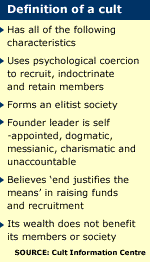
cultdefinition
A true cult’s agenda and operation is definitely psychopathic. (click to enlarge).

Sam Vaknin has a lot to say about religion and cults and how they relate to psychopathy.
On his website, he addresses the problems of religious cults and describes the way they are almost always run by malignant narcissists who use their usual bag of psychopathic tricks to brainwash people into converting and once converted, keeping them in thrall to the cult. The article is here.

Vaknin’s description of cults sounds exactly the way a cult such as Scientology is run (I dabbled in it back in the late 1970s for about 2 years but was fortunate enough to be able to escape before I was completely taken in). I have no doubt Scientology’s founder, L. Ron Hubbard, a hack science fiction writer, was a malignant narcissist (his official bio is full of lies and “accomplishments” that are complete fabrications). Scientology doctrine uses every trick in the psychopath’s book of coercion: brainwashing techniques disguised as “auditing” or “training routines (TR’s), threats to members who threaten to leave the cult (“fair game”), attempts to separate members from their non-Scientologist families and friends, exhorbitant and extortionist prices to move up the “bridge,”
insane doctrine passed off as “truth,” and definitely lots of paranoia and secrecy.

Lronhubbard
L. Ron Hubbard, malignant narcissist

Scientology is the enemy of any legitimate psychotherapy–psychology and psychiatry are held to be the utmost evil, members are required to use underhanded means to attack and even attempt to destroy the careers of professionals in those fields (I have a personal story about this I’ll describe at a later time), and of course Scientology has had numerous problems with the IRS and other government agencies. Anyone who criticizes Scientology is labeled a “Suppressive Person” and is either excommunicated from Scientology or punished by a form of shunning. Members who are influenced by someone who is against Scientology are labeled “Potential Trouble Sources” (PTS) and ordered to cut the “SP” out of their lives, even if it’s a spouse or another close family member.

There’s an excellent and fascinating website about the insane mindgames this “religion” plays and includes case histories of people whose lives were totally ruined by this dangerous and psychopathic cult. The “secrets” of the upper OT (operating thetan) levels used to be unobtainable to anyone who had not “gone clear” and had the money to pay for further “processing” to the OT levels, but those jealously guarded secrets are now available to anyone who has Internet access and is curious enough to Google them. Well, naturally I was curious and the “secrets” are indeed pretty crazy, obviously the ravings of L. Ron Hubbard’s disordered and paranoid mind.

It used to be said that the secrets could not be revealed to members at lower levels because such knowledge would shock them to the point of actually killing them. I remember reading about one ex-Scientologist who suggested that the real reason the upper level secrets were so carefully guarded was not to “protect” anyone from the shock of the “truth” but rather, because the things revealed at the upper levels were so insane that only someone who had spent thousands of dollars and been thoroughly brainwashed could possibly take them seriously (in fact, there are cases of those who did reach those levels and when the secrets were finally revealed to them, they left the Church because they felt their entire journey had been a colossal waste of time and money). Anyone who hadn’t made such a huge mental and financial investment and read about the OT revelations online would die alright: they would die of laughter. And yes, they are that crazy. I read the “revelations” of the OT levels with my jaw glued to the table in disbelief that any sane person would believe such a load of crap.

Vaknin should have used the example of Scientology, a perfect example of a “religion” with a psychopathic agenda and a malignant narcissist “god.” There are many other examples he could have used too–the Branch Davidians, Heaven’s Gate, the Unificiation Church (Sun Myung Moon’s cult), a few “New Age” cults, and many others.

But no, instead Vaknin attacks Christianity. He actually says Jesus Christ was a narcissist. I don’t know what Vaknin’s religious beliefs are, or even if he has any, and I certainly have my own issues with organized religion and fundamentalist Christianity in particular (the God of the Old Testament does come off as quite psychopathic at times), but I think Vaknin is missing the mark by describing Jesus Christ this way (or Christianity in general as a cult). He uses Bible quotes to “prove” that Jesus was a narcissist. Rather than try to paraphrase what he says, I’ll just post it here:

Jesus Christ, narcissist
http://samvak.tripod.com/journal79.html

Note:
Though most of the quotes in this essay are from the Gospel of Saint Matthew, I was careful to compare them with the texts of the other three canonical gospels. Where the gospels disagree, I avoided using the quote altogether.

Illegitimate and adopted children, especially of humble origins, often develop narcissistic defenses to fend off persistent feelings of inadequacy and inferiority. Admittedly, it is highly unlikely that Jesus was an illegitimate child. Adulteresses in ancient Judea were stoned to death. But, equally, there is little doubt that the circumstances of Jesus’s birth were shrouded in mystery. His mother, Mary, got herself pregnant but not by having sexual intercourse with her lawfully-wedded husband, Joseph.

Early on, Jesus developed magical thinking, compensatory grandiose delusions, and fantasies of omnipotence and omniscience. A firstborn, he was much pampered by his doting mother. He was a prodigy, a Wunderkind: highly intelligent and inquisitive and more comfortable in the company of adults than with his peers.

When he was a mere 12 years old:

“(T)hey found him in the temple, sitting in the midst of the doctors, both hearing them, and asking them questions.” (Luke 2:46)

Even at this tender age, he showed a marked lack of empathy and a full-fledged case of pathological grandiosity:

“His mother said unto him, Son, why hast thou thus dealt with us? behold, thy father and I have sought thee sorrowing. And he said unto them, How is it that ye sought me? wist ye not that I must be about my Father’s business?” (“My Father” being God – SV). (Luke 2:48-49)

Gurus at the center of emergent cults are inevitably narcissistic, if not outright narcissists. The self-imputation of superiority, epiphanic knowledge, and infallibility and the assumption that others need and crave the guru’s message are at the heart of an elaborate construct which often borders on the psychotic:

“… (T)he people were astonished at his doctrine: For he taught them as one having authority, and not as the scribes.” (Matthew 7:28-29)

Referring to his 12 disciples, Jesus made clear that: “The disciple is not above his master, nor the servant above his lord.” (Matthew 10:24)

“He that loveth father or mother more than me is not worthy of me: and he that loveth son or daughter more than me is not worthy of me. And he that taketh not his cross, and followeth after me, is not worthy of me. He that findeth his life shall lose it: and he that loseth his life for my sake shall find it.” (Matthew 10:37-39)

Here is how Jesus, the lowly, unmarried, and itinerant son of a carpenter – an abysmal failure by the standards of his society – viewed himself:

“When the Son of man shall come in his glory, and all the holy angels with him, then shall he sit upon the throne of his glory: And before him shall be gathered all nations: and he shall separate them one from another, as a shepherd divideth his sheep from the goats … And these shall go away into everlasting punishment: but the righteous into life eternal.” (Matthew 25:31-32 and 25:46)

“Thinkest thou that I cannot now pray to my Father, and he shall presently give me more than twelve legions of angels?” (Matthew 26:53)

Contrary to his much-cultivated image, Jesus, like the vast majority of cult leaders, lacked empathy and was a heartless and irresponsible manipulator whose magical thinking ruined the lives of many. He instructed his followers to commit acts that must have had harshly adverse impacts on their hitherto nearest and dearest. Jesus monopolized the lives of his disciples to the exclusion of all else and all others:

“For I am come to set a man at variance against his father, and the daughter against her mother, and the daughter in law against her mother in law. And a man’s foes shall be they of his own household.” (Matthew 10:35-36)

“Then one said unto him, Behold, thy mother and thy brethren stand without, desiring to speak with thee. But he answered and said unto him that told him, Who is my mother? and who are my brethren? And he stretched forth his hand toward his disciples, and said, Behold my mother and my brethren!” (Matthew 12:47-48)

“And Jesus, walking by the sea of Galilee, saw two brethren, Simon called Peter, and Andrew his brother, casting a net into the sea: for they were fishers. And he saith unto them, Follow me, and I will make you fishers of men. And they straightway left their nets, and followed him. And going on from thence, he saw other two brethren, James the son of Zebedee, and John his brother, in a ship with Zebedee their father, mending their nets; and he called them. And they immediately left the ship and their father, and followed him.” (Matthew 4:18-22)
Consider the disastrous effects their actions had had on their fathers and their families, now left to starve. To Jesus, evidently, these were irrelevant considerations.

Jesus healed only those who visibly, volubly, clearly, publicly and repeatedly worshipped him. In other words, he extended his gift only to his sources of narcissistic supply. There are numerous instances in the four canonical gospels where Jesus actually bargains with the afflicted and demands – sometimes in anger – their unconditional adoration. He is happiest when acknowledged and affirmed as Christ, the Son of Man (son of God). Those who do not recognize his splendid grandeur, unbounded might, and implied divinity are “dogs” and “swine” (Matthew 7:6)

His much-touted love of the poor was not a match for his malignant self-love. When his disciples upbraided a woman for anointing Jesus with expensive ointment because the money could have been better used to help the poor, the great humanist, Jesus, had this to say:

“Why trouble ye the woman? for she hath wrought a good work upon me. For ye have the poor always with you; but me ye have not always.” (Matthew 26:10-11)

The principles espoused by Jesus were malleable and easily bent. He professed to minister only to the Hebrews (Sons of Israel) and steadfastly refused to heal the Gentiles whom he called “dogs”. When a woman of Canaan beseeched him to cast the devil out of her daughter (“Have mercy on me!”), he retorted, shockingly:

“I am not sent but unto the lost sheep of the house of Israel … It is not meet to take the children’s bread, and to cast it to dogs.” (Matthew 15:24-26)

But he soon forgot and retracted this lofty “principle” when she adulated him:

“Then Jesus answered and said unto her, O woman, great is thy faith: be it unto thee even as thou wilt. And her daughter was made whole from that very hour.” (Matthew 15:28)

Similarly, he cured the servant of a Roman centurion after his master catered to Jesus’s by-now rampant megalomania:

“When Jesus heard it, he marvelled, and said to them that followed, Verily I say unto you, I have not found so great faith, no, not in Israel. And Jesus said unto the centurion, Go thy way; and as thou hast believed, so be it done unto thee. And his servant was healed in the selfsame hour.” (Matthew 8:10 and 8:13)

Jesus’s initial false modesty soon gave way to bragging and outlandish, often confabulatory claims.

Whenever he affected a miracle – such as restoring eyesight to the blind, cleansing lepers, reviving the crippled, and raising the ostensibly dead – Jesus beseeched them to keep mum about the events. One of many examples:

“And their eyes were opened; and Jesus straitly charged them, saying, See that no man know it.” (Matthew 9:30)

But Jesus was not averse to blatant self-promotion when his false modesty failed to elicit narcissistic supply:

“Go and shew John again those things which ye do hear and see: The blind receive their sight, and the lame walk, the lepers are cleansed, and the deaf hear, the dead are raised up, and the poor have the gospel preached to them.” (Matthew 11:2)

“I say unto you, That in this place is one greater than the temple … For the Son of man is Lord even of the sabbath day … behold, a greater than (the prophet) Jonas is here … behold, a greater than (King) Solomon is here.” (Matthew 12)

As a true narcissist, Jesus reprimanded others for his own brand of behavior. This psychological defense mechanism is called “projection”.

This is how he described the Pharisees, the scribes, and the Sadducees (and, inadvertently, himself and his own conduct):

“(T)hey say, and do not. For they bind heavy burdens and grievous to be borne, and lay them on men’s shoulders; but they themselves will not move them with one of their fingers. But all their works they do for to be seen of men: they make broad their phylacteries, and enlarge the borders of their garments, And love the uppermost rooms at feasts, and the chief seats in the synagogues, And greetings in the markets, and to be called of men, Rabbi, Rabbi.” (Matthew 23:1-6)
Narcissists are disruptive, counter-dependent, combative, and resent authority (rebellious and contumacious). They feel that they are above the law, or, rather, that they are a law unto themselves. They hold themselves to be immune to the consequences of their actions:

“Think not that I am come to send peace on earth: I came not to send peace, but a sword.” (Matthew 10:34)

“And Jesus went into the temple of God, and cast out all them that sold and bought in the temple, and overthrew the tables of the moneychangers, and the seats of them that sold doves, And said unto them, It is written, My house shall be called the house of prayer; but ye have made it a den of thieves.” (Matthew 21:12-13)

Narcissists are ill-disposed towards disagreement and criticism. They react to the slightest hint of either with narcissistic rage and fury that knows no bounds and no mercy:

“And thou, Capernaum, which art exalted unto heaven, shalt be brought down to hell: for if the mighty works, which have been done in thee, had been done in Sodom, it would have remained until this day. But I say unto you, That it shall be more tolerable for the land of Sodom in the day of judgment, than for thee.” (Matthew 11:23-24)

“He that is not with me is against me” (Matthew 12:30)

“For I say unto you, Ye shall not see me henceforth, till ye shall say, Blessed is he that cometh in the name of the Lord.” (Matthew 23:39)

Narcissists react particularly badly when their concocted personal myth, their False Self, is directly and effectively challenged and they are consequently discredited and humiliated in public:

“And when he was come into his own country, he taught them in their synagogue, insomuch that they were astonished, and said, Whence hath this man this wisdom, and these mighty works? Is not this the carpenter’s son? is not his mother called Mary? and his brethren, James, and Joses, and Simon, and Judas? And his sisters, are they not all with us? Whence then hath this man all these things? And they were offended in him. But Jesus said unto them, A prophet is not without honour, save in his own country, and in his own house. And he did not many mighty works there because of their unbelief.” (Matthew 13:54-58)

Ultimately, the narcissist pays the price for years of ill-treating others and sucking their energies dry with constant demands for attention, adulation, and affirmation. People get tired of the overbearing and overweening presence of the narcissist in their lives, of his disruptive and destabilizing influence, and of the pernicious effects he has on their nearest, dearest, and communities. Invariably, they seek to banish him and extricate themselves from his cult. The authorities usually are forced to intervene and lock the narcissist up or, worse, crucify him.

Even his closest followers, supporters, and disciples give up on the narcissist:

“Then all the disciples forsook him, and fled.” (Matthew 26:56)

“Then did they spit in his face, and buffeted him; and others smote him with the palms of their hands, Saying, Prophesy unto us, thou Christ, Who is he that smote thee?” (Matthew 26:67-68)

“Peter remembered the word of Jesus, which said unto him, Before the cock crow, thou shalt deny me thrice.” (Peter, indeed, denying knowing Jesus thrice – SV) (Matthew 26:75)

And the fickle “multitude” (the common folk), who were supposed to be the mainstay of Jesus’s power and popularity, betrayed him gleefully and with a clear sense of relief and good riddance:

“Whether of the twain will ye that I release unto you? They said, Barabbas … They all say unto him, Let him be crucified … they cried out the more, saying, Let him be crucified … Then answered all the people, and said, His blood be on us, and on our children … And they that passed by reviled him, wagging their heads, And saying, Thou that destroyest the temple, and buildest it in three days, save thyself. If thou be the Son of God, come down from the cross. Likewise also the chief priests mocking him, with the scribes and elders, said, He saved others; himself he cannot save. The thieves also, which were crucified with him, cast the same in his teeth.” (Matthew 27)

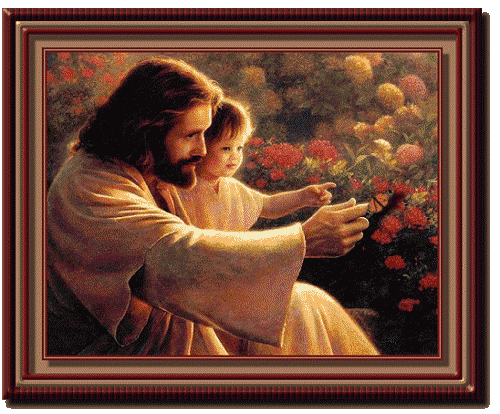
Jesus_with_a_child
Jesus doesn’t look like a narcissist to me.

Vaknin is using the words and deeds described in the Gospels to spin Jesus into a malignant narcissist. I don’t buy it. I have been attending RCIA classes (the classes one takes to become Catholic), and am still on the fence as to whether Jesus was actually the Son of God or just a very good man and prophet, but have lately been leaning more toward him being divine.

If Jesus was actually who he said he was–the Son of God–then he was being truthful and not narcissistic or grandiose in any manner. Jesus was compassionate and empathetic toward the unfortunate and the poor and healed the sick and disabled, and while he does appear to have had a temper, it was a righteous anger toward those who refused to believe who He was. He didn’t reject or disrespect his mother either. He had a great love for Mary as his earthly mother, but if Jesus was the son of God, then God’s desires would naturally have to come first.

In Vaknin’s defense, if he doesn’t believe Jesus was divine (and many people don’t), then I suppose it could be argued Jesus acted in narcissistic and grandiose ways (it could actually more easily be argued he was a paranoid schizophrenic–insisting he was God Himself when he really wasn’t), but I still wouldn’t call him a narcissist. Vaknin is probably not a Christian due to his nationality (he’s from Israel and his mother was Turkish) so it’s understandable that he wouldn’t believe Jesus was the Son of God, but to make such a sweeping accusation against a religious entity whose words have changed the lives of many millions of people for the better is pretty narcissistic on Vaknin’s part (which of course is no surprise).

Some of the more extreme evangelistic and fundamentalist Christian churches (especially those that believe in such unpleasant and elitist doctrines as predestination–a Calvinistic belief that certain “chosen” people have been predestined for heaven even before they were born, making the concept of “free will” and works null and void) are not too far removed from cults and they commonly have psychopathic leaders and use cult-like brainwashing tactics. There are also unfortunately many religious leaders of mainstream churches who are very narcissistic and even psychopathic, but this doesn’t mean Christianity itself is a cult of narcissism or that Jesus was a narcissist.

I still defend most of Vaknin’s writings from his critics, given that as a narcissist who is honest about himself, he is more than qualified to call himself an expert on the disorder and write as much as he wants to about it. Whether intentional or not, he has helped a great number of sufferers and victims of psychopathy. But in this particular discussion about cults, using Christianity as an example of a cult and Jesus as a malignant narcissist not only misses the mark, but to many people would be considered blasphemous. In spite of my own misgivings about Christian doctrine, I just couldn’t let this pass.

We All Need a “Mother”

This article is right in keeping with my own attendance at RCIA (the classes one takes to become Catholic) and what I am learning. As the child of a malignant narcissist mother, Mary is about as unlike my mother as it’s possible to be. I need a ever merciful Mary in my life! I’m also finding that, rather than the dogmatic, intolerant, bloated religion Catholicism has a reputation of being, that’s it’s actually one of the most loving and tolerant of all Christian religions–and probably the most authentic (being the oldest and apostolic church Jesus actually founded).

I’m also taken with this writer’s affinity for Buddhism, which I’ve dabbled in myself. Buddhism, rather than being a religion, is more of a philosophy. You can believe in one God or not. I don’t think reincarnation and karma are reconcilable with Catholicism (or any other form of Christianity), but these beliefs have a lot going for them and there are a lot of good arguments in their favor. I’m reblogging this article because it puts a lot of the thoughts I’ve been having into words much better than I can.

So apparently God accepted my deal… (Part Two of Two)

stainedglass

As far as Catholic mysticism goes, I never had a problem with it and don’t now. In fact, I always liked the idea of Mary and the saints, not for any theological reason, but simply because sometimes the saints and Mary are just easier for the average person to relate to. According to Catholic theology, in no way does Mary or the saints replace Jesus and God. They are venerated and honored, not worshipped. They act as intercessors and do not answer prayers themselves, but pray on behalf of the person who is addressing them and those prayers are offered to God. Of course, belief in Mary and the saints is not a requirement for Catholics, but is encouraged. Mary is particularly venerated because, as the woman chosen by God to give birth to the human incarnation of Himself (Jesus), she is held in high esteem by God and deserves such honor. I happen to agree with this. I always thought Mary was sort of cool, actually. As far as her physical assumption into Heaven, I have some problems with that, but it’s a minor point and I’m willing to let it go. Again, this doctrine is not a requirement to be a Catholic.

Although unscientific, I really like the idea of transubstantiation (the literal transformation of the bread and wine into the body and blood of Jesus Christ during Communion). Suspending scientific disbelief at the climax of the Catholic mass, Communion (which is considered a sacrament, not merely a symbolic ritual) becomes something very special and mysterious and seems an appropriate way to end such a solemn event as the Mass. I also like the “Peace be with you” ritual, where just before communion, parishioners turn to one another and offer this sentiment. If only this sentiment were more often followed in daily life! Throughout my life, I always felt a sense of great peace during this and the Communion rituals, something I never felt at any Protestant service.

In the Catholic faith, while we are saved by grace and Christ’s sacrifice for us on the cross, grace ALONE is not enough. Protestantism in part arose from Martin Luther’s idea that grace alone was enough to satisfy God, and works were not important. But works are very important. While works won’t give you salvation, they are important as a means to practice and use the grace Jesus gave us when he died on the cross. In evangelical Protestantism, you can be a murderer or a selfish, immoral person in life but will still get to heaven if you accept Jesus as your personal savior. There’s something wrong with that picture and it just seems very lazy to me. They get to have their cake and eat it too: say a few words in the “sinner’s prayer,” but not be required to show anything for it (although according to most evangelicals, accepting Jesus will change your heart so you won’t want to do bad things–of course this doesn’t always seem to play out in reality!).

I also found out that Catholics do NOT condemn other Christians (or even non-Christians who do good works in life) to eternal torment. (This is a sea change from what I understood the Vatican taught when I was in grammar school.) It seems the Vatican has changed their stance on this issue, and they now accept that ALL Christians who accept Jesus as their divine Savior will go to Heaven, regardless of denomination. (It’s okay to be Protestant!) Denomination is regarded as personal preference. It’s tragic how much bloodshed and misery has resulted between groups of Christians who couldn’t agree on the extraneous details of their religion, Catholics in the past having been one of the biggest perpretators (which the Church readily admits). Even if you’re not a Christian but are a good and moral person, you will not necessarily go to hell (although the greatest glories of Heaven may be barred to you). Hell itself is something Catholics can’t seem to agree on, and while some interpret it as a literal lake of fire, others do not (hell being merely a spiritual state of separation from God). However, there does seem to be a consensus that if you are a terrible person who spends most of your life deliberately hurting others, you will probably go to hell. And of course, there is also Purgatory, which is kind of a way station on the way to Heaven, for those who have been saved, but whose works don’t measure up. Purgatory has been one of the biggest bones of contention between Catholics and Protestants, but it makes sense to me, and it’s purpose has been misunderstood by many as one of temporary punishment rather than spiritual cleansing. According to fundamentalist Protestants, you are going to heaven or hell, with nothing in between. I just could never get on board with that because people aren’t all good or all bad. There are many shades of gray in between. In a nutshell, all that’s required to get to heaven is a belief that Jesus was born, lived and died on the cross to save us from our sins–something that evangelical Protestants also believe. All the other stuff (belief in the Bible as a literal document rather than allegory, evolution [divinely inspired] vs. creationism, veneration of Mary and the saints, participation in the sacraments, etc.) is basically window dressing that helps Catholics in their faith and their journey with God.

mary

Getting back to my own journey these past few days, the thing that happened that made me realize that maybe God had seen my post and was taking me up on my challenge to Him, was that suddenly I understood the concept of the Trinity in a personal way. In the past, I never could wrap my mind around how God could be three persons in one, no matter how hard I tried or how many Bible verses born-agains tried to make me read. Out of the blue, it all made perfect sense. There is God the Father (the one who created the universe), God the Son (God presented himself in human form because that was the only way we could truly understand each other and because only God in human form could deliver us from sin) and the Holy Spirit (which is basically what you feel when a hymn, sermon or religious work of art makes you teary eyed or overcome with awe–I also think the holy spirit can get through via ANY transformative experience, be it a work of art or piece of music, nature, encounter, etc.). I know I’m not explaining my revelation very well, but I could see how this concept does not negate science or logic. It was also very comforting. After reading the personal stories of conversion on WhyImCatholic.com and explanation of Catholic theology on Catholic.com, I realized that perhaps I could be “saved” after all–as a Roman Catholic.

Why Catholic? After all, there are a few mainstream Protestant faiths that don’t preach about hell and Satan, and are more “liberal” than Catholicism and may be in keeping with a progressive worldview like mine, but honestly I always found those churches to be kind of wishy-washy, as if they were cherry-picking what they liked from traditional Christianity and chucking the rest. Their theology seems like a sort of copout, a man-made compromise that has nothing to do with God. I don’t get that feeling about the Catholic church, even though they have updated many of their traditional doctrines for modern times.

It also holds a great deal of weight for me that the Catholic church was the first organized Christian religion, and all other Christian faiths emerged or split off from that. In spite of their bloody history and many transgressions, I felt Catholicism as it stands today could be something I could accept with both my mind and heart. That being said, I do need to point out that I don’t agree with all Catholic doctrine and there are several problems I have with the Catholic church:

–Their highly heirarchical structure. While I realize this is due to tradition and is perhaps the only way to organize and administer such a huge worldwide religion, I need to find out if talking to God directly is really not a possibility, and a priest must always be a mediator between myself and the Divine.

–Their stance on abortion and contraception. While neither affects me directly (I’m no longer of childbearing age) and as I already said, their rationale does make a type of sense, it’s hard for a liberal, politically progressive woman to accept such strictures on women’s reproductive rights.

–I need to find out more about their stance on homosexuality. While the current Pope (who is pretty cool) does not condemn homosexuality and thinks too much emphasis has been put on the entire issue by evangelical Christians, it’s my understanding it’s still not acceptable according to the tenets of the Church. As a mother of a gay son, this is important for me to find out.

–Celibacy of the clergy. While on a theoretical level this actually makes a type of sense (clergy who are not married or don’t have the option to be involved in a sexual relationship are less likely to be distracted by those things and can turn their energies into a closer relationship to God), on a practical level it doesn’t seem to work: witness the recent publicization of sexual abuse cases perpetrated by Catholic clergy–it may be unrealistic to expect a human being, regardless of how pious they are, to completely divorce himself from his sexual urges and the Church’s refusal to acknowledge these physical needs may result in inappropriate sexual behavior to “whatever or whoever” is available.

–Women in the priesthood. A no brainer. Women should be allowed in the priesthood, period.

There are other problems as well, but these are the ones that bother me the most. All that being said, overall I feel that I may have finally found a spiritual “home” that works best for me–one that’s been staring me in the face my entire life but I always dismissed for one reason or another. There are a lot of negative stereotypes about Roman Catholicism and some of them are deserved, but to my surprise I realized that most are not. There are a lot of misconceptions. The Catholic church may be one of the most misunderstood religions, but it says something that it’s been around so long and continues to have so many adherents all over the world. I’ll have to dig a little deeper and make sure this is really something I’m willing and ready to embrace. Tomorrow I plan to attend Mass and talk to a priest about upcoming RCIA classes.

worldisabook

I’m completely blown away by everything that’s happened since I made that deal with God, and feel like he really is trying to get through to me. I haven’t accepted Christ yet, but I think maybe I could. One thing I have no doubt about is that God really does work in strange and mysterious ways. I’m on the quest of my life.

So apparently God accepted my deal…(Part One of Two)

outofthedarkness

For the past couple of days, I haven’t posted anything, mostly because something has happened I’ve been burning to write about, but am reluctant to because I’m afraid of what my atheist and agnostic followers will think (my feelings get hurt easily LOL). I know that’s silly, but if I don’t write about this I feel like I might explode. And I want to keep this blog active. I dearly hope my atheist and agnostic followers can keep an open mind and realize that this is something personal that has happened to ME, and in no way affects anyone else or my views about other faiths including agnosticism and atheism. I have a deep respect for all belief systems (including the right not to have one at all) and atheists and agnostics do make a lot of rational sense and I can understand why they feel the way they do about God and religion. Hell, I more or less felt that way myself until just a couple of days ago, and I don’t see myself as a person who would ever shut my mind off from their all too often very valid viewpoints.

But still. I have to blog about this, so here goes.

When I wrote my post, “I made a little deal with God,” I really didn’t expect anything to come out of it, other than a lively discussion about God and religion, which is what happened and I am grateful to all those who participated, no matter whether they’re Christians, pagans, atheists, or anything else. So after I wrote that post, I put it in the back of my mind and moved on to other things. After a couple of days, I concluded that because nothing dramatic had happened and there was no Saul-to-Paul-like “miracle” or sudden, earth-shattering change of heart, that perhaps the atheists were right and there was no God at all, that He was just a comforting construct invented by humans to deal with the stresses and injustices in our lives. Perhaps Napoleon was onto something when he said, “religion is what keeps the poor from murdering the rich.”

But in spite of all that, I’ve always been a spiritual seeker and was never satisfied with the atheistic idea that we are just a random bunch of cells that happened to glom together and gradually shape-shift into our current form. I’ve always believed there was something more, much more, but never found a religion I was happy with. Apparently God saw my post and decided to take me up on my challenge. Because two days ago while browsing the web, I came across a Catholic website, called WhyImCatholic, which is basically a bunch of testimonials from people who converted to Catholicism from other faiths, ranging from born-again (Protestant) Christianity to hardcore atheism. I have no idea how I found this website or what I was looking for, but the subject matter was interesting so I started reading some of the testimonials. Why would anyone become a Catholic, of all things? So I started to read and I couldn’t stop reading. I found that, unlike the many born-again Christians who had tried and tried without avail to explain their faith to me, these stories ACTUALLY MADE SENSE! Imagine that.

More about that later, but let me give you a little background on my relationship with Catholicism. While I’m not Catholic myself, I was raised in northern New Jersey, where Catholics were as common as toadstools after a rainstorm. Almost all my neighbors were Catholic (with a sprinkling of Jews and atheists) and I was sent to Catholic schools (the one thing I’m really grateful to my parents for, due to the superior education Catholic schools usually provide) for most of my childhood. As a child, I remember envying my Catholic friends, because of all the cool stuff and rituals their Church had–such as rosary beads, incense, a new name they got at their confirmation, and statues and painting of Mary and the saints. The Methodist church my family sometimes went to (we were really an agnostic family, and while I was sent to Sunday school and was baptized by my paternal grandfather, who was a Methodist minister, my parents were never churchgoers) didn’t have any of those awesome tangibles and there was no “mystery” to Methodism (or any other Protestant church I ever attended) like there was at the Catholic masses I had the privilege to attend with my friends or at school. As I got older, and learned more about what Catholics actually believed, I found I didn’t agree with their doctrine and also had a number of problems with their stance on abortion, homosexuality, women in the clergy, the celibacy of the priesthood, etc. But despite my issues with their beliefs, and even with my ambivalence about God and Jesus, my attraction to the Catholic mass did not wane. From time to time throughout my adulthood, I’ve attended Catholic services, just because I like the ritual and the formality of the liturgy, the chanting and the hymns. There’s a lot to be said on an aesthetic level about Catholicism, but I never really embraced what they believed and in fact now realize I had closed my mind off to a lot and had developed a lot of preconceived notions (some which are simply not true).

In 2003 I attended a 5-day retreat sponsored by a local Catholic church that also happened to be extremely progressive on many issues. It was an amazing experience (and a lot of fun), and I was surprised that one of its leaders, a Cherokee Indian named Owl, was not even a Catholic. He taught us about Cherokee symbology and mysticism and we spent one golden August afternoon making stone carvings of a “totem animal” we had chosen to represent ourselves. This was Catholicism? It was all so New Age, even Pagan. Of course this was all balanced by a morning Mass, Bible readings and very personal and deep group discussions about spirituality and God. There were other non-Catholics attending the retreat, including another agnostic, two Protestants and a Jew. There was nothing about that retreat to offend the sensibilities of an agnostic like myself, and so I decided to take their RCIA classes (the classes you are required to take to become a Catholic). But in my current spiritual state and embroiled in an impending divorce, I quickly lost interest once the discussions in the classes became too Biblical and religious. I explained to Father Bill (the priest running the classes) that I’d learned a lot but I didn’t think I was ready. He was very understanding and told me he understood and to take my time finding my path. And so I moved on, chalking up this experience to one more thing I’d undertaken but eventually abandoned (my track record for sticking with anything to the end is embarrassing). Other than attending one Midnight Mass about 5 years ago, I never thought about Catholicism again until a few days ago.

So anyway. I was reading the above-mentioned website, and was riveted by the stories of people, many much like myself–intelligent, thoughtful, educated, forward-thinking people who were ambivalent or even opposed to the idea of religion and submission to God and Jesus–who had decided through various means that the Catholic Church was right for them. I found a link on that site to another website that explained Catholic theology in exhausting detail and is set up in encyclopedic form, so that you can type in anything you want to know about in the search bar, and get all the information you need about the Catholic stance on that topic. Sometimes there was just too much to read! But what surprised and shocked me more than anything is all the misunderstandings and preconceived notions I had about the Catholic church. It came as quite a shock to find I agreed with most of their views, or at least wasn’t particularly offended by them when I didn’t agree. For example, while abortion and artificial contraception is still unacceptable, unlike fundamentalists, who preach about sin and what the Bible says/doesn’t say on these issues, the Catholic stance on these things actually made rational sense! Imagine that. I won’t get into their stance on those things here, as it’s not my desire to convert anyone, but suffice to say that there is nothing about their reasoning that offends my rational mind. I’m not saying I agree with them on these things (I don’t), but simply that their stance does not offend me. Nor does it judge opposing viewpoints in the harsh way that fundamentalist Christianity does. Granted, there are a few Catholics who are also very harsh and judgmental (and a few in politics), but they are almost always evangelical Catholics, who are not really any different from other evangelical Christians. There are extremes in any religion. It also holds a great deal of weight for me that Catholics are opposed to killing in general (in spite of their bloody past, which they have publicly apologized for), and while against abortion (for sound reasons to my way of thinking), they are also against the death penalty.

Some of the explanations the site offered seemed to be a perfect reconcilation between spirituality and science. They spoke to ME. For example, their stance on evolution is one that I’ve held myself for a very long time: that evolution is most likely a fact, proved by science (as well as the 3.5 billion year timeframe for the age of the earth), but was divinely inspired by a higher intelligence we call God. Now, they don’t actually take an official stance on this, and there are some Catholics who do buy the Creation story in the Bible, but Catholic theology doesn’t dispute evolution and it is acceptable to believe in it, as long as God is given credit for being behind it all. As for Adam and Eve, you have the choice to think of them as a literal couple in the Bible, or a figurative story about early civilized humans falling from grace. They acknowledge that while humans have probably been around for several million years, and evolved from ape-like ancestors, that shortly after we became sentient, and developed the capacity for self-awareness and the idea there was something greater overseeing things (which happened about 10,000 years ago), we fell from grace (which I won’t get into here as that’s not my aim in this article and it would take too long). Adam and Eve represent tribes of ancient peoples in the near East, not actual persons. I won’t get into all the theology behind that now, but that’s the gist of it, and it actually made sense to my skeptical, science-loving brain. Taken this way, it was possible to read the Bible as truth but realize at the same time that the details in the stories were allegorical, not a literal account of historical events. I always wondered how so many of the world’s greatest scientists could also be devout Catholics, and this explained how that could be possible. The Church’s support of science and encouragement of scientific thought is cetainly impressive: a very high emphasis is put on education and this is shown by how many Catholic-run colleges and universities there are today.

This article is getting too long and unwieldy to contain in one post, so Part Two will be posted later today. I have to run a few errands first.

Next up: Catholic mysticism, the concepts of grace vs. works, the Trinity, Jesus as Savior, and more.

Note to my atheist and agnostic readers: I certainly you continue to read and follow my blog! I value your contributions, and am in no way attempting to convert anyone, just relating what has happened to me in the past few days. I hope you keep reading!

I made a little deal with God today

rainbow

In my post from a few days ago about my problems with Christianity, I discussed how lately, I’ve been thinking a lot about God and religion and how it all fits into my worldview.

I have a sort of dilemma though. I believe in God, and I want to be on his/her/its good side when I die, just in case there really is a hell, which I don’t think there is. But there’s still that niggling little voice in the back of my mind just the same: what if hell is real? What if the born again Christians are right and I am going there, no matter how moral a life I try to lead, because I have not accepted Jesus as my personal savior? I can’t accept their dogma (my brain and heart just can’t get on board with it). I have serious issues with biblical literalism and the divinity of Jesus, but…what if hell is real? I don’t want to go there!

Now, I’ve heard of Pascal’s wager, which basically means going ahead and getting “saved,” even if you have doubts, just in case they’re right. The logic goes like this: if they’re wrong, nothing’s lost but if they’re right then you’re safe from eternal torment. But my problem with Pascal’s wager is that I simply don’t believe in evangelical Christian doctrine. If my brain and heart don’t buy what they’re selling, then taking Pascal’s wager means I’d be living a lie, something I think is much worse (and probably more offensive to God) than being honest about my true feelings about evangelical Christianity. If God really is omnicient and knows what’s in my heart and mind, then he’d know I was being dishonest. It makes me wonder how many born-again Christians actually really believe the doctrine they’ve embraced–and how many of them converted only because they were afraid of what might happen if they didn’t. That alone is a huge problem for me. Religious fear tactics just seem so…wrong.

So I made a little deal with God. Not to challenge or test God or anything, but to help me out of this conundrum. Since I actually believe in God, this part wasn’t too hard. I told God I didn’t believe what fundamentalist Christians were selling, and that “praying for faith” in the past hadn’t worked. I told him that if in order to escape the fiery pit I had to embrace dogma I simply didn’t believe, then could he please give me some sort of concrete sign that would show me this was actually the truth. If I could believe it was real, maybe then I could accept it. I reminded him that conversions like this were performed all the time in the Bible–heathen Saul’s miraculous vision and subsequent conversion to Paul, for example–so if things like that happened so often back then, why couldn’t it happen today? I reminded him that sending me yet another person trying to save my soul or coming across some Bible tract in a laundromat or gas station would not work. It hasn’t worked before and it wouldn’t work now. I would need something more dramatic, much more dramatic than that. I would need an actual miracle, something like, oh, maybe Jesus himself talking to me (hey, some Christians say that’s happened to them). I told God that I was open to it, if it was his will for that to happen, but if nothing happened, I wouldn’t have any other choice than to go on assuming Jesus was just a man, heaven and hell are probably mythical places, and the Bible is nothing more than a collection of ancient fairy tales.

So far nothing’s happened. Maybe tomorrow.

My problem with Christianity

christianity

I check my WP Reader almost every day, and always find fascinating viewpoints there. Of course, I don’t agree with all of them, but my mind is always opened and that’s a good thing.

I’ve been doing a lot of thinking about the nature of God lately, and living in a Bible Belt state, I think a lot about who Jesus really was and where a belief in the Bible and God fits into my life. I happened across a couple of excellent and well written blogs about atheism here on WordPress, and I recommend both of them to Christians and those of other faiths as well as agnostics and atheists. The two websites I’m referring to are Godless Cranium and The Superstitious Naked Ape.

There’s a lot of negative stereotypes about atheists and how arrogant and intolerant they are toward religion, Christianity in particular, but I think this view is erroneous. I’m not denying there may be a few atheists out there who are arrogant and hostile toward the idea of religion, but from my readings, I don’t get that impression. I also want to clear up the idea that atheists “hate God.” How can you hate something you don’t believe exists? It’s like hating Santa Claus or unicorns.

Let me start out by saying I am not an atheist, nor do I believe I’ll ever become one. I believe in God, and I also pray. I also occasionally like to attend church services, mostly because I enjoy the aesthetics of the service and the music, particularly that of a Catholic high mass (I am not Catholic) or the joyful gospel singing of a black Baptist church. I believe there may be angels but I am not sure (or maybe I just want to believe in them). I believe Jesus provides a great example of how we should treat others. I also believe many other men and women throughout history provide examples that are just as beneficial to humanity.

But my faith, for lack of a better word, pretty much stops there. I won’t go into a long detailed account of why I think most of the Bible is bunk (especially the Old Testament), or why I don’t believe Jesus was actually the Son of God (in the divine sense), because plenty can be said about that on both of the named websites and elsewhere, by people who know a lot more about these things than I do.

I don’t believe after we die, we only have two options–Heaven or Hell. People run the gamut from nearly totally evil to very, very good, and I don’t think anyone is 100% one or the other. None of us is perfect of course, but on the other end of the spectrum, even Hitler had a couple of good points: he loved dogs and children (as long as they were blonde, blue eyed white children). To say we will either spend eternity in a place with streets of gold and lots of harps and winged beings OR in a place of fire and eternal torment by demons just seems silly and overly simplistic–why would a God of mercy and love send an average Joe or Jane, who just doesn’t happen to have accepted Jesus as their personal savior, to a place of eternal torment? It’s black or white (and to my mind, very toxic) thinking, with no shades of gray in between, and I can’t accept that way of thinking.

ifgodiswilling

Here’s a laundry list of my problems with the idea of heaven and hell:

— If all that is required to get into Heaven is to accept Jesus as your savior, then a serial killer like Jeffrey Dahmer (who was “saved” before his execution) or another otherwise horrible person who got “saved” (and there are horrible Christians out there) would be accepted into heaven while a very good person of a faith other than Christianity, such as Gandhi or Buddha, would be burning in hell. It just doesn’t make sense, and any God who would allow such a state of affairs is no God I would want anything to do with. That God would be a sadist, a bigot, and a narcissist: basically the God of the Old Testament.

— While there is evidence of fire and brimstone under the earth (easily explained by geologic science), how is it possible that so many souls could fit into such a small space in the center of the earth? If most humans are hellbound, and even if humans have only populated the planet for 6,000 years (which I think is complete bunk), that’s a hell of a lot of souls crammed together (pun intended).

— Why would any God of mercy give Satan so much power? Is Satan God’s hatchetman, the supernatural equivalent of the good cop/bad cop meme or the company hatchetman or woman who does all the “nice” boss’s firing?

— Lots of people have never heard of Jesus Christ. If they’re all going to hell too, that’s a pretty unjust God.

— Are children who have never been baptized or told about Christianity all going to hell? That’s a cruel and sadistic God.

— What about people like me, who have tried and tried to believe in Jesus the way most Christians want us to, even praying for the gift of faith, but just can’t do it? God gave me a brain to think with, and to question things. Before I can believe Jesus Christ died on the cross for my sins and that the only way I can attain salvation is to accept Him, I need some sort of evidence proving this is so. If God didn’t want me to think and question, why would He have given me a brain?

— Most Christians (at least the evangelicals) think animals have no souls and won’t go to heaven. To me, heaven without animals would be hell. When I look into my dog’s or my cats’ eyes, I know there’s a soul there. Nothing can convince me otherwise.

–Any God who would allow the majority of human beings to suffer for all eternity just because their level of faith didn’t satisfy him, is a sadistic, evil, unempathetic narcissist. I can’t and won’t believe in a God like that. I also think threatening people with eternal damnation is a horrible way to get people to convert. If it works, then it’s a tactic based on fear and is very toxic and soul-damaging.

god

I’m not a Buddhist or any other eastern religion (I have problems with those religions too), but I actually like the idea of reincarnation. It makes more sense to me and takes into account why there’s so much suffering and injustice in the world. A difficult life may be a way of paying off karmic debt and our next life could be much easier if we pay off the debt sufficiently in this life. Or a more advanced soul could have a difficult life, because they’ve attained enough spiritual growth to be able to learn something valuable from their suffering or use it to help others. I don’t know, but it just seems much more like something a loving and merciful God would do than throw his creations into the Good Box or the Bad Box after they die, and that’s it for you for all eternity.

I take issue with any religion that only values what happens to you after you die, and fundamentalist Christianity seems to care much more about the afterlife than enjoying this life.

Christianity, as is all too often the case today, especially in America, has become very much tied up with conservative politics, and is turning off a lot of liberals who may otherwise be attracted to Christianity. I doubt if Jesus was around today, he would worship the free market economy, think helping the poor was “enabling” them, and be intolerant toward LGBT people, atheists, and women.

And that brings me to the evangelical Christian attitude toward women. According to the Bible, it was because of a woman (Eve) that man fell from grace, and because God made man first (with women being created as helpmates), the biblical view is that men have dominion over women and women should submit to their will, even when the man is abusing them. For that matter, the God of the Old Testament acted much like an abusive husband. I’m sorry, but that view is a total turnoff to me, and isn’t doing anything to win more women over to evangelical Christianity.

I know I said I wasn’t going to talk about the Bible here, but there’s something I need to get off my chest. When Christians can’t back up their arguments with reason and evidence (creationism vs. evolution is just one example), they almost always use the “But it’s in the Bible so it must be so” argument. If you try to pin them down as to why the Bible is right, all they can say is “it’s the word of God.” No. It’s the words of men, translated many times and from many different languages. The Bible can and has been interpreted differently by different Christian denominations, and even Christians can’t seem to agree among themselves what the Bible is actually saying in many cases–because it’s full of contradictions (which I won’t get into here because it would take way too long). What makes the Bible so special anyway? It’s a book. Homer’s Odyssey is a book too. Why isn’t Homer’s Odyssey taken as the word of God? For that matter, what makes one religious text right and another one wrong? Christians think Muslims are all going to hell and their Koran is the wrong holy book. Muslims think the same about Christians and the Bible. Mormons think only the Book of Mormon is the correct holy text. What makes one automatically right and the other ones wrong? If any of them were right, wouldn’t God somehow give us some sort of clue as to which text we should all be following?

minesbigger

There’s a lot more things I could say, but then this article would turn into a book, so let me just sum up here with what I personally believe.

I believe God exists, and that he created the universe, but I also very much believe in scientific evidence that the earth is several billion years old and that all life on earth evolved, and was not created in 6 literal days. I think a concept known as “divine intervention” is a possibility–that is, that evolution occurred, but was overseen by God or a higher intelligence and that the evolution of human beings may have been “helped along.” Some evolutionists actually believe this view is a watered down version of creationism, and perhaps it is. I don’t dispute the idea of random evolution, but human intelligence seemed to happen too fast for that to be the case although I could be wrong. Besides, I find the idea of no higher intelligence watching over things a little frightening and to me that would seem to make all our striving and suffering a little pointless. I like to think there is some higher purpose to this life than mere physical reality.

why

As for the afterlife, I believe some people may go to heaven, but I don’t believe in hell, unless it’s a hell created by our own minds during this life that continues into the afterlife. I actually find the idea of annihilation after death more attractive than one of eternal torment, but I think our souls live on. Perhaps hell exists but only for the truly evil and unrepentant. I think the rest of us–who are too good for hell but not good enough for heaven–probably get reincarnated after a time of contemplating and assimilating the lessons learned in this life. I believe God is merciful and loving, and loves all his children, even those who have no faith he exists, and he would never give an evil entity like Satan (who probably doesn’t exist anyway) dominion over the majority of human souls after they die. As for Jesus, I have a lot of trouble with both the concept of his divinity and the idea of the Trinity. The first seems like a fairy tale and there’s no evidence, and as for the concept of the Trinity, I just can’t wrap my brain around it. Is there one God or three? How can God be three persons in one? Believers take it on faith alone and don’t try to analyze it, but I just can’t do that because of my analytical nature. I need to know the why’s and hows of everything before I embrace it. However, I do think Jesus was an extremely evolved soul who showed us a lot about grace, mercy and love, and I wish more Christians actually tried to follow the example of Jesus Christ in their daily lives instead of only on Sundays.

I have no idea what “religion” my beliefs make me; I suppose it’s bits and pieces of a lot of things that fit in with my worldview. But I’m open to changing my mind about a lot given enough proof.

I like to read blogs and books by atheists, Christians, and everything in between, in an attempt to understand differing viewpoints, and it saddens me that so much hatred, violence and death has occurred in the name of religion. Why does it matter if you worship a different God than I do, or even no God at all? We can all be moral and decent people who bring good to the world and to others, no matter whether we’re Christians, Jews, Buddhists, agnostics, pagans, or atheists. I wish people with different belief systems would act the way this atheist and Christian pastor do in this video, in a civil and respectful manner. These two men have completely opposite beliefs, and yet have become good friends, and I find that very heartwarming and the video is extremely interesting.

I can’t embed the video, but here’s the link:
http://www.patheos.com/blogs/friendlyatheist/2013/07/08/video-from-the-megachurch-service/

napkin
Nuff said.